
Endoscopic Vessel Harvesting Market Size and Share
Market Overview
| Study Period | 2020 - 2031 |
|---|---|
| Market Size (2026) | USD 541.53 Million |
| Market Size (2031) | USD 650.47 Million |
| Growth Rate (2026 - 2031) | 3.74 % |
| Fastest Growing Market | Asia Pacific |
| Largest Market | North America |
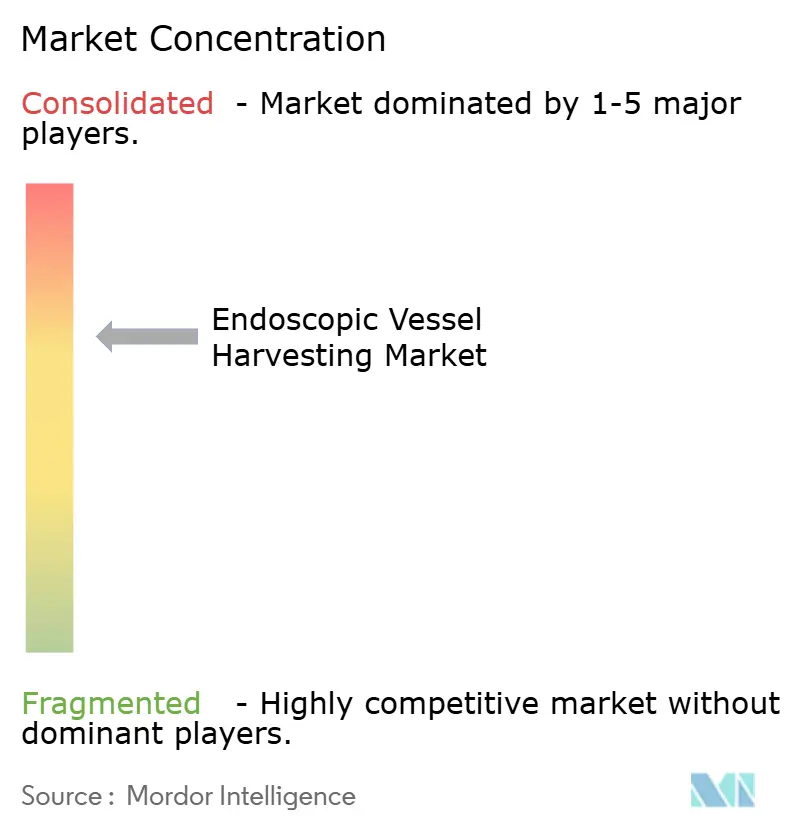
| Market Concentration | Medium |
Major Players *Disclaimer: Major Players sorted in no particular order Image © Mordor Intelligence. Reuse requires attribution under CC BY 4.0. | |
Endoscopic Vessel Harvesting Market Analysis by Mordor Intelligence
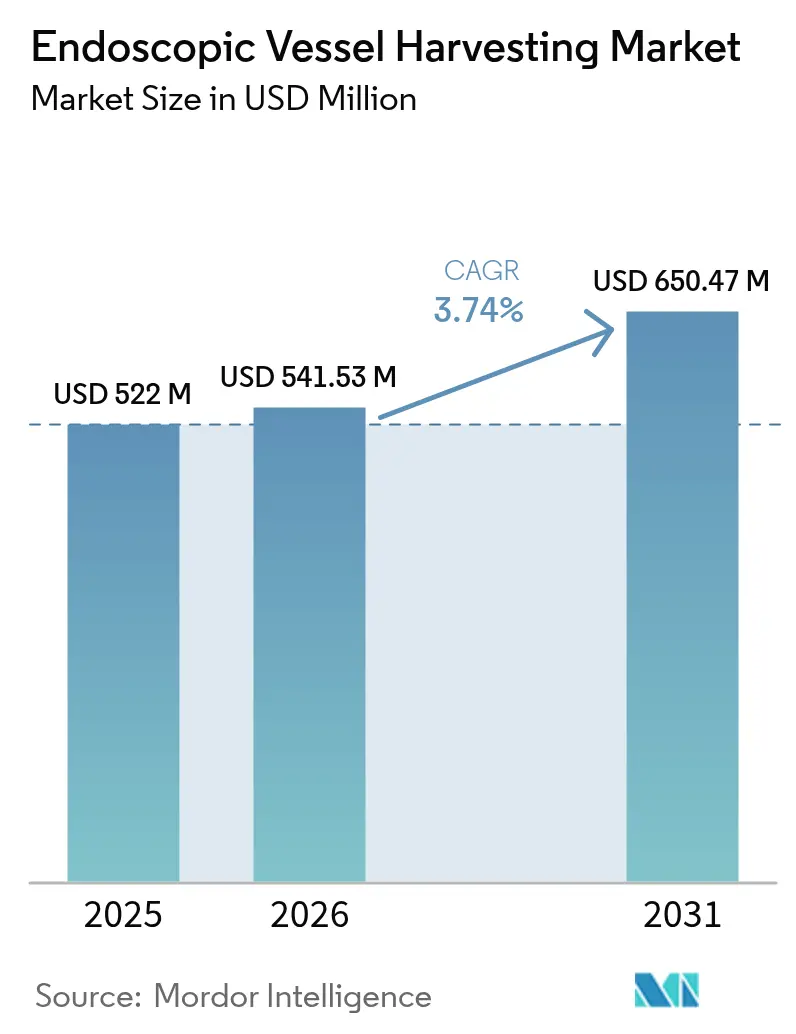
The endoscopic vessel harvesting market size is expected to grow from USD 522 million in 2025 to USD 541.53 million in 2026 and is forecast to reach USD 650.47 million by 2031 at 3.74% CAGR over 2026-2031. Growing cardiac surgery volumes, heightened surgeon preference for minimally invasive conduit procurement, and steady product innovation all sustain this measured expansion. Demand remains most intense in high-income regions where value-based care frameworks reward shorter stays and lower complication rates. Hybrid platforms that bundle visualization, insufflation, and disposable kits are gaining traction because they simplify procurement and standardize procedural quality. Meanwhile, recent device recalls are prompting hospitals to scrutinize supplier quality systems more closely, encouraging a flight to vendors with strong post-market surveillance records.
Key Report Takeaways
- By product type, EVH systems held a 65.78% revenue share in 2025, while accessories and disposables are forecast to grow at a 7.92% CAGR through 2031.
- By vessel type, radial artery harvesting led with 42.12% of the endoscopic vessel harvesting market share in 2025; saphenous vein procedures are expected to expand at a 7.48% CAGR to 2031.
- By usability, disposable devices accounted for 64.05% of the endoscopic vessel harvesting market size in 2025, whereas reusable systems are projected to advance at an 8.05% CAGR between 2026-2031.
- By application, coronary artery disease procedures represented 83.78% of total cases in 2025, while peripheral artery disease interventions are poised for a 7.26% CAGR.
- By end-user, hospitals commanded 58.21% of 2025 revenue, though ambulatory surgical centers are on track to post the fastest growth at 9.25% CAGR.
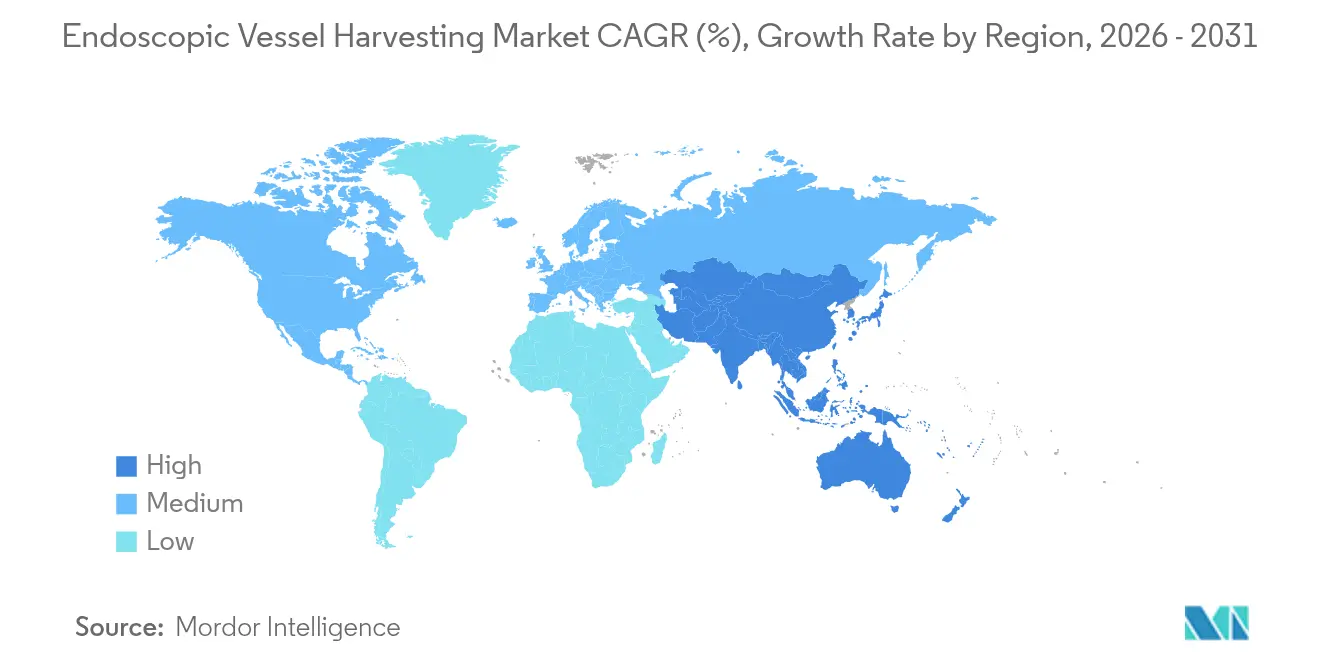
- By geography, North America contributed 42.25% of 2025 turnover; Asia-Pacific is set to be the fastest-growing territory at 9.71% CAGR.
Note: Market size and forecast figures in this report are generated using Mordor Intelligence’s proprietary estimation framework, updated with the latest available data and insights as of 2026.
Market Trends and Insights
Drivers Impact Analysis of Endoscopic Vessel Harvesting Market*
| Driver | (~) % Impact on CAGR Forecast | Geographic Relevance | Impact Timeline |
|---|---|---|---|
| Growing global cardiovascular disease burden | +1.2% | Worldwide, highest in North America and Europe | Long term (≥ 4 years) |
| Preference for minimally invasive harvesting | +0.8% | North America and Europe, spreading to Asia-Pacific | Medium term (2-4 years) |
| Higher adoption of off-pump CABG surgeries | +0.6% | Global, led by developed markets | Medium term (2-4 years) |
| Hospitals’ cost-saving pivot from open EVH | +0.5% | North America and Europe, emerging in Asia-Pacific | Short term (≤ 2 years) |
| Simulator-based surgeon training uptake | +0.3% | North America and Europe, selective Asian centers | Medium term (2-4 years) |
| Supply-chain shift from open disposables | +0.2% | Global, concentrated in high-volume hospitals | Short term (≤ 2 years) |
| Source: Mordor Intelligence | |||
Increasing Global Burden of Cardiovascular Diseases
Cardiovascular pathology affects nearly half of U.S. adults and continues to climb in many emerging economies. Growing procedure volumes make efficient conduit harvesting a strategic necessity for surgical programs managing tight bed capacity and readmission penalties. Hospitals adopting endoscopic techniques report fewer wound infections and faster ambulation, outcomes that align with modern bundled-payment incentives. The burden remains particularly high among aging cohorts with diabetes and hypertension, reinforcing the need for durable grafts and low-morbidity access sites. Governments are channeling funds into cardiac centers of excellence, catalyzing procurement of integrated EVH platforms that promise predictable learning curves and reduced staff turnover. Vendors able to document long-term graft patency and cost offsets stand to benefit most from these epidemiological tailwinds.
Growing Preference for Minimally-Invasive Harvesting
Prospective data show leg wound complications of 0.82% with endoscopic approaches versus 3% for open extraction[1]Maria Cannoletta et al., “Endoscopic Conduit Harvest,” Journal of Cardiothoracic Surgery, cardiothoracicsurgery.biomedcentral.com. Patient-reported outcome measures consistently favor minimal scarring and quicker mobility, metrics now embedded in many pay-for-performance dashboards. Hospitals marketing “scar-sparing” programs gain reputational lift that translates into higher referral volumes, especially in competitive urban catchments. Widespread adoption of virtual-reality simulation has shortened operator learning curves and cut fluoroscopy exposure times by nearly one-third. Nonetheless, centers must invest in structured mentorship to avoid early complication clusters that can erode surgeon confidence. Device designers are responding with ergonomic handles and automated cutting controls to further flatten proficiency curves.
Rising Adoption of Off-Pump CABG Surgeries
Beating-heart grafting eliminates cardiopulmonary bypass-related inflammatory cascades and has shown lower mortality in patients with moderate renal dysfunction. Off-pump workflows pair naturally with endoscopic conduit harvesting because both seek to minimize physiologic insult. Robotic platforms now facilitate totally endoscopic, anaortic techniques that achieved 97.3% freedom from mitral regurgitation recurrence in a recent Japanese series[2]Tatsuya Tarui et al., “Totally Endoscopic Robotic Repair,” Circulation Journal, jstage.jst.go.jp. As hybrid rooms proliferate, hospitals bundle off-pump and EVH capabilities into turnkey service lines marketed toward high-risk patients. Vendors offering interoperable robotic arms, angioscopes, and insufflation units gain a competitive edge by simplifying capital-budget decisions.
Hospitals’ Cost-Saving Shift from Open to EVH
Secondary analysis of the REGROUP trial placed discharge costs at USD 76,607 for endoscopic versus USD 75,368 for open harvest, suggesting cost neutrality at worst while generating fewer wound-related readmissions. CFOs increasingly view EVH devices as enablers of higher throughput rather than discretionary “nice-to-have” tools. Volume-based discounts on single-use kits and shared-risk contracts that rebate disposables if complication benchmarks are met are gaining favor. Meanwhile, supply-chain teams value the smaller storage footprint of sealed EVH kits compared with bulky open-harvest drapes and instruments. These operational considerations elevate purchasing criteria beyond unit price toward total-cost-of-ownership models.
Restraints Impact Analysis of Endoscopic Vessel Harvesting Market*
| Restraint | (~) % Impact on CAGR Forecast | Geographic Relevance | Impact Timeline |
|---|---|---|---|
| Alternative revascularization therapies | -0.9% | Global, highest in advanced markets | Medium term (2-4 years) |
| Unfavorable reimbursement in some countries | -0.7% | Europe and emerging economies | Long term (≥ 4 years) |
| Class-I recalls denting surgeon confidence | -0.4% | Worldwide, concentrated in North America | Short term (≤ 2 years) |
| Steep learning curve & harvester shortage | -0.3% | Global, acute in lower-income regions | Medium term (2-4 years) |
| Source: Mordor Intelligence | |||
Availability of Alternative Revascularization Therapies
Rapid improvements in complex percutaneous coronary intervention techniques are siphoning off some multi-vessel cases that once defaulted to coronary artery bypass grafting. Although CABG retains superiority in diabetics and diffuse disease, declining open-heart volumes in certain geographies could curb EVH unit sales. Yet, the remaining surgical cases now skew toward higher-risk profiles where minimally invasive conduit harvest offers outsized benefits. Device makers therefore position EVH as a precision tool for the subset of patients who still require grafts, emphasizing patency and wound-healing advantages versus open techniques.
Unfavorable Reimbursement in Several Countries
Health technology assessment bodies in Europe often demand long-term cost-utility data before issuing broad coverage for new disposables, delaying adoption cycles. While the July 2024 U.S. outpatient prospective payment update added new pass-through codes for select endoscopic technologies, many private insurers still require prior authorization[3]Centers for Medicare & Medicaid Services, “Hospital Outpatient PPS July 2024 Update,” cms.gov. In emerging markets, capital budgets concentrate on cath labs and basic ICU beds, leaving little room for premium harvesting systems. Vendors are countering by launching low-cost towers and rental models that spread acquisition costs over procedure volume.
*Our forecasts treat driver/restraint impacts as directional, not additive. The impact forecasts reflect baseline growth, mix effects, and variable interactions.
Endoscopic Vessel Harvesting Market Segment Analysis
By Product Type:
Systems Drive Revenue, Accessories Accelerate GrowthEVH systems generated USD 343.37 million in 2025, equal to 65.78% of the endoscopic vessel harvesting market. Hospitals purchase these capital assets once every 5-7 years, locking equipment vendors into multiyear service contracts. The accessories and disposables category, though smaller in absolute value, is growing at an 7.92% CAGR thanks to its annuity-style revenue that aligns with procedure counts. Bundled kits containing blades, scopes, and CO₂ lines simplify case setup and ensure compatibility, a convenience that purchasing managers value.
Recurring consumables are particularly attractive to ambulatory surgical centers that lack onsite sterilization capacity. Meanwhile, competitive differentiation among capital systems now hinges on image resolution, ergonomic handpieces, and analytics dashboards that log usage statistics for credentialing purposes. Getinge’s Hemopro 3 rollout exemplifies this pivot toward safety-enhanced systems designed to reassure surgeons following prior recalls.




By Vessel Type:
Radial Dominance Meets Saphenous AccelerationRadial artery conduits captured 42.12% of 2025 volume owing to superior 10-year patency, especially in younger and diabetic patients. Surgeons increasingly adopt bilateral radial strategies, boosting system utilization. Conversely, saphenous vein grafting remains indispensable when three or more distal targets must be bypassed, explaining its projected 7.48% CAGR. Evidence supporting no-touch, perivascular-preserving harvest has mitigated early skepticism regarding vein quality.
Device vendors are developing slimmer scopes and lower-pressure insufflation protocols to reduce endothelial trauma, thereby appealing to skeptics who still prefer open harvest for long conduits. Hospitals now run parallel workflows: radial for high-patency needs and optimized saphenous for multi-graft cases, a trend that increases demand for versatile system platforms.
By Usability:
Disposables Lead, Reusables ResurgeSingle-use kits held 64.05% of 2025 billings, reflecting infection-control priorities. However, the reusable subsegment is rebounding at 8.05% CAGR as sustainability mandates and capital-constrained public hospitals seek lifecycle savings. Manufacturers are extending reprocessing cycles through durable coatings and modular components, lowering per-case depreciation.
Environmental impact assessments, particularly in Europe, now influence tender decisions, requiring vendors to quantify waste reduction. Reusable advocates also highlight smoother instrument articulation compared with some disposable equivalents, a factor surgeons cite when performing delicate radial harvests.
By Application:
CAD Dominance Amid PAD EmergenceCoronary artery disease applications accounted for 83.78% of procedures in 2025, mirroring the dominance of CABG in surgical revascularization. PAD-related harvest is smaller but expanding at 7.26% CAGR as peripheral bypasses gain favor for complex limb ischemia. Surgeons treating PAD appreciate the smaller incisions of EVH, which help fragile skin heal faster.
Reimbursement for PAD bypass varies widely, but centers adopting EVH report shorter ward stays that free capacity for lucrative structural-heart cases. Consequently, administrators view EVH as a platform technology transcending coronary indications and supporting broader vascular programs.
By End-User:
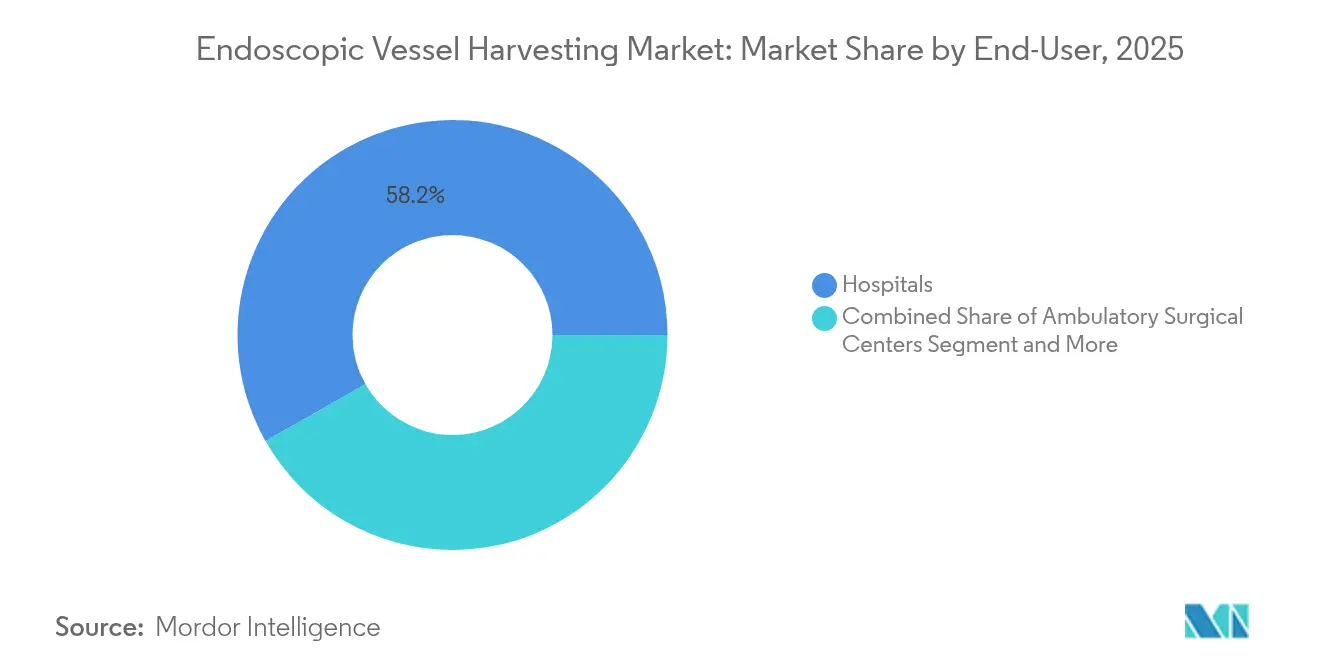
Hospitals Anchor, ASCs AccelerateGeneral hospitals still house 58.21% of annual revenue thanks to full-service cardiac units and residency programs that ingest large patient volumes. Yet, ambulatory surgical centers will post the fastest 9.25% CAGR through 2031 as payers steer low-risk CABG candidates to lower-cost settings. EVH enables same-day ambulation and discharge pathways, making it a prerequisite for ASC accreditation in many U.S. states.
Capital-light disposable kits resonate with ASC managers who avoid large sterilizers. At the same time, hospital systems acquiring ASC chains often mandate cross-facility standardization, guaranteeing steady disposable pull-through for selected vendors.
By Harvesting Technique:
CO₂ Insufflation Leads, No-Touch GainsClosed-tunnel CO₂ insufflation methods supplied 53.02% of 2025 procedures, underpinned by two decades of clinical familiarity. The newer no-touch approach, which eschews pressurized gas to keep perivascular tissue intact, is rising at a 9.88% CAGR. Early adopters report higher long-term patency in saphenous grafts, convincing multidisciplinary boards to update protocols.
Transitioning to no-touch requires needle-free insufflators and larger working channels, prompting many sites to upgrade towers. Vendors offering conversion kits enjoy first-mover advantage, while training organizations bundle simulation modules to speed uptake.
Geography Analysis
North America Endoscopic Vessel Harvesting Market
North America generated 42.25% of 2025 turnover, underpinned by robust reimbursement and high procedural density across academic centers and community hospitals. CMS coverage consistently endorses EVH when clinically justified, and bundled-payment pilots reward shorter length of stay. Ongoing FDA engagement, including 510(k) clearances for upgraded systems, keeps innovation pipelines active. Training consortia such as STS and AATS integrate EVH modules into resident curricula, reinforcing widespread competence.
Europe Endoscopic Vessel Harvesting Market
Europe follows with steady uptake driven by data-driven protocols and cross-border trials. Yet, budget caps in single-payer systems delay refresh cycles, compelling vendors to emphasize cost-utility. Scandinavian hospitals pioneered reusable scopes to satisfy environmental directives, a model now emulated in Germany and France. Mediterranean health systems, facing constrained capital budgets, gravitate toward service-leasing contracts that convert upfront equipment outlays into per-procedure fees.
APAC Endoscopic Vessel Harvesting Market
Asia-Pacific is the fastest-growing territory at 9.71% CAGR through 2031, fueled by Japan’s aging population, China’s expanding middle class, and government investments in tertiary cardiac centers. Japanese surgeons have embraced totally endoscopic robotic harvests, setting performance benchmarks admired across the region. Chinese regulators increasingly fast-track cardiac devices deemed essential to public-health goals, but provincial reimbursement remains uneven. India and Southeast Asia show latent demand limited by training bottlenecks; therefore, vendors partner with medical colleges to build harvesting fellowships.
South America and MEA Endoscopic Vessel Harvesting Market
South America records moderate growth, spearheaded by Brazil’s public-private hospital network that undertakes high-volume CABG. Import taxes and currency volatility challenge foreign entrants, encouraging localized production partnerships. The Middle East and Africa present niche opportunities tied to flagship cardiac institutes in the Gulf and South Africa, yet widespread adoption is hampered by limited insurance coverage and surgeon shortages.

Competitive Landscape
Market concentration is moderate, with the top five manufacturers controlling significant global revenue. Getinge leads on installed base, but its 2024 Class I recall heightened scrutiny of silicone particulate risks, prompting some health systems to dual-source disposables. Terumo capitalized by expanding Puerto Rico manufacturing capacity in 2025, ensuring supply resilience and shortened shipping lanes to U.S. customers.
Strategic acquisitions continue to reshape the landscape. Teleflex’s pending USD 791 million purchase of BIOTRONIK’s vascular intervention unit signals converging interests between coronary, peripheral, and conduit-harvesting portfolios. LivaNova, after positive OSPREY trial results on cardiac tissue viability, is scouting partnerships to integrate perfusion data with real-time endoscopic imaging feeds.
Innovation pipelines emphasize modular devices with AI-assisted dissection tracking and cloud dashboards that log harvest duration, thermal exposure, and graft orientation. Start-ups financed by EU green-tech funds are prototyping biodegradable disposable components to cut medical waste. Larger incumbents respond by offering trade-in credits for hospitals adopting eco-certified kits, a tactic aimed at retaining accounts mindful of CSR targets. Overall, the competitive field balances incremental safety upgrades with ambitious digital-workflow visions.
Endoscopic Vessel Harvesting Industry Leaders
Getinge AB
Terumo Corporation
LivaNova PLC
Medical Instruments Spa
KARL STORZ SE & Co. KG
- *Disclaimer: Major Players sorted in no particular order
Endoscopic Vessel Harvesting Market Companies Covered in this Report
- Getinge
- Terumo Corp.
- LivaNova
- Karl Storz
- Saphena Medical Inc.
- Medical Instruments SpA
- Medtronic
- Olympus Corp.
- Conmed
- B. Braun
- Cardio Medical GmbH
- Valeriot GmbH
- LeMaitre Vascular
- Boston Scientific
- Ethicon (J&J)
- Smiths Group
- Stryker
- Teleflex
- CardiMedical Inc.

Market Opportunities and Future Outlook
Hospital procurement is increasingly favoring EVH platforms that reduce setup variability and support tighter process documentation, which broadens opportunities for systems that pair visualization and insufflation with disposable kits and usage logging for credentialing and quality programs. The U.S. commercial launch of Getinge's Vasoview Hemopro 3 in June 2026, following earlier FDA 510(k) clearances for Hemopro 3 variants, reinforces continued investment in workflow-oriented design, including simplified connectivity and a dedicated power supply. This direction tends to shift differentiation toward standardization, service support, and ease of use, rather than incremental scope performance alone.
Demand growth is most visible in sites expanding minimally invasive CABG pathways outside traditional tertiary centers. Ambulatory surgical centers, in particular, lean toward sealed single-use kits due to limited reprocessing capacity, while public systems and European tenders continue to create space for propositions framed around reusability and waste reduction tied to sustainability requirements. Clinical publications in 2024 and 2026 keep positioning EVH as a minimally invasive alternative to open harvesting in CABG, supporting hospital value arguments around wound-complication reduction and patient-reported recovery, and sustaining vendor interest in training-enabled adoption programs that help manage the learning curve after heightened recall scrutiny.
Recent Industry Developments in Endoscopic Vessel Harvesting Market
- June 2026: Getinge launched the Vasoview Hemopro 3 endoscopic vessel harvesting system, highlighting an integrated harvesting tool power cable and a dedicated power supply. The update focuses on operating-room workflow simplification and connectivity standardization, supporting broader account conversion from prior-generation EVH setups.
- May 2025: The US FDA granted 510(k) clearance (K251238) for components associated with Getinge's Vasoview Hemopro 3 endoscopic vessel harvesting system. This clearance broadened the regulatory basis for commercialization and enabled hospitals to proceed with evaluations and procurement planning under cleared labeling.
- May 2024: Getinge hosted its inaugural Asia-Pacific Endovascular Vessel Harvesting (EVH) Summit in Singapore at the Getinge Experience Center. The education-led initiative aimed to support technique standardization and skill development in a region where training capacity is a key adoption constraint for EVH programs.


Endoscopic Vessel Harvesting Market Report Scope and Research Methodology
Market Definition and Coverage
This market covers revenue generated from devices used to harvest blood vessels endoscopically for use as graft conduits, mainly in coronary and peripheral bypass procedures. The scope includes EVH systems, endoscopes used in EVH, and related accessories sold for these procedures.
Scope exclusions: Open (non-endoscopic) vessel harvesting tools, general surgical endoscopy towers not purchased for EVH use, and procedure or hospital service revenue are excluded.
Segments Covered in This Report
- By Product Type
- EVH Systems
- Endoscopes
- Accessories & Disposables
- By Vessel Type
- Saphenous Vein
- Radial Artery
- Others
- By Usability
- Disposable
- Re-usable
- By Application
- Coronary Artery Disease (CAD)
- Peripheral Artery Disease (PAD)
- By End-user
- Hospitals
- Ambulatory Surgical Centers
- Cardiac Specialty Clinics
- By Harvesting Technique
- Closed-tunnel CO? insufflation
- No-touch / CO?-free
- Geography
- North America
- United States
- Canada
- Mexico
- Europe
- Germany
- United Kingdom
- France
- Italy
- Spain
- Rest of Europe
- Asia-Pacific
- China
- Japan
- India
- South Korea
- Australia
- Rest of Asia-Pacific
- Middle East and Africa
- GCC
- South Africa
- Rest of Middle East and Africa
- South America
- Brazil
- Argentina
- Rest of South America
- North America
Data Sources, Market Sizing, and Validation
Desk Research
Desk work starts with building the demand context around bypass volumes and conduit choices, and then translating that into likely EVH utilization. Public sources such as the US CDC, the OECD health statistics, the World Health Organization, and the World Bank help us anchor population, cardiovascular burden, and procedure setting trends that influence adoption.
We also review non-paywalled clinical evidence and practice discussions from peer-reviewed cardiothoracic journals, along with guidance and outcomes reporting commonly shared by professional societies in cardiac surgery. For the supply side, we use company filings and investor materials to understand product mix, geographic exposure, and pricing commentary, and we complement it with a paid subscription source used for company financials and news tracking, plus a paid patent database to map product refresh cycles. These sources are not exhaustive, and many other public references were used for data collection, validation, and clarification during the work.
Primary Interviews and Surveys
Primary work focuses on confirming how EVH is actually used and purchased, because adoption can differ by surgeon preference, hospital policy, and disposable versus reusable choices. We speak with device-side roles, procurement and OR stakeholders, and clinical experts across APAC, EMEA, and the Americas to validate penetration assumptions, typical replacement cycles, and real-world pricing ranges that sit below list prices.
Distribution of primary research fieldwork respondents
| Company type | Respondent position | Region |
|---|---|---|
| Top tier: 37% | CXOs: 14% | APAC: 43% |
| Mid tier: 47% | Functional/Unit leaders: 40% | EMEA: 30% |
| Smaller Players: 16% | Managers: 46% | Americas: 27% |
Market-Sizing & Forecasting
The sizing model begins with a top-down build that reconstructs the EVH demand pool from bypass procedure volumes, the share of cases using harvested conduits, and the EVH penetration within eligible surgeries, which is then converted into device and accessory revenue. To keep the totals realistic, we corroborate the outcome with selective bottom-up approximations, such as sampled average selling price (ASP) times estimated unit volumes for disposables, along with channel checks on how systems are placed and serviced.
A few market fingerprints are used as inputs so the numbers stay tied to real activity. These include CABG and peripheral bypass procedure trends, disposable kit usage per case, the installed base and replacement cycle for capital components, shifts in reusable versus single-use preference, and tender versus direct purchase patterns that impact realized ASPs. When data is missing by country, we fill gaps using proxy procedure rates and hospital capacity indicators, and then adjust through expert feedback so smaller markets are not overstated.
For forecasting, we use scenario analysis supported by simple regression checks that link procedure growth and adoption to broader health spending and demographic indicators. Assumptions on ASP progression are updated using interview-based pricing corridors and observed mix shifts, before the final forecast is prepared.
Data Validation & Update Cycle
Validation is done by checking whether outputs align with independent signals, such as procedure volumes, expected kit-per-case ranges, and the implied installed base needed to support the modeled usage. Any sharp year-over-year variance is reviewed, and if it cannot be explained by a known event like guideline shifts, recalls, or procurement changes, the inputs are rechecked and experts are re-contacted.
Before sign-off, the model and assumptions go through multi-step analyst review so arithmetic, scope boundaries, and regional splits are consistent. Reports are refreshed annually, and interim updates are made when material events occur. Right before delivery, a final pass is done so the client receives the most current view available.
Mordor Intelligence's Endoscopic Vessel Harvesting Market Size Measured Against Other Published Estimates
Published market sizes for endoscopic vessel harvesting can vary even when they look like the same topic, because the refresh timing, currency conversion date, and how ASPs are handled can shift the final value. Differences also come from whether a source treats accessories as procedure-linked consumption or as a broader endoscopy add-on category.
In our work, the model is checked against procedure-driven consumption signals and updated pricing corridors, and then restated using consistent USD conversion timing, which helps keep year-on-year movement reasonable. The largest gaps typically show up when older snapshots are carried forward without revalidating penetration changes, or when list prices are used without discount logic that matches tender and hospital contracting behavior.
Benchmark comparison
| Source | Market Size | Gaps in Research Methodology |
|---|---|---|
| Mordor Intelligence | USD 522.00 M (2025) | |
| Industry Research House A | USD 462.58 M (2024) | Uses a 2024 base and can understate the current run-rate if procedure recovery and disposable mix shifts after 2024 are not fully carried into the sizing year, and if discounting is applied with a broad average across regions. |
| Global Consultancy B | USD 497.81 M (2024) | Anchors sizing to 2024 with a fixed forecast window, and the total can move depending on whether accessories are grouped as a broad device bundle or tied to per-case consumption, plus how currency timing is applied across regions. |
The table shows that timing and pricing mechanics explain a meaningful share of the spread. By keeping the scope centered on EVH systems, endoscopes used for EVH, and EVH-specific accessories, and by rechecking penetration and ASP movement as part of the refresh cadence, Mordor Intelligence reduces drift that can build up when older assumptions are carried forward.


Key Questions Answered in the Report
What is the current size of the endoscopic vessel harvesting market?
The endoscopic vessel harvesting market size stood at USD 541.53 million in 2026.
How fast is the market expected to grow?
It is projected to register a 3.74% CAGR, reaching USD 650.47 million by 2031.
Which region generates the highest revenue?
North America led with 42.25% of global revenue in 2025.
Which product segment is expanding the fastest?
Accessories and disposables are forecast to grow at a 7.92% CAGR through 2031.
Why are ambulatory surgical centers important for future growth?
ASCs adopt endoscopic harvesting to enable same-day CABG discharge, driving a 9.25% CAGR in this end-user segment.
Page last updated on:


 Your data is secure and never sold or shared.


