
Endoscopic Stricture Management Market Size and Share
Market Overview
| Study Period | 2020 - 2031 |
|---|---|
| Market Size (2026) | USD 0.97 Billion |
| Market Size (2031) | USD 1.27 Billion |
| Growth Rate (2026 - 2031) | 5.55 % |
| Fastest Growing Market | Asia Pacific |
| Largest Market | North America |
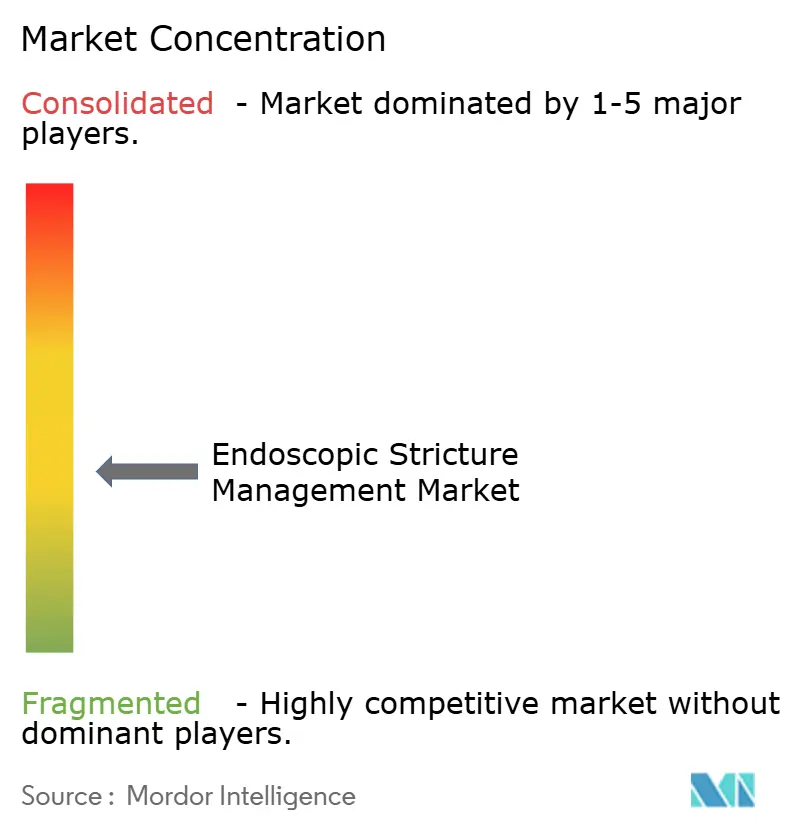
| Market Concentration | Medium |
Major Players
*Disclaimer: Major Players sorted in no particular order Image © Mordor Intelligence. Reuse requires attribution under CC BY 4.0. |
|
Endoscopic Stricture Management Market Analysis by Mordor Intelligence
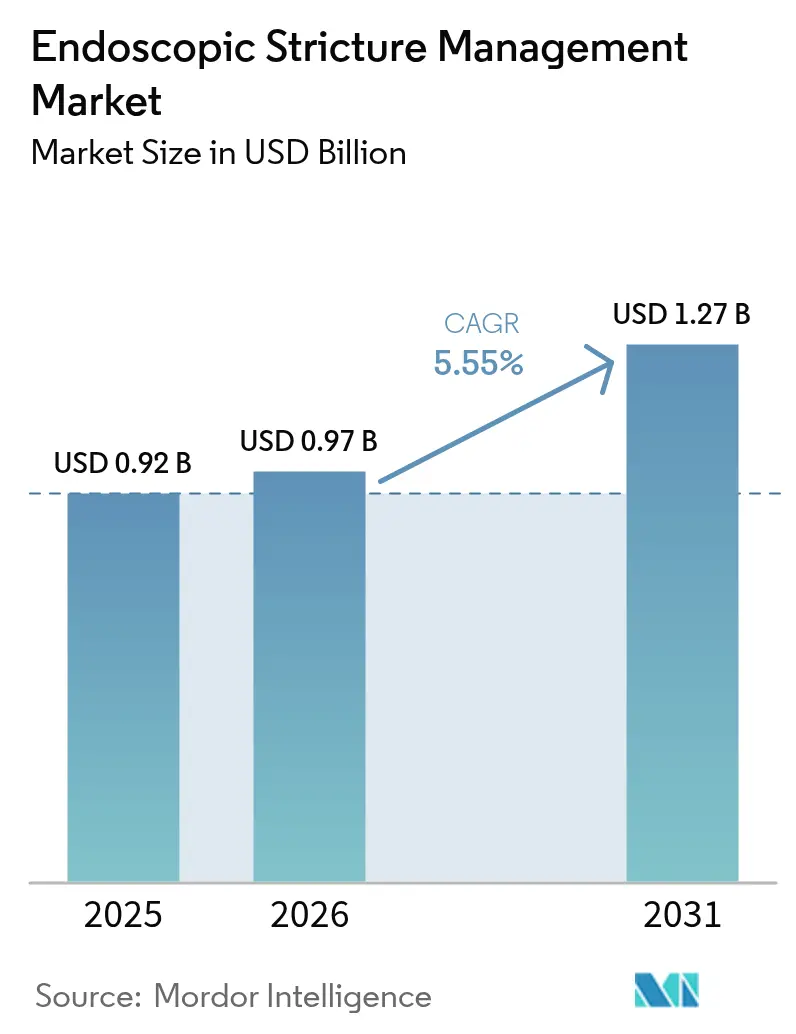
Endoscopic stricture management market size in 2026 is estimated at USD 0.97 billion, growing from 2025 value of USD 0.92 billion with 2031 projections showing USD 1.27 billion, growing at 5.55% CAGR over 2026-2031. Expanding outpatient capacity, rapid device innovation, and payer support for minimally invasive treatments are steering hospitals and physicians away from open surgery toward endoscopic solutions. Balloon dilators, drug-coated platforms, biodegradable stents, and lumen-apposing metal stents shorten recovery times and lower complication risks, which aligns with payer incentives to cut inpatient costs. A steady rise in gastrointestinal strictures among older adults keeps procedure volumes growing, while ambulatory surgical centers (ASCs) capture a rising share of cases once restricted to inpatient wards. Competitive intensity is building as major suppliers broaden portfolios, vertical integration gains momentum, and emerging companies secure investment for next-generation technologies [1]Karl Storz SE & Co. KG, "Acquisition of Asensus Surgical by KARL STORZ," karlstorz.com.
Key Report Takeaways
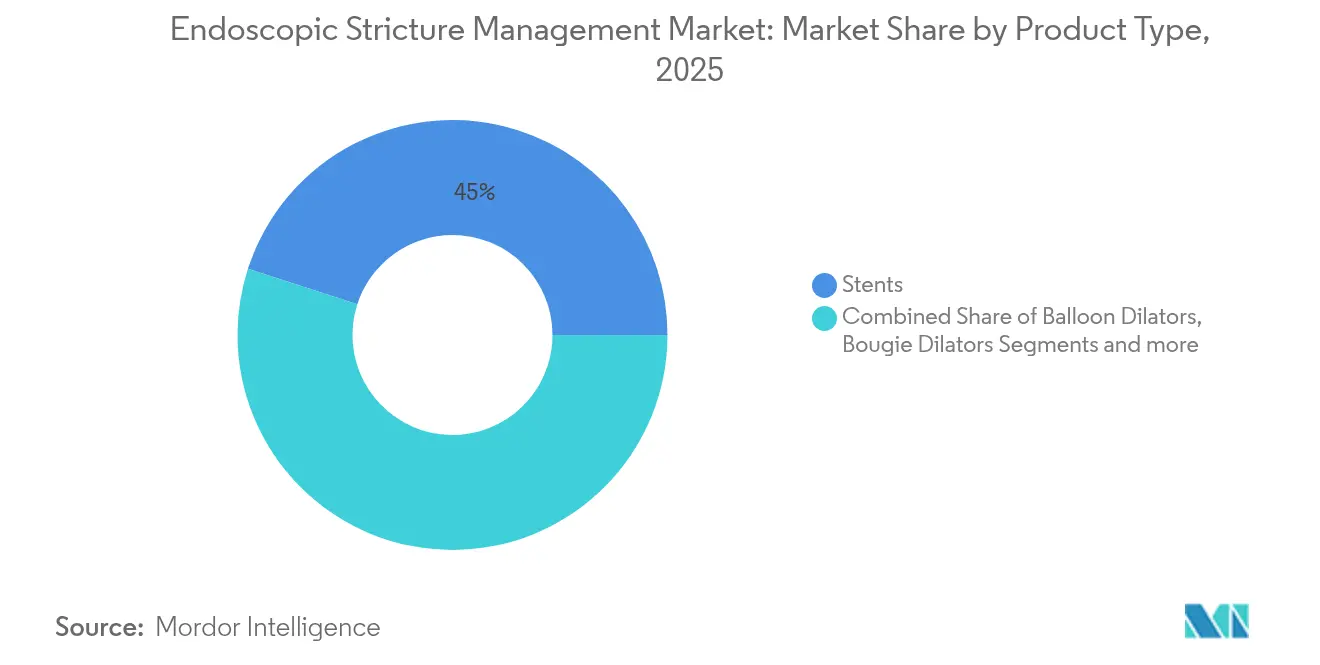
- By product type, stents led with 45.02% revenue share in 2025; balloon dilators are projected to expand at a 6.31% CAGR through 2031.
- By stricture location, esophageal procedures held 51.01% of the Endoscopic stricture management market share in 2025, while duodenal interventions are on track for a 6.29% CAGR through 2031.
- By end-user, hospitals accounted for 61.98% of the Endoscopic stricture management market size in 2025; ASCs are advancing at a 6.33% CAGR to 2031.
- By procedure setting, inpatient cases represented 69.12% share of the Endoscopic stricture management market size in 2025, whereas outpatient cases are rising at a 6.38% CAGR through 2031.
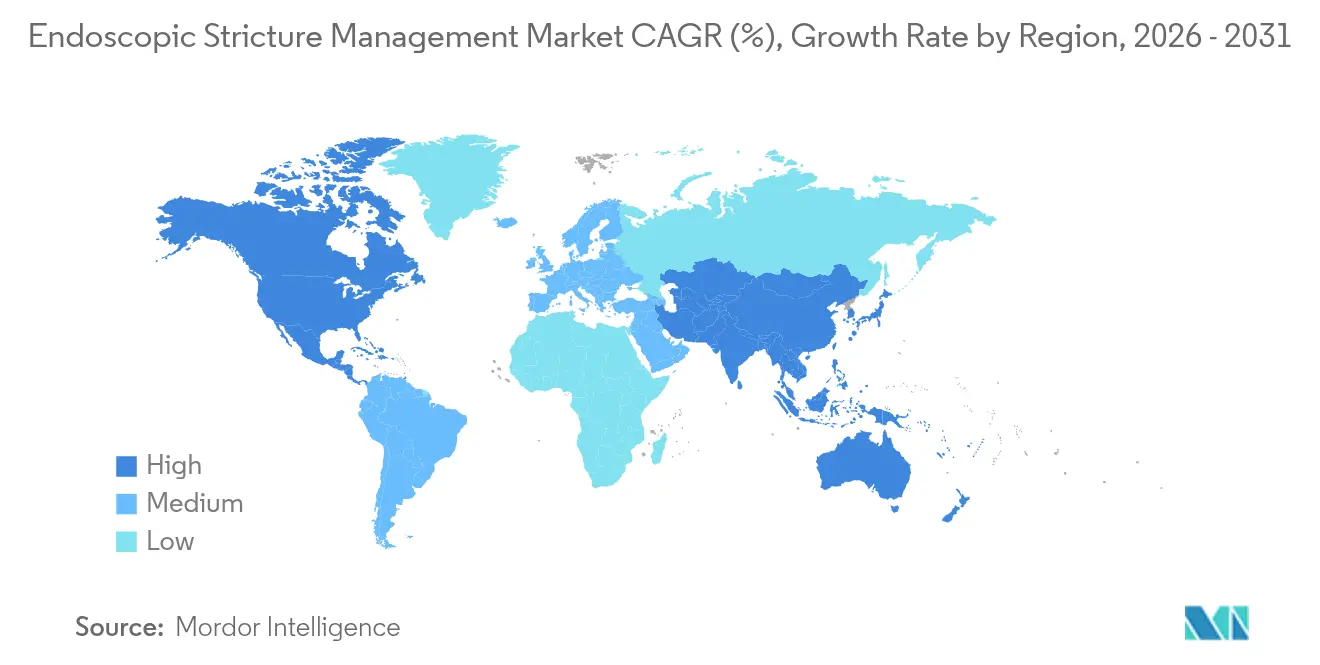
- By geography, North America led with 40.97% revenue share in 2025; Asia-Pacific is forecast to register the fastest 6.52% CAGR to 2031.
Note: Market size and forecast figures in this report are generated using Mordor Intelligence’s proprietary estimation framework, updated with the latest available data and insights as of 2026.
Global Endoscopic Stricture Management Market Trends and Insights
Drivers Impact Analysis*
| Driver | ( ~ ) % Impact on CAGR Forecast | Geographic Relevance | Impact Timeline |
|---|---|---|---|
| Growing geriatric population & rising GI-stricture burden | +1.8% | Global, strongest in North America & Europe | Long term (≥ 4 years) |
| Preference for minimally invasive endoscopic dilation | +1.5% | Global, led by developed markets | Medium term (2-4 years) |
| Continuous product innovation with multi-stage balloons & biodegradable stents | +1.2% | North America & EU, expanding into Asia-Pacific | Medium term (2-4 years) |
| Expanding reimbursement for outpatient stricture procedures | +0.8% | North America, selective EU markets | Short term (≤ 2 years) |
| Early clinical success of lumen-apposing metal stents | +0.6% | Global, led by North America & Europe | Medium term (2-4 years) |
| Emergence of patient-managed self-dilation protocols | +0.4% | North America & Europe, expanding globally | Long term (≥ 4 years) |
| Source: Mordor Intelligence | |||
Growing Geriatric Population & Rising GI-Stricture Burden
Esophageal stricture prevalence reached 203.1 cases per 100,000 among commercially insured adults and 1,123.5 cases per 100,000 in Medicare beneficiaries, driving USD 1.39 billion in annual costs [2]Angela Z. Xue, "Prevalence and Costs of Esophageal Strictures in the United States," Clinical Gastroenterology and Hepatology, sciencedirect.com. Older patients often present with reflux-induced strictures or anastomotic scarring that require repeated dilations or stenting. Untreated strictures lead to malnutrition and aspiration, creating additional system costs. As longevity rises across developed economies, healthcare planners anticipate heavier reliance on endoscopic treatment pathways that cost less than surgical reconstruction yet deliver durable results.
Preference for Minimally Invasive Endoscopic Dilation
Endoscopic balloon dilation achieves 67.1% success in urethral strictures and improves maximum urinary flow, while drug-coated balloons show 77.8% freedom from re-intervention at two years versus 23.6% for standard therapy. Patient demand for fast recovery and lower pain dovetails with payer pressure to limit inpatient stays [3]Xiaoyu Li, "Balloon dilation for the treatment of male urethral strictures: a systematic review and meta-analysis," BMJ Open, bmjopen.bmj.com. Hospitals and ASCs invest in advanced scopes and dilation platforms, and younger gastroenterologists—trained heavily in therapeutic endoscopy—are driving faster adoption in daily practice.
Continuous Product Innovation: Multi-Stage Balloons & Biodegradable Stents
Five-year data from the ROBUST I trial show 58% functional success and 71.7% freedom from repeat intervention with paclitaxel-coated balloons for recurrent bulbar urethral strictures. Biodegradable stents remove the need for second-look removal procedures, while lumen-apposing metal stents (LAMS) achieve 97% technical success for pancreatic fluid collections and minimize migration risk. Venture backing is strong: Sotelix raised USD 1.7 million for therapeutic endoscopy, and Fractyl Health secured FDA Breakthrough Device Designation for its Revita system.
Expanding Reimbursement for Outpatient Stricture Procedures
The Centers for Medicare & Medicaid Services adjusted payment rules to encourage procedure migration from hospital outpatient departments to ASCs, prompting 21% projected volume growth through 2034 with gastroenterology a principal driver. Private payers mirror these moves, approving premium devices such as drug-coated balloons when total cost of care falls. Value-based contracts further reward providers who move appropriate cases to outpatient settings without readmissions.
Restraints Impact Analysis*
| Restraint | ( ~ ) % Impact on CAGR Forecast | Geographic Relevance | Impact Timeline |
|---|---|---|---|
| High device & procedure costs | -1.1% | Global, acute in emerging markets | Medium term (2-4 years) |
| Shortage of trained interventional endoscopists | -0.9% | Global, severe in rural and developing regions | Long term (≥ 4 years) |
| Safety concerns over off-label LAMS use in benign strictures | -0.7% | Global, heightened in North America & EU | Short term (≤ 2 years) |
| Limited long-term data for drug-coated balloon approvals | -0.5% | Global, regulatory bottlenecks in key markets | Medium term (2-4 years) |
| Source: Mordor Intelligence | |||
High Device & Procedure Costs
Premium-priced LAMS and drug-coated balloons exceed capital budgets in many emerging economies, and payers often hesitate to grant quick coverage when long-term savings remain unproven. Hospitals juggle needs across cardiology, oncology, and surgery, often delaying purchases of advanced endoscopy systems. Utilization management controls can restrict access, slowing the Endoscopic stricture management market in cost-sensitive regions.
Shortage of Trained Interventional Endoscopists
The European Society of Gastrointestinal Endoscopy mandates 250 supervised EUS procedures for competence, yet many programs lack volume and mentors. Rural areas worldwide struggle to attract specialists, forcing patients to travel to tertiary centers and inflating wait times. As experienced endoscopists retire faster than new fellows graduate, workforce gaps may widen through 2030.
*Our forecasts treat driver/restraint impacts as directional, not additive. The impact forecasts reflect baseline growth, mix effects, and variable interactions.
Segment Analysis
By Product Type: Stents Dominate While Balloons Accelerate
Stents controlled 45.02% of the Endoscopic stricture management market in 2025 owing to their established role in maintaining luminal patency when strictures are complex or malignant. Balloon dilators lead growth at a 6.31% CAGR thanks to drug-coated surfaces and controllable inflation profiles. The Endoscopic stricture management market size for stents is projected to expand steadily, yet balloons increasingly capture repeat procedures as physicians value their lower perforation risk. Boston Scientific’s CRE balloon platform improves fluoroscopic visibility, while Merit Medical’s Wrapsody stent extends use into dialysis access, signaling cross-specialty opportunity. Bougie dilators continue to decline as single-use economics and controlled dilation favor balloons. Drug-coated balloons incorporating paclitaxel showed 77.8% freedom from repeat procedure in the ROBUST III trial, encouraging physicians to adopt them in recurrent benign strictures. Biodegradable stents eliminate removal procedures, and LAMS address migration with wider flanges.
The emerging “others” category—incision devices, anti-scarring injectables, and AI-guided dilation platforms—remains a small slice but attracts venture interest. Suppliers design devices that fit both hospital and ASC workflows, focusing on reusability and lower per-case cost to widen adoption across income settings. As patent cliffs approach for early-generation metal stents, companies differentiate through coatings, delivery ergonomics, and evidence bundles that document real-world savings.



By Stricture Location: Esophageal Dominance Faces Duodenal Challenge
Esophageal cases held 51.01% share in 2025, reflecting reflux prevalence and post-surgical anastomotic scarring. The Endoscopic stricture management market share for esophageal disease stays high because benign strictures often require multiple dilations over a lifetime. Duodenal procedures, however, grow at a 6.29% CAGR through 2031 as improved imaging and device-assisted enteroscopy increase detection of small-bowel lesions. Olympus earned FDA clearance for its EZ1500 series scopes with extended depth-of-field optics, improving duodenal lesion visibility. Biliary strictures remain steady, treated mainly with stent placement.
Cross-specialty uptake in urology, hepatology, and colorectal surgery supports the “others” bucket, where urethral and pancreatic applications adopt balloon and stent know-how from gastroenterology. Location drives therapy choice: benign esophageal strictures prefer balloons first, while malignant obstructions move directly to metal stents. In Asia-Pacific, higher prevalence of biliary and duodenal strictures nudges R&D toward devices sized for narrower lumens common in that population set.
By End-user: Hospital Dominance Challenged by ASC Growth
Hospitals retained 61.98% market share in 2025 thanks to full ICU backup, multidisciplinary support, and the ability to handle emergency perforations. Yet ASCs grow at 6.33% CAGR as payers incent providers to move routine dilations and stent exchanges to lower-cost sites. The Endoscopic stricture management market size flowing through ASCs is expected to climb steadily to 2031. Site-neutral payment rules narrow reimbursement gaps and boost surgeon preference for ASC schedules that minimize after-hours staffing. Hospitals respond by opening hospital-owned ASCs or joint ventures. Physician offices and specialty clinics form the small “others” group, enabled by compact high-definition towers and single-operator cholangioscopes that fit outpatient rooms.
ASC workflows demand devices that are quick to set up, single-use where infection risk is high, and packaged with simple staff training. Manufacturers tailor balloon inflation systems with pre-set pressures and color-coded gauges for ASC technicians. Hospitals, meanwhile, invest in capital-intensive EUS towers and robotics for complex procedures, anchoring premium device sales in tertiary centers.

By Procedure Setting: Outpatient Surge Reshapes Care Delivery
Inpatient procedures still made up 69.12% of cases in 2025, reflecting case complexity, comorbidities, and the need for overnight observation. Outpatient volumes, however, are rising at 6.38% CAGR through 2031 as anesthesia protocols, hemostatic powders, and rapid-acting reversal agents reduce risk. Medicare data show ASCs treated 3.3 million beneficiaries in 2022 with USD 6.1 billion in spend, highlighting scale.
The Endoscopic stricture management market continually adapts: device makers shrink catheter profiles for same-day recovery, and remote monitoring platforms allow safe discharge. Hospitals keep the sickest patients, including those with variceal bleeding or complex strictures at high perforation risk. The “others” setting group—mainly extended-stay recovery centers—remains niche but may gain ground as bundled payments encourage one-stop episodes of care.
Geography Analysis
North America captured 40.97% of Endoscopic stricture management market revenue in 2025 and remains the technology bellwether. Medicare site-neutral rules and broad private payor alignment nurture outpatient migration, while strong fellowship pipelines ensure a deep bench of interventional endoscopists. Device makers often launch first in the United States to leverage early adopter clinics that generate pivotal data.
Asia-Pacific is forecast to lead growth with a 6.52% CAGR through 2031. China’s annual endoscopic ultrasound procedures rose from 207,166 in 2012 to 464,182 in 2019, revealing swift uptake of advanced tools even as per-capita usage trails developed nations. India rolled out AI-driven detection software that lifted adenoma detection rates in pilot sites, showing technology leapfrogging potential. Japan remains the region’s procedure volume leader, aided by universal coverage and public awareness campaigns that catch strictures earlier. Australia and South Korea invest in high-definition systems and medical tourism, luring regional patients.
Europe holds a mature yet slower-growing position. Rigorous training standards—250 supervised EUS cases for credentialing—uphold quality, but budget caps temper switching to premium DCBs and LAMS. Germany and the United Kingdom maintain strong hospital-based volumes, while Nordic countries push outpatient growth via bundled payments.
South America and the Middle East & Africa are emerging opportunity zones. Brazil’s unified procurement for public hospitals helps negotiate pricing, boosting stent access. South Africa leads sub-Saharan adoption through private-public hospital clusters, yet rural gaps remain. Tele-mentoring and modular endoscopy suites aim to solve workforce shortages in these regions.

Regulatory Landscape
Endoscopic stricture management devices generally move through standard medical-device regulatory pathways, with expectations centered on risk-based classification, clinical and bench evidence, labeling, and manufacturing quality systems. In the United States, FDA oversight typically covers premarket routes used for GI access and for dilation and stenting tools, and it also includes usability requirements. In May 2026, FDA issued final guidance on the content of human factors information in medical device marketing submissions, reinforcing expectations for device-use safety in endoscopy workflows.
In 2026, compliance programs tightened around manufacturing and lifecycle controls and around EU MDR execution. FDA's Quality Management System Regulation (QMSR) became effective in February 2026, aligning quality-system requirements more closely with internationally used frameworks and raising the bar for suppliers serving multiple geographies. In Europe, Medical Device Regulation (EU) 2017/745 continues to shape clinical evaluation and post-market surveillance, with MDCG 2025-10 (December 2025) addressing post-market surveillance expectations. For certain legacy devices, MDR transition timelines remain extended into 2027/2028, which affects recertification timing and notified-body capacity planning.
Competitive Landscape
The Endoscopic stricture management market features moderate fragmentation. Boston Scientific, Olympus, and Cook Medical anchor global share with broad catalogs and KOL ties. They defend position through iterative upgrades—coatings, delivery ergonomics, and hybrid visualization—and by offering service bundles that smaller firms struggle to match. Mid-sized players such as Merit Medical and Conmed focus on niche balloons and ancillary tools, often partnering with distributors in emerging markets.
Vertical integration is accelerating. KARL STORZ acquired Asensus Surgical for USD 0.35 per share in 2024 to blend digital laparoscopy with endoscopy workflows, enhancing the LUNA robotic platform. In February 2025 Teleflex paid EUR 760 million for BIOTRONIK’s vascular intervention unit, adding drug-coated balloons and scaffold technology to its access portfolio. These moves aim to offer turnkey therapeutic pathways rather than single instruments.
Start-ups target white spaces: Sotelix raised USD 1.7 million for therapeutic endoscopy devices, and Fractyl Health secured breakthrough status for its Revita metabolic intervention system. AI-guided navigation, robotic manipulators, and personalized dilation plans form the next competitive frontier. Top players invest heavily in training platforms to lock in brand loyalty, while recurring-revenue service contracts cushion pricing pressure in commodity segments.
Endoscopic Stricture Management Industry Leaders
-
Boston Scientific Corporation
-
Merit Medical Systems
-
CONMED Corporation
-
Cook Medical LLC
-
Olympus Corporation
- *Disclaimer: Major Players sorted in no particular order

Market Opportunities and Future Outlook
Opportunities are concentrated in outpatient migration and in technologies that reduce repeat interventions for benign strictures, where per-case economics and durability drive procurement choices. CMS payment adjustments that encourage shifting appropriate procedures from hospital outpatient departments to ambulatory surgical centers support demand for faster-setup dilation and stent-exchange workflows, creating whitespace for suppliers that bundle devices with inflation or energy accessories and training into ASC-ready pathways.
The product pipeline also shows ongoing activity through iterative clearances and expanded technique options. In 2026, FDA 510(k) clearances included GIE Medical's BARE Wireguided Balloon Dilation Catheter for biliary duct applications and Endo Tools Therapeutics' endomina EZFuse system entering US commercialization following 510(k) clearance, highlighting investment in both dilation and endoscopic suturing platforms that can be paired with stricture management. In Europe, the 2026 European Association of Urology urethral stricture guidance frames endoluminal approaches as less invasive options that call for individualized selection. In parallel, comparative evidence in complex GI indications such as Crohn's anastomotic strictures underscores differentiation between stricturotomy and balloon dilation, supporting demand for indication-specific evidence packages, adjunct tools, and procedure-standardization services from device makers.
Recent Industry Developments
- April 2026: CONMED completed the sale of its remaining gastroenterology product lines to an undisclosed buyer, following its earlier decision to exit the category. The transaction accelerates portfolio reshaping among endoscopy suppliers and can alter channel access and service continuity for hospitals and ASCs that standardize on legacy GI accessories used alongside stricture procedures.
- January 2026: Olympus assumed exclusive US distribution rights for the GORE VIABIL Biliary Endoprosthesis after a transition from CONMED. Consolidating distribution under a major endoscopy franchise can strengthen contracting leverage and streamline procedural support for biliary stricture interventions.
- August 2024: KARL STORZ completed its acquisition of Asensus Surgical. The combination strengthens KARL STORZ capabilities around digital and robotic-assisted workflows that can influence capital purchasing and integrated endoscopy suite decisions that underpin therapeutic stricture management.


Research Methodology Framework and Report Scope
Market Definition and Coverage
For this report, the market covers the value of endoscopic devices used to manage gastrointestinal strictures during endoscopic procedures, across inpatient and outpatient settings, and across major regions.
Scope exclusions: We exclude open surgical stricture correction and non-GI stricture care when it is treated outside an endoscopic GI workflow.
Segmentation Overview
-
By Product Type
- Balloon Dilators
- Bougie Dilators
- Stents
- Others
-
By Stricture Location
- Esophageal
- Biliary
- Duodenal
- Others
-
By End-user
- Hospitals
- Ambulatory Surgical Centers
- Others
-
By Procedure Setting
- Inpatient
- Outpatient
-
By Geography
-
North America
- United States
- Canada
- Mexico
-
Europe
- Germany
- United Kingdom
- France
- Italy
- Spain
- Rest of Europe
-
Asia-Pacific
- China
- Japan
- India
- Australia
- South Korea
- Rest of Asia-Pacific
-
Middle East and Africa
- GCC
- South Africa
- Rest of Middle East and Africa
-
South America
- Brazil
- Argentina
- Rest of South America
-
North America
Data Sources, Market Sizing, and Validation
Desk Research
Desk work was used to build the fact base for GI stricture burden and endoscopy care context, then to keep assumptions tied to real care delivery. We referenced public sources such as the US FDA device databases and US FDA safety communications, the US CDC for digestive disease indicators, and the World Health Organization for broader epidemiology context. We also used sources such as PubMed indexed clinical literature to understand typical dilation and stenting practice patterns and to estimate how often repeat procedures occur.
To pressure test market direction, we reviewed company annual reports, regulatory filings, investor presentations, and endoscopy society and hospital system publications where procedural trends are discussed. In parallel, we used paid subscriptions for company financials and intelligence, news and financials, and patent databases to track technology refresh cycles and to confirm when product lines expanded or were discontinued. The sources listed here are illustrative, and many other public datasets and documents were reviewed for data collection, validation, and clarification.
Primary Interviews and Surveys
Primary work was used to validate how devices are actually selected by stricture location, and how purchasing behaves across hospitals and ambulatory surgical centers. We spoke with clinical users, procurement and supply chain teams, and device-side product and commercial leaders across APAC, EMEA, and the Americas, and then the feedback was used to confirm adoption curves and pricing logic for balloons, bougies, and stents.
Distribution of primary research fieldwork respondents
| Company type | Respondent position | Region |
|---|---|---|
| Top tier: 39% | CXOs: 17% | APAC: 42% |
| Mid tier: 40% | Functional/Unit leaders: 34% | EMEA: 31% |
| Smaller Players: 21% | Managers: 49% | Americas: 27% |
Market-Sizing & Forecasting
Sizing started with a top-down build that reconstructs the demand pool from procedure volumes and eligible GI stricture cases, then converts that into device demand using typical units used per procedure. The output was checked with selective bottom-up approximations, such as sampled average selling prices multiplied by implied unit volumes for key device types, and then adjusted when the two views did not line up.
Key model inputs included indicators such as endoscopy procedure throughput by care setting (inpatient and outpatient), the diagnosed burden of GI strictures by location, repeat intervention rates for recurrent strictures, adoption of stenting versus dilation, and the direction of average selling prices by device class. Since product innovation matters in this market, we tracked signals like the shift toward drug-coated balloons and newer stent designs, and we used those to shape the mix over time. When local unit data was thin, gaps were handled through regional proxying based on similar care pathways and then re-validated through interviews.
Forecasts were developed using scenario analysis anchored on procedure growth and care-site shift assumptions, and the final growth path was accepted only after primary feedback converged on the same direction for utilization and pricing.
Data Validation & Update Cycle
Outputs were cross-checked against independent signals such as procedure setting shares, stricture location mix, and device category shares, and then any unusual jumps were investigated before sign-off. If a variance was traced back to one driver, the assumption was revised and the full model was rerun so the ripple effects were visible.
Before publication, we run multi-step analyst reviews and re-contact selected interviewees when new launches, safety notices, or reimbursement changes could alter near-term demand. Reports are refreshed annually, and interim updates are made when material events affect volumes, pricing, or availability, followed by a final pre-delivery pass to keep the view current.
Mordor Intelligence's Endoscopic Stricture Management Market Estimate Compared With Other Published Estimates
Published numbers for this market can look far apart because the counted items are not always the same, and the time base can shift between a procedure-led view and a device shipment view. Differences also come from how pricing is treated, whether outpatient growth is modeled explicitly, and how strict the inclusion of GI-only strictures is.
Some estimates describe a broader devices space and can also pull in adjacent endoscopy device categories or related accessories that are not used only for strictures. In Mordor Intelligence, the value is limited to endoscopic stricture management devices used for GI strictures (balloon dilators, bougie dilators, and stents) and the yearly totals are kept consistent by linking price movement to mix shifts and validating the result against setting-level procedure signals.
Benchmark comparison
| Source | Market Size | Gaps in Research Methodology |
|---|---|---|
| Mordor Intelligence | USD 0.97 B (2026) | |
| Global Consultancy A | USD 1.01 B (2025) | Uses a different base year and a longer forecast window, and its device basket is described at a high level, which can lead to adjacent GI endoscopy devices being counted along with stricture-specific tools. |
| Research Publisher B | USD 0.76 B (2024) | Lower starting value can come from conservative procedure assumptions and narrower channel coverage, and the forecast framing is not aligned to the same year-by-year utilization and pricing checks used in this study. |
Overall, the spread is mostly explained by the year chosen for the starting point and how strictly the device basket is tied to stricture-specific use. By keeping the calculation traceable to procedure volumes, repeat rates, and realistic pricing by device class, the final value stays practical to audit and update.


Key Questions Answered in the Report
What is the current value of the Endoscopic stricture management market?
The market is valued at USD 0.97 billion in 2026 and is projected to reach USD 1.27 billion by 2031 at a 5.55% CAGR.
Which product segment is growing fastest?
Balloon dilators are the fastest-growing segment with a 6.31% CAGR through 2031, driven by drug-coated technology and lower per-procedure costs.
Why are ASCs gaining share in stricture management procedures?
Site-neutral reimbursement rules and patient demand for same-day discharge are pushing routine dilations and stent exchanges into ASCs, which operate at lower cost than hospitals.
Which region shows the strongest growth potential?
Asia-Pacific is forecast for the quickest expansion at 6.52% CAGR due to rising procedure volumes in China, India, and Southeast Asia.
What are the main restraints on market growth?
High device prices, shortage of trained interventional endoscopists, and limited long-term data for innovative coatings and stents slow adoption, especially in emerging markets.
How fragmented is the competitive landscape?
The market is moderately fragmented with top companies controlling just over half of global revenue, leaving room for start-ups to disrupt niches such as AI-guided navigation and biodegradable stents.
Page last updated on:


 Your data is secure and never sold or shared.


