
Employee Offboarding And Exit Management Software Market Size and Share
Market Overview
| Study Period | 2020 - 2031 |
|---|---|
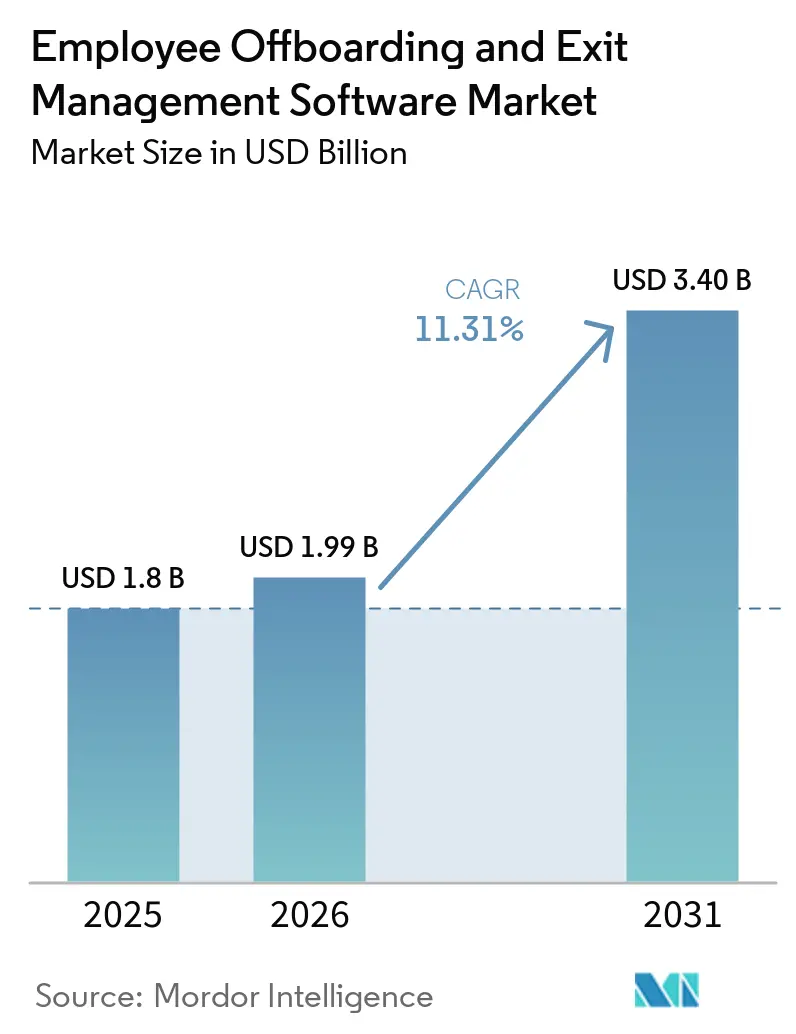
| Market Size (2026) | USD 1.99 Billion |
| Market Size (2031) | USD 3.40 Billion |
| Growth Rate (2026 - 2031) | 11.31 % |
| Fastest Growing Market | Asia-Pacific |
| Largest Market | North America |
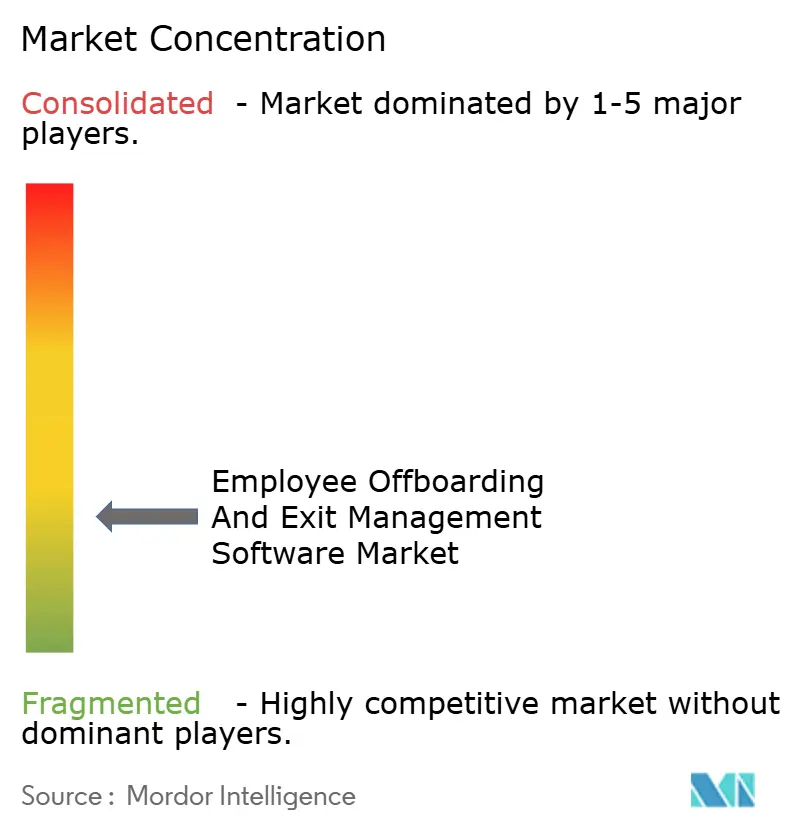
| Market Concentration | Low |
Major Players *Disclaimer: Major Players sorted in no particular order Image © Mordor Intelligence. Reuse requires attribution under CC BY 4.0. | |
Employee Offboarding And Exit Management Software Market Analysis by Mordor Intelligence
The Employee Offboarding and Exit Management Software Market size is projected to be USD 1.80 billion in 2025, USD 1.99 billion in 2026, and reach USD 3.40 billion by 2031, growing at a CAGR of 11.31% from 2026 to 2031. The Employee Offboarding and Exit Management Solutions Market is being shaped by tighter access-revocation rules, wider HR digitization, and the need to manage exits across distributed and cross-border workforces. Buyers are moving away from manual checklists and isolated team handoffs toward policy-based workflows that connect HR, IT, payroll, security, and legal teams in one sequence. Demand is also strengthening because employers now treat delayed deprovisioning, missing audit trails, and incomplete asset recovery as governance issues rather than routine administrative gaps. Competitive pressure is rising as HR platforms, employer-of-record providers, and identity governance vendors all expand their reach into offboarding orchestration. Vendors that can connect human and non-human identity controls with localized compliance and cross-functional integrations are better placed to capture the next phase of spending in the Employee Offboarding and Exit Management Solutions Market.
Key Report Takeaways
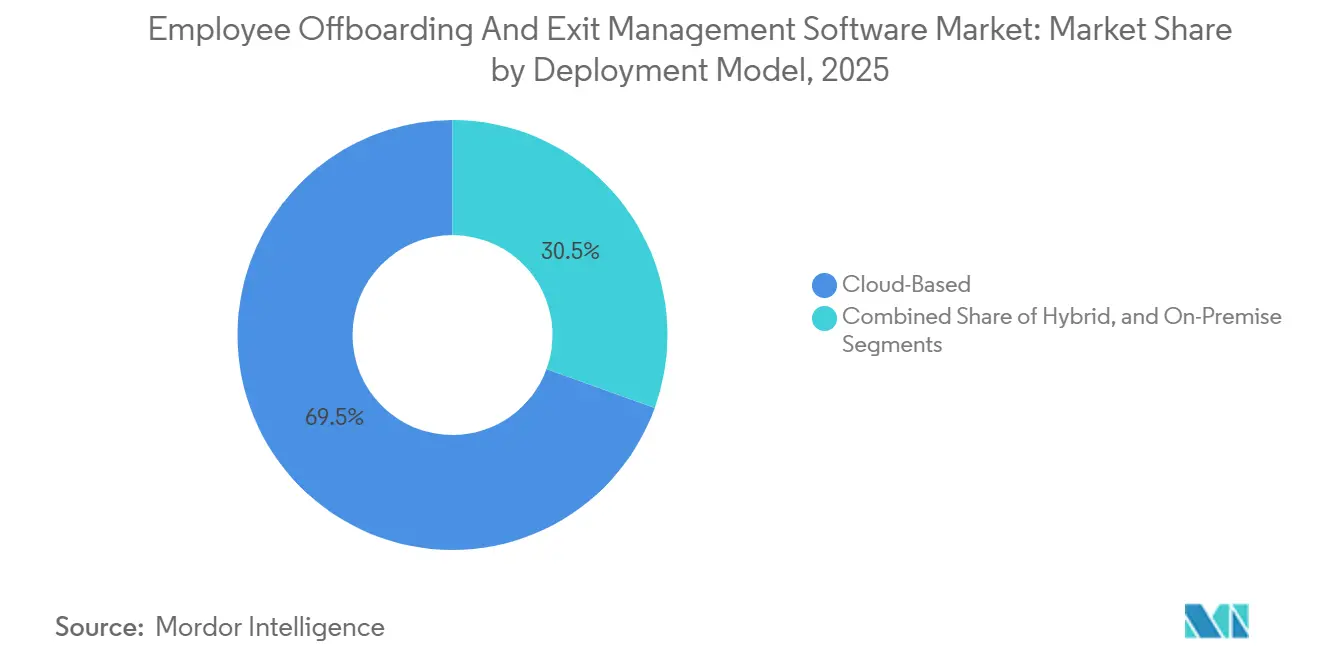
- By deployment model, cloud-based deployment accounted for 69.42% of revenue in 2025, while the hybrid model is projected to expand at a 12.47% CAGR through 2031 in the employee offboarding and exit management software market.
- By enterprise size, large enterprises accounted for 62.31% of the market in 2025, while SMEs are projected to expand at a 13.82% CAGR through 2031 in the employee offboarding and exit management solutions space.
- By component, software captured 64.88% of the market in 2025, while professional services are projected to expand at a 15.92% CAGR through 2031.
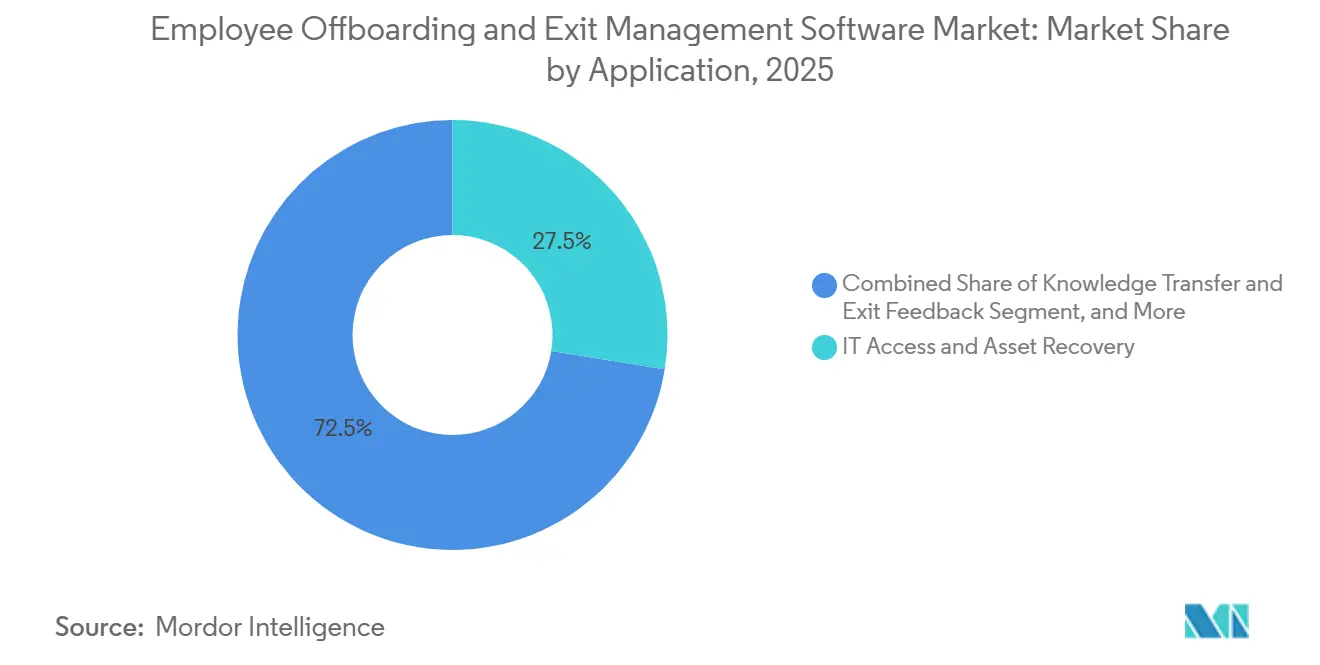
- By application, IT access and asset recovery accounted for 27.54% share in 2025, while knowledge transfer and exit feedback are projected to expand at a 14.63% CAGR through 2031.
- By end-user industry, information technology and telecom remained the largest segment in 2025, while BFSI is projected to expand at a 15.94% CAGR through 2031.
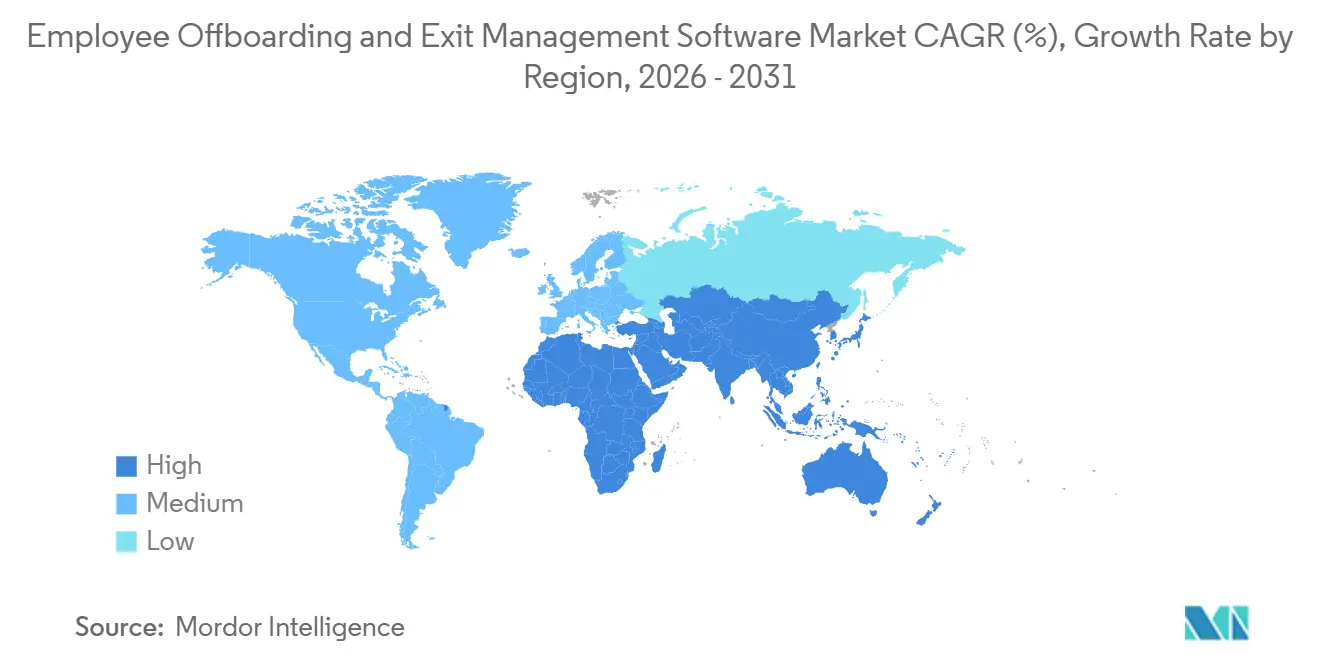
- By geography, North America held 41.03% of the Employee Offboarding and Exit Management Software Market share in 2025, while Asia-Pacific is projected to expand at a 13.71% CAGR through 2031.
Note: Market size and forecast figures in this report are generated using Mordor Intelligence’s proprietary estimation framework, updated with the latest available data and insights as of January 2026.
Market Trends and Insights
Drivers Impact Analysis of Employee Offboarding And Exit Management Software Market*
| Driver | (~) % Impact on CAGR Forecast | Geographic Relevance | Impact Timeline |
|---|---|---|---|
| Rising Regulatory Pressure for Access Revocation and Audit Trails | +2.8 | Global, with concentrated enforcement in North America and Europe | Medium term (2-4 years) |
| HR Digitization and Workflow Automation Spend | +2.3% | Global, with strongest gains in North America and Asia-Pacific | Short term (≤ 2 years) |
| Hybrid and Distributed Workforce Exit Complexity | +2.0% | Global, particularly North America, Europe, and Asia-Pacific | Short term (≤ 2 years) |
| Identity Governance Convergence With HR-Triggered Offboarding | +1.7% | North America and Europe, with early spillover to Asia-Pacific core | Medium term (2-4 years) |
| Cross-Border EOR and Global Payroll Separation Complexity | +1.2% | Global, with particular focus on Asia-Pacific and Europe | Long term (≥ 4 years) |
| Employer Brand and Alumni Experience Prioritization | +0.8% | Global | Long term (≥ 4 years) |
| Source: Mordor Intelligence | |||
Rising Regulatory Pressure for Access Revocation And Audit Trails
Regulators increasingly treat delayed access removal as a control failure rather than a routine process gap in the employee offboarding and exit management software market.[1]European Parliament and Council, “Directive (EU) 2022/2555 on Measures for a High Common Level of Cybersecurity Across the Union,” EUR-Lex, eur-lex.europa.eu The NIS2 Directive requires documented offboarding procedures with evidence of access revocation, asset return, and data erasure, and it allows penalties up to EUR 10 million (USD 11.3 million) or 2% of global annual turnover for noncompliance. In the financial sector, NYDFS expanded the pressure in October 2025 by requiring covered entities to maintain documented access lifecycle controls from onboarding through offboarding for third-party service providers as well. GDPR Article 32 has also kept secure account handling and verifiable control operation in active focus for employers handling personal data at exit. This combination makes offboarding automation less tied to hiring volume and more tied to the need to prove control execution. It also provides the Employee Offboarding and Exit Management Solutions Market with a stable, compliance-led demand base, even when labor conditions soften.
HR Digitization and Workflow Automation Spend
HR teams are under steady pressure to complete more repeatable work without increasing staffing at the same pace, which keeps workflow automation high on the agenda in the employee offboarding and exit management software market. In 2026, 92% of CHROs expected further AI adoption in their organizations, with repeatable transactional workflows emerging as a natural area for broader use.[2]Society for Human Resource Management, “State of AI in HR,” SHRM, shrm.org Exit checklists, access-removal sequences, payroll closure, and documentation routing fit that pattern because they are rule-based and easy to standardize. As core HR systems become more connected, employers also want structured exit data for workforce planning, compliance reviews, and process improvement. That creates space for platforms to capture exit reasons, return-of-asset status, and completion evidence in a usable format, rather than leaving these tasks in email threads. The result is a broader buying case for the employee offboarding and exit management software market, where automation serves both labor efficiency and control visibility.
Hybrid And Distributed Workforce Exit Complexity
Hybrid and remote work have widened the number of systems that must be touched when an employee leaves the organization in the employee offboarding and exit management solutions market. A departure is no longer limited to badge access and laptop return, because employers now have to shut down SaaS access, cloud infrastructure permissions, external collaboration tools, payroll touchpoints, and personal-device authorizations as well. In distributed teams, the legal exit date, HR notification date, and IT execution date do not always align, creating risk. Contractor-heavy workforces make the problem harder because access may sit across customer environments, shared workspaces, and partner tools outside the employer’s central directory. Cross-border teams also force employers to manage different notice rules, equipment return practices, and final settlement steps in the same workflow. That operational spread increases demand for the employee offboarding and exit management software market, as standardized, time-bound execution has become much harder to achieve manually.
Identity Governance Convergence With HR-Triggered Offboarding
Identity governance vendors are moving toward HR-triggered lifecycle orchestration, which is changing buyer expectations in the employee offboarding and exit management software market. In Q1 2026, SailPoint added capabilities that flagged dormant and partially offboarded accounts, enabling deprovisioning to occur more immediately within the identity graph itself.[3]SailPoint, “Identity Security Cloud Q1 2026 Enhancements,” SailPoint, sailpoint.com Saviynt then pushed the boundary further in March 2026 with Identity Security for AI, which added lifecycle governance and runtime authorization controls for autonomous AI agents and other non-human identities. These product moves matter because a standard HR exit now extends beyond the employee record to include OAuth grants, service accounts, API tokens, and machine credentials tied to that employee’s access chain. ISO 27001:2022 also reinforces the need to revoke or adjust access rights when employment changes occur, thereby strengthening the linkage between HR events and identity controls. The employee offboarding and exit management software market is therefore shifting toward platforms that can coordinate HR, security, and non-human identity cleanup in a single auditable flow.
Restraints Impact Analysis of Employee Offboarding And Exit Management Software Market*
| Restraint | (~) % Impact on CAGR Forecast | Geographic Relevance | Impact Timeline |
|---|---|---|---|
| Integration Complexity Across HR, IT, Payroll, and Identity Systems | -1.5% | Global | Medium term (2-4 years) |
| Sensitive Exit Data Privacy and Security Concerns | -1.0% | Global, with particular emphasis on Europe | Medium term (2-4 years) |
| Works Council and Jurisdiction-Specific Approval Friction | -0.7% | Europe, particularly DACH region and France | Long term (≥ 4 years) |
| Low Exit Frequency Weakening Standalone ROI for Small Employers | -0.4% | Global, concentrated in emerging markets and small business segments | Long term (≥ 4 years) |
| Source: Mordor Intelligence | |||
Integration Complexity Across HR, IT, Payroll, and Identity Systems
A useful exit workflow must simultaneously connect HR records, identity providers, payroll engines, SaaS applications, and asset-tracking systems, and that is still a hard task in many organizations. If even one layer stays outside the workflow, teams revert to email coordination and manual follow-up, weakening the value of the system they just bought. This is especially difficult in large enterprises where legacy ERP environments sit alongside modern SaaS stacks, and where each business unit may use a slightly different process. Connector development, approval logic, and exception handling can stretch implementation for months before the first automated workflow runs in production. The cost burden then rises because deployment work can move well beyond the base subscription. That slows adoption in the employee offboarding and exit management solutions market and delays the point at which buyers feel a clear return on investment.
Sensitive Exit Data Privacy And Security Concerns
Exit workflows gather some of the most sensitive information in the employee record, including performance context, final pay details, disciplinary history, and separation documentation. GDPR requires lawful processing, defensible retention, and deletion controls, meaning vendors must demonstrate that exit records can be stored and deleted in a compliant manner. This becomes a larger issue in multi-tenant cloud deployments where buyers want clarity on access limits, logging, and data residency before approving procurement. Regulated sectors face an even higher bar because offboarding data may sit next to financial, health, or customer records that are already subject to strict controls. Employers are also careful with exit interviews and termination notes because these records can become sensitive in labor disputes. That caution does not stop demand in the Employee Offboarding and Exit Management Solutions Market, but it does lengthen vendor reviews and pushes buyers toward platforms with stronger privacy design and clearer localization options.
*Our forecasts treat driver/restraint impacts as directional, not additive. The impact forecasts reflect baseline growth, mix effects, and variable interactions.
Employee Offboarding And Exit Management Software Market Segment Analysis
By Deployment Model:
Cloud Infrastructure Anchors Security-Driven Exit WorkflowsCloud-based deployment accounted for 69.42% of the Employee Offboarding and Exit Management Software Market share in 2025, reflecting buyer preference for centralized policy updates, reduced infrastructure burden, and easier integration with cloud-native identity tools. The leading role of cloud deployment also fits the broader shift toward subscription software and continuous product updates in HR operations. Centralized audit logs, shared workflow templates, and faster rollout across sites make the model attractive for organizations that need consistent execution at scale. Cloud systems also help employers apply rule changes quickly when local separation requirements or internal controls are updated.
The hybrid model is projected to expand at a 12.47% CAGR through 2031, as organizations modernize offboarding without moving every HR and payroll workload into a shared cloud environment at once. A hybrid design is especially useful in jurisdictions where data residency rules vary across employee records, system logs, and payroll files. On-premises deployment still matters in the public sector, defense, and other tightly controlled settings where tenant-shared cloud usage remains constrained. ISO 27001:2022 keeps pressure on all deployment choices because security objectives, access changes, and evidence trails must be defined across every environment, not only the primary one.[4]ISO, “ISO 27001:2022 Information Security Management Systems,” ISO, iso.org In the Employee Offboarding and Exit Management Systems Market, vendors with flexible hosting, auditable controls, and local data options are in a stronger position than providers tied to a single-region architecture.



Large enterprises held 62.31% share in 2025, supported by higher software budgets, multi-system environments, and stronger internal pressure to document every offboarding step. These buyers typically run complex HR, IT, payroll, and security stacks, making the value of orchestration easier to justify. They also face higher exposure when access remains active after a departure because the number of connected systems is much larger. As a result, enterprise demand continues to anchor the current revenue base of the employee offboarding and exit management software market.
SMEs are projected to grow at a 13.82% CAGR through 2031, altering the category's demand profile. A major reason is the spread of bundled HR platforms that include offboarding workflows as part of broader subscriptions, rather than requiring smaller firms to buy a standalone system. That lowers the entry barrier for employers that previously managed exits with spreadsheets or simple checklists. Employment Hero reported in April 2026 that it had surpassed AUD 300 million (USD 195 million) in annual recurring revenue while supporting more than 350,000 businesses, underscoring the scale now being achieved in the SME-focused segment. In the employee offboarding and exit management software market, this means growth is widening faster at the lower end of the customer base, even as large enterprises continue to account for most of the current spend.
By Component:
Software Consolidates But Services Gain Structural MomentumSoftware accounted for 64.88% of market revenue in 2025, showing that recurring platform revenue remains the core value pool in this category. Subscription models, embedded workflow logic, and direct integration with HR and identity systems keep software at the center of the buying decision. Once these systems are connected to employee records, access controls, and payroll processes, switching becomes difficult, which supports vendor stickiness. The current mix, therefore, still favors software-led monetization in the employee offboarding and exit management software market.
Professional services are projected to expand at a 15.92% CAGR through 2031, which is faster than the overall market growth rate. That rise reflects the practical reality that many deployments still need custom connector work, approval-flow design, process mapping, and managed support after go-live. Buyers often find that standard templates are not enough when local labor law, finance approvals, and regional IT controls must all be built into the workflow. This is especially true when organizations operate older ERP systems alongside newer cloud applications. The employee offboarding and exit management software market is therefore moving toward a more balanced value split, where implementation depth and managed support increasingly shape total contract value rather than acting solely as add-ons.
By Application:
Exit Intelligence Gains Ground Beyond Security-Led Use CasesIT access and asset recovery accounted for 27.54% of applications in 2025, making it the largest application, as security exposure has long been the primary reason companies automate employee exits. Access revocation delays are visible, measurable, and closely tied to audit findings, making them easier to prioritize than softer process benefits. Asset return, device lockout, and license reclamation also deliver immediate savings and reduced risk. For that reason, access-focused workflows still account for a large share of current demand in the employee offboarding and exit management software market.
Knowledge transfer and exit feedback are projected to expand at a 14.63% CAGR through 2031, indicating that buyers are looking beyond pure shutdown workflows. Employers increasingly want structured capture of project history, handover status, process knowledge, and departure feedback before an employee leaves. That change broadens the role of offboarding from a security checkpoint to a source of operational learning. HR management, compliance management, and payroll and final settlement remain essential because they apply to every separation, but knowledge capture is where the growth profile is now moving faster. In the employee offboarding and exit management software market, vendors that can tie access closure to knowledge transfer, alum handling, and insight capture are better matched to the direction of buyer demand.
By End User Industry:
IT And Telecom Anchors The Base While BFSI AcceleratesInformation technology and telecom remained the largest end-user industry in 2025, supported by high employee mobility, large SaaS footprints, and a strong focus on identity hygiene. Organizations in this vertical often run layered application environments, share administrative permissions, and use distributed work models, which make every departure more complex. Fast-moving hiring cycles also lead to more frequent offboarding events, strengthening the business case for automation. This kept the segment at the center of the employee offboarding and exit management software market in the base year.
BFSI is projected to expand at a 15.94% CAGR through 2031, which is the highest growth rate among end-user industries. The sector faces concentrated insider-risk exposure because former employees may retain access to financial systems, customer records, or regulated workflows if offboarding is incomplete. That pressure is reinforced by regulatory scrutiny from bodies such as the European Banking Authority and NYDFS, both of which emphasize documented access lifecycle management and stronger operational control in financial environments. Healthcare and life sciences, retail and e-commerce, and manufacturing also remain meaningful demand pools because each has its own compliance and operational-risk layer at employee exit. Government adoption is moving more slowly because legacy systems and procurement cycles remain more difficult to navigate, but the need for documented separation workflows continues to support steady demand over time.
Geography Analysis
North America and Europe Employee Offboarding and Exit Management Software Market
North America accounted for 41.03% of the employee offboarding and exit management software market share in 2025, supported by mature enterprise software adoption, deeper identity governance spending, and a regulatory environment that directly pressures access control and audit readiness. The United States generated most of that regional revenue because it combines a large enterprise base with a dense vendor ecosystem across HR technology, SaaS management, and identity governance. Canada and Mexico added incremental growth, with Mexico attracting interest from multinational employers using employer-of-record structures to manage cross-border hiring and separations. Europe remained the second-largest regional market, supported by GDPR obligations, NIS2 enforcement, and the DORA control requirements for financial institutions. Germany adds a further layer because works councils hold codetermination rights in dismissal-related procedures, which means offboarding workflows often need localized approval logic rather than a simple global template.
APAC and South America Employee Offboarding and Exit Management Software Market
Asia-Pacific is projected to grow at a 13.71% CAGR through 2031, making it the fastest-expanding regional market for employee offboarding and exit management software. India stands out because Darwinbox raised USD 140 million in March 2025 and then secured another USD 40 million in August 2025 to support international expansion and product development, signaling rising confidence in scalable HR platforms in the region. Australia and New Zealand are also active growth points, with Employment Hero extending its managed employment model across these markets in 2026 to address payroll, compliance, and HR administration needs for SMEs. South America remains at an earlier adoption stage, but JumpCloud’s January 2026 acquisition of MacSolution in Brazil points to growing investment in identity and access infrastructure that supports stronger offboarding execution.
MEA Employee Offboarding and Exit Management Software Market
The Middle East and Africa region is still emerging, with adoption concentrated in the Gulf Cooperation Council states, where digitization programs and multinational headquarters are driving enterprise HR modernization. Saudi Arabia and the United Arab Emirates matter most because local labor rules, expatriate workforce flows, and compliance-heavy payroll closure create a more complex exit process than many global templates assume. Keka’s May 2026 payroll and finance expansion for global employers, with explicit GCC relevance, reflects vendor recognition that the region’s separation workflows have become a meaningful niche. Africa remains the smallest regional market, with demand centered on South Africa, Nigeria, and selected technology hubs where multinational subsidiaries need more formal employee lifecycle controls.

Competitive Landscape
The employee offboarding and exit management software market is fragmented, and no single vendor holds a dominant position across all deployment models, customer sizes, and functional categories. Competition now plays out across three layers: HRIS and HCM suites with embedded offboarding modules, standalone employee lifecycle platforms, and identity governance or SaaS management tools extending into HR-triggered deprovisioning. That structure keeps pricing pressure high because buyers can compare integrated suites against narrower specialist tools in the same deal cycle. Deel moved in this direction in March 2026 by unifying hiring, payroll, compliance, and offboarding into one operating model for global workforces. CoreStack did the same from a governance angle when it acquired BetterCloud in March 2026, combining SaaS lifecycle automation with broader cloud and AI governance coverage.
SailPoint’s March 2026 collaboration with AWS and its Q1 2026 product updates pushed identity governance deeper into the employee offboarding and exit management software market by making partially offboarded accounts and non-human identity risk more visible. White-space opportunities still remain, especially in Europe where works-council-aware workflow design is harder to standardize and in markets where predictive exit signals are becoming more relevant to planning. Smaller regional players can still compete when they embed local labor rules and regional compliance steps directly into workflow logic, which reduces implementation effort for customers. Saviynt’s USD 700 million financing in December 2025 at a USD 3 billion valuation reinforced the idea that platforms connecting identity governance with workforce lifecycle controls can command premium investor attention.
Thoma Bravo’s 2026 agreement to acquire SailPoint for approximately USD 6.9 billion added further evidence that identity governance will remain a major strategic layer around automated offboarding. These moves narrow the room for point products that only remove access or only manage HR checklists without deeper workflow coverage. Buyers are increasingly favoring vendors that can connect HR events, identity controls, payroll closure, knowledge capture, and localized compliance in one operating flow. That keeps the employee offboarding and exit management software market competitive, broad, and still open to platform consolidation rather than near-term share concentration.
Employee Offboarding And Exit Management Software Industry Leaders
Bamboo HR LLC
Deel Inc.
Hi Bob Ltd.
EVERYDAY SOFTWARE, S.L.
Personio SE and Co. KG
- *Disclaimer: Major Players sorted in no particular order
Employee Offboarding And Exit Management Software Market Companies Covered in this Report
- Bamboo HR LLC
- Deel Inc.
- Personio SE and Co. KG
- Hi Bob Ltd.
- EVERYDAY SOFTWARE, S.L.
- HR Cloud, Inc.
- GoCo.io, Inc.
- Enboarder Inc.
- Greytip Software Private Limited
- Darwinbox Digital Solutions Private Limited
- PeopleForce LTD.
- Employment Hero Pty Ltd.
- Keka Inc.
- Zimyo Consulting Private Limited
- 4i Apps Solutions Pvt Ltd.
- BetterCloud, Inc.
- JumpCloud, Inc.
- SailPoint Technologies, Inc.
- Saviynt, Inc.
- Torii Labs Ltd.

Recent Industry Developments in Employee Offboarding And Exit Management Software Market
- May 2026: Keka launched a payroll and finance infrastructure update for global firms, adding visibility, compliance-oriented pay documentation, and expanded benefits for US, India, and GCC markets, directly addressing final settlement workflows.
- April 2026: Employment Hero surpassed AUD 300M (USD 195M) in annual recurring revenue, up 30%, while SEEK Growth Fund began a stake divestment. The milestone highlights the scale of SME-focused HR and offboarding across multiple regions.
- April 2026: Employment Hero rolled out HeroForce globally, extending its managed employment model to New Zealand, targeting payroll, compliance, and HR administration burdens in high-regulation SME markets.
- April 2026: CoreStack acquired BetterCloud, creating an Agentic Governance Operating System overseeing USD 35B in SaaS spend and 2,000+ customers, integrating automated offboarding into broader cloud/AI governance.


Global Employee Offboarding And Exit Management Software Market Report Scope
The employee offboarding and exit management software market comprises digital solutions and services that streamline and automate the process of employee separation within organizations. These platforms manage critical functions such as HR administration, compliance checks, IT access and asset recovery, payroll and final settlement, knowledge transfer, and exit feedback collection. Offered through cloud-based, on-premises, and hybrid deployment models, they cater to both large enterprises and SMEs across industries, including BFSI, healthcare, IT and telecom, retail, manufacturing, and government. The core purpose of this market is to help organizations reduce compliance risks, safeguard data, ensure smooth transitions, and enhance employee experience during offboarding, while also capturing valuable insights to improve workforce management practices.
The employee offboarding and exit management software market report is segmented by Deployment Model (Cloud-Based, On-Premises, and Hybrid), Enterprise Size (Large Enterprises, and Small and Medium-Sized Enterprises), Component (Software, and Services), Application (HR Management, Compliance Management, IT Access and Asset Recovery, Payroll and Final Settlement, Knowledge Transfer and Exit Feedback, and Other Applications), End-user Industry (BFSI, Healthcare and Life Sciences, Information Technology and Telecom, Retail and E-commerce, Industrial Manufacturing, and Government and Public Sector), and Geography (North America, South America, Europe, Asia-Pacific, Middle East, and Africa). The Market Forecasts are Provided in Terms of Value (USD).
| Cloud-Based |
| On-Premises |
| Hybrid |
| Large Enterprises |
| Small and Medium-Sized Enterprises |
| Software |
| Services |
| HR Management |
| Compliance Management |
| IT Access and Asset Recovery |
| Payroll and Final Settlement |
| Knowledge Transfer and Exit Feedback |
| Other Applications |
| BFSI |
| Healthcare and Life Sciences |
| Information Technology and Telecom |
| Retail and E-commerce |
| Industrial Manufacturing |
| Government and Public Sector |
| North America | United States |
| Canada | |
| Mexico | |
| South America | Brazil |
| Argentina | |
| Rest of South America | |
| Europe | Germany |
| United Kingdom | |
| France | |
| Italy | |
| Spain | |
| Russia | |
| Netherlands | |
| Rest of Europe | |
| Asia-Pacific | China |
| Japan | |
| India | |
| South Korea | |
| Australia and New Zealand | |
| Rest of Asia-Pacific | |
| Middle East | Saudi Arabia |
| United Arab Emirates | |
| Rest of Middle East | |
| Africa | South Africa |
| Nigeria | |
| Egypt | |
| Kenya | |
| Rest of Africa |
| By Deployment Model | Cloud-Based | |
| On-Premises | ||
| Hybrid | ||
| By End User Enterprise Size | Large Enterprises | |
| Small and Medium-Sized Enterprises | ||
| By Component | Software | |
| Services | ||
| By Application | HR Management | |
| Compliance Management | ||
| IT Access and Asset Recovery | ||
| Payroll and Final Settlement | ||
| Knowledge Transfer and Exit Feedback | ||
| Other Applications | ||
| By End User Industry | BFSI | |
| Healthcare and Life Sciences | ||
| Information Technology and Telecom | ||
| Retail and E-commerce | ||
| Industrial Manufacturing | ||
| Government and Public Sector | ||
| By Geography | North America | United States |
| Canada | ||
| Mexico | ||
| South America | Brazil | |
| Argentina | ||
| Rest of South America | ||
| Europe | Germany | |
| United Kingdom | ||
| France | ||
| Italy | ||
| Spain | ||
| Russia | ||
| Netherlands | ||
| Rest of Europe | ||
| Asia-Pacific | China | |
| Japan | ||
| India | ||
| South Korea | ||
| Australia and New Zealand | ||
| Rest of Asia-Pacific | ||
| Middle East | Saudi Arabia | |
| United Arab Emirates | ||
| Rest of Middle East | ||
| Africa | South Africa | |
| Nigeria | ||
| Egypt | ||
| Kenya | ||
| Rest of Africa | ||


Key Questions Answered in the Report
What is the size of the employee offboarding and exit management software market?
The Employee Offboarding and Exit Management Software Market was valued at USD 1.80 billion in 2025, is projected at USD 1.99 billion in 2026, and is forecast to reach USD 3.40 billion by 2031 at an 11.31% CAGR.
Which deployment model leads demand today?
Cloud-based deployment led with 69.42% share in 2025 because buyers prefer centralized policy updates, lower infrastructure burden, and easier integration with cloud-native identity tools.
Which application is growing the fastest?
Knowledge transfer and exit feedback is projected to expand at a 14.63% CAGR through 2031, showing that employers increasingly want structured knowledge capture and departure insights alongside security controls.
Which end-user segment is expanding the fastest?
BFSI is forecast to grow at a 15.94% CAGR through 2031 as financial institutions face strict access lifecycle requirements and high exposure to insider-risk at employee exit.
Which region is likely to see the fastest expansion through 2031?
Asia-Pacific is projected to grow at a 13.71% CAGR through 2031, supported by rising HR technology adoption, multinational workforce growth, and stronger need for locally compliant separation workflows.
What is the main challenge vendors and buyers still face?
Integration remains the largest hurdle because an effective exit workflow must connect HR, IT, payroll, identity, SaaS access, and asset tracking systems without falling back to manual team handoffs.
Page last updated on:


 Your data is secure and never sold or shared.


