
Market Overview
| Study Period | 2020 - 2031 |
|---|---|
| Forecast Data Period | 2026 - 2031 |
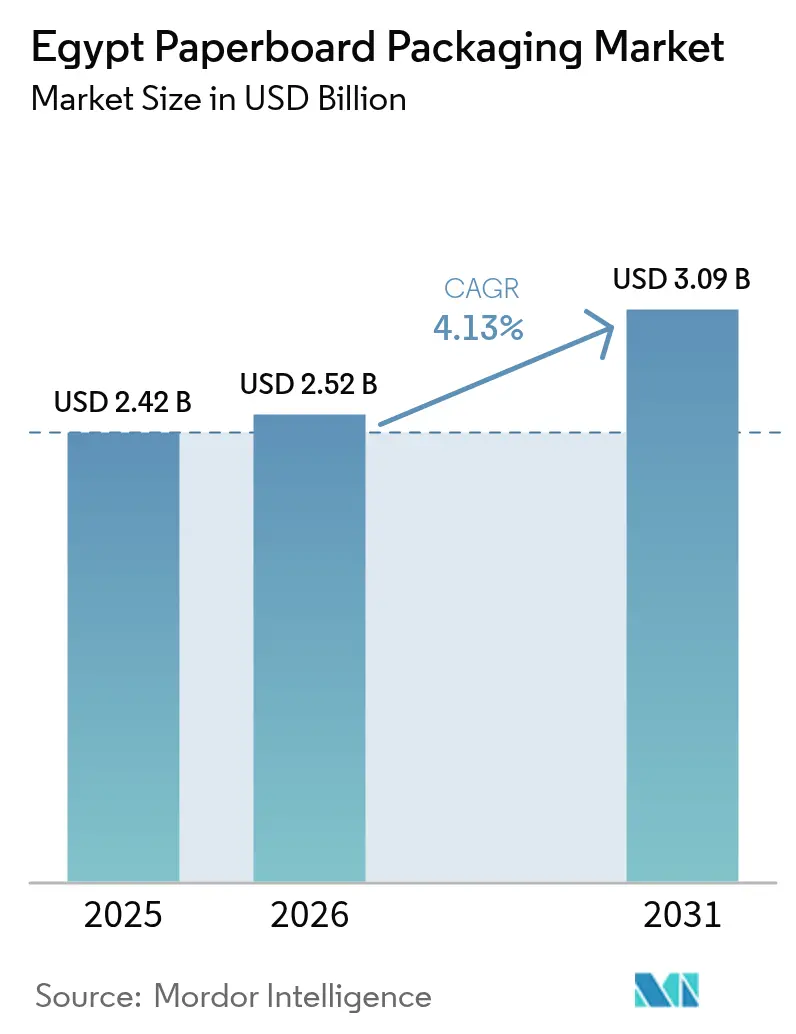
| Base Year Market Size (2025) | USD 2.42 Billion |
| Market Size (2026) | USD 2.52 Billion |
| Market Size (2031) | USD 3.09 Billion |
| Growth Rate (2026 - 2031) | 4.13 % |
| Market Concentration | Medium |
Major Players *Disclaimer: Major Players sorted in no particular order Image © Mordor Intelligence. Reuse requires attribution under CC BY 4.0. | |
Egypt Paperboard Packaging Market Analysis by Mordor Intelligence
The Egypt Paperboard Packaging market size was valued at USD 2.42 billion in 2025 and estimated to grow from USD 2.52 billion in 2026 to reach USD 3.09 billion by 2031, at a CAGR of 4.13% during the forecast period (2026-2031). Strong processed-food export gains, widening e-commerce penetration, and policy shifts favoring fiber-based formats underpin sustained demand across corrugated boxes, folding cartons, and liquid cartons. Export-oriented food processors require temperature-stable, contamination-free packaging that complies with Gulf and European regulations, while online retailers seek lightweight, brandable shipping containers that protect products during last-mile delivery. Rising private-sector investment of EGP 133.1 billion in Q1 FY2024/25 channels capital toward logistics hubs, fulfillment centers, and converting plants that enlarge the domestic converting base. Meanwhile, bans on single-use plastic bags in the Red Sea governorate and Sharm El-Sheikh are accelerating the substitution toward recyclable paperboard along Egypt’s tourism corridors.[1]Zeinab El-Gundy, “Egypt in the process of going plastic-free,” Ahram Online, ahram.org.eg Currency stability following the March 2024 float and USD 35 billion UAE injection bolsters investor confidence, yet mills remain exposed to higher electricity tariffs after the COVID-era industrial discount was revoked in June 2025.
Key Report Takeaways
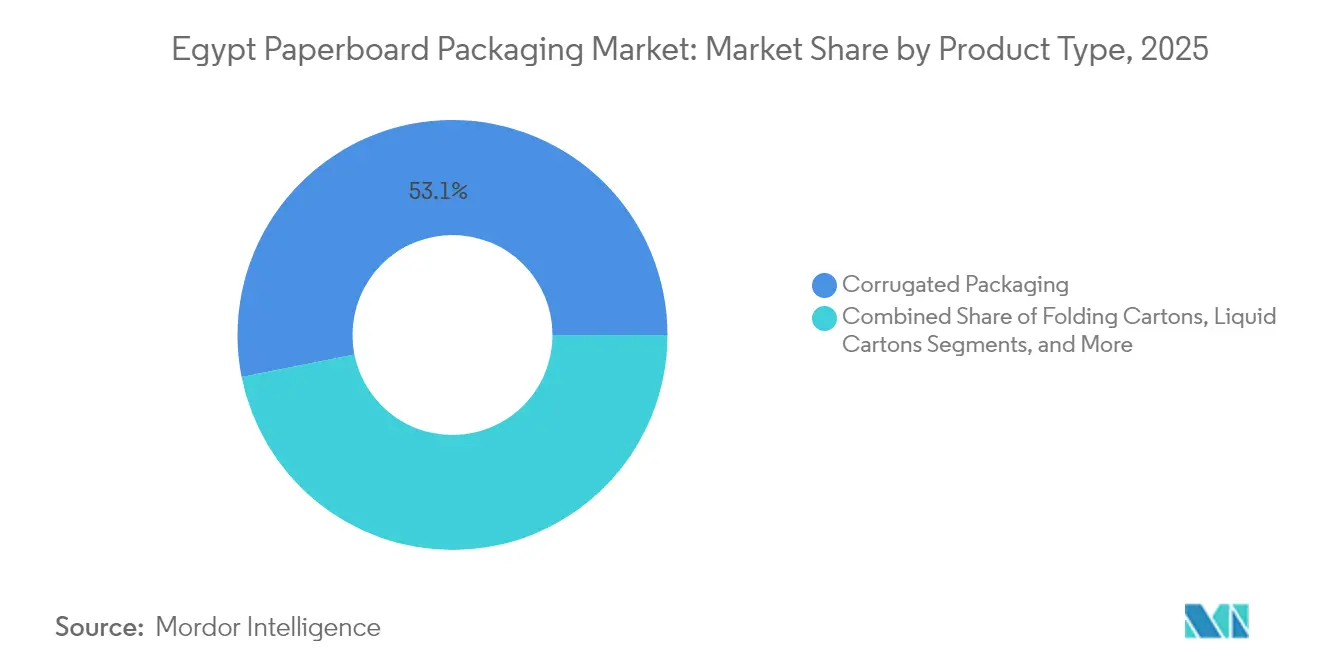
- By product type, corrugated packaging captured 53.12% of the Egypt paperboard Packaging market share in 2025.
- By material grade, the Egypt Paperboard Packaging market size for mixed fiber is projected to expand at a 5.05% CAGR between 2026-2031.
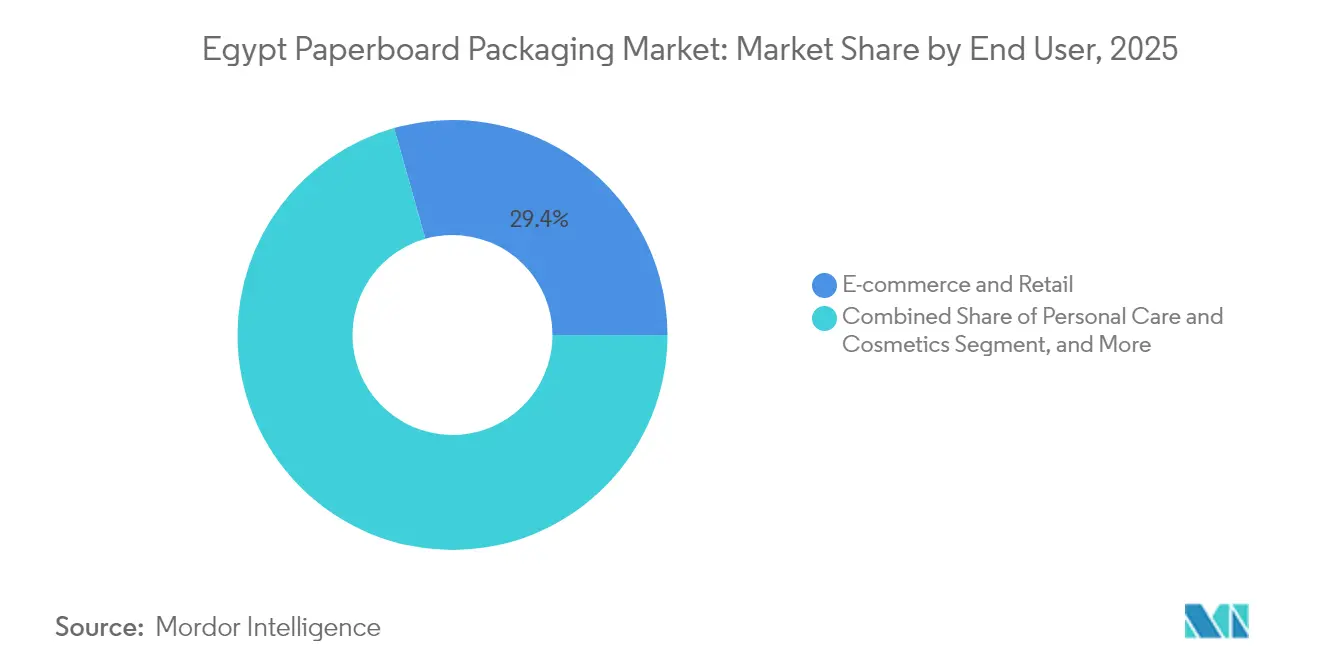
- By end-user, e-commerce and retail captured 29.38% of the Egypt paperboard Packaging market share in 2025.
Note: Market size and forecast figures in this report are generated using Mordor Intelligence’s proprietary estimation framework, updated with the latest available data and insights as of 2026.
Egypt Paperboard Packaging Market Trends and Insights
Drivers Impact Analysis*
| Driver | (~) % Impact on CAGR Forecast | Geographic Relevance | Impact Timeline |
|---|---|---|---|
| Processed-food export boom | +1.2% | Nile Delta, Alexandria | Medium term (2-4 years) |
| E-commerce last-mile acceleration | +0.8% | Cairo, Alexandria, Giza | Short term (≤ 2 years) |
| Plastic-bag bans | +0.6% | Red Sea, national rollout | Long term (≥ 4 years) |
| Green-manufacturing incentives | +0.4% | Industrial zones, Suez Canal Economic Zone | Long term (≥ 4 years) |
| Import tariffs on empty cartons | +0.3% | National | Medium term (2-4 years) |
| Smart digital printing adoption | +0.2% | Urban consumer markets | Medium term (2-4 years) |
| Source: Mordor Intelligence | |||
Processed-food export boom
Egypt’s processed-food exports surged 21% year over year to USD 6.1 billion in 2024, stimulating upstream demand for corrugated shippers, liquid cartons, and folding cartons that satisfy transport, barrier, and regulatory requirements for frozen potatoes, edible oils, and fruit juices. Arab destinations absorbed 54% of shipments, often favoring stackable, moisture-resistant corrugated cases, while EU buyers worth USD 1.168 billion mandated high-grade, multilayer paperboard with traceability features. The Food Export Council’s training programs and trade-fair support extend processors’ reach into new markets, sustaining the Egypt Paperboard Packaging market through 2030.
E-commerce last-mile acceleration
Digital commerce revenue expansion hinges on rising smartphone adoption and domestic logistics expansion, prompting retailers to standardize corrugated shipper dimensions, integrate QR-based authentication, and adopt custom inserts that reduce in-transit damage. Private investment climbed 30% year over year to EGP 133.1 billion in Q1 FY2024/25, much of it financing warehouses and delivery fleets that consume high volumes of folding cartons and mailers. Sustainability-minded online brands prefer recyclable substrates, driving growth in the Egyptian Paperboard Packaging market across urban hubs.
Plastic-bag bans
The Red Sea governorate’s 2019 decree and Sharm El-Sheikh’s sweeping ban, ahead of COP27, exemplify the tightening of rules that restrict petroleum-based carrier bags and food-service disposables. Hospitality chains, grocers, and souvenir stores are migrating to kraft paper sacks, molded pulp trays, and coated folding cartons, gradually expanding fiber demand nationwide.
Green-manufacturing incentives
Fiscal incentives offered by Egypt’s Sovereign Fund and the Suez Canal Economic Zone encourage the development of low-carbon production, recycling plants, and waste-to-energy facilities. Such programs reduce project-financing costs for mills installing biomass boilers or solar rooftops, underpinning capacity additions that reinforce the growth trajectory of the Egyptian Paperboard Packaging market.
Restraints Impact Analysis*
| Restraint | (~) % Impact on CAGR Forecast | Geographic Relevance | Impact Timeline |
|---|---|---|---|
| Pound depreciation inflating pulp costs | -0.7% | National | Short term (≤ 2 years) |
| Fragmented collection infrastructure | -0.5% | Rural areas | Long term (≥ 4 years) |
| Volatile energy tariffs | -0.4% | Industrial zones | Medium term (2-4 years) |
| Reusable plastic crates in produce logistics | -0.2% | Agricultural chains | Medium term (2-4 years) |
| Source: Mordor Intelligence | |||
Currency-driven pulp inflation
The pound’s sharp devaluation in early 2024 increased imported pulp costs in local terms, reducing gross margins for mills that rely on Scandinavian, Brazilian, and North American fiber. Mondi booked a EUR 32 million currency loss in H1 2024, underscoring the exposure faced by global producers operating in Egypt.
Collection-system fragmentation
Only 35% of rural solid waste is formally collected, which constrains the recovered-fiber pool available to local recyclers and compels converters to import supplementary material despite high freight charges.
*Our forecasts treat driver/restraint impacts as directional, not additive. The impact forecasts reflect baseline growth, mix effects, and variable interactions.
Segment Analysis
By Product Type: Corrugated leadership amid export logistics needs
Corrugated solutions generated 53.12% of the Egyptian paperboard Packaging market share in 2025, reflecting their versatility across processed foods, electronics, and industrial commodities. The Egypt Paperboard Packaging market size for corrugated boxes is expected to expand in tandem with the growth of export-processing zones along the Nile Delta. Local converters continue to add high-speed flexo lines and rotary die-cutters, which shorten lead times for multicolor shippers targeting Gulf retailers.
Liquid cartons are projected to post the fastest 5.55% CAGR through 2031, buoyed by rising domestic juice and UHT milk consumption, as well as export-oriented beverage processors adopting aseptic technology. SIG’s April 2025 launch of Egypt’s first closed-loop collection and recycling system for beverage cartons brings end-of-life solutions into the mainstream. Folding cartons continue to meet demand in the pharmaceuticals and personal care sectors, where precision creasing and premium graphics remain essential.



By Material Grade: Recycled fiber prominence with mixed-grade upswing
Recycled fiber held 52.05% of Egypt's Paperboard Packaging market share in 2025, supported by the Waste Management Law’s producer-responsibility provisions and steadily rising recovered-paper imports. Yet feedstock shortages persist, prompting mills to optimize furnish blends and invest in OCC sorting lines. Mixed fiber, blending virgin and recycled stock, is projected to log a 5.05% CAGR as converters balance performance, food-contact safety, and cost.
Virgin fiber remains indispensable for liquid cartons and heavy-duty corrugated grades requiring high ring-crush strength. Domestic capacity additions are limited, so mills hedge supply risk through long-term pulp contracts and on-site deinked pulp facilities that partially offset dollar-denominated raw material exposure.
By End User: E-commerce reigns while cosmetics accelerate
The e-commerce and retail segment commanded 29.38% of 2025 revenue, driven by Cairo-centric last-mile networks and consumers’ preference for return-ready, branded boxes that heighten unboxing appeal. Automated fulfillment centers utilize machine-erected corrugated trays, paper void-fill, and tamper-evident seals to reduce labor costs and shrink damage claims, thereby fueling the growth of the Egyptian Paperboard Packaging market.
Personal care and cosmetics applications are expected to advance at a 5.29% CAGR as local brands scale and international players co-pack region-specific SKUs in Egypt to leverage tariff advantages. High-gloss folding cartons, window patching, and digital embellishments differentiate products on pharmacy and hypermarket shelves, lifting average selling prices and converting margins.
Geography Analysis
Cairo’s metropolitan cluster accounts for the largest slice of consumption, driven by its 20 million residents, dense e-commerce volumes, and proximity to printing hubs. Alexandria’s port ecosystem supports high outbound container volumes of food, chemicals, and manufactured goods, anchoring corrugated demand among exporters. The Suez Canal Economic Zone is emerging as a green-industry enclave, offering subsidized land leases and streamlined customs, which makes it a favored site for new paperboard mills and recyclers.
Upper Egypt’s agricultural governorates foster demand for produce trays and wax-free fruit cartons. Nevertheless, low waste-collection coverage restricts OCC availability, prompting pilot community-collection projects funded by development banks. Red Sea tourism corridors, having banned single-use plastics, generate specialty kraft shopping bags and coated salad-box demand across hotels and resorts, advancing the Egypt Paperboard Packaging market.
Exports to Arab partners, which account for 54% of processed-food shipments, require Arabic-language graphics and Halal-certified materials, while EU shipments necessitate FSC certification and migration-compliant inks, prompting converters to secure chain-of-custody audits. Emerging East-African markets are opening to Egyptian suppliers leveraging competitive freight rates via the soon-to-be-expanded Safaga Port.
Regulatory Landscape
Paperboard packaging used in Egypt is shaped by food-contact rules, border standards enforcement, and waste-management obligations that support recyclable formats. The National Food Safety Authority (NFSA) Decision No. 17/2022 sets technical requirements for multiple categories of food contact materials and articles, including paper and paperboard. This affects substrate selection, inks, and migration compliance for food and beverage cartons.
For standards and trade compliance, the Egyptian Organization for Standardization and Quality (EOS) maintains a large catalogue of national standards, including packaging and packaging waste requirements (e.g., EOS 4630/2022), while the General Organization for Export and Import Control (GOEIC) enforces conformity for imported and locally produced regulated goods through registration and inspection documentation at ports. Circularity requirements are reinforced by Law No. 202 of 2020 on Waste Management and its Executive Regulations under Prime Minister Decision No. 722 of 2022, which underpin producer-responsibility provisions. These are complemented by local single-use plastic restrictions that have already been applied in tourism-heavy areas such as the Red Sea governorate and Sharm El-Sheikh.
Competitive Landscape
The Egyptian paperboard Packaging market features a medium concentration, with the top five producers holding roughly a 50% collective share. Integrated multinationals such as Mondi, International Paper, and Smurfit Kappa (formerly WestRock) operate kraft liner production and corrugating plants, benefiting from scale economies and captive pulp.[3]PaperAge staff, “Smurfit WestRock Reports Third-Quarter 2024 Financial Results,” paperage.com Regional groups like Indevco and Uniboard focus on lightweight corrugated and specialty folding cartons. Local champions Misr Cartonboard and El-Ahram Printing capitalize on proximity to FMCG clients and short lead times.
Capacity expansions dominate strategy. Mondi’s January 2024 purchase of Lafarge Cement Egypt’s paper-bag assets resulted in an additional 180 million bags of annual throughput, securing long-term contracts in the cement sector. SIG partnered with Plastic Bank and Carta Misr to establish an end-to-end beverage carton recycling chain, enhancing brand sustainability credentials while unlocking PCR fibers. Tetra Pak piloted QR-enabled traceability solutions, and Smurfit WestRock installed high-efficiency corrugators that cut energy intensity by 15%.
Rising input-cost pressure spurs efficiency moves: mills deploy AI-based predictive maintenance, switch to natural-gas-fired boilers, and sign 20-year solar PPAs to hedge tariff hikes. Digital printing adoption accelerates the use of short-run, versioned packaging for cosmetics and online sellers, differentiating converters that invest in single-pass inkjet or toner platforms.
Egypt Paperboard Packaging Industry Leaders
Huhtamaki Egypt L.L.C.
International Paper Company
Smurfit WestRock plc
Mondi plc
Tetra Pak Egypt Ltd
- *Disclaimer: Major Players sorted in no particular order


Market Opportunities and Future Outlook
A near-term whitespace is visible in domestic supply of containerboard and converting capacity aligned to export logistics and e-commerce specifications, supported by large disclosed investments and industrial-zone clustering. In November 2025, Greenliner started up what it described as Egypt's largest containerboard machine (PM1) at 10th of Ramadan City. The expansion adds local availability for lighter-weight grades (from 80 gsm) that can be converted into corrugated shippers for processed-food exporters and urban delivery networks.
Export-oriented paperboard packaging manufacturing is also being anchored through government-enabled project approvals and new plants designed around fiber-based formats. In January 2025, Huhtamaki Egypt received a Golden License for an EGP 1.5 billion fiberboard packaging factory in Sadat City, designed to export 70% of production, pointing to continued capacity build-out tied to foreign-market requirements. Additional whitespace sits in aseptic carton supply chains and circular infrastructure, with the Suez Canal Economic Zone and Qantara West Industrial Zone attracting large packaging projects. At the same time, collection constraints in rural areas limit recovered-fiber availability and quality, which remains a practical opportunity for converters and recyclers.
Recent Industry Developments
- June 2026: Tetra Pak Egypt reported that the integrated beverage carton recycling line at the Uniboard plant in Sadat City processed about 4,000 tonnes of beverage cartons during 2025. The throughput milestone supports scaling of local end-of-life solutions for used beverage cartons and helps converters access more locally recovered fiber streams tied to carton collections.
- May 2026: Huhtamaki highlighted an energy-efficiency upgrade at its Cairo flexible packaging site, including deployment of a water-cooled chiller system to replace air-cooled equipment and reduce electricity consumption. The move aligns with cost and sustainability pressures faced by packaging manufacturers in Egypt, particularly after changes to industrial power pricing, and it supports competitiveness for export-linked production.
- May 2025: Huhtamaki Egypt confirmed receipt of a Golden License for a new molded fiber packaging facility in Sadat City, with a projected investment of about EGP 1.47 billion and plans targeting 70% exports and 70% local component usage. This increases momentum behind fiber-based packaging substitution and adds capacity for paperboard-adjacent formats used in foodservice and retail applications.


Research Methodology Framework and Report Scope
Market Definition and Coverage
For this methodology, the Egypt paperboard packaging market includes paperboard-based packaging used across major end users in Egypt, tracked in value terms in USD across the study period.
Scope exclusions: We exclude non-paperboard packaging materials (such as plastics, metal, and glass) and packaging used outside Egypt.
Segmentation Overview
- By Product Type
- Folding Cartons
- Corrugated Packaging
- Liquid Cartons
- Other Product Types
- By Material Grade
- Virgin Fiber
- Recycled Fiber
- Mixed Fiber
- By End-User
- Food
- Beverage
- Healthcare and Pharmaceutical
- Household and Personal Care
- E-commerce and Retail
- Industrial and Electronics
Data Sources, Market Sizing, and Validation
Desk Research
We started by mapping the local demand backdrop and supply signals that influence paperboard packaging consumption in Egypt, then we aligned those signals with what producers and converters share publicly. Public sources used for grounding included CAPMAS releases for industrial activity, UN Comtrade trade statistics for paper and board flows, FAOSTAT for packaging-linked food production indicators, and the World Bank for macro variables and inflation trends.
Next, we reviewed industry-facing references such as customs and port updates, association websites for packaging and paper topics, and issuer documents like annual reports and investor presentations for capacity additions and utilization commentary. Where available, we also used paid subscriptions for company financials and intelligence, alongside patent databases and an import-export shipment-level database to sanity check supplier footprints and material movements. The desk sources listed here are illustrative rather than exhaustive, since we also drew on other public references during data collection, validation, and clarification.
Primary Interviews and Surveys
To ensure the desk picture matched real buying and selling behavior, we spoke with a spread of industry participants in Egypt, including converters, board suppliers, distributors, and large buyers serving food, beverage, and pharma packaging. These interviews were used to confirm the typical mix shifts between folding cartons, corrugated packaging, and liquid cartons, and to pressure-test pricing behavior when recycled and virgin fiber costs change.
Distribution of primary research fieldwork respondents
| Company type | Respondent position |
|---|---|
| Top tier: 35% | CXOs: 15% |
| Mid tier: 49% | Functional/Unit leaders: 38% |
| Smaller Players: 16% | Managers: 47% |
Market-Sizing & Forecasting
The core sizing starts with a top-down build where demand is reconstructed from Egypt-linked indicators, then filtered through packaging intensity and conversion economics for paperboard formats. In practice, we rely on market fingerprints such as output trends in packaged food and beverages, pharma volumes, e-commerce shipment activity, and import and export patterns for paperboard and cartons, then translate these into a value view using observed price ranges.
To corroborate totals, we ran selective bottom-up checks using sampled converter revenues, added channel checks on average selling prices by format (folding cartons, corrugated, and liquid cartons), and used capacity utilization discussions from interviews. Where coverage was thin for smaller, private players, we applied conservative scaling factors tied to known production clusters and trade flows, then revisited those factors with expert feedback. For forecasting, scenario analysis was applied around inflation, fiber cost pass-through, and demand growth in key end uses, before finalizing a single base case.
Data Validation & Update Cycle
After initial modeling, our team ran variance checks across format splits, price assumptions, and implied consumption per end-user to avoid drift away from practical operating ranges. If an anomaly appeared, such as a sudden jump in value without a matching signal in trade or end-use output, we reworked the assumption and, when needed, re-contacted a respondent for clarification.
Before sign-off, the model is reviewed in multiple steps so calculations, units, and currency handling remain consistent from history through the forecast. Reports are refreshed annually, and interim updates are added when material events occur, such as sharp fiber price moves, major capacity changes, or policy shifts affecting trade. Right before delivery, an analyst completes a fresh pass so clients receive the most current view available.
Mordor Intelligence's Egypt Paperboard Packaging Market2 Market Size Measured Against Other Published Estimates
Published numbers for Egypt paperboard packaging can vary because different studies mix product boundaries, use different price bases, and do not always align the same demand indicators to the same year. The table below shows how results can spread even when the topic name looks similar, so we call out the main drivers behind each estimate.
The largest gaps usually come from whether liquid cartons are counted inside the same total as folding cartons and corrugated packaging, and from how recycled versus virgin fiber pricing is rolled into average selling prices during inflationary periods. The benchmark table shows a tighter current-year number, and in this Mordor Intelligence model the scope explicitly includes folding cartons, corrugated packaging, and liquid cartons, while avoiding non-paperboard packaging materials that can inflate broader packaging totals.
Benchmark comparison
| Source | Market Size | Gaps in Research Methodology |
|---|---|---|
| Mordor Intelligence | USD 2.42 B (2025) | |
| Trade Journal A | USD 2.10 B (2025) | This figure appears to undercount liquid cartons and may rely on a narrower converter sample, which can pull down totals when smaller regional suppliers are missed. |
| Regional Consultancy B | USD 2.80 B (2025) | This estimate likely applies broader packaging price assumptions and may blend adjacent paper packaging items beyond paperboard formats, which can push the value upward versus a format-specific scope. |
Reading the table together, the spread is mainly explained by scope boundaries across formats and by how pricing is treated when fiber costs move quickly. Our approach stays traceable because the total is built from clear demand signals and then cross-checked with supplier and converter realities, which makes the final number easier to replicate and defend.


Key Questions Answered in the Report
How big is the Egypt Paperboard Packaging market in 2026?
The market is valued at USD 2.52 billion in 2026 and is forecast to grow at a 4.13% CAGR to 2031.
Which product type leads demand?
Corrugated packaging leads with 53.12% 2025 share, driven by export logistics and e-commerce shipping needs.
Why are liquid cartons growing fastest?
Rising juice and dairy processing plus SIG’s new recycling network support a 5.55% CAGR in liquid cartons.
How significant is recycled fiber in Egypt?
Recycled fiber represents 52.05% of 2025 volume, backed by waste-management reforms and cost advantages.
What regulatory trends favor paperboard?
Single-use plastic-bag bans and green-procurement policies in Red Sea and national programs encourage fiber substitution.
Which end-user segment offers the highest growth?
Personal care and cosmetics packaging is projected to expand at 5.29% CAGR through 2031 due to rising domestic production and exports.
Page last updated on:





