
Market Overview
| Study Period | 2020 - 2031 |
|---|---|
| Forecast Data Period | 2026 - 2031 |
| Base Year Market Size (2025) | USD 0.89 Billion |
| Market Size (2026) | USD 0.92 Billion |
| Market Size (2031) | USD 1.12 Billion |
| Growth Rate (2026 - 2031) | 3.96 % |
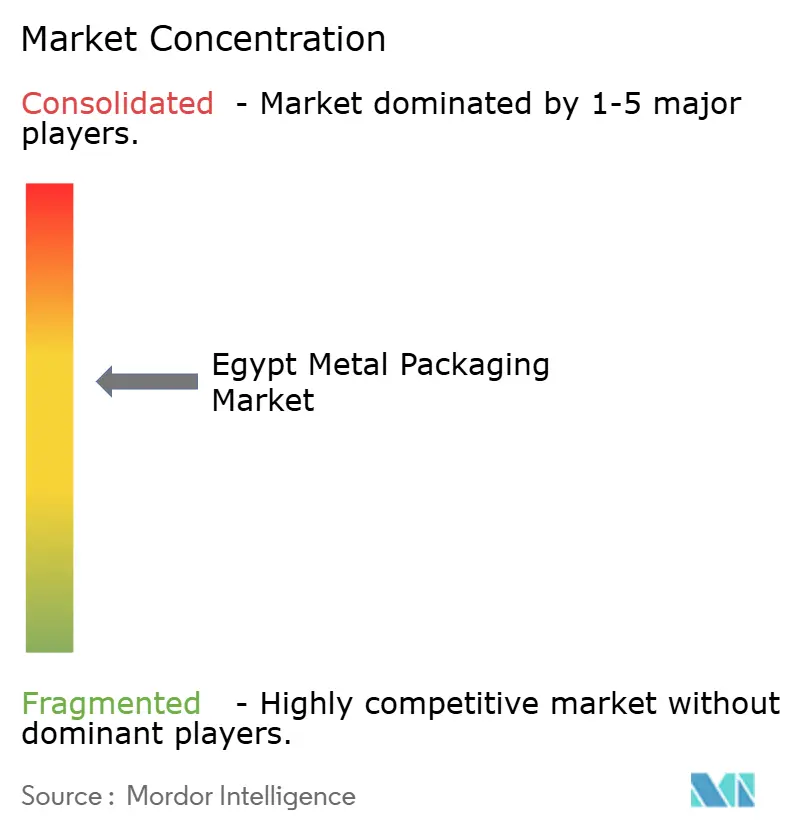
| Market Concentration | Medium |
Major Players *Disclaimer: Major Players sorted in no particular order Image © Mordor Intelligence. Reuse requires attribution under CC BY 4.0. | |
Egypt Metal Packaging Market Analysis by Mordor Intelligence
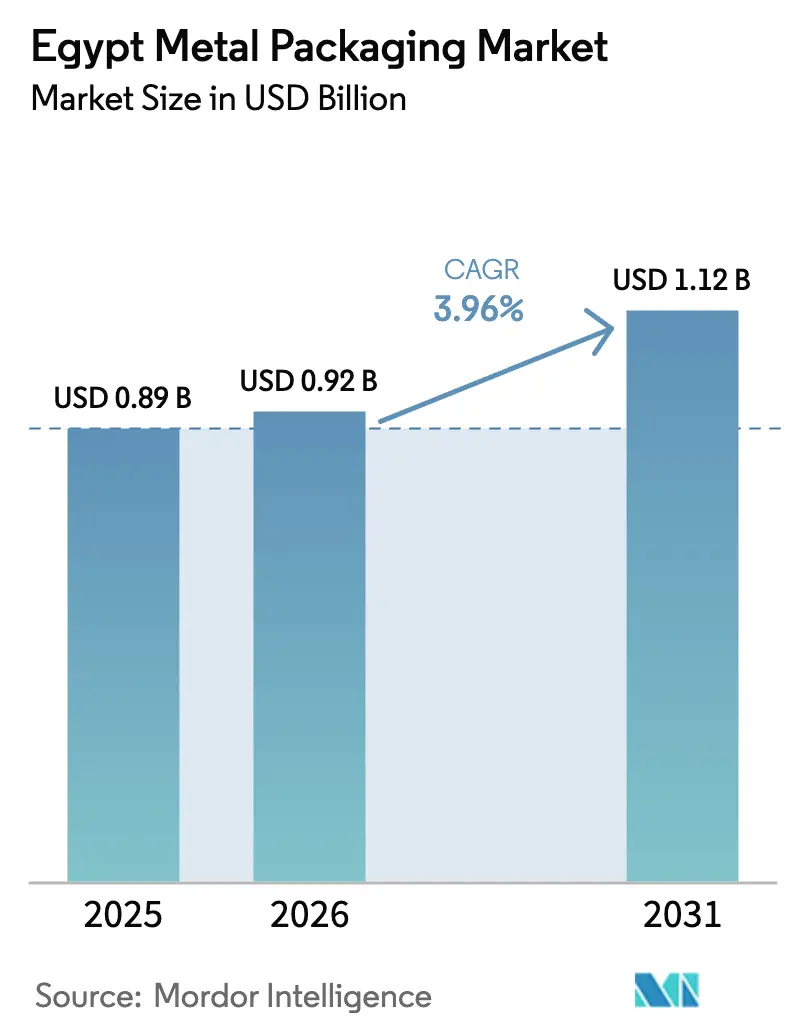
The Egypt metal packaging market size is projected to expand from USD 0.89 billion in 2025 and USD 0.92 billion in 2026 to USD 1.12 billion by 2031, registering a CAGR of 3.96% between 2026 to 2031. A surge in beverage production, growing agro-processing exports, and new domestic aluminium smelter investments are widening end-user demand while limiting the impact of foreign exchange swings on imported raw materials. Tourism-driven consumption in the HoReCa channel, government incentives under the Golden License regime, and rising adoption of premium QR-coded cans continue to favor the Egypt metal packaging market, even as PET suppliers inject fresh capacity. Domestic recycling pilots, though nascent, are beginning to improve scrap availability. At the same time, volatile London Metal Exchange pricing and the Egyptian pound’s prior depreciation introduce short-term cost variability that converters must manage through hedging and long-term supply contracts with Egyptalum and other regional smelters.
Key Report Takeaways
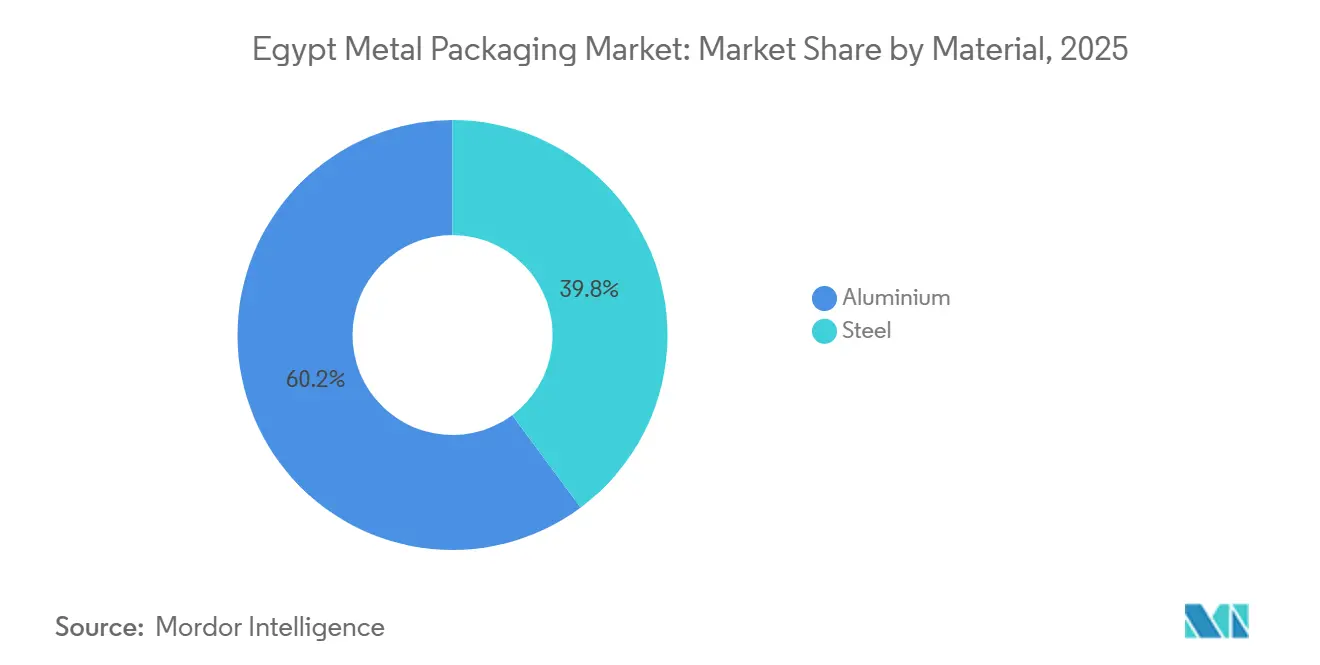
- By material, aluminium led with 60.17% of Egypt metal packaging market share in 2025 while steel is forecast to post a 4.56% CAGR through 2031.
- By product type, cans held 58.17% revenue share in 2025 whereas shipping barrels and drums are projected to expand at a 5.23% CAGR to 2031.
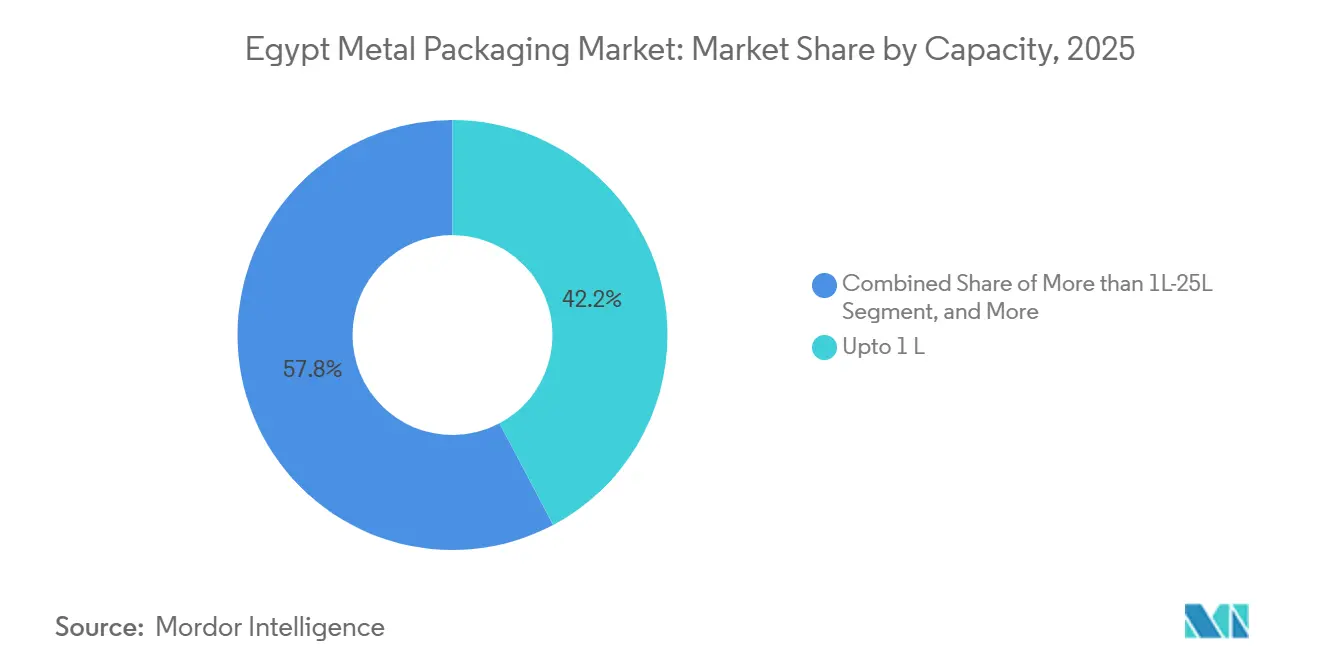
- By capacity, containers up to 1 litre commanded 42.23% share of the Egypt metal packaging market size in 2025 and the >1L-25L segment is set to grow at a 4.78% CAGR during 2026-2031.
- By end-use industry, beverages captured 39.23% share in 2025 while the industrial segment is advancing at a 5.44% CAGR during the forecast period.
Note: Market size and forecast figures in this report are generated using Mordor Intelligence’s proprietary estimation framework, updated with the latest available data and insights as of January 2026.
Egypt Metal Packaging Market Trends and Insights
Drivers Impact Analysis*
| Driver | (~) % Impact on CAGR Forecast | Geographic Relevance | Impact Timeline |
|---|---|---|---|
| Domestic Aluminium-Smelter Expansion Boosts Local Can-Sheet Supply | +0.8% | National, Alexandria and Nag Hammadi industrial zones | Medium term (2-4 years) |
| Rising Beverages Demand from Tourism and HoReCa Channel | +0.9% | National, early gains in Cairo, Alexandria, Red Sea resorts | Short term (≤ 2 years) |
| EPR and Deposit-Return Pilots Favor Highly Recyclable Metal Containers | +0.6% | National, pilot in Red Sea area | Long term (≥ 4 years) |
| Brand-Owner Shift to Premium, Smart , and QR-Coded Cans | +0.4% | National, led by multinational beverage brands | Medium term (2-4 years) |
| Growth of Agro-Processing Export Cans | +0.5% | Nile Delta and Suez Canal Economic Zone | Medium term (2-4 years) |
| Government Incentives for Import-Substitution Industrialization | +0.5% | Nationwide under Golden License regime | Long term (≥ 4 years) |
| Source: Mordor Intelligence | |||
Domestic Aluminium-Smelter Expansion Boosts Local Can-Sheet Supply
Egyptalum and Aluminium Bahrain signed a USD 3 billion memorandum of understanding in September 2025 to develop an alumina refinery that will feed 1.5 million tonnes of raw material into downstream rolling mills.[1]Egyptalum, “Egyptalum and Alba Sign Alumina Refinery MoU,” Egyptalum, egyptalum.comEgyptalum’s profits rose 160% in the first quarter of fiscal 2024/25 as higher aluminium prices and planned solar power investments lowered energy intensity.[2]Scatec, “Scatec Partners with Egyptalum on Solar Plant,” Scatec, scatec.comGreater local can-sheet availability shortens lead times for converters and reduces hard-currency exposure, helping the Egypt metal packaging market meet just-in-time orders from beverage brands trialing seasonal flavors. The refinery is expected to enable a doubling of domestic can capacity by 2030, create high-skill jobs in Upper Egypt, and reinforce the supply-security narrative that aluminium producers use when competing with PET. Shorter supply chains also permit smaller production runs, which align with the trend of SKU proliferation in the craft soda and energy drink niches.
Rising Beverages Demand from Tourism and HoReCa Channel
Egypt welcomed 15.7 million tourists in 2024, and the tourism sector expanded 13.8% in the first quarter of fiscal 2025/26. Hotels, restaurants, and cafés prefer single-serve aluminium cans that chill quickly and minimize back-of-house waste. Beverage manufacturing jumped 37% in the same quarter, vastly outpacing overall non-oil manufacturing growth of 14.5%. The Red Sea corridor, which hosts roughly 40% of Egypt’s hotel rooms, is widening premium drink menus, including craft sodas packed exclusively in cans to support brand storytelling. This demand feeds directly into the Egypt metal packaging market, sustaining high throughput at Ball and Crown lines while opening capacity-utilization headroom for local converters. Strong regional air connectivity into Hurghada and Sharm el Sheikh also accelerates cold-chain turnover, another variable that favors lightweight cans over glass.
EPR and Deposit-Return Pilots Favor Highly Recyclable Metal Containers
The United Nations Industrial Development Organization and GIZ assisted Egypt in designing an Extended Producer Responsibility framework, which entered the pilot phase in the Red Sea in 2024.[3]UNIDO, “Extended Producer Responsibility Framework for Packaging Waste,” UNIDO, unido.orgIn September 2025, SIG, Plastic Bank, Carta Misr, and TileGreen launched Egypt’s first closed-loop beverage carton system, aiming to recover 700 tonnes of materials within three years. Aluminium cans already contain 74% recycled content globally, a figure Ball plans to raise to 85% by 2030. Egypt’s evolving EPR targets will penalize low-recyclability substrates more sharply than infinitely recyclable metals, which positions the Egypt metal packaging market for incremental volume from sustainability-minded brand owners. Coca-Cola HBC Egypt’s collection of 29,000 tonnes of PET in 2024 signals that beverage multinationals foresee mandatory deposit-return obligations in the near term. Formalizing such schemes will raise the competitive bar for plastics while rewarding converters that can certify recycled content under the Aluminium Stewardship Initiative protocols.
Brand-Owner Shift to Premium, Smart and QR-Coded Cans
Variable-data printing now enables every can to carry a unique QR code, unlocking loyalty programs, provenance checks, and dynamic recycling instructions. Ball’s digital presses support rapid artwork changes with no plate costs, allowing Egyptian beverage marketers to synchronize limited-edition launches with social media campaigns. Egypt’s packaging sector, which includes over 8,000 companies, is ordering more matte lacquer, tactile varnish, and thermochromic ink to elevate shelf presence, especially in the energy-drink segment, where unit prices exceed standard soft drinks by 20-30%. Smart cans also deter counterfeiting, an issue for high-margin imports sold through informal retail in Greater Cairo. As smartphone penetration climbs above 90%, scan-and-win promotions become more effective, tightening the feedback loop between brand owners and consumers and further anchoring the Egypt metal packaging market in high-value applications.
Restraints Impact Analysis*
| Restraint | (~) % Impact on CAGR Forecast | Geographic Relevance | Impact Timeline |
|---|---|---|---|
| Volatile Aluminium and Steel Input Prices | -0.5% | Global, pass-through to Egypt via LME-linked contracts | Short term (≤ 2 years) |
| Nascent Organized Scrap-Collection and Recycling Infrastructure | -0.3% | National, informal sector dominance | Long term (≥ 4 years) |
| Intense Competition from Lightweight Flexibles and PET Bottles | -0.4% | National, especially dairy, juice, edible-oil lines | Medium term (2-4 years) |
| Foreign-Exchange Swings Raising Imported Lacquer and Liner Costs | -0.3% | National, converters sourcing from Europe and Asia | Short term (≤ 2 years) |
| Source: Mordor Intelligence | |||
Volatile Aluminium and Steel Input Prices
London Metal Exchange contracts have swung 15-20% quarter over quarter in the past two years, compressing margins for converters that lack hedging arrangements. Egypt’s net international reserves stood at USD 48.7 billion in November 2025, yet external debt reached USD 161.2 billion, limiting fiscal room for industrial subsidies. Greif reported thinner drum margins in fiscal Q4 2024 after customers resisted cost-pass-through clauses. When aluminium prices spike alongside a weakening pound, converters serving export clients face a double hit because output is invoiced in USD while inputs are denominated in EGP. Short-term agreements with Egyptalum for billet supply at indexed discounts offer some relief but rarely cover imported lacquers, rivets, or coil coatings sourced in Europe and Asia.
Nascent Organised Scrap-Collection and Recycling Infrastructure
Roughly 60,000-80,000 informal waste pickers retrieve post-consumer material, but a lack of centralized sorting and washing limits the purity of aluminium scrap entering remelters. A USD 20 million PET plant is under construction in the Suez Canal Economic Zone, yet no comparable large-scale aluminium facility has been announced. Domestic smelters therefore rely on imported pre-consumer scrap, adding logistics cost and diluting the circular-economy narrative that metal packagers use to differentiate from PET. Without a nationwide deposit-return system, beverage cans continue to be included in mixed municipal waste streams, increasing contamination and reducing collection economics. Until formal scrap aggregation scales up, recycled-content targets will hinge more on foreign feedstock than on local collection, slowing progress relative to public sustainability commitments.
*Our forecasts treat driver/restraint impacts as directional, not additive. The impact forecasts reflect baseline growth, mix effects, and variable interactions.
Segment Analysis
By Material: Steel Gains Momentum in Export-Oriented Drums
Aluminium retained 60.17% of Egypt metal packaging market share in 2025 because it anchors beverage cans, aerosols, and premium retort food packs. Steel, however, is set to grow at a 4.56% CAGR through 2031, the fastest rate among materials, thanks to rising demand for conical drums from tomato paste and tuna exporters. Aluminium revenues track beverage output, which jumped 37% in the first quarter of fiscal 2025/26, while steel benefits from Egypt’s agro-processing exports that reached USD 6.1 billion in 2024. The Egypt metal packaging market size for aluminium is expanding steadily, yet steel’s affordability and robustness make it the preferred option for bulk concentrates moving through the Suez Canal corridor.
Domestic smelter projects will lower aluminium sheet import dependence and may temper price volatility, but steel enjoys an established tinplate-coating base that serves chemical and paint customers on short lead times. Greif Egypt leverages ISO-certified plants to supply both standard drums and conical formats to North Africa, reinforcing the material’s cross-border appeal. Tinplate cans manufactured in 10th of Ramadan City reach edible-oil and adhesive lines in Upper Egypt, further diversifying steel’s order book. Consequently, procurement managers balance weight savings and recycling narratives with total delivered cost, ensuring both materials retain strategic relevance within the Egypt metal packaging market.


By Product Type: Cans Dominate, Drums Accelerate
Cans accounted for 58.17% of 2025 revenue, underscoring their central role in carbonated soft drinks, beer, ready-to-drink coffee, and aerosols slated for domestic sale and re-export into the Levant. Shipping barrels and drums, though smaller in base volume, are forecast to advance at a 5.23% CAGR to 2031 as Egypt’s industrial and agro-processing clusters rely on large-format steel containers for bulk logistics. Up-to-70 cl beverage cans underpin plant utilization at Ball and Crown sites near Cairo, but new tomato-paste lines in the Suez Canal Economic Zone are booking three-piece conical drums months ahead of commissioning. The Egypt metal packaging market size tied to drums is therefore rising in tandem with processed-food export contracts secured under duty-free trade schemes with COMESA partners.
CairoPac’s expansion to 1.2 million food cans per day widens fast-rotation SKUs for tuna and legumes stocked by Middle Eastern retailers, while MetalPrint’s aerosol lines benefit from growing household-and-personal-care demand among Egypt’s urban middle class. Supply chain resilience drives some paint makers to dual-source cylinders from EuroPack and Greif, reducing risk of line stoppages. The product-type profile thus mirrors Egypt’s industrial strategy: cans remain the workhorse for beverages, yet drums carve the fastest lane as bulk-export infrastructure scales.
By Capacity: Mid-Range Containers Catch Up
Containers up to 1 litre held 42.23% of Egypt metal packaging market share in 2025, reflecting the dominance of 250-500 ml cans consumed in HoReCa and retail multipacks. The 1L-25L bracket is forecast to grow 4.78% annually, driven by paint, chemical, and edible-oil fillers seeking tamper-evident metal formats that withstand hot-fill and stacking pressures. As tourism rebounds, bar owners in Hurghada are ordering slim 330ml energy-drink cans that chill quickly and free up fridge space. Meanwhile, paint producers in 6th of October City shift to 18 litre pails with child-safe lids, a niche where the Egypt metal packaging market size still shows headroom for import substitution.
Large-capacity ranges exceeding 25 litres are growing in line with lubricant and specialty chemical output, yet they face palletization constraints in land transport to Sub-Saharan Africa. Egypt’s conical designs enable nested stacking, reducing shipping volume, and underpin its franchise in tomato paste exports to Europe. Single-serve formats will remain indispensable to fast-moving beverages, but mid-range packs increasingly attract capital spending as Egypt targets deeper penetration into regional construction and agro-input markets.

By End-Use Industry: Industrial Lines Outpace Beverage Growth
Beverages commanded 39.23% of the share in 2025, buoyed by tourism, rising disposable income, and multi-flavor rollouts among global soda brands. Yet the industrial segment is on track for a 5.44% CAGR through 2031, outstripping all peers due to government incentives for domestic chemical and lubricant plants that mandate local packaging content. The Egypt metal packaging market size booked by beverage fillers continues to climb, largely from energy drinks and ready-to-drink coffee that rely on sleek aluminium cans for brand differentiation. Crown’s ongoing capacity upgrade supports this trajectory and signals sustained confidence from multinational partners.
Export-oriented food processors added 21% value in 2024 and still expand, but now share capacity with paint, adhesive, and specialty chemical players seeking ISO-approved steel drums. Greif Egypt meets this demand by offering conformance to global hazardous goods regulations, which in turn lowers insurance premiums for exporters. Pharmaceutical and cosmetics users, aided by Abdos FMCG’s new plant, are pivoting toward metal aerosols for antiseptic sprays and deodorants to improve their barrier properties. As the industrial supply chain matures, order volumes shift toward larger drums and pails, tilting revenue toward the sector with the fastest forecast CAGR inside the Egypt metal packaging market.
Geography Analysis
Greater Cairo generates nearly 45% of national demand, featuring beverage can filling lines, pharmaceutical production, and a dense HoReCa footprint that consumes single-serve formats daily. Nile Delta governorates contribute roughly 30%, driven by agro-processing plants in Dakahlia and Gharbia that can tomatoes and fruit concentrates in steel conicals for onward shipment through Damietta and Port Said. The Suez Canal Economic Zone emerges as a third anchor where integrated logistics, bonded storage, and export rebates attract packaging investors, including Huhtamaki’s USD 48 million fiberboard project approved in January 2025.
Alexandria and the Red Sea resort corridor collectively account for around 40% of hotel rooms and therefore drive high turnover rates in tourist season. Port Said hosts GCAN’s facility, which targets Levant exports, leveraging its proximity to the canal and straightforward customs procedures. Upper Egypt contributes under 10% today but may rise if Egyptalum’s refinery in Nag Hammadi triggers further downstream investment.
Transport economics shape plant siting. Rail and river barge options along the Nile reduce backhaul costs, encouraging converters to cluster close to beverage or petrochemical fillers. Golden License approvals, which hit 43 by January 2025, are deliberately mapped to diversify industrial capacity beyond the congested Cairo hub, easing pressure on domestic freight rates while enlarging the geographic footprint of the Egypt metal packaging market.
Regulatory Landscape
The Egyptian Organization for Standards and Quality (EOS) is the key regulator for metal packaging standards, with ES 2146:1992 setting general requirements for food-contact metal packaging, including chemical composition, corrosion resistance, and structural integrity.
The National Food Safety Authority (NFSA) enforces binding food-contact requirements, including Decision No. 17/2022 effective October 19, 2022, while EOS 8964/2024 adds testing for dangerous substances in packaging. The Waste Management Regulatory Authority oversees the Green Label Initiative to encourage recyclable inputs and clean production practices, which ties packaging compliance to wider circular-economy policies.
Value Chain Analysis
Egypt metal packaging production starts with upstream metal inputs and moves through rolling and sheet supply to can fabrication, coating, printing, and finishing. Ball Beverage Packaging Egypt SAE operates in Giza, while Ghandour Brothers Metal Industries (GCAN) runs facilities in Port Said and 10th of Ramadan City, helping anchor domestic capacity.
Demand is concentrated across beverages, food processing, paint and chemical, and industrial customers, with Greater Cairo and canal-region logistics hubs supporting throughput. Converters still rely on imported lacquers, inks, and liners, which increases the value of domestic capacity expansion and of meeting ISO and NFSA food-contact requirements when targeting export markets.
Competitive Landscape
Market concentration is moderate, as two global heavyweights coexist alongside a number of agile local converters. Ball Corporation’s EMEA sales reached USD 1.059 billion in Q3 2025, up 11.5% year-over-year, aided by its recycled content credentials, which secure contracts with multinational beverage brands. Crown operates a two-line plant outside Cairo and continues to debottleneck end lines to handle sleek can diameter shifts demanded by energy drink marketers. Greif Egypt, founded in 1992, leads the supply of steel drums for chemicals and lubricants, capitalizing on its parent company’s quality systems and regional distribution network.
Mid-tier players, such as CairoPac and MetalPrint, differentiate themselves through shorter lead times, lower minimum order quantities, and a willingness to accommodate mixed pallets of diameters for SME food brands. ISO 9001 certifications are commonplace, but only a handful of companies invest in ISO 14001 or PAS 2060 carbon neutrality audits, which large consumer packaged goods firms now require. Digital printing and QR coding are still niche services offered by Ball, although local converters are exploring modular retrofit kits to help existing decorators close that gap.
Competitive intensity is rising as PET suppliers complete fresh lines and court beverage fillers with lightweight bottles. Metal packagers respond by highlighting recyclability, tamper evidence, and cold-chain efficiency. The absence of a mandatory EPR fee gives converters little economic incentive to fund collection infrastructure, yet forward-looking players pilot can-back schemes to lock in contracts ahead of forthcoming regulation. Overall, the Egypt metal packaging market balances multinational capital strength with domestic market agility, sustaining room for specialization in high-margin niches.
Egypt Metal Packaging Industry Leaders
Greif Inc.
Willy Group
Ghandour Brothers Metal Industries(Gcan)
EuroPack
Ball Corporation
- *Disclaimer: Major Players sorted in no particular order

Market Opportunities and Future Outlook
Egypt’s Industrial Development Strategy 2026-2030 identifies 28 priority sectors to deepen domestic manufacturing and targets USD 100 billion in exports by 2030, with metal packaging closely linked to food processing and engineering industries. The strategy also highlights enabling capabilities such as metal fabrication and robotics to build local packaging capacity and support a green, export-oriented supply chain.
Within that framework, regulatory and circularity measures anchored by NFSA and EOS standards, the Green Label Initiative, and EPR and deposit-return pilots create clearer differentiation for converters that invest in testing, traceability, and recycled-content documentation. Opportunities are reinforced for higher-end formats such as QR-coded cans and premium coatings, with production and sourcing concentrated around regional packaging clusters centered on the Suez Canal Economic Zone and Greater Cairo.
Recent Industry Developments
- July 2026: DP World launches Egypt's first integrated packaging, re-packaging, and labelling logistics distribution centre at Sokhna Logistics Park. The integrated packaging and logistics hub expands end-to-end handling and value-added services for operators in the Egypt metal packaging market. The facility strengthens port-adjacent distribution capabilities and supports faster turnover for cans and packaging materials.
- June 2026: Egypt Aluminium pursues a 100 million loan to finance the first domestic aluminium foil manufacturing facility with initial 25,000 tonnes per year capacity. This downstream capability broadens local input materials for metal packaging and boosts domestic value addition. It reduces import reliance and enhances pricing resilience for local converters.
- January 2026: Eroglu Global Holding signed an agreement with SCZONE to invest 175 million in a 70,000 m2 packaging and cardboard plant in Qantara West Industrial Zone, annual capacity 400,000 tonnes of corrugated sheets. The project adds new carton and converting capacity to Egypt's SCZONE cluster and strengthens regional carton supply chains.


Research Methodology Framework and Report Scope
Market Definition and Coverage
This market covers the value of metal packaging sold into Egypt, counted as supplier revenues from finished metal packs used to store, transport, and protect products across consumer and industrial uses.
Scope exclusions: Paper, plastic, and glass packaging are excluded, and metal inputs sold as raw sheet, coil, or ingot are not counted as packaging revenue.
Segmentation Overview
- By Material
- Aluminium
- Steel
- By Product Type
- Cans
- Food Cans
- Beverage Cans
- Aerosol Cans
- Bulk Containers
- Shipping Barrels and Drums
- Caps and Closures
- Other Product Types
- Cans
- By Capacity
- Upto 1 L
- >1L-25L
- >25L-200L
- Above 200L
- By End-use Industry
- Beverage
- Food
- Paint and Chemical
- Industrial
- Other End-use Industries
Data Sources, Market Sizing, and Validation
Desk Research
Desk research sets up the model structure and provides base demand signals that are harder to dispute. We relied on public sources such as CAPMAS industrial production releases, the Central Bank of Egypt macro series (FX and inflation), UN Comtrade trade statistics using metal pack related HS codes, and UNIDO industrial indicators to understand output trends.
To keep the model tied to metal packaging use, we also reviewed sources such as Ministry of Trade and Industry notices, Egyptian Organization for Standardization and Quality references, and widely available association and customs summaries that describe can and drum usage in food, beverage, and chemicals. These are complemented with company filings, investor presentations, and press coverage, and then cross checked with paid subscription inputs for company financials, shipment level import-export data, and patent intelligence where it helped confirm capacity, mix, and technology direction. This list is indicative only, and other sources were used for data collection, validation, and clarifying assumptions.
Primary Interviews and Surveys
Primary work was used to pressure test the desk view and close gaps around price realization, utilization, and end use mix. We spoke with converters, material distributors, brand owners, and large buyers in beverage, food processing, and paints and chemicals, and then checked the final assumptions again across the value chain.
Distribution of primary research fieldwork respondents
| Company type | Respondent position |
|---|---|
| Top tier: 31% | CXOs: 14% |
| Mid tier: 51% | Functional/Unit leaders: 39% |
| Smaller Players: 18% | Managers: 47% |
Market-Sizing & Forecasting
The market is sized mainly using a top-down build that reconstructs demand from packaged product activity in Egypt, then converts it into metal packaging value through penetration and pricing assumptions. In practice, beverage output trends, processed food activity, and chemicals and coatings production are used to define the demand pool, and metal pack shares are applied by use case.
After building the demand pool, we run selective bottom-up approximations to keep totals from drifting. These checks use supplier revenue ranges from public financials, capacity and utilization discussions from interviews, and sampled price per unit and weight-to-value conversions for cans, drums, and caps and closures. Key inputs include aluminum and steel price direction, the Egyptian pound and pass-through timing, the split between food and beverage cans versus industrial packs, and the share of imported filled goods that shifts local packaging need. Forecasts are produced with scenario analysis, using base, low, and high cases tied to macro and packaged goods growth, and the final curve is chosen based on what industry experts view as most plausible.
Data Validation & Update Cycle
Validation is done in steps so one weak signal does not determine the final number. Model outputs are compared with independent indicators such as import patterns for packed goods, metal price movement, and announced capacity changes, and then any sharp variance is reviewed and recalculated before sign off.
If a mismatch remains after desk checks, respondents are re-contacted to confirm whether it is a pricing swing, a utilization shift, or a mix change across end uses. Reports are refreshed annually, and interim updates are made when material events occur, such as major currency moves, policy shifts, or capacity additions. Before delivery, an analyst performs a fresh pass on key inputs so clients get the most current view.
Mordor Intelligence's Egypt Metal Packaging Market Sizing Compared With Other Published Estimates
It is common to see different market values for Egypt metal packaging because publishers do not always count the same products, the same transaction point, or the same currency timing. Some figures track production output more directly, while others focus only on beverage cans or only on consumer packs, which changes the starting value before forecasting begins.
A frequent gap driver in this space is that some sources blend metal packaging with other fabricated metal products, and then report a factory output number that can move quickly with FX translation. In the Mordor Intelligence approach, the value is kept to supplier revenues from metal packaging products sold into end users in Egypt, and adjacent fabricated metal items are left out even if they sit in the same industrial reporting bucket.
Benchmark comparison
| Source | Market Size | Gaps in Research Methodology |
|---|---|---|
| Mordor Intelligence | USD 0.92 B (2026) | |
| Trade Journal A | USD 0.83 B (2024) | Uses production output reporting that also groups metal packaging with other fabricated metal products, so the value is not limited to packaging sales and can be distorted by reporting classifications. |
| Industry Portal B | USD 0.84 B (2024) | Often applies a broad product list and optimistic growth rate without clearly separating Egypt-only demand from wider category rollups, and the price assumptions are not shown at a pack type level. |
Taken together, the spread is explained mainly by what is being counted and at what point in the value chain it is measured, rather than a disagreement on demand direction. Our approach stays traceable to packaged product activity, metal pack penetration, and practical pricing pass-through, which makes the final market value easier to replicate and update.


Key Questions Answered in the Report
What is the current value of the Egypt metal packaging market?
The market was valued at USD 0.92 billion in 2026 and is projected to hit USD 1.12 billion by 2031.
Which material leads demand in Egyptian metal containers?
Aluminium holds 60.17% share, led by beverage cans, although steel is the fastest growing at a 4.56% CAGR.
Why are drums the fastest expanding product type?
Export-oriented tomato paste, chemicals, and lubricants need large-format steel drums, driving a 5.23% CAGR in this category.
How is tourism affecting packaging demand?
Tourism growth of 13.8% in Q1 2025/26 is lifting HoReCa beverage orders, accelerating can consumption in coastal resorts.
Which end-use sector shows the highest growth outlook?
The industrial segment, spanning chemicals and lubricants, is forecast to grow at 5.44% CAGR through 2031.
What role will recycling regulation play in future demand?
Egypt’s evolving Extended Producer Responsibility framework is likely to favor infinitely recyclable aluminium, improving long-term demand for metal containers.
Page last updated on:


 Your data is secure and never sold or shared.


