
Educational Consulting And Training Market Size and Share
Market Overview
| Study Period | 2020 - 2031 |
|---|---|
| Market Size (2026) | USD 81.72 Billion |
| Market Size (2031) | USD 144.14 Billion |
| Growth Rate (2026 - 2031) | 12.02 % |
| Fastest Growing Market | Asia Pacific |
| Largest Market | North America |
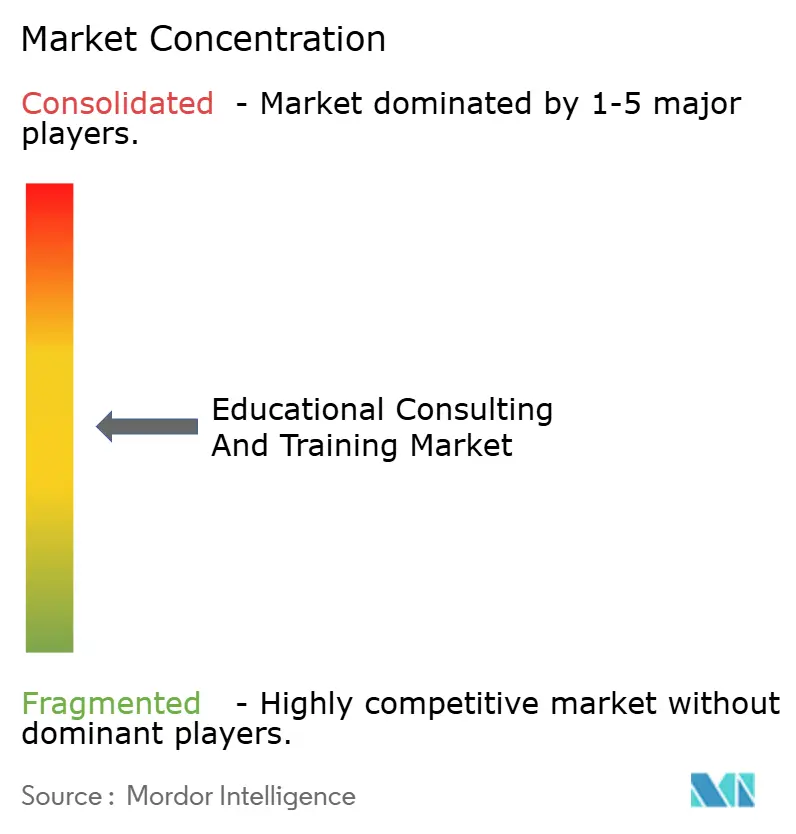
| Market Concentration | Medium |
Major Players *Disclaimer: Major Players sorted in no particular order Image © Mordor Intelligence. Reuse requires attribution under CC BY 4.0. | |
Educational Consulting And Training Market Analysis by Mordor Intelligence
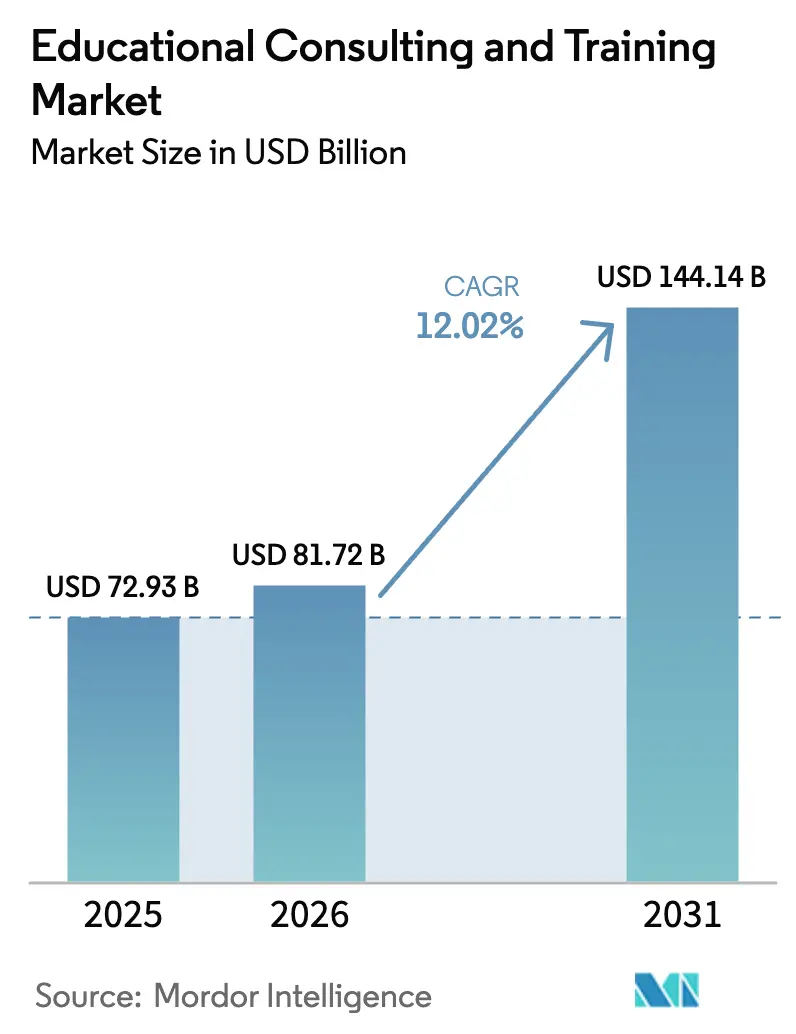
Educational Consulting and Training market size in 2026 is estimated at USD 81.72 billion, growing from 2025 value of USD 72.93 billion with 2031 projections showing USD 144.14 billion, growing at 12.02% CAGR over 2026-2031. To sustain that pace, public-sector agencies, higher-education systems, and large employers are shifting away from ad-hoc workshops toward multiyear, outcome-based engagements that tie invoices to clearly defined learning or employment metrics. Buyers of Educational Consulting and Training market services now demand integrated solutions that cover needs analysis, program design, technology deployment, instructor enablement, and post-training analytics in one contract, eroding the historic distinction between strategy consultants and content providers [1]HM Treasury, “Spring Budget 2024,” gov.uk . Artificial-intelligence tooling has become the lever that compresses development cycles by generating adaptive content and real-time feedback loops, allowing providers to charge premium fees for personalization at scale while improving completion rates and learner satisfaction. At the same time, tightening privacy regulations and new professional-licensure rules oblige institutions to demonstrate auditable compliance, channelling additional demand toward firms that can bundle instructional expertise with legal and cybersecurity capabilities.
Key Report Takeaways
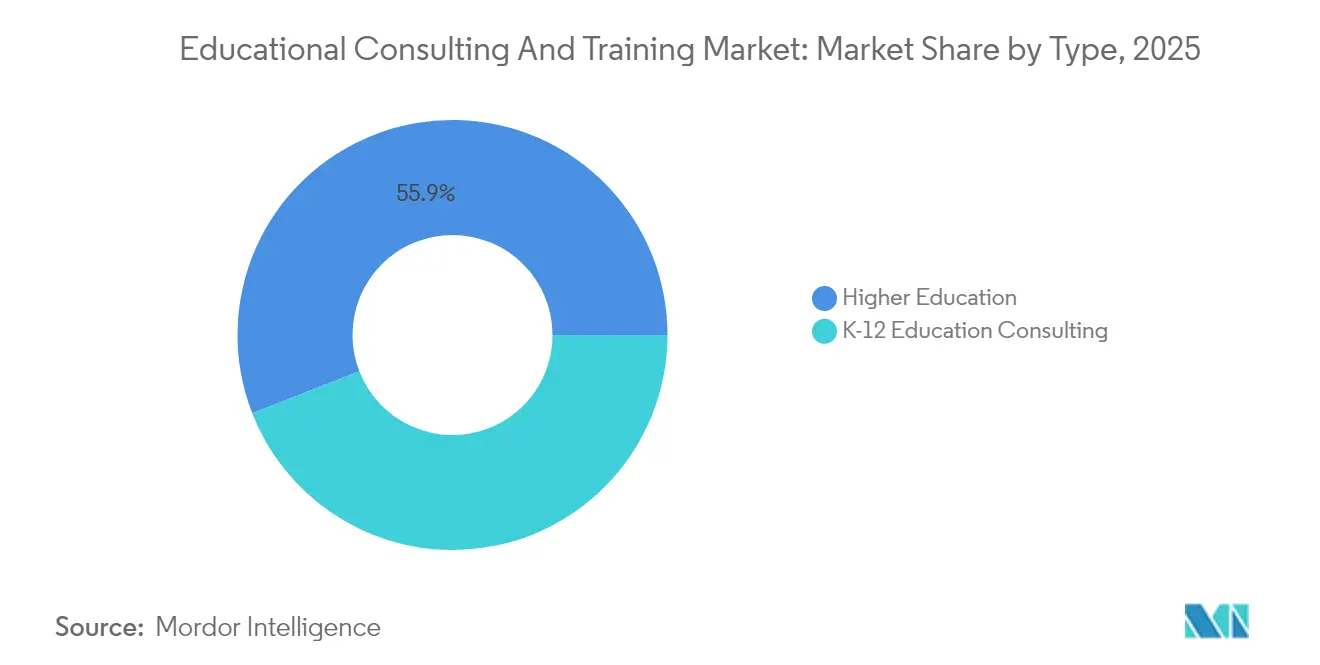
- By type, Higher Education held 55.92% of the educational consulting and training market share in 2025, whereas K-12 is expanding at an 13.1% CAGR through 2031.
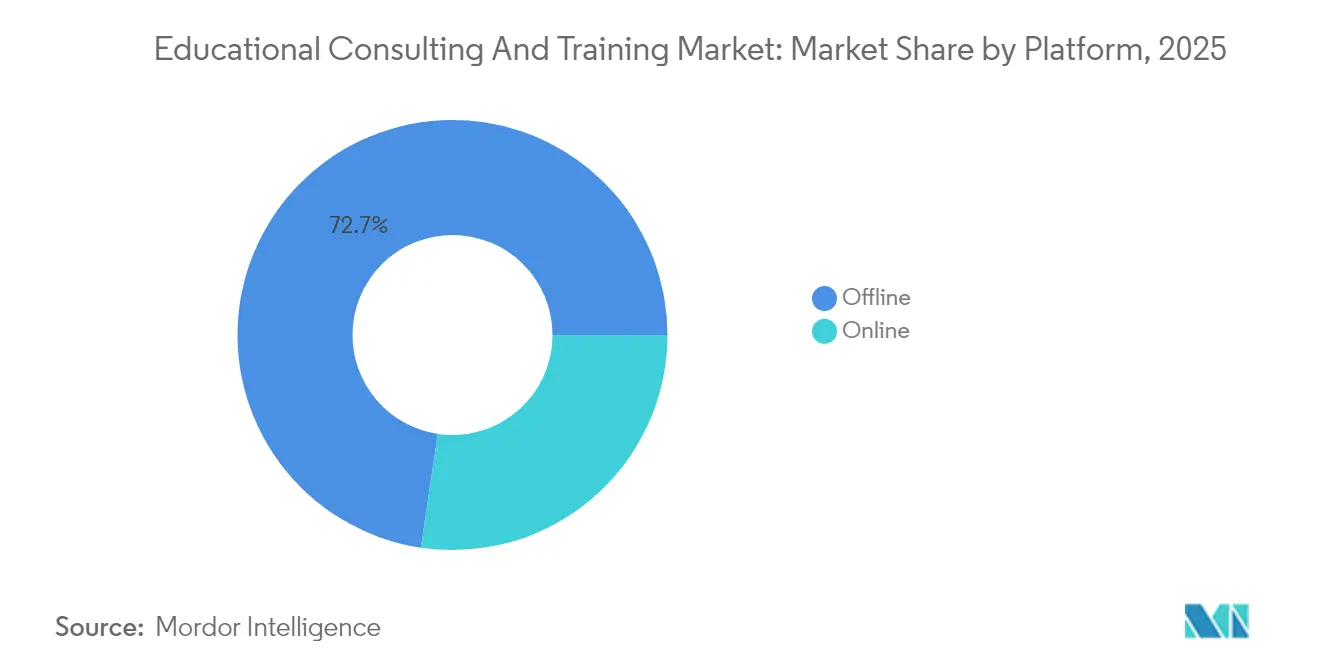
- By platform, offline solutions accounted for 72.65% of the educational consulting and training market share in 2025, while online modalities are forecast to grow at a 19.2% CAGR to 2031.
- By service offering, teacher professional development captured 36.12% of the educational consulting and training market share in 2025; AI-assisted instructional design is projected to surge at a 19.75% CAGR through 2031.
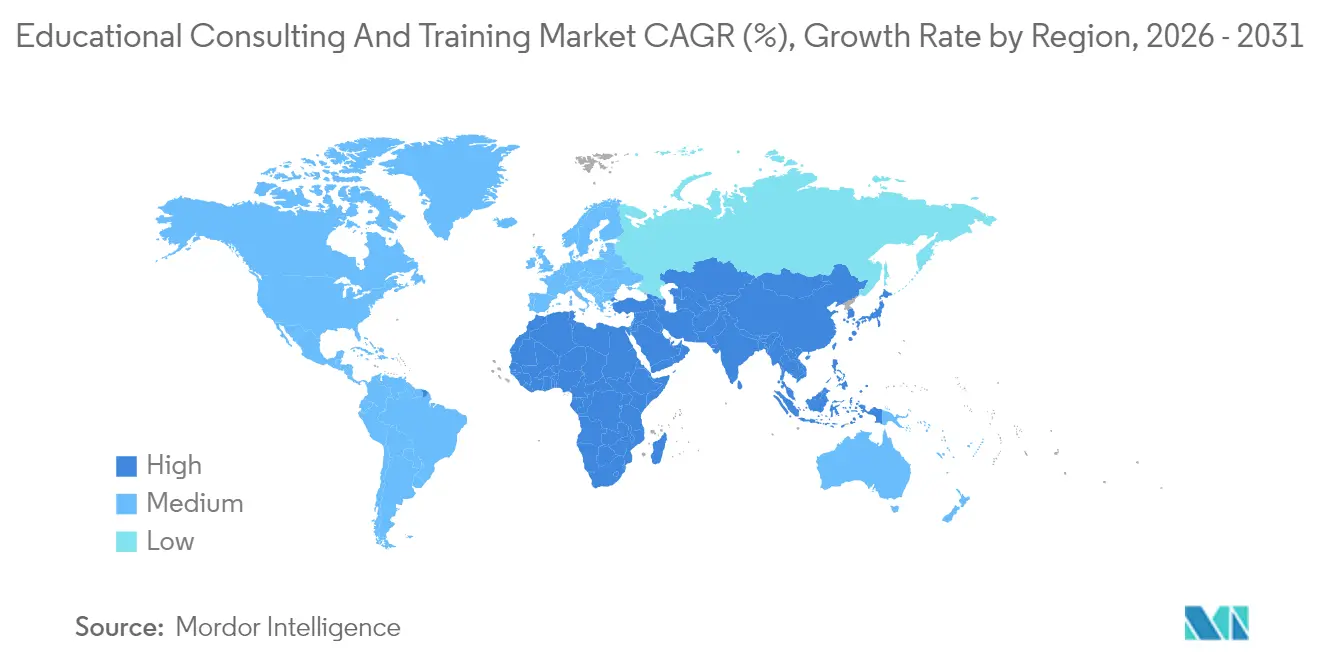
- By geography, North America led with a 38.95% of the educational consulting and training market share in 2025, but Asia-Pacific is set to post the fastest 14.62% CAGR between 2026 and 2031.
Note: Market size and forecast figures in this report are generated using Mordor Intelligence’s proprietary estimation framework, updated with the latest available data and insights as of 2026.
Market Trends and Insights
Drivers Impact Analysis of Educational Consulting And Training Market*
| Driver | (~) % Impact on CAGR Forecast | Geographic Relevance | Impact Timeline |
|---|---|---|---|
| Rapid digital-learning adoption (post-pandemic) | +2.8% | Global, with concentrated impact in North America & Europe | Medium term (2-4 years) |
| Government upskilling initiatives & funding | +2.1% | Global, strongest in Asia-Pacific and North America | Long term (≥ 4 years) |
| Rising corporate L&D budgets for reskilling | +1.9% | North America & Europe core, expanding to APAC | Medium term (2-4 years) |
| Growing demand for outcome-based consulting | +1.6% | Global, led by North America and Western Europe | Short term (≤ 2 years) |
| AI-assisted instructional design outsourcing | +1.4% | North America & Europe, emerging in Asia-Pacific | Short term (≤ 2 years) |
| Demand for ESG-linked workforce training | +1.2% | Europe leading, North America following, APAC emerging | Long term (≥ 4 years) |
| Source: Mordor Intelligence | |||
Rapid Digital-Learning Adoption Drives Platform Transformation
Hybrid delivery has become institutional policy rather than a contingency plan, which materially enlarges the Educational Consulting and Training market as clients seek partners who can unify pedagogy, technology, and change management. The United Kingdom appropriated USD 3.14 billion (GBP 2.5 billion) for national digital-skills development running through 2025[2]New Jersey Department of Labor & Workforce Development, “Future of Work Task Force Update,” nj.gov . In 2024, Singapore's SkillsFuture initiative expanded its portfolio of online learning modules and introduced a requirement for outcome-tracking dashboards as a prerequisite for grant funding. This strategic move aims to enhance accountability and measure the effectiveness of funded programs. Such mandates shift consulting scopes from basic platform selection to enterprise-wide learner analytics integration, faculty enablement, and credential architecture. Corporations mirror this urgency by migrating legacy content into cloud-based learning-experience platforms that embed adaptive algorithms, thereby feeding a virtuous cycle in which data-rich environments help consultants demonstrate ROI and unlock follow-on assignments.
Government Upskilling Initiatives Reshape Market Demand
Governments now treat workforce skilling as macroeconomic policy. New Jersey’s USD 50 million Workforce Development Initiative, launched in 2024, requires grantees to partner with external specialists for curriculum design and employer outreach[3]Journal of Interactive Media in Education, “The Importance of Offline Options for Online Learners,” jime.open.ac.uk . Queensland's Skills Strategy allocates co-investment grants to training consortia designed to align with industry requirements. These consortia are mandated to deliver annual impact reports, which undergo audits conducted by independent third-party consultants to ensure accountability and transparency. Similarly, Canada's Future Skills Centre has prioritized funding for experimental training pilots, with disbursement contingent upon the adoption of comprehensive and rigorous evaluation frameworks. These strategic initiatives are driving growth in the Educational Consulting and Training market, as a significant portion of colleges, vocational institutions, and employer coalitions lack the internal resources and expertise necessary to comply with the increasingly stringent evidence-based policy standards.
Corporate L&D Budget Expansion Fuels Reskilling Demand
Enterprise training budgets have rebounded sharply as boards link skill currency to risk mitigation. In 2024, technology firms across North America demonstrated a strategic shift by increasing their per-employee learning investments. Notably, over 50% of these expenditures were allocated to skill development in critical areas such as cloud computing, artificial intelligence, and cybersecurity, reflecting a focused approach to addressing evolving technological demands. Consulting opportunities span needs analysis, curriculum co-development with original-equipment manufacturers, and post-program analytics that map learning to operational KPIs—a holistic mandate that few pure-play content vendors can satisfy. As a result, the Educational Consulting and Training market increasingly rewards full-stack providers capable of advising on technology roadmaps, sourcing adjunct faculty, and integrating learning telemetry into enterprise data warehouses.
Outcome-Based Consulting Models Gain Traction
In 2025, several U.S. university systems released RFPs that incorporated performance-bond requirements specifically for retention-focused projects. This development reflects a growing emphasis on financial accountability and measurable outcomes, such as improved graduation rates and higher certification pass rates. Consequently, consulting firms are allocating resources toward advanced baseline diagnostics, rigorous control-group design, and the establishment of secure data rooms to meet the demands of third-party verification processes. These measures have significantly increased entry barriers, favoring established players with substantial financial stability. This shift underscores a broader trend in the Educational Consulting and Training market, where scalability and robust balance sheets are becoming critical competitive advantages.
Restraints Impact Analysis of Educational Consulting And Training Market*
| Restraint | (~) % Impact on CAGR Forecast | Geographic Relevance | Impact Timeline |
|---|---|---|---|
| Budget constraints in educational institutions | -1.8% | Global, most acute in North America post-ESSER | Short term (≤ 2 years) |
| Talent shortage of specialized consultants | -1.2% | Global, concentrated in North America & Europe | Medium term (2-4 years) |
| Data-privacy compliance costs (GDPR, etc.) | -0.9% | Europe is leading, expanding globally | Long term (≥ 4 years) |
| Client fatigue from point-solution sprawl | -0.7% | North America & Europe primarily | Short term (≤ 2 years) |
| Source: Mordor Intelligence | |||
Budget Constraints Challenge Institutional Spending
The wind-down of Elementary and Secondary School Emergency Relief funding forces U.S. districts to trim discretionary services just as pandemic-related learning loss persists. Higher-education institutions confront flat tuition revenue and declining public appropriations, compelling CFOs to favor incremental, modular consulting scopes over transformational megaprojects. Providers seeking to defend their share of the Educational Consulting and Training market must therefore embed ROI calculators, flexible payment milestones, and grant-writing assistance into proposals.
Specialized Consultant Talent Shortage Limits Growth
The North American market is witnessing a pronounced gap between the demand for and supply of professionals with expertise in pedagogy, data science, and cloud architecture. This talent shortage has driven up average salary packages for senior learning analytics roles, reflecting the premium placed on these specialized skills. The resulting capacity constraints are causing extended delivery lead times, which, in turn, are delaying revenue recognition across the Educational Consulting and Training market. To mitigate these challenges, key market players are implementing strategic initiatives, including the establishment of internal academies and the formation of partnerships with universities. These efforts are designed to build a sustainable talent pipeline of credentialed designers, enabling organizations to enhance scalability, improve operational efficiency, and meet growing market demands effectively.
*Our forecasts treat driver/restraint impacts as directional, not additive. The impact forecasts reflect baseline growth, mix effects, and variable interactions.
Educational Consulting And Training Market Segment Analysis
By Type:
Higher Education Dominance Amid K-12 AccelerationIn 2025, Higher Education engagements accounted for 55.92% of the Educational Consulting and Training market share. This performance was attributed to universities prioritizing strategies to address declining enrolment rates, develop stackable micro-credential programs, and align academic curricula with labour-market trends and data-driven insights. Typical statements of work span diagnostic analytics, program-portfolio rationalization, and registrar-system integration. K-12, although representing a smaller share, will log an 13.1% CAGR, marking it the fastest-moving component of the Educational Consulting and Training market through 2031. State literacy mandates, science-of-reading implementations, and federally backed tutoring consortia anchor demand for professional-development sessions, coaching cycles, and curriculum mapping. District buyers favour short, grant-aligned projects, yet the cumulative volume of those engagements generates sizeable addressable revenue for regional specialists able to scale delivery across multiple school systems.
Higher Education clients typically sign multiyear master services agreements that cover enterprise resource planning, data-warehouse upgrades, and enrollment-marketing optimization, preserving high visibility for service revenue. Conversely, K-12 boards operate on annual budgets, driving providers to adopt modular toolkits and cost-sharing consortium models. Cross-selling potential emerges as higher-education consultancies downshift adjacent services, such as graduate-tracking dashboards, into K-12 markets, thereby expanding the Educational Consulting and Training market footprint without large marketing overhead.



By Platform:
Offline Persistence Despite Online SurgeOffline engagement still delivered 72.65% of the Educational Consulting and Training market size in 2025, mainly because leadership institutes, lab-based technical training, and compliance audits demand face-to-face observation. Yet online modalities will absorb nearly all incremental spend, accelerating at 19.2% CAGR as synchronous virtual classrooms, AI-chat tutors, and mobile micro-learning apps mature. Institutions increasingly favour hybrid “click-and-campus” blueprints whereby foundational theory appears in asynchronous modules and higher-order practice unfolds in facilitated workshops. Consultants must therefore design content that travels seamlessly between platforms, institute data pipelines that blend LMS logs with in-person observation rubrics, and certify facilitators in both virtual and live delivery. Providers excelling at this orchestration will gain a disproportionate share of the Educational Consulting and Training market.
Operational economics vary significantly depending on the modality. Digital programs achieve higher gross margins, particularly after the completion of platform amortization, whereas travel-intensive workshops tend to operate with comparatively lower gross margins. However, offline pathways maintain higher client-retention rates and generate ancillary revenue from facility rentals and executive-education lodging. The optimal portfolio for Educational Consulting and Training industry leaders, therefore, balances margin-rich digital catalogs with relationship-anchoring in-person residencies, supported by unified credential frameworks.
By Service Offering:
Professional Development LeadershipTeacher Professional Development accounted for 36.12% of the Educational Consulting and Training market share in 2025, reflecting legislative pressure linking educator effectiveness to student-achievement metrics. Key contract themes revolve around the implementation of culturally responsive pedagogy, the adoption of project-based assessment methodologies, and the organization of workshops aimed at enhancing educational technology integration. The AI-assisted Instructional Design market is projected to grow at a CAGR of 19.75%. This growth is driven by the increasing utilization of generative AI technologies, which facilitate the development of personalized learning sequences designed to meet the unique requirements of diverse learner demographics. The integration of such advanced AI tools is expected to significantly transform instructional methodologies, enabling more effective and inclusive educational outcomes. Consultants sell subscription-style retainers that combine design sprints, model-drift monitoring, and ethical-AI audits—services that command double-digit margin premiums.
Strategic & Operational Consulting keeps steady momentum by guiding institutions through structural reform, shared-services adoption, and partnership brokering with employers. Student Assessment & Support Services exhibit moderate expansion as early-warning analytics and success coaching become essential to retention targets. Collectively, these offerings reinforce the breadth requirement for players seeking to lead the Educational Consulting and Training industry.
Geography Analysis
North America Educational Consulting and Training Market
North America generated 38.95% of 2025 revenue, owing to substantial federal and state funds aligned to workforce programs and digital-infrastructure upgrades. The Infrastructure Investment and Jobs Act earmarked multibillion-dollar grants for community-college modernization, while state initiatives such as California’s Strong Workforce Program stipulate mandatory third-party evaluations. Consulting engagements often encompass platform migration, workforce reskilling, and economic impact evaluations. These integrated service offerings contribute to an increase in the average size of deals, reflecting the growing demand for comprehensive and value-driven solutions in the market. Canadian provinces deploy stackable credential pilots and Indigenous education initiatives that further expand the Educational Consulting and Training market.
APAC Educational Consulting and Training Market
Asia-Pacific is projected to clock a 14.62% CAGR, fuelled by government digitization drives and demographic tailwinds. China’s regional governments roll out AI-literacy certifications linked to industrial policy, forcing vocational institutes to seek external curriculum partners. India’s National Education Policy mandates multidisciplinary curriculum conversion across colleges, generating sustained consulting demand for syllabus mapping, faculty coaching, and accreditation logistics. Southeast Asian ministries of education, notably Vietnam and Indonesia, allocate ed-tech subsidies aimed at English proficiency and STEM capacity, positioning foreign consultants as valued implementation guides.
EMEA Educational Consulting and Training Market
Europe posts mid-single-digit growth on the strength of GDPR compliance projects and ESG-skills mandates. The Corporate Sustainability Reporting Directive requires companies to track employee competence in climate-impact topics, spawning specialized instructional-design engagements at. Nordic countries pilot lifelong-learning vouchers redeemable on approved course catalogs, necessitating audit mechanisms often outsourced to consultants. Mediterranean economies leverage EU cohesion funds to modernize vocational centers, creating cross-border collaboration opportunities that enlarge the Educational Consulting and Training market footprint. The Middle East & Africa show smaller but accelerating demand as Gulf states pivot to knowledge-economy strategies and African Union members prioritize teacher-capacity building, though budget volatility tempers near-term scale.

Regulatory Landscape
Regulation shaping educational consulting and training demand increasingly emphasizes auditable outcomes, teacher-quality standards, and accountability rules across publicly funded education and workforce programs. In the United Kingdom, the Further Education (Initial Teacher Training) Regulations 2026, effective April 15, 2026, tightened quality requirements for teacher training courses in England and Wales, which is raising the need for external support in program design, evidence collection, and quality-improvement systems.
In the United States, federal policy changes are pushing institutions and training providers toward stronger measurement and reporting. The US Department of Labor issued Circular 2026-01 clarifying competency-based, hybrid, and time-based training criteria for Registered Apprenticeship programs, reinforcing demand for consulting that aligns curriculum, delivery models, and documentation to program rules. Separately, the US Department of Education initiated 2026 negotiated rulemaking on higher-education accountability and modernization, while an April 2026 federal proposal introduced an earnings-premium approach for program eligibility tied to federal student aid. That approach is increasing the need for secure data handling, outcomes analytics, and compliance-ready learner reporting workflows.
Value Chain Analysis
The value chain begins with client needs identification (ministries of education, school districts, universities, and employers), followed by diagnostic assessment, program strategy and design, and then solution build-out that blends curriculum development, instructional design, and delivery. Technology enablement is a recurring layer in current engagements, covering learning platform selection or migration, cloud and data-architecture setup, and cybersecurity and privacy controls for learner data, with implementation support extending into faculty or instructor enablement, change management, and program operations.
Measurement and assurance sit downstream, including outcomes dashboards, third-party evaluations for grant compliance, and audits of data governance and ethical AI use in content generation and learner analytics. Large professional-services firms (Accenture, Deloitte, McKinsey, PwC) increasingly provide this end-to-end stack by combining advisory, systems integration, and managed services, while content owners and assessment specialists contribute proprietary assets. Partnerships and alliances, including Pearson and Deloitte, reflect how content, skills intelligence, and implementation capabilities are being bundled, extending offerings from content and credentials to analytics, employer alignment, and operational transformation.
Competitive Landscape
The Educational Consulting and Training market remains moderately concentrated: the top five providers control one-fourth of worldwide revenue. Multinational professional-services firms leverage their audit and IT-integration arms to secure multi-tower engagements, exemplified by Accenture’s 2024 purchase of Udacity that fused nano-degree catalogs with global change-management muscle. Big Four competitors replicate the strategy by bundling cloud alliances, analytics dashboards, and instructional-design studios, making it harder for smaller firms to win enterprise accounts.
Private equity accelerates consolidation, viewing SaaS learning platforms as recurring-revenue anchors around which service revenue can be layered. Bain Capital's acquisition of PowerSchool exemplifies a strategic approach by integrating a well-established base of school districts with the potential of an emerging AI assistant. This combination is positioned to drive growth opportunities through professional development offerings, leveraging the AI assistant to enhance value and expand market reach. Nonetheless, meaningful whitespace persists for specialists in learning analytics implementation, accessibility compliance, and bilingual curriculum design—areas where domain depth trumps scale.
Talent scarcity shapes competitive dynamics: firms that establish internal academies enjoy faster project mobilization and tighter delivery quality. Partnerships also proliferate; for example, mid-tier consultancies ally with cloud hyperscalers to access pre-built AI models, reducing development cost and accelerating deployment cycles. As regulatory frameworks tighten, credibility in data-governance certification becomes a decisive differentiator in the Educational Consulting and Training industry.
Educational Consulting And Training Industry Leaders
Accenture
Deloitte
PwC
Pearson
McKinsey & Company
- *Disclaimer: Major Players sorted in no particular order
Educational Consulting And Training Market Companies Covered in this Report
- Accenture plc
- Deloitte Touche Tohmatsu Ltd.
- PricewaterhouseCoopers (PwC)
- Ernst & Young (EY)
- KPMG International
- McKinsey & Company
- Boston Consulting Group (BCG)
- Bain & Company
- GP Strategies Corporation
- NIIT Limited
- Pearson plc
- Kaplan, Inc.
- Chegg, Inc.
- 2U, Inc.
- Blackboard Inc.
- Instructure Inc.
- Coursera Inc.
- Udacity, Inc.
- BYJU’S
- Cornerstone OnDemand, Inc.
- Skillsoft Corporation
- Franklin Covey Co.
Read Analysis of Educational Consulting And Training Companies

Market Opportunities and Future Outlook
Accountability-led measurement requirements are creating near-term whitespace for providers that can operationalize outcomes tracking across education and workforce programs, especially where funding is tied to documented impact. In the United States, 2026 negotiated rulemaking activity and the April 2026 proposal introducing an earnings-premium accountability approach for federal student aid are increasing the importance of data readiness, auditable reporting, and secure analytics environments. This is expanding opportunities for consulting linked to assessment design, learner progression analytics, and compliance-grade data governance.
Enterprise and public-sector buyers are also consolidating around partners that combine AI-enabled content with implementation, change management, and skills intelligence, supporting scaled multi-year engagements. The February 2026 Pearson and Deloitte alliance to co-develop AI-powered learning solutions is a specific marker of this shift toward integrated offerings for governments and global organizations. In parallel, the US Department of Labor guidance in Circular 2026-01 for Registered Apprenticeship training approaches supports consulting demand for competency frameworks, hybrid delivery redesign, and documentation systems that meet program criteria, particularly for employers building role-based pathways in AI, cloud, and cybersecurity.
Recent Industry Developments in Educational Consulting And Training Market
- June 2026: Pearson signs a five-year contract extension with the Jordanian Ministry of Education to continue delivering a vocational education program through 2031. The agreement sustains public sector demand for structured, outcome-based learning programs in vocational education, supporting Pearson's long-term revenue visibility in government partnerships. The contract extension also reinforces multi-year engagement activity with state systems.
- June 2026: Pearson selected as a partner in the UK Government AI Skills Boost initiative to upskill 10 million workers in AI by 2030. The program expands scale-driven demand for AI-enabled learning and credentialing across the public sector and large employers. The selection strengthens Pearson’s role in national AI education initiatives and supports additional enterprise-scale upskilling work.
- May 2026: Pearson signed a Memorandum of Understanding with ICESCO to improve teaching methods and develop school assessment guides. The collaboration signals AI-enabled and standardized assessment and teaching improvement efforts across international markets. The agreement broadens Pearson’s international collaboration footprint and creates additional scope for standardized assessment partnerships.


Educational Consulting And Training Market Report Scope and Research Methodology
Market Definition and Coverage
This market tracks revenues earned from education-focused consulting and training services that help K-12, higher education, employers, and public bodies plan, deliver, and improve learning outcomes across online and offline formats.
Scope exclusions: This sizing excludes pure content publishing and software-only learning platforms when they are sold without a defined consulting or training service component.
Segments Covered in This Report
- By Type
- Higher Education Consulting
- K-12 Education Consulting
- By Platform
- Online
- Offline
- By Service Offering
- Strategic & Operational Consulting
- Curriculum & Instructional Design
- Teacher Professional Development & Training
- Student Assessment & Support Services
- By Geography
- North America
- Canada
- United States
- Mexico
- South America
- Brazil
- Peru
- Chile
- Argentina
- Rest of South America
- Europe
- United Kingdom
- Germany
- France
- Spain
- Italy
- BENELUX (Belgium, Netherlands, Luxembourg)
- NORDICS (Denmark, Finland, Iceland, Norway, Sweden)
- Rest of Europe
- Asia-Pacific
- India
- China
- Japan
- Australia
- South Korea
- South-East Asia
- Rest of Asia-Pacific
- Middle East and Africa
- United Arab Emirates
- Saudi Arabia
- South Africa
- Nigeria
- Rest of Middle East and Africa
- North America
Data Sources, Market Sizing, and Validation
Desk Research
Desk research was used to map the demand pool, pricing structure, and delivery mix (online versus offline) before the model was built. We leaned on public sources such as UNESCO and OECD education indicators, World Bank education and skills datasets, U.S. Bureau of Labor Statistics training and employment series, Eurostat education statistics, and national education ministry publications that flag funding priorities and reform programs.
To translate these signals into a workable revenue model, we also reviewed company filings and investor presentations, reputable press coverage of education services contracts, and association websites that describe training accreditation and procurement norms. Where needed, paid subscription sources for company financials and news intelligence helped confirm revenue exposure to education services and timing of large program awards. These examples are indicative only, and many other sources were reviewed to collect, validate, and clarify data points during the study.
Primary Interviews and Surveys
Primary work focused on interviews and surveys with education consultants, training providers, institutional decision-makers, and procurement or program managers who oversee delivery budgets. Respondent input from North America, Europe, and Asia-Pacific clarified typical utilization and renewal behavior, and how decision-makers expect ASPs to move over contract cycles. These checks were then aligned with what was seen in desk research.
Distribution of primary research fieldwork respondents
| Company type | Respondent position | Region |
|---|---|---|
| Top tier: 33% | CXOs: 12% | APAC: 43% |
| Mid tier: 50% | Functional/Unit leaders: 43% | EMEA: 35% |
| Smaller Players: 17% | Managers: 45% | Americas: 22% |
Market-Sizing & Forecasting
Sizing starts with a top-down build where education spend and training intensity are reconstructed by geography, and then filtered by the share that typically flows into outsourced consulting and structured training delivery. To keep the totals realistic, selective bottom-up approximations are used as checks, including sampled provider revenue splits, channel feedback on average contract values, and volume x ASP sanity checks for common program types.
In practice, the model leans on repeatable inputs that can be validated: education and workforce development budgets, institutional enrollment and staffing levels, share of learning delivered online, average program duration, and typical pricing per learner or per engagement. Where data gaps exist for smaller geographies, proxy ratios are applied from comparable markets, and then corrected after expert feedback on local procurement behavior.
Forecasts were built using scenario analysis, because pricing, funding cycles, and digital delivery adoption can shift quickly depending on policy and employer hiring plans. Assumptions on ASP progression and volume growth were stress-tested using primary inputs, then reconciled to visible macro indicators so the 2026 to 2031 trajectory remains explainable.
Data Validation & Update Cycle
Validation is done through triangulation across demand signals, provider revenue exposure, and independent education and workforce metrics, then checked again for obvious outliers by region and delivery mode. If large variances show up, the relevant inputs are re-opened, assumptions are revisited, and follow-up calls are triggered with the appropriate respondent type to confirm whether the change is real or driven by the model.
Before sign-off, the model is reviewed in steps by analysts to confirm that growth rates, implied pricing, and adoption patterns remain consistent with the underlying drivers. Reports refresh annually, with interim updates when material policy changes, funding announcements, or large contract waves occur, and a final pre-delivery pass is completed so clients receive the latest view available at release time.
Mordor Intelligence's Educational Consulting and Training Market Estimate Compared With Other Published Estimates
Published market sizes for educational consulting and training can look far apart, even when they describe similar buyer needs, because the boundary between training services, adjacent education support services, and software-led learning models is not consistent. Differences also come from how exchange rates are applied, how ASP increases are handled, and how frequently underlying assumptions are refreshed.
In this study, the main gap drivers are service scope and timing. Some estimates blend tutoring and test prep, broader education support services, or workforce development categories into one total and then convert currencies using a single period rate. A refresh-led build helps reduce drift in pricing and mix changes, and the 2026 base-year view is kept current through iterative checks on contract pricing, online delivery share, and regional demand signals, following the approach used by Mordor Intelligence.
Benchmark comparison
| Source | Market Size | Gaps in Research Methodology |
|---|---|---|
| Mordor Intelligence | USD 81.72 B (2026) | |
| Global Insights Publisher A | USD 84.80 B (2026) | Uses a broader bucket of educational support and consulting services, which can pull in tutoring, exam preparation, and related support revenues that are not always delivered as defined consulting or training engagements. |
| Regional Publisher B | USD 73.00 B (2024) | Anchors on an older base year and provides limited transparency on service boundaries and currency timing, which can understate recent online training mix shifts and price resets seen in 2025 to 2026. |
Taken together, the spread is mainly explained by what gets counted as a service engagement and how quickly pricing and mix assumptions are updated. By tying the model to observable budget signals and repeatable pricing checks, the estimate stays easier to trace and reproduce across regions and years.


Key Questions Answered in the Report
How large will the Educational Consulting and Training market be in 2031?
Forecasts indicate it will reach USD 144.14 billion, expanding from USD 72.93 billion in 2025 to USD 81.72 billion in 2026 at a 12.02% CAGR.
Which segment represents the greatest share of current consulting revenue?
Higher Education engagements hold 55.92% of 2025 revenue, driven by enrolment, digital-transformation, and workforce-alignment initiatives.
Which delivery platform is growing fastest?
Online and hybrid modalities are projected to scale at a 19.2% CAGR, absorbing most incremental spending through 2031.
Why is AI-assisted instructional design accelerating?
Generative-AI tools cut course-development cycles while enabling personalization, propelling this service line at a 19.75% CAGR.
What regional market will record the quickest growth?
Asia-Pacific is set to pace the field with a 14.62% CAGR, supported by government digitization programs and rising middle-class enrolment demand.
How are consulting fee structures evolving?
Institutions and enterprises increasingly insist on outcome-based contracts that link consultant payments to measurable learning or employment metrics.
Page last updated on:




