
Market Overview
| Study Period | 2020 - 2031 |
|---|---|
| Forecast Data Period | 2026 - 2031 |
| Base Year Market Size (2025) | USD 10.34 Billion |
| Market Size (2026) | USD 11.45 Billion |
| Market Size (2031) | USD 19.02 Billion |
| Growth Rate (2026 - 2031) | 10.69 % |
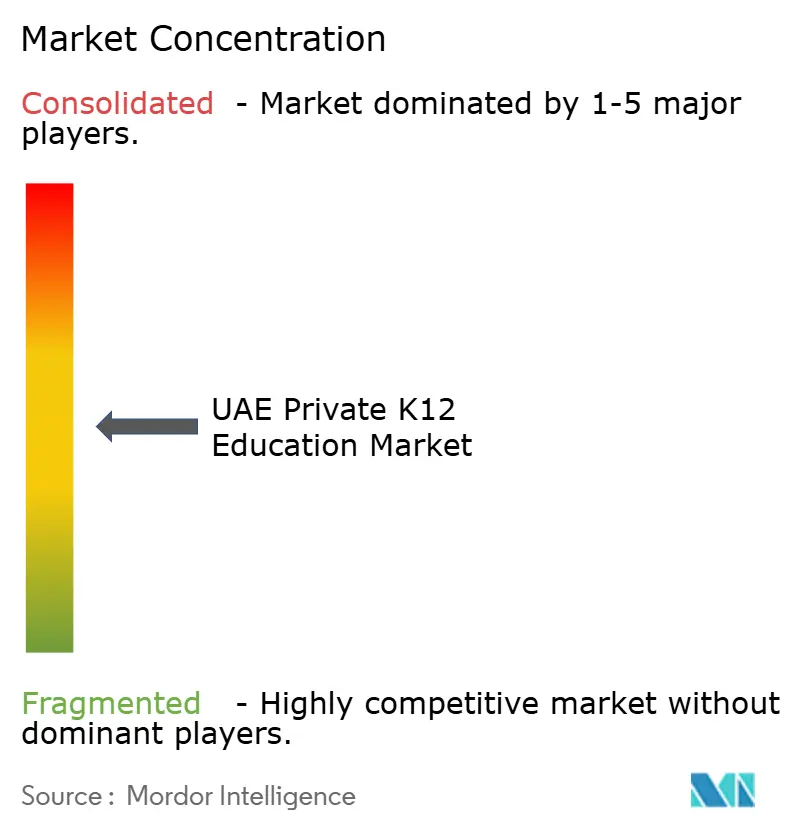
| Market Concentration | Medium |
Major Players *Disclaimer: Major Players sorted in no particular order Image © Mordor Intelligence. Reuse requires attribution under CC BY 4.0. | |
UAE Private K-12 Education Market Analysis by Mordor Intelligence
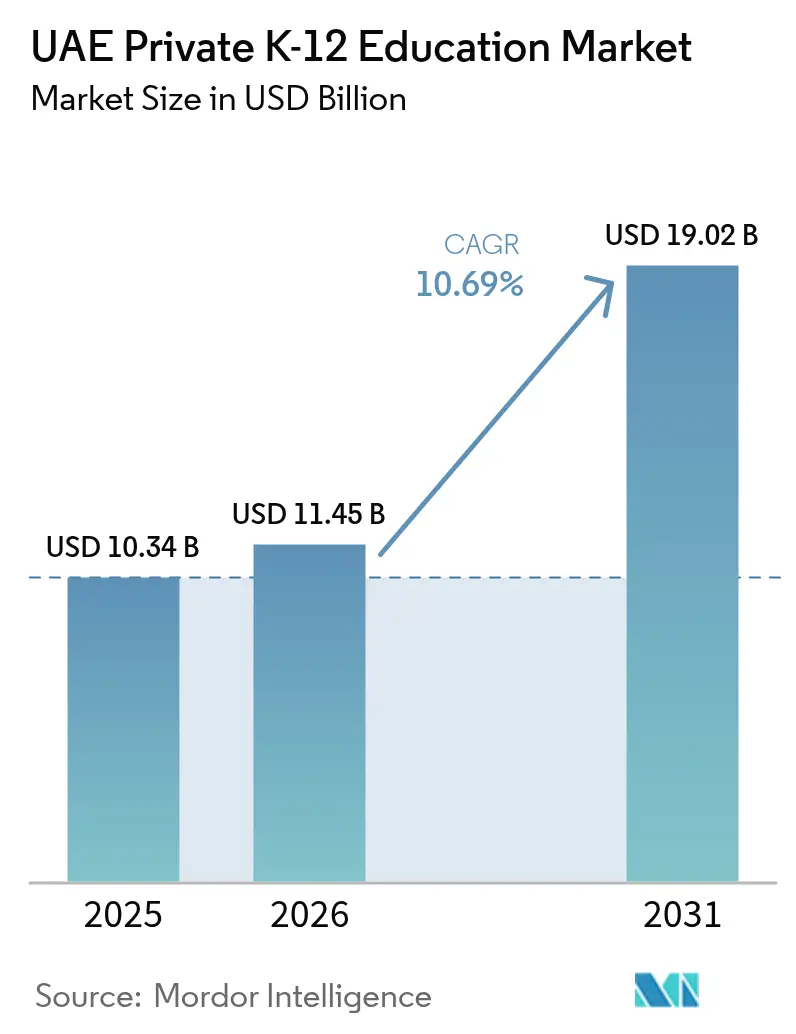
The UAE Private K-12 Education Market size was valued at USD 10.34 billion in 2025 and estimated to grow from USD 11.45 billion in 2026 to reach USD 19.02 billion by 2031, at a CAGR of 10.69% during the forecast period (2026-2031).
Robust expansion is powered by sustained expatriate inflows, Vision 2030-aligned privatization policies and higher disposable incomes that enable families to favor premium schooling options. Demand is most pronounced in Dubai, where a rigorous quality-assurance regime under the Knowledge and Human Development Authority (KHDA) continues to attract international operators while maintaining curriculum diversity.
Across the UAE private K-12 education market, early-years capacity additions, rapid EdTech adoption and foreign ownership allowances in education free zones have further elevated investor confidence, evidenced by multiple nine-figure capital injections from global asset managers. Even so, tuition-fee inflation and regulatory fee caps pose affordability challenges for middle-income households, nudging operators to explore mid-tier and blended-learning propositions that balance cost with quality.
Key Report Takeaways
- By geography, Dubai commanded 57.63% revenue share in 2025, while Ajman is projected to expand at a 9.97% CAGR through 2031.
- By curriculum, the British curriculum captured 37.66% of the UAE private K-12 education market share in 2025, and the CBSE curriculum is forecast to post a 7.61% CAGR between 2026-2031.
- By source of revenue, the primary segment accounted for 38.85% of the UAE private K-12 education market size in 2025, whereas kindergarten is advancing at a 10.88% CAGR to 2031.
- By nationality, expat students dominated the landscape, accounting for 90.55% of the UAE K-12 market share in 2025; however, the K-12 market size for local students is projected to expand at a 9.63% CAGR through 2031.
Note: Market size and forecast figures in this report are generated using Mordor Intelligence’s proprietary estimation framework, updated with the latest available data and insights as of 2026.
Market Trends and Insights
Drivers Impact Analysis of UAE Private K-12 Education Market*
| Driver | (~) % Impact on CAGR Forecast | Geographic Relevance | Impact Timeline |
|---|---|---|---|
| Expat-family population growth & premiumisation | +2.8% | Dubai, Abu Dhabi, Sharjah | Medium term (2-4 years) |
| Government privatisation agenda & Vision 2030 alignment | +2.1% | UAE-wide, Dubai lead | Long term (≥ 4 years) |
| Rising disposable income & preference for international curricula | +1.9% | Dubai, Abu Dhabi premium segments | Medium term (2-4 years) |
| Rapid EdTech adoption enhancing value proposition | +1.4% | Dubai, Abu Dhabi, spillover to Northern Emirates | Short term (≤ 2 years) |
| Expansion of mid-market school offerings by established operators | +1.6% | Sharjah, Northern Emirates, and outer Dubai districts | Medium term (2–4 years) |
| Policy support for private investment in education | +1.3% | UAE-wide, particularly in free zones and education hubs | Long term (≥ 4 years) |
| Source: Mordor Intelligence | |||
Expat-Family Population Growth & Premiumisation
Dubai’s private-school enrollment climbed 6% in the 2024-25 academic year to 387,441 students across 227 institutions, underscoring the magnet effect of a diversified expatriate workforce. Premium segments advanced even faster, with Taaleem Holdings reporting an 18.80% year-over-year enrollment surge that now generates 87.42% of its operating revenues. Land allocations totaling more than 1.5 million sq ft for new campuses delivered an extra 10,000 student seats in 2024, signaling proactive capacity planning by the Knowledge Fund Establishment. [1] Higher-income expatriates relocating to the UAE private K-12 education market prioritize international curricula that offer globally recognized qualifications. Corporate relocations also fuel the premiumisation trend, as multinational employers often subsidize tuition packages to attract talent. This demographic dynamic underpins sustained demand for British and U.S. curriculum schools even as emerging Asian programs gain traction.
Government Privatisation Agenda & Vision 2030 Alignment
Public-policy momentum remains strong with Dubai’s Education 33 strategy targeting 100 new private schools and 49,000 affordable seats by 2033. Federal support is visible in the AED 989.2 million budget allocation to the Ministry of Education in 2024, which creates complementary infrastructure enabling private growth. Free-zone regulations that permit 100% foreign ownership encourage renowned brands such as Harrow School and Reigate Grammar School to enter the UAE private K-12 education market via franchise or management contracts. Vision 2030 frames education as a pillar of a knowledge-based economy, aligning governmental goals with operator expansion strategies. Streamlined licensing and land-lease incentives reduce entry barriers and shorten construction timelines. Over the long term, this policy environment is expected to lift market penetration of organized school chains and enhance quality benchmarks nationwide.
Rising Disposable Income & Preference for International Curricula
Dubai approved a 2.35% tuition-fee increase for 2025-26 based on the Education Cost Index, giving premium operators limited but steady pricing headroom. Employer tuition allowances also buoy household purchasing power; Emirates NBD’s AED 200 million “Get Future Ready” scheme exemplifies corporate support for education benefits that sustain enrollment even during economic volatility.[2] The British curriculum retains its leadership with 37% of Dubai enrollments, while U.S. programs hold 14%, mirroring expatriate preferences for globally portable credentials. The UAE private K-12 education market continues to attract Indian families seeking CBSE schools, and the board’s 107 UAE campuses mark its largest offshore footprint. Rising incomes thus reinforce a consumer tilt toward established curricula that align with university admission requirements in home countries.
Rapid EdTech Adoption Enhancing Value Proposition
Alef Education posted AED 759 million revenues in 2024 and secured contract extensions with Abu Dhabi’s education authority through 2033, illustrating the commercial scale attainable via digital-learning solutions. GESS Dubai exhibitions showcase heightened interest in AI, AR and data analytics tools as schools in the UAE private K-12 education market seek instructional differentiation.[3] GEMS Education’s forthcoming School of Research and Innovation will feature advanced robotics and AI laboratories, demonstrating how premium campuses convert technology leadership into pricing power. KHDA’s regulated frameworks for distance-learning evaluation ensure minimum standards for hybrid and online models, promoting confidence among parents considering blended options. EdTech integration also streamlines administrative workflows, potentially easing fee-cap pressures by lowering operating costs over time.
Restraints Impact Analysis of UAE Private K-12 Education Market*
| Restraint | (~) % Impact on CAGR Forecast | Geographic Relevance | Impact Timeline |
|---|---|---|---|
| Tuition-fee inflation outpacing wage growth | -1.6% | Dubai, Abu Dhabi middle-income segments | Short term (≤ 2 years) |
| KHDA/ADEK fee-cap regulations | -1.2% | Dubai, Abu Dhabi | Medium term (2-4 years) |
| High teacher turnover and recruitment costs | -1.0% | National; most acute in Tier 2 schools | Medium term (2–4 years) |
| Parent shift toward hybrid and home-school models | -0.8% | Urban expat-heavy areas | Short term (≤ 2 years) |
| Source: Mordor Intelligence | |||
Tuition-Fee Inflation Outpacing Wage Growth
Although KHDA capped 2025-26 fee increases at 2.35%, cumulative hikes still strain budgets for families with multiple children. Affordable initiatives such as GEMS Founders Dubai South, with annual fees beginning at AED 27,300, respond directly to this cost-income gap. Employers continue to widen tuition allowance programs, yet coverage varies and often leaves middle-management families under-insured. As a result, demand is gravitating toward mid-market schools that balance quality and affordability within the UAE private K-12 education market. Economic swings in expatriate source countries add another layer of uncertainty to household planning. Persistent affordability tension may curb premium-segment growth unless operators diversify price points or enhance scholarship schemes.
KHDA/ADEK Fee-Cap Regulations
KHDA’s Education Cost Index ties annual fee adjustments to operational-cost movements, limiting revenue upside for operators despite rising input costs. ADEK rules in Abu Dhabi allow exceptional 15% hikes only when schools prove financial losses and sustain 80% enrollment, setting a high bar for approval. [4] Mandatory disclosure of all charges via fee fact sheets further sharpens parental price sensitivity. Smaller chains in the UAE private K-12 education market face disproportionate compliance burdens, particularly around documentation and audit readiness. Maintaining educational quality amid tight fee controls necessitates operational efficiencies that may defer capital-intensive improvements. Over time, persistent caps could accelerate consolidation as scale advantages become critical for margin stability.
*Our forecasts treat driver/restraint impacts as directional, not additive. The impact forecasts reflect baseline growth, mix effects, and variable interactions.
UAE Private K-12 Education Market Segment Analysis
By Source of Revenue:
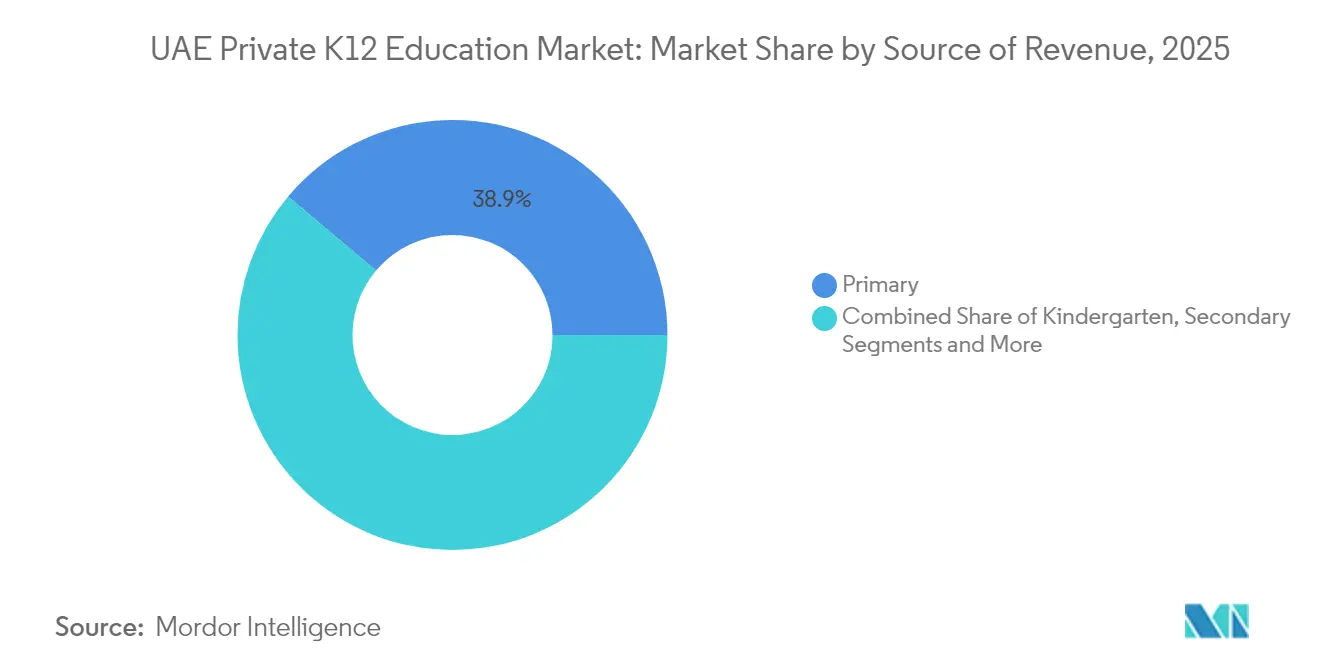
Early Years Drive Growth MomentumKindergarten and primary schooling dominate revenue streams within the UAE private K-12 education market. In 2025, the primary segment delivered 38.85% revenue share, reflecting its large enrollment base and compulsory nature for most expatriate families. Kindergarten, while smaller, is forecast to generate a 10.88% CAGR between 2026-2031, the fastest among all stages, driven by heightened parental awareness of early childhood learning outcomes. Taaleem Holdings’ acquisition of Kids First Group, securing a 95% stake in nurseries, corroborates institutional conviction in early-years upside. New capacity releases by the Knowledge Fund Establishment added thousands of pre-K seats in 2024, ensuring supply keeps pace with younger expatriate inflows. Employers in fast-growing sectors now factor early childhood education into family relocation packages, reinforcing kindergarten enrollment resilience.
Early-years expansion also benefits from Dubai’s Education 33 emphasis on holistic child development, which prescribes mandated student-teacher ratios that appeal to quality-conscious parents. Operators capture cross-selling opportunities by offering seamless progression from nursery to primary classes on the same campus, boosting lifetime value per student within the UAE private K-12 education market. ESG-driven corporate subsidies focused on female workforce participation further incentivize investment in on-site or partner nurseries. Secondary education retains a 35.05% share as families commit to international diplomas, yet its growth is steadier than the explosive kindergarten trajectory. Intermediary (middle-school) programs occupy 8.28% of revenue and act as a bridge that locks in retention ahead of high-stakes exams. Overall, the mix shift toward younger cohorts positions operators to secure longer enrollment duration and recurring cash flows.

By Curriculum:
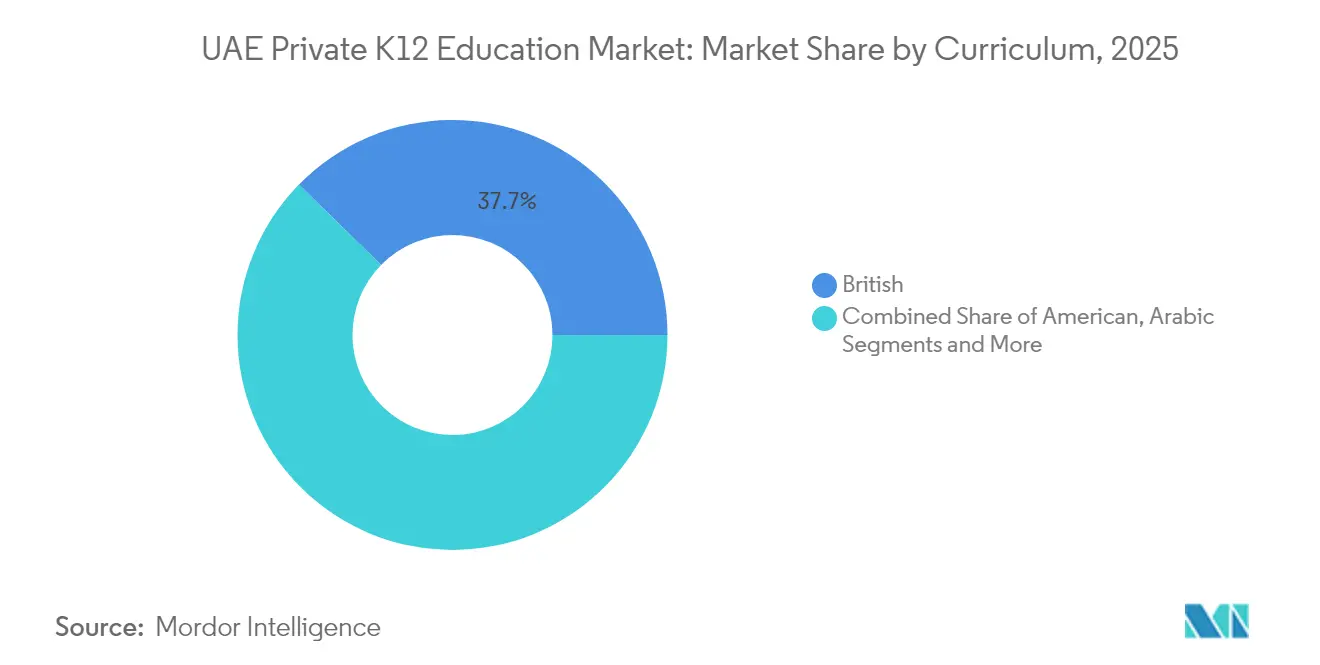
British Dominance Faces CBSE ChallengeThe British model continues to anchor the UAE private K-12 education market with a 37.66% share in 2025, supported by its alignment with UK university admission pathways and a sizable Commonwealth expatriate base. American programs follow with 30.72% share, favored by Emirati nationals seeking U.S. college matriculation. CBSE’s 7.61% forecast CAGR makes it the fastest-growing curriculum amid deepening India-UAE economic ties and an Indian diaspora exceeding 3.5 million. The board’s 107 UAE schools represent its largest overseas footprint, showcasing scalability potential. Operators increasingly launch dual-curriculum campuses to diversify risk and capture multiple demographic segments. French, German and International Baccalaureate programs collectively hold 4.43%, serving niche communities yet adding to the multicultural appeal of the market.
KHDA and ADEK ensure quality parity across curricula, mandating periodic inspections that publish transparent ratings influential in parental decision-making. Recent approvals favor British expansions, with five of the six new Dubai schools for 2024-25 following UK frameworks. Nonetheless, CBSE’s momentum is evident in Sharjah and Northern Emirates where fee sensitivity intersects with high academic rigor. Curriculum choice also influences per-capita fee structures, with British and IB programs commanding premium pricing in the UAE private K-12 education market, whereas CBSE remains competitively priced. Over the medium term, the rivalry between UK and Indian boards is likely to intensify, pushing operators to innovate around ancillary offerings such as global internship pathways and STEM specializations.
By Nationality:
Emirati Enrolment Accelerates Despite Expatriate DominanceExpatriate children accounted for 90.55% of private-school enrolment in 2025, underscoring Dubai and Abu Dhabi’s position as the world’s largest hub for K-12 students following British, Indian, and American curricula. Demand is propelled by long-term Golden Residence visas and a diversified economy that attracts global professionals in technology, finance, and logistics. Private operators opened 10 additional campuses for the 2024-25 academic year, raising Dubai’s enrolment base to 387,441 students across 227 private schools. Federal Decree-Law No. 18 of 2020 obliges every private school to embed Emirati social studies and Arabic-language modules, ensuring cultural preservation even within global syllabi. These policies together deliver a dual promise of international accreditation for expatriate families and national identity reinforcement for locals.
Local enrolment is gaining momentum; Emirati students are projected to expand at a 9.63% CAGR between 2026 and 2031. KHDA’s Education 33 strategy provides merit-based scholarships in premium schools. The Dubai Distinguished Students Programme further lowers tuition barriers for top-performing nationals while mandating Arabic instruction in early years to strengthen language proficiency. Rising household wealth from non-oil sectors enables Emirati families to choose international campuses that were once the preserve of expatriates. Long-term residency paths convert many expatriate households into permanent education consumers, bolstering overall market stability. As a result, bilingual programs blending IB or A-Level credentials with UAE culture are scaling quickly to capture both segments.
Geography Analysis
Dubai accounted for 57.63% of 2025 revenues in the UAE private K-12 education market, buoyed by its role as a global business hub and its well-established KHDA governance model. Abu Dhabi contributed second dominating share, leveraging government and hydrocarbon sector employment to sustain premium-segment growth. Sharjah captured 9.41%, positioning itself as a value-for-money alternative with cultural-heritage cachet. Rapid urbanization in Ajman translated to the country’s highest projected CAGR of 9.97% for 2026-2031, aided by lower real-estate costs that translate into affordable fees. Ras Al Khaimah, Fujairah and Umm Al Quwain collectively offer 7.90% growth potential as tourism and manufacturing projects attract new residents.
Regional policy support reinforces geographic diversification. Dubai’s Education 33 blueprint calls for 100 new schools by 2033, while ADEK’s 39 updated policies enhance transparency and quality across Abu Dhabi campuses. Sharjah’s Masaar development will host a 42,000 sq m Reigate Grammar campus opening in 2027, highlighting northern emirate ambitions to lure international brands. Free-zone structures in Ras Al Khaimah offer long land leases and 100% foreign equity, appealing to operators seeking greenfield opportunities without KHDA oversight. Improved transport corridors shorten commute times, making cross-emirate schooling viable for families. Collectively, these factors could gradually rebalance enrollment share away from Dubai toward emerging hubs, although Dubai is expected to retain clear primacy through the forecast horizon.
Regulatory Landscape
Private K-12 education in the UAE is governed by Federal Decree-Law No. 18 of 2020 on Private Education, with licensing, inspections, and fee approvals delegated to emirate-level authorities. In practice, regulation is decentralized across the Knowledge and Human Development Authority (KHDA) in Dubai, the Department of Education and Knowledge (ADEK) in Abu Dhabi, and the Ministry of Education (MOE) in the Northern Emirates, with each body setting operational requirements, inspection regimes, and approval processes for opening or expanding schools.
Pricing and compliance requirements are tightly managed. Dubai fee adjustments are linked to KHDA mechanisms such as the Education Cost Index, while Abu Dhabi permits exceptional fee increases only under strict ADEK criteria (including demonstrated financial stress and high enrollment thresholds). Recent Dubai compliance tightening includes Administrative Resolution No. 54 of 2025, which introduced updated technical and academic qualification requirements for private-school staff. The compliance grace period ends 1 April 2026 for schools that start their academic year in April, and schools also must implement mandatory national-subject requirements (Arabic, Islamic Education, Social Studies, and Moral Education) within international curricula in line with federal standards.
Value Chain Analysis
The UAE private K-12 value chain starts with regulation and licensing (KHDA, ADEK, MOE, and Sharjah Private Education Authority), which gate campus approvals, inspection ratings, and fee-change permissions that directly shape revenue management. Core operators (for example, GEMS Education, SABIS, Aldar Education, Taaleem, and Innoventures) source inputs across real estate development and fit-out, teacher recruitment and credentialing, curriculum licensing (British, American, IB, CBSE, and Arabic requirements), and student admissions supported by transport, uniforms, catering, and other on-campus services.
Technology and learning-content partners increasingly act as upstream enablers as schools differentiate on digital delivery and analytics while operating under fee caps. EdTech providers such as Alef Education and global hyperscalers and XR partners (including Microsoft, Core42, and EON Reality) supply AI-enabled platforms, cloud infrastructure, and immersive learning tools, while procurement and publishing providers such as e7 Education support scale purchasing for books, exams, and classroom materials. Distribution to end users runs through school chains and standalone campuses, with parent decision-making influenced by regulator-published ratings (notably in Dubai and Abu Dhabi), and with corporate employers and scholarship programs acting as demand-side enablers for premium and mid-fee segments.
Competitive Landscape
The UAE private K–12 education market shows moderate concentration, with the top school groups holding a significant share of total enrollment and revenue. GEMS Education leads the sector and has recently secured major funding to support its expansion plans. SABIS continues to prioritize standardization across its network of schools, while Aldar Education leverages its real estate capabilities to build integrated, mixed-use education campuses. Taaleem Holdings is strengthening its premium market position through new school developments and strategic acquisitions such as Kids First nursery. Innoventures Education is targeting underserved areas in Sharjah and the Northern Emirates to attract more price-sensitive expatriate families.
Strategic differentiation increasingly hinges on technology and teacher-quality metrics. Alef Education’s 10-year contract extension with Abu Dhabi’s authority exemplifies the viability of digital-first learning solutions in public-private contexts. Operators also innovate through hybrid models that combine online platforms with brick-and-mortar facilities to expand catchment without proportionate capex. Fee-cap headwinds accelerate cost-efficiency programs, including shared-services centers and bulk procurement of learning resources. At the same time, premium schools justify higher fees by investing in AI labs, robotics studios and university counseling services that translate into alumni success stories.
Global capital continues to flow into the UAE private K-12 education market. Dubai Holding joined a USD 14.5 billion bid for Nord Anglia in March 2025, signaling appetite to build transcontinental portfolios. Cognita’s acquisition of Al Ain English Speaking School underlines the attractiveness of regional bolt-ons that deliver instant market access. Free-zone policies permitting full foreign ownership and dividend repatriation draw international operators that value regulatory clarity. Looking ahead, M&A is expected to intensify, particularly around mid-market chains that can be scaled via standardized systems and central procurement.
UAE Private K-12 Education Industry Leaders
-
GEMS Education
-
SABIS Education Services
-
Aldar Education
-
Taaleem Holdings
-
Innoventures Education
- *Disclaimer: Major Players sorted in no particular order
UAE Private K-12 Education Market Companies Covered in this Report
- GEMS Education
- SABIS Education
- Aldar Education
- Taaleem Holdings
- Innoventures Education
- Beaconhouse
- Al-Dar Academies
- Ryan International Group
- Bright Learners
- Repton Family of Schools UAE
- Scholars International Group
- Nord Anglia Education UAE
- Leams Education
- Dubai International Academy
- Raffles World Academy
- Delta English School
- Credence High School
- Horizon International School
- Safa British School
- Hartland International School
Market Opportunities and Future Outlook
Regulated pricing is creating room for operators to expand access without relying on annual fee uplifts. In May 2026, KHDA confirmed no private-school fee increase for Dubai for the 2026-27 academic year under a directive from Sheikh Hamdan bin Mohammed, shifting attention to operating levers such as shared services, procurement scale, and blended delivery models. This environment supports opportunity in mid-fee and affordable capacity additions aligned with Dubai Education 33 targets (100 new private schools and 49,000 affordable seats by 2033), as well as in early-years expansions where operators can build longer student lifetime value and improve cohort retention.
Quality assurance and skills agendas are also reshaping investment priorities. KHDA announced the resumption of private-school inspections and ratings for the 2026-27 academic year (June 2026), reinforcing demand for measurable outcomes, compliance-ready governance, and data-driven improvement programs. In Abu Dhabi, ADEK introduced a new private education strategy in June 2026 centered on national identity, wellbeing, future-ready skills, and high-quality learning systems, with AI frameworks and teacher training positioned as explicit components. Combined with ADEK-Aldar collaboration on Emiratisation (May 2026), this creates opportunity for operators and suppliers that can deliver Arabic and national-subject capability, teacher development pipelines, and compliant AI-enabled learning systems across premium and mid-market schools.
Recent Industry Developments in UAE Private K-12 Education Market
- May 2026: Aldar Education and the Abu Dhabi Department of Education and Knowledge (ADEK) signed a strategic partnership to increase UAE National representation across key roles in Aldar-operated schools through a structured talent development roadmap. The initiative formalizes Emiratisation pathways for private operators and elevates workforce planning and training demand across the sector.
- January 2025: GEMS Education announced the launch of the GEMS School of Research and Innovation in Dubai as a technology-forward premium campus concept. The launch reinforced competitive differentiation around advanced learning environments and signaled continued capital deployment toward super-premium offerings.
- December 2024: GEMS Education launched First Schools Management to provide school management services and operational expertise beyond its owned-and-operated campuses. The move broadened its model toward asset-light services and supports replication of UAE-developed operating practices across additional schools.
UAE Private K-12 Education Market Report Scope and Research Methodology
Market Definition and Coverage
This market is measured as the annual revenue generated by private schools in the UAE for delivering K-12 education services, mainly through tuition and mandatory school fees across the academic year.
Scope exclusions: We exclude public schools, short-term tutoring-only centers, and pure online learning platforms that do not operate as licensed K-12 schools.
Segments Covered in This Report
- By Source of Revenue
- Kindergarten
- Primary
- Intermediary
- Secondary
- By Curriculum
- American
- British
- Arabic
- CBSE
- Other Curriculum
- By Nationality
- Expat Students
- Local Students
- By City
- Abu Dhabi
- Dubai
- Sharjah
- Rest of UAE
Data Sources, Market Sizing, and Validation
Desk Research
Desk research is used to build the initial demand pool and keep inputs realistic before we speak to the market. We rely on public education statistics and policy updates from sources such as the UAE Ministry of Education, KHDA and ADEK publications, Federal Competitiveness and Statistics Centre releases, and World Bank population and migration indicators.
To translate enrollment and capacity signals into value, we also review items like school inspection reports, tuition fee frameworks, and curriculum mix disclosures, along with audited annual reports and investor presentations from major school operators. When needed, paid company financials and intelligence subscriptions help us standardize revenue definitions, while a paid patent database is used only to sense longer-term edtech direction, not to size the market. These desk sources are not exhaustive, and we used additional public documents and filings as cross-checks for clarification.
Primary Interviews and Surveys
Primary interviews and surveys are used to pressure-test model assumptions that desk sources do not fully explain, especially around fee trends, discounting behavior, seat utilization, and year-to-year enrollment movement. We speak with school operator leadership, finance and admissions teams, education regulators and advisers, and service partners across the UAE so the assumptions reflect what is actually being observed in admissions cycles and fee approvals.
Distribution of primary research fieldwork respondents
| Company type | Respondent position |
|---|---|
| Top tier: 36% | CXOs: 17% |
| Mid tier: 46% | Functional/Unit leaders: 25% |
| Smaller Players: 18% | Managers: 58% |
Market-Sizing & Forecasting
Market sizing starts with a top-down build where enrollment and school capacity signals are reconstructed by emirate, then converted into revenue using tuition and fee schedules aligned to the academic year cycle. The model is calibrated using checks such as student mix shifts between curricula, average class size and utilization, and the direction of fee approvals over the same period.
To keep totals grounded, we corroborate results with selective bottom-up approximations, including sampled school fee cards multiplied by enrollment bands, channel checks on seat additions, and roll-ups from a subset of operators where disclosure allows. When a school or emirate has partial disclosure, gaps are handled using peer benchmarks on utilization and fee progression, and then adjusted after interview feedback. For forecasting, scenario analysis is used because fee growth and capacity additions can move differently by emirate, and the scenarios are aligned to expert views on expatriate inflows, new school openings, and regulatory fee guidance.
Data Validation & Update Cycle
Validation is done by comparing model outputs against independent signals, such as regulator-reported enrollment trends, school opening pipelines, and published fee frameworks, then reconciling any large variances. When outliers appear, we revisit assumptions, re-check the input series, and re-contact respondents if the variance cannot be explained cleanly.
Before sign-off, a multi-step analyst review is carried out so calculation logic, units, and currency treatment stay consistent across years. Reports are refreshed annually, and interim updates are triggered if major policy changes, large operator transactions, or sudden enrollment shifts materially change the outlook. Right before delivery, a final pass is completed so clients receive the most current view available.
Mordor Intelligence's UAE Private K12 Education Market Size Versus Other Published Estimates
Published market sizes for UAE private K-12 education can differ even when they appear to describe the same space, because the underlying counting logic is not always aligned. Differences usually come from what is treated as private school revenue, the year used as the starting point, and how fee increases are carried forward.
The main gap comes from whether the figure is built from school-level enrollment and fee schedules versus a broader private education bucket that blends K-12 with adjacent learning services. In our approach, Mordor Intelligence counts only regulated private school revenues tied to K-12 delivery during the academic year, and we avoid folding in tutoring-only and non-school online revenues.
Benchmark comparison
| Source | Market Size | Gaps in Research Methodology |
|---|---|---|
| Mordor Intelligence | USD 10.34 B (2025) | |
| Trade Platform A | USD 6.67 B (2024) | Uses an earlier base year and a shorter horizon, and the definition can lean toward reported market pages that may not fully standardize how tuition discounts, fee approvals, and capacity utilization are treated across emirates. |
| Global Advisory B | USD 7.19 B (2024) | Covers private education more broadly, so K-12 may not be isolated cleanly from other private education activities, which can compress or inflate the K-12-only value depending on what is included in the private segment. |
Seen together, the spread is mostly explained by scope and year alignment, not by simple arithmetic. By anchoring the size to enrollment, capacity additions, and fee guidance, and then cross-checking with operator realities, the final number stays traceable to inputs a client can review and repeat over time.
Key Questions Answered in the Report
How large is the UAE private K-12 education market in 2026?
The market is valued at USD 11.45 billion in 2026 and is forecast to reach USD 19.02 billion by 2031.
What is the projected CAGR for UAE private K-12 education between 2026 and 2031?
The compound annual growth rate is expected to be 10.69% over the forecast period.
Which emirate leads in private school revenue?
Dubai leads with 57.63% market share, supported by a robust KHDA regulatory framework and diverse curricula.
Which curriculum is growing fastest in UAE private schools?
The CBSE curriculum shows the strongest momentum with a 7.61% CAGR forecast through 2031.
What factors are driving investment in UAE private schools?
Key drivers include expatriate population growth, Vision 2030 privatization initiatives and rapid EdTech adoption.
How concentrated is the competitive landscape?
The top five operators control about 50% of revenue, giving the market a moderate concentration score of 6.