
Market Overview
| Study Period | 2021 - 2031 |
|---|---|
| Forecast Data Period | 2026 - 2031 |
| Base Year Market Size (2025) | USD 1.35 Billion |
| Market Size (2026) | USD 1.48 Billion |
| Market Size (2031) | USD 2.31 Billion |
| Growth Rate (2026 - 2031) | 9.27 % |
| Market Concentration | Medium |
Major Players *Disclaimer: Major Players sorted in no particular order Image © Mordor Intelligence. Reuse requires attribution under CC BY 4.0. | |
Oman Private K-12 Education Market Analysis by Mordor Intelligence
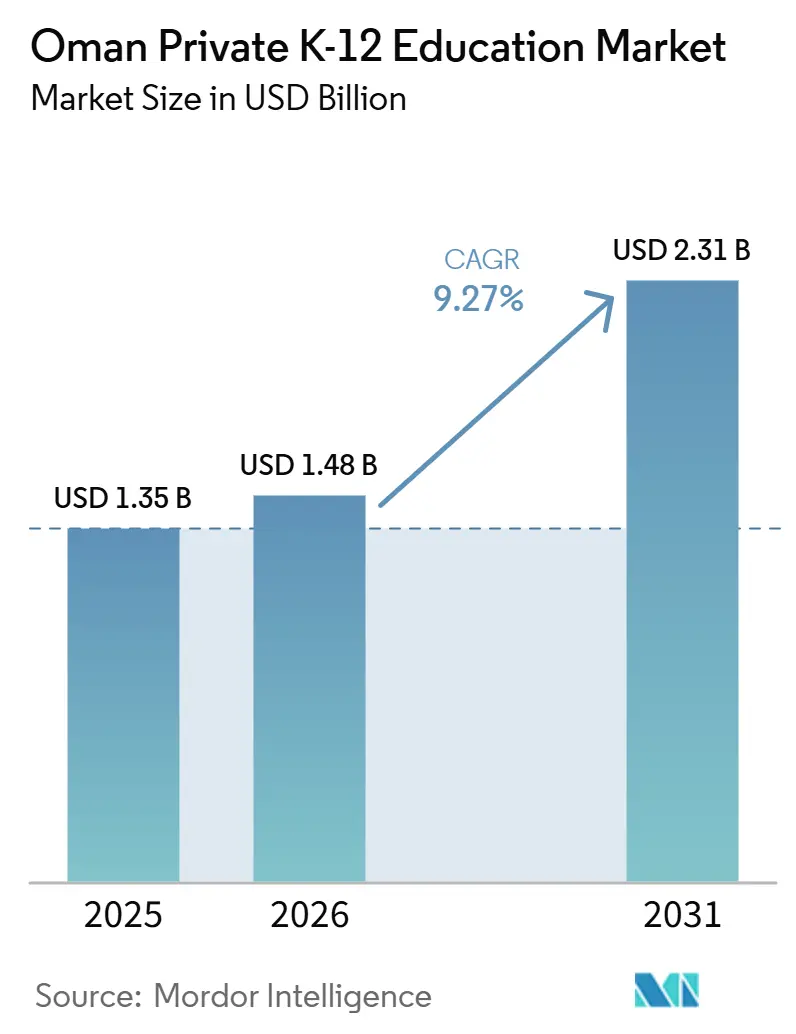
The Oman Private K-12 Education Market size is expected to grow from USD 1.35 billion in 2025 to USD 1.48 billion in 2026 and is forecast to reach USD 2.31 billion by 2031 at 9.27% CAGR over 2026-2031.
Enrollment momentum is sustained by a 10-year Golden Residency pathway that draws high‑net‑worth expatriate families who seek premium British and IB pathways for their children. Vision 2040’s pro‑investment policies and a school infrastructure PPP pipeline shorten time to market for serious operators, which supports both capacity expansion and service quality upgrades. Digital transformation spending at the Ministry of Education is enabling blended learning models that expand access beyond tier‑one operators. Compliance requirements for Omanisation and tuition‑approval protocols are raising operating discipline and pushing mid‑tier providers to scale networks rather than rely on price increases.
Key Report Takeaways
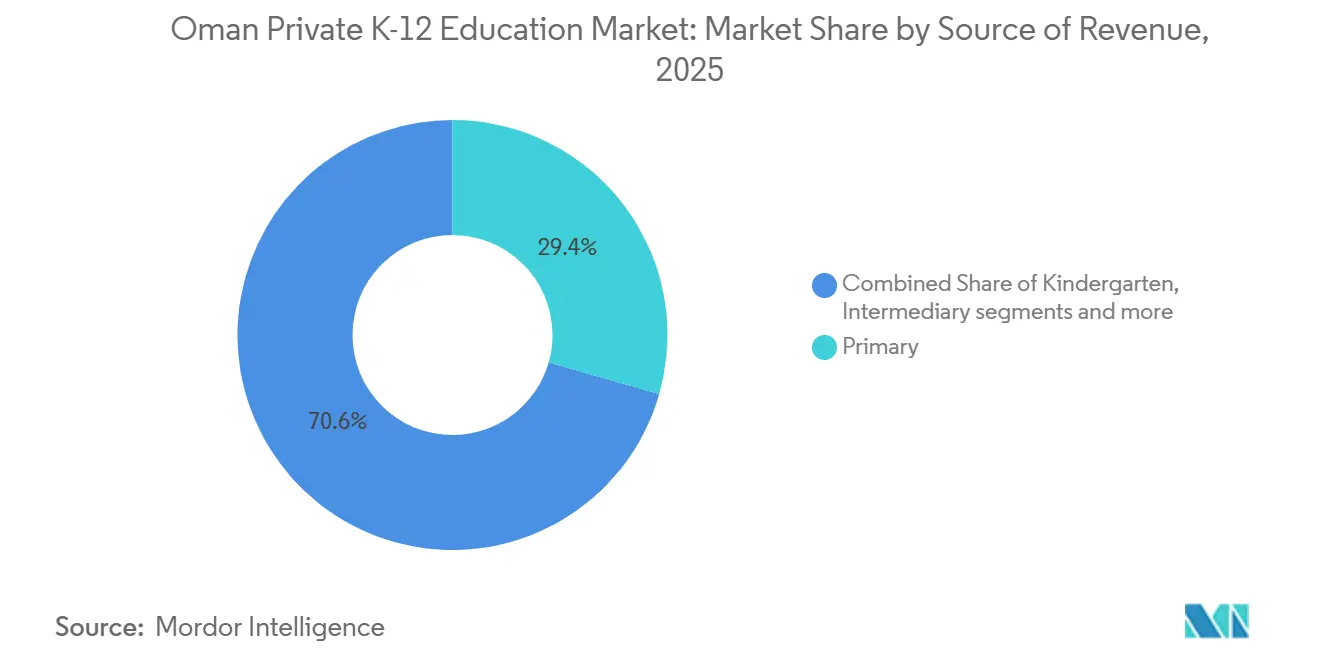
- By source of revenue, primary accounted for 29.43% of the Oman private K-12 education market share in 2025, while secondary is projected to record the fastest growth at a CAGR of 8.23% through 2031, driving the Oman private K-12 education market size.
- By curriculum, British pathways held 38.52% of the Oman private K-12 education market share in 2025 and are projected to expand at the highest CAGR of 11.22% through 2031, contributing to the growth of the Oman private K-12 education market size.
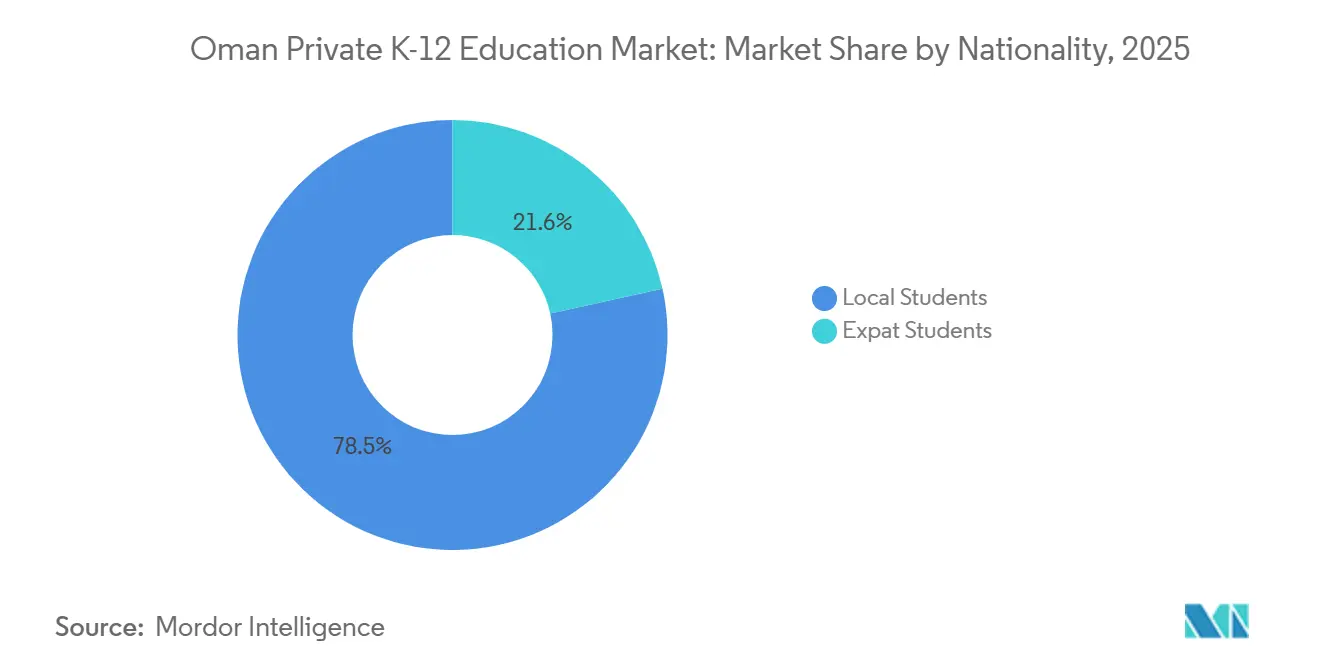
- By nationality, local students accounted for 78.45% of the Oman private K-12 education market share in 2025, while expat students are forecast to register the fastest CAGR of 12.61% through 2031, supporting the expansion of the Oman private K-12 education market size.
- By geography, Muscat held 50.99% of the Oman private K-12 education market share in 2025, while Dhofar is projected to record the fastest growth at a CAGR of 11.01% through 2031, contributing to the Oman private K-12 education market size.
Note: Market size and forecast figures in this report are generated using Mordor Intelligence’s proprietary estimation framework, updated with the latest available data and insights as of January 2026.
Market Trends and Insights
Drivers Impact Analysis of Oman Private K-12 Education Market*
| Driver | (~) % Impact on CAGR Forecast | Geographic Relevance | Impact Timeline |
|---|---|---|---|
| Rising expatriate population & Omani demand for international curricula | 2.8% | Global, with concentrated gains in Muscat, Al Batinah North, and Dhofar governorates | Medium term (2-4 years) |
| Vision 2040 incentives (100% FDI, PPP, land grants) | 1.9% | National, with early gains in Muscat, North Al Batinah, and Duqm SEZ | Long term (≥ 4 years) |
| 42-school PPP pipeline accelerating capacity build-out | 1.2% | Muscat, North Al Batinah, Dhofar | Medium term (2-4 years) |
| Golden-Residency visas expanding the premium-school segment | 0.9% | Global, with spill-over to Muscat, Salalah | Medium term (2-4 years) |
| Omanisation-driven teacher up-skilling lifts perceived quality | 0.5% | National, with early gains in Muscat, North Al Batinah | Medium term (2-4 years) |
| MOE digital-transformation & AI funding enabling blended learning | 0.8% | Global | Short term (≤ 2 years) |
| Source: Mordor Intelligence | |||
Rising Expatriate Population & Omani Demand for International Curricula
Oman’s expatriate population has been rising in step with job creation in non‑oil sectors, which sustains demand for English‑medium instruction and globally recognized qualifications. The World Bank reported steady non‑oil expansion in 2024, a trend that kept professional migration flows healthy and underpinned private K12 enrollments into 2026. This shift is accretive to the Oman Private K12 Education market because expatriate families tend to prioritize curricula that offer A‑levels, IB, or AP credentials recognized by universities worldwide. At the same time, more Omani families are choosing international pathways, which aligns with higher‑education equivalency requirements and the preferences of scholarship committees. These dynamics enlarge the pool of students in premium British and IB programs as well as in high‑performing CBSE networks. The combined effect strengthens enrollment depth across Muscat and fast‑growing nodes in Dhofar and North Al Batinah[1].
Vision 2040 Incentives
Vision 2040 execution continues to support the Oman Private K12 Education market by permitting 100% foreign ownership in education and channeling projects through PPP concessions. The Ministry of Finance has kept a pipeline of school infrastructure PPPs that contract private partners for non‑instructional services under multi‑year availability‑based models. Land grant and usufruct policies reduce site‑acquisition costs for operators willing to develop campuses in underserved wilayats, which helps spread investment beyond Muscat. These features compress go‑to‑market timelines for international operators that can deploy proven curricula and quality systems. As these facilities come online, parents in secondary cities gain options that previously required long commutes or relocation. The policy mix improves both capacity and service standards in the Oman Private K12 Education market[2].
42‑School PPP Pipeline Accelerating Capacity Build‑Out
The Ministry of Finance advanced a multi‑school PPP package that assigns construction, facilities management, and related services to private concessionaires for the public system. By shifting non‑teaching functions to operators under long‑term contracts, the government can focus on staffing and curriculum delivery while ensuring modern infrastructure standards. The PPPs target high‑density corridors such as Muscat, North Al Batinah, and Dhofar, which are also priority catchment areas for private providers. For private schools, these projects validate enrollment density and de‑risk capital planning in neighborhoods where parents already search for international curricula. Availability‑based payments stabilize contractor cash flows, which may serve as a reference for future co‑location or hybrid models with private K12 brands. The approach increases the overall supply of quality seats and complements private capacity in the Oman Private K12 Education market.
Golden‑Residency Visas Expanding the Premium Segment
The 10‑year Golden Residency program launched on August 31, 2025, with a minimum investment of OMR 200,000, equal to USD 520,000 at the prevailing peg, and it extends education and health access to first‑degree family members. This step addresses the uncertainty of shorter work visas and encourages families to settle and enroll children for full program cycles, including IGCSE and IB Diploma years. Premium British and IB schools in Muscat reported heightened inquiries for the 2025/26 intake in line with this policy change. Fee disclosures indicate that top‑tier schools charge USD 11,024 to USD 26,728, which is consistent with the income profiles targeted by Golden Residency holders. As these families relocate, providers also see demand for tutoring, counseling, and enrichment, which broadens revenue streams beyond tuition. The program therefore expands both enrollment volume and ancillary services in the Oman Private K12 Education market.
Restraints Impact Analysis of Oman Private K-12 Education Market*
| Restraint | (~) % Impact on CAGR Forecast | Geographic Relevance | Impact Timeline |
|---|---|---|---|
| Tuition affordability gap vs median household income | -1.4% | Global, with acute pressure in Muscat's middle-income suburbs and Dhofar | Short term (≤ 2 years) |
| Tuition-fee caps & lengthy MOE approvals | -0.8% | National | Medium term (2-4 years) |
| STEM-teacher shortages from Omanisation quotas | -0.5% | National, with concentrated impact in Muscat, North Al Batinah | Medium term (2-4 years) |
| VAT compliance on ancillary revenue streams | -0.3% | Global | Short term (≤ 2 years) |
| Source: Mordor Intelligence | |||
Tuition Affordability Gap Vs Median Household Income
GDP per capita readings can obscure variability in household budgets, and many middle-income families face constraints when annual fees exceed their affordability threshold. Median disposable income for Omani households is around USD 3,120, which illustrates how even mid‑tier schools can be a stretch without subsidies. The Ministry of Education has scholarship mechanisms for Omani students in private schools, but caps tied to public‑school per‑pupil outlays limit eligibility to lower‑fee institutions. Expatriate families without corporate sponsorship also encounter budget limits, particularly where schools rely on ancillary charges for transport, activities, and examinations. Fee schedules at large network schools such as Indian School Muscat, which range from USD 1,940 to USD 2,189, show the tension between accessible pricing and the cost of upgrading laboratories and digital content. This affordability pinch is most visible in urban corridors where demand is strong, but headroom for price increases is narrow.
Tuition‑Fee Caps and Approval Timelines
Tuition adjustments require Ministry of Education approval under the School Education Law, and schools must substantiate requests with audited spending and investment plans. The approvals process has formal timelines that reduce pricing flexibility during sudden cost shocks such as wage adjustments or technology upgrades. Premium operators can supplement revenue with boarding services, examination fees, and facility rentals, but smaller schools lack similar levers. Operators that communicate early with parents and regulators on planned upgrades achieve smoother approvals but still face calendar‑driven constraints. The compliance rhythm encourages multi‑year capital planning and pushes operators to pursue scale economies. Over the medium term, fee‑cap governance keeps the Oman Private K12 Education market focused on value and outcomes rather than price alone.
*Our forecasts treat driver/restraint impacts as directional, not additive. The impact forecasts reflect baseline growth, mix effects, and variable interactions.
Oman Private K-12 Education Market Segment Analysis
By Source of Revenue:
Primary Grades Drive Enrollment VelocityBy source of revenue, primary accounted for 29.43% of the Oman private K-12 education market share in 2025, while secondary is projected to record the fastest growth at a CAGR of 8.23% through 2031, driving the Oman private K-12 education market size. The expansion of early‑years pathways, including the three‑year Balvatika program across Indian Schools, is pushing demand for classrooms, teachers, and materials beginning in April 2025. Network initiatives to embed financial literacy and AI modules from Class 5 also increase parental preference for early entry into private systems that emphasize foundational skills. Kindergarten and middle grades are sustained by urban demand in Muscat and North Al Batinah, where capacity additions trail enrollment needs. Secondary grades generate higher per‑pupil fees due to international examination costs, but their volume lifts more slowly as students track into vocational and technical pathways. This configuration aligns revenue growth with early‑stage enrollment momentum through 2031.
The Oman Private K12 Education industry is adapting staffing and curriculum planning to support the primary cohort’s larger share of total enrollment. Teacher licensing initiatives tighten supply, which results in higher wages in early years and primary stages where demand is strongest. Schools that scale homerooms and specialist blocks while maintaining quality ratios can spread fixed costs across larger cohorts. The Oman Private K12 Education market benefits when networks coordinate procurement and professional development across campuses. Investment in learning resources and classroom technology at this stage supports attainment later in middle and secondary years. These choices help protect value for families in fee‑sensitive segments.

By Curriculum:
British Pathways Dominate, CBSE Scales RapidlyBy curriculum, British pathways held 38.52% of the Oman private K-12 education market share in 2025 and are projected to expand at the highest CAGR of 11.22% through 2031, contributing to the growth of the Oman private K-12 education market size. Brand‑name partnerships and consistent GCSE and A‑level outcomes attract Omani and expatriate families who value UK university articulation. CBSE networks are scaling in line with the Indian expatriate presence and curriculum upgrades that add applied skills from upper primary onward. American‑curriculum schools remain niche but have invested in STEM facilities to sharpen their appeal to North American and GCC families seeking SAT and AP pathways. Arabic‑curriculum bilingual schools serve Omani families that desire English proficiency without premium fees, while niche offerings such as French programs cover embassy and multinational cohorts. The mix supports choice across fee bands and academic preferences.
The Oman Private K12 Education industry is seeing accreditation become a baseline requirement across curricula. External quality assurance under the National System for School Performance Evaluation is standardizing reporting and tightening expectations for teaching, assessment, and student growth. Schools invest in staff development aligned with Cambridge, IB, and CBSE frameworks to maintain consistency across grade bands. As admission and equivalency processes formalize, families consider data on student outcomes rather than relying on brand familiarity alone. This transparency supports fair comparisons across curricula and encourages continuous improvement. The net result is broader access to consistent quality for families across governorates.
By Nationality:
Omani Enrollments Lead, Expat Growth OutpacesBy nationality, local students accounted for 78.45% of the Oman private K-12 education market share in 2025, while expat students are forecast to register the fastest CAGR of 12.61% through 2031, supporting the expansion of the Oman private K-12 education market size. The Oman Private K12 Education market reflects widespread demand among Omani families for bilingual or international programs that strengthen university options. Expatriate inflows heighten demand for British, IB, and CBSE seats in urban centers and logistics hubs. Indian community density sustains CBSE networks, which plan capacity upgrades and feasibility studies in new catchments. Premium British and American schools attract corporate‑sponsored families and Golden Residency holders who are positioned for multi‑year placements. The mix ensures healthy utilization at both premium and mid‑tier price points.
Data governance now matters to cross‑border student mobility and admissions flows. Oman’s Personal Data Protection Law requires explicit consent and safeguards for handling student records, which is central to families transferring between systems and countries. Private schools are aligning parent communications and consent forms with the law to preserve trust. Quality initiatives and teacher‑training programs also elevate the appeal of Omani‑staffed schools to both national and expatriate families. As capacity expands in Dhofar and North Al Batinah, more expatriates can enroll their children closer to workplaces without relocating to Muscat. These elements reinforce a broad‑based growth pattern in the Oman Private K12 Education market.
Geography Analysis
By geography, Muscat held 50.99% of the Oman private K-12 education market share in 2025, while Dhofar is projected to record the fastest growth at a CAGR of 11.01% through 2031, contributing to the Oman private K-12 education market size. North Al Batinah reports a high count of private schools and continued underserved needs in special education and international curricula. Duqm’s special economic zone shows rising student numbers alongside industrial investment and workforce growth. Private providers evaluating new campuses are balancing land and staffing costs with proximity to industrial clusters. Salalah’s development as a logistics and tourism hub is lifting demand for international curricula in Dhofar. These shifts encourage greenfield builds and expansions outside of Muscat.
As transport infrastructure improves, catchments extend to neighborhoods that previously fell outside practical commute times. The public‑school bus PPP that replaces about 5,000 vehicles between 2024 and 2028 also sets safety and service benchmarks relevant to private school transport providers. Investment forums and licensing improvements raise investor familiarity with zoning and approvals in North Al Batinah and other governorates. Schools that create bilingual and international options in secondary cities can address affordability while preserving academic quality. Network operators use shared services to anchor quality standards as they deploy across multiple sites. This approach is improving resilience and reach in the Oman private K12 education market.
Regulatory Landscape
Oman private K-12 schools operate under a centralized framework led by the Ministry of Education (MOE), which licenses institutions, supervises operations, and approves curricula and key changes such as tuition adjustments under the School Education Law issued by Royal Decree 31/2023. Ministerial Decision 30/2023 amended the implementing bylaws for school education, strengthening the documentation and compliance burden around program delivery, staffing, and operational readiness for new schools and expansions.
Quality assurance is formalized through the private school rating and performance evaluation mechanisms, including the Office of Rating Private Schools (established via Ministerial Decision 211/2017) and the national school performance evaluation approach referenced by the Oman Authority for Academic Accreditation and Quality Assurance of Education (OAAAQA). For international schools, MOE program delivery requirements are tied to the right to use the "international" designation, with the potential loss of the title if designated programs are not implemented for two consecutive years, which makes compliance, reporting, and inspection outcomes central to competitive positioning.
Value Chain Analysis
The value chain starts with regulation-led market entry and program design, where private operators define school type and the curriculum pathway (British, IB, American, CBSE/Indian, Arabic, or other) and compile licensing submissions for MOE review and approval. Upstream inputs include campus development (land access, design, construction, and fit-out), curriculum and assessment materials, edtech and learning platforms aligned to blended learning, and human capital (teachers, leaders, and support staff) shaped by Omanisation and licensing expectations.
Delivery and monetization flow through enrollment management, teaching and assessment, student services (transport, activities, counseling, exam administration), and compliance reporting into MOE systems and evaluation frameworks, including the private school rating process. Network operators add shared services (HR, procurement, training, IT, and finance) to improve unit economics and standardize quality across campuses, while third parties participate through facilities management and PPP-linked infrastructure models that influence benchmarks for transport safety and campus standards. Bottlenecks commonly arise at the intersection of approvals (licensing and tuition), specialized teacher availability (notably STEM), and capex-heavy campus expansion timelines in high-demand catchments such as Muscat, North Al Batinah, and Dhofar.
Competitive Landscape
Oman Private K-12 Education Industry Leaders
-
British School Muscat
-
Indian School Muscat
-
American International School of Muscat
-
A’Soud Global School
-
Knowledge Gate International School
- *Disclaimer: Major Players sorted in no particular order

Oman Private K-12 Education Market Companies Covered in this Report
- British School Muscat
- Indian School Muscat
- American International School of Muscat
- ABA Oman International School
- Knowledge Gate International School
- The Sultan’s School
- ABA Oman International School
- International School of Choueifat – Muscat
- Beaconhouse School Muscat
- Al Injaz Private School
- Al Shomoukh International School
- A’Soud Global School Salalah
- A’Soud Global School Duqm
- Muscat International School
- Pakistan School Muscat
- OurPlanet International School
- Al-Seeb International School
- Modern Generation Private School
- Taaleem National Schools (PPP cluster)
Market Opportunities and Future Outlook
White-space is concentrated in capacity and program depth outside Muscat, with Dhofar and North Al Batinah highlighted as growth nodes where families seek international curricula and special education options with shorter commutes. The government-backed school infrastructure PPP pipeline (referenced in the market context as a 42-school package) provides a demand-density signal and a route to modern infrastructure, creating room for private operators to pursue greenfield campuses, grade expansions, and co-located service models that complement public capacity additions.
Operational opportunities also sit in compliance-aligned differentiation: the Office of Rating Private Schools and the broader performance evaluation framework increase visibility of governance, teaching quality, and outcomes, pushing investment toward measurable improvement rather than fee-led competition. On the entry and expansion side, digitized government services such as the Invest Easy portal support licensing and registration workflows for private education entities, reducing administrative friction for established operators scaling networks. Programmatically, blended learning and online subject delivery (supported by MOE digital transformation efforts in the market context) offer a practical lever for expanding advanced-subject availability while managing teacher scarcity within MOE oversight expectations.
Recent Industry Developments in Oman Private K-12 Education Market
- July 2026: British School Muscat began demolition of the former Music Villa and initiated excavation works to prepare the site for a new classroom building (P Block). The move points to a capacity and facilities upgrade program in Muscat, supporting premium operators that compete on campus quality and learning-space availability.
- November 2025: The Board of Directors of Indian Schools Oman announced a 2025-2027 strategic agenda covering major infrastructure projects across multiple Indian Schools (including Muscat, Darsait, Seeb, Sur, and Salalah) and feasibility studies for new campuses in Barka and Sinaw. The plan highlights network-led expansion and modernization in mid-fee segments, with an emphasis on spreading capacity into additional catchments.
- May 2024: The Ministry of Finance continued advancing multi-year PPP structuring for school-related infrastructure and services, aligning with the broader pipeline that includes transport modernization programs running through 2028. This ongoing PPP execution strengthens reference models for private participation in non-instructional services and raises service and safety benchmarks that spill over into private school operations.
Oman Private K-12 Education Market Report Scope and Research Methodology
Market Definition and Coverage
This market is defined as the value of tuition and recurring school fees earned by private K-12 schools operating in Oman, across kindergarten through secondary grades, during the year.
Scope exclusions: It excludes public-school spending, higher education, tutoring and test-prep centers, and one-time donations and building capex that are not billed as school fees.
Segments Covered in This Report
- By Source of Revenue
- Kindergarten
- Primary
- Intermediary
- Secondary
- By Curriculum
- American
- British
- Arabic
- CBSE / Indian
- Other Curriculum
- By Nationality
- Expat Students
- Local Students
- By Geography
- Muscat
- Al Batinah North
- Dhofar
- Other Governorates
Data Sources, Market Sizing, and Validation
Desk Research
For desk research, we start by mapping the private school system in Oman and the factors that drive enrollment and fee levels, then translate that into a usable demand and revenue picture. Public sources help anchor the model on realistic student counts, operator rules, and macro capacity signals that do not shift week to week.
Typical inputs came from sources such as the Oman Ministry of Education releases on private-school licensing and school statistics, the National Centre for Statistics and Information population and household indicators, the UNESCO Institute for Statistics education series, World Bank macro and demographic tables, and IMF country outlook data for household spending direction. We also reviewed school websites and fee schedules where publicly available, along with audited filings or operator notes when available, and we cross-checked major announcements through reputable press. For selected entities, we used paid subscriptions for company financials and intelligence, and for scanning patents where relevant to education services. These examples are not exhaustive, and many other public references were also used to collect, validate, and clarify inputs.
Primary Interviews and Surveys
Primary work was used to pressure-test the desk model with people who see pricing and enrollment decisions up close, including school administrators, education service providers, and parent community representatives. Because this is a single-country market, interviews were kept focused on Oman, with extra attention to Muscat versus other governorates so fee and occupancy assumptions did not become overly centralized.
The respondent mix also helped check whether fee-setting practices and utilization assumptions differed between international-curriculum schools and other private operators.
Distribution of primary research fieldwork respondents
| Company type | Respondent position |
|---|---|
| Top tier: 39% | CXOs: 14% |
| Mid tier: 47% | Functional/Unit leaders: 32% |
| Smaller Players: 14% | Managers: 54% |
Market-Sizing & Forecasting
Sizing is built using a top-down demand pool approach where student population by age, private-school participation, and grade-wise enrollment are used to reconstruct the paying base, which is then converted to value using representative annual fee levels. Those totals are checked with selective bottom-up approximations, like rolling up a sampled set of schools by capacity and published fee bands, then adjusting for occupancy and discounts so the final number stays realistic.
Key inputs include private enrollment share trends, expat versus local student mix, school capacity and utilization signals, annual tuition fee progression by grade level, and changes tied to licensing, curriculum approvals, and teacher qualification requirements. Where fee sheets were missing or not comparable across schools, gaps were handled by using nearby fee bands for similar curricula and grade levels, followed by a sanity check with interview feedback.
For forecasting, we apply scenario analysis around variables that matter most for Oman, mainly enrollment growth in Muscat and other governorates, household affordability, and fee increases linked to staffing and compliance costs. Assumptions are aligned to what interviewees described as achievable, and they are cross-checked against recent macro direction so the growth path does not jump without a clear driver.
Data Validation & Update Cycle
Outputs are validated through multiple checks so totals remain consistent with independent signals, like student base movement, capacity additions, and fee-level ranges observed in the market. When a school count or enrollment indicator creates an outlier jump, we re-check the source series, revisit conversion factors, and, in some cases, re-contact a respondent to confirm whether a structural change occurred.
Before sign-off, the model and narrative go through step-wise analyst review so assumptions, units, and currency handling remain consistent across years. Reports are refreshed annually, with interim updates triggered when material events occur, such as regulation changes, large school openings, or sharp macro shifts. Prior to delivery, we run a fresh pass so clients receive the latest updated view.
Mordor Intelligence's Oman Private K12 Education Market Size Versus Other Published Estimates
Published market values for Oman private K-12 education can differ a lot because each publisher mixes scope and pricing in its own way, even when the topic label looks similar. The biggest differences usually come from whether the estimate is built from enrolled students and fee levels, whether it blends K-12 with broader education services, and how exchange rates and base years are applied.
The main gap comes from what is counted as school revenue, where Mordor Intelligence treats the market as private K-12 school fee value in Oman and avoids folding in tutoring, higher education, or non-recurring capex items that inflate totals. Other differences show up when a model uses a narrow school sample from a single governorate, applies one average fee across all grades, or keeps an older base year without updating for recent enrollment shifts and fee adjustments.
Benchmark comparison
| Source | Market Size | Gaps in Research Methodology |
|---|---|---|
| Mordor Intelligence | USD 2.45 B (2025) | |
| Regional Consultancy A | USD 0.49 B (2026) | Uses a smaller implied revenue pool that appears closer to a subset of international schools and Muscat-weighted enrollments, with limited visibility on grade-wise fee scaling and occupancy adjustments. |
| Industry Publisher B | USD 1.30 B (2025) | Anchors on a single average tuition assumption tied to an OMR-per-student figure, which can undercount premium fee tiers and over-smooth differences by curriculum, grade, and governorate mix. |
Taken together, the spread is mainly explained by scope boundaries and how fee and enrollment averages are applied. By tying the value build to a clear paying student base and realistic fee ranges, the final estimate stays traceable to inputs that can be rechecked and updated year over year.
Key Questions Answered in the Report
What is the current size and growth outlook of the Oman Private K12 Education market?
The Oman Private K12 Education market size was USD 1.48 billion in 2026 and is forecast to reach USD 2.31 billion by 2031 at a 2026-2031 CAGR of 9.27%.
Which curriculum segment leads in Oman’s private K-12 space?
British curriculum providers led with a 38.52% share in 2025 and are projected to grow at a 11.22% CAGR through 2031, supported by exam outcomes and university articulation.
Which region is growing fastest for private K-12 in Oman?
Dhofar is the fastest-growing governorate, forecast at an 11.01% CAGR through 2031, while Muscat remained the largest by share in 2025.
How is policy shaping the Oman Private K12 Education market?
Vision 2040 incentives, a 42-school PPP pipeline, and digital transformation funding by the Ministry of Education are accelerating capacity and modernizing delivery.
How do tuition approvals and affordability affect operators?
Ministry tuition approval processes and fee caps moderate price changes, while median income levels push mid-tier schools to compete on value and scale rather than price.