
Disaster Restoration Services Market Size and Share
Market Overview
| Study Period | 2020 - 2031 |
|---|---|
| Market Size (2026) | USD 46.55 Billion |
| Market Size (2031) | USD 60.43 Billion |
| Growth Rate (2026 - 2031) | 5.36 % |
| Fastest Growing Market | Asia-Pacific |
| Largest Market | North America |
| Market Concentration | Low |
Major Players *Disclaimer: Major Players sorted in no particular order Image © Mordor Intelligence. Reuse requires attribution under CC BY 4.0. | |
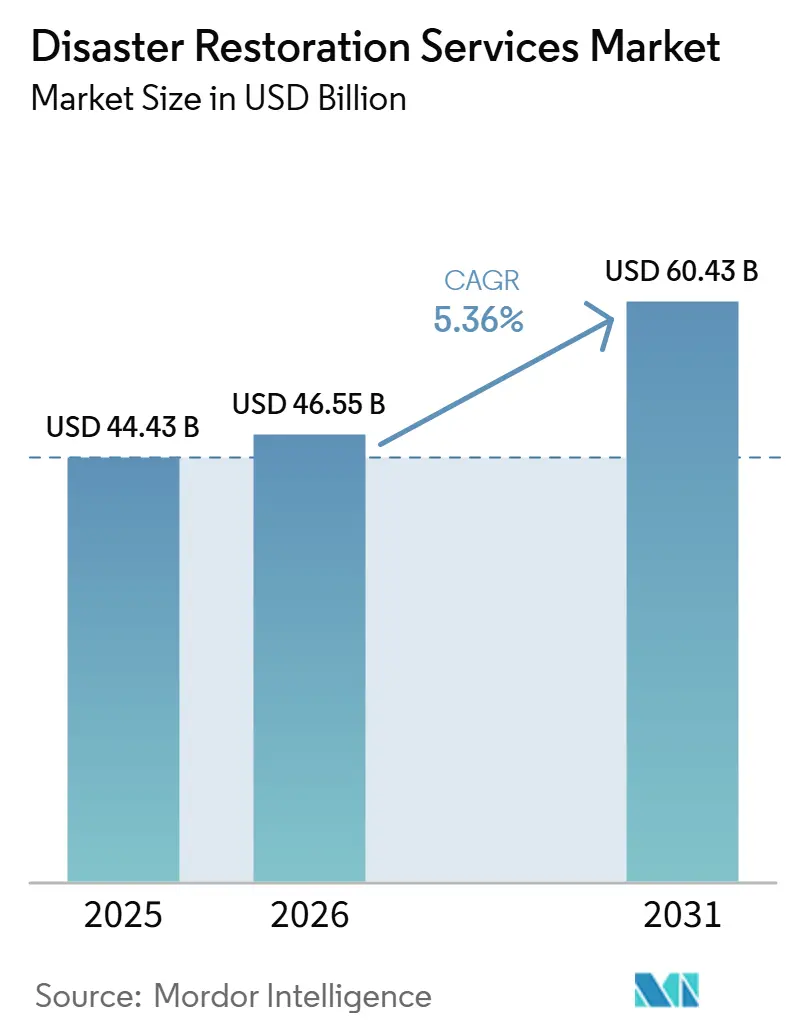
Disaster Restoration Services Market Analysis by Mordor Intelligence
The Disaster Restoration Services Market size is projected to be USD 44.43 billion in 2025, USD 46.55 billion in 2026, and reach USD 60.43 billion by 2031, growing at a CAGR of 5.36% from 2026 to 2031.
The disaster restoration services market is supported by severe weather losses, aging buildings, higher property values, and development in exposed urban areas. Insurance coverage and government recovery programs channel a growing share of repair work to qualified providers after major events. Digital claims tools, sensor-based monitoring, and wider franchise coverage are changing how providers receive and manage work. Larger platforms are improving their coverage, technology, and access to financing, while regional firms remain important in routine local work. Increasing adoption of preventive risk management, including IoT-enabled leak detection and predictive property monitoring, is creating recurring opportunities for mitigation and early-intervention services. Growing consolidation through acquisitions and franchise expansion is strengthening the presence of national restoration networks, enabling standardized service delivery and faster response during large-scale catastrophe events. Labor shortages, rising material costs, and delayed claims payments continue to limit operating capacity and pressure margins.
Key Report Takeaways
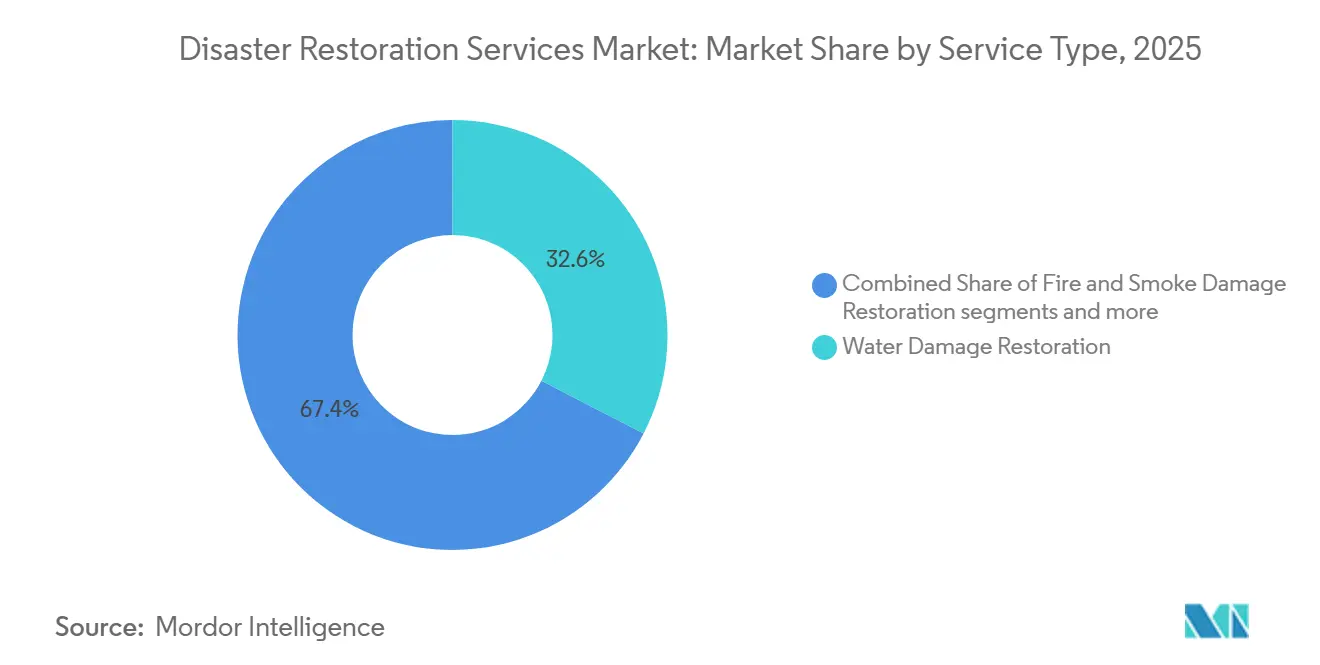
- By service type, water damage restoration held 32.6% of the disaster restoration services market share in 2025, while others are forecast to expand at a 6.9% CAGR through 2031.
- By application, commercial and industrial properties accounted for 53.3% of the disaster restoration services market size in 2025, while residential restoration is projected to grow at a 5.5% CAGR through 2031.
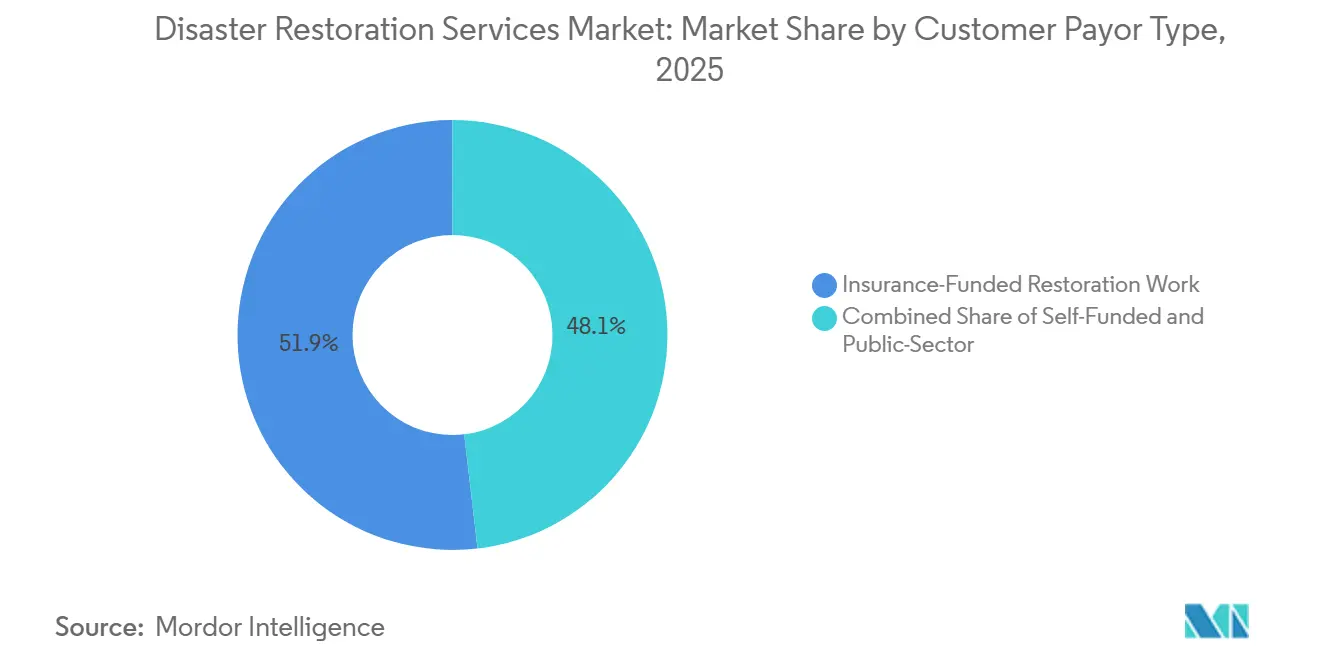
- By customer or payor type, insurance-funded work accounted for 51.9% of revenue in 2025, while public-sector and government-funded work is forecast to grow at a 5.6% CAGR through 2031.
- By geography, North America held 45.2% of revenue in 2025, while Asia-Pacific is forecast to grow at a 6.3% CAGR through 2031.
Note: Market size and forecast figures in this report are generated using Mordor Intelligence’s proprietary estimation framework, updated with the latest available data and insights as of January 2026.
Market Trends and Insights
Drivers Impact Analysis of Disaster Restoration Services Market*
| Driver | (~) % Impact on CAGR Forecast | Geographic Relevance | Impact Timeline |
|---|---|---|---|
| Climate-Driven Increase in Extreme Weather Events | +1.6% | Global, with highest intensity in North America, Asia-Pacific, and coastal Europe | Short term (≤ 2 years) |
| Predictive IoT Sensors Support Proactive Contracts | +1.0% | North America and Europe, with early adoption in Asia-Pacific urban centers | Medium term (2-4 years) |
| Insurance Platform Digitization Accelerates Lead Flow | +0.8% | North America and Europe, expanding to Asia-Pacific, the Middle East, and Africa | Medium term (2-4 years) |
| Franchise Expansion Reaches Underserved Secondary Cities | +0.6% | United States Tier-2 and Tier-3 metropolitan areas and Canadian provincial capitals | Short term (≤ 2 years) |
| ESG Demand for Low-Toxin Restoration Chemicals | +0.4% | Europe and North America, with spillover to the Asia-Pacific | Medium term (2-4 years) |
| Government Resilience Funding for Retrofit Programs | +0.3% | North America, Europe, and the Asia-Pacific national programs | Long term (≥ 4 years) |
| Source: Mordor Intelligence | |||
Climate-Driven Increase in Extreme Weather Events
The rising frequency and cost of major weather events have raised the baseline demand for disaster restoration services. The United States recorded 23 weather and climate disasters costing at least USD 1 billion in 2025, totaling USD 115 billion in combined costs. Severe storms accounted for 91% of the events, and the January 2025 Los Angeles wildfires caused USD 61.2 billion in damage. The 2020 to 2024 annual average was 23 events, compared with a long-term average of 9 events since 1980. FEMA reported USD 14.3 billion in flood insurance payments and survivor grants after Hurricanes Helene and Milton in 2024. These losses encourage insurers to use pre-positioned restoration networks and support the disaster restoration service market through multi-year preferred-vendor arrangements.[1] Institute of Inspection, Cleaning and Restoration Certification, “IICRC Standards,” IICRC, iicrc.org
Predictive IoT Sensors Support Proactive Contracts
Leak detection and environmental monitoring systems are creating service agreements that support the disaster restoration services market before a major loss occurs. Brickeye reported in 2026 that its platform monitored more than 4,500 active projects in more than 20 countries. The company stated that automated valve shutoff and real-time moisture monitoring helped clients reduce water-loss deductibles by up to 50%. Brickeye and Shepherd integrated IoT risk data into autonomous underwriting workflows for United States builder’s risk policies in 2026. The ANSI/IICRC S500 water damage restoration standard supports early detection and pre-cleaning procedures that align with faster sensor-led response. The disaster restoration service market can gain more recurring monitoring and response work during periods without catastrophic losses.[2]U.S. Bureau of Labor Statistics, “Producer Price Index,” U.S. Bureau of Labor Statistics, bls.gov
Insurance Platform Digitization Accelerates Lead Flow
Digital links between claims platforms and restoration contractors support the disaster restoration services market by reducing the time between a loss report and a field assignment. Verisk acquired AccuLynx for USD 2.4 billion in July 2025 to simplify insurer-contractor interactions and enable faster claims processing. HSB began referring Flume’s residential water monitoring service to policyholders in March 2025, connecting property data more closely with insurance workflows. The disaster restoration services market benefits when preferred providers can receive assignments through integrated systems rather than manual referrals. Providers without compatible data connections may be excluded from automated assignment processes used by larger carriers. This process supports work-order concentration among credentialed franchise networks and integrated independent firms.
Franchise Expansion Reaches Underserved Secondary Cities
Franchise development in smaller United States cities is extending the disaster restoration services market beyond the largest metropolitan areas. ServiceMaster Restore opened 25 locations in 2025 across Texas, Florida, Colorado, Ohio, Kentucky, and California. The company plans to add 52 additional locations in 2026 and has prioritized existing owner territories and secondary markets. PuroClean announced expansion activity in Massachusetts, the Cincinnati tri-state area, and California during 2025. ServiceMaster Recovery Management has opened more than 400 locations since designating new sites in Milwaukee, Columbus, and Tacoma in April 2026. Expanding franchise networks are improving emergency response times, increasing local technician availability, and strengthening relationships with insurers and commercial property owners in underserved markets. Standardized operating procedures, centralized training, and shared technology platforms also enable franchise operators to maintain consistent service quality as they scale into new regions. The disaster restoration services market is expanding as formerly undercovered areas gain access to certified, insured providers for water, fire, and mold remediation.
Restraints Impact Analysis of Disaster Restoration Services Market*
| Restraint | (~) % Impact on CAGR Forecast | Geographic Relevance | Impact Timeline |
|---|---|---|---|
| Skilled Labor Shortages Lengthen Response Times | -1.2% | Global, most acute in North America and Oceania | Short term (≤ 2 years) |
| Volatile Materials and Fuel Costs Compress Margins | -1.0% | Global, with the greatest pressure in tariff-exposed North American and European markets | Short term (≤ 2 years) |
| AI-Enabled Prevention Reduces Reactive Revenue | -0.7% | North American and European early-adopter commercial real estate markets | Long term (≥ 4 years) |
| Insurance Claim Backlogs Restrict Cash Flow | -0.5% | North America, including Florida, California, and the Gulf Coast states | Medium term (2-4 years) |
| Source: Mordor Intelligence | |||
Skilled Labor Shortages Lengthen Response Times
The availability of trained technicians remains a major operating constraint for restoration firms. The Bureau of Labor Statistics recorded 292,000 unfilled construction and extraction positions in December 2025, equal to 3.4% of industry jobs. This was 87,000 more openings than in December 2024. The National Association of Home Builders estimated that the broader skilled labor shortage costs residential construction USD 10.8 billion annually. Short staffing delays mobilization and raises wage costs when insurer reimbursement schedules do not keep pace. IICRC certification requirements further narrow the pool, as new hires need specialized training before they can perform certain restoration work. The shortage is particularly pronounced during large-scale catastrophe events, when simultaneous claims create intense competition for qualified restoration crews across affected regions. To address workforce constraints, leading providers are increasing investments in technician training, apprenticeship programs, recruitment incentives, and digital field-management tools that improve labor productivity and resource allocation.[3]Federal Emergency Management Agency, “Recovery Continues After Historic 2024 Hurricane Season,” FEMA, fema.gov
Volatile Materials and Fuel Costs Compress Margins
Higher material and energy costs are putting pressure on restoration providers operating under fixed-insurer agreements. The BLS intermediate-demand index for construction materials reached 178.254 in June 2026, up 4.3% from a year earlier. Copper wire and cable prices were 22.3% higher in June 2026, while softwood lumber prices were 6.2% higher. Roofing asphalt products rose 9.2% from the prior year, and diesel costs were 65.7% higher in June before a partial July correction. Smaller operators face greater pressure because they have less purchasing scale and a limited ability to adjust prices. Long procurement lead times and supply chain disruptions for specialized restoration equipment and construction materials can further delay project completion and increase working capital requirements. Larger restoration networks are better positioned to offset these pressures through centralized procurement, supplier agreements, and greater negotiating leverage, widening the competitive gap with independent firms. These cost conditions can encourage sales or exits by undercapitalized firms, adding to consolidation in the disaster restoration services market.
*Our forecasts treat driver/restraint impacts as directional, not additive. The impact forecasts reflect baseline growth, mix effects, and variable interactions.
Disaster Restoration Services Market Segment Analysis
By Service Type:
Water Damage Restoration Leads While Other Services Grow FasterWater damage restoration accounted for 32.6% of revenue in 2025 and was the largest service category in the disaster restoration services market. Plumbing failures, storm intrusion, and flooding affect both homes and commercial facilities more frequently than fire or biohazard incidents. The ANSI/IICRC S500 standard sets service expectations for professional, insurance-reimbursed water damage work. Certified providers use this framework to demonstrate compliance and define job scopes. Rapid-response capabilities, including 24/7 emergency dispatch and advanced moisture detection equipment, have become key competitive differentiators in this segment, helping reduce secondary property damage and claim costs. Fire and smoke restoration gained attention after the January 2025 Los Angeles wildfires caused USD 61.2 billion in damage.
Others is forecast to grow at a 6.9% CAGR from 2026 to 2031, the highest rate among service categories. This group includes contents restoration, pack-out services, cleaning, and storage. These services can charge higher fees because they involve inventory management and specialized processes. Demand is also increasing as insurers and commercial property owners place greater emphasis on recovering high-value contents and minimizing business interruption following disaster events. Storm and catastrophe work has episodic demand, but rising large-loss events support its longer-term need. Mold remediation, biohazard cleanup, and specialty services remain smaller in scale, but their protocols and methods support premium pricing.



By Application:
Commercial, Industrial & Infrastructure Properties Lead While Residential Work ExpandsCommercial, industrial & infrastructure properties represented 53.3% of revenue in 2025, giving the segment the leading share of the disaster restoration service market. Office buildings, industrial facilities, healthcare institutions, and mixed-use properties generate larger bills per incident. Business interruption costs make rapid restoration especially important for these clients. Large property owners increasingly use master service agreements with restoration networks. Increasing regulatory and insurance requirements for business continuity and disaster recovery planning are encouraging organizations to establish long-term restoration partnerships before loss events occur. ATI Restoration reorganized into West, Central, East, and National Response Services divisions in 2026 to support multi-location commercial customers.
Residential restoration is projected to advance at a 5.5% CAGR through 2031. Growth is linked to franchise expansion in secondary cities, broader flood insurance coverage, and demand from older homes. FEMA provided more than USD 1.7 billion in direct repair grants to hurricane survivors after the 2024 storm season. Nearly 70% of the United States housing stock predates modern building codes, leaving many homes exposed to water, mold, and fire damage. Rising homeowner awareness of mold prevention, indoor air quality, and timely post-disaster remediation is further increasing demand for professional restoration services following both major disasters and localized property damage incidents. This building profile supports demand beyond changes in storm frequency.
By Customer or Payor Type:
Insurance Funding Leads While Public Funding RisesInsurance-funded restoration work accounted for 51.9% of revenue in 2025, making it the primary payment channel in the disaster restoration services market. Preferred-vendor and managed-repair status can bring recurring assignments through an insurer’s claims process. This arrangement reduces the need to find customers one job at a time. It makes consistent documentation, response times, and certified technicians more important. The increasing use of digital claims platforms, AI-assisted damage assessments, and electronic documentation is improving coordination between insurers and restoration contractors, reducing claim processing times. California’s 2026 Senate Bill 878 would impose a 20% interest penalty on delayed insurer payments.
Public-sector and government-funded work is projected to grow at a 5.6% CAGR from 2026 to 2031. FEMA reopened the BRIC program with USD 1 billion for fiscal years 2024 and 2025, including USD 757 million for construction-ready projects. Germany allocated EUR 1.33 billion (USD 1.5 billion) for BBK and THW in 2026, a 68% increase over the prior year. Governments are also increasing investments in community resilience, critical infrastructure restoration, and disaster preparedness programs, creating sustained opportunities for qualified restoration contractors. Self-funded work remains necessary when policy exclusions, deductibles, or lapses leave owners with unreimbursed losses.
Geography Analysis
North America Disaster Restoration Services Market
North America accounted for 45.2% of revenue in 2025, the largest regional share in the disaster restoration services market. The United States has dense franchise coverage, substantial property insurance use, and many federally declared disasters. FEMA committed USD 14.3 billion in flood insurance payments and survivor grants after Hurricanes Helene and Milton in 2024. This funding links major disaster declarations with restoration activity. The region also benefits from a mature ecosystem of restoration contractors, insurance carriers, equipment suppliers, and certified training organizations, enabling rapid response and standardized service delivery. Canada is growing through acquisitions, including First Onsite’s November 2025 purchase of RBT Restoration by Trades in Kelowna, British Columbia.
Europe Disaster Restoration Services Market
Europe remains at an earlier stage of formal restoration service development, although public spending is building demand. Germany announced a EUR 10 billion (USD 11.3 billion) civil protection investment package through 2029 in May 2026. The package included EUR 1.33 billion (USD 1.5 billion) for BBK and THW in 2026. The United Kingdom, Germany, and France are the core European markets. Germany’s older residential stock and flood exposure create conditions similar to those in North America. Stricter building sustainability standards and climate adaptation policies are encouraging investment in resilient reconstruction and professional restoration services across the region.
APAC, South America and MEA Disaster Restoration Services Market
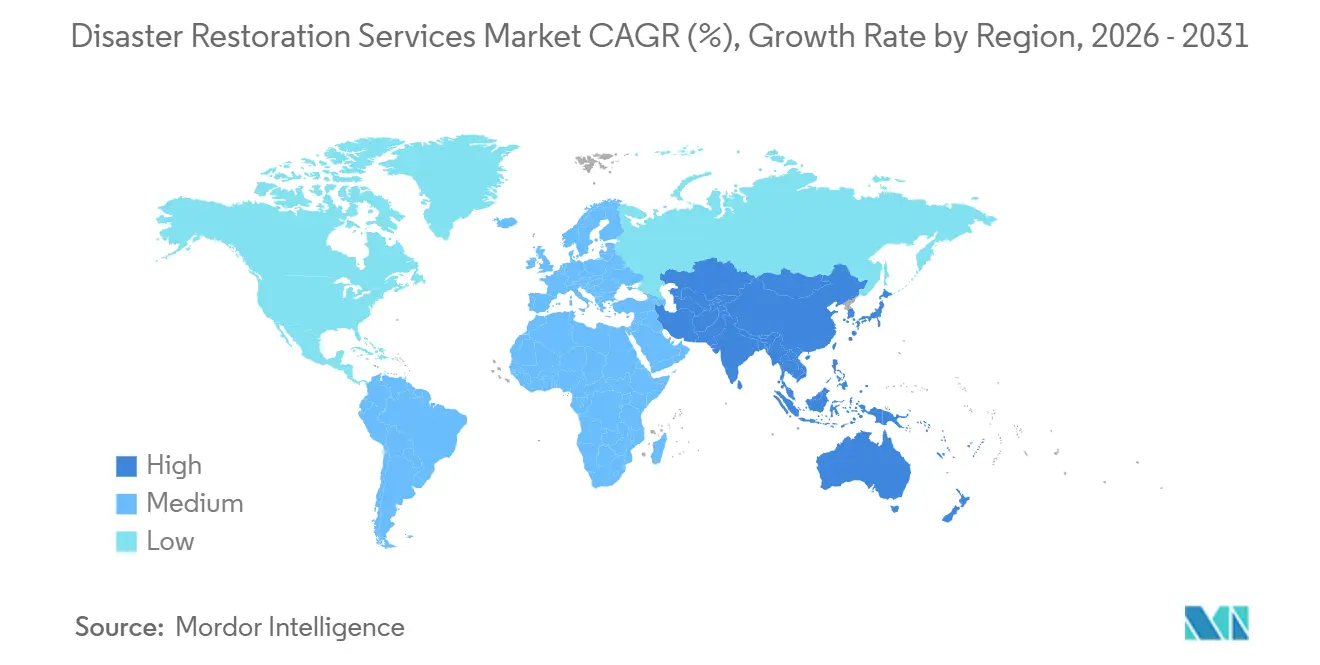
Asia-Pacific is projected to grow at a 6.3% CAGR through 2031, the fastest regional rate in the disaster restoration services market. Insurance penetration, middle-class property ownership, and resilience investment are increasing from lower bases than in mature regions. Japan’s National Resilience Promotion Plan supports demand for professional remediation and recovery capacity. China and India offer long-term potential as urban property density rises. Australia has an established commercial structure because of recurring bushfires, cyclones, and floods. Indonesia, the Philippines, and Vietnam are adding property value faster than their local capacity can support. Increasing public and private investment in disaster resilience, smart infrastructure, and emergency response capabilities is expected to accelerate adoption of professional restoration services across emerging Asia-Pacific markets. South America remains developing, while the Middle East and Africa have demand concentrated in the United Arab Emirates, Saudi Arabia, South Africa, and Turkey.

Competitive Landscape
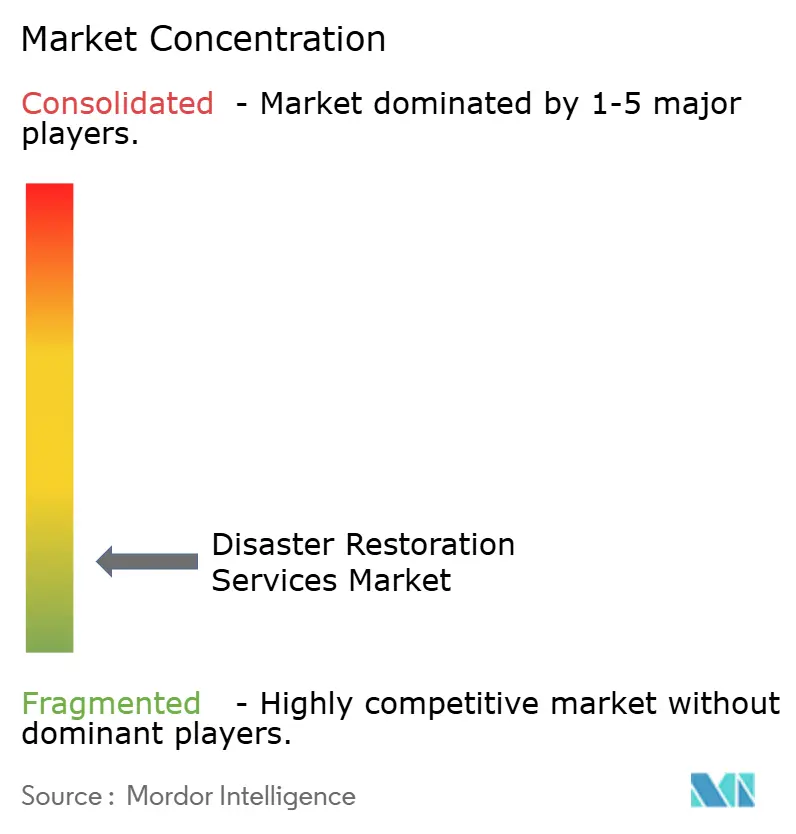
The disaster restoration services market is fragmented, with several national franchise platforms and private-equity-backed firms competing alongside many regional operators. Larger providers focus on commercial losses and catastrophe response, while smaller firms often handle recurring residential events. ATI Restoration completed 18 acquisitions between 2020 and 2024. BMS CAT made its 12th acquisition in four years when it bought Legacy Services Corp. in Minnesota. First Onsite entered Kelowna through an acquisition in November 2025 rather than a new build. Franchise-based operating models continue to expand geographic reach while enabling standardized training, centralized marketing, and consistent service quality across local markets.
Private investment has supported technology, training, and broader geographic coverage across the disaster restoration services market. Blackstone continues to back Servpro, while Roark Capital supports the ServiceMaster Restore platform through its Neighborly platform. IICRC credentials are often required for insurance-preferred programs. This makes it harder for untrained firms to participate in higher-value carrier work. Providers also differentiate through biohazard, contents restoration, and decontamination services. Strategic partnerships with insurers, property managers, and commercial facility operators are increasingly becoming a key source of recurring revenue and long-term contract opportunities.
Technology integration is becoming more important as insurers and contractors share claims data. Verisk’s July 2025 acquisition of AccuLynx highlighted the value of the technology layer between insurers and contractors. Providers that document response times, repair cycles, and customer outcomes can meet data-driven performance expectations. Prevention tools may reduce reactive work but can create monitoring and rapid-response contracts. ESG requirements and carrier platform access favor firms that can demonstrate compliant processes at scale. Growing adoption of AI-powered estimating, remote damage assessment, and workflow automation is expected to improve operational efficiency while strengthening insurer-contractor collaboration.
Disaster Restoration Services Industry Leaders
SERVPRO Industries LLC
BELFOR Holdings, Inc.
Polygon group
First Service
ServiceMaster Restore
PUROSYSTEMS
- *Disclaimer: Major Players sorted in no particular order
Disaster Restoration Services Market Companies Covered in this Report
- BELFOR Holdings Inc.
- Servpro Industries LLC
- Polygon Group
- ServiceMaster Restore
- Paul Davis Restoration
- Rainbow International Restoration
- PuroClean
- First OnSite Restoration
- DKI Services
- BlueSky Restoration
- ATI Restoration
- BMS CAT
- Steamatic
- Restoration
- Duraclean Corporation
- Bio-One Inc.
- Restoration 1
- RestorePro Reconstruction
- Signal Restoration Services
- United Water Restoration Group
- COIT Services
- Johns Lyng Group Limited

Recent Industry Developments in Disaster Restoration Services Market
- June 2026: PuroClean recently announced an expansion in El Paso to address growing demand for restoration services driven by weather-related property damage in West Texas.
- April 2026: FirstService Corporation completed two acquisitions that strengthened its company-owned operations in the Paul Davis Restoration and California Closets business lines. The acquisition of the Paul Davis franchise in the Cleveland and Akron, Ohio, markets enabled the company to provide mitigation, reconstruction, and mold remediation services while retaining the existing leadership team.
- August 2025: The “DKI PROs” update indicated that Restotech had been incorporated into DKI’s professional network branding, reflecting its long-standing membership and role as a local provider within a larger restoration organization. DKI Restotech was a family-owned restoration company in Southern California that had served Los Angeles and Orange County since 1980 and operated as part of the wider DKI network of restoration professionals. The company addressed water, fire, mold, storm, sewage, and biohazard-related property damage for homes and businesses, with services covering inspection, mitigation, and reconstruction.


Global Disaster Restoration Services Market Report Scope
The Disaster Restoration Services Market Report is Segmented by Service Type (Water Damage Restoration, Fire and Smoke Damage Restoration, Mold Remediation, and more), by Application (Residential and Commercial, Industrial & Infrastructure ), by Region (North America, South America, Europe, Asia-Pacific, and Middle East and Africa). The Report Offers Market Size and Forecast in Terms of Value (USD) for all the Above Segments.
| Water Damage Restoration (Drying/Dehumidification, Sewage Backup) |
| Fire & Smoke Damage Restoration |
| Mold Remediation |
| Storm / Catastrophe Restoration (Wind, Hail, Flood Response, Large-Loss) |
| Biohazard & Trauma Cleanup (Crime Scene, Unattended Death, Infectious Cleanup) |
| Specialty Services |
| Others (Contents Restoration, Pack-Out, Cleaning, Storage, etc.) |
| Residential |
| Commercial, Industrial & Infrastructure |
| Insurance-funded Restoration Work |
| Self-funded / Direct-pay Restoration Work |
| Public-sector / Government-funded Restoration Work |
| North America | United States |
| Canada | |
| Mexico | |
| South America | Brazil |
| Argentina | |
| Rest of South America | |
| Europe | United Kingdom |
| Germany | |
| France | |
| Italy | |
| Spain | |
| Rest of Europe | |
| Asia-Pacific | China |
| India | |
| Japan | |
| Australia | |
| ASEAN (Indonesia, Thailand, Philippines, Malaysia, Vietnam) | |
| Rest of Asia-Pacific | |
| Middle East and Africa | Saudi Arabia |
| United Arab Emirates | |
| Turkey | |
| South Africa | |
| Rest of Middle East and Africa |
| By Service Type | Water Damage Restoration (Drying/Dehumidification, Sewage Backup) | |
| Fire & Smoke Damage Restoration | ||
| Mold Remediation | ||
| Storm / Catastrophe Restoration (Wind, Hail, Flood Response, Large-Loss) | ||
| Biohazard & Trauma Cleanup (Crime Scene, Unattended Death, Infectious Cleanup) | ||
| Specialty Services | ||
| Others (Contents Restoration, Pack-Out, Cleaning, Storage, etc.) | ||
| By Application | Residential | |
| Commercial, Industrial & Infrastructure | ||
| By Customer/Payor Type | Insurance-funded Restoration Work | |
| Self-funded / Direct-pay Restoration Work | ||
| Public-sector / Government-funded Restoration Work | ||
| By Geography | North America | United States |
| Canada | ||
| Mexico | ||
| South America | Brazil | |
| Argentina | ||
| Rest of South America | ||
| Europe | United Kingdom | |
| Germany | ||
| France | ||
| Italy | ||
| Spain | ||
| Rest of Europe | ||
| Asia-Pacific | China | |
| India | ||
| Japan | ||
| Australia | ||
| ASEAN (Indonesia, Thailand, Philippines, Malaysia, Vietnam) | ||
| Rest of Asia-Pacific | ||
| Middle East and Africa | Saudi Arabia | |
| United Arab Emirates | ||
| Turkey | ||
| South Africa | ||
| Rest of Middle East and Africa | ||


Key Questions Answered in the Report
How large is the disaster restoration services market in 2026?
The disaster restoration services market is valued at USD 46.55 billion in 2026 and is forecast to reach USD 60.43 billion by 2031 at a 5.36% CAGR. Growth is tied to property losses, insurance workflows, and broader provider coverage.
What is driving growth in disaster restoration services?
Severe weather losses, aging buildings, higher insured property values, insurance funding, digital claims systems, and wider franchise coverage support demand. These factors increase repair needs while improving qualified providers' ability to receive assignments.
Which restoration service has the largest revenue position?
Water damage restoration led service revenue with 32.6% in 2025. Plumbing failures, flooding, and storm intrusion affect a broad set of homes, offices, and industrial facilities, sustaining its leading position.
Which customer group pays for most restoration work?
Insurance-funded work was the leading payor channel, representing 51.9% of revenue in 2025. Preferred-provider programs can direct recurring claims to firms that meet carrier service and documentation requirements.
Which region is growing fastest for restoration services?
Asia-Pacific is forecast to grow at a 6.30% CAGR through 2031. Increasing property ownership, insurance use, resilience investment, and gaps in formal local capacity support this higher regional growth rate.
What are the main operating challenges for restoration providers?
Firms face shortages of trained technicians, higher material and fuel costs, delayed insurance payments, and insurer technology requirements. These conditions can lengthen response times, reduce margins, and favor larger providers with stronger cash reserves.
Page last updated on:


 Your data is secure and never sold or shared.


