
Market Overview
| Study Period | 2020 - 2031 |
|---|---|
| Forecast Data Period | 2026 - 2031 |
| Base Year Market Size (2025) | USD 70.08 Billion |
| Market Size (2026) | USD 74.32 Billion |
| Market Size (2031) | USD 99.73 Billion |
| Growth Rate (2026 - 2031) | 6.05 % |
| Market Concentration | High |
Major Players *Disclaimer: Major Players sorted in no particular order Image © Mordor Intelligence. Reuse requires attribution under CC BY 4.0. | |
Europe Auditing Services Market Analysis by Mordor Intelligence
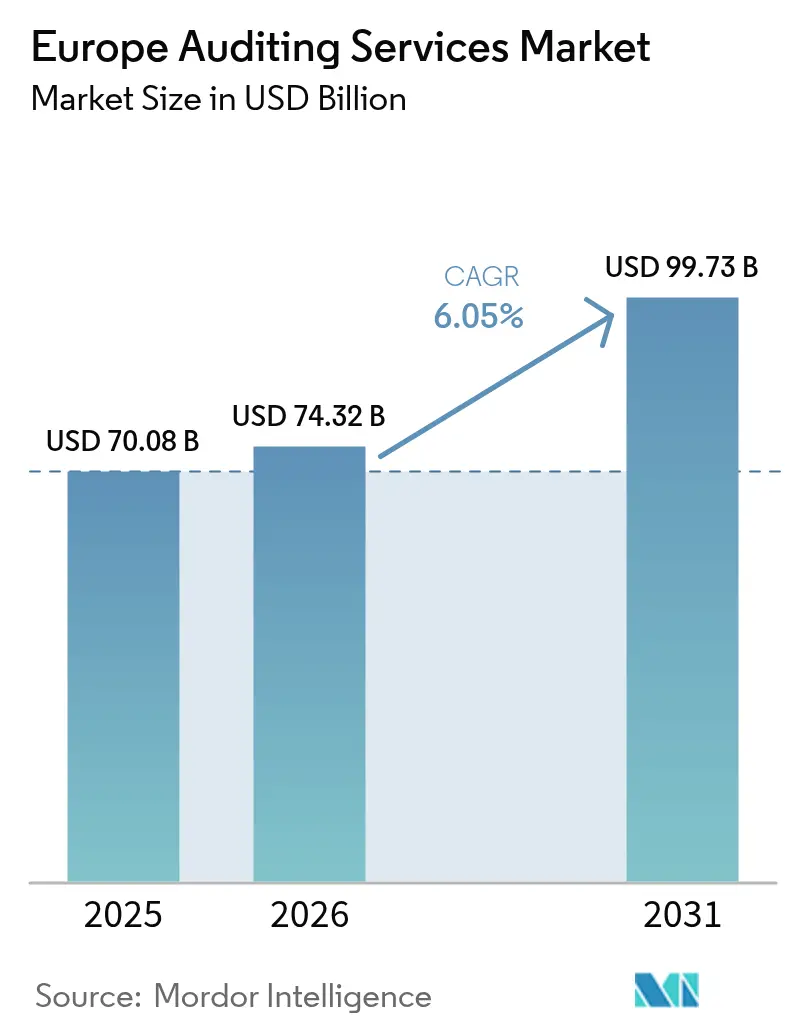
Europe auditing services market size in 2026 is estimated at USD 74.32 billion, growing from 2025 value of USD 70.08 billion with 2031 projections showing USD 99.73 billion, growing at 6.05% CAGR over 2026-2031. Mandatory rotation rules, real-time assurance adoption, and ESG-linked assurance mandates are the strongest drivers shaping the European auditing services market. Accelerating automation of compliance tasks frees auditors to focus on judgment-based procedures, while AI-enabled anomaly detection expands population testing and improves fraud detection accuracy. Digital-first small and mid-sized businesses are surpassing statutory audit thresholds, further enlarging the European auditing services market as these companies require their first external audit engagements. Simultaneously, information-system audit demand is rising because regulators now view cyber resilience as an intrinsic aspect of financial reporting integrity. The European auditing services market is also benefiting from the Corporate Sustainability Reporting Directive, which opens entirely new assurance revenue streams related to carbon accounting and social-impact metrics. Overall, firms that fuse proprietary analytics with human expertise are positioned to capture outsized gains, even as talent scarcity and liability inflation temper headline growth.
Key Report Takeaways
- By type, external audit services retained 71.92% of Europe auditing services market share in 2025, while internal audit outsourcing is expanding at an 7.78% CAGR through 2031.
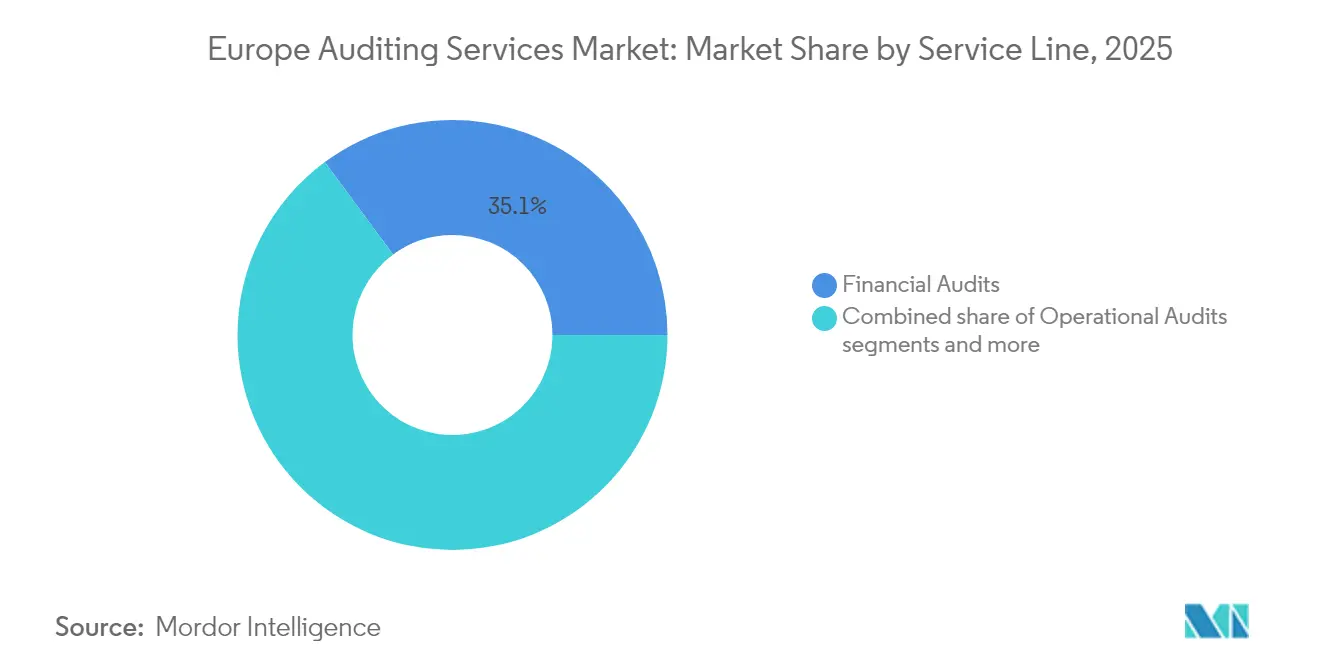
- By service line, financial audits accounted for 35.12% of the Europe auditing services market size in 2025, and information-system audits are forecast to grow at a 13.08% CAGR to 2031.
- By end-user, banking, Financial Services, and Insurance segment held 30.78% of the Europe auditing services market size in 2025; IT & Telecom is projected to increase at a 12.35% CAGR through 2031.
- By geography, the United Kingdom commanded 29.12% Europe auditing services market share in 2025, while the BENELUX region is advancing at an 7.74% CAGR to 2031.
Note: Market size and forecast figures in this report are generated using Mordor Intelligence’s proprietary estimation framework, updated with the latest available data and insights as of 2026.
Market Trends and Insights
Drivers Impact Analysis of Europe Auditing Services Market*
| Driver | (~) % Impact on CAGR Forecast | Geographic Relevance | Impact Timeline |
|---|---|---|---|
| Shift to continuous auditing & real-time assurance solutions | +1.2% | Global, strongest in UK & Germany | Medium term (2-4 years) |
| Mandatory rotation & tendering rules amplify audit churn | +1.8% | Europe-wide, particularly strong in EU core | Long term (≥ 4 years) |
| Digital-first SMBs entering statutory-audit bracket | +0.9% | Global, with early gains in BENELUX, NORDICS | Short term (≤ 2 years) |
| EU Green Deal driving ESG-linked audit demand | +1.4% | Europe-wide, spill-over to UK | Medium term (2-4 years) |
| Cloud-native ERP penetration enables remote audit delivery | +0.8% | Global | Short term (≤ 2 years) |
| AI-powered anomaly detection raises audit scope | +1.1% | Global, strongest in Switzerland, UK | Medium term (2-4 years) |
| Source: Mordor Intelligence | |||
Shift to Continuous Auditing & Real-Time Assurance Solutions
Continuous monitoring platforms allow 100% transaction testing instead of sampling, sharply enhancing fraud-risk coverage across the European auditing services market[1]Grant Thornton, “AI in Audit: European Deployment Report,” Grant Thornton Global, grantthornton.global. . Mid-tier networks that deploy standardized analytics quickly gain credibility among mid-market issuers. Big Four firms are revamping legacy systems, yet partner consensus requirements slow enterprise-wide rollouts, creating competitive white space. Real-time dashboards enable boards to identify control breaches within hours rather than weeks, which strengthens governance effectiveness. Audit fees increasingly incorporate subscription pricing tied to data-stream connections instead of hourly billing. The transition also requires reskilling auditors to interpret algorithmic alerts and to evaluate AI model governance. As a result, technology fluency becomes a core competency across the European auditing services industry.
Mandatory Rotation & Tendering Rules Amplify Audit Churn
Statutory rotation mandates generate predictable retender cycles that inject an estimated EUR 2.3 billion in contestable fees into the European auditing services market[2]Financial Reporting Council, “Audit Quality Review,” FRC, frc.org.uk. . Mid-tier networks with sector specialism and competitive rates capitalize on these openings to penetrate large-cap rosters. However, winning new mandates demands upfront investment in bid teams and onboarding capacity, which strains cash flows when talent costs are rising. Incumbents defend positions by bundling multidisciplinary services and highlighting institutional knowledge accumulated over prior audit cycles. Regulators closely monitor fee negotiations to ensure auditor independence, sometimes disallowing ancillary consulting, which reshapes revenue mixes. Rotation also prompts companies to reassess internal control maturity, indirectly lifting demand for pre-transition readiness reviews. Overall, enforced churn diversifies the European auditing services market yet raises compliance complexity for issuers.
Digital-First SMBs Entering Statutory-Audit Bracket
E-commerce and SaaS scale-ups in the NORDICS and BENELUX are surpassing revenue or headcount thresholds that trigger statutory audit, broadening the European auditing services market [3]Nordic Innovation, “Technology Sector Audit Requirements,” Nordic Innovation, nordicinnovation.org. . Founders favor cloud-native audit portals that integrate directly with ERP data lakes, reducing PBC (prepared-by-client) friction. Audit engagement letters increasingly bundle tax compliance and cyber-risk diagnostics as startups seek one-stop governance solutions. Mid-tier auditors gain an advantage by offering agile workflows, while larger firms compete through brand credibility when companies prepare for IPOs. The influx of first-time audit clients increases the volume of smaller engagements, prompting firms to automate low-complexity tasks for cost efficiency. Over time, scaling SMBs evolve into mid-cap clients, creating lifetime value potential across the European auditing services market. This driver, therefore, supports sustainable revenue expansion beyond macroeconomic cycles.
EU Green Deal Driving ESG-Linked Audit Demand
The Corporate Sustainability Reporting Directive requires limited assurance in 2025, escalating to reasonable assurance by 2028, which injects new service lines into the European auditing services market[4]PwC, “ESG Assurance Services in Europe,” PwC, pwc.com.. Auditors must validate carbon footprints, supply-chain labor practices, and biodiversity impacts, calling for multidisciplinary teams that blend accountants, engineers, and environmental scientists. Big Four firms have built dedicated ESG hubs across 15 European countries, signaling significant investment. Mid-tier networks partner with niche consultancies to fill capability gaps, accelerating M&A activity. Pricing models remain nascent because market participants debate engagement scoping and liability caps for non-financial misstatements. Early-mover issuers that voluntarily seek assurance gain investor trust, setting peer pressure across industries. Over the next decade, ESG validation could rival financial audit revenues within the European auditing services market.
Restraints Impact Analysis of Europe Auditing Services Market*
| Restraint | (~) % Impact on CAGR Forecast | Geographic Relevance | Impact Timeline |
|---|---|---|---|
| Auditor talent crunch and escalating wage inflation | -1.5% | Europe-wide, particularly acute in UK & Germany | Short term (≤ 2 years) |
| Rising liability caps & litigation risk | -0.8% | Europe-wide, with spillover effects from US litigation | Medium term (2-4 years) |
| Blockchain-enabled self-assurance threatens fee pools | -0.3% | Global, early adoption in financial services | Long term (≥ 4 years) |
| SME cost-sensitivity limits advisory cross-sell | -0.6% | Europe-wide, particularly in Southern Europe | Short term (≤ 2 years) |
| Source: Mordor Intelligence | |||
Auditor Talent Crunch and Escalating Wage Inflation
Qualified auditor supply lags demand by double-digit percentages, pushing senior-staff wages up 23% in 2024 and squeezing engagement margins across the European auditing services market. Firms respond with hybrid work models and accelerated promotion pathways, yet these perks sometimes dilute mentoring rigor. Scarcity is most acute in IT audit and ESG assurance, where interdisciplinary expertise is required. Recruitment of overseas professionals faces immigration friction, especially post-Brexit, compounding shortages in the United Kingdom. High attrition also erodes institutional memory, raising the cost of maintaining audit quality controls. Automation offsets some resource gaps, but clients remain cautious when junior teams run critical procedures. Unless training pipelines expand, talent deficits could slow delivery timelines and jeopardize fee recovery across the European auditing services industry.
Rising Liability Caps & Litigation Risk
Professional indemnity premiums have climbed 18% annually since 2024 amid headline audit failures, lifting fixed-cost structures within the European auditing services market. Legislative debates on joint-and-several liability intensify risk perception among insurers, who expand exclusions for technology-related errors. Smaller networks face disproportionate pricing, making it tougher to bid for large-cap audits that require EUR 100 million coverage. Some firms create captive insurance vehicles, but regulators scrutinize self-insurance for solvency adequacy. Higher deductible layers encourage extensive use of forensic tools to pre-empt claims, raising audit execution costs. Meanwhile, clients negotiate clawback clauses that transfer part of litigation exposure back to firms. Unless liability reforms offer balanced protections, expanding risk premiums could curb competitive entry and reinforce concentration in the European auditing services market.
*Our forecasts treat driver/restraint impacts as directional, not additive. The impact forecasts reflect baseline growth, mix effects, and variable interactions.
Europe Auditing Services Market Segment Analysis
By Type:
External Audit Dominance Amid Internal GrowthExternal audit engagements generated 71.92% of 2025 revenue, confirming statutory compliance as the anchor of the European auditing services market. Mandatory filing deadlines and investor pressure ensure relatively inelastic demand, which supports predictable cash flows for audit networks. Nonetheless, internal audit outsourcing is accelerating at an 7.78% CAGR, reflecting board-level appetite for independent assessments of operational controls without staff overhead. Mid-tier firms leverage sector-specific teams to win managed-service contracts from mid-market enterprises that seek scalability. Simultaneously, Big Four incumbents spin out dedicated internal audit units to avoid independence conflicts with external audit clients while capturing incremental wallet share. Technology deployment, such as continuous control monitoring, allows providers to run lean resource models that improve profitability. Consequently, internal audit gains prominence within the European auditing services market as governance expectations widen beyond financial reporting. This convergence also creates cross-referral pathways, as external auditors recommend internal audit enhancements to improve overall assurance ecosystems.
Internal audit growth alters pricing architecture, shifting from time-and-materials to subscription models tied to the number of control tests or business processes covered. Firms that package risk analytics dashboards with quarterly committee briefings secure multi-year contracts that stabilize utilization rates. Meanwhile, external audit fee pressure rises because tender processes emphasize cost competitiveness amid rotation rules. Pairing both services grants providers negotiation leverage, allowing cross-subsidization strategies. Regulators, however, enforce independence safeguards that limit simultaneous provision to the same client, which nudges the Europe auditing services market toward clearer internal-external delineation. Over the forecast horizon, hybrid sourcing models, where companies keep strategic internal audit planning in-house but outsource execution, are likely to expand. This blend maximizes governance depth while containing payroll costs, underlining the complementary growth trajectories of both audit types.




By Service Line:
Financial Audits Lead While Tech Audits SurgeFinancial audits delivered 35.12% of the total 2025 revenues and remain the reputational foundation of the European auditing services market. They enable cross-selling into advisory, tax, and transaction services, reinforcing client stickiness. However, information-system audits are projected to advance at a 13.08% CAGR, outpacing all other service lines as cyber-risk monitoring becomes integral to financial reliability. Regulators emphasize IT general controls and data-integrity validations, compelling auditors to integrate security engineers into field teams. Big Four firms deploy proprietary code-review tools that scan ERP customization layers, while mid-tier networks partner with cybersecurity boutiques for niche expertise. The escalating reliance on cloud architectures extends audit scope to third-party service organizations, increasing engagement complexity.
Compliance audits and operational audits continue to address sector-specific regulations, such as Solvency II in insurance and GMP in pharmaceuticals. Investigation audits, though smaller in volume, command premium fees during fraud crises, boosting margins. Strategy consultancies pressure advisory lines but remain valuable when bundled with assurance mandates. Over time, service-line convergence is expected, as clients request integrated audit opinions covering financial statements, IT controls, and ESG metrics within a single engagement. Such integration necessitates multidomain frameworks, pushing firms to invest in unified data platforms to handle heterogeneous evidence sets. The service-mix evolution thus redefines capability priorities throughout the European auditing services market.
By End-User Industry:
BFSI Leads While Tech AcceleratesThe Banking, Financial Services, and Insurance sector generated 30.78% of audit demand in 2025 because prudential oversight requires extensive assurance on credit risk models and capital adequacy. Complex financial instruments further heighten reliance on valuation specialists, sustaining fee density. Yet IT & Telecom audit expenditure is forecast to climb at a 12.35% CAGR as digital platforms, 5G rollouts, and artificial intelligence systems invite heightened regulatory scrutiny over data privacy and algorithmic fairness. Audit firms must now validate software life-cycles, data-governance frameworks, and ethical-AI controls alongside traditional financial reconciliations. This trend broadens talent requirements within the European auditing services market, blending technologists with CPAs.
Manufacturing entities contribute steady revenue via supply-chain transparency and carbon-footprint verification. Energy & Utilities engagements rise as renewable integration and carbon trading proliferate, demanding audits of power-purchase agreements and emissions registries. Government & Public Sector audits remain sizable but constrained by public-budget cycles, while Healthcare & Life Sciences audits expand modestly amidst clinical-trial digitization. Cross-industry divergence in growth rates compels firms to pursue industry-centric go-to-market strategies rather than monolithic service models. Consequently, resource allocation aligns with sectors undergoing the fastest transformation, reinforcing the structural shift toward technology-intensive engagements across the Europe auditing services market.
Geography Analysis
United Kingdom and Broader Europe Auditing Services Market
United Kingdom maintains 29.12% market share in 2025 despite Brexit-related regulatory divergence, benefiting from London's financial center status, complex corporate structures, and sophisticated audit requirements that command premium fees, while BENELUX emerges as the fastest-growing region at 7.74% CAGR driven by regulatory harmonization and cross-border M&A activity. Germany represents the second-largest market with strong industrial audit demand, complex corporate governance requirements, and substantial mid-market audit opportunities that benefit both Big Four and mid-tier firms. France demonstrates steady growth through corporate governance reforms and ESG reporting requirements that create additional audit scope and advisory opportunities.
BENELUX, Nordics and Broader Europe Auditing Services Market
The BENELUX region's exceptional growth reflects economic integration benefits, with Netherlands serving as a European headquarters location for multinational corporations requiring sophisticated audit services, while Belgium's position as an EU administrative center creates demand for regulatory compliance and government audit services. NORDICS shows solid growth driven by sustainability leadership, technology adoption, and transparent governance practices that create demand for ESG assurance and technology audit services. Spain and Italy represent substantial markets with growth opportunities in mid-market audit services and regulatory compliance verification, while Rest of Europe captures emerging markets in Central and Eastern Europe where economic development drives increasing audit requirements and regulatory sophistication.
Nordics, Southern Europe and CEE Auditing Services Market
NORDIC markets exhibit 7.12% CAGR growth through 2031, catalyzed by technology entrepreneurship and leadership in climate transparency. Sweden and Denmark drive renewable-energy audit demand, while Finland’s gaming industry necessitates IP-valuation expertise. Spain and Italy offer emerging upside linked to EU recovery-fund projects that mandate stringent audit oversight. However, economic volatility and complex labor regulations temper near-term momentum. Rest-of-Europe territories, including Central and Eastern European economies, deliver moderate growth but serve as cost-efficient delivery centers for large networks. Overall, capturing geographic growth within the Europe auditing services market requires balancing local regulatory fluency with pan-European delivery infrastructure.
Regulatory Landscape
The European auditing services market operates under the Statutory Audit Directive (Directive 2006/43/EC) and oversight by national competent authorities, coordinated at EU level through the Committee of European Auditing Oversight Bodies (CEAOB). In November 2025, the CEAOB approved its 2026 Work Plan, prioritizing audit quality, market monitoring, and work linked to international auditing standards, which supports more consistent supervision across Member States.
Sustainability assurance regulation is also expanding near-term scope. Directive (EU) 2026/470, adopted on 24 February 2026, extended the European Commission deadline to adopt EU limited sustainability assurance standards to 1 July 2027 (from 1 October 2026). In parallel, March 2026 CEAOB plenary discussions continued alignment on CSRD assurance approaches. The European Commission further consulted the CEAOB and the European Supervisory Authorities in January 2026 on a review clause that could extend DORA-related requirements to statutory auditors and audit firms, raising cyber and operational resilience expectations for audit delivery.
Value Chain Analysis
The value chain in the European auditing services market starts with EU rule-setting and oversight (audit legislation and the CEAOB coordinating national regulators). It then moves through audit committees and management governance processes that commission audits, and ends with delivery by statutory auditors and audit firms, followed by inspection and remediation cycles driven by oversight findings. As CSRD reporting phases in from 2024 financial years (reports filed in 2025), sustainability assurance is increasingly embedded into financial-audit workflows, increasing reliance on multidisciplinary inputs (data, controls evidence, and domain specialists) alongside conventional accounting evidence.
Technology and talent are the main enabling inputs. Audit execution increasingly depends on secure data access, analytics, and documentation tools, plus specialist staff for IT controls and ESG metrics. Regulatory changes are shaping participation and workflow design as well. Directive (EU) 2026/470 (24 February 2026) extended the timeline for EU limited assurance standards to 1 July 2027, influencing how firms build methodologies during the transition period. Separately, Directive (EU) 2025/794 (14 April 2025) postponed sustainability reporting requirements for certain undertakings by two years, smoothing the demand ramp-up and changing onboarding cadence for new sustainability assurance engagements.
Competitive Landscape
The European auditing services market is highly concentrated, with the Big Four firms dominating the vast majority of audit revenues, indicating a near-monopolistic structure. PwC maintains a leadership position, followed closely by Deloitte, EY, and KPMG. However, competition among these giants is increasingly shaped by capability differentiation rather than a focus on retaining market share. Major investments in AI-driven analytics, ESG capabilities, and blockchain-secured audit documentation reflect this shift. Notable moves include PwC’s launch of a Europe-wide ESG Center of Excellence and Deloitte’s expansion of its proprietary Cortex platform, enabling advanced journal-entry testing.
Mid-tier audit networks, while much smaller in overall market share, are successfully targeting niche areas to win new mandates. Firms like BDO and Grant Thornton appeal to specialized client groups through focused strategies in family-owned enterprises and private equity, respectively. The merger of Mazars and FORVIS has created a larger player capable of challenging the dominance of the Big Four. Baker Tilly’s recent acquisitions in France and Spain highlight a broader trend of consolidation to build scale and fund tech upgrades. Regulatory emphasis on audit quality over firm size has allowed these challengers to compete on effectiveness, subtly diversifying the competitive landscape.
Future competitiveness in the sector is increasingly tied to strategic partnerships and talent innovation. Alliances with cloud providers, cybersecurity experts, and ESG consultants are shaping next-generation audit offerings. Deloitte’s collaboration with Google Cloud supports advanced AI-powered risk tools, while RSM’s work with Microsoft focuses on audit solutions for small and mid-sized businesses. Firms are also intensifying recruitment efforts, offering benefits like tuition-free master’s programs in data science to attract top talent. Growing litigation risks are prompting joint legal defense arrangements, showing that technology, specialization, and talent development are now more critical than sheer market size.
Europe Auditing Services Industry Leaders
PwC
Deloitte
EY
KPMG
BDO
- *Disclaimer: Major Players sorted in no particular order

Europe Auditing Services Market Companies Covered in this Report
- Deloitte
- PwC
- EY
- KPMG
- BDO
- Grant Thornton
- RSM International
- Mazars
- Crowe Global
- Baker Tilly
- PKF International
- Nexia International
- Moore Global
- HLB International
- Kreston Global
- Ecovis
- UHY International
- SMP Europe
- PKF Littlejohn
- MHA MacIntyre Hudson

Market Opportunities and Future Outlook
CSRD-linked assurance is the most direct expansion lane, particularly for providers that can productize limited-assurance engagements for mid-caps and scale delivery across jurisdictions. The February 2026 omnibus changes under Directive (EU) 2026/470 adjusted requirements around who can perform sustainability assurance and moved the Commission deadline for EU limited assurance standards to 1 July 2027, leaving methodologies and tooling in active build-out across firms and professional bodies during the transition window.
Audit delivery models are also shifting toward controlled deployment of AI and automation, which creates space for platform-based evidence management, anomaly detection, and continuous controls testing that can be defended under regulator scrutiny. Concrete signals include the European Court of Auditors launching its 2026-2030 AI strategy to integrate AI into audit processes, and the Netherlands AFM publishing guidance (12 building blocks) for controlled use of auditing tools. The AFM also includes a requirement that GenAI outputs used as audit evidence be verifiable or replicable. These developments raise demand for governance, model documentation, and audit-trail capabilities in tools used by both Big Four and mid-tier networks, while creating differentiation opportunities for firms that can standardize evidence integrity across financial, IT, and sustainability assurance work.
Recent Industry Developments in Europe Auditing Services Market
- July 2026: BDO Ireland and BDO UK completed their merger into a combined BDO LLP entity, with the combination taking effect on 4 July 2026. The integration increases cross-border delivery capacity and deepens the bench for technology and assurance work across the UK and Ireland, supporting larger and more complex audit engagements.
- March 2026: Grant Thornton expanded its Advisors multinational platform in Europe by adding Grant Thornton Denmark. This expansion strengthens the network model for serving mid-market clients with multi-country needs, including internal audit outsourcing and emerging sustainability assurance work.
- July 2024: The UK Financial Reporting Council (FRC) published its annual Tier 1 audit firm inspection results. The findings keep audit quality and remediation programs in focus for major firms, shaping investment priorities in methodology, training, and audit technology across the UK-led portion of the European market.


Europe Auditing Services Market Report Scope and Research Methodology
Market Definition and Coverage
For this study, the Europe auditing services market is defined as revenues earned from audit and assurance work delivered to organizations across Europe, including statutory and non-statutory engagements that test financial reporting, internal controls, and compliance.
Scope exclusions: pure bookkeeping and routine accounting work that does not include an audit or assurance opinion is excluded from the market value.
Segments Covered in This Report
- By Type
- Internal Audit
- External Audit
- By Service Line
- Operational Audits
- Financial Audits
- Compliance Audits
- Other Service Lines (Investigation Audit, Information System Audit, etc)
- By End-User Industry
- BFSI
- Manufacturing
- Government & Public Sector
- Healthcare & Life Sciences
- IT & Telecom
- Energy & Utilities
- Other Industries
- By Geography
- United Kingdom
- Germany
- France
- Spain
- Italy
- BENELUX (Belgium, Netherlands, Luxembourg)
- NORDICS (Denmark, Finland, Iceland, Norway, Sweden)
- Rest of Europe
Data Sources, Market Sizing, and Validation
Desk Research
Desk work starts by mapping what creates audit demand in Europe and how pricing typically moves by country and client type. We used public references such as Eurostat structural business statistics, European Securities and Markets Authority publications, national audit oversight body releases, EU policy pages for CSRD and related reporting rules, and academic papers available via open journals that discuss audit fees and risk drivers.
This is then paired with company annual reports, investor presentations, and press coverage to understand service mix and where growth is being reported. We used a paid subscription for company financials and news intelligence selectively to speed up cross-checks on revenue splits and reported regional exposure, and a patent database was used to scan audit analytics themes that affect delivery efficiency. The desk sources listed here are illustrative only, and we also reviewed other public documents to clarify, validate, and fill gaps.
Primary Interviews and Surveys
We speak with audit partners, finance leaders, compliance heads, and managers at firms and client organizations in Europe. Interviews and surveys test audit demand, fee levels, engagement volumes, staff productivity, technology use, and reporting-rule effects, helping fill country-level data gaps. These findings challenge secondary inputs and support triangulation of the final calculation.
Distribution of primary research fieldwork respondents
| Company type | Respondent position |
|---|---|
| Top tier: 30% | CXOs: 20% |
| Mid tier: 45% | Functional/Unit leaders: 30% |
| Smaller Players: 25% | Managers: 50% |
Market-Sizing & Forecasting
Sizing is built using a top-down approach where business population, audit mandate coverage, and typical fee pools by country are used to reconstruct the total demand value, and then that value is allocated to audit service revenue. To keep the model grounded, we corroborate totals with selective bottom-up approximations like sampled fee benchmarks by entity type, limited supplier roll-ups from public financial disclosures, and channel checks on prevailing hourly rates and engagement complexity.
Key inputs used in the model include the number of active enterprises and listed entities, audit rotation and oversight requirements, CSRD linked assurance adoption timing, average engagement hours by client size, and the observed shift toward IT and controls testing in audits. Where country data is not equally available, gaps are handled by using proxy indicators such as GDP mix, business density, and regulated-sector share, and then adjusted through interview feedback.
For forecasting, scenario analysis is used to reflect different adoption paths for sustainability assurance, staffing constraints, and pricing inflation driven by fee progression. The forward view is then reconciled with expert views on fee progression and workload intensity so the final numbers stay explainable and repeatable.
Data Validation & Update Cycle
Outputs are checked against independent signals such as reported fee pools, listed-company counts, and country-level audit activity trends, and any sharp jumps are reviewed line by line before sign-off. We run variance checks across countries to ensure pricing and penetration assumptions do not drift away from what interviewees described.
Reports are refreshed annually, and interim updates are made when there are material regulatory changes or major shifts in assurance requirements. Before delivery, the latest public updates are re-scanned and key assumptions are re-tested, and then the model is re-locked after a final analyst review.
Mordor Intelligence's Europe Auditing Services Market Size Compared With Other Published Estimates
Published market sizes for Europe auditing services can differ because authors do not always count the same service basket, and they may also use different timing for currency conversion and fee inflation. Differences also show up when one model leans more on broad professional services totals and another rebuilds demand from audit mandates and enterprise counts.
Some estimates expand the scope to include a wider advisory and consulting mix bundled with audit engagements, which can lift the headline number even if pure audit demand is stable. Mordor Intelligence limits the counted value to audit and assurance revenues tied to defined internal and external audit activities in Europe, and it is kept in line using checks like enterprise counts, audit coverage rates, and fee progression validated in interviews.
Benchmark comparison
| Source | Market Size | Gaps in Research Methodology |
|---|---|---|
| Mordor Intelligence | USD 70.08 B (2025) | |
| Global Consultancy A | USD 63.48 B (2025) | Uses a broader Europe split derived from a global total and regional share, and the implied service mix can undercount higher-fee assurance add-ons captured in country-level fee pools. |
| Trade Journal B | USD 68.40 B (2026) | Applies a longer-dated forecast window and uses a different start-year normalization for fee inflation, which can compress near-term size even if the long-run trajectory looks similar. |
Taken together, the spread is mainly explained by what services are bundled into the audit label, plus the year used for fee and currency timing. Our approach stays transparent because each step can be traced back to a small set of demand drivers, and adjustments are only made when cross-checks and interviews point to a clear miss.


Key Questions Answered in the Report
How fast is the Europe auditing services market expected to grow through 2031?
It is projected to expand at a 6.05% CAGR, moving from USD 74.32 billion in 2026 to USD 99.73 billion by 2031.
Which service line is growing quickest in European audit engagements?
Information-system audits are forecast to rise at a 13.08% CAGR because cyber resilience is now integral to financial-reporting integrity.
What segment holds the largest Europe auditing services market share today?
External audit services command 71.92% of revenues owing to statutory compliance demands.
Which end-user vertical is set to post the highest audit-spend growth?
IT & Telecom audit demand is expected to climb at a 12.35% CAGR as regulators tighten oversight of platform companies.
Who are the dominant players in European audit services?
PwC, Deloitte, EY, and KPMG collectively hold 97% of audit revenues, reflecting extreme market concentration.
Why is ESG assurance significant for audit firms?
The Corporate Sustainability Reporting Directive mandates limited assurance from 2025 and reasonable assurance by 2028, creating new revenue streams for firms with sustainability expertise.
Page last updated on:


 Your data is secure and never sold or shared.


