
Photographic Services Market Size and Share
Market Overview
| Study Period | 2020 - 2031 |
|---|---|
| Market Size (2026) | USD 39.21 Billion |
| Market Size (2031) | USD 48.91 Billion |
| Growth Rate (2026 - 2031) | 4.52 % |
| Fastest Growing Market | Asia Pacific |
| Largest Market | North America |
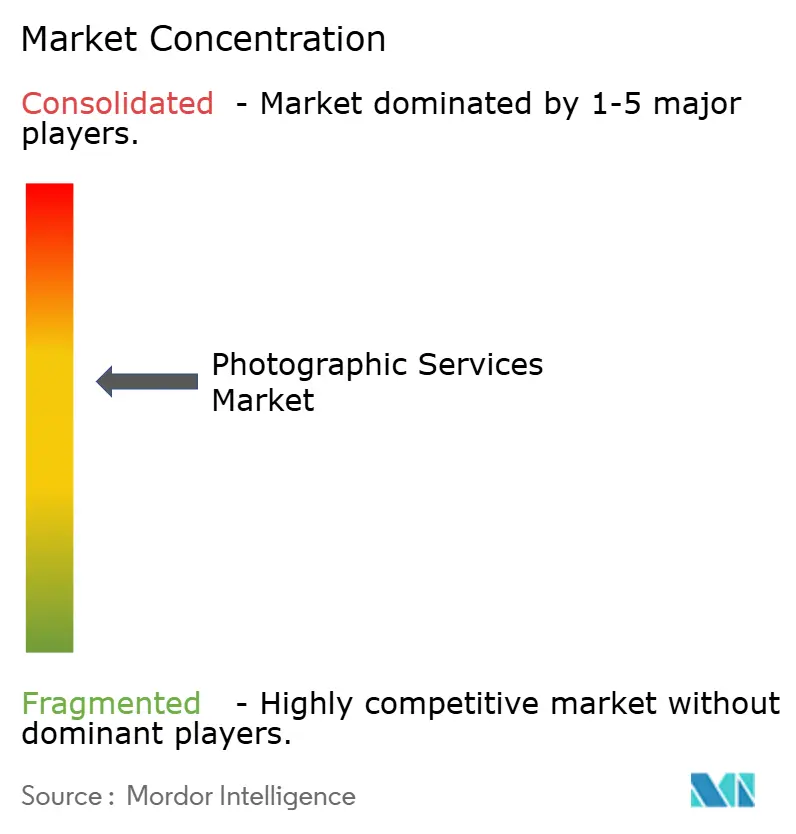
| Market Concentration | Medium |
Major Players *Disclaimer: Major Players sorted in no particular order Image © Mordor Intelligence. Reuse requires attribution under CC BY 4.0. | |
Photographic Services Market Analysis by Mordor Intelligence
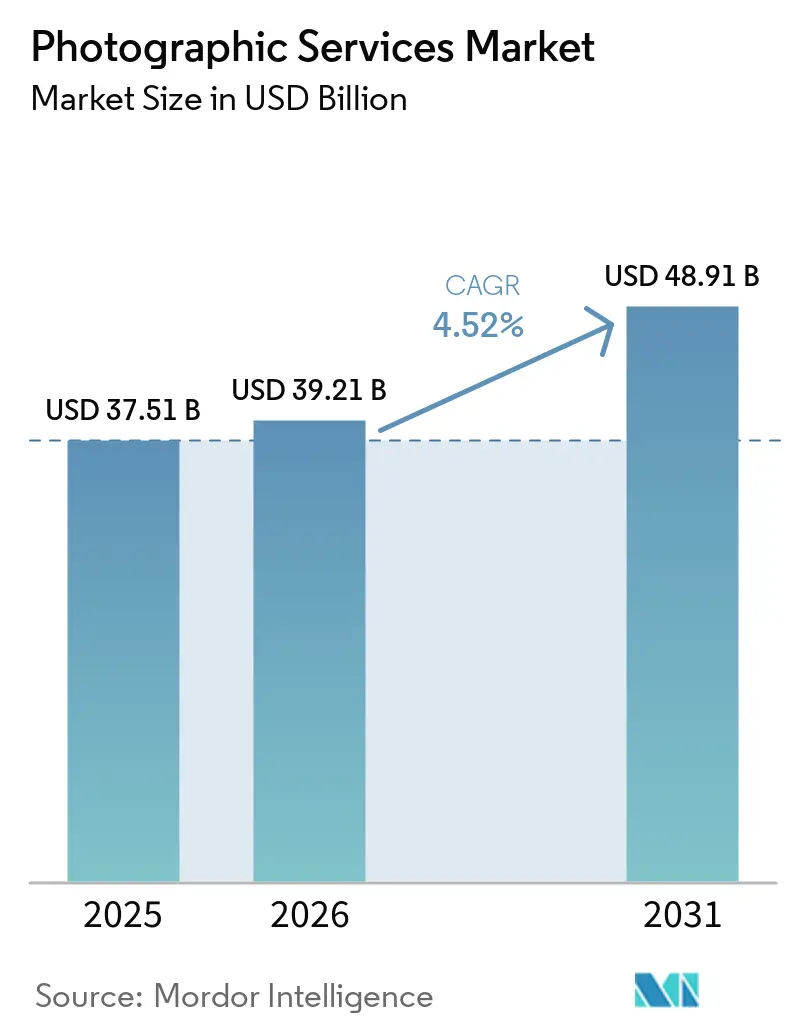
The photography services market size is expected to grow from USD 37.51 billion in 2025 to USD 39.21 billion in 2026 and is forecast to reach USD 48.91 billion by 2031 at 4.52% CAGR over 2026-2031. Healthy growth reflects steady global demand for compelling visual content, underpinned by rapid adoption of subscription-based platforms, increasing corporate spending on brand storytelling, and a widening technology stack that now includes generative AI for editing and asset creation. Consolidation among leading stock libraries is reshaping competitive dynamics, while professional service providers differentiate through specialization, workflow automation, and environmental credentials. Digital channels, particularly online marketplaces, remain the primary revenue engine, yet physical studios retain relevance for high-touch corporate portraiture and premium print output. Regionally, North America retains scale advantages, but Asia-Pacific’s accelerated corporate digitalization positions the region as the long-term volume driver.
Key Report Takeaways
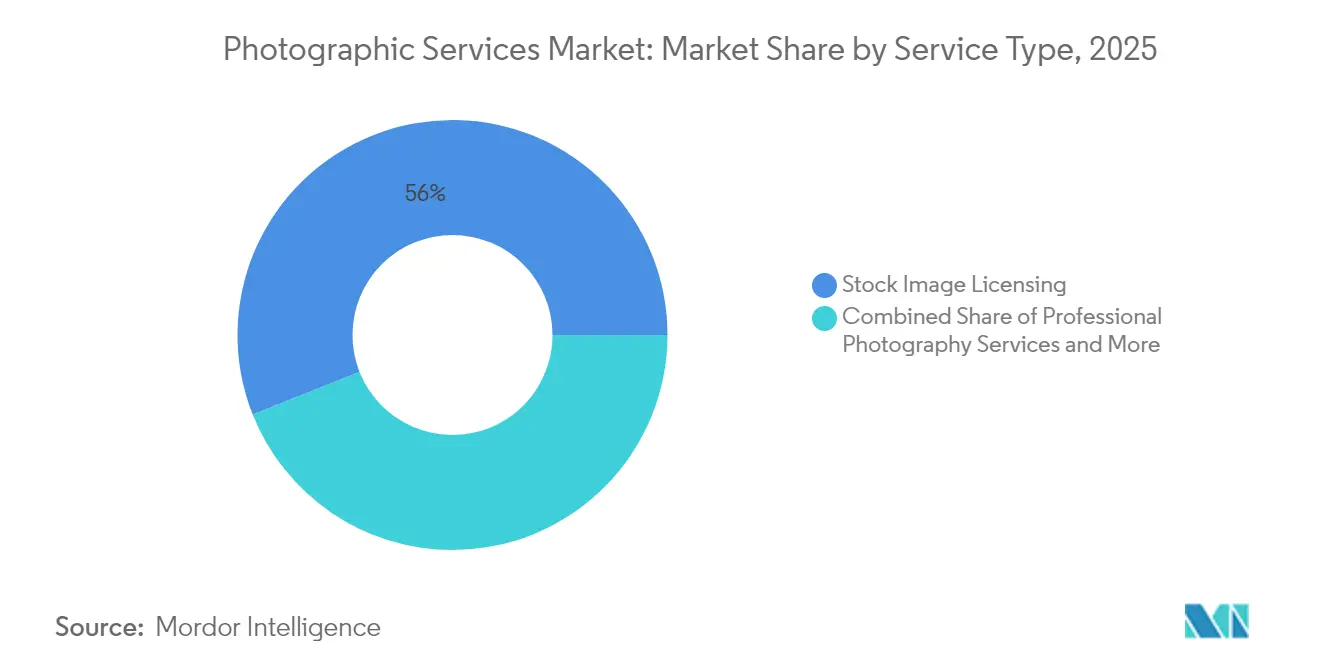
- By service type, Stock Image Licensing led with 56.02% of the photography services market in 2025, while Professional Photography Services is projected to expand at a 6.64% CAGR through 2031.
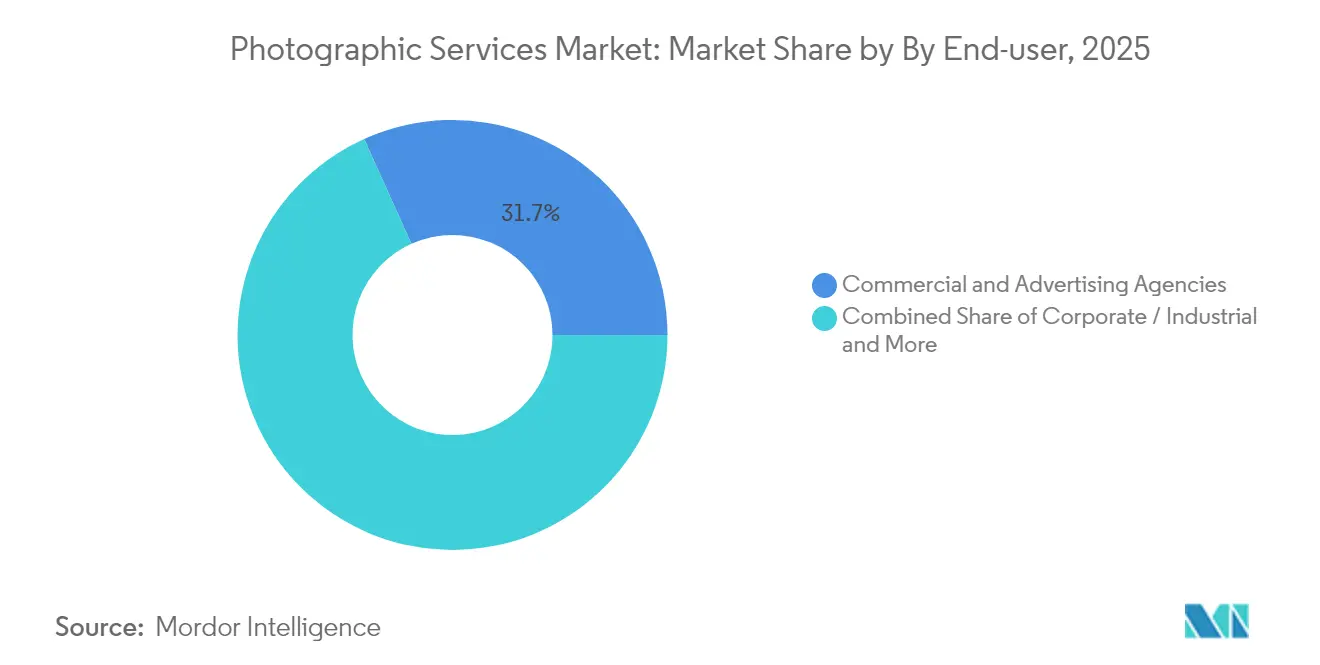
- By end-user, Commercial & Advertising Agencies commanded 31.74% revenue share in 2025; Corporate & Industrial applications are growing fastest at 7.1% CAGR to 2031 in the photography services market.
- By distribution channel, Online Platforms & Marketplaces accounted for 63.67% of the photography services market size in 2025 and are advancing at a 6.47% CAGR.
- By geography, North America contributed 36.18% of revenue in 2025, whereas Asia-Pacific is forecast to grow at 6.19% CAGR through 2031 in the photography services market.
- Top 5 players, such as Getty Images, Shutterstock, Adobe Stock, Alamy, and Shutterfly, hold major market share in 2024.
Note: Market size and forecast figures in this report are generated using Mordor Intelligence’s proprietary estimation framework, updated with the latest available data and insights as of 2026.
Market Trends and Insights
Drivers Impact Analysis of Photographic Services Market*
| Driver | (~) % Impact on CAGR Forecast | Geographic Relevance | Impact Timeline |
|---|---|---|---|
| Rise in digital-first brand campaigns | +1.2% | Global, with early gains in North America & Europe | Short term (≤ 2 years) |
| E-commerce boom driving product imagery demand | +1.8% | Global, strongest in Asia-Pacific & North America | Medium term (2-4 years) |
| Smartphone proliferation & pro-grade enhancement add-ons | +0.9% | Global, particularly emerging markets | Long term (≥ 4 years) |
| Expansion of subscription-based stock platforms | +1.1% | North America & Europe, expanding to APAC | Medium term (2-4 years) |
| Generative-AI training needs for curated photo datasets | +1.3% | Global, concentrated in tech hubs | Short term (≤ 2 years) |
| NFT & Web3 monetization of photo assets | +0.4% | North America & Europe, selective adoption | Long term (≥ 4 years) |
| Source: Mordor Intelligence | |||
Rise in Digital-First Brand Campaigns
Corporate marketing strategies increasingly prioritize visual storytelling across digital channels, creating sustained demand for professional photography services. It allocates 23% more budget to visual content than in 2023, and corporate buyers increasingly commission bespoke photography to differentiate brand narratives[1]. Custom shoots for product launches, executive portraits, and omnichannel ads have driven many studios to add viewing-appointment workflows that lift average order value by up to 20%. The persistent shift toward always-on content strategies underlies recurring demand that benefits both stock platforms and professional providers across the photography services market.
E-commerce Boom Driving Product Imagery Demand
Online sellers attribute 90% of purchase intent to image quality, prompting retailers to invest in studio-grade hero shots that lift click-through rates well above standard pack images[2]. High-volume e-commerce photography has spawned specialized micro-studios optimized for rapid turnaround, and their scaled operations support the broader photography services market as global e-retail grows.
Smartphone Proliferation & Pro-Grade Enhancement Add-ons
Professional photographers embrace smartphone technology, with 13% using mobile devices for half or more of their professional work, while 64% incorporate smartphones into personal photography workflows. Sensor upgrades, AI-enabled lenses and improved computational imaging sharpen output quality, allowing hybrid shoots and expanding the client pool for on-location corporate briefs. Computational photography is now available in-camera software and camera modules for standalone cameras, machine vision cameras, standalone cameras for smartphones, mixed reality imaging, digital imaging, augmented reality imaging, and other applications.
Expansion of Subscription-Based Stock Platforms
Annual Subscription plans deliver 57% of Getty Images’ revenue, validating a model that grants predictable income for contributors and lower marginal cost for buyers. Shutterstock’s Q1 2025 report confirmed 17% content revenue growth on similar plans, cementing the recurring revenue shift that underpins the scaling of the photography services market. This model provides photographers with more stable income while offering customers cost-effective access to extensive image libraries.
Restraints Impact Analysis of Photographic Services Market*
| Restraint | (~) % Impact on CAGR Forecast | Geographic Relevance | Impact Timeline |
|---|---|---|---|
| Abundance of free UGC compressing price points | -1.4% | Global, particularly social media-driven markets | Short term (≤ 2 years) |
| Complex IP & licensing disputes | -0.8% | Global, concentrated in developed markets | Medium term (2-4 years) |
| Sustainability scrutiny curbing on-location shoots | -0.6% | Europe & North America, expanding globally | Medium term (2-4 years) |
| Verification costs vs. deepfakes & synthetic media | -0.5% | Global, critical in journalism & commercial sectors | Long term (≥ 4 years) |
| Source: Mordor Intelligence | |||
Abundance of Free UGC Compressing Price Points
Smartphones now capture 92.5% of all photos, saturating social platforms with no-cost visuals that reset client expectations[3]. Professional photographers report declining rates for basic services as clients increasingly accept lower-quality alternatives, forcing specialization toward high-value applications requiring technical expertise and creative vision that cannot be replicated through amateur photography.
Complex IP & Licensing Disputes
The flood of AI-generated art blurs ownership lines, prompting agencies to revise submission guidelines and heightening legal spending for usage vetting. Dreamstime’s selective acceptance of AI imagery illustrates the operational friction small vendors face, and lingering uncertainty restrains market velocity. These disputes create operational uncertainty and increase legal compliance costs, particularly affecting smaller photography service providers lacking resources for comprehensive IP management.
*Our forecasts treat driver/restraint impacts as directional, not additive. The impact forecasts reflect baseline growth, mix effects, and variable interactions.
Photographic Services Market Segment Analysis
By Service Type:
Stock Licensing Dominates as Professional Services AccelerateStock Image Licensing held 56.02% of the photography services market share in 2025, benefiting from long-established distribution channels and scalable subscription revenue. Demand from marketing teams for quick, cost-effective visuals sustains volume, while large libraries monetize legacy archives through AI data agreements. In value terms, the segment anchors the current photography services market size with recurring revenue streams that stabilize cash flow even during economic soft patches.
Professional Photography Services, although smaller in revenue, grows at a forecast 6.64% CAGR through 2031 on increased corporate demand for unique brand content and technical shoots that free stock cannot supply. Studio investments in automated editing, AI-curated proofing, and live collaboration workflows raise throughput, enabling higher job volume without commensurate labor expansion. The dual-track dynamic, where licensing brings a breadth, and bespoke services deliver depth, underscores the evolving balance inside the photography services market.

By End-User:
Corporate Sector Becomes the Prime Growth EngineCommercial & Advertising Agencies commanded 31.74% of 2025 revenue, leveraging multi-year contracts for campaign assets that require diverse shoot lists and rapid iteration. Agencies prize usage-cleared stock bundles and agile photographers capable of mixed-media deliverables. Even as budgets fragment across channels, agency spending remains the foundation of current photography services market size, sustaining established studios and global stock houses alike.
Corporate & Industrial clients exhibit the fastest expansion, growing at 7.1% CAGR as businesses integrate professional imagery into investor reports, manufacturing documentation, and employer-branding portals. Safety-compliant industrial shoots, factory VR walkthroughs, and executive portraits now often bundle with video components, increasing average project value. Media & Entertainment participants adopt drone rigs for cinematic shots and leverage 3D capture for streaming platforms, while Individual/Consumer demand concentrates in high-emotion events such as weddings, a segment still willing to pay for on-site crews and premium post-production. Together, varied use cases deepen the photography services market penetration across economic sectors.
By Distribution Channel:
Digital Platforms Drive Revenue While Offline Studios RefocusOnline Platforms & Marketplaces generated 63.67% of 2025 revenue and are set to expand at a 6.47% CAGR as clients favor frictionless search, subscription access, and instant downloads. The post-merger scale of Getty Images and Shutterstock, with combined revenue nearing USD 2 billion, reinforces network effects through algorithmic discovery and diverse content tiers. Integrated editing APIs embed stock selection into design software, further anchoring customer loyalty within the photography services market.
Offline Studios & Retail Labs now prioritize premium portraiture, photo printing, large-format archival printing, and experiential services that digital channels cannot replicate. Sustainability initiatives, such as solar-powered labs and eco-certified substrates, resonate with environmentally conscious clients and provide differentiation. Hybrid storefront-plus-web models offer remote proofing with in-store pickup, maintaining foot traffic while maximizing operational reach. As a result, the balanced channel mix sustains overall photography services market resilience even amid digital predominance.
Geography Analysis
North America Photographic Services Market
North America benefits from corporate marketing budgets, early subscription adoption, and advanced infrastructure for content distribution. The region's mature client base values indemnified licensing, pushing agencies to premium providers that guarantee rights clarity. At the same time, widespread AI experimentation introduces competitive tension, prompting professional studios to invest in proprietary workflows that protect margins across the photography services market.
APAC Photographic Services Market
Asia-Pacific represents the fastest-growing territory in the photography services market, with a projected 6.19% CAGR through 2031. Rapid digital commerce expansion fuels product imagery demand, while government incentives for creative-industry development spur local studio formation. China drives absolute volume, whereas Japan and South Korea set quality benchmarks, together enriching the regional photography services market.
EMEA Photographic Services Market
Europe balances mature consumption with emergent sustainability mandates. EU environmental directives encourage low-carbon print operations and recycling of consumables, nudging service providers toward greener workflows. Equipment supply chains experienced Brexit-related import frictions, pushing European studios to build local maintenance capacity and diversify suppliers. Despite regulatory overhead, the continent's diverse cultural heritage and high art-market activity secure a stable premium segment of the photography services market. In the Middle East & Africa, improving connectivity and smartphone adoption unlock digital distribution, though infrastructure gaps outside major hubs temper near-term scale.
Mordor Intelligence provides coverage of the photographic services market across other key regional markets, including North America, each with their regulatory frameworks and demand patterns.
Regulatory Landscape
Regulatory pressure on photographic services is increasingly driven by copyright, licensing, and AI governance, especially when stock libraries and professional archives are used for model training or AI-assisted discovery. In the European Union, the EU AI Act (Regulation (EU) 2024/1689) introduces transparency and copyright-compliance obligations for providers of general-purpose AI models, and the European Commission adopted a mandatory transparency template for GPAI training data on 24 July 2025. This reinforces disclosure expectations that shape how image libraries document provenance and rights reservations.
In the United Kingdom, policy and case law developments are feeding into licensing strategies for synthetic media. The UK government published its report on copyright and artificial intelligence on 2 April 2026, focusing on transparency, licensing and enforcement options for content used in AI development, while the UK High Court ruling in Getty Images v Stability AI (4 November 2025) clarified aspects of how AI systems are assessed under UK copyright law. Competition oversight has also intersected with the sector, with the UK Competition and Markets Authority (CMA) scrutinizing consolidation among major stock platforms in 2026, influencing how platforms structure their editorial and commercial licensing operations.
Value Chain Analysis
The photographic services value chain runs from creator acquisition (professional photographers, agencies, and contributors) to production and post-production (capture, editing, tagging, model releases and rights clearance), then to distribution (online marketplaces, subscriptions, and APIs embedded in design tools). Monetization occurs through license fees, subscriptions, enterprise agreements, and data/display partnerships. Online platforms and marketplaces remain the dominant route to market, while providers differentiate with faster workflows, AI-assisted editing, and rights-managed catalog governance that reduces buyer risk for commercial and corporate use cases.
Upstream value is shifting toward metadata quality, indemnification, and content provenance as generative AI increases substitution pressure and raises verification requirements. At the platform layer, consolidation and regulatory scrutiny can reshape how editorial inventories and contributor networks are organized. In the UK, the CMA conditionally cleared the Getty Images-Shutterstock merger on 15 May 2026 subject to divestiture of Shutterstock's editorial business, and Getty Images later discontinued its pursuit of the acquisition after those conditions. Downstream, AI-integrated discovery and display partnerships are adding another distribution route, extending the value chain beyond traditional stock search-and-download workflows into embedded consumption surfaces.
Competitive Landscape
The January 2025 agreement for Getty Images to acquire Shutterstock for USD 3.7 billion creates a visual-content powerhouse with expected USD 150–200 million in annual cost synergies by year three. Post-deal, the enlarged entity commands unmatched contributor reach, proprietary AI assets and cross-selling potential spanning enterprise, SMB and media verticals, reinforcing high-end dominance in the photography services market.
Beyond stock, competition remains fragmented. Thousands of boutique studios and regional event specialists compete on proximity, niche style and personalized service. Adobe Stock, Alamy and Shutterfly round out the top-five digital libraries, each leveraging distinctive contributor incentives and brand equity. Equipment makers now encroach on services: Nikon’s purchase of cinema-camera firm RED.com positions the company to bundle hardware, support and production expertise for professional clientele. AI developers also partner with content owners—Clarifai integrates Getty assets to power enterprise ML applications—blurring the line between technology vendor and creative supplier.
Strategic alliances center on workflow efficiency. Imagen’s “Edit to Delivery” integration with Pic-Time slashes editing time by up to 96%, freeing photographers to handle greater project volume. Lensrentals’ acquisition of BorrowLenses consolidates rental capacity and broadens geographic coverage for specialist gear. While M&A accelerates among top players, most national markets still feature a long tail of independents, keeping customer choice vibrant and sustaining innovation across the photography services market.
Photographic Services Industry Leaders
-
Getty Images
-
Shutterstock
-
Adobe Stock
-
Alamy
-
Shutterfly
- *Disclaimer: Major Players sorted in no particular order
Photographic Services Market Companies Covered in this Report
- Getty Images
- Shutterstock
- Adobe Stock
- Alamy
- iStock
- Unsplash
- 500px
- SmugMug
- Shutterfly
- CEWE
- Photobox
- Snapfish
- Canva Photos
- Dreamstime
- Depositphotos
- Kodak Moments (Kodak Alaris)
- Fujifilm Imaging
- PhotoSi
- Fotomax
- PicTime*
Market Opportunities and Future Outlook
A key whitespace remains rights-cleared, human-created imagery packaged for AI-era use, including licensed content for AI-assisted search, summarization, and in-product creative workflows where provenance and permissions are contractually explicit. Visible market moves support this direction, including Getty Images announcing a multi-year display partnership with OpenAI in June 2026 to bring licensed content into ChatGPT discovery experiences, and entering a multi-year image partnership with Perplexity in 2026, indicating a monetization path that goes beyond model-training-only data licensing.
Compliance-driven transparency requirements also create commercial opportunity for platforms and professional service providers to productize documentation (releases, usage restrictions, provenance, and opt-out/rights reservation handling) and to sell enterprise-grade licensing bundles to corporate buyers managing legal exposure. In Europe, EU AI Act obligations for general-purpose AI providers, including training-data transparency and copyright-compliance policies, increase demand for catalogs with robust rights management and traceable sourcing. At the same time, competition authorities have explicitly treated generative AI as a constraint on traditional stock suppliers (UK CMA, 2026), which supports differentiation through premium editorial access, verified content, and integrated distribution partnerships rather than relying on commodity licensing alone.
Recent Industry Developments in Photographic Services Market
- July 2026: Getty Images extends Creative and Editorial image subscriptions to individual professionals. The move expands Getty's share in multi-asset subscriptions and reinforces AI-enabled workflows for pros in the market.
- June 2026: Getty Images announced a multi-year display partnership with OpenAI to bring licensed content into ChatGPT search and discovery experiences. Enhances distribution reach and AI-driven licensing opportunities for Getty's catalog.
- April 2026: Shutterstock launched the Shutterstock app in ChatGPT, enabling users to discover and license assets directly within the AI-native environment. Increases licensing velocity and embeds Shutterstock assets in AI-assisted content creation ecosystems.
Photographic Services Market Report Scope and Research Methodology
Market Definition and Coverage
This market covers paid photographic services where a professional creates, edits, licenses, or delivers images for personal and commercial use, including related post-production and delivery that is billed as part of the service.
Scope exclusions: We exclude consumer camera and smartphone hardware sales and general-purpose software sold as products (not priced as a photography service).
Segments Covered in This Report
- By Service Type
- Professional Photography Services
- Stock Image Licensing
- Photofinishing & Printing
- Photo Booth & Event Imaging
- Others (Restoration, Digitization)
- By End-user
- Commercial & Advertising Agencies
- Media & Entertainment
- Individual / Consumer
- Corporate / Industrial
- By Distribution Channel
- Offline Studios & Retail Labs
- Online Platforms & Marketplaces
- By Geography
- North America
- Canada
- United States
- Mexico
- South America
- Brazil
- Peru
- Chile
- Argentina
- Rest of South America
- Asia-Pacific
- India
- China
- Japan
- Australia
- South Korea
- South East Asia (Singapore, Malaysia, Thailand, Indonesia, Vietnam, and Philippines)
- Rest of Asia Pacific
- Europe
- United Kingdom
- Germany
- France
- Spain
- Italy
- BENELUX (Belgium, Netherlands, and Luxembourg)
- NORDICS (Denmark, Finland, Iceland, Norway, and Sweden)
- Rest of Europe
- Middle East And Africa
- United Arab Emirates
- Saudi Arabia
- South Africa
- Nigeria
- Rest of Middle East And Africa
- North America
Data Sources, Market Sizing, and Validation
Desk Research
Desk work started with mapping how photography services are monetized across assignments, licensing, and printing, then aligning those revenue lines to measurable public indicators. We used official and open sources such as the US Bureau of Labor Statistics for industry wage and employment signals, the US Census Bureau for service sector context, and international trade statistics from sources like UN Comtrade where photo-related printing inputs and outputs can be directionally checked.
To keep assumptions grounded, we also reviewed association and standards bodies that touch the industry (for example, PPA and ISO references for imaging terminology), along with listed-company filings, investor presentations, and reputable business press that reflects pricing, demand cycles, and channel shifts. Where needed, analysts referenced paid subscriptions for company financials and intelligence, patent databases, and import export shipment-level records to verify scale and activity signals. This list is illustrative only, and other sources were also used for data collection, cross-checks, and clarification.
Primary Interviews and Surveys
Primary work focused on validating what is actually billed and recognized as service revenue across use cases such as events, portraits, commercial shoots, and stock and licensing. We spoke with service providers, channel partners, and enterprise buyers across major regions so we could confirm pricing logic, utilization patterns, and digital delivery trends, then apply those details back to the model.
Distribution of primary research fieldwork respondents
| Company type | Respondent position | Region |
|---|---|---|
| Top tier: 33% | CXOs: 13% | APAC: 41% |
| Mid tier: 49% | Functional/Unit leaders: 33% | EMEA: 37% |
| Smaller Players: 18% | Managers: 54% | Americas: 22% |
Market-Sizing & Forecasting
Our sizing uses a top-down reconstruction where service revenue pools are built by geography and use case, then aligned to observable demand signals such as business marketing spend intensity, growth in e-commerce content needs, and the pace of events and life milestones that drive bookings. Once the market total is established, it is split using practical shares for how work is delivered (studio, on-location, and online ordering) and how revenue is recognized (shoot fees, editing packages, licensing, and printing bundles).
The totals are then corroborated with selective bottom-up checks, where sampled price points are multiplied by realistic volumes, followed by channel checks on typical package pricing and utilization. Inputs tracked in the model include average project pricing for consumer and commercial work, the mix shift toward digital delivery versus physical prints, licensing activity for stock imagery, the share of work sourced through online marketplaces, and labor availability trends that affect capacity and turnaround times. Forecasts are built using scenario analysis supported by expert views on pricing progression, corporate content demand, and substitution effects from smartphones and AI editing, and then ranges are tightened through follow-up validations. When gaps appear in smaller geographies, proxy indicators are used first, and the assumption is revisited after primary feedback confirms whether local pricing and purchase frequency behave differently.
Data Validation & Update Cycle
Model outputs are checked against independent signals such as employment and wage direction, reported revenue trends from relevant companies, and observed pricing moves in common service packages. If a market subtotal moves faster than its demand indicators, we flag it, re-check the driver, and then revisit the assumption with a fresh round of expert inputs before sign-off.
Each report goes through multi-step internal review, where calculations, unit consistency, and currency treatment are verified, then re-verified by another analyst. Reports are refreshed annually, and interim updates are made when material events occur that can shift demand, pricing, or service delivery economics. Before delivery, an analyst performs a fresh pass so clients receive the latest updated view.
Mordor Intelligence's Photographic Services Market Sizing Compared With Other Published Estimates
Published market sizes for photographic services can look far apart because the service boundary is not always treated the same, especially around stock licensing, photo finishing, and bundled editing packages. Differences also come from how each publisher converts currencies, selects a base year, and handles rapid channel shifts toward online ordering and subscription-like licensing.
By tracking billed service revenue streams and refreshing scope rules each update, Mordor Intelligence keeps the total tied to photography work that is actually paid for, which avoids quietly folding in adjacent categories like hardware sales or generic software. In addition, some estimates lean on a single growth view for the whole period, while our model uses scenario checks around pricing, event demand cycles, and corporate content budgets so the forecast path stays realistic.
Benchmark comparison
| Source | Market Size | Gaps in Research Methodology |
|---|---|---|
| Mordor Intelligence | USD 39.21 B (2026) | |
| Trade Publisher A | USD 45.37 B (2023) | Uses an earlier base year and a narrower type split that can over-attribute revenue to studio-style services, and it may not consistently separate licensing and bundled post-production from broader media services. |
| Industry Bulletin B | USD 11.25 B (2024) | The value is likely scoped to a subset of services (often consumer-facing shoots or a limited channel set), which reduces the addressable pool and makes the global total look materially smaller. |
The spread in values is mainly explained by what gets counted as photography services, and how the base year and currency treatment are set. When scope is kept consistent across assignments, licensing, and paid editing, and when assumptions are rechecked with market participants, the resulting market size becomes easier to trace and repeat year over year.
Key Questions Answered in the Report
How large is the photography services market in 2026 and what is its growth outlook?
The market is valued at USD 39.21 billion in 2026 and is projected to reach USD 48.91 billion by 2031, advancing at a 4.52% CAGR.
Which service type currently holds the largest share of industry revenue?
Stock Image Licensing leads with 56.02% of photography services market share in 2025, supported by mature subscription models and global distribution networks.
Which region is expected to grow the fastest through 2031?
Asia-Pacific is forecast to expand at a 6.19% CAGR, driven by rapid e-commerce adoption and rising corporate demand for professional visuals.
How is generative AI influencing business spending on photography services?
Enterprises license curated image libraries for AI training and adopt text-to-image tools, creating new revenue streams while accelerating content production workflows.
What effect does free user-generated content have on professional pricing?
The prevalence of smartphone photos now 92.5% of all images compresses prices for commodity shoots, pushing professionals toward high-value specialty offerings.