
Custom T-Shirt Printing Market Size and Share
Market Overview
| Study Period | 2020 - 2031 |
|---|---|
| Market Size (2026) | USD 7.63 Billion |
| Market Size (2031) | USD 13.19 Billion |
| Growth Rate (2026 - 2031) | 11.56 % |
| Fastest Growing Market | North America |
| Largest Market | Asia Pacific |
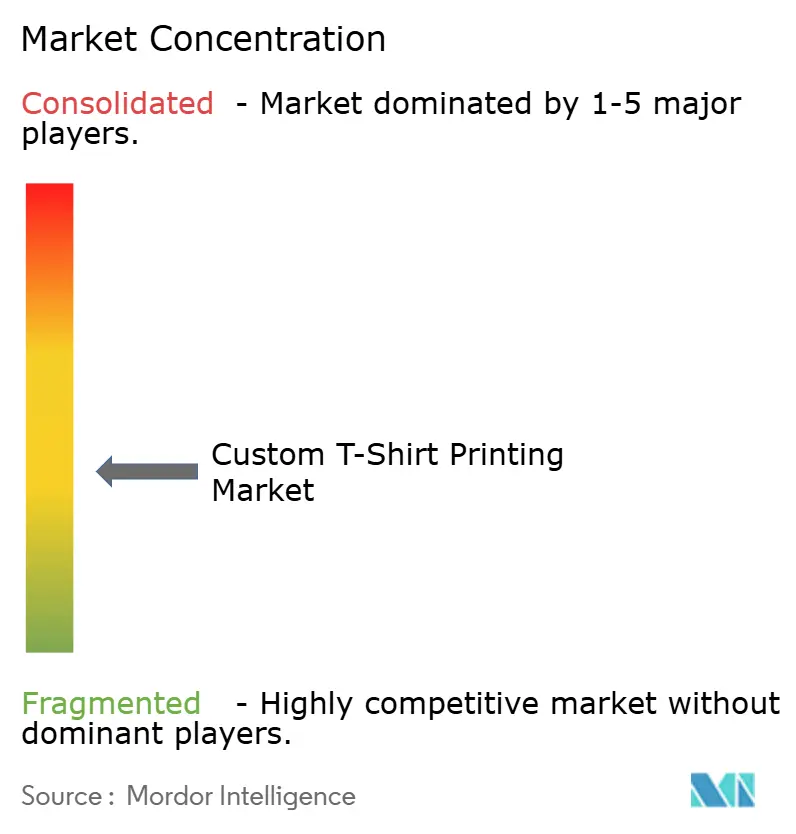
| Market Concentration | Medium |
Major Players *Disclaimer: Major Players sorted in no particular order Image © Mordor Intelligence. Reuse requires attribution under CC BY 4.0. | |
Custom T-Shirt Printing Market Analysis by Mordor Intelligence
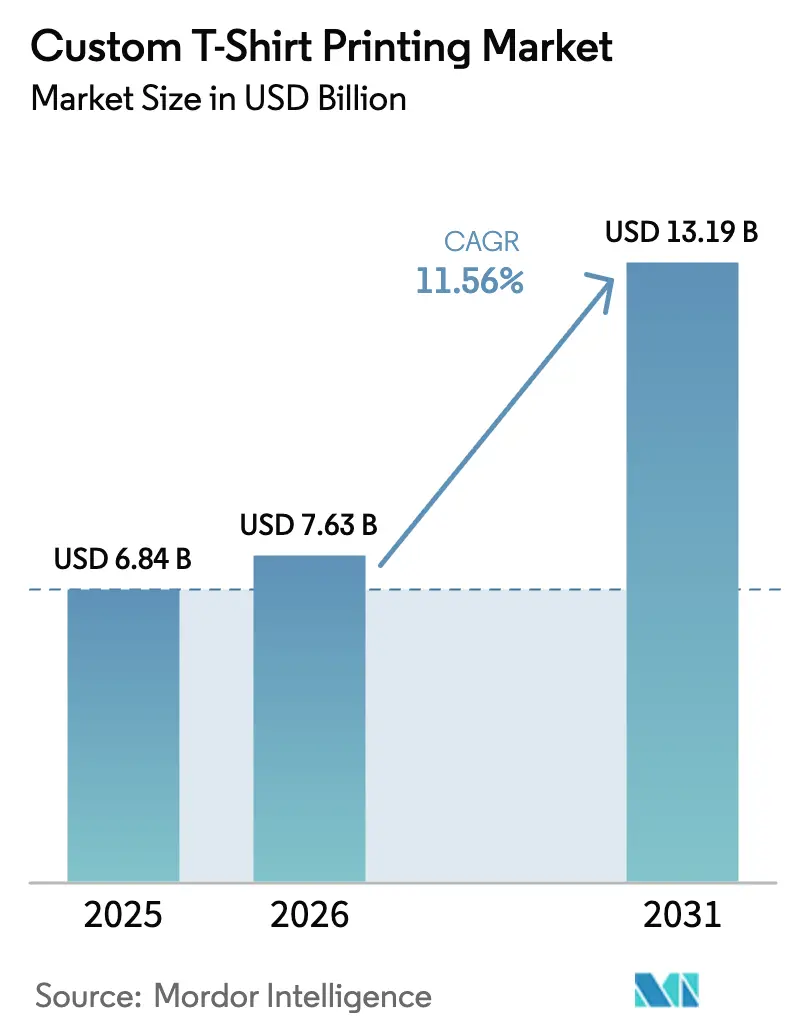
The Custom T-Shirt Printing Market size was valued at USD 6.84 billion in 2025 and estimated to grow from USD 7.63 billion in 2026 to reach USD 13.19 billion by 2031, at a CAGR of 11.56% during the forecast period (2026-2031).
Shifts in consumer appetite for personalized fashion, advances in digital printing, and the continuous rise of on-demand e-commerce platforms underpin this growth trajectory. Competitive dynamics favor operators that blend web-to-print software with agile fulfillment networks, lowering entry hurdles for independent creators and micro-brands. Artificial intelligence now streamlines artwork creation and product mock-ups, pulling more casual users into the addressable base. Sustainability is moving from an ethical add-on to a commercial requirement as buyers and regulators push for water-based inks and circular materials, prompting firms to retool production lines and deepen supplier audits.
Key Report Takeaways
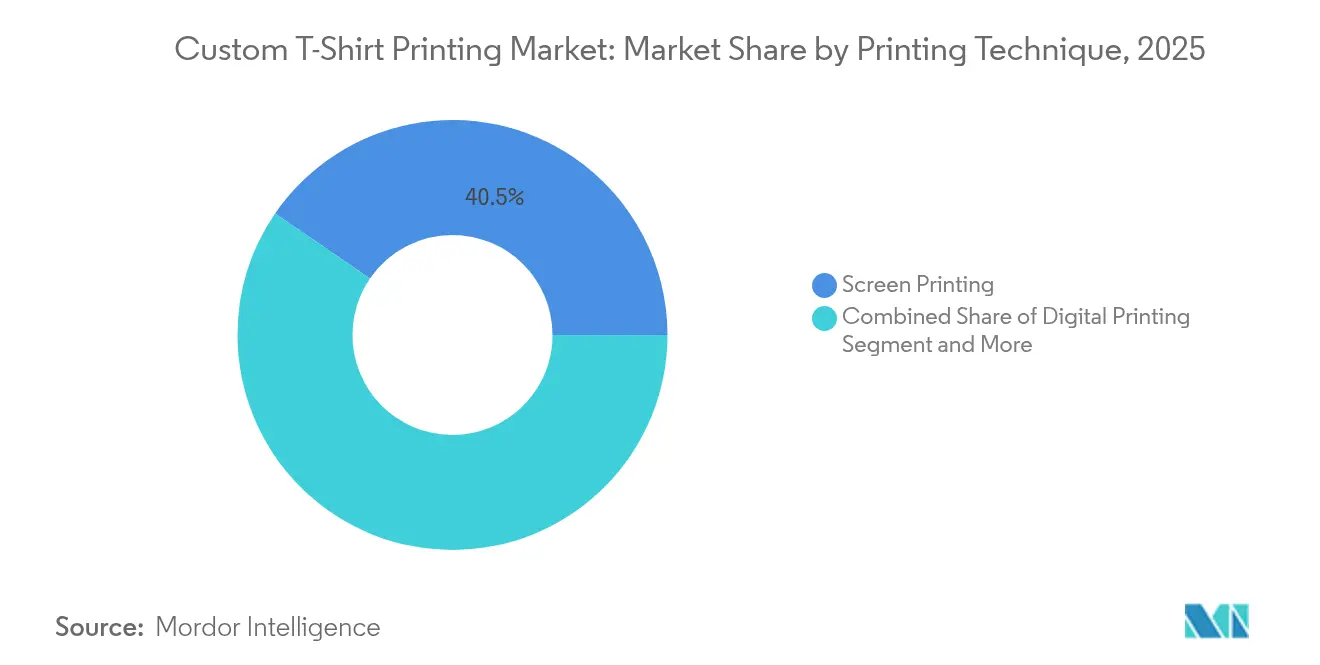
- By printing technique, screen printing led with 40.45% of the custom t-shirt printing market share in 2025; digital printing is projected to expand at a 12.28% CAGR to 2031.
- By design, graphic-designed shirts accounted for 45.35% of the custom t-shirt printing market size in 2025, while artwork/illustrations are forecast to grow at an 11.19% CAGR through 2031.
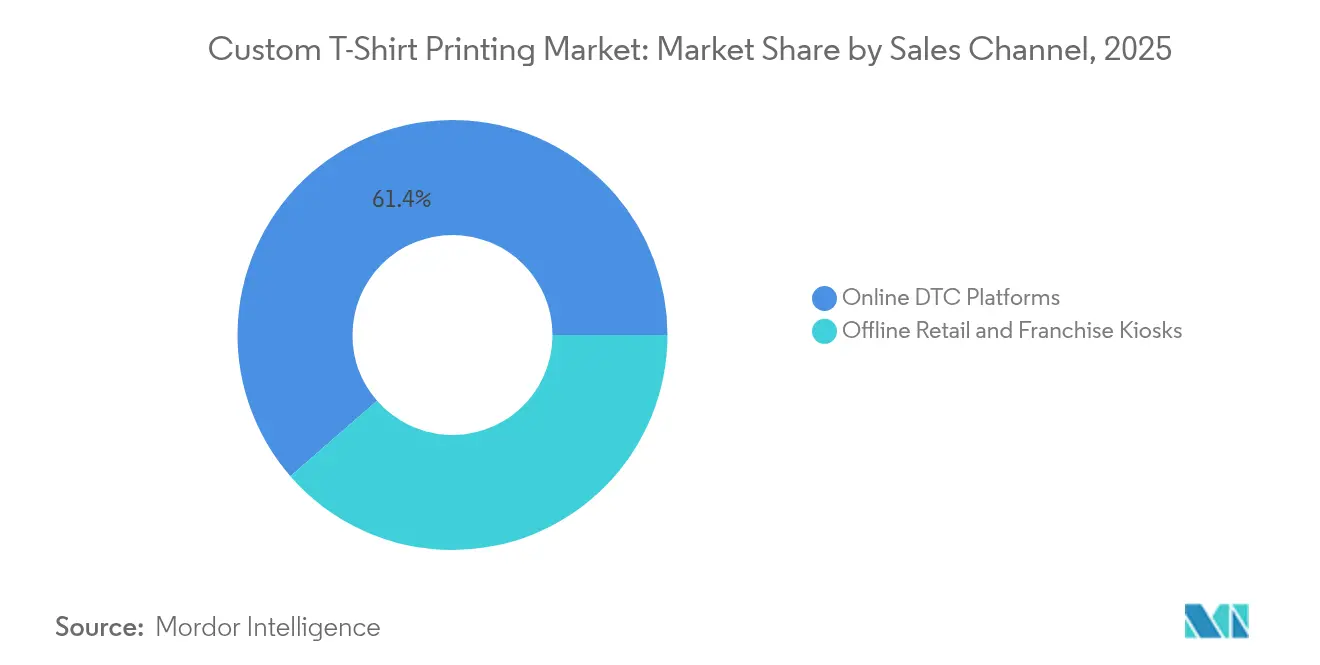
- By sales channel, the online direct-to-consumer segment held 61.40% revenue share in 2025 and is advancing at a 13.55% CAGR through 2031.
- By end-use, commercial/promotional orders captured 54.40% share of the custom t-shirt printing market size in 2025; the personal fashion segment is set to rise at a 11.87% CAGR to 2031.
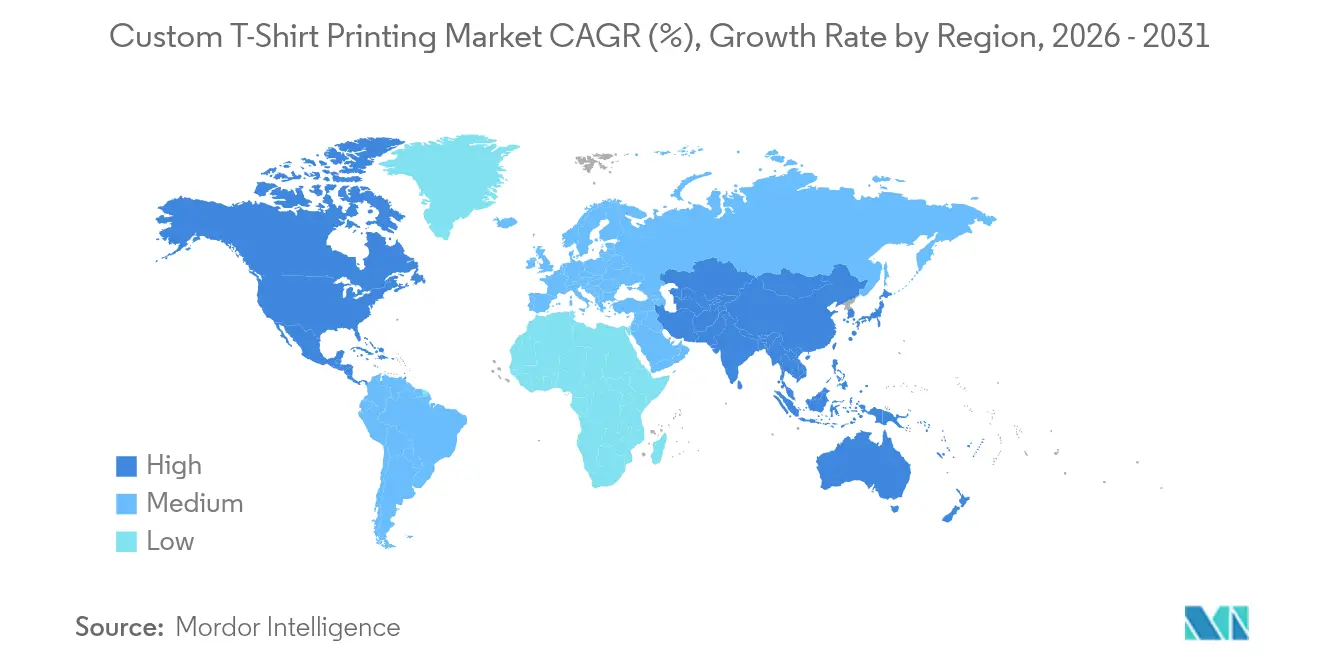
- By region, North America commanded 33.60% revenue in 2025, while Asia-Pacific is forecast to register a 12.64% CAGR through 2031.
Note: Market size and forecast figures in this report are generated using Mordor Intelligence’s proprietary estimation framework, updated with the latest available data and insights as of 2026.
Market Trends and Insights
Drivers Impact Analysis of Custom T-Shirt Printing Market*
| Driver | (~) % Impact on CAGR Forecast | Geographic Relevance | Impact Timeline |
|---|---|---|---|
| E-commerce platforms fuel on-demand fulfillment | +3.2% | Global, strongest in North America and Europe | Medium term (2-4 years) |
| Millennial and Gen-Z appetite for self-expression apparel | +2.8% | Global urban centers | Medium term (2-4 years) |
| Advances in DTG lower turnaround and MOQ | +2.1% | North America, Europe, developed APAC markets | Short term (≤ 2 years) |
| AI-generated design tools expand mass customization | +1.5% | Tech-forward markets worldwide | Medium term (2-4 years) |
| Eco-friendly waterless inks gain brand mandates | +1.2% | Europe, North America, later APAC | Long term (≥ 4 years) |
| Micro-merch influencer drops open B2B2C revenue | +0.9% | Regions with high social media penetration | Short term (≤ 2 years) |
| Source: Mordor Intelligence | |||
E-commerce platforms fuel on-demand fulfillment
Online storefronts integrate design editors, automated order routing, and distributed production hubs that minimize inventory risk and speed delivery. Roughly 62% of global custom t-shirt sales flowed through these channels in 2024, and platform mergers are adding scale that can raise technical barriers for late entrants[1]. Low setup costs let creators target hyper-niche audiences, keeping the pipeline of unique designs vibrant and renewing demand cycles.
Millennial and Gen-Z appetite for self-expression apparel
Consumers under 40 view apparel as a communication tool. They accept premium pricing when the product aligns with personal identity or social values. In 2024, they generated nearly two-thirds of all custom t-shirt purchases, with especially high uptake in large cities where trend diffusion is rapid and social media visibility is high. Their focus on sustainability further nudges suppliers toward eco-ink formulations and ethical sourcing.
Advances in DTG lower turnaround and MOQ
Successive hardware upgrades have shortened print cycles and improved colorfastness, letting small businesses profit on runs of fewer than 10 pieces. Environmental upsides—namely water-based inks—support compliance in regulated markets. DTG’s flexibility safeguards margins when buyers shift design choices late in the sales funnel, making it a favored technology for fast-moving online catalogs.
AI-generated design tools expand mass customization
Intuitive text-to-art platforms cut design time from hours to minutes, empowering non-professionals to launch collections with minimal cost. Integrated mock-ups speed listing creation, while predictive color suggestions lift conversion rates. Early adopters are capturing share by embedding these tools directly within storefronts, reducing dropout in the design stage and widening the creative funnel.
Restraints Impact Analysis of Custom T-Shirt Printing Market*
| Restraint | (~) % Impact on CAGR Forecast | Geographic Relevance | Impact Timeline |
|---|---|---|---|
| Volatile cotton prices squeeze margins | -1.3% | Global, most acute in price-sensitive markets | Medium term (2-4 years) |
| Plastisol waste and VOC regulations tighten | -1.1% | Europe, North America, developed Asia-Pacific | Long term (≥ 4 years) |
| Digital ads ROI diverts SME promo budgets | -0.8% | Mature digital advertising regions | Medium term (2-4 years) |
| Impending EPR fees on fast-fashion waste | -0.7% | EU, California, progressive markets worldwide | Long term (≥ 4 years) |
| Source: Mordor Intelligence | |||
Volatile cotton prices squeeze margins
Cotton costs swung by up to 35% between 2023 and 2025, pressuring profit structures where raw materials form nearly half of production expense. Firms with limited buying power face thinner spreads, prompting a pivot toward blended or recycled fabrics that offer greater price stability and resonate with eco-conscious buyers[3].
Plastisol waste and VOC regulations tighten
Jurisdictions such as California have enacted rules that penalize non-biodegradable inks, raising compliance costs for printers who still rely on plastisol. Adapting requires capital outlays for new equipment and staff training, advantaging early movers in water-based or hybrid systems and widening the gap between large and micro-scale producers.
*Our forecasts treat driver/restraint impacts as directional, not additive. The impact forecasts reflect baseline growth, mix effects, and variable interactions.
Custom T-Shirt Printing Market Segment Analysis
By Printing Technique:
balance shifts as digital maturesScreen printing retains volume leadership, propelled by its cost edge on large runs and durable output, yet its growth pace is moderating. Automation is helping curb setup labor by 40%, letting shops handle shorter cycles. Conversely, digital printing is closing the gap through better color depth and wash resistance. The custom t-shirt printing market size for digital methods is set to widen in line with the online direct-to-consumer boom. Digital workflows align with AI-assisted design, reducing idle capacity and widening margins on micro-orders. As capital prices for hybrid units fall, larger houses mix DTG and DTF on the same floor, using data to steer jobs toward the most efficient path each hour.
Screen printers are not standing still. Investments in eco-ink chemistries and rapid-cure flashes lighten energy footprints, satisfying retailer scorecards tied to sustainability. Collaboration between equipment suppliers and ink formulators is shortening drying times, improving productivity. In markets with strict VOC limits, water-based variants already represent more than half of screen press output, a trend likely to accelerate through 2030.

By Design:
creativity fuels premium demandGraphic-oriented shirts formed the bulk of commercial orders in 2024, buoyed by corporate branding and event merchandise that prize logo clarity and uniformity. Stable demand from enterprise procurement teams supports steady machine utilization for plant operators. The artwork and illustrations niche is smaller but rising faster, appealing to consumers who seek uniqueness and storytelling. The custom t-shirt printing market size for these expressive designs stands to benefit from AI that democratizes illustration skills. Retailers banking on capsule drops and limited editions use scarcity to justify higher price points, improving per-unit profitability.
Culture-driven design themes such as retro-futurism and nature motifs travel fast on social platforms. Because these trends can fade quickly, print houses with agile pre-press pipelines capture upside by turning concepts into live products within days. Intellectual-property questions remain, yet platform-level filtering tools reduce legal exposure, smoothing adoption for independent artists.
By Sales Channel:
online DTC cements dominanceOnline direct-to-consumer storefronts combine design creation, payment, and fulfillment in one interface, explaining their 61.40% share in 2025. Superior user journeys, targeted recommendations, and social-commerce links convert inspiration into purchase with fewer clicks. These strengths underpin the channel’s 13.55% forecast CAGR. To preserve loyalty, leading platforms plug into real-time production dashboards, giving buyers visibility on order status—a feature still missing in most brick-and-mortar chains.
Offline retail remains relevant for experiential browsing and bulk corporate orders, yet its expansion is trailing. Some traditional shops now partner with online marketplaces to expose catalog items to global audiences without carrying inventory. The blended model lets local printers monetize physical proximity for rush jobs while leveraging digital traffic spikes driven by influencers.
By End-use:
personal fashion narrows the gapCommercial and promotional buyers still generated 54.40% of 2025 revenue, rooted in uniform programs and event swag. Yet budget scrutiny and the appeal of measurable online adverts are tempering that growth. In contrast, personal fashion demand is accelerating, thanks to shoppers who favor self-curated wardrobes. The custom t-shirt printing market share of this segment is set to expand alongside social commerce and AI-enabled design feeds that recommend apparel reflecting stated values and recent browsing history.
Material choice influences purchase decisions more strongly in personal fashion than in bulk corporate orders. Brands boasting organic cotton blends and climate-neutral logistics command price premiums, signaling that environmental differentiation is no longer niche.
Geography Analysis
North America Custom T-Shirt Printing Market
North America held 33.60% of global revenue in 2025. The United States drives most sales, aided by widespread internet connectivity and a cultural emphasis on personal expression. More than two-thirds of regional orders transact online, reflecting mature e-commerce habits. Regulatory developments such as California’s Responsible Textile Recovery Act are compelling producers to adopt traceable supply chains and water-based inks earlier than peers elsewhere.
APAC Custom T-Shirt Printing Market
Asia-Pacific is the fastest-growing theater with a 12.64% CAGR projected to 2031. Urbanization, digital wallets, and smartphone saturation fuel rising disposable income and a willingness to experiment with personalized fashion. Domestic equipment makers in China and Southeast Asia are rolling out advanced DTF machines, shortening lead times and cutting import duties on Western technology. Local designers capitalize on anime, streetwear, and K-culture influences to capture young buyers, creating a vibrant competitive scene.
Europe Custom T-Shirt Printing Market
Europe accounts for roughly 28% of revenue, underpinned by stringent environmental standards and a preference for well-crafted garments. Mandatory recycling targets and chemical restrictions are accelerating the shift to eco-friendly substrates. Producers in Germany and the United Kingdom emphasize quality stitching and longevity, carving a premium niche. Cross-border sales within the EU benefit from harmonized digital payment frameworks, though linguistic diversity necessitates localized design catalogues.
Competitive Landscape
Industry structure blends platform-level consolidation with shop-floor fragmentation. The Printful-Printify merger exemplifies the race to scale technical infrastructure and AI capabilities. While these giants aggregate global orders, regional print shops thrive by offering specialty finishes, in-person consultations, or ultra-fast turnaround. Hybrid models, such as CustomInk’s blend of digital ordering and owned production facilities, provide control over both customer interface and output quality.
Sustainability acts as a strategic divider. Companies like Real Thread foreground water-based inks and transparent sourcing to gain contracts with values-driven brands. Wholesale distributors Sand S Activewear and Alphabroder combined in late 2024, enhancing bargaining power and reinforcing supply resilience for downstream printers. Meanwhile, innovators explore micro-factory setups with robotic presses and automated folding systems, aiming to profit on single-piece runs without manual labor.
Competitive intensity is rising in adjacent niches, including smart fabrics, augmented-reality prints, and modular supply-chain software. Operators that harmonize data analytics, eco-compliance, and user-friendly design portals are best positioned to capture future wallet share.
Custom T-Shirt Printing Industry Leaders
-
Printful Inc.
-
CustomInk, LLC
-
Cimpress Schweiz GmbH (trading as “Vistaprint”)
-
Spreadshirt, Inc. (Spread Group Holding GmbH & Co. KG)
-
Printify, Inc.
- *Disclaimer: Major Players sorted in no particular order
Custom T-Shirt Printing Market Companies Covered in this Report
- Printful, Inc.
- CustomInk, LLC
- Cimpress Schweiz GmbH (trading as "Vistaprint")
- Spreadshirt, Inc. (Spread Group Holding GmbH & Co. KG)
- Printify, Inc.
- CafePress LLC (a Shutterfly company)
- Spring, Inc.
- Threadless.com, Inc.
- TeePublic, Inc. (a subsidiary of Redbubble Ltd.)
- Zazzle Inc.
- Rush Order Tees, LLC
- UberPrints, Inc.
- Redbubble Ltd.
- Gooten Inc.
- Shirt.io LLC
- Amazon.com Services LLC
- T-Shirt Elephant Inc.
- CustomThread E-commerce, Inc.
- Gildan Activewear Inc.
Recent Industry Developments in Custom T-Shirt Printing Market
- February 2025: ScreenBroidery rebranded and acquired Thumbprint, expanding regional reach and service depth.
- January 2025: Whitestone Branding acquired American Apparel & Promotions to enlarge production capacity in the commercial segment.
- November 2024: Printful and Printify announced a merger to combine technology and fulfillment resources while retaining separate brands.
- October 2024: S&S Activewear finalized its acquisition of Alphabroder, reshaping wholesale distribution in the United States.
Custom T-Shirt Printing Market Report Scope and Research Methodology
Market Definition and Coverage
The study defines the global custom T-shirt printing market as finished knit shirts that carry a customer-specified graphic, slogan, or illustration applied by screen, direct-to-garment, plot vinyl, sublimation, or heat-transfer methods and delivered through online or offline sales channels to consumers, businesses, and institutions. According to Mordor Intelligence, revenues are captured at the print service or in-house fulfillment level, not at blank garment manufacture.
Scope Exclusion: Plain tees and other apparel sold without any custom print fall outside this analysis.
Segments Covered in This Report
- By Printing Technique
- Screen Printing
- Digital Printing
- Plot Printing
- Sublimation Printing
- Heat Transfer Vinyl
- By Design
- Graphic-designed Shirts
- Artwork / Illustrations
- Slogan / Text-only
- By Sales Channel
- Online DTC Platforms
- Offline Retail and Franchise Kiosks
- By End-use
- Commercial / Promotional
- Personal Fashion
- By Geography
- North America
- United States
- Canada
- Mexico
- South America
- Brazil
- Argentina
- Rest of South America
- Europe
- United Kingdom
- Germany
- France
- Italy
- Spain
- Nordics
- Rest of Europe
- Asia-Pacific
- China
- India
- Japan
- South Korea
- ASEAN
- Australia
- New Zealand
- Rest of Asia-Pacific
- Middle East and Africa
- Middle East
- Saudi Arabia
- United Arab Emirates
- Turkey
- Rest of Middle East
- Africa
- South Africa
- Egypt
- Nigeria
- Rest of Africa
- Middle East
- North America
Data Sources, Market Sizing, and Validation
Primary Research
Mordor analysts next interviewed print-on-demand platform operators across North America, Europe, and Asia-Pacific, regional garment decorators, print equipment vendors, and corporate merchandisers. These conversations validated average selling prices, printer utilization, and online order mixes, and helped us refine adoption curves for digital techniques in emerging economies.
Desk Research
Our analysts opened with tier-one public datasets such as United Nations Comtrade export codes for printed cotton shirts, Eurostat's PRODCOM textile tables, the U.S. Census Bureau's Quarterly E-commerce Report, and OECD Purchasing Power Parity files to benchmark spending power. Trade association portals, such as the International Textile Manufacturers Federation, Specialty Graphic Imaging Association, and FESPA, provided shipment, installed-base, and ink consumption hints. Company filings, investor decks, reputable business press retrieved through Dow Jones Factiva, and financial snapshots from D&B Hoovers rounded out pricing and margin clues. The sources cited illustrate, not exhaust, the wider body of secondary material consulted for data collection, sense-checking, and context.
Market-Sizing & Forecasting
A top-down construct begins with global trade and retail sales of knit shirts, then applies custom-print penetration rates by channel and region. Results are corroborated through selective bottom-up roll-ups of leading fulfillment providers' revenues and sampled ASP times volume checks, which are then adjusted for duplicate counting. Key model drivers include web-to-print order share, digital printer installed base, youth apparel expenditure, cotton price trends, and corporate promotional budgets. A multivariate regression forecasts each driver; scenario analysis overlays account for currency swings and raw-material shocks. Gaps in bottom-up data are bridged using regional proxy ratios drawn from primary interviews.
Data Validation & Update Cycle
Outputs pass a two-step peer review, anomaly sweeps against adjacent metrics like DTG ink shipments, and senior analyst sign-off. The model refreshes annually, with interim revisions triggered by material events such as major e-commerce policy changes or disruptive technology launches, ensuring clients receive the latest vetted view.
How Mordor Intelligence's Custom T-Shirt Printing Market Size Compares to Other Published Estimates
Published figures often diverge because firms choose different printing techniques, channel mixes, and currency bases before forecasting.
Key gap drivers include Mordor's inclusion of plot vinyl and B2B promotional runs, our balanced base-case scenario versus more bullish or cautious outlooks elsewhere, and a yearly refresh cadence that limits data aging.
Benchmark comparison
| Market Size | Anonymized source | Primary gap driver |
|---|---|---|
| USD 6.84 B (2025) | Mordor Intelligence | - |
| USD 5.16 B (2024) | Global Consultancy A | Excludes plot printing and corporate promo volumes |
| USD 8.17 B (2024) | Advisory Firm B | Adds blank apparel; capacity roll-ups lack channel split |
| USD 4.90 B (2024) | Research Firm C | Low e-commerce penetration; linear CAGR without scenario testing |
Taken together, the comparison shows that Mordor's disciplined scope selection, dual-layer modeling, and live update cycle deliver a balanced, transparent baseline decision-makers can rely on.
Key Questions Answered in the Report
What is driving the strong CAGR in the custom t-shirt printing market?
Growth stems from digital printing advances, AI-assisted design tools, and the popularity of on-demand e-commerce platforms that remove inventory barriers.
Which printing technique is gaining ground the fastest?
Digital printing—covering DTG, DTF, and related methods—shows a 12.28% forecast CAGR as it supports small runs and rapid turnaround.
How important is sustainability to buyers?
Sustainability is rising from a nice-to-have to a purchase driver, with water-based inks and certified fabrics increasingly influencing buying decisions, especially in Europe and North America.
Why is Asia-Pacific the fastest-growing region?
Urbanization, expanding middle-class disposable income, and rapid e-commerce adoption create fertile conditions for personalized apparel demand across China, India, and Southeast Asia.
What impact will the Printful-Printify merger have on market competition?
The merger consolidates technological and fulfillment assets, raising the innovation bar and potentially making it harder for smaller platforms to match user experience and global reach.
How are volatile cotton prices affecting producers?
Price swings squeeze margins, prompting printers to diversify into blended or recycled fabrics that offer greater cost stability and meet sustainability preferences.