
Market Overview
| Study Period | 2020 - 2031 |
|---|---|
| Forecast Data Period | 2026 - 2031 |
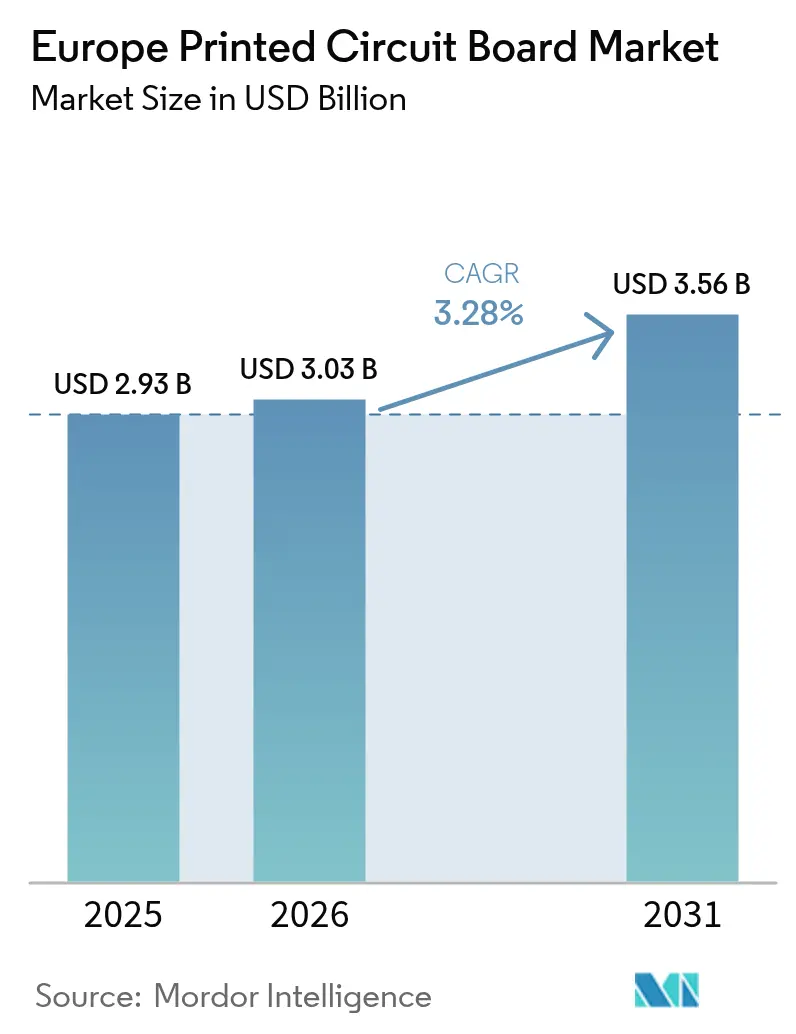
| Base Year Market Size (2025) | USD 2.93 Billion |
| Market Size (2026) | USD 3.03 Billion |
| Market Size (2031) | USD 3.56 Billion |
| Growth Rate (2026 - 2031) | 3.28 % |
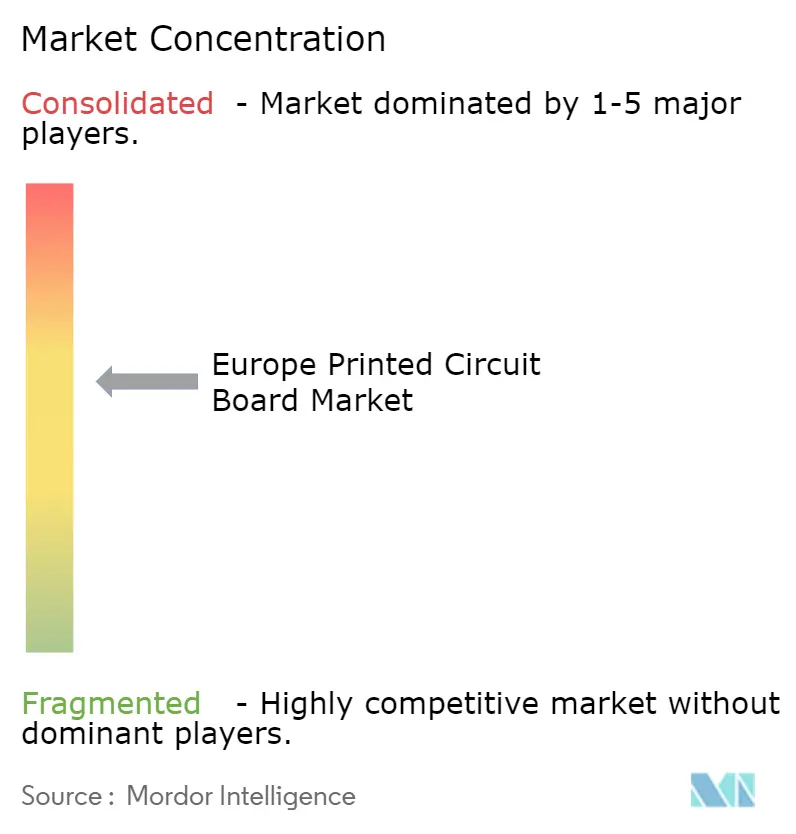
| Market Concentration | Medium |
Major Players *Disclaimer: Major Players sorted in no particular order Image © Mordor Intelligence. Reuse requires attribution under CC BY 4.0. | |
Europe Printed Circuit Board Market Analysis by Mordor Intelligence
The Europe printed circuit board market size ize was valued at USD 2.93 billion in 2025 and is estimated to grow from USD 3.03 billion in 2026 to reach USD 3.56 billion by 2031, at a CAGR of 3.28% during the forecast period (2026-2031). Demand pivots toward high-density interconnect (HDI) and IC substrates as automotive electrification, on-shore semiconductor packaging, and data-center upgrades reshape ordering patterns. Flexible circuits for medical wearables, low-loss laminates for telecom gear, and rigid-flex formats for defense systems are capturing capital even while copper-price volatility and Asia-centric laminate sourcing weigh on gross margins. Tier-1 suppliers with IATF 16949 and AS9100 certifications are consolidating automotive and aerospace volumes, whereas dozens of quick-turn specialists still thrive on prototype and low-volume industrial demand. National subsidy programs under the European Chips Act lower the effective cost of capital for new substrate fabs and encourage regional co-location with test and assembly houses.
Key Report Takeaways
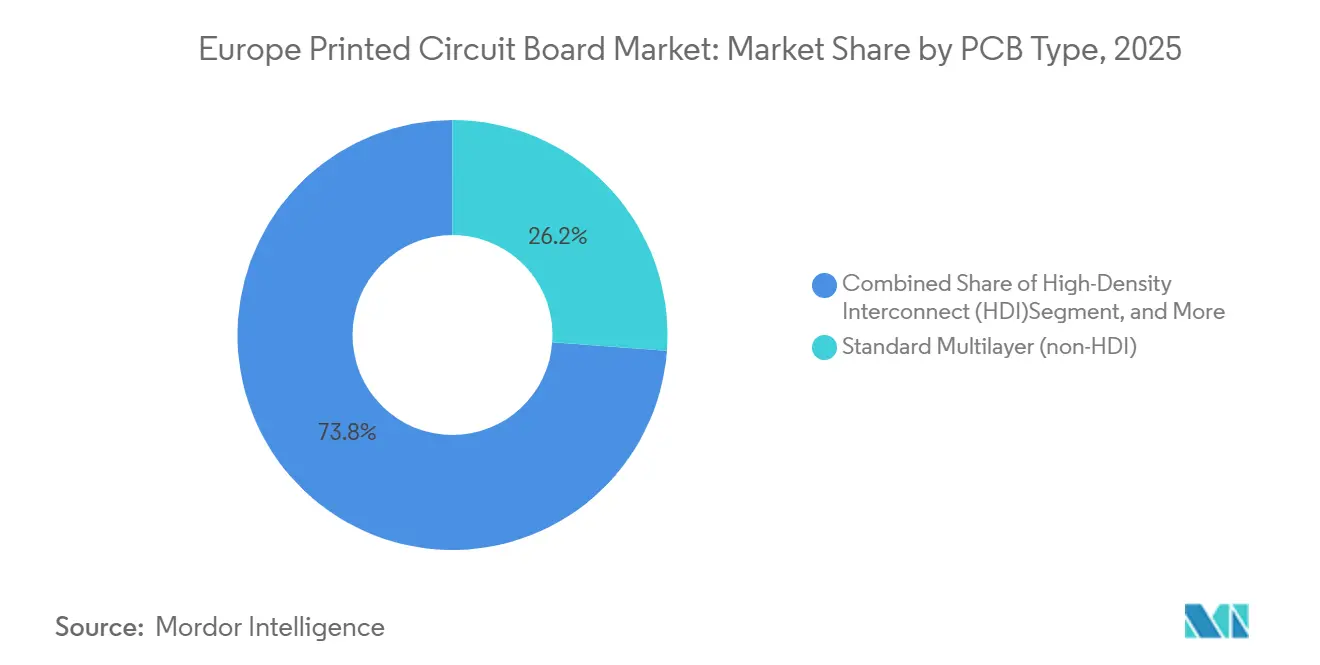
- By PCB type, standard multilayer boards held 26.15% of the Europe printed circuit board market share in 2025, while flexible circuits are forecast to expand at a 4.62% CAGR through 2031.
- By substrate material, glass-epoxy FR-4 captured 41.59% revenue in 2025, and high-speed low-loss laminates are projected to grow at a 4.41% CAGR over 2026-2031.
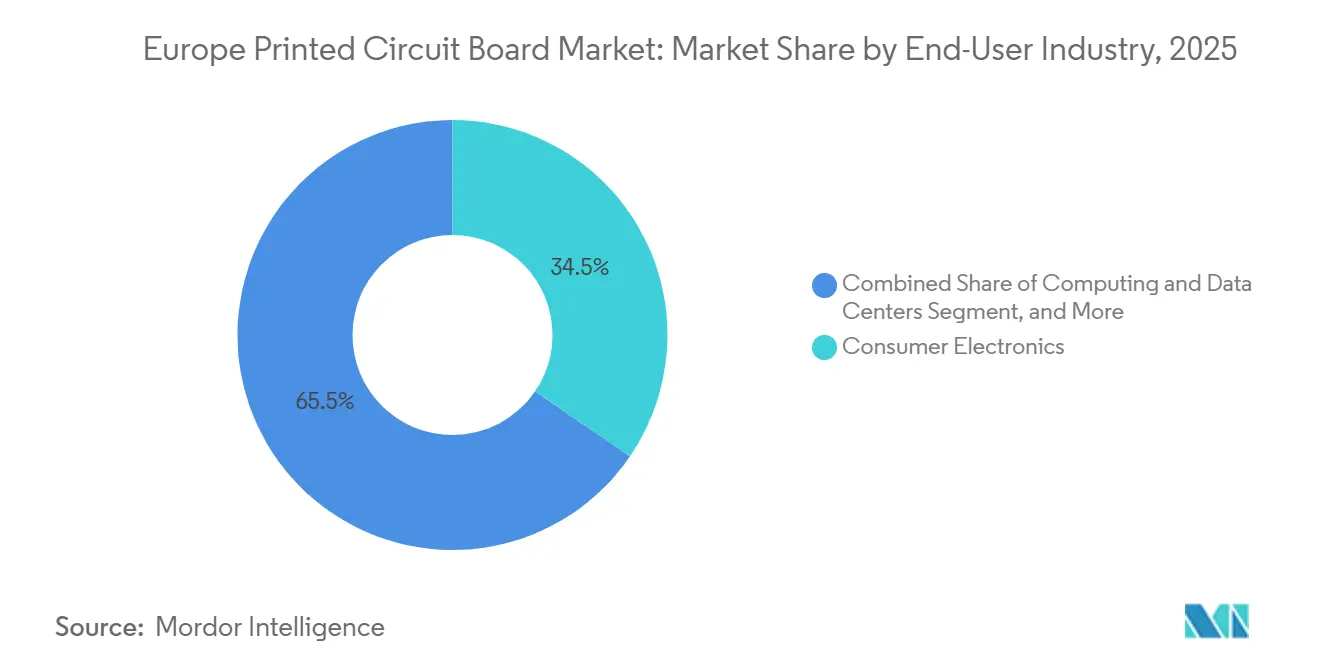
- By end-user industry, consumer electronics accounted for 34.53% demand in 2025, whereas automotive and electric-vehicle applications are advancing at a 4.86% CAGR during the same horizon.
- By geography, Germany commanded 43.77% of 2025 revenue and the United Kingdom is set to register the fastest growth at a 4.34% CAGR to 2031.
Note: Market size and forecast figures in this report are generated using Mordor Intelligence’s proprietary estimation framework, updated with the latest available data and insights as of 2026.
Europe Printed Circuit Board Market Trends and Insights
Drivers Impact Analysis*
| Driver | (~) % Impact on CAGR Forecast | Geographic Relevance | Impact Timeline |
|---|---|---|---|
| Growing Demand for Miniaturization and High-Density Interconnect PCBs | +1.2% | Germany, United Kingdom, Italy, Rest of Europe | Medium term (2-4 years) |
| Rapid Proliferation of Electric Vehicles Requiring Advanced Automotive PCBs | +1.5% | Germany, Italy, Rest of Europe | Medium term (2-4 years) |
| Increasing Research and Development Investment in European PCB Fabs | +0.8% | Germany, United Kingdom, Rest of Europe | Long term (≥ 4 years) |
| Government Subsidies for On-Shore Semiconductor and Packaging Capacity | +0.9% | Germany, Italy, United Kingdom | Long term (≥ 4 years) |
| Regulatory Push for REACH-Compliant Halogen-Free Laminates | +0.4% | Germany, United Kingdom, Italy, Rest of Europe | Short term (≤ 2 years) |
| Surging Adoption of Bio-Compatible Flexible PCBs for Implantable Medical Devices | +0.6% | Germany, United Kingdom, Rest of Europe | Medium term (2-4 years) |
| Source: Mordor Intelligence | |||
Rapid Proliferation of Electric Vehicles Requiring Advanced Automotive PCBs
Electric-vehicle platforms expose boards to -40 °C to 150 °C thermal cycles, 400-ampere currents, and multi-gigabit sensor backbones. European automakers shipped 2.8 million battery-electric and plug-in hybrids in 2025, elevating PCB content per vehicle as 800-volt zone-controller topologies proliferate. AT&S reported 22% year-over-year automotive revenue growth on battery-management and central-computing wins, validating a migration toward HDI and rigid-flex lines that carry gross margins 8-10 points above commodity rigid boards in the Europe PCB market.[1]AT&S Austria Technologie und Systemtechnik AG, “Annual Report 2025,” ats.net
Growing Demand for Miniaturization and High-Density Interconnect PCBs
Wearables and IoT nodes compress board real estate, driving line-and-space targets below 50 µm and via diameters under 100 µm. Würth Elektronik qualified a laser-direct-imaging system capable of 25 µm features in early 2025, supporting power-management modules for industrial and medical gear.[2]Würth Elektronik Group, “Press Release: New Laser Direct Imaging System Qualified,” we-online.com Any-layer HDI and coreless substrates blur the boundary between traditional boards and IC packages, locking suppliers with sequential lamination and modified semi-additive plating into long design-in cycles.
Government Subsidies for On-Shore Semiconductor and Packaging Capacity
The European Chips Act directs EUR 43 billion (USD 48.4 billion) to double the bloc’s semiconductor share by 2030, with sizable tranches earmarked for advanced packaging. Germany budgeted EUR 2 billion (USD 2.25 billion) for pilot packaging lines, while Italy committed EUR 500 million (USD 563 million) to expand IC-substrate output at Agrate Brianza, lowering capital hurdles for PCB makers that co-locate with assembly houses in the Europe PCB Market.
Increasing Research and Development Investment in European PCB Fabs
Fabricators spent EUR 850 million (USD 957 million) on process R&D during 2025, up 37% from 2023. AT&S channeled EUR 120 million (USD 135 million) into glass-core substrates for high-performance computing, and Schweizer Electronic partnered with Fraunhofer IZM on embedded-component boards that cut area by 30%.[3]Fraunhofer IZM, “Embedded-Component PCB Pilot Project,” izm.fraunhofer.de These projects target automotive power electronics, AI accelerators, and implantable devices with gross-margin potential above 35%.
Restraints Impact Analysis*
| Restraint | (~) % Impact on CAGR Forecast | Geographic Relevance | Impact Timeline |
|---|---|---|---|
| Volatile Copper and Laminate Prices Squeezing Margins | -0.9% | Germany, United Kingdom, Italy, Rest of Europe | Short term (≤ 2 years) |
| High Capital Intensity of Next-Gen HDI Production Lines | -0.6% | Germany, United Kingdom, Rest of Europe | Medium term (2-4 years) |
| Extended Lead Times Due to Asia-Centric Laminate Supply | -0.5% | Germany, United Kingdom, Italy, Rest of Europe | Short term (≤ 2 years) |
| PFAS Phase-Out Compliance Costs Across the Value Chain | -0.4% | Germany, United Kingdom, Italy, Rest of Europe | Medium term (2-4 years) |
| Source: Mordor Intelligence | |||
Volatile Copper and Laminate Prices Squeezing Margins
Copper futures averaged USD 9,200 per metric ton in 2025, swinging nearly USD 1,700 inside a quarter and complicating fixed-price contracts. FR-4 sheet quotations rose 14% through Q3 2025 before easing as consumer-electronics demand cooled. Mid-tier board shops running 12-15% gross margins absorbed cost spikes when automotive customers resisted mid-contract adjustments, accelerating consolidation toward scale players that hedge raw materials on the London Metal Exchange impacting the Europe PCB market.[4]London Metal Exchange, “Copper Futures Data 2025,” lme.com
High Capital Intensity of Next-Gen HDI Production Lines
A greenfield 1-N-1 HDI line requires EUR 40-60 million (USD 45-68 million) for laser drilling, sequential lamination, and automated inspection. Schweizer Electronic invested EUR 25 million (USD 28 million) in 2025 to qualify automotive HDI programs, pushing return on invested capital below its weighted-average cost for the year.[5]Schweizer Electronic AG, “Annual Report 2025,” schweizer.ag Smaller fabricators instead focus on quick-turn prototypes, ceding high-volume opportunities to vertically integrated peers in the Europe PCB market.
*Our forecasts treat driver/restraint impacts as directional, not additive. The impact forecasts reflect baseline growth, mix effects, and variable interactions.
Segment Analysis
By PCB Type: Flexible Circuits Lead Growth Amid Medical and Wearable Demand
Flexible circuits are forecast to expand at a 4.62% CAGR through 2031, the fastest-growing category within the Europe printed circuit board market. Medical wearables, implantable cardiac monitors, and foldable displays rely on polyimide substrates that survive thousands of bend cycles without trace fracture. Standard multilayer boards still commanded 26.15% of Europe printed circuit board market share in 2025, dominating automotive body electronics and industrial automation. Yet design wins are gravitating to HDI formats in smartphones and advanced driver-assistance modules, where layer-count reduction offsets a 2-3× unit-cost premium.
Rigid 1-2 sided boards stay relevant for power supplies and LED lighting, and IC substrates are gaining traction as on-shore packaging lines ramp under Chips Act funding. Rigid-flex boards retain niche appeal in aerospace flight controls and implantable devices, commanding gross-margins above 30% but requiring AS9100 or IATF 16949 certification. Aspocomp reported 31% year-over-year growth in medical-grade flexible revenue after landing a Scandinavian OEM supply deal, underscoring how regulated niches shield suppliers from price competition and enrich the Europe printed circuit board market.



By Substrate Material: High-Speed Low-Loss Laminates Gain Share in Telecom and Data Centers
Glass-epoxy FR-4 accounted for 41.59% revenue in 2025, underscoring its cost efficiency in the Europe printed circuit board market size equation. Yet 5G base stations, 400-GbE switches, and AI accelerators require low-loss materials with dielectric constants below 3.5 and dissipation factors under 0.005. Rogers RO4000 and Isola I-Speed laminates, already qualified by Würth Elektronik for European telecom infrastructure, are projected to expand at a 4.41% CAGR.
Polyimide substrates support under-hood automotive electronics and avionics thanks to glass-transition temperatures above 250 °C. Packaging films such as ajinomoto build-up enable chiplet integration on coreless interposers, fetching 3-5× the price per square meter of FR-4 but unlocking fine-line geometries demanded by advanced packaging. Ceramic and PTFE compounds fill microwave and satellite niches. Hyperscale cloud providers insist on low-loss laminates for 112-Gbps PAM4 backplanes, pushing hybrid stack-ups that marry FR-4 power planes with premium signal layers and elevating average selling prices across the Europe printed circuit board market.
By End-User Industry: Automotive and Electric Vehicles Outpace Consumer Electronics
Consumer electronics contributed 34.53% of 2025 revenue, yet its growth is moderating as smartphone saturation and system-in-package adoption reduce board area per device. Automotive and electric-vehicle systems, by contrast, are projected to grow at 4.86% CAGR through 2031, becoming the prime accelerator for Europe printed circuit board market demand. Battery-management, zone-controller, and 800-volt inverter boards require 0.2 mm microvias, heavy-copper layers, and conformal coatings that justify premium pricing.
Computing and data-center equipment benefit from AI server deployments that demand 20-plus layer stack-ups with controlled impedance. Telecommunications spending on Open RAN densification keeps base-station board demand steady, while industrial automation and renewable-energy inverters deliver mid-single-digit growth. Aerospace and defense remain low-volume but high-margin, shielding qualified suppliers from commoditization. Jabil cited 19% automotive PCB growth in its 2025 report, far above its overall electronics-manufacturing expansion, signaling how electrification pulls the Europe printed circuit board market toward higher value content.
Geography Analysis
Germany generated 43.77% of Europe printed circuit board market revenue in 2025, anchored by automotive platforms that consumed roughly two-thirds of local output. Mittelstand fabricators combine quick-turn prototypes with IATF-qualified HDI mass production, enabling sub-two-week delivery for Tier-1 suppliers. Federal subsidies of EUR 2 billion (USD 2.25 billion) for advanced-packaging pilot lines in Dresden and Munich further strengthen domestic capacity, while battery-electric vehicle production hit 1.2 million units, intensifying demand for zone-controller and battery-management boards.
The United Kingdom is predicted to clock a 4.34% CAGR through 2031, the fastest in the region. A 12% jump in 2025 defense-electronics procurement and GBP 4.2 billion (USD 5.3 billion) in 5G densification outlays are redirecting prototype and small-batch volumes to domestic board shops with AS9100 certification. Defense mandates on secure supply chains favor fabricators such as Exception PCB, while telecom operators specify low-loss laminates for millimeter-wave small cells.
Italy’s concentration in Lombardy and Piedmont leverages proximity to automotive suppliers and industrial machinery builders. STMicroelectronics’ EUR 500 million (USD 563 million) IC-substrate project at Agrate Brianza anchors a budding advanced-packaging cluster set to unlock local rigid-flex and substrate demand from 2027 onward. Rest-of-Europe markets, including Finland, Sweden, Switzerland, Iberia, and Central Europe, collectively supply specialized niches. Finland’s medical-device ecosystem drives biocompatible flexible boards from Aspocomp, Sweden’s NCAB Group orchestrates multisource production for lead-time agility, and Switzerland’s Cicor focuses on HDI rigid-flex assemblies with sub-three-week cycles.
Regulatory Landscape
European PCB manufacturing is shaped by EU-wide product, chemicals, and circular-economy rules that influence materials selection and end-of-life obligations. RoHS (Directive 2011/65/EU) continues to govern restricted substances in electrical and electronic equipment, and Delegated Directive (EU) 2025/2364 (issued September 2025) updated specific exemptions for lead in certain steel, aluminum, and copper alloys used in EEE, which affects qualification choices for high-reliability interconnects and finishes.
Sustainability and supply security requirements are tightening in parallel. Regulation (EU) 2024/1781 (Ecodesign for Sustainable Products Regulation, ESPR) sets a framework for sustainable product requirements and digital product passports that are being implemented progressively, raising data and traceability expectations for PCB-containing products. Regulation (EU) 2024/1252 (Critical Raw Materials Act, entered into force in 2024) sets 2030 EU benchmarks of 10% extraction, 40% processing, and 25% recycling capacity for strategic raw materials, which reinforces interest in recycling streams that include PCBs. Separately, the European Commission tabled the Chips Act 2.0 proposal on June 3, 2026 (COM(2026) 503 final), which explicitly brings PCB assembly and packaging into the strategic project discussion, potentially affecting permitting and state-aid eligibility once legislated.
Value Chain Analysis
The Europe PCB value chain starts with upstream inputs such as copper foil, glass fabric, resins/laminates (FR-4 and low-loss materials), specialty chemicals, and process equipment (laser drilling, direct imaging, plating, AOI). Europe retains meaningful capability in high-reliability and quick-turn fabrication and in downstream electronics manufacturing services (EMS), but upstream material dependence remains a structural constraint, with many laminates and specialty inputs sourced outside the region, contributing to the lead-time volatility highlighted in the report context.
Midstream, regional fabricators (for example, AT&S, Wurth Elektronik, Schweizer Electronic, KSG, and specialist quick-turn shops) convert laminates into multilayer, HDI, flex, rigid-flex, and substrate-like products, often bundling testing and engineering support for automotive, aerospace/defense, industrial, telecom, and medical customers. Industry bodies also point to a shrinking manufacturing base, with fewer than 180 active PCB factories in Europe by late 2025. EIPC/IPC discussions further note cost frictions, including import duties of up to 6.5% on some raw materials while finished PCB imports can enter tariff-free under the WTO Information Technology Agreement, pressuring commodity segments. Downstream, OEMs and Tier-1s drive long qualification cycles (IATF 16949, AS9100, IPC Class 3), and distributors/aggregators such as NCAB coordinate certified multi-source supply for lead-time agility and risk management.
Competitive Landscape
The Europe printed circuit board market balances moderate consolidation at the top with lengthy fragmentation below. AT&S, Würth Elektronik, Schweizer Electronic, NCAB Group, and Aspocomp captured 38% of 2025 revenue, leaving the rest to scores of regional specialists. Automotive and aerospace buyers increasingly single-source from Tier-1 suppliers holding zero-defect track records and embedded-component know-how, while prototype and industrial customers continue to prize lead-time agility over scale.
Technology capability is the chief separator. Market leaders deploy laser direct imaging, modified semi-additive plating, and embedded-passive integration to reach sub-50 µm line widths, enabling them to address high-speed switches, 800-V powertrains, and implantables. AT&S earmarked EUR 300 million (USD 338 million) for an IC-substrate line in Leoben, pursuing vertical integration that moves it closer to chiplet packaging. Würth Elektronik adopts a hybrid model, adding German HDI capacity while leveraging Asian partners for consumer volumes. NCAB’s digital platform aggregates demand across a certified network, trading premium margins for a light asset base that insulates it from capital swings.
White-space opportunities emerge in biocompatible flexible circuits, on-shore IC substrates, and ultra-high-frequency microwave boards where regulatory barriers and process complexity shrink the eligible supplier pool to fewer than ten European plants. IPC-6012 Class 3 and ISO 9001 remain baseline, but competitive advantage now rests on long-term R&D programs and the ability to co-locate with customer engineering teams for rapid iteration.
Europe Printed Circuit Board Industry Leaders
KSG GmbH
Wurth Elektronik Group (Wurth Group)
AT&S Austria Technologie und Systemtechnik AG
NCAB Group AB
Schweizer Electronic AG
- *Disclaimer: Major Players sorted in no particular order

Market Opportunities and Future Outlook
White space is clearest where European buyers pay for proximity, qualification, and traceability rather than lowest unit cost. This shows up most directly in automotive electrification (battery management, zone controllers, power electronics), aerospace/defense secure supply, and regulated medical flex. The report context already points to capital shifting toward HDI, rigid-flex, embedded components, and IC-substrate-adjacent capability, and supplier actions support that pattern, including AT&S expanding IC-substrate capacity in Leoben and investing in glass-core substrates and embedding-related processes, which helps anchor higher-value programs that are harder to dual-source.
Policy and adjacent ecosystem investments also create openings for European PCB suppliers to align with packaging and power-electronics clusters. The Chips Act 2.0 proposal (June 2026) explicitly broadens the strategic-project conversation to include PCB assembly and packaging, while Germany has budgeted EUR 2 billion for pilot packaging lines (per the report context), supporting co-location opportunities for substrate and advanced interconnect suppliers. On the circularity side, Regulation (EU) 2024/1252 (Critical Raw Materials Act) and ESPR (Regulation (EU) 2024/1781) increase the emphasis on traceability and recycling-oriented design. CORDIS-backed initiatives such as CIRCUIT4EU (launched May 2026) also show active work on selective recovery of critical raw materials from PCB-containing waste, which signals demand for compliant materials, documentation, and end-of-life pathways.
Recent Industry Developments
- February 2026: AT&S initiated a series of investments at its Fehring, Austria plant totaling over EUR 29.8 million through March 2027, covering semiconductor test equipment, e-mobility inverter solutions, and sustainability measures. The spend strengthens capability for higher-reliability and power-electronics-oriented interconnects that carry longer qualification cycles. It also supports differentiation as automotive and industrial customers push for localized, audited supply.
- December 2025: Wurth Elektronik inaugurated a EUR 45 million HDI line in Niedernhall, qualified for 1-N-1 and 2-N-2 automotive stack-ups and an annual capacity of 120,000 m2. The added capacity targets higher-complexity automotive programs where microvia capability and process control are gating factors. This also increases regional availability of advanced HDI output versus imported supply.
- May 2024: Regulation (EU) 2024/1252, the European Critical Raw Materials Act, entered into force, setting 2030 benchmarks for the EU of 10% extraction, 40% processing, and 25% recycling capacity for strategic raw materials. For electronics and PCB supply chains, it elevates the priority of recycling and secondary raw material sourcing in procurement and compliance programs. This direction supports investment interest in PCB-containing e-waste recovery and materials traceability initiatives.


Research Methodology Framework and Report Scope
Market Definition and Coverage
For this study, the market covers the value of printed circuit boards sold for use in electronic equipment across Europe, counted at the point of PCB manufacture and supply into end-use industries.
Scope exclusions: This sizing does not count downstream electronics assembly value, semiconductors and passive components, or equipment used to make PCBs.
Segmentation Overview
- By Category
- Standard Multilayer PCBs
- Rigid 1-2-sided PCBs
- HDI / Micro-via / Build-up
- Flexible PCBs
- Rigid-Flex PCBs
- Other Categories
- By End-User Vertical
- Industrial Electronics
- Aerospace and Defense
- Consumer Electronics
- Communications
- Automotive
- Medical
- Other End-User Verticals
- By PCB Substrate
- FR-4
- Metal Core
- Polyimide
- Ceramic
- Other PCB Substrates
- By Layer Count
- 1-2 Layers
- 4-6 Layers
- 8-10 Layers
- more than 10 Layers
- By Assembly Type
- Surface-Mount Technology
- Through-Hole Technology
- Mixed Assembly
- By Country
- United Kingdom
- Germany
- France
- Italy
- Spain
- Rest of Europe
Data Sources, Market Sizing, and Validation
Desk Research
Desk work started with mapping Europe-level electronics output and trade signals that typically move PCB demand, then aligned those signals with PCB-relevant supply indicators. Public sources were used to keep definitions consistent across time series, including Eurostat for industrial production and trade by electronics categories, the European Commission for policy and manufacturing programs, the European Patent Office for activity tied to interconnect and materials, and OECD indicators for macro and manufacturing trends.
We also reviewed technical and demand-side context from IEEE publications, electronics industry association releases (where accessible), company annual reports, and investor presentations. This helped us track how product mix is changing, for example multilayer needs in automotive electronics and higher-speed designs tied to data centers and telecom. For company-level cross-checks, we supplemented with paid subscriptions covering company financials and intelligence, news and financials, and patent databases, which helped verify revenue exposure and plant footprint signals. The desk sources listed here are illustrative only, and additional public and paid references were used for data collection, validation, and research clarification.
Primary Interviews and Surveys
Primary work focused on validating what gets shipped in Europe versus what is imported, and how pricing shifts with layer counts, materials, and qualification requirements. We spoke with PCB makers, material and equipment ecosystem participants, and OEM or EMS-side buyers across major European demand centers, so assumptions on utilization, lead times, and product mix could be adjusted before finalizing the model.
Distribution of primary research fieldwork respondents
| Company type | Respondent position |
|---|---|
| Top tier: 25% | CXOs: 17% |
| Mid tier: 57% | Functional/Unit leaders: 35% |
| Smaller Players: 18% | Managers: 48% |
Market-Sizing & Forecasting
Sizing was built using a top-down approach where electronics production trends, end-market build cycles, and trade flows were used to reconstruct the demand pool that typically drives PCB consumption in Europe. We then corroborated the result using selective bottom-up checks, such as sampling maker revenues by country, sense-checking capacity and utilization narratives, and validating typical ASP ranges for board complexity so totals did not drift.
Key inputs (illustrative) included European industrial production and export-import movements for electronics categories that are heavy PCB users, the shift toward higher layer count boards in automotive and industrial controls, deployment pace of telecom network upgrades, data-center hardware refresh intensity, and reported copper and laminate cost pass-through behavior that affects PCB ASPs. Where bottom-up information was incomplete for smaller private players, gaps were handled through proportional allocation using country-level manufacturing signals, and validated share bands from interviews.
Forecasts relied mainly on scenario analysis, since demand is shaped by a few large end markets that can change direction quickly. Base, conservative, and upside paths were anchored to expected automotive electronics content growth, industrial investment cycles, and telecom and computing hardware replacement timing, and then reviewed with primary inputs before final figures were locked.
Data Validation & Update Cycle
Outputs were checked in multiple steps so unusual jumps could be explained before sign-off. We compared the implied market totals against independent signals such as manufacturing output direction, trade movement consistency, and observed ASP changes linked to materials and complexity, and then reworked assumptions where the story did not match.
Before publication, the model and the written narrative were reviewed by more than one analyst so calculation errors and definition gaps were caught early. The report is refreshed annually, and interim updates are triggered when material events occur, such as major plant openings, shocks in key end-use demand, or large pricing swings. Right before delivery, an analyst performs a fresh pass so clients receive the latest updated view.
Mordor Intelligence's Europe Printed Circuit Board Market Size Compared Against Other Published Estimates
Published numbers for the European PCB market do not always match because the boundary can shift between production value, consumption value, and broader electronics interconnect content, and each choice changes the final total. Differences also come from how product mix is treated, since multilayer and HDI boards carry different pricing and the mix can move by end market.
Production-side totals, import dependence signals, and price-per-panel trends are the evidence checks that keep Mordor Intelligence tied to a Europe demand pool that includes locally made boards plus boards supplied into Europe through trade, rather than only domestic output or a narrow product subset. When a source uses a different year, applies a different currency timing, or does not explain whether it is production or consumption, it typically lands on a smaller or slower-growing figure.
Benchmark comparison
| Source | Market Size | Gaps in Research Methodology |
|---|---|---|
| Mordor Intelligence | USD 3.03 B (2026) | |
| Trade Journal A | USD 2.60 B (2024) | Often stated as a point estimate without clarifying if it is production-only or consumption, and it may not fully adjust for imports, product mix, and pricing differences across board complexity. |
| Industry Data Note B | USD 1.95 B (2024) | Commonly reflects Europe PCB production value (and can exclude certain geographies), which understates the broader market when imported boards supplying European demand are not counted. |
The spread is mainly explained by what is being counted, which is either Europe production only or Europe supply into end users. By keeping the definition consistent and then cross-checking totals with trade and pricing signals, the final value stays traceable to clear levers that can be re-tested each update cycle.


Key Questions Answered in the Report
How large will the Europe printed circuit board market be by 2031?
It is projected to reach USD 3.56 billion, growing at a 3.28% CAGR between 2026 and 2031.
Which PCB type is expanding the fastest in Europe?
Flexible circuits, benefiting from medical wearables and foldable devices, are forecast to grow at a 4.62% CAGR through 2031.
Why is automotive demand important for European PCB suppliers?
Electric-vehicle architectures need HDI and rigid-flex boards that carry higher margins and longer design-in cycles, pushing automotive applications to a 4.86% CAGR.
What materials are gaining share in high-speed telecom boards?
Low-loss laminates such as Rogers RO4000 and Isola I-Speed are replacing FR-4 in 5G and data-center hardware due to superior signal integrity.
Which country will grow the quickest within Europe?
The United Kingdom is set to post the fastest growth at a 4.34% CAGR through 2031, propelled by defense electronics and 5G densification.
How concentrated is competition in the region?
The top five suppliers account for 38% of revenue, indicating moderate concentration with room for niche and quick-turn specialists.
Page last updated on:




