
Crypto Exchange Market Size and Share
Market Overview
| Study Period | 2020 - 2031 |
|---|---|
| Market Size (2026) | USD 95.02 Trillion |
| Market Size (2031) | USD 204.97 Trillion |
| Growth Rate (2026 - 2031) | 16.62 % |
| Fastest Growing Market | Middle East and Africa |
| Largest Market | Asia-Pacific |
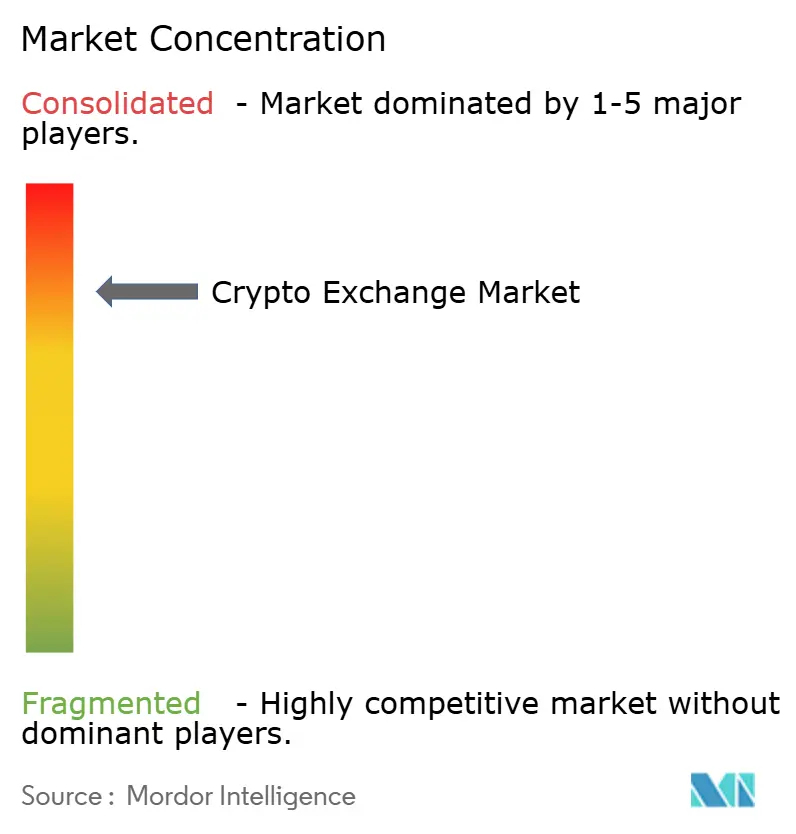
| Market Concentration | High |
Major Players *Disclaimer: Major Players sorted in no particular order Image © Mordor Intelligence. Reuse requires attribution under CC BY 4.0. | |
Crypto Exchange Market Analysis by Mordor Intelligence
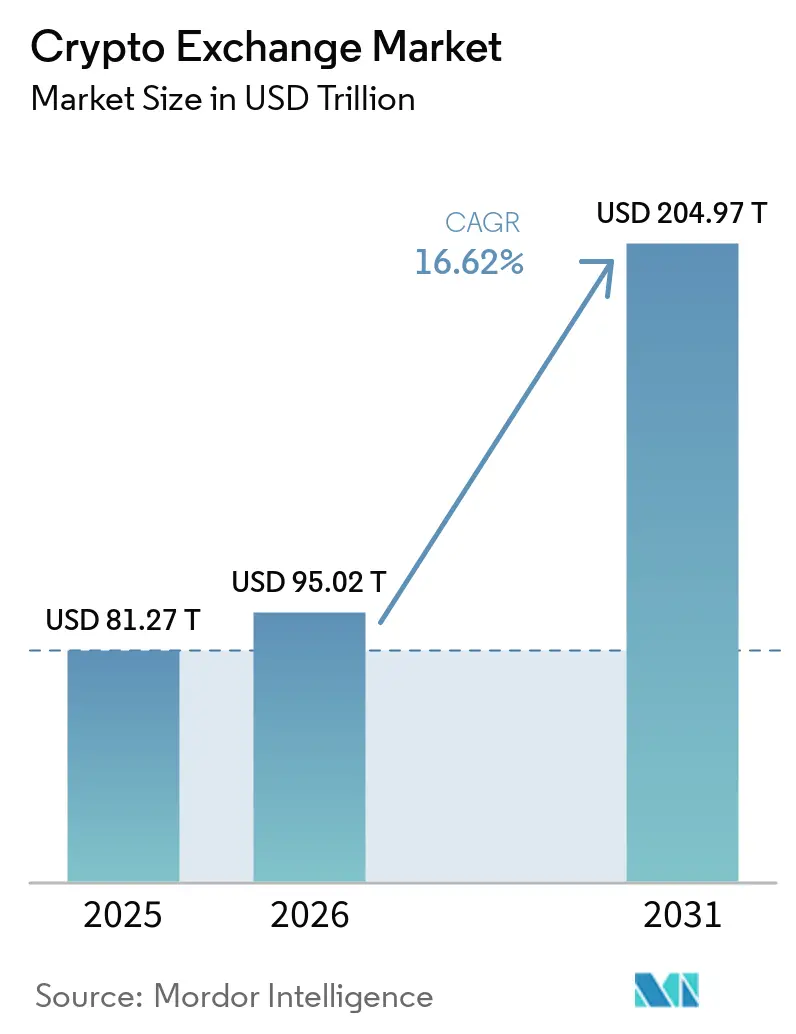
The Crypto Exchange Market size is expected to increase from USD 81.27 trillion in 2025 to USD 95.02 trillion in 2026 and reach USD 204.97 trillion by 2031, growing at a CAGR of 16.62% over 2026-2031.
The current trajectory of the crypto exchange market reflects a durable shift in capital allocation, as large institutions, treasury teams, and sovereign investors increasingly treat digital asset venues as part of long-term financial infrastructure rather than short-term speculative channels. In January 2026, 73% of institutional investors said they planned to increase digital asset allocations, up from 62% in 2025. That shift has increased the volume concentration advantage of licensed and audited venues with stronger controls and clearer reporting standards. Regulatory enforcement is also changing where activity settles, because the July 1, 2026, MiCA deadline in the EU has narrowed the operating room for unauthorized platforms and favored exchanges that already hold national approvals and passporting rights. Stablecoin settlement and tokenized treasury activity are creating an additional institutional use case for the crypto exchange market, as 88% of surveyed institutions identified T+0 settlement as their main stablecoin use case, and tokenized reserve collateral is moving closer to production deployment. At the same time, the crypto exchange market still faces a clear adoption constraint because large hacks and custody failures continue to shape how institutions evaluate counterparty risk, platform selection, and execution concentration.
Key Report Takeaways
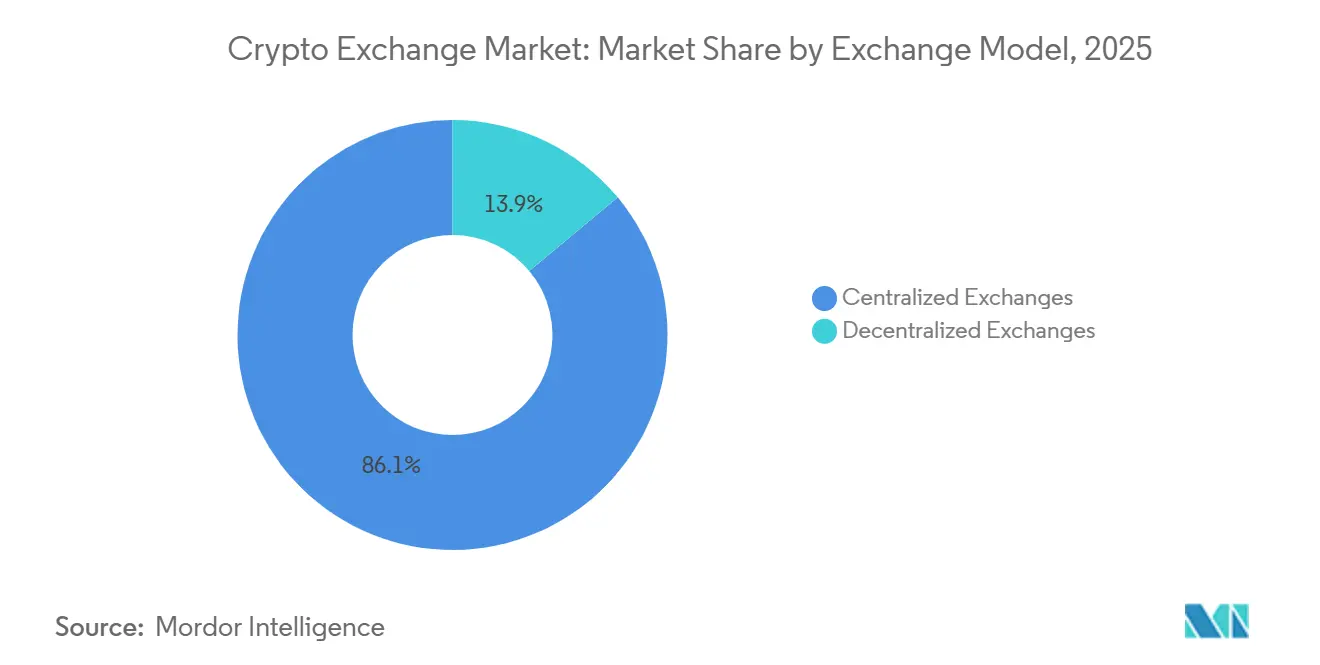
- By the exchange model, centralized exchanges captured 86.1% of the crypto exchange market share in 2025, while decentralized exchanges are projected to grow at a 22.8% CAGR through 2031.
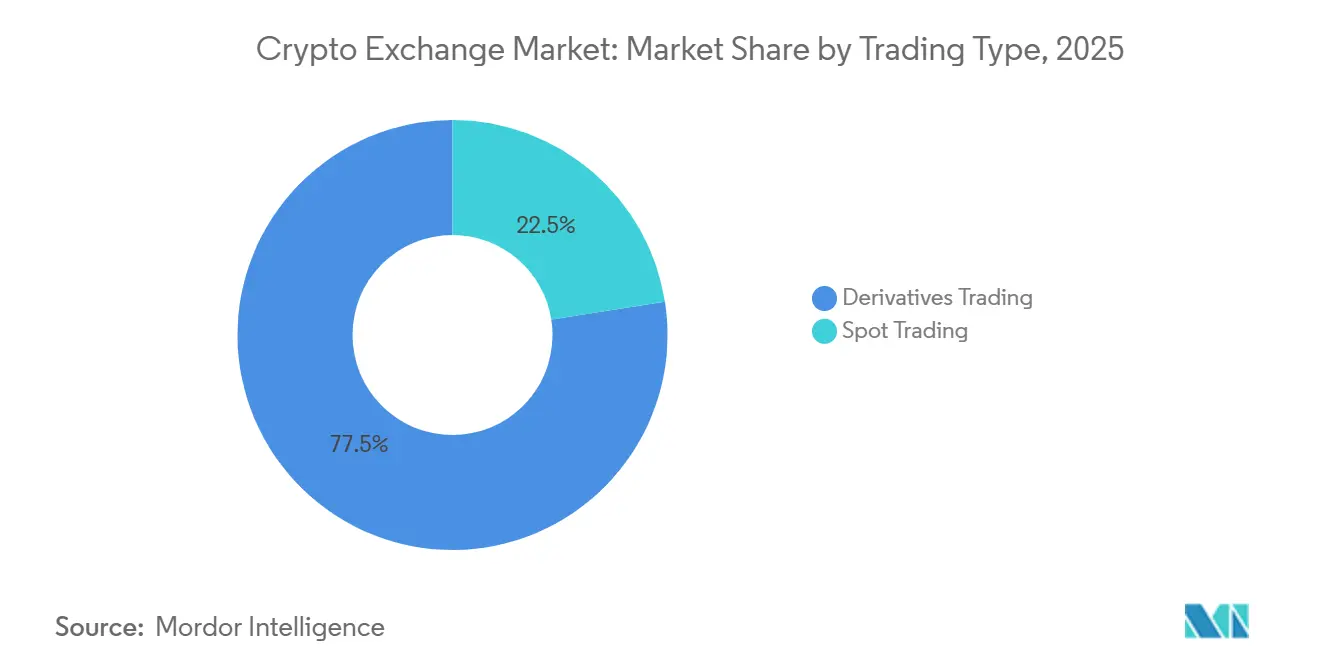
- By trading type, derivatives accounted for 77.5% of the crypto exchange market size in 2025, and this segment is forecast to expand at a 17.1% CAGR through 2031.
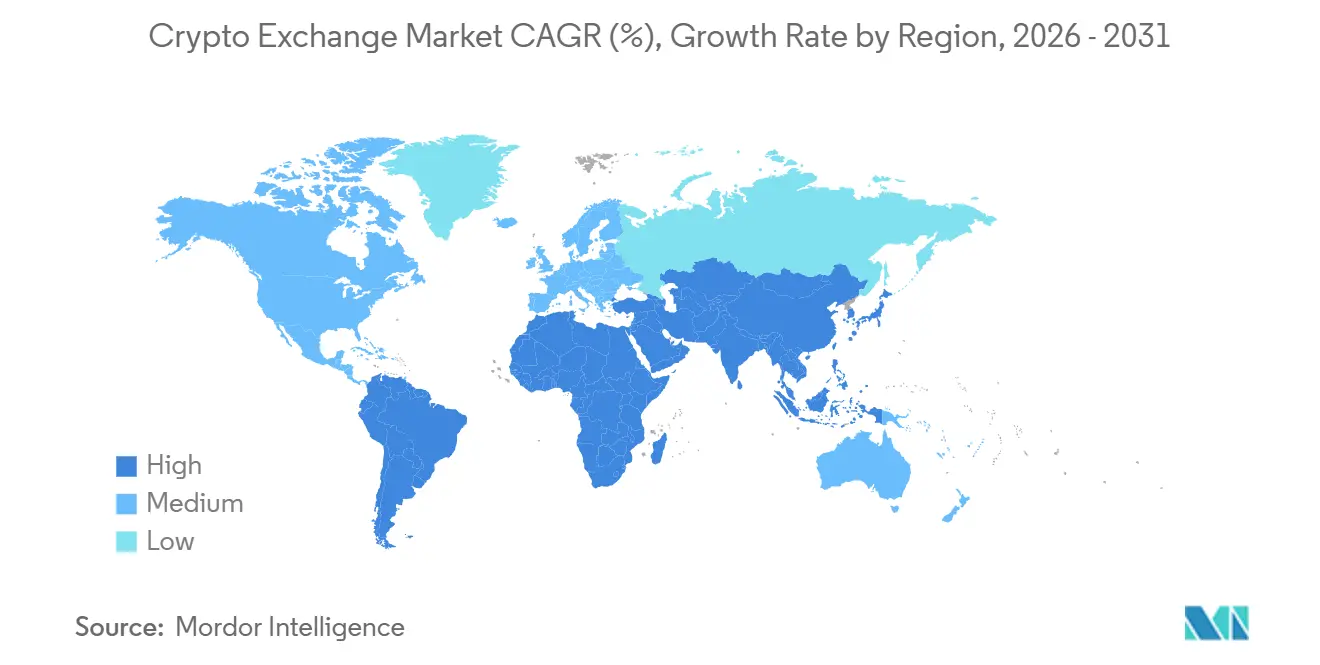
- By geography, Asia-Pacific held 42.9% of the crypto exchange market share in 2025, while the Middle East and Africa are set to advance at a 23.5% CAGR through 2031.
Note: Market size and forecast figures in this report are generated using Mordor Intelligence’s proprietary estimation framework, updated with the latest available data and insights as of January 2026.
Market Trends and Insights
Drivers Impact Analysis of Crypto Exchange Market*
| Driver | (~) % Impact on CAGR Forecast | Geographic Relevance | Impact Timeline |
|---|---|---|---|
| Rising Institutional Allocation To Digital Assets | +3.8% | Global, with concentration in North America, Europe, and Asia-Pacific institutional centers | Medium term (2-4 years) |
| Expansion Of Regulated Spot And Derivatives Venues | +3.2% | North America, Europe, Asia-Pacific core, spill-over to Middle East and Africa | Medium term (2-4 years) |
| Mobile First Trading And Embedded Finance Access | +2.5% | Asia-Pacific, Middle East and Africa, South America | Short term (≤ 2 years) |
| Tokenized Treasury And Stablecoin Settlement Flows | +2.8% | Global, with early gains in the United States, the EU, Singapore, United Arab Emirates | Medium term (2-4 years) |
| Fee Compression And Zero Fee Acquisition Models | +1.4% | Global, most pronounced in North America and Asia-Pacific | Short term (≤ 2 years) |
| Exchange Proof Of Reserve And Auditability Demand | +0.7% | Global | Short term (≤ 2 years) |
| Source: Mordor Intelligence | |||
Rising Institutional Allocation to Digital Assets
Institutional participation in the crypto exchange market has moved beyond trial activity and is now shaping volume distribution more permanently. In January 2026, a survey of 351 institutional investors found that 73% planned to increase digital asset allocations in 2026, and the share targeting more than 5% of AUM was expected to rise from 18% to 29% within the year[1]EY and Coinbase, “2026 Institutional Investor Survey,” Coinbase, assets.ctfassets.net. That change matters for the crypto exchange market because larger allocation sizes tend to favor venues that can support auditability, reporting, and operational resilience at institutional standards. Traditional hedge fund exposure to digital assets also reached 55% in 2025, up from 47% in 2024, which reinforced the shift from exploratory positioning to repeat capital deployment. Custody selection criteria also changed sharply, with security and key-signing protocols rising from 8% to 66% as the leading factor in custodian selection, directly favoring crypto exchange market operators that offer stronger self-custody or multi-party control frameworks.
Expansion of Regulated Spot and Derivatives Venues
The faster buildout of regulated spot and derivatives platforms across major jurisdictions is also reshaping the crypto exchange market. OKX opened United States spot trading in 2026 with access to nearly 75 digital assets under Money Transmitter License coverage across 45 states, which raised the competitive pressure on incumbents that had long dominated the domestic market[2]COININFOMANIA US Trading Opens on OKX as Protocol 23 Goes Live. Coinbase’s USD 2.9 billion acquisition of Deribit closed in August 2025, expanding its position from a major spot venue into a broader derivatives platform with immediate scale in options and perpetuals. At the time of the deal, Deribit held close to USD 60 billion in open interest and processed more than USD 185 billion in trading volume in July 2025, which showed how much product depth now matters in the crypto exchange market. The practical result is that exchanges are no longer competing as spot-only or derivatives-only venues, because the crypto exchange market now rewards platforms that can offer regulated access across spot, perpetuals, and options within one operating structure.
Mobile First Trading and Embedded Finance Access
Mobile-led access is widening the reachable user base of the crypto exchange market, especially in high-growth regions where app-based finance already dominates customer behavior. India’s user base is projected to reach 127 million in 2026, and Coinbase launched direct INR deposit and withdrawal rails via IMPS on June 1, 2026, after registering with the Financial Intelligence Unit, making local currency conversion far simpler for a large user base [3]COINDESK Coinbase makes a major play for India’s booming $3 billion crypto market with local currency launch. Bitget reported 216% cumulative user growth in Southeast Asia between 2024 and Q1 2026, underscoring how regional expansion in the crypto exchange market is now tied to mobile acquisition rather than desktop-led trading habits. Embedded finance amplifies that effect by enabling exchanges paired with wallets, neobanks, or payment apps to remove the onboarding friction that often slows activation in price-sensitive markets. Robinhood’s zero-commission model generated USD 25 billion in crypto notional volume in February 2026, up 74% year on year, which showed that the crypto exchange market can scale meaningfully even when explicit trading fees are not the main customer hook.
Tokenized Treasury and Stablecoin Settlement Flows
Stablecoin settlement is becoming an increasingly important growth layer for the crypto exchange market, as institutional users increasingly view it as practical financial plumbing rather than a narrow trading tool. In the January 2026 institutional survey, 86% of respondents said they used or were interested in stablecoins, while 88% identified T+0 securities settlement and 85% identified 24/7 cash management as the main use cases. The GENIUS Act, signed in July 2025, required 1:1 backing of payment stablecoins with short-dated Treasuries and insured deposits, and the Treasury Borrowing Advisory Committee estimated that stablecoins could drive nearly USD 900 billion of additional T-bill demand. JPMorgan’s May 2026 filing for the JLTXX tokenized money market fund on Ethereum showed that reserve collateral and on-chain settlement are moving closer together inside workflows that can later route through licensed exchanges[4]CRYPTOTIMES JPMorgan Files for JLTXX: New Tokenized Treasury Fund on Ethereum for Stablecoins. As these products move from pilot programs into regular usage, the crypto exchange market stands to gain new price discovery and redemption volume from institutional treasury and stablecoin-related flows.
Restraints Impact Analysis of Crypto Exchange Market*
| Restraint | (~) % Impact on CAGR Forecast | Geographic Relevance | Impact Timeline |
|---|---|---|---|
| Regulatory Fragmentation Across Licensing Regimes | -1.6% | Global, most acute in Asia-Pacific and Middle East, and Africa, where frameworks are still evolving | Long term (≥ 4 years) |
| Counterparty Risk From Hacks, Insolvencies, And Custody Failures | -1.3% | Global | Medium term (2-4 years) |
| Liquidity Migration To Off-Exchange And Onchain Venues | -0.8% | Global, concentrated in Asia-Pacific and North America | Medium term (2-4 years) |
| Banking Access And Fiat On-Ramp Disruption Risk | -0.6% | Emerging markets, the Middle East and Africa, South America, and Asia-Pacific | Short term (≤ 2 years) |
| Source: Mordor Intelligence | |||
Regulatory Fragmentation Across Licensing Regimes
The crypto exchange market still faces a material drag from uneven licensing systems across countries and regions. In the EU, Markets in Crypto-Assets (MiCA) entered full enforcement in 2026, and the European Securities and Markets Authority (ESMA) stated that platforms without valid authorization must stop serving EU clients after the transition period ends, sharply raising the compliance threshold for any operator still under review. The United Arab Emirates also operates multiple digital asset regimes across the CMA, VARA, DFSA, FSRA, and CBUAE, each with distinct activity scopes and capital requirements, which increases the cost and complexity of regional expansion. That burden falls hardest on mid-tier exchanges, because large global operators can spread legal and reporting costs across broader revenue pools while smaller firms cannot. The result is that the crypto exchange market can become even more concentrated at the top, even as regulators try to improve transparency and investor protection.
Counterparty Risk from Hacks, Insolvencies, and Custody Failures
Security failures remain one of the clearest constraints on the crypto exchange market because they slow institutional onboarding and keep counterparty screens unusually strict. The February 2025 Bybit hack resulted in losses of USD 1.5 billion. The FBI attributed it to North Korea’s Lazarus Group, which made it the largest single crypto theft on record and a defining event for exchange risk assessment. April 2026 then became the worst month for protocol losses since that event, with Drift Protocol losing USD 286 million on April 1 and Kelp DAO’s rsETH bridge losing USD 292 million on April 18, which pushed 2026 year-to-date losses to USD 771.8 million across 47 incidents. The pattern is also changing, as attacks are increasingly focused on administrative keys and signing infrastructure rather than only on smart-contract weaknesses. That shift matters for the crypto exchange market because it means custody alone is not enough to reassure institutions if authorization workflows and operational controls remain vulnerable.
*Our forecasts treat driver/restraint impacts as directional, not additive. The impact forecasts reflect baseline growth, mix effects, and variable interactions.
Crypto Exchange Market Segment Analysis
By Exchange Model:
Centralized Platforms Hold Volume, Decentralized Venues Claim Structural ShareCentralized exchanges accounted for 86.1% of total market volume in 2025, maintaining their dominance despite rising competition from on-chain alternatives. That lead came from stronger fiat on-ramp capability, faster matching infrastructure, and broader regulatory licensing, all of which still matter more to institutions than protocol openness alone. Binance processed USD 3.54 trillion in spot cumulative volume between August 2025 and January 2026, accounting for 39.6% of tracked spot exchange volume during that period. CEX perpetual open interest peaked at USD 213.5 billion in October 2025, up 291% from January 2024, which showed how much of the crypto exchange market still depends on centralized liquidity depth for leveraged trading. At the same time, late 2025 gains by MEXC and Gate.io showed that the crypto exchange market is not locked in at the bottom tier, as fee cuts and faster feature rollouts are eroding the stability of inherited market positions.
Decentralized exchanges are the fastest-growing segment of the crypto exchange market, with the market size projected to grow at a 22.8% CAGR through 2031. Their spot share doubled from 6.9% in January 2024 to 13.6% in January 2026, and DEX perpetual open interest rose 12-fold to USD 15 billion over the same period. PancakeSwap and Uniswap entered the top 10 global spot exchanges by cumulative volume between August 2025 and January 2026, which showed that the crypto exchange market now has credible on-chain challengers in categories once dominated by major CEXs. Hyperliquid’s launch of gold, silver, and S&P 500 perpetuals widened the competitive landscape of the crypto exchange industry by pushing DEX competition into instrument types that were once largely tied to centralized venues. Institutional appetite also points in that direction, with 56% of surveyed investors expecting to engage with DeFi protocols by 2028, mainly for lending and derivatives, suggesting that the crypto exchange market could see more permissionless institutional flows as compliance controls mature.


By Trading Type:
Derivatives Economics Anchor Exchange Revenue While Spot Delivers On-Ramp FunctionDerivatives accounted for 77.5% of total volume in 2025, and the crypto exchange derivatives market is projected to grow at a 17.1% CAGR through 2031. That combination of scale and growth makes derivatives the main driver of platform economics across the crypto exchange market. Perpetual futures alone accounted for close to USD 62 trillion of the USD 79 trillion in combined exchange volume in 2025, keeping leveraged contracts at the center of the crypto exchange market even as institutional use cases expanded beyond retail speculation. A large part of that shift came from institutional hedging, basis trading, and ETF-related flows replacing purely retail-driven leverage demand after the January 2024 approval of spot Bitcoin ETFs in the United States.
Spot trading generated USD 18.6 trillion in 2025, up 9% year on year, but it played a more supportive role in the crypto exchange market than a volume-leading one. Its role remained important for fiat entry, custody transfers, and stablecoin conversion. Yet, its slower expansion showed that many sophisticated users now manage exposure through contracts rather than simple cash positions. That shift changes revenue quality across the crypto exchange market, because exchanges that rely mostly on spot fees face more pressure than venues with deeper derivatives books and institutional pricing structures. The May 2026 CFTC no-action letter that allowed Coinbase to offer global crypto-perpetual futures through Deribit directly to United States clients was especially important because it validated a regulated path for domestic access to a product category long associated with offshore venues. It also showed that the crypto exchange industry is moving toward a structure in which regulated access and complex product depth are becoming less distinct than they were in earlier cycles.
Geography Analysis
APAC Crypto Exchange Market
Asia-Pacific held 42.9% of the crypto exchange market share in 2025, making it the largest regional center for trading activity. That position rests on a combination of large retail user bases, high on-chain engagement, and a wide mix of regulatory approaches across developed and emerging countries. Regional crypto transaction volume rose from USD 1.4 trillion to USD 2.4 trillion over the 12 months to June 2025, representing 69% year-on-year growth, with India, Vietnam, and Pakistan among the main contributors. India ranked first in the Chainalysis Global Adoption Index in both 2024 and 2025, and Coinbase’s local INR rails launch in June 2026 showed how global exchanges are targeting the next stage of user activation in the crypto exchange market through direct fiat access. South Korea’s real-name account system, Japan’s FSA-led model, offshore China-linked activity, and Indonesia’s and Vietnam’s mobile-first trading patterns together give the Asia-Pacific crypto exchange market both depth and diversification.
North America Crypto Exchange Market
North America remained the second-largest region in 2025, supported by clearer exchange licensing pathways and the growing presence of institutional capital. Spot Bitcoin ETF approvals in January 2024 helped create a sustained institutional bid, and global crypto ETPs attracted more than USD 40 billion in net inflows in 2025 while assets under management briefly moved above USD 200 billion. OKX’s 2026 United States market entry and the Coinbase-Deribit combination both pointed to stronger competition for institutional and advanced retail order flow in the crypto exchange market. Canada added regulated exchange capacity through CSA-supervised structures, while Mexico continued to expand through mobile-led retail participation.
EMEA and South America Crypto Exchange Market
The Middle East and Africa are the fastest-growing regions in the crypto exchange market, with the region's market size forecast to grow at a 23.5% CAGR through 2031. Growth there is being supported by United Arab Emirates licensing momentum, rising grassroots adoption in Turkey, Egypt, and South Africa, and a broader push to formalize virtual asset oversight across Gulf markets. Europe is moving through a separate consolidation phase under MiCA, where better-capitalized exchanges have a clearer path to scale across all 27 member states once approvals are secured. South America also remains relevant for the crypto exchange market, because stablecoin demand in Argentina and more structured regulation in Brazil are supporting both peer-to-peer and exchange-led activity in USD-pegged assets.

Competitive Landscape
The crypto exchange market is consolidated at the top, with Binance, OKX, Bybit, and Coinbase accounting for a significant part of derivatives volume in 2025. Even so, the crypto exchange market remains fragmented beneath that top tier, with regional and mid-sized venues still competing for share through pricing, local access, and faster product rollouts. The main divide in the crypto exchange market now sits between United States-listed platforms such as Coinbase and Robinhood, which emphasize regulatory legitimacy and breadth, and Asian-headquartered exchanges such as Binance, OKX, Bybit, and Bitget, which continue to compete through speed, geographic reach, and more aggressive fee structures. Coinbase’s USD 2.9 billion purchase of Deribit was the clearest strategic move in the first camp, bringing spot, futures, perpetuals, and options together under a more unified, regulated structure with immediate scale in global options liquidity. OKX’s launch of Exchange OS on X Layer in May 2026 demonstrated the second path, in which the crypto exchange market is approached as shared infrastructure that can extend liquidity beyond the exchange’s branded venue.
There is still open space in the crypto exchange market for regulated retail derivatives, tokenized real-world asset pairs, and mobile-embedded exchange access in emerging regions. Proof of Reserves has also become a more visible competitive tool, as repeated reserve disclosures now signal operating discipline and capital strength. OKX completed 36 consecutive monthly PoR reports by October 2025 and disclosed USD 35.4 billion in verified reserves, while Bitget reported a 192% reserve ratio in May 2025, and Kraken continued to publish third-party-attested quarterly reports. These disclosures matter in the crypto exchange market because client trust now depends on visible verification as much as on brand recognition alone.
Compliance posture is also becoming a direct competitive variable in the crypto exchange market. United Kingdom sanctions imposed on HTX in May 2026 led Binance, OKX, Bybit, and Bitget to tighten transaction screening, which showed that major exchanges are using compliance infrastructure to widen the reputational distance between themselves and less transparent rivals. Mid-tier exchanges are still capable of taking a selective share, especially where fee cuts, app-first acquisition, or local currency rails can outweigh weaker global brand recognition. That said, the crypto exchange market increasingly rewards firms that can combine licensing, liquidity, auditability, and broad product coverage within one operating framework. This is why the top of the crypto exchange market remains contested, even though the threshold for serious global competition is clearly rising.
Crypto Exchange Industry Leaders
Binance
Bybit
MEXC
Gate.io
OKX
- *Disclaimer: Major Players sorted in no particular order
Crypto Exchange Market Companies Covered in this Report
- Binance
- Coinbase Global, Inc.
- Bybit
- OKX
- Gate.io
- MEXC
- Kraken
- Bitget
- Crypto.com
- KuCoin
- HTX
- Upbit
- Bitfinex
- Gemini
- Bitstamp
- Robinhood Markets, Inc.
- eToro Group Ltd.
- BitMEX
- Coincheck, Inc.
- Luno
- CEX.IO

Recent Industry Developments in Crypto Exchange Market
- June 2026: Coinbase launched direct INR deposit and withdrawal rails via IMPS for Indian users on June 1, alongside spot trading and perpetual futures, marking its most substantive India re-entry since the 2022 UPI suspension. The exchange registered with India's Financial Intelligence Unit (FIU-IND) in March 2025 as a prerequisite compliance milestone. India's crypto user base is projected to reach 127 million in 2026, making it a strategically critical fiat on-ramp for the global exchange landscape.
- May 2026: The CFTC issued a no-action letter permitting Coinbase to offer global crypto-perpetual futures to United States clients through Deribit, making Coinbase the first United States-licensed exchange authorized to connect domestic retail clients to offshore crypto-perp markets. This regulatory development directly addresses the United States' retail derivatives gap and could redirect substantial institutional flows that previously went to offshore venues.
- April 2026: Drift Protocol on Solana lost USD 286 million in a suspected North Korea-linked admin key compromise on April 1, 2026. Kelp DAO's rsETH bridge suffered a USD 292 million exploit via spoofed LayerZero DVN messages on April 18, making April 2026 the worst month for DeFi protocol losses since the USD 1.5 billion Bybit hack in February 2025.
- August 2025: Coinbase closed its USD 2.9 billion acquisition of Deribit, USD 700 million cash plus 11 million shares of Coinbase Class A stock, the largest acquisition in crypto industry history, elevating Coinbase to the top position in global crypto options by open interest and establishing a full-spectrum spot-futures-perpetuals-options platform.


Global Crypto Exchange Market Report Scope
| Centralized Exchanges |
| Decentralized Exchanges |
| Spot Trading |
| Derivatives Trading |
| North America | United States |
| Canada | |
| Mexico | |
| South America | Brazil |
| Argentina | |
| Rest of South America | |
| Europe | Germany |
| United Kingdom | |
| France | |
| Italy | |
| Spain | |
| Rest of Europe | |
| Asia-Pacific | China |
| India | |
| Japan | |
| South Korea | |
| Australia | |
| Indonesia | |
| Rest of Asia-Pacific | |
| Middle East and Africa | Turkey |
| Israel | |
| Saudi Arabia | |
| United Arab Emirates | |
| South Africa | |
| Egypt | |
| Rest of Middle East and Africa |
| By Exchange Model | Centralized Exchanges | |
| Decentralized Exchanges | ||
| By Trading Type | Spot Trading | |
| Derivatives Trading | ||
| By Geography | North America | United States |
| Canada | ||
| Mexico | ||
| South America | Brazil | |
| Argentina | ||
| Rest of South America | ||
| Europe | Germany | |
| United Kingdom | ||
| France | ||
| Italy | ||
| Spain | ||
| Rest of Europe | ||
| Asia-Pacific | China | |
| India | ||
| Japan | ||
| South Korea | ||
| Australia | ||
| Indonesia | ||
| Rest of Asia-Pacific | ||
| Middle East and Africa | Turkey | |
| Israel | ||
| Saudi Arabia | ||
| United Arab Emirates | ||
| South Africa | ||
| Egypt | ||
| Rest of Middle East and Africa | ||


Key Questions Answered in the Report
What is driving growth in crypto exchange activity through 2031?
Growth is being driven by rising institutional allocations, wider regulated venue coverage, mobile-first access, and expanding stablecoin settlement use cases. The market is projected to rise from USD 95 trillion in 2026 to USD 205 trillion by 2031 at a 16.6% CAGR.
Which exchange model leads global trading volume today?
Centralized exchanges remain the volume leader, holding 86.1% of total market volume in 2025. Their advantage comes from fiat rails, deeper liquidity, and stronger licensing coverage.
Why are decentralized exchanges gaining share so quickly?
Decentralized exchanges are benefiting from higher on-chain participation, expanding perpetual products, and growing institutional openness to DeFi. Their spot share rose from 6.9% in January 2024 to 13.6% in January 2026, and they are projected to grow at a 22.8% CAGR through 2031.
Which trading type matters most for exchange economics?
Derivatives are the most important segment for exchange economics. They held 77.5% of total volume in 2025 and are forecast to grow at a 17.1% CAGR through 2031, which keeps them at the center of revenue and liquidity strategy.
Which region leads the global landscape?
Asia-Pacific leads with 42.9% share in 2025, supported by large user bases, strong on-chain engagement, and broad regional market participation. The Middle East and Africa is the fastest-growing region, with a projected 23.5% CAGR through 2031.
What is the main risk slowing institutional adoption of exchanges?
The USD 1.5 billion Bybit hack in February 2025 and USD 771.8 million in losses across 47 incidents in 2026 year to date show why institutions still place heavy weight on custody, signing controls, and operational resilience.
Page last updated on:





