
Costa Rica Tourism Market Size and Share
Market Overview
| Study Period | 2020 - 2031 |
|---|---|
| Forecast Data Period | 2026 - 2031 |
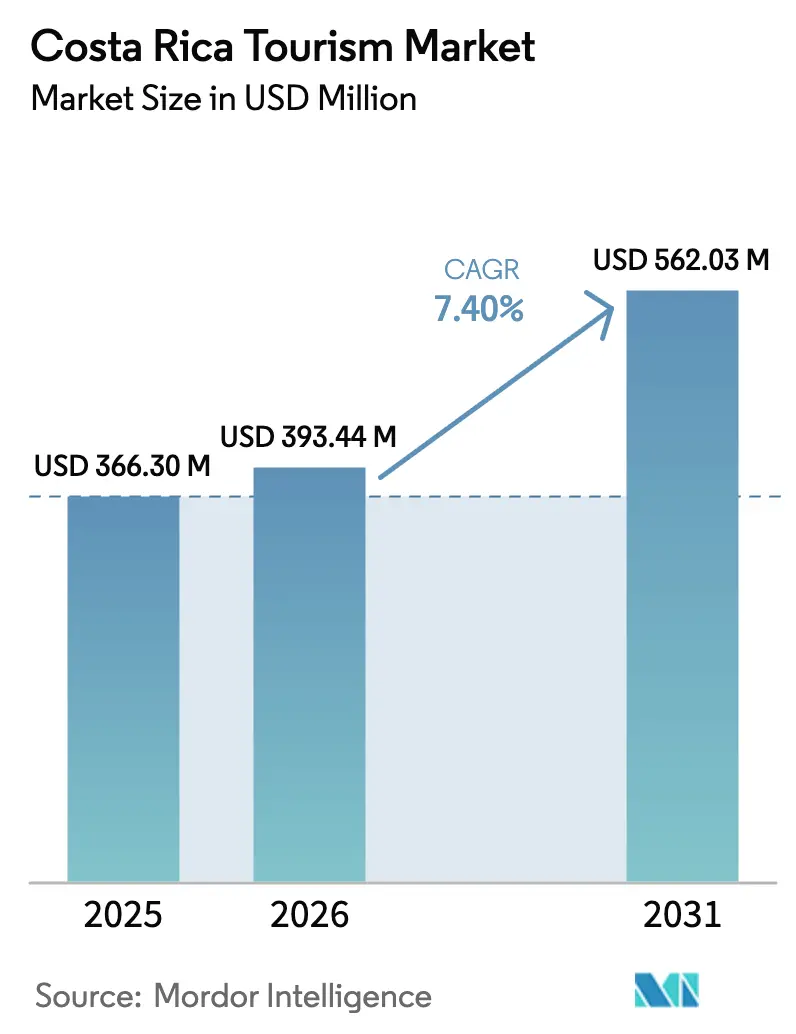
| Base Year Market Size (2025) | USD 366.30 Million |
| Market Size (2026) | USD 393.44 Million |
| Market Size (2031) | USD 562.03 Million |
| Growth Rate (2026 - 2031) | 7.40 % |
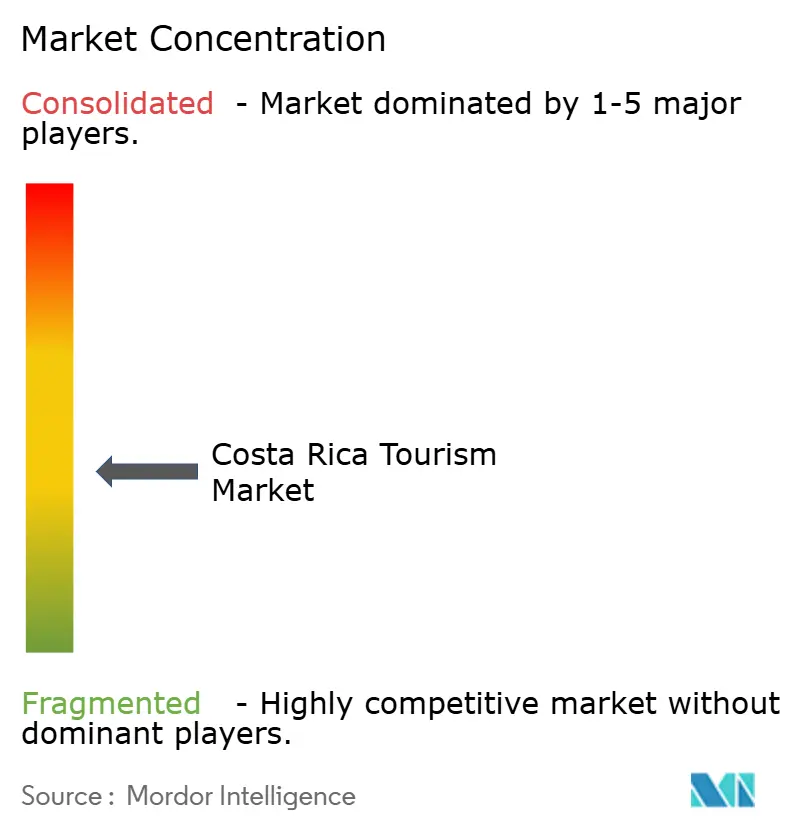
| Market Concentration | Medium |
Major Players *Disclaimer: Major Players sorted in no particular order Image © Mordor Intelligence. Reuse requires attribution under CC BY 4.0. | |
Costa Rica Tourism Market Analysis by Mordor Intelligence
The Costa Rica tourism market size was USD 366.3 million in 2025 and estimated to grow from USD 393.44 million in 2026 to reach USD 562.03 million by 2031 at a 7.4% CAGR during the forecast period (2026-2031). The Costa Rica tourism market is shifting from volume-led expansion to higher-value demand anchored in sustainability and wellness, which supports steadier yield per traveler and more resilient earnings. Expanded air links from United States cities outside the traditional Florida and Texas gateways, the maturing digital-nomad framework under Law 10008, and steady nearshoring-led business travel are diversifying demand and smoothing seasonal peaks. The Costa Rica tourism market also benefits from targeted destination branding in North America that tilts bookings toward travelers who value nature, wellness, and authentic experiences. Regenerative practices that restore ecosystems and create local economic linkages are being built into products and partnerships, which is shaping premium offerings in coastal and rainforest areas.
Key Report Takeaways
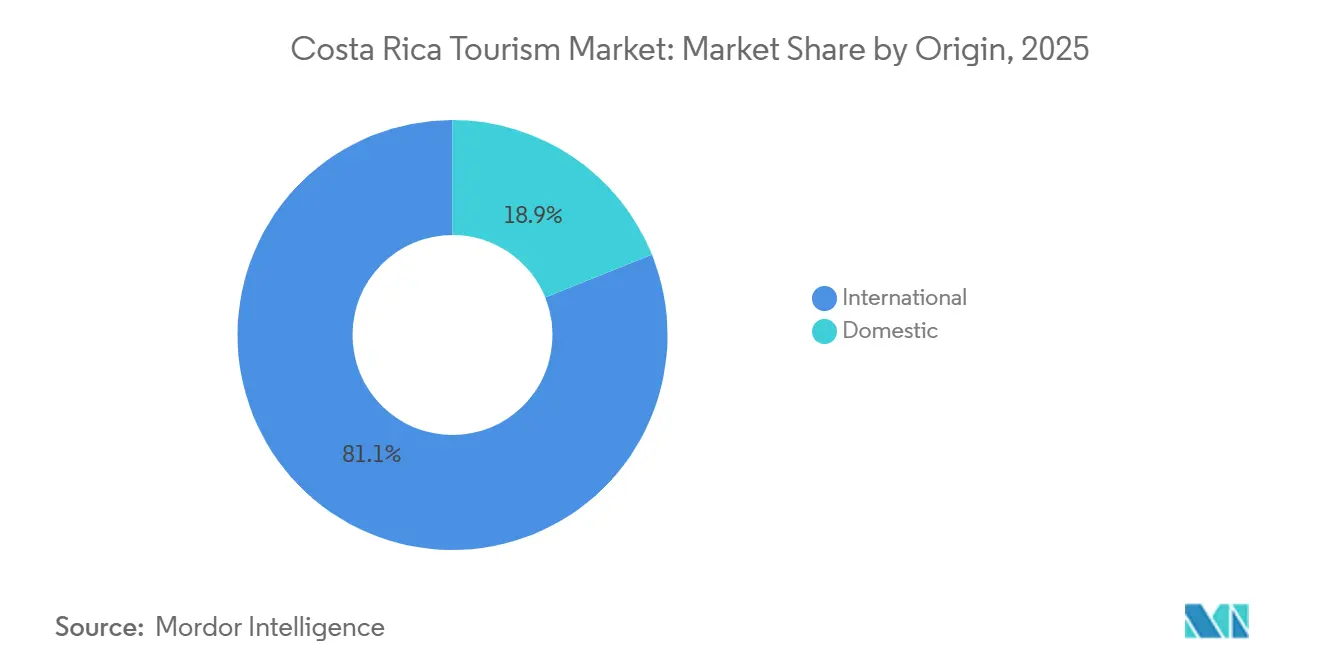
- By origin, international travelers supplied 81.10% of the Costa Rica tourism market share in 2025; domestic trips are expanding at a 9.75% CAGR through 2031.
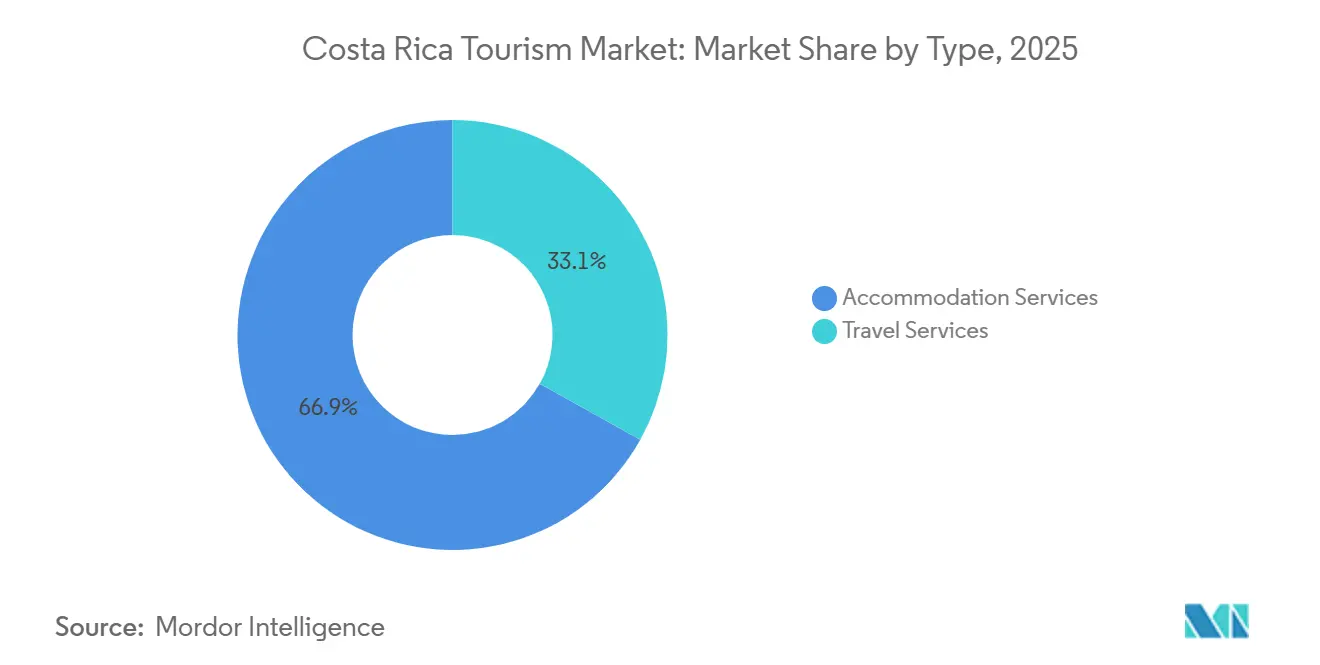
- By type, accommodation services captured 66.90% of the Costa Rica tourism market share in 2025, whereas travel services are forecast to compound at 11.40% annually through 2031.
- By purpose, leisure retained 78.30% share of the Costa Rica tourism market size in 2025; the MICE segment is advancing 13.20% per year to 2031.
Note: Market size and forecast figures in this report are generated using Mordor Intelligence’s proprietary estimation framework, updated with the latest available data and insights as of 2026.
Costa Rica Tourism Market Trends and Insights
Drivers Impact Analysis*
| Driver | (~) % Impact on CAGR Forecast | Geographic Relevance | Impact Timeline |
|---|---|---|---|
| Secondary United States cities ramp up air-lift services | +1.8% | National, with a concentration in Guanacaste and San José | Medium term (2-4 years) |
| Luxury eco-lodges proliferate in Osa & Nicoya | +1.3% | Pacific coast, Osa Peninsula, and Nicoya Peninsula | Long term (≥ 4 years) |
| ICT rebrands as “Pura Vida,” targeting premium markets | +1.0% | National, targeting North America and Europe | Short term (≤ 2 years) |
| Corporate travel surges, fueled by a near-shoring trend | +0.9% | Greater Metropolitan Area, San José and Alajuela | Medium term (2-4 years) |
| Law 10008 sees a surge in digital nomad visa applications | +1.1% | National, with early gains in Tamarindo, Nosara, and Santa Teresa | Short term (≤ 2 years) |
| DMCs introduce a growing array of regenerative tourism packages | +1.3% | National, spill-over to rural coastal communities | Long term (≥ 4 years) |
| Source: Mordor Intelligence | |||
Secondary United States cities ramp up air-lift services
United States carriers continue to improve access to Costa Rica with new and reinstated routes that reduce friction for travelers in the Northeast and Mountain West. American Airlines added Saturday-only service between Philadelphia and Liberia beginning in December 2024, creating a direct mid-Atlantic link to Guanacaste that previously required a connection[1]Source: American Airlines Newsroom, “American Airlines Expands Winter Schedule With Eight New Routes to Latin America and the Caribbean,” American Airlines, news.aa.com . Southwest scaled its Central Florida connectivity to San José as part of its 2024 schedule build, adding another non-legacy option from a major leisure origin. These city-pair additions complement core gateways, which help the Costa Rica tourism market tap demand pools not tied to Miami, Dallas, or Houston. As schedules stabilize, airlines and destination partners can co-market shoulder-season trips around nature, wellness, and active pursuits to support year-round yields. Airline industry momentum and disciplined capacity deployment continue to underpin the diversification of arrivals to the Costa Rica tourism market.
Luxury eco-lodges proliferate in Osa & Nicoya
Integrated luxury and wellness investments on the Pacific coast are reinforcing Costa Rica’s premium positioning while deepening local linkages. Peninsula Papagayo opened Papagayo Park in December 2025, a 23-acre social and wellness hub designed to anchor community life for guests of Four Seasons, Andaz, and Ritz-Carlton Reserve, and to broaden on-site experiences that capture more guest spend[2]Source: Peninsula Papagayo, “Papagayo Park to Open December 2025,” PR Newswire, prnewswire.com . Four Seasons Peninsula Papagayo expanded curated wellness and performance offerings for 2026 through visiting practitioners and programming, signaling continued escalation of medical-grade and biofeedback-informed experiences at the top end[3]Source: Four Seasons Press Room, “Visiting Wellness Practitioners 2026,” Four Seasons, press.fourseasons.com . Operators that align conservation outcomes with guest participation are differentiating room product and rate strategy. Partnerships that link marine and rainforest restoration to guest education, such as Nayara Resorts’ January 2026 collaboration with One Ocean Planet, reinforce place-based narratives and deepen willingness to pay. As these properties cluster in Osa and Nicoya, destination development shifts toward integrated resort ecosystems with bundled dining, activity, and wellness, which reduces leakage and stabilizes the Costa Rica tourism market during shoulder months. The overall effect is a sustained lift in average spend that aligns with conservation finance and community outcomes.
ICT rebrands as “Pura Vida” targeting premium markets
Destination promotion is focusing on segments that value biodiversity, wellness, and authentic culture, which aligns with higher ADR properties and regenerative itineraries. Campaign work across Canada and the United States is designed to pre-qualify travelers who prioritize nature and wellness, which improves conversion for premium eco-lodges and branded resorts. Messaging that pairs national parks, cloud forests, and Pacific beaches with wellness and soft adventure helps the Costa Rica tourism market draw longer stays during shoulder periods. The approach aims to lift spend per arrival rather than counting on pure volume increases, which reduces stress on core infrastructure. Coordination with regional partners for multi-country circuits can further mitigate seasonality by appealing to travelers on multi-week trips. Institutions that promote responsible investment and sustainable growth in tourism underscore the importance of this strategy in maintaining quality and competitiveness for the Costa Rica tourism market.
Corporate travel surges, fueled by a near-shoring trend
Foreign direct investment momentum is strengthening the base of business travel, extended stays, and incentive events. Costa Rica recorded 73 new investment projects supported by CINDE in 2024, including 52 reinvestments, reflecting resilience in services and life sciences and supporting continuous flows of corporate travelers and project teams[4]Source: CINDE via PR Newswire, “Costa Rica Maintains Strong FDI Momentum,” PR Newswire, prnewswire.com . MICE specialists and destination partners are expanding partnership networks to meet rising demand for complex corporate programs. On the Pacific coast, integrated resort ecosystems provide scale, indoor-outdoor venues, and ready access to team-building activities, which elevate Costa Rica’s attractiveness for incentives within the Americas. Operational reliability remains essential for corporate planners, so continued improvements in aviation handling and ground services support the Costa Rica tourism market during peak event periods. Ongoing investment promotion and a pro-business services base continue to channel corporate demand into hotels, DMCs, and transport providers across the Greater Metropolitan Area and Guanacaste.
Restraints Impact Analysis*
| Restraint | (~) % Impact on CAGR Forecast | Geographic Relevance | Impact Timeline |
|---|---|---|---|
| Airport slots become scarce at SJO & LIR | -0.8% | National, affecting Juan Santamaría and Guanacaste airports | Short term (≤ 2 years) |
| Proposals for eco-taxes on protected areas gain momentum | -0.5% | National, with a concentration in high-visit parks | Medium term (2-4 years) |
| Hotel ADR inflation outpaces regional peers during peak season | -0.9% | Guanacaste, Central Pacific coast | Short term (≤ 2 years) |
| Cruise-port berthing depth faces limitations | -0.3% | Limón on the Caribbean and Puntarenas on the Pacific | Long term (≥ 4 years) |
| Source: Mordor Intelligence | |||
Airport slots become scarce at SJO & LIR
Tight operating windows and ground-capacity constraints during peak periods can increase schedule risk and limit flexibility for premium segments. Private aviation flows associated with incentives and high-net-worth travel are particularly sensitive to on-the-day approvals and handling bottlenecks. New handling capacity and a dedicated general and business aviation terminal planned for Guanacaste Airport in 2026 are intended to add premium processing, on-site customs and immigration, and electric vehicle charging to improve throughput. Even with incremental facilities, coordinated slot management remains necessary to sustain on-time performance during holiday peaks. The Costa Rica tourism market needs predictable airport operations to protect its reliability premium for MICE and luxury segments. Aviation service upgrades can mitigate pressure, although structural peak-season surges require disciplined planning between airports, handlers, and airlines.
Proposals for eco-taxes on protected areas gain momentum
Entry fees for protected areas create essential revenue for conservation, but higher charges can test price sensitivity among backpackers and families. Costa Rica’s park system is exploring a future-flows securitization model that dedicates a portion of entrance-fee revenue to repay bonds raised for trail repairs, ranger stations, and basic services. Published park admission structures distinguish between foreigners and citizens and help fund conservation, though any changes must be weighed against accessibility for value-focused travelers. Clear communication of how fees are invested can improve acceptance and sustain visitation to flagship parks and reserves. Enforcement measures that address illegal entry and unauthorized guiding protect ecosystems and visitor safety when aligned with transparent park management. Over time, predictable funding and fair enforcement will support quality upgrades that benefit both conservation and the Costa Rica tourism market.
*Our forecasts treat driver/restraint impacts as directional, not additive. The impact forecasts reflect baseline growth, mix effects, and variable interactions.
Segment Analysis
By Origin: United State Arrivals Stagnate While Domestic Trips Surge
International travelers held 81.10% of the Costa Rica tourism market share in 2025, while domestic trips are projected to grow at 9.75% CAGR through 2031, which reshapes the Costa Rica tourism market toward a more balanced demand base. The Costa Rica tourism market is therefore less tied to foreign-currency swings, as rising local purchasing power supplies parallel revenue that smooths seasonality. Domestic weekend travel to national parks and cloud forests is filling mid-week gaps that once depended on long-haul leisure. Improved air access from non-traditional United States cities and selective reinstatement of transnational routes broaden exposure for the Costa Rica tourism market beyond Florida and Texas feeder hubs. Targeted destination messaging in North America is steering higher-value travelers toward nature and wellness experiences that fit Costa Rica’s positioning.
Domestic growth is also supported by the digital-nomad framework that lengthens stays and disperses spending to local communities, which helps stabilize occupancy outside peak holiday windows. As these trends compound, the Costa Rica tourism market can pursue yield over pure headcount by tailoring products and rates to each origin segment. The Costa Rica tourism market is also building resilience by aligning local travel with conservation and regenerative initiatives that enhance visitor experiences over time. With international demand still dominant and domestic trips compounding, channel mix will matter more for pricing power and midweek utilization in the Costa Rica tourism industry. The outcome is a more diversified Costa Rica tourism market that can withstand demand shocks and currency volatility without sacrificing service quality.



By Type: Travel Services Outpace Accommodation as Infrastructure Bottlenecks Ease
Accommodation services captured 66.90% of the Costa Rica tourism market size in 2025, while travel services are set to grow at 11.40% CAGR through 2031 as mobility and activity providers scale to meet demand. The Costa Rica tourism market is benefiting from aviation and ground-handling upgrades that improve reliability for groups and premium independent travelers. New business-aviation capabilities at Guanacaste Airport are slated to add specialized processing and amenities in 2026, which should support incentive programs and high-net-worth itineraries. Airline additions like the Philadelphia to Liberia service enhance access for travelers in the mid-Atlantic, which raises utilization for local ground transport and tour operators in Guanacaste.
Destination management companies are expanding partnerships and capabilities to serve complex programs, which channels more spend into transport fleets, guides, and curated activities. Wellness-led programming at leading coastal resorts also increases demand for specialized experiences that complement room revenue and keep guests on property longer. The Costa Rica tourism market is therefore seeing stronger growth in travel services as travelers mix self-drive, private transfers, and curated excursions for cloud forests, volcanoes, and marine reserves. As transport and marina infrastructure scales in phases, DMCs and local operators gain more room to differentiate with regenerative and community-linked offerings that align with conservation finance. These shifts reinforce the Costa Rica tourism market by increasing the share of spend captured by local mobility and activity providers.
By Purpose: MICE Segment Advances as Corporate Travel Rebounds
Leisure retained 78.30% of the Costa Rica tourism market size in 2025, while MICE demand is expanding at 13.20% CAGR to 2031 as nearshoring and corporate reinvestment lift event volumes and trip frequency. MICE specialists with long-standing destination expertise have strengthened their credentials through international awards and nominations, which signal readiness to manage complex itineraries and large groups across multiple provinces. As investment promotion delivers new projects and reinvestments, a steady pipeline of meetings, site visits, and incentive trips supports growth in premium coastal venues and extended-stay urban properties.
The Costa Rica tourism market benefits from indoor-outdoor venues that combine meeting facilities with access to national parks, beaches, and cultural sites suited to team-building. Destination partners that integrate wellness, sustainability, and data privacy practices into event operations are better positioned to win multinational programs. As air and ground services improve and venue capacity deepens, the MICE mix lift should persist alongside core leisure demand in the Costa Rica tourism market. Stronger MICE foundations also help stabilize off-peak hotel utilization and lift ancillary revenue streams for DMCs and transport providers. The net result is a more balanced Costa Rica tourism market where leisure’s dominant base is complemented by a rising business-events engine.
Geography Analysis
Guanacaste remains the flagship for upper-upscale and luxury supply within the Costa Rica tourism market, anchored by Peninsula Papagayo’s branded resorts and growing on-site amenity clusters. The opening of Papagayo Park in December 2025 added a 23-acre wellness and social hub to the peninsula, reinforcing integrated programming that keeps spend in-destination and supports extended stays. Ongoing wellness evolution at leading properties, including curated practitioners and performance-focused services, helps Guanacaste maintain its premium positioning through peak and shoulder months. Additional aviation handling upgrades planned for Liberia support premium segments and improve the on-the-ground experience for incentives and private travelers, which benefits the Costa Rica tourism market.
The Central Pacific corridor, including Manuel Antonio and Jacó, strengthens the Costa Rica tourism market with a blend of boutique luxury, wildlife access, and beach proximity that supports three to five-night itineraries. Conservation-minded developments and eco-certified operators leverage proximity to protected areas to deliver guided experiences that differentiate beyond sun-and-sand. Public finance mechanisms tied to park admissions are set to upgrade basic facilities and trail networks, which can improve visitor flow and interpretation quality. As digital nomads and longer-stay guests extend their time in cooler microclimates and cloud forests, places such as Monteverde and the Northern Plains attract wellness and nature enthusiasts who value biodiversity access over nightlife. The Costa Rica tourism market gains from this dispersion as local businesses capture additional mid-week trade linked to longer stays.
On the Caribbean and southern Pacific coasts, the Costa Rica tourism market faces infrastructure constraints that cap cruise and marina throughput, yet this also points to a strategic pivot toward ultra-luxury yachting and high-touch eco-excursions. Regional development priorities emphasize resilience and sustainability, which can direct capital to projects that balance access with environmental safeguards. Over time, investments that deepen berths, improve tender logistics, and expand marina services will raise per-guest spend and strengthen local linkages. As these improvements phase in, the Costa Rica tourism market may see a rising share of premium maritime traffic that aligns well with regenerative land-based experiences. Coordinated planning between conservation authorities and destination partners will be key to protect ecosystem integrity while enhancing visitor experience quality.
Competitive Landscape
The Costa Rica tourism market is moderately fragmented, with global brands anchoring luxury and upper-upscale supply in Guanacaste and boutique eco-lodges leading in remote coastal and rainforest locations. Four Seasons Peninsula Papagayo continues to enhance wellness and performance programming, a signal that premium competition is shifting toward medically informed and results-based offerings that can support ADR integrity. Integrated coastal ecosystems with bundled dining, activities, and wellness, such as the 23-acre Papagayo Park, capture a greater share of guest spend and length of stay. DMCs with long track records in the destination emphasize exclusivity and program execution for large groups, reinforced by international recognition and a growing partner network.
Repositioning activity in the lifestyle and hybrid hostel-hotel space is reshaping mid-tier inventory that had historically anchored digital-nomad demand. The Socialtel brand rollout across former Selina assets signals a shift toward higher-energy food and beverage venues and away from large-format co-working spaces, which influences how longer-stay remote workers engage with local neighborhoods. At the high end, operators and asset owners are aligning with marine and rainforest NGOs to integrate education and stewardship into premium stays, which bolsters authenticity for eco-conscious guests. These moves help the Costa Rica tourism market lean into regenerative narratives that resonate with affluent travelers who want active participation and clear impact.
Aviation services are also part of the competitive equation, as premium handling and dedicated facilities improve guest experience for high-net-worth travelers and incentive groups. The planned general and business aviation terminal at Liberia is a clear example of private-sector investment that strengthens service reliability and throughput in a peak-demand gateway. Combined with targeted airline additions such as Philadelphia to Liberia, these service enhancements broaden the attainable market for upscale and MICE-focused properties and DMCs. Over the forecast horizon, operators that blend verified sustainability, wellness depth, and reliable logistics will be best positioned to grow share in the Costa Rica tourism market. Public and blended finance for protected areas can further support experience quality and safeguard the natural assets on which long-term competitiveness depends.
Costa Rica Tourism Industry Leaders
Marriott International
Hilton Worldwide
Four Seasons Hotels & Resorts
Swiss Travel Service
Selina Hospitality
- *Disclaimer: Major Players sorted in no particular order

Recent Industry Developments
- January 2026: Nayara Resorts announced a partnership with One Ocean Planet for coral reef restoration and rainforest conservation, launching the “One Ocean Nayara Stewardship Lab” to embed education and action into guest experiences.
- December 2025: Peninsula Papagayo opened Papagayo Park, a USD 26 million, 23-acre social, wellness, and recreation hub adding community-scale amenities for members and guests of Four Seasons, Andaz, and Ritz-Carlton Reserve.
- June 2025: Four Seasons Resort Peninsula Papagayo launched “Choose Your Pura Vida” summer programming, reinforcing its wellness-led value proposition with curated culinary and performance experiences.
- March 2025: Global DMC Partners added TE DMC in Costa Rica to its worldwide network, strengthening MICE execution and multi-destination program capabilities.


Costa Rica Tourism Market Report Scope
The Costa Rica Tourism Market can be segmented on the basis of type (local/domestic, international) and by purpose (Adventure, Business, Medical, Sea Farming, and others).
Costa Rica is located in parts of North America and the Central American region. Market prospects are excellent in a variety of sectors, including building products, construction equipment, hotel and restaurant equipment, solar energy, franchising, cosmetics, auto parts and service equipment, electric vehicles and related equipment, pharmaceuticals, packaging, education, and tourism to the Costa Rica market. The report offers market size and forecasts for the US Real Estate Services Market in value (USD) for all the above segments.
| Domestic |
| International |
| Accommodation Services |
| Travel Services |
| Leisure |
| Business |
| Visiting Friends & Relatives (VFR) |
| Religious |
| Meetings-Incentives-Conferences-Exhibitions (MICE) |
| Other Purposes |
| By Origin | Domestic |
| International | |
| By Type | Accommodation Services |
| Travel Services | |
| By Purpose | Leisure |
| Business | |
| Visiting Friends & Relatives (VFR) | |
| Religious | |
| Meetings-Incentives-Conferences-Exhibitions (MICE) | |
| Other Purposes |


Key Questions Answered in the Report
What is the current size and growth outlook for the Costa Rica tourism market?
The Costa Rica tourism market size reached USD 366.3 million in 2025 and is projected to reach USD 562.03 million by 2031 at a 7.4% CAGR.
Which demand segments are growing fastest in Costa Rica?
MICE is the fastest-growing purpose segment at 13.20% CAGR, and travel services lead by type at 11.40% CAGR to 2031, driven by corporate travel and expanding mobility and activity options.
How is air connectivity evolving for Costa Rica?
New and reinstated routes such as American Airlines’ Philadelphia–Liberia service, plus improvements in business-aviation handling in Guanacaste, are broadening access and supporting premium and group travel.
What role does the digital-nomad visa play in Costa Rica?
Law 10008 enables one-year renewable stays with tax exemptions on foreign income and duty-free import of work equipment, which supports longer visits that fill shoulder periods and disperse spending locally.
Where is luxury and wellness supply most concentrated?
Guanacaste, led by Peninsula Papagayo’s integrated resort ecosystem and expanding wellness programming, anchors upper-upscale and luxury capacity that reinforces premium positioning.
How is conservation finance shaping visitor experiences?
Future-flows securitization of park admission revenue will fund trails, ranger stations, and basic services, strengthening protected-area experiences while supporting conservation outcomes.
Page last updated on:


 Your data is secure and never sold or shared.


