
Corrosion-resistant Resin Market Size and Share
Market Overview
| Study Period | 2020 - 2031 |
|---|---|
| Market Size (2026) | USD 11.11 Billion |
| Market Size (2031) | USD 14.33 Billion |
| Growth Rate (2026 - 2031) | 5.22 % |
| Fastest Growing Market | Asia Pacific |
| Largest Market | Asia Pacific |
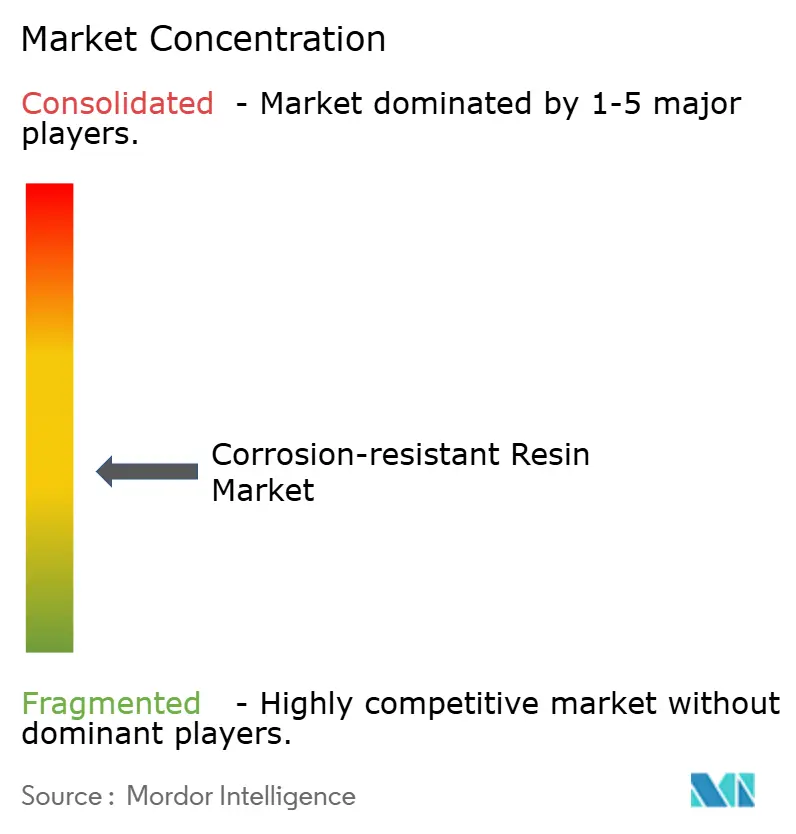
| Market Concentration | Medium |
Major Players *Disclaimer: Major Players sorted in no particular order Image © Mordor Intelligence. Reuse requires attribution under CC BY 4.0. | |
Corrosion-resistant Resin Market Analysis by Mordor Intelligence
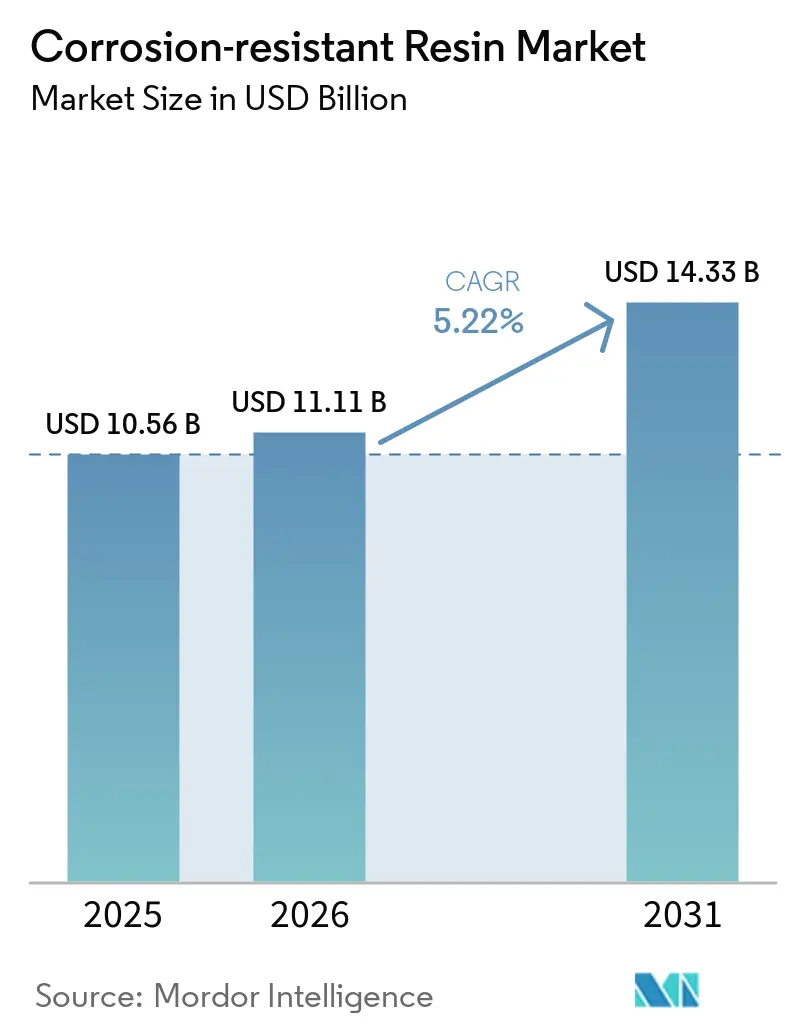
The Corrosion-resistant Resin market size in 2026 is estimated at USD 11.11 Billion, growing from 2025 value of USD 10.56 Billion with 2031 projections showing USD 14.33 Billion, growing at 5.22% CAGR over 2026-2031. The principal growth engines are intensifying corrosion-related capital and operating expenses in oil and gas pipeline infrastructure, wider adoption of lightweight composites in renewable energy, and stricter environmental rules for marine coatings. Technological advances in epoxy, vinyl-ester, and polyurethane chemistries expand performance envelopes while lowering end-user lifecycle costs. Regional investment programs, especially in Asia Pacific, are scaling local resin blending capacity, easing supply constraints, and accelerating application development. At the same time, regulatory scrutiny of bisphenol-A and volatility in methylene diphenyl di-isocyanate (MDI) pricing are prompting formulators to diversify feedstocks and explore bio-based pathways. Competitive rivalry remains moderate because intellectual-property-protected chemistries provide differentiated value; however, new entrants with sustainable formulations are beginning to chip away at legacy positions.
Key Report Takeaways
- By resin type, epoxy resins led with 42.38% of the Corrosion-resistant Resin market share in 2025, whereas polyurethane recorded the fastest projected CAGR at 5.74% through 2031.
- By application, composites accounted for 41.07% share of the Corrosion-resistant Resin market size in 2025, while coatings are expected to expand at a 5.86% CAGR to 2031.
- By end-user industry, oil and gas held 30.02% share of the Corrosion-resistant Resin market in 2025; marine applications are forecast to grow at 6.08% CAGR through 2031.
- By geography, Asia Pacific contributed 38.21% revenue in 2025 and is projected to advance at a 6.35% CAGR between 2026 and 2031.
Note: Market size and forecast figures in this report are generated using Mordor Intelligence’s proprietary estimation framework, updated with the latest available data and insights as of 2026.
Market Trends and Insights
Drivers Impact Analysis of Corrosion-resistant Resin Market*
| Driver | (~) % Impact on CAGR Forecast | Geographic Relevance | Impact Timeline |
|---|---|---|---|
| Increasing Demand for Epoxy Resins | +1.8% | Global, led by Asia Pacific and North America | Medium term (2-4 years) |
| Rising Corrosion-related CAPEX and OPEX in Oil & Gas Pipelines | +1.2% | Middle East, North America, offshore regions | Long term (≥ 4 years) |
| Light-weighting Trend in Wind-blade Composites | +0.9% | Europe, Asia Pacific, North America | Medium term (2-4 years) |
| Mainstream Shift to Water-borne Vinyl-ester Systems in Marine | +0.7% | Global maritime hubs | Short term (≤ 2 years) |
| Localized Resin Blenders Emerging Around Middle-east Tank-farm Clusters | +0.4% | Middle East and North Africa | Long term (≥ 4 years) |
| Source: Mordor Intelligence | |||
Increasing Demand for Epoxy Resins
Epoxy resins continue to redefine corrosion management because nano-silica-filled matrices are delivering higher barrier performance and longer service intervals. Fluorescence-enabled coatings allow visual detection of microcracks, supporting proactive maintenance on offshore platforms where inspection windows are limited [1]R. Lopez et al., “Fluorescence-Based Corrosion Detection in Epoxy Systems,” ScienceDirect, sciencedirect.com. Regulators’ focus on sustainability is catalyzing commercial roll-out of vegetable-oil-derived epoxies that match incumbent mechanical properties while lowering carbon footprints. Self-healing chemistries that trigger inhibitor release in response to temperature spikes are further positioning epoxies as the workhorse for next-generation protective systems. Collectively, these advances boost asset uptime and compress total cost of ownership for heavy-industry end-users.
Rising Corrosion-related CAPEX (Capital Expenditures) and OPEX (Operational Expenditures) in Oil & Gas Pipelines
Pipeline operators confront corrosion costs of roughly USD 1.372 Billion annually, prompting adoption of nonmetallic pipe networks and advanced resin-rich liners. Aramco has already installed over 10,000 km of reinforced thermoplastic pipe to mitigate sweet-gas corrosion in desert and offshore environments. New resin systems qualified for 198.33 MPa and 352.25°C downhole conditions are unlocking deep-reservoir completions while reducing downtime linked to tubing failures. Response-surface corrosion modelling lets engineers tailor resin selection to local chloride and CO₂ levels, lowering lifecycle spend and enhancing safety metrics. These economics underpin sustained purchasing of high-performance corrosion-resistant resin market solutions by energy majors.
Lightweighting Trend in Wind-blade Composites
Wind-turbine manufacturers are scaling blade lengths beyond 100 m, so reducing mass without sacrificing stiffness is paramount. Polyurethane infusion resins provide 10–25% higher tensile strength than legacy epoxies and can trim lay-up cycle times by 15%, lowering the cost per kilowatt. Natural-fiber-reinforced thermoplastics such as flax/polypropylene panels achieve up to 40% weight reduction with full recyclability, aligning with circular-economy targets. Offshore installations favour vinyl-ester matrices given their fatigue resistance in high-humidity environments, extending maintenance intervals for floating platforms. Bio-based polyesters derived from sugars (e.g., PECAN) are emerging as end-of-life-friendly alternatives that retain mechanical integrity for 20-year blade life cycles.
Mainstream Shift to Water-borne Vinyl-ester Systems in Marine
Ballast-tank standards now require 15-year coating durability, pushing yards toward low-volatile organic compound (VOC) water-borne vinyl-ester technologies that outlast solvent-borne predecessors. Proprietary epoxy blends anchored by covalent-bond topcoats are achieving 20–30-year lifespans with minimal rust creep, trimming dry-dock frequency for shipowners. Silver metal-organic frameworks dispersed at 0.5 wt% within acrylic binders have demonstrated antifouling efficacy while curbing biocide leaching. Glass-flake vinyl esters add a tortuous-path barrier, cutting moisture ingress and maintaining gloss retention in polar trades. The net result is faster compliance with tightening emission and waste-water discharge rules across global fleets.
Restraints Impact Analysis of Corrosion-resistant Resin Market*
| Restraint | (~) % Impact on CAGR Forecast | Geographic Relevance | Impact Timeline |
|---|---|---|---|
| REACH and TSCA re-classification of bisphenol-a | -0.8% | Europe, North America | Short term (≤ 2 years) |
| Volatile MDI prices | -0.6% | Global | Medium term (2-4 years) |
| Lack of skilled composite fabricators in Middle East & Africa | -0.3% | Middle East and Africa | Long term (≥ 4 years) |
| Source: Mordor Intelligence | |||
REACH and TSCA Re-classification of Bisphenol-a
Europe’s sharp reduction of Bisphenol-A (BPA) tolerable daily intake and the United States’ antidumping levies on Asian epoxy imports are forcing formulators to pivot toward Bisphenol A (BPA)-free chemistries. Sherwin-Williams and PPG Industries, Inc. now market non-Bisphenol A (BPA) container linings, while Roquette’s isosorbide-based hardeners preserve chemical resistance without endocrine-disruption concerns [2]Federal Register, “Epoxy Resin Antidumping Duty Orders,” federalregister.gov. Supply uncertainty during the transition period elevates production costs and may slow qualification cycles for new aerospace and food-contact applications.
Volatile MDI Prices
Pure MDI consumption hit 434.9 Million lb in 2023, yet concentrated producer bases and logistical bottlenecks triggered price swings that compressed polyurethane resin margins. BASF’s research and development (R&D) into bio-attributed MDI and mass-balance certification aims to buffer volatility and meet scope-3 decarbonization expectations BASF. Polyurethane formulators increasingly hedge feedstock risk via long-term offtake contracts or by transitioning select product lines to hybrid epoxy-urethane networks that tolerate broader raw-material windows.
*Our forecasts treat driver/restraint impacts as directional, not additive. The impact forecasts reflect baseline growth, mix effects, and variable interactions.
Corrosion-resistant Resin Market Segment Analysis
By Resin Type:
Epoxy Dominance Drives InnovationThe epoxy segment commanded 42.38% of the Corrosion-resistant Resin market share in 2025, anchored by its bonding strength, chemical inertness, and adaptability across marine, oil and gas, and infrastructure projects. Epoxy-based formulations infused with bis-silane modifiers now achieve self-healing rates above 90% after salt-spray exposure, extending maintenance intervals for offshore installations. Polyurethane’s 5.74% CAGR reflects its rapid curing, which cuts blade cycle times and lowers capital tied up in molds, propelling its use in 100-m class wind blades. Vinyl esters retain a foothold in chemical-tank fabrication because their ester linkage tolerates acids and solvents that attack conventional polyesters.
Emerging smart-resin platforms integrate fluorescent tracers for early-stage crack visibility and temperature-responsive inhibitor release, supporting predictive maintenance programs that slash unplanned downtime by up to 25% for refinery operators. These advances reinforce epoxy’s premium positioning even as alternative chemistries race to close performance gaps.




By Application:
Composites Lead While Coatings AccelerateComposites captured 41.07% of the Corrosion-resistant Resin market size in 2025, buoyed by wind, pipe, and storage-tank projects that demand lightweight strength and corrosion immunity. Glass-fiber-reinforced epoxy pipelines deliver 20-year lifecycles with 50% lower installation weight than metallic pipe, directly translating to lower transport and lay costs for desert oilfields. Coatings, posting a 5.86% CAGR, are advancing through water-borne vinyl-ester systems that meet VOC caps while matching the abrasion resistance of solvent-borne predecessors. High-build, non-atomizing spray techniques minimize overspray and hazardous air pollutants, improving operator safety and paint-shop throughput. Adhesives and linings, though smaller in absolute demand, are exploiting niche repair scenarios where composite sleeves reinforce live pipelines, eliminating hot-work permits and cutting downtime by 70%.
By End-User Industry:
Oil & Gas Drives Demand, Marine Shows PromiseOil and gas applications dominate with a 30.02% market share in 2025, reflecting the industry's substantial corrosion-related expenditures and strategic shift toward nonmetallic pipeline and processing infrastructure solutions. Aramco's extensive deployment of over 10,000 km of nonmetallic pipes and ongoing investments in corrosion-immune technologies reinforce the segment's leadership. Marine applications exhibit the fastest growth at 6.08% CAGR through 2031, driven by stringent International Maritime Organization (IMO) regulations mandating 15-year service life requirements for protective coatings and the industry's transition toward environmentally compliant antifouling systems.
Automotive and transportation segments are experiencing transformation through lightweighting initiatives and electric vehicle adoption, creating new opportunities for advanced composite materials. Infrastructure applications benefit from aging asset replacement cycles and increasing emphasis on lifecycle cost optimization in public works projects. Food and beverage industries represent emerging opportunities as regulatory standards for food-contact materials drive demand for specialized corrosion-resistant formulations that meet stringent safety requirements while providing long-term durability.

Geography Analysis
APAC Corrosion-resistant Resin Market
Asia Pacific accounted for 38.21% of the Corrosion-resistant Resin market revenue in 2025 and is projected to expand at a 6.35% CAGR to 2031, cementing its leadership position. China’s annual installation of over 30 GW of new wind capacity drives bulk consumption of glass-fiber-epoxy resins for blades and nacelles. India’s contract manufacturing, highlighted by Kineco Exel’s qualification for Vestas carbon-fiber planks, signals rising local value-addition in advanced composites. Taiwan’s Swancor supplies more than 50% of material input for regional offshore wind projects, reflecting supply-chain maturation.
North America Corrosion-resistant Resin Market
North America captures demand through technological innovation and trade policy. United States antidumping duties on certain Asian epoxy imports shield domestic players and encourage capacity expansions, ensuring a secure supply for defense and infrastructure applications. ExxonMobil’s collaboration with McClarin Composites on polyolefin-based thermosets underscores the region’s push for lower-carbon alternatives that maintain tensile performance. BASF already operates coating plants on 100% renewable electricity, reducing scope-2 emissions while holding throughput steady.
EMEA and South America Corrosion-resistant Resin Market
Europe prioritizes sustainability and regulatory leadership, prompting rapid commercialisation of BPA-free epoxies and bio-attributed intermediates under stringent Registration, Evaluation, Authorization, and Restriction of Chemicals (REACH) frameworks. Middle East and Africa accelerate through localization plans such as Sadara’s PlasChem Park, geared toward anticorrosion products, while Strata-Solvay’s prepreg facility positions the United Arab Emirates as an aerospace material supplier. South America’s industrialization and port upgrades sustain moderate resin demand, yet the region trails in composite expertise and remains import-reliant for key intermediates.


Competitive Landscape
The Corrosion-resistant Resin market is moderately fragmented with the top producers, such as Ashland Inc., Hexion Inc., BASF, Huntsman Corporation, and Polynt S.p.A. Multinationals leverage backward integration to secure epichlorohydrin, bisphenol-a, and isocyanate supply, sheltering margins from feedstock shocks. Technology-led differentiation is evident in Hexion Inc.’s acquisition of Smartech, embedding AI-driven autonomous manufacturing that boosts reactor yield and reduces off-spec output by 12%. BASF and Huntsman Corporation focus on circular-economy initiatives such as chemical recycling of polyurethane waste, meeting downstream customer sustainability metrics. Niche formulators exploit white space in hydrogen pipelines and carbon-capture service, where extreme pressure-temperature profiles demand customized high-glass-transition-temperature epoxies. Competitive intensity is expected to rise as bio-based entrants scale pilot plants and challenge incumbents on both Environmental, Social, and Governance (ESG) and cost dimensions.
Corrosion-resistant Resin Industry Leaders
Ashland Inc.
Hexion Inc.
Huntsman Corporation
Polynt S.p.A.
BASF
- *Disclaimer: Major Players sorted in no particular order
Corrosion-resistant Resin Market Companies Covered in this Report
- Aditya Birla Chemicals
- AOC Resins
- Ashland Inc.
- BASF SE
- DIC Corporation
- Guangdong Yinyang Environment-Friendly New Materials Co., Ltd.
- Hexion Inc.
- Huntsman Corporation
- Olin Corporation
- Polynt-Reichhold Group
- Resonac
- Scott Bader Co. Ltd.
- Sino Polymer Co. Ltd.
- Sir Industriale

Recent Industry Developments in Corrosion-resistant Resin Market
- December 2024: Sir Industriale launched SIRESTER VE 64-M-140, a high-reactivity, medium-viscosity epoxy novolac vinyl ester resin with high corrosion resistance against a broad spectrum of substances, including strong acids, bases, and organic solvents diluted in styrene.
- April 2024: Guangdong Yinyang Environment-Friendly New Materials Co., Ltd. launched a water-based acrylic synthetic resin, WA-54C, for metal anti-corrosion coatings. The resin is compatible with a wide range of metal materials, including steel, aluminum, and copper, among others.


Global Corrosion-resistant Resin Market Report Scope
The corrosion-resistant resin market report includes:
| Epoxy |
| Vinyl Ester |
| Polyester |
| Polyurethane |
| Others |
| Composites |
| Coatings |
| Others (Adhesives & Linings) |
| Automotive and Transportation |
| Food and Beverage |
| Industrial |
| Infrastructure |
| Marine |
| Oil and Gas |
| Other End-user Industries |
| Asia-Pacific | China |
| Japan | |
| India | |
| South Korea | |
| ASEAN Countries | |
| Rest of Asia-Pacific | |
| North America | United States |
| Canada | |
| Mexico | |
| Europe | Germany |
| United Kingdom | |
| France | |
| Italy | |
| Spain | |
| Russia | |
| NORDIC Countries | |
| Rest of Europe | |
| South America | Brazil |
| Argentina | |
| Rest of South America | |
| Middle East and Africa | Saudi Arabia |
| South Africa | |
| Rest of Middle East and Africa |
| By Resin Type | Epoxy | |
| Vinyl Ester | ||
| Polyester | ||
| Polyurethane | ||
| Others | ||
| By Application | Composites | |
| Coatings | ||
| Others (Adhesives & Linings) | ||
| By End-User Industry | Automotive and Transportation | |
| Food and Beverage | ||
| Industrial | ||
| Infrastructure | ||
| Marine | ||
| Oil and Gas | ||
| Other End-user Industries | ||
| By Geography | Asia-Pacific | China |
| Japan | ||
| India | ||
| South Korea | ||
| ASEAN Countries | ||
| Rest of Asia-Pacific | ||
| North America | United States | |
| Canada | ||
| Mexico | ||
| Europe | Germany | |
| United Kingdom | ||
| France | ||
| Italy | ||
| Spain | ||
| Russia | ||
| NORDIC Countries | ||
| Rest of Europe | ||
| South America | Brazil | |
| Argentina | ||
| Rest of South America | ||
| Middle East and Africa | Saudi Arabia | |
| South Africa | ||
| Rest of Middle East and Africa | ||


Key Questions Answered in the Report
What is the current Corrosion-resistant Resin Market size?
The Corrosion-resistant Resin market size stands at USD 11.11 Billion in 2026 and is projected to reach USD 14.33 Billion by 2031.
Which region leads the Corrosion-resistant Resin market?
Asia Pacific holds the largest share at 38.21% in 2025 and is also the fastest-growing region with a 6.35% CAGR through 2031.
Which resin type dominates market share?
Epoxy resins dominate with 42.38% market share in 2025, supported by strong adhesion and chemical resistance.
Why are coatings the fastest-growing application?
Coatings benefit from stricter VOC regulations and wider adoption of water-borne vinyl-ester systems, supporting a 5.86% CAGR forecast to 2031.
How are regulations affecting resin formulations?
REACH and TSCA re-classification of bisphenol-a is accelerating the shift toward BPA-free and bio-based epoxies, impacting supply chains and cost structures in the short term.
Page last updated on:


 Your data is secure and never sold or shared.


