
Corneal Cross-Linking Devices Market Size and Share
Market Overview
| Study Period | 2020 - 2031 |
|---|---|
| Market Size (2026) | USD 326.62 Million |
| Market Size (2031) | USD 608.72 Million |
| Growth Rate (2026 - 2031) | 13.26 % |
| Fastest Growing Market | Asia-Pacific |
| Largest Market | North America |
| Market Concentration | Medium |
Major Players *Disclaimer: Major Players sorted in no particular order Image © Mordor Intelligence. Reuse requires attribution under CC BY 4.0. | |
Corneal Cross-Linking Devices Market Analysis by Mordor Intelligence
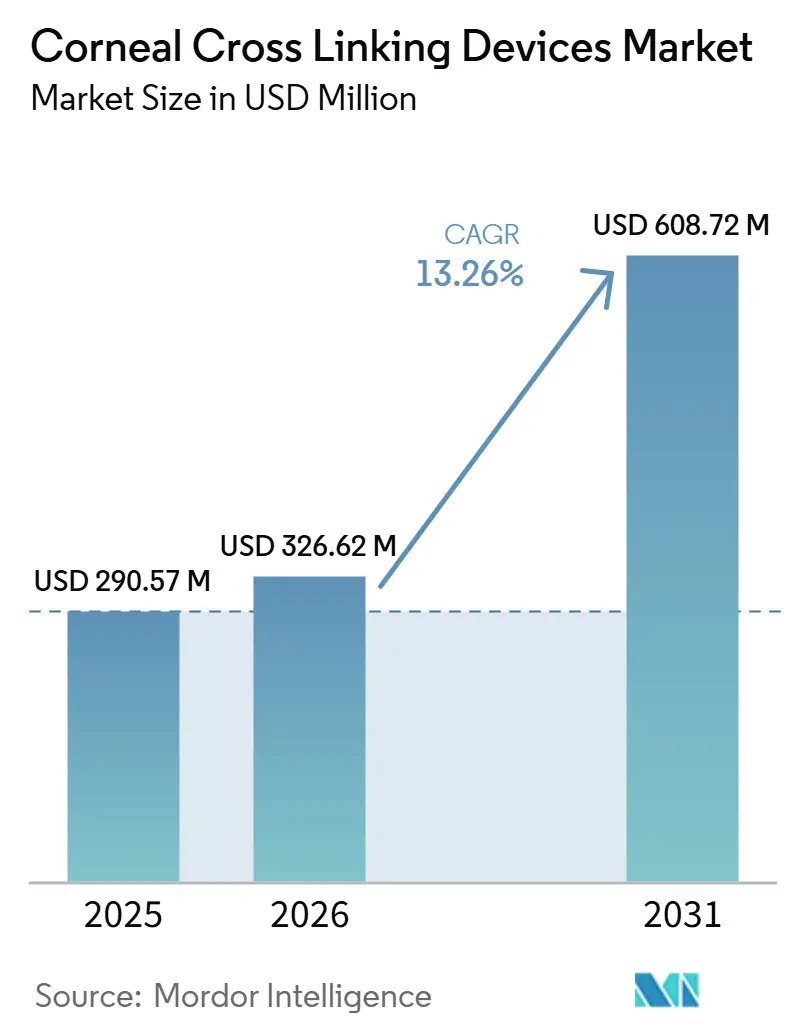
The corneal cross-linking devices market was valued at USD 290.57 million in 2025 and is projected to be valued at USD 326.62 million in 2026. It is expected to reach USD 608.72 million by 2031, registering a CAGR of 13.26% during the forecast period (2026-2031). The corneal cross-linking devices market is benefiting from a much larger diagnosed and treatable keratoconus population than older screening practices had captured, with a 2025 systematic review estimating more than 23.7 million affected people worldwide and showing especially high prevalence in South Asia. The corneal cross-linking devices market also entered a new commercial phase after the October 2025 FDA approval of Glaukos Epioxa and its March 2026 launch, because the first approved incision-free epi-on therapy removes the epithelial debridement step that had limited procedure acceptance in younger and earlier-stage patients. The corneal cross-linking devices market is further supported by a recurring revenue structure in which installed hardware drives repeat demand for riboflavin formulations and related consumables, which gives leading companies steadier cash generation than stand-alone capital equipment categories. A 2025 health economics model found lower lifetime direct medical costs and higher quality-adjusted life years for corneal cross-linking than conventional management, which strengthens the case for broader payer acceptance and supports higher-value treatment platforms over time. Growth will still be moderated by uneven reimbursement for epi-on procedures, capital cost pressure in lower-resource settings, and continued variation in treatment protocols that can slow adoption outside experienced centers.
Key Report Takeaways
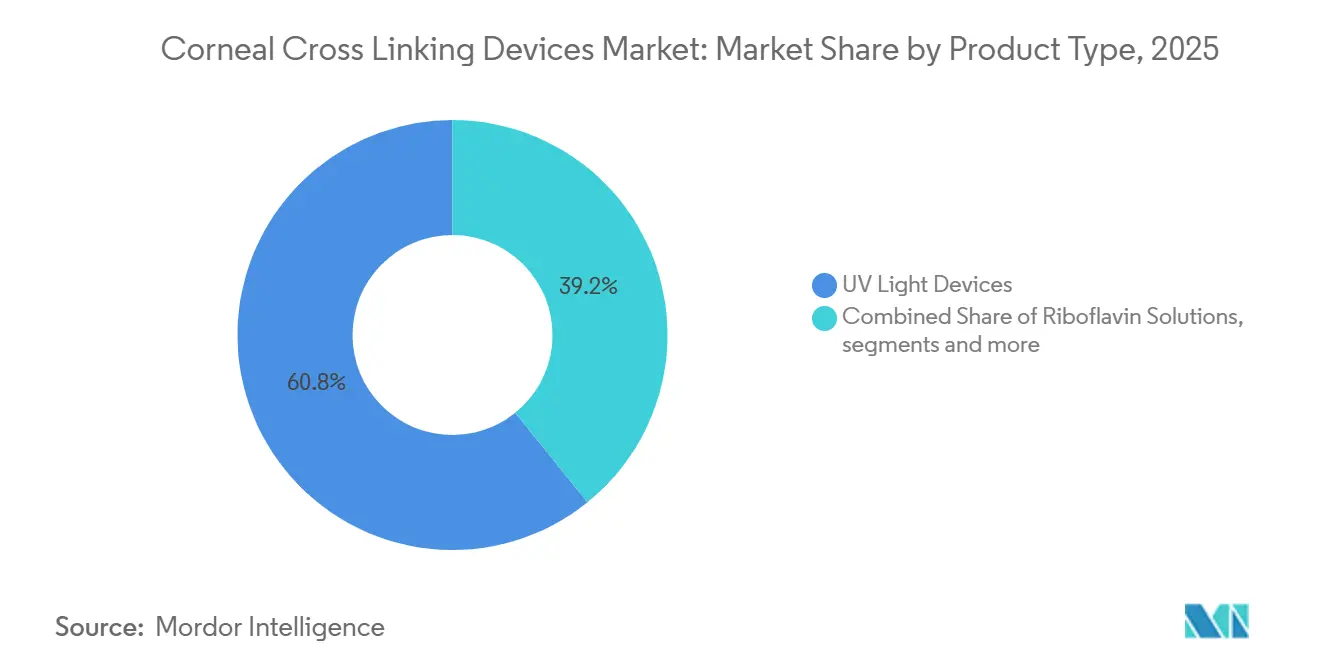
- By product type, UV light devices held 60.84% revenue share in 2025, while combination devices are forecast to grow at 14.58% CAGR through 2031.
- By application, keratoconus accounted for 52.67% of revenue in 2025, while corneal ectasia is projected to grow at 14.82% CAGR through 2031.
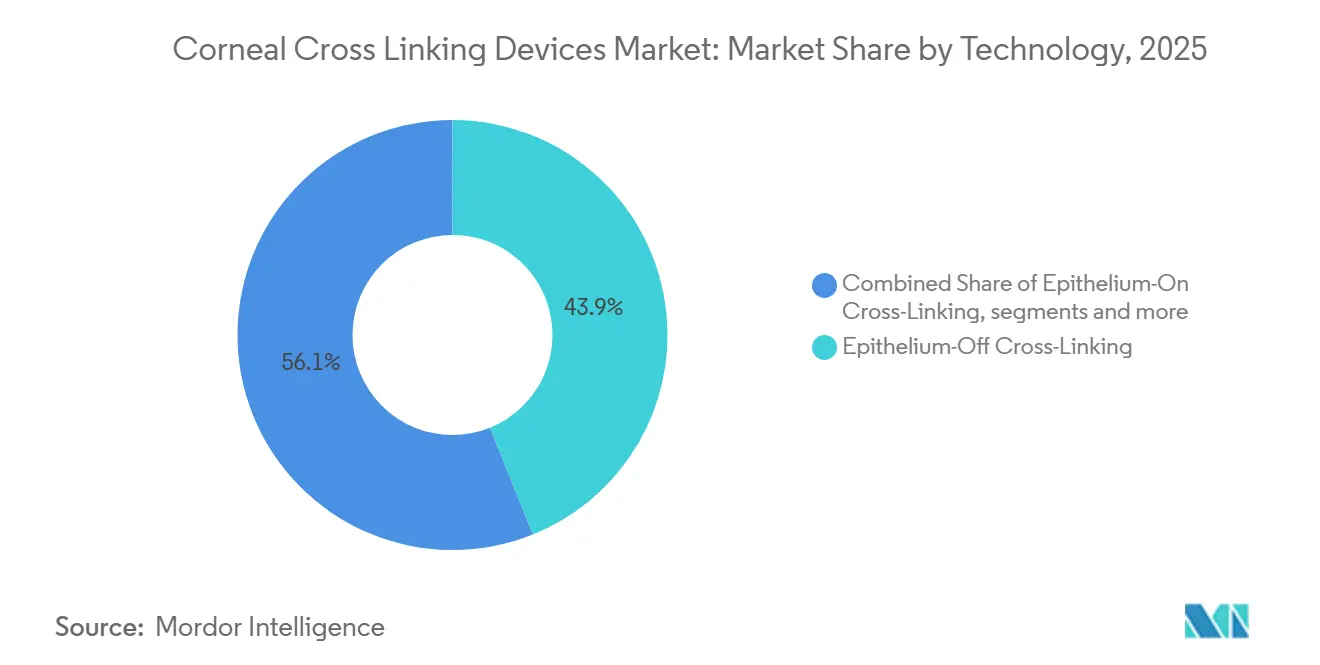
- By technology, epithelium-off cross-linking held 43.88% of revenue in 2025, while accelerated cross-linking is expected to advance at 15.24% CAGR through 2031.
- By end-user, hospitals captured 50.72% of revenue in 2025, while eye clinics are forecast to expand at 15.01% CAGR through 2031.
- By geography, North America held 48.95% of revenue in 2025, while Asia-Pacific is projected to record the fastest regional CAGR of 16.28% through 2031.
Note: Market size and forecast figures in this report are generated using Mordor Intelligence’s proprietary estimation framework, updated with the latest available data and insights as of January 2026.
Market Trends and Insights
Drivers Impact Analysis of Corneal Cross-Linking Devices Market*
| Driver | (~) % Impact on CAGR Forecast | Geographic Relevance | Impact Timeline |
|---|---|---|---|
| Rising Keratoconus Diagnosis and Earlier Intervention | +3.8% | Global, strongest in South Asia, Middle East and Africa, and East Asia | Medium term (2-4 years) |
| Shift Toward Faster, Office-Based Cross-Linking Workflows | +2.5% | North America and Europe, with early gains in urban Asia-Pacific | Short term (≤ 2 years) |
| Broader Adoption of Transepithelial and Accelerated Protocols | +2.2% | North America, Europe, and developed Asia-Pacific | Medium term (2-4 years) |
| Expansion of Corneal Screening and Topography-Led Referral Pathways | +2.0% | China, India, GCC countries, and other screening-intensive systems | Long term (≥ 4 years) |
| Recurring Riboflavin and Consumables Demand from Installed Base Growth | +1.5% | Global, with highest impact in North America | Short term (≤ 2 years) |
| AI-Guided Treatment Planning and Fluence Optimization Integration | +0.8% | North America, Europe, and urban Asia-Pacific | Long term (≥ 4 years) |
| Source: Mordor Intelligence | |||
Rising Keratoconus Diagnosis Rates
The corneal cross-linking devices market is gaining from a broader diagnostic funnel as corneal topography is being used more often in routine ophthalmic workups and pre-refractive surgery screening. A 2025 multicenter review placed pooled global keratoconus prevalence at 289.1 per 100,000 persons and estimated more than 23.7 million affected people worldwide, which materially raises the addressable treatment pool for the corneal cross-linking devices market.[1] A 2025 multicentric study from India also showed that the largest diagnosed group was 20 to 29 years old and that the mean delay from symptom onset to diagnosis was 2.7 years, which points to a large backlog of patients who can still be treated earlier than before.[2] Earlier identification matters because cross-linking is most valuable before corneal thinning and visual loss become advanced. As that clinical pattern becomes more visible to physicians and families, the corneal cross-linking devices market is likely to see stronger procedural conversion in both specialty and referral settings. The same trend also improves the commercial value of diagnostic integration, because treatment volumes increasingly depend on who can identify progression first.
Shift Toward Faster, Customized Protocols
The corneal cross-linking devices market is moving away from long, operating-room-oriented workflows and toward shorter protocols that fit office-based care. A 2026 Journal of Refractive Surgery study found no statistically significant biomechanical difference between a new epi-on protocol and a widely used accelerated epi-off protocol, which supports the clinical case for less invasive and more convenient treatment pathways.[3] EMAGine stated that its C-eye platform supports 11 preset protocols, including options intended to deliver Dresden-equivalent outcomes in less than 10 minutes, which shows how the corneal cross-linking devices market is competing on workflow efficiency as much as on treatment effect. Shorter sessions improve daily throughput, reduce patient burden, and make it easier for eye clinics to adopt treatment without dedicated operating room capacity. The commercial effect is important because faster protocols improve cost per visit and widen the range of sites that can offer care. The corneal cross-linking devices market is therefore shifting toward platforms that combine efficacy, portability, and lower procedural friction.
Broader Adoption of Therapeutic Cross-Linking
The corneal cross-linking devices market is expanding beyond a narrow keratoconus-only view and is increasingly addressing post-refractive surgery ectasia and related corneal instability states. The FDA approval of Epioxa in October 2025 also matters because the label covers keratoconus and corneal ectasia following refractive surgery, which gives the corneal cross-linking devices market a larger and more clearly defined treatment base in the United State. A 2025 health economics study further found large cost and utility advantages for cross-linking, which strengthens the case for future premium positioning once reimbursement widens. As these use cases become more established, the corneal cross-linking devices market should see more demand from clinicians managing complex corneal disease rather than only classic progressive keratoconus.
AI-Guided Treatment Planning Integration
The corneal cross-linking devices market is starting to add machine learning and connected workflow tools that reduce dependence on highly specialized operator judgment. A registered 2026 clinical trial is evaluating a multi-agent AI diagnostic workflow that combines corneal topography, pachymetry, and biometry to generate structured staging and treatment recommendations, including cross-linking eligibility. iVis also demonstrated remote cross-linking management in a live surgery link between India and Italy, which shows how the corneal cross-linking devices market may extend specialist input into locations that do not have dense cornea specialist coverage. The practical value is not only better planning, but also more consistent execution in clinics that are newer to the procedure. Over time, the corneal cross-linking devices market may benefit as AI tools help standardize treatment quality across a wider care network.
Restraints Impact Analysis of Corneal Cross-Linking Devices Market*
| Restraint | (~) % Impact on CAGR Forecast | Geographic Relevance | Impact Timeline |
|---|---|---|---|
| High Device Acquisition Cost and Procedure Affordability Pressure | -1.8% | Global, with highest constraint in Middle East and Africa, South America, and tier-2 Asia-Pacific | Medium term (2-4 years) |
| Limited Reimbursement and Uneven Insurance Coverage | -1.5% | United States, parts of Europe, and most of Asia-Pacific | Medium term (2-4 years) |
| Protocol Variation and Clinical Standardization Gaps | -0.8% | Global | Medium term (2-4 years) |
| Skilled Operator Dependence and Training Bottlenecks | -0.7% | Middle East and Africa, South America, and rural Asia-Pacific | Long term (≥ 4 years) |
| Source: Mordor Intelligence | |||
High Device Acquisition Costs
The corneal cross-linking devices market still faces a real adoption barrier because treatment requires both capital equipment and recurring single-use materials. That cost structure is easier to absorb in well-funded centers, but it is harder for smaller eye clinics and emerging-market providers with tighter cash flow. In 2026, physicians cited inadequate reimbursement for the Photrexa drug component from major payers such as UnitedHealthcare and Medicaid, which shows that even established parts of the corneal cross-linking devices market can face margin pressure at the provider level. In China, patient out-of-pocket treatment costs were listed at CNY 5,000 (USD 688) to CNY 10,000 (USD 1,376), and federal reimbursement was absent, which limits uptake outside higher-income urban settings. The present use of unclassified billing for Epioxa also adds claim uncertainty and administrative work for providers.
Limited Reimbursement Coverage
The strongest near-term brake on the corneal cross-linking devices market is the gap between clinical evidence for epi-on treatment and current insurance coverage. As of 2026, major U.S. payers such as Aetna and Anthem BCBS still classify epi-on cross-linking as investigational, so FDA approval has not yet translated into universal insured access for the intended patient base. Providers are being advised to use case-by-case prior authorization with procedure and drug billing codes, which slows scheduling and introduces payment risk into the corneal cross-linking devices market. This matters because the commercial launch of a less invasive product can only scale quickly if payers accept it as medically necessary and reimbursable. The issue is especially important in the United States, where payer decisions can rapidly change site of care, product mix, and patient conversion. If coverage stays uneven for several years, the corneal cross-linking devices market will likely remain split between a reimbursed epi-off base and a more slowly expanding self-pay or exception-based epi-on segment.
*Our forecasts treat driver/restraint impacts as directional, not additive. The impact forecasts reflect baseline growth, mix effects, and variable interactions.
Corneal Cross-Linking Devices Market Segment Analysis
By Product Type:
UV Light Devices Lead While Combination Systems Gain Workflow ValueUV light devices held 60.84% of corneal cross-linking devices market share in 2025, which reflects their role as the central hardware layer in every cross-linking procedure. The corneal cross-linking devices market still leans heavily on these systems because they carry the treatment protocol, the dosing logic, and, in many cases, the link to proprietary riboflavin products. That installed-base effect gives incumbent platforms a stable advantage because clinics do not switch hardware easily once training, service, and drug use are aligned. It also explains why the leading hardware platforms remain the commercial anchor of the corneal cross-linking devices market even as newer treatment protocols emerge.
Combination devices are projected to grow at 14.58% CAGR through 2031, which is the fastest rate within product type. The appeal comes from the ability to combine topography-guided PRK and cross-linking in one visit, which improves convenience for both physicians and patients. Riboflavin solutions remain strategically important because they create recurring revenue from each procedure and tie customers more closely to the platform family. Confocal microscopes and related imaging tools are still smaller in revenue, but they are gaining importance in tertiary settings where depth control and post-procedure assessment matter more.

By Application:
Keratoconus Remains the Revenue Base While Ectasia Expands FasterKeratoconus accounted for 52.67% of revenue in 2025, which keeps it as the main application area in the corneal cross-linking devices market. This leading position reflects the fact that keratoconus is the core labeled indication for approved U.S. therapy and the condition with the strongest clinical evidence base. The corneal cross-linking devices industry also benefits from the age profile of the disease, because onset often occurs early and progression can be aggressive in teenagers and young adults. The Epioxa label for patients aged 13 years and older is therefore commercially important because it addresses an age group where preserving corneal stability can prevent lifelong visual decline.
Corneal ectasia is forecasted to grow at 14.82% CAGR through 2031, which makes it the fastest-rising application segment. The reason is straightforward because cumulative LASIK, PRK, and SMILE volumes continue to expand the pool of patients at risk of post-surgical ectasia. The corneal cross-linking devices market is responding as clinicians recognize this group as a separate treatment opportunity rather than a small extension of classic keratoconus care. Other applications such as pellucid marginal degeneration, infectious keratitis, and bullous keratopathy remain smaller and more specialized, but they keep the long-run indication base broader than a single-disease market.
By Technology:
Epi-Off Holds the Base While Accelerated and Epi-On Methods Shape GrowthEpithelium-off cross-linking held 43.88% of revenue in 2025, which kept it as the largest technology segment in the corneal cross-linking devices market. That position came from a long period of regulatory exclusivity in the United States, a large physician training base, and stronger long-term familiarity with the classic treatment pathway. The corneal cross-linking devices market still relies on epi-off as the best-established standard in many hospital and specialist settings. This installed practice pattern will not disappear quickly because many reimbursement pathways and treatment habits were built around epi-off workflows.
Accelerated cross-linking is expected to grow at 15.24% CAGR through 2031, which makes it the fastest-moving technology segment. The demand driver is shorter procedure time, which improves clinic efficiency and supports broader adoption outside the operating room. Epi-on treatment is also becoming a likely share gainer after the March 2026 launch of Epioxa and the continuing Phase 3 work around EpiSmart, although reimbursement still limits how fast that shift can happen. Customized and topography-guided protocols remain concentrated in advanced centers, but they may become more scalable as automated planning tools reduce physician-to-physician variability.
By End-User:
Hospitals Hold the Largest Base While Eye Clinics Gain Structural AdvantageHospitals held 50.72% of revenue in 2025, which made them the largest end-user group in the corneal cross-linking devices market. That share reflects the legacy requirements of epi-off treatment, which involves epithelial removal and has historically fit better into sterile surgical environments. Hospitals also concentrated more fellowship-trained cornea specialists, which made them the natural home for earlier procedure adoption. The corneal cross-linking devices industry therefore grew from tertiary and academic settings before it spread into lighter-care environments.
Eye clinics are projected to grow at 15.01% CAGR through 2031, which is the fastest pace among end users. The shift is being enabled by portable devices and epi-on approaches that reduce the need for operating room infrastructure. Ambulatory surgical centers still have an intermediate role because existing billing structures can support epi-off cases, especially in the United States. Research institutions remain the smallest end-user segment by revenue, but they are strategically important because multicenter trials and registries continue to generate the evidence that will shape future product adoption and payer acceptance.
Geography Analysis
North America Corneal Cross-Linking Devices Market
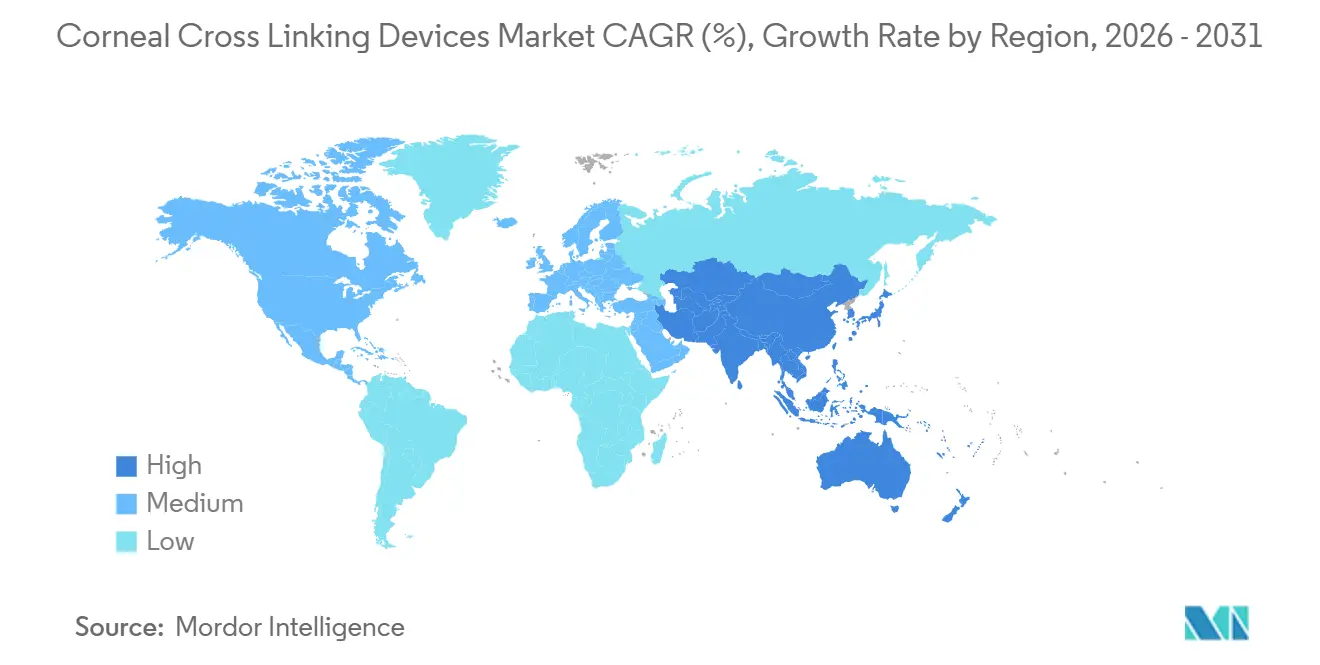
North America held 48.95% of corneal cross-linking devices market size in 2025, which made it the leading regional block in the corneal cross-linking devices market. The region benefited from a decade of U.S. epi-off platform familiarity and from reimbursement pathways that had already expanded across many commercial payers for documented progressive keratoconus. The United States moved into a new phase in March 2026 when Glaukos made Epioxa commercially available, giving physicians the first FDA-approved epi-on option and giving the corneal cross-linking devices market a new route to earlier and less invasive intervention. Early company commentary described physician interest as encouraging, but the next step for the region will depend on how quickly permanent reimbursement mechanisms develop for epi-on treatment.
Europe Corneal Cross-Linking Devices Market
Europe remained the second-largest regional market, supported by established ophthalmic infrastructure and a deep base of device manufacturers and corneal specialists. Germany, the United Kingdom, France, Italy, and Spain account for most regional revenue, with Germany and the United Kingdom especially important for evidence-led adoption patterns. Italy also matters because domestic companies such as iVis Technologies and IROMED have long contributed to the regional technology base.
APAC, MEA and South America Corneal Cross-Linking Devices Market
Asia-Pacific is projected to grow at 16.28% CAGR through 2031, which makes it the fastest-growing region in the corneal cross-linking devices market. Disease burden is a major reason, with South Asian prevalence estimated at 1,374.5 per 100,000 persons in the 2025 review, far above the pooled global rate. India also showed a 2.7-year diagnostic delay in a 2025 study, which indicates a large untreated pool that could support strong future procedure growth as screening expands. In China, federal reimbursement is still absent, but regional pilots in Zhejiang and Jiangsu point to a possible pathway for broader inclusion over time. Japan, Australia, and South Korea contribute steady advanced-care volumes, while India and South Korea stand out as important installation opportunities. Middle East and Africa presents strong epidemiological need but weaker infrastructure, and South America remains led by private hospital adoption in Brazil and Argentina with growth still limited by affordability.
Competitive Landscape
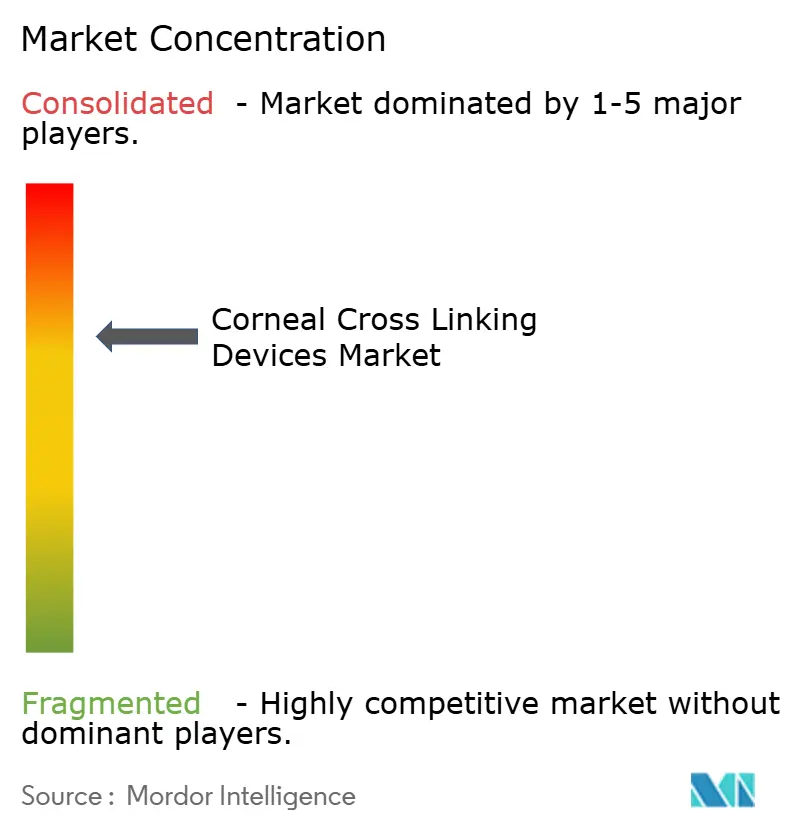
The corneal cross-linking devices market shows moderate concentration at the global level, but the structure is much tighter in the United States than in Europe or other international markets. Glaukos holds a clear structural advantage in the U.S. portion of the corneal cross-linking devices market because it controls approved riboflavin formulations and the companion treatment systems for both epi-off and epi-on therapy. That closed architecture supports recurring revenue per procedure and gives the company control over both installed systems and treatment consumables.
Outside the United States, the corneal cross-linking devices market is more fragmented and competition depends more on portability, protocol breadth, and workflow integration. EMAGine competes with its battery-powered slit lamp-compatible C-eye platform and linked Ribo-Ker formulation, which gives it a practical position in clinics that want flexible setup and multiple protocol options. SCHWIND is using a different strategy through direct integration of cross-linking with excimer laser workflow, which is aimed at combined refractive and stabilizing procedures. Carl Zeiss Meditec is extending its role through connected software and collaborative care tools rather than competing only on stand-alone hardware, which makes the corneal cross-linking devices market increasingly digital as well as procedural. iVis has also shown remote surgery coordination capability, which adds another competitive dimension around specialist reach and digital support.
The main strategic pattern in the corneal cross-linking devices market now revolves around 3 levers, proprietary drug-device pairing, workflow compression, and software-led treatment planning. Glaukos advanced the first lever with the commercial launch of Epioxa in March 2026 and a related patient support and awareness program. EMAGine strengthened the second lever by expanding protocol variety and outlining additional epi-on options for CE-mark settings. As reimbursement expands and protocol quality becomes easier to standardize, the winners in the corneal cross-linking devices market will likely be the companies that can combine clinical evidence, ease of use, and repeatable economics rather than only faster illumination hardware.
Corneal Cross-Linking Devices Industry Leaders
-
Glaukos Corporation
-
Carl Zeiss Meditec AG
-
iVis Technologies
-
Peschke GmbH
-
EMAGine AG
- *Disclaimer: Major Players sorted in no particular order
Corneal Cross-Linking Devices Market Companies Covered in this Report
- AJL Ophthalmic S.A.
- Alcon
- BVI Medical
- Carl Zeiss
- EMAGine AG
- EssilorLuxottica
- Glaukos
- IROMED GROUP Srl
- iVis Technologies
- Lumenis
- Nidek
- Oculus Optikgerate
- OptoVue, Inc.
- Peschke GmbH
- Santen Pharmaceuticals
- SCHWIND eye-tech-solutions GmbH
- Topcon
- Ziemer Group
Recent Industry Developments in Corneal Cross-Linking Devices Market
- April 2026: Carl Zeiss Meditec AG showcased ZEISS Collaborative Care at the ASCRS Annual Meeting, a browser-based secure data-sharing application enabling eye care professionals to refer patients and exchange corneal topography data across care settings via the ZEISS Health Data Platform. The launch deepens Zeiss' integrated corneal refractive workflow proposition, connecting CXL diagnostic data to surgical planning environments and broadening its competitive relevance beyond device hardware to clinical workflow software.
- March 2026: Glaukos Corporation announced commercial availability of Epioxa HD / Epioxa, making it the first and only FDA-approved epi-on CXL therapy commercially available in the United States. Available via specialty pharmaceutical distribution and direct from Glaukos, Epioxa is indicated for adults and pediatric patients aged 13+ with keratoconus using the O2n System and Boost Goggles. Glaukos launched an accompanying co-pay assistance program and comprehensive patient awareness initiative targeting the estimated 90%+ of keratoconus patients who remain undertreated.
- October 2025: Glaukos Corporation received FDA approval (NDA 219910) for Epioxa HD (0.239% riboflavin 5'-phosphate) and Epioxa (0.177% riboflavin 5'-phosphate) for epithelium-on CXL with the O2n System and Boost Goggles. Approval was based on two Phase 3 pivotal trials enrolling over 400 patients, which met primary efficacy endpoints at 12-month follow-up. Glaukos planned commercial availability for Q1 2026, making this the first epi-on CXL product to reach the US market.
Global Corneal Cross-Linking Devices Market Report Scope
According to the report’s scope, the corneal cross‑linking devices market refers to the segment of ophthalmic medical technology focused on systems that deliver UV light and riboflavin solutions to strengthen corneal tissue by inducing collagen cross‑links. These devices are primarily used to treat keratoconus and other corneal ectatic disorders, aiming to halt disease progression, improve corneal stability, and reduce the need for invasive procedures like corneal transplantation.
The corneal cross‑linking devices market is segmented into product type, application, technology, end-user, and geography. By product type, the market is segmented into UV light devices, riboflavin solutions, combination devices, confocal microscopes, and other product types. By application, the market is segmented into keratoconus, corneal ectasia, refractive surgery ectasia, pellucid marginal degeneration, and other applications. By technology, the market is segmented into epithelium-off cross-linking, epithelium-on cross-linking, accelerated cross-linking, customized and topography-guided cross-linking, and other technologies. By end-user, the market is segmented into hospitals, eye clinics, ambulatory surgical centers, and research institutions. By geography, the market is segmented into North America, Europe, Asia-Pacific, the Middle East and Africa, and South America. The report also covers the estimated market sizes and trends for 17 countries across major regions globally. The report offers values (USD) for all the above segments.
Segmentation Overview
| UV Light Devices |
| Riboflavin Solutions |
| Combination Devices |
| Confocal Microscopes |
| Other Product Types |
| Keratoconus |
| Corneal Ectasia |
| Refractive Surgery Ectasia |
| Pellucid Marginal Degeneration |
| Other Applications |
| Epithelium-Off Cross-Linking |
| Epithelium-On Cross-Linking |
| Accelerated Cross-Linking |
| Customized and Topography-Guided Cross-Linking |
| Other Technologies |
| Hospitals |
| Eye Clinics |
| Ambulatory Surgical Centers |
| Other End-Users |
| North America | United States |
| Canada | |
| Mexico | |
| Europe | Germany |
| United Kingdom | |
| France | |
| Italy | |
| Spain | |
| Rest of Europe | |
| Asia-Pacific | China |
| Japan | |
| India | |
| Australia | |
| South Korea | |
| Rest of Asia-Pacific | |
| Middle East and Africa | GCC |
| South Africa | |
| Rest of Middle East and Africa | |
| South America | Brazil |
| Argentina | |
| Rest of South America |
| By Product Type | UV Light Devices | |
| Riboflavin Solutions | ||
| Combination Devices | ||
| Confocal Microscopes | ||
| Other Product Types | ||
| By Application | Keratoconus | |
| Corneal Ectasia | ||
| Refractive Surgery Ectasia | ||
| Pellucid Marginal Degeneration | ||
| Other Applications | ||
| By Technology | Epithelium-Off Cross-Linking | |
| Epithelium-On Cross-Linking | ||
| Accelerated Cross-Linking | ||
| Customized and Topography-Guided Cross-Linking | ||
| Other Technologies | ||
| By End-User | Hospitals | |
| Eye Clinics | ||
| Ambulatory Surgical Centers | ||
| Other End-Users | ||
| By Geography | North America | United States |
| Canada | ||
| Mexico | ||
| Europe | Germany | |
| United Kingdom | ||
| France | ||
| Italy | ||
| Spain | ||
| Rest of Europe | ||
| Asia-Pacific | China | |
| Japan | ||
| India | ||
| Australia | ||
| South Korea | ||
| Rest of Asia-Pacific | ||
| Middle East and Africa | GCC | |
| South Africa | ||
| Rest of Middle East and Africa | ||
| South America | Brazil | |
| Argentina | ||
| Rest of South America | ||
Key Questions Answered in the Report
How big is the Corneal Cross Linking Devices Market?
The corneal cross-linking devices market was valued at USD 290.57 million in 2025 and is projected to be valued at USD 326.62 million in 2026.
Which application is expanding fastest?
Corneal ectasia is projected to grow at 14.82% CAGR through 2031 as clinicians treat more post-refractive surgery instability and related ectatic cases.
Why is Asia-Pacific the fastest-growing region?
Asia-Pacific is forecasted to grow at 16.28% CAGR through 2031 because disease prevalence is high, diagnostic delays remain significant, and treatment infrastructure is still expanding from a relatively underpenetrated base.
What is driving growth in corneal cross-linking devices through 2031?
Growth is being supported by earlier keratoconus diagnosis, the launch of FDA-approved epi-on therapy, faster office-based workflows, and strong demand from high-prevalence regions such as Asia-Pacific.