
Connected Ship Market Size and Share
Market Overview
| Study Period | 2020 - 2031 |
|---|---|
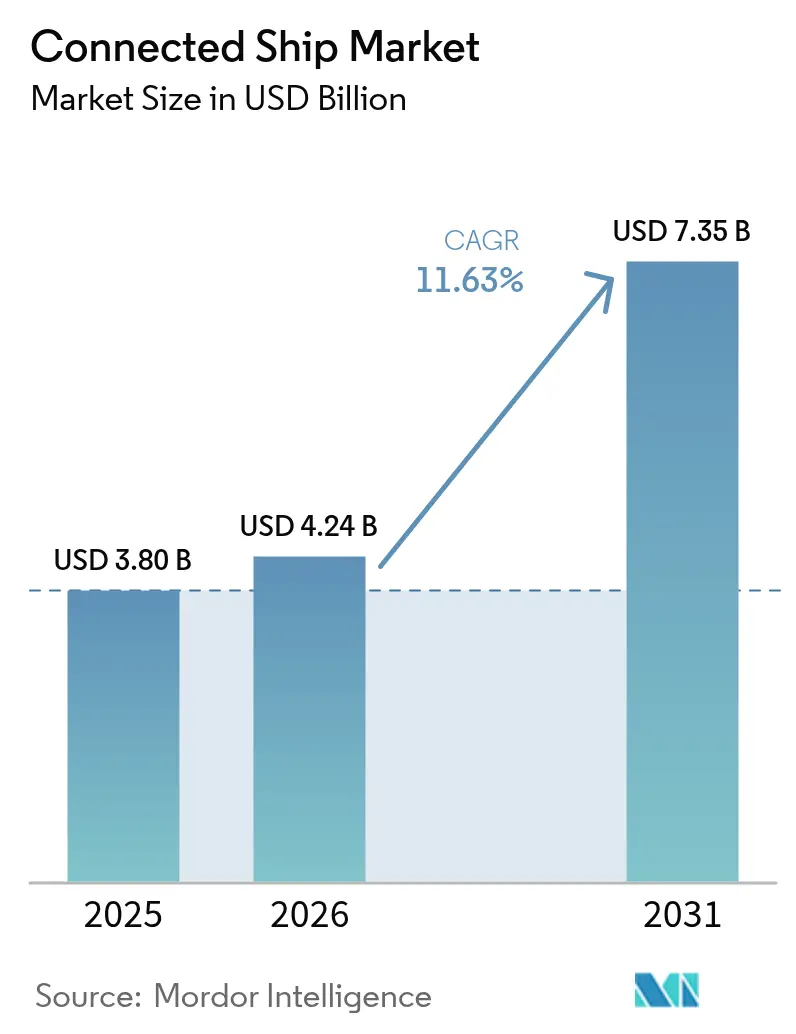
| Market Size (2026) | USD 4.24 Billion |
| Market Size (2031) | USD 7.35 Billion |
| Growth Rate (2026 - 2031) | 11.63 % |
| Fastest Growing Market | Asia Pacific |
| Largest Market | Asia Pacific |
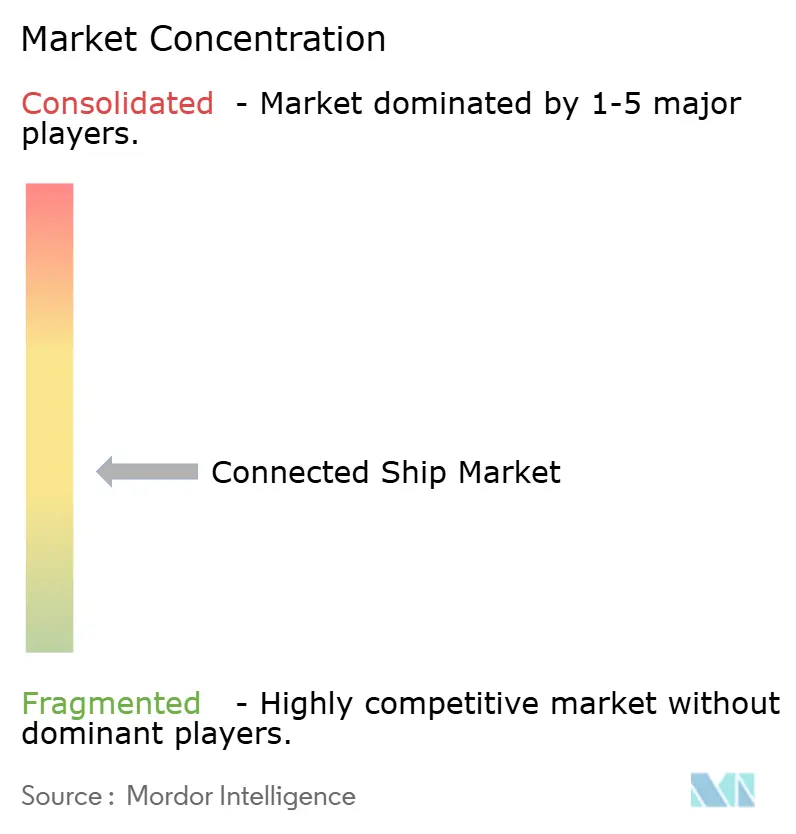
| Market Concentration | Medium |
Major Players *Disclaimer: Major Players sorted in no particular order Image © Mordor Intelligence. Reuse requires attribution under CC BY 4.0. | |
Connected Ship Market Analysis by Mordor Intelligence
Connected Ship market size in 2026 is estimated at USD 4.24 billion, growing from 2025 value of USD 3.80 billion with 2031 projections showing USD 7.35 billion, growing at 11.63% CAGR over 2026-2031.
Rising enforcement of International Maritime Organization requirements for e-navigation and carbon intensity reporting has moved data connectivity from an optional add-on to an operational prerequisite. Commercial fleet owners are digitizing operations to trim fuel use, cut emissions, and maintain compliance, while defense agencies accelerate adoption for situational awareness and crew welfare. Satellite innovations, especially Low Earth Orbit constellations, have slashed bandwidth costs, widening access for small operators. Supply-chain shocks in 2024 exposed hardware vulnerabilities and prompted manufacturers to seek near-shore production, yet regulatory certainty and maturing technology continue to reinforce demand across all vessel classes.[1]International Maritime Organization, “Maritime Single Window comes into force,” imo.org
Key Report Takeaways
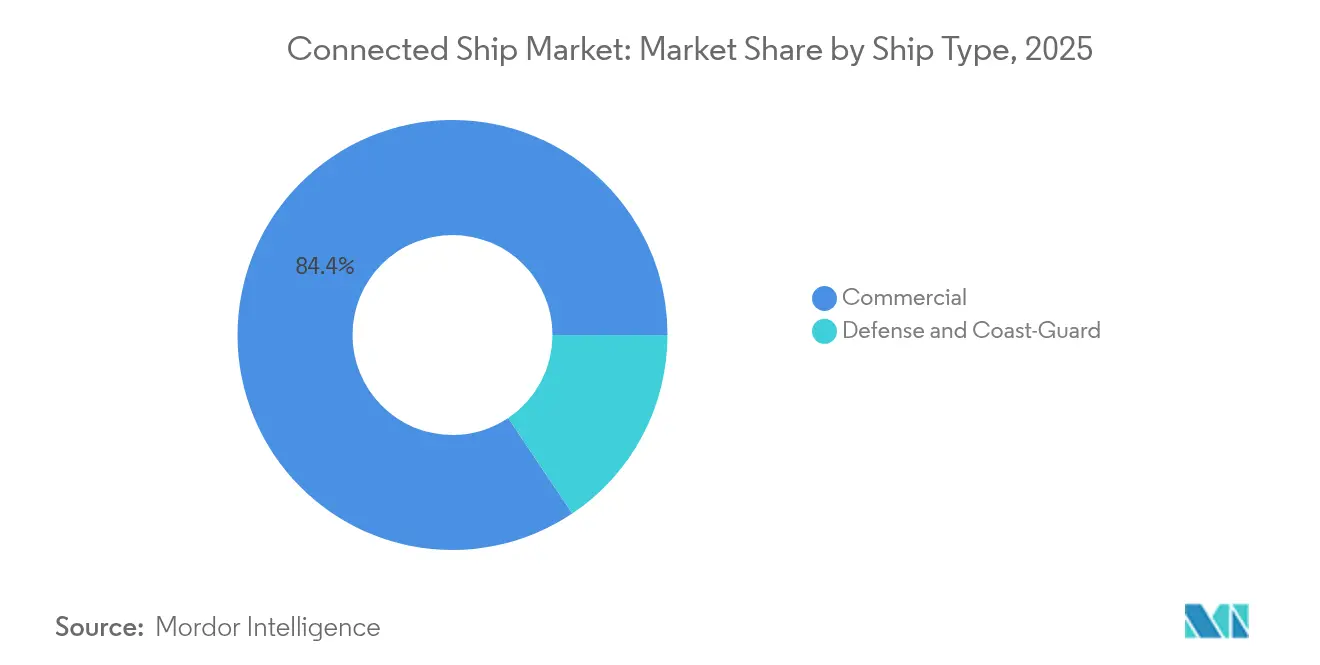
- By ship type, commercial vessels held 84.40% revenue share of the connected ship market in 2025; defense applications are growing fastest at a 12.96% CAGR through 2031.
- By application, fleet operations commanded 41.30% of the connected ship market share in 2025, while fleet health monitoring is set to rise at a 13.86% CAGR to 2031.
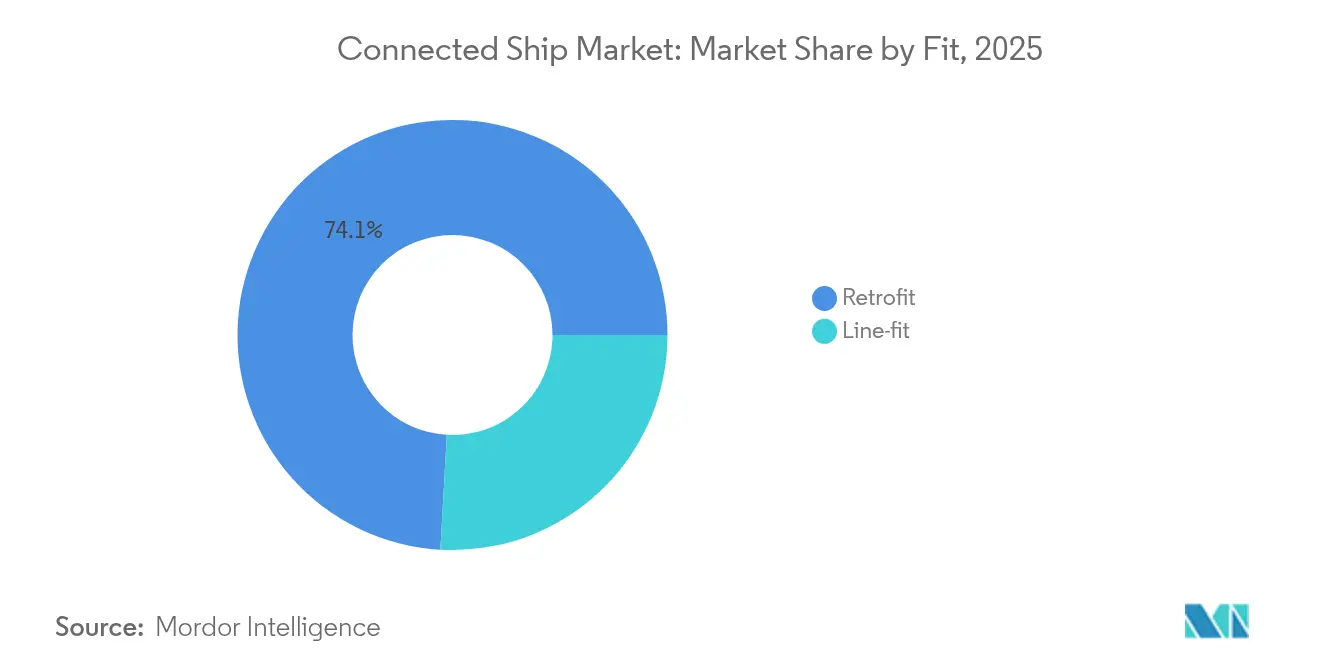
- By fit, retrofit installations accounted for a 74.10% share of the connected ship market size in 2025, whereas line-fit solutions are projected to climb at a 16.92% CAGR over 2026-2031.
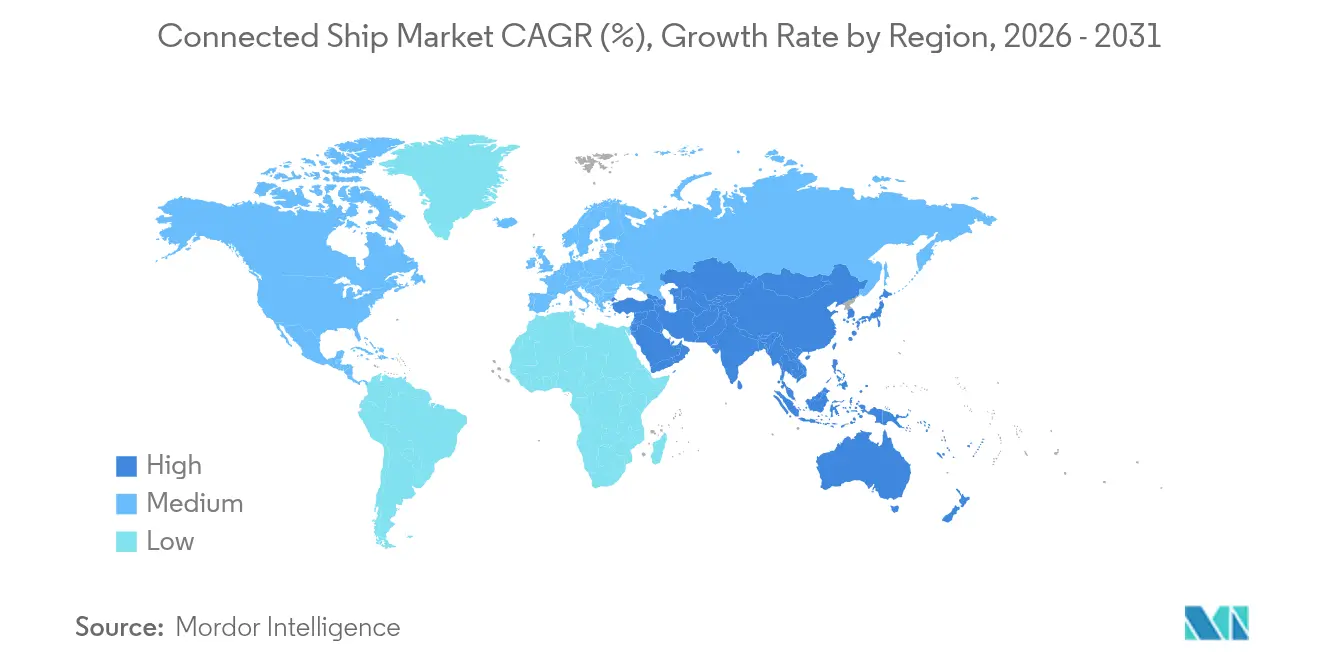
- By geography, Asia Pacific dominated with 34.60% connected ship market share in 2025, and the region is forecast to expand at a 20.95% CAGR to 2031.
Note: Market size and forecast figures in this report are generated using Mordor Intelligence’s proprietary estimation framework, updated with the latest available data and insights as of 2026.
Market Trends and Insights
Drivers Impact Analysis of Connected Ship Market*
| Driver | (~) % Impact on CAGR Forecast | Geographic Relevance | Impact Timeline |
|---|---|---|---|
| IMO e-navigation & CII mandates | +3.10% | Global with stricter enforcement in EU waters | Short term (≤ 2 years) |
| Growing incorporation of ICT and IoT on-board | +2.80% | Europe and North America lead early adoption | Medium term (2-4 years) |
| Rapid roll-out of LEO constellations | +2.40% | Major shipping lanes worldwide | Short term (≤ 2 years) |
| Carbon-intensity targets | +1.90% | Global with accelerated adoption in EU | Medium term (2-4 years) |
| Source: Mordor Intelligence | |||
IMO e-navigation and CII mandates
Continuous data reporting now replaces periodic logs, forcing vessels to integrate real-time connectivity that links bridge, engine room, and shore offices. The Maritime Single Window, live since January 2024, obliges ports to accept standardized electronic submissions, which raises baseline connectivity requirements worldwide. New S-100 hydrographic standards, operational from 2025, add granular bathymetric layers that feed digital twins used for autonomous navigation. The revised International Maritime Organization strategy targets a 40% cut in CO₂ intensity by 2030, so ship owners equip sensors that validate progress and avoid penalties.[2]The Maritime Executive, “IMO adopts revised GHG strategy,” maritime-executive.com Electronic certificates for seafarers, adopted in 2025, further digitize crew management and reduce administrative lags.
Growing incorporation of ICT and IoT on board
Fleet managers now deploy thousands of low-power sensors that feed predictive analytics engines, allowing maintenance teams to fix components before failure. Maersk’s collaboration with Onomondo connects containers through global cellular and satellite links, showing how large carriers exploit IoT to raise schedule reliability. [3]IoT Tech News, “Maersk expands Onomondo partnership,” iottechnews.com NB-IoT and BLE Mesh devices track humidity, vibration, and shock inside boxes, creating continuous end-to-end cargo visibility. Edge computing modules process data locally to lower satellite bandwidth use and preserve latency-sensitive functions. Port operators in South Korea and Japan support ship-to-shore 5 G networks that backhaul the data once vessels berth, closing the information loop.
Rapid roll-out of LEO constellations
Low Earth Orbit services have cut latency below 70 ms and dropped price per megabit by more than half compared with legacy geostationary links. Starlink equipment is now active on about 75,000 ships, and its entry spurred established operators to bundle LEO and GEO coverage in hybrid plans. Iridium’s acceptance into 3GPP Release 19 clears a path to global 5 G NB-IoT satellite links by late 2025, which will offer direct-to-device messaging without proprietary terminals. National fleets such as the Japan Coast Guard endorse LEO systems to improve crew morale, since streaming and real-time video calls are now affordable. Competitive pricing and service resilience accelerate adoption among small coastal craft that previously relied on voice-only L-band terminals.
Carbon-intensity targets driving data-driven voyage optimization
Voyage planning tools now model fuel, weather, and charter constraints alongside real-time carbon pricing to minimize total cost. The European Union’s FuelEU Maritime rule, live in 2025, forces ships in EU waters to curb emissions by 2% each year, which pushes owners toward software-based route adjustments. Studies show optimization algorithms can lift fleet profit by 4.38% while satisfying the Carbon Intensity Indicator, illustrating a direct financial upside to compliance. Alternative measures, such as shipboard carbon capture, cost EUR 115 per ton of CO₂, so operators first exploit digital efficiency before capital-heavy retrofits. Lifecycle service contracts that tie engine performance to verified emission gains further embed connectivity in daily operations.
Restraints Impact Analysis of Connected Ship Market*
| Restraint | (~) % Impact on CAGR Forecast | Geographic Relevance | Impact Timeline |
|---|---|---|---|
| High CAPEX / OPEX of broadband connectivity | -1.80% | Global with sharper effect in developing fleets | Medium term (2-4 years) |
| Escalating cyber-risk & insurance premiums | -1.40% | United States and European Union | Short term (≤ 2 years) |
| Source: Mordor Intelligence | |||
High CAPEX / OPEX of broadband connectivity
Hardware, installation, airtime, and crew training together stretch shipowner budgets, especially for smaller tramp operators. The United States Coast Guard cyber rules add USD 138.7 million per year in compliance costs, raising the hurdle for digital upgrades. Semiconductor scarcity lifted electronics pricing throughout 2024, and tariffs on Chinese components added a further 25% to production costs. Many owners delay line-fit projects until vessels dry-dock to minimize downtime, yet this approach prolongs payback periods. Leasing models and bandwidth-as-a-service plans are emerging to ease capital strain, though adoption remains cautious.
Escalating cyber-risk and insurance premiums
Every additional entry point—from bridge displays to cargo sensors—creates a potential attack vector. The International Association of Classification Societies now demands cybersecurity controls for critical onboard systems, making non-compliance a safety deficiency. Underwriters have responded with double-digit hikes in cyber cover, linking premiums to evidence of layered defenses and crew awareness programs. Research shows machine-learning-based anomaly detection outperforms signature approaches in maritime networks, yet false positives still burden operators. A lack of uniform standards across flag states complicates risk assessments and leaves fleets exposed to regulatory patchwork. The resulting uncertainty slows some investment decisions and caps short-term growth.
*Our forecasts treat driver/restraint impacts as directional, not additive. The impact forecasts reflect baseline growth, mix effects, and variable interactions.
Connected Ship Market Segment Analysis
By Ship Type:
Commercial Vessels Maintain Commanding LeadThe commercial segment generated 84.40% of the connected ship market revenue in 2025, reflecting the sheer number of merchant hulls and rising regulatory compliance costs. The connected ship market size for commercial vessels is projected to grow at an 11.21% CAGR, underpinning investments in fuel optimisation, cargo visibility, and crew connectivity. Defense applications are expanding at 12.96% CAGR as navies pursue autonomous patrol craft, secure communications, and integrated battlespace awareness. Growing geopolitical tensions and joint exercises in the Indo-Pacific further drive defense demand, yet budget cycles introduce procurement delays that temper near-term volumes. Commercial carriers look to defense innovations—such as mesh networking and hardened cybersecurity—for cost-effective civilian spin-offs.
Fleet digitization in the commercial arena anchors financial return on investment through lower fuel burn and port call efficiency. Meanwhile, defense buyers value redundant satcom links and electromagnetic resilience over bandwidth price, a distinction that shapes vendor roadmaps. As software-defined radios shrink in size and cost, cross-segment platforms emerge that serve merchants, coast guard, and naval customers with minimal hardware variance. The convergence shortens development cycles and spreads R&D cost across a wider volume base, reinforcing incumbent yet open niches for specialized cybersecurity vendors.



By Application:
Fleet Health Monitoring Takes Growth SpotlightFleet operations solutions retained 41.30% connected ship market share in 2025, supported by widespread use of electronic chart systems, route optimization, and cargo tracking. In contrast, fleet health monitoring advances at 13.86% CAGR thanks to falling sensor prices and cloud analytics that predict machinery failure with high accuracy. The connected ship market size for fleet health monitoring is forecast to more than double by 2031, aided by classification societies that now accept condition-based survey data in lieu of calendar inspections. Ship managers deploy digital twins that integrate propulsion, hull, and auxiliaries, allowing simulations that cut maintenance planning time and dockyard overruns.
Artificial intelligence elevates voyage planning tools from passive dashboards to prescriptive advisors that balance cost, safety, and emissions. Vessel traffic management growth moderates as mandatory systems reach saturation in busy waterways; however, advanced collision-avoidance algorithms add incremental revenue through software upgrades rather than new hardware. Integrated application suits merge operational and maintenance planning, so operators no longer juggle multiple vendors and user interfaces. The shift rewards platforms that expose open APIs and support cybersecurity standards suitable for insurance audits.
By Fit:
Line-fit Momentum Signals Design Paradigm ShiftRetrofit projects accounted for 74.10% of the connected ship market in 2025, since the global fleet averages 12 years of age and must meet near-term digital mandates. Yet line-fit installs are climbing at 16.92% CAGR as yards embed antenna cabling, server racks, and sensor wiring during construction, slashing lifecycle cost. Newbuild designers now allocate deck, mast, and bridge real estate for phased-array terminals, making bandwidth upgrades a firmware exercise rather than a cutting-steel modification. The connected ship market share for line-fit solutions is set to reach 38.70% by 2031 as owners specify digital-ready hulls to protect asset value.
Shipyards in South Korea and China advertise “smart factory” outputs that pre-configure vessels with cyber-secure networks and edge servers. Owners lock in multi-year airtime packages at delivery, smoothing cash flow and ensuring compliance from day one. Retrofit demand persists, however, as emission regulations require even decade-old tonnage to install data logging and satellite links. Class societies streamline approvals for drop-in terminals and power over Ethernet sensors, shortening retrofit yard stays. Vendors that support both fit types achieve scale benefits, whereas one-product specialists face margin compression.
Geography Analysis
APAC Connected Ship Market
Asia Pacific leads global adoption with 34.60% connected ship market share in 2025 and a 20.95% growth trajectory to 2031. China’s green shipbuilding action plan, targeting 50% share in zero-carbon vessels by 2025, pushes yards to integrate digital systems that monitor fuel cells, batteries, and alternative fuels. Japan’s Society 5.0 program funds research on ship-to-shore data exchange and maritime autonomous surface ships, reinforcing domestic demand. South Korea’s export credit support encourages fleets to specify high-bandwidth satcom during newbuild tenders, ensuring early migration to LEO-enabled hybrid networks.
North America Connected Ship Market
North America ranks second by revenue, driven by strict cybersecurity regulations and high labor costs that make predictive maintenance attractive. The United States Coast Guard mandate, effective July 2025, accelerates cyber-secure retrofits on Jones Act fleets, while offshore energy operators view connected drilling vessels as essential for safety and uptime. Canadian operators leverage connectivity to comply with Arctic voyage reporting and to enable remote technical assistance amid sparse shore infrastructure.
Europe Connected Ship Market
Europe commands mature adoption levels but remains growth-relevant due to environmental legislation. FuelEU Maritime and inclusion of shipping in the EU Emissions Trading System demand granular data reporting that only connected platforms can deliver. Ports across Scandinavia, the Netherlands, and Spain now offer reduced harbour dues for digitally verified carbon reductions, reinforcing the business case. Intra-EU short-sea operators invest in low-power terminals paired with cellular backhaul to maintain constant data flow even within coastal zones. Together, these factors underpin steady European fleet conversions through 2030.

Regulatory Landscape
International maritime rules continue to formalize digital reporting and cyber governance, raising baseline connectivity requirements for ship-to-shore data exchange. The IMO Maritime Single Window entered into force in January 2024, and in April 2025 the IMO approved a revision to its Guidelines on maritime cyber risk management (MSC-FAL.1/Circ.3/Rev.3), reinforcing cyber controls as part of operational safety and facilitation. Industry assurance is also increasingly shaped by IACS cyber resilience requirements (UR E26 and UR E27), which affects how shipowners specify networks, onboard systems, and audit evidence.
Regional policy is tightening as well around secure data exchange and port digitalization. In March 2026, the European Commission advanced an EU Industrial Maritime Strategy and Ports Strategy agenda that emphasizes secure data exchanges and digital autonomy for ports, supported by policy and funding alignment such as CEF Digital support for 5G deployments. The same period also saw proposals at IMO (FAL with MSC participation) to develop a goal-based, non-mandatory Maritime Cyber Code, indicating progress toward more structured and harmonized cyber frameworks that connected-ship platforms will need to map to across flag states and port jurisdictions.
Value Chain Analysis
The connected ship value chain runs from sensor and bridge/engine instrumentation suppliers to onboard IT and edge-compute integrators, satellite and terrestrial connectivity providers (LEO/GEO/L-band plus coastal cellular), and cybersecurity and identity vendors. Application-layer software then supports fleet operations, health monitoring, and compliance reporting. Shipyards and retrofit yards are key delivery nodes where antenna hardware, cabling, gateways, and onboard networks are installed and tested, while classification societies and flag-state compliance workflows shape acceptance criteria for cyber resilience and data integrity. Downstream, ports and Port Community Systems (PCS) increasingly function as data consumers and orchestrators, enabling single-data submissions and automated logistics processes.
Capital and infrastructure programs are influencing how the ecosystem scales and where integration bottlenecks appear. In 2024, electronics supply constraints and tariff impacts highlighted hardware exposure, driving OEMs and integrators to diversify sourcing and emphasize software-defined upgrades. On the demand side, port and corridor investments are adding new integration points for ship-to-shore digital workflows, including Thailand reviving the Land Bridge corridor connecting Chumphon and Ranong deep-sea ports (June 2026) and CMA CGM-backed terminal modernization plans at the Port of Mombasa (May 2026). Multilateral finance is also supporting fleet-port-logistics modernization, illustrated by an Asian Development Bank loan agreement for Arkas Group in Turkey (May 2026), which strengthens demand for connected-ship hardware, connectivity contracts, and analytics services.
Competitive Landscape
The connected ship market hosts a mixture of legacy marine equipment makers, satellite operators, and software specialists. Kongsberg, Wärtsilä, and Thales leverage decades of voyage, power, and defense know-how, bundling sensors, analytics, and support into multi-year service agreements. Space-economy entrants such as Starlink and OneWeb compete primarily on bandwidth cost and latency, forcing incumbents to adopt hybrid GEO-MEO-LEO architectures. Software-first firms, including Orca AI and Nautilus Labs, differentiate through machine-learning algorithms that boost fuel and safety outcomes without proprietary hardware.
Strategic alliances dominate investment patterns. CMA CGM links with Google to fuse ocean freight data with cloud AI, and Maersk partners with Onomondo for container telematics at scale. Patent filings reveal heavy activity around maritime 5 G, holographic beamforming, and quantum-safe encryption, signaling long-term bets on leapfrog connectivity. Vendors race to deliver platforms that expose open APIs, easing integration with port community systems and classification society portals.
Market exits and consolidations illustrate intensifying rivalry. VSAT suppliers merge to achieve scale, while equipment makers divest non-core units to fund digital capabilities, seen in Cargotec’s sale of MacGregor for EUR 480 million. Cybersecurity startups attract strong funding as charterers and insurers prefer audited defenses. Larger groups absorb niche players to seal portfolio gaps, yet fragmentation persists around specialized AI, edge computing, and autonomous navigation.
Connected Ship Industry Leaders
Northrop Grumman Corporation
Wärtsilä Corporation
Kongsberg Gruppen AS
Marlink AS
General Electric Co.
- *Disclaimer: Major Players sorted in no particular order
Connected Ship Market Companies Covered in this Report
- Northrop Grumman Corp.
- General Electric Co.
- Wärtsilä Oyj Abp
- Kongsberg Gruppen ASA
- Marlink AS
- Synectics Ltd.
- Atos SE
- Inmarsat (Viasat)
- Iridium Communications
- Navis (Navis LLC)
- DNV (Veracity)
- ABS Wavesight
- ABB Marine and Ports
- Thales Group
- Cobham Satcom
- KVH Industries
- Furuno Electric
- Samsung Heavy Industries
- Raytheon Technologies
- Starlink (SpaceX)
- OneWeb (Eutelsat)

Market Opportunities and Future Outlook
Regulatory digitalization and new communications pathways are creating whitespace for upgrade programs that combine onboard networks, certified cybersecurity controls, and standardized data exchange. In March 2026, the IMO Facilitation Committee approved the IMO Strategy on Maritime Digitalization and amendments requiring cybersecurity measures for Maritime Single Windows (with a stated entry-into-force timeline of January 1, 2029), which increases the value of solutions that package secure reporting, identity, and audit-ready telemetry for fleets and ports. Separately, the IMO NCSR 13 work in June 2026 on guidance for next-generation ECDIS (S-100) transition and a transition scheme from analog to digital VHF voice communications expands the addressable scope for integrated bridge data, charting, and communications modernization.
A second opportunity area is the broadening definition of “connected” beyond navigation and maintenance into crew welfare and new communication standards. The UK’s Merchant Shipping (Maritime Labour Convention and Miscellaneous Amendments) Regulations 2026 introduced mandates around social connectivity facilities for seafarers on UK-flagged ships, increasing demand for reliable onboard internet capacity and policy-managed networks. At the technology and compliance interface, IMO MSC 111 in May 2026 adopted SOLAS Chapter V amendments recognizing VDES as an alternative to AIS (effective January 1, 2028), expanding integration work for terminal vendors, bridge OEMs, and software providers to incorporate VDES-capable systems and hybrid terrestrial-satellite communications. In parallel, the non-mandatory IMO MASS Code entered into effect on July 1, 2026, reinforcing the need for resilient, cyber-secure connectivity architectures that can support higher autonomy levels, remote oversight, and machine-to-machine data flows.
Recent Industry Developments in Connected Ship Market
- June 2026: Marlink deployed a multi-orbit hybrid connectivity solution (LEO, GEO VSAT, and MSS) on TUI Cruises flagship Mein Schiff Flow. The installation points to growing adoption of blended satellite architectures to balance bandwidth-intensive applications with redundancy for operational data, compliance reporting, and crew connectivity.
- April 2026: Northrop Grumman received a US Navy contract modification to produce up to nine additional SEWIP Block 3 maritime electronic attack systems, including the first shipset for an aircraft carrier. The award supports continued integration of advanced, networked electronic warfare capability across fleet platforms, reinforcing demand for hardened connectivity and onboard data integration in defense and coast-guard segments.
- April 2025: Wärtsilä ANCS installed its first NACOS Connect Remote Mimics application on Princess Cruises Sun Princess. The deployment extends shore-side visibility into onboard bridge systems, strengthening the use case for remote monitoring and support workflows that depend on robust ship-to-shore connectivity.


Connected Ship Market Report Scope and Research Methodology
Market Definition and Coverage
For this study, the connected ship market is defined as hardware, software, and related services that enable ships to transmit, receive, and use data for safer navigation and better fleet operations, either at sea or while in port.
Scope exclusions: We exclude general shipbuilding value, cargo handling equipment that is not connectivity-enabled, and shore-side port digitization projects that do not directly serve onboard connectivity and vessel data use cases.
Segments Covered in This Report
- By Ship Type
- Commercial
- Defence and Coast-Guard
- By Application
- Vessel Traffic Management
- Fleet Operations
- Fleet Health Monitoring
- By Fit
- Retrofit
- Line-fit
- By Geography
- North America
- United States
- Canada
- Europe
- United Kingdom
- Germany
- France
- Rest of Europe
- Asia-Pacific
- China
- Japan
- India
- South Korea
- Rest of Asia-Pacific
- Middle East and Africa
- South America
- North America
Data Sources, Market Sizing, and Validation
Desk Research
Desk research starts with setting the demand pool using public maritime fleet and trade indicators, and then aligning it with what is typically installed on vessels. We refer to sources such as IMO publications, ITU statistics on communications, World Bank trade and logistics indicators, UN Comtrade summaries for maritime equipment trade signals, and IHS-style vessel registry snapshots (where accessible) to sense-check adoption direction by region.
We also review company annual reports, investor decks, class society guidance notes, and credible maritime press to understand product positioning and rollout timing. In addition, we selectively use paid subscriptions for company financials and intelligence, news and financials, patent databases, and shipment-level import-export data where it helps validate product mix and track pricing movement. These desk research inputs are not exhaustive, and many other public documents and datasets were also used for data collection, validation, and clarification.
Primary Interviews and Surveys
Primary work focuses on interviews and structured surveys with ship operators, system integrators, connectivity service providers, and marine electronics stakeholders, so the model reflects what is actually purchased and installed. We cover demand patterns across APAC, EMEA, and the Americas, and then use expert feedback to close gaps on retrofit timing, bundle splits, and realistic pricing ranges by application.
Distribution of primary research fieldwork respondents
| Company type | Respondent position | Region |
|---|---|---|
| Top tier: 28% | CXOs: 18% | APAC: 50% |
| Mid tier: 51% | Functional/Unit leaders: 23% | EMEA: 31% |
| Smaller Players: 21% | Managers: 59% | Americas: 19% |
Market-Sizing & Forecasting
Sizing is built using a top-down approach where the global active fleet and newbuild deliveries are translated into an addressable install base, and then adjusted by penetration rates for connected solutions by ship class and region. The totals are corroborated with selective bottom-up approximations using sampled pricing times likely volumes, channel checks, and supplier revenue cues, which helps avoid over-counting bundles and multi-year contracts.
Key inputs used in the model include retrofit share versus line-fit share, average connectivity and data service spend per vessel, adoption of fleet operations and health monitoring applications, satellite bandwidth cost direction, and regulatory or safety-driven digital reporting needs that push upgrades. Where direct volume signals are weak, assumptions are held to narrow ranges and re-checked with interviews so the gaps do not get filled with aggressive multipliers.
For forecasting, scenario analysis is used, supported by simple regression-based cross checks on fleet growth, trade activity, and expected digitalization pace, as validated by expert consensus. This keeps the projection practical, and it also makes it easier to update the forward curve when fleet ordering cycles or connectivity pricing changes.
Data Validation & Update Cycle
Validation is done through triangulation across independent indicators, and we also run variance checks by region, ship type, and fit type so outliers are visible early. When a number moves beyond a reasonable range, analysts revisit adoption, pricing, or fleet assumptions, and respondents may be re-contacted to confirm what changed and why.
Before sign-off, the model and logic go through multi-step analyst reviews, and checks are performed against external signals like fleet delivery trends and publicly visible maritime connectivity announcements. The report is refreshed annually, with interim updates triggered by material events, and a final pre-delivery review is completed so clients receive the latest updated view.
Mordor Intelligence's Connected Ship Market Size Compared Against Other Published Estimates
Different sources often show different connected ship market values because they do not always count the same ship population, the same mix of onboard and shore connectivity elements, or the same application coverage. Differences also come from how pricing is treated, especially when services are bundled into multi-year contracts and reported in different years.
In practice, the biggest gaps come from whether studies include broad maritime digitalization spend, or only the connectivity-enabled vessel systems tied to fleet operations, traffic management, and health monitoring. Currency conversion timing, base year selection, and the assumed speed of retrofit upgrades also shift totals, particularly when a higher share of defense and commercial fleets are grouped together without a clear separation.
Benchmark comparison
| Source | Market Size | Gaps in Research Methodology |
|---|---|---|
| Mordor Intelligence | USD 4.24 B (2026) | |
| Global Consultancy A | USD 8.11 B (2024) | Uses an earlier base year and appears to include a wider definition that blends connected ship with broader maritime digitalization spend, which inflates the addressable wallet beyond vessel connectivity and operations use cases. |
| Research Firm B | USD 6.74 B (2023) | Anchors the model on a 2023 base and applies a slower growth curve, and the scope mix may treat installation types and hybrid-fit programs as full revenue earlier than actual rollout timing. |
The table shows that the spread is mainly explained by scope breadth and timing choices, not just growth rates. When the counted spend is limited to onboard connected capabilities that directly support vessel operations and monitoring, and when retrofit timing is kept realistic by operator feedback, the estimate stays closer to the install base that can be traced and updated. This is the basis for how the market total is built by Mordor Intelligence.


Key Questions Answered in the Report
What is the current size of the connected ship market?
The connected ship market is valued at USD 4.24 billion in 2026 and is projected to hit USD 7.35 billion by 2031.
Which ship type leads the adoption of connected technologies?
Commercial vessels dominate with 84.40% revenue share in 2025, reflecting regulatory pressure on merchant fleets and higher operational ROI.
Which application segment is growing fastest?
Fleet health monitoring is expanding at a 13.86% CAGR for 2026-2031 because predictive maintenance lowers downtime and repair expense.
Why is Asia Pacific the largest regional market?
Policy mandates, extensive shipbuilding capacity, and government funding for digital initiatives give Asia Pacific 34.60% market share and the highest growth rate at 20.95% CAGR.
How are Low Earth Orbit satellites affecting maritime connectivity costs?
LEO constellations cut latency and bandwidth pricing, enabling small operators to adopt broadband services that were previously unaffordable.
What are the main barriers to faster market growth?
High capital expenditure, escalating cyber-risk compliance costs, semiconductor shortages, and geopolitical transit disruptions each reduce forecast CAGR by roughly 1%-2%.
Page last updated on:


 Your data is secure and never sold or shared.


