
Connected Motorcycle Market Size and Share
Market Overview
| Study Period | 2020 - 2031 |
|---|---|
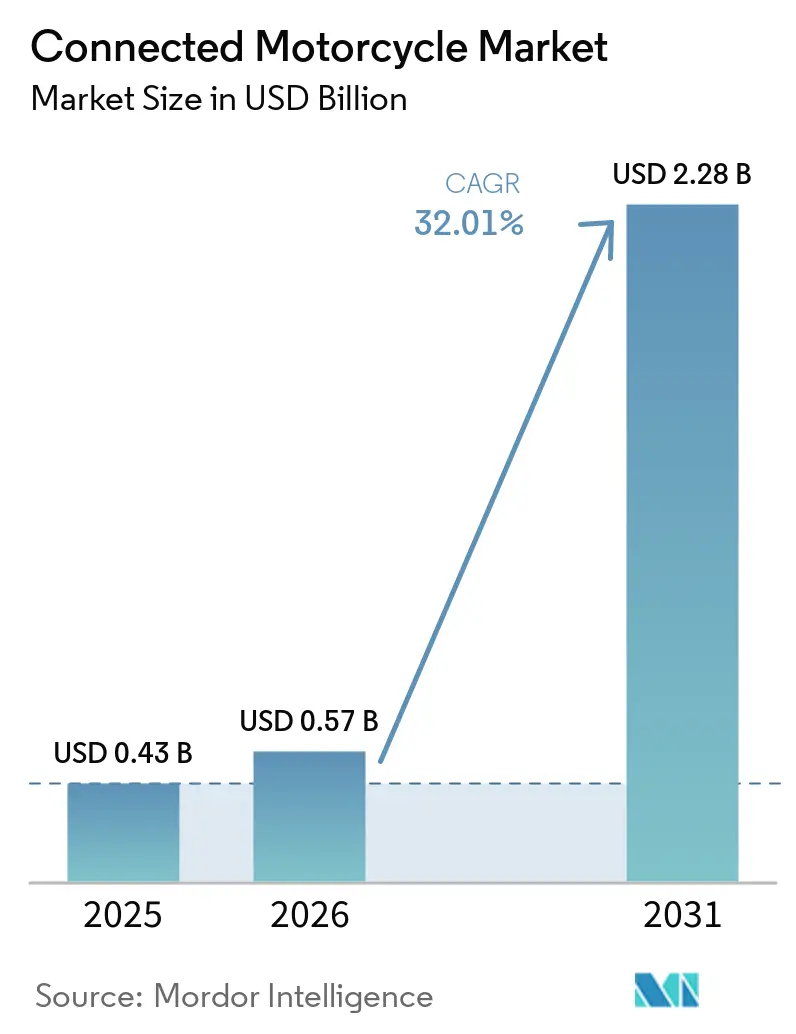
| Market Size (2026) | USD 0.57 Billion |
| Market Size (2031) | USD 2.28 Billion |
| Growth Rate (2026 - 2031) | 32.01 % |
| Fastest Growing Market | Asia Pacific |
| Largest Market | Asia Pacific |
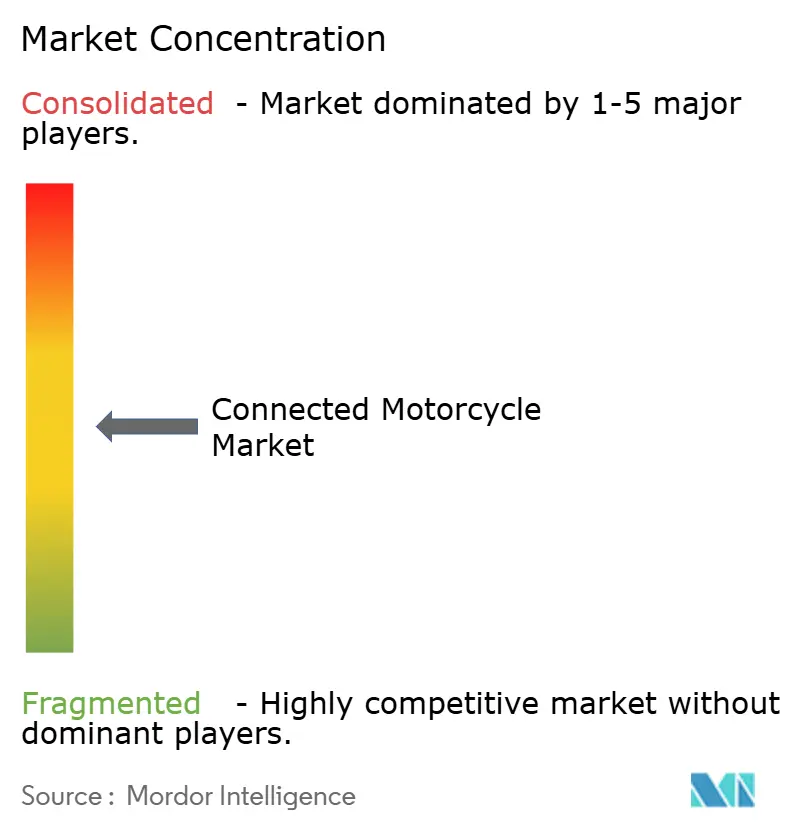
| Market Concentration | Medium |
Major Players *Disclaimer: Major Players sorted in no particular order Image © Mordor Intelligence. Reuse requires attribution under CC BY 4.0. | |
Connected Motorcycle Market Analysis by Mordor Intelligence
The connected motorcycle market size is expected to grow from USD 0.43 billion in 2025 to USD 0.57 billion in 2026 and is forecasted to reach USD 2.28 billion by 2031 at a 32.01% CAGR over 2026-2031. Regulatory cybersecurity deadlines, 5G network densification, and the increasing integration of telematics in premium two-wheelers underpin this rapid rise in value. Cellular 4G and 5G technologies already account for the majority of on-road links. At the same time, radar-enabled rider assistance is poised to surpass infotainment features as collision avoidance transitions from prototypes to series production. Hardware suppliers are reducing power draw with edge-AI chips, alleviating battery-life concerns and encouraging OEMs to integrate always-on connectivity across more price tiers. The Asia-Pacific region remains the epicenter of growth, driven by India’s burgeoning premium segment and China’s investments in smart roads, while Europe and North America sustain solid momentum as the UNECE R155 and R156 rules make secure telematics compulsory.
Key Report Takeaways
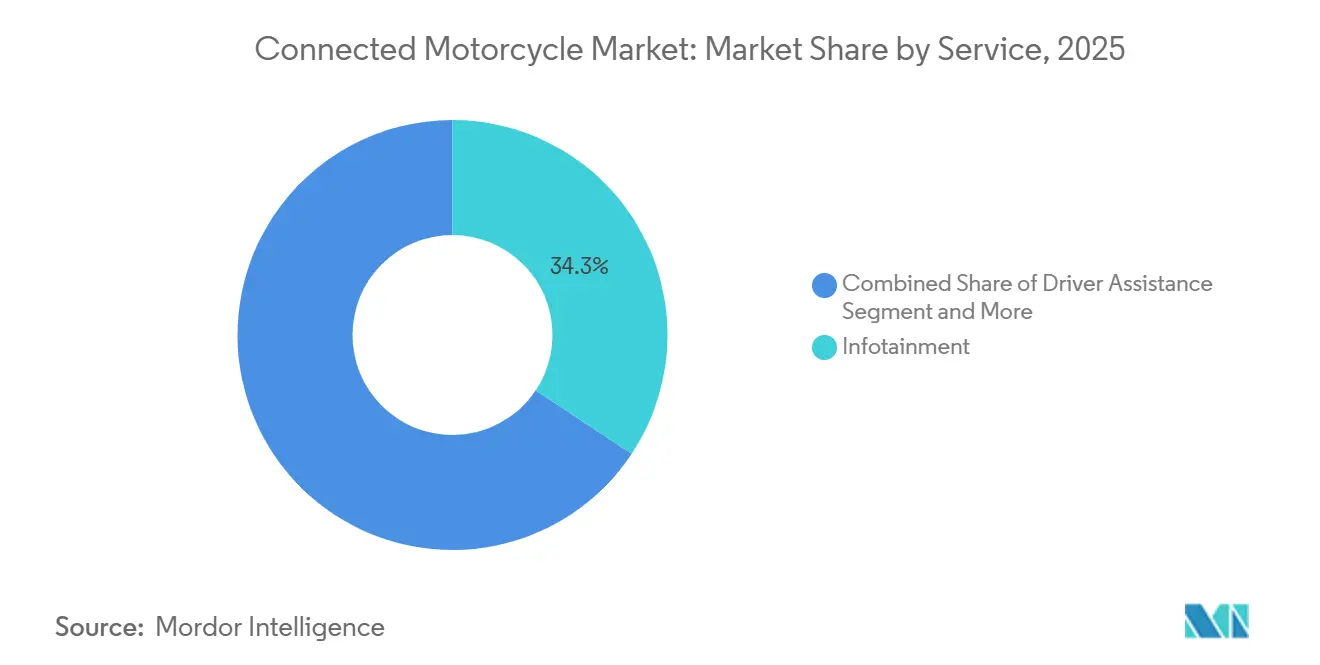
- By service, infotainment retained 34.31% revenue share in 2025, while the driver assistance sub-segment is projected to post a 44.21% CAGR through 2031.
- By hardware type, embedded control units held 54.82% of the connected motorcycle market share in 2025, while smartphone-based solutions are set to register a 37.51% CAGR through 2031.
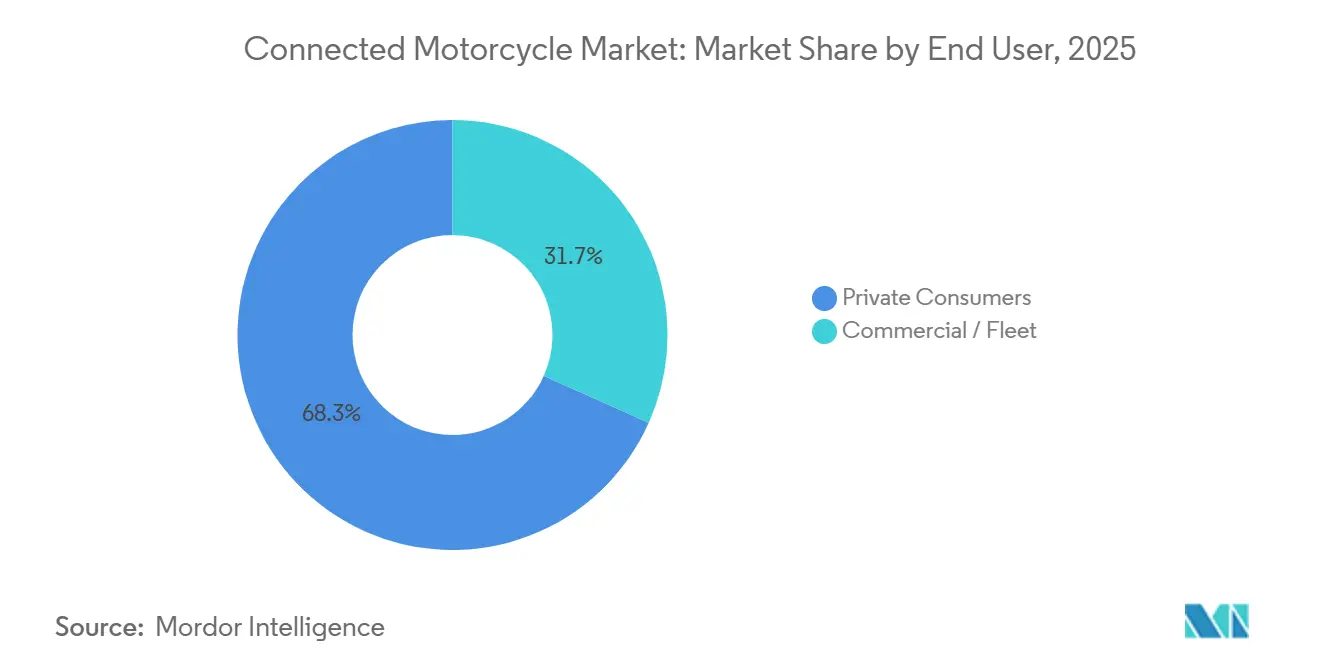
- By end user, private consumers accounted for 68.31% of the connected motorcycle market in 2025, whereas commercial fleets are expected to grow at a 32.11% CAGR through 2031.
- By network type, cellular 4G/5G networks led with 59.31% of the connected motorcycle market share in 2025 and are expanding at a 41.11% CAGR through 2031.
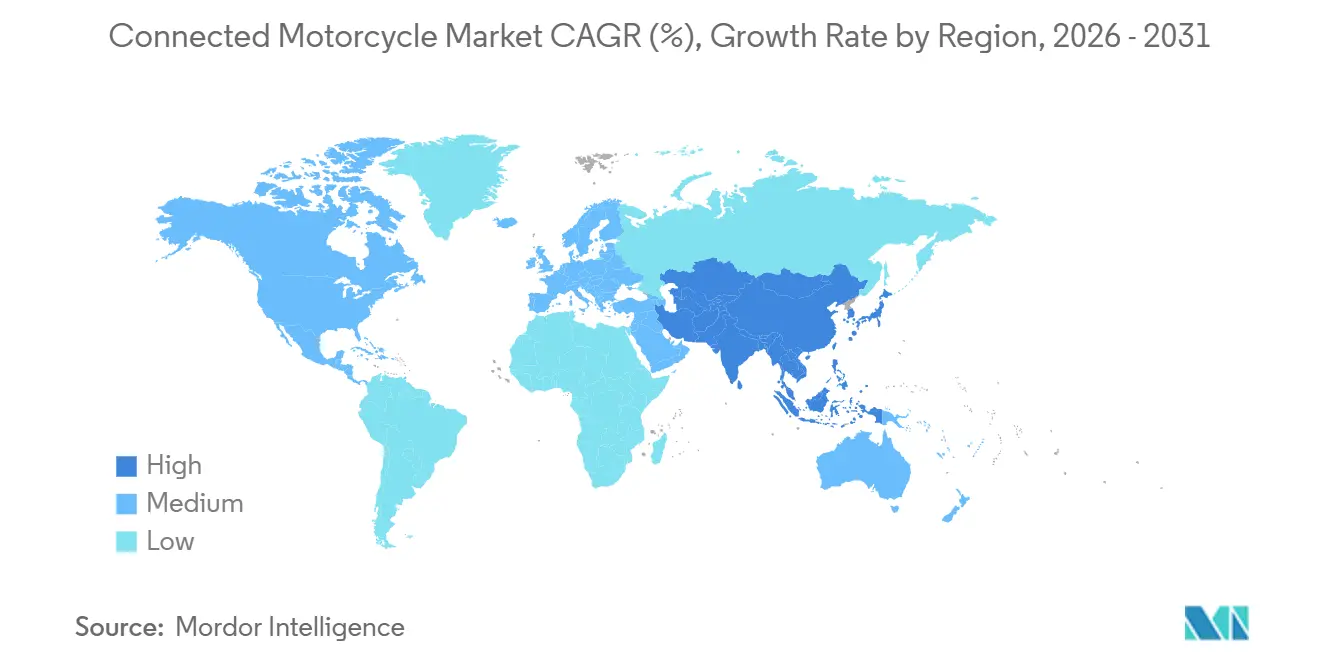
- By geography, Asia-Pacific led the connected motorcycle market with 41.73% market share in 2025 and is projected to expand at a 35.81% CAGR through 2031.
Note: Market size and forecast figures in this report are generated using Mordor Intelligence’s proprietary estimation framework, updated with the latest available data and insights as of January 2026.
Market Trends and Insights
Drivers Impact Analysis of Connected Motorcycle Market*
| Driver | (~)% Impact on CAGR Forecast | Geographic Relevance | Impact Timeline |
|---|---|---|---|
| 5G Roll-Outs | +7.8% | Global, led by Asia-Pacific and North America | Medium term (2-4 years) |
| Cyber-Security Mandates (UNECE R155/156) | +6.0% | Europe, North America, expanding to Asia-Pacific | Short term (≤ 2 years) |
| Integration of eSIM-Based Telematics | +5.5% | Global, strongest in Europe and Asia-Pacific | Medium term (2-4 years) |
| ADAS-Ready Two-Wheelers | +4.8% | Europe, North America, premium Asia-Pacific | Medium term (2-4 years) |
| Premium Bike Sales Boom | +3.7% | Asia-Pacific core, spill-over to Middle East | Long term (≥ 4 years) |
| Edge-AI Chips | +2.5% | Global, early adoption in North America and EU | Long term (≥ 4 years) |
| Source: Mordor Intelligence | |||
5G Roll-Outs Enabling Ultra-Low-Latency V2X
With stand-alone 5G networks achieving radio latency in the millisecond range, features like collision warnings and cooperative adaptive cruise control are becoming a reality for riders. Autotalks and Rolling Wireless have unveiled a 5G-V2X chipset family set for series production, compatible with both cellular V2X and older DSRC modes. Japan has allocated a dedicated frequency band for V2X, laying the groundwork for nationwide V2X pilot corridors. Meanwhile, in the United States, efforts are underway to expand V2X coverage on highways. Such initiatives firmly establish 5G as the cornerstone of the connected motorcycle market, enabling advanced safety features and seamless communication for riders over the coming decade.
Government Cyber-Security Mandates (UNECE R155/156)
UNECE Regulation 155 obliges every new motorcycle type-approval from July 2029 to include a full Cyber Security Management System, while Regulation 156 codifies software-update logging and validation. These rules apply to category L vehicles and push security hardware costs into even entry-level models. Tier-one suppliers respond with bundled telematics and ABS units that amortize certification expense. Smaller manufacturers must weigh white-label platforms against in-house solutions, a strategic fork that can alter brand differentiation. Early adoption helps firms avoid future production bottlenecks as the deadline approaches.
Surging Integration of eSIM-Based Telematics
eSIM modules displace physical SIM cards, allowing motorcycles to roam seamlessly and switch carriers without hardware swaps. Qualcomm’s QWM2290 chipset combines LTE/5G connectivity and GNSS into a single package, reducing board space and certification cycles[1]. Fleet operators use the technology to optimize coverage and service fees, while Sentiance reports 30-40% reductions in claims for bikes fitted with behavior-tracking telematics. Partnerships like Sibros with PIERER Mobility illustrate how over-the-air platforms shorten feature rollouts and reduce dealership visits. Collectively, these developments strengthen the connected motorcycle market across premium and mainstream segments.
OEM Push Toward ADAS-Ready Two-Wheelers
Motorcycle makers emulate automotive safety roadmaps by embedding adaptive cruise control, blind-spot detection, and emergency call functions. Bosch's radar-based cruise control on the Ducati Multistrada V4 and BMW R 1250 RT, combining its inertial measurement unit with front-facing sensors to maintain safe distances[2]. BMW’s ConnectedRide initiative integrates motorcycles into Car-to-X networks, allowing other vehicles to receive proximity alerts from two-wheelers. Higher safety ratings support insurance discounts, enlarging the total addressable connected motorcycle market.
Restraints Impact Analysis of Connected Motorcycle Market*
| Restraint | (~)% Impact on CAGR Forecast | Geographic Relevance | Impact Timeline |
|---|---|---|---|
| High Incremental BOM Cost | -3.2% | Global, acute in South Asia, Africa, South America | Short term (≤ 2 years) |
| Li-Ion Thermal-Runaway Recalls | -2.1% | Asia-Pacific, spill-over to Europe and North America | Medium term (2-4 years) |
| Rider Privacy Concerns | -1.8% | Europe, North America, expanding to Asia-Pacific | Medium term (2-4 years) |
| Limited DSRC/5.9 GHz Spectrum | -1.5% | Europe | Long term (≥ 4 years) |
| Source: Mordor Intelligence | |||
High Incremental BOM Cost for Mass-Market Bikes
Entry-level motorcycle manufacturers are experiencing a squeeze on margins as the addition of telematics, displays, and secure gateways significantly increases component costs. Renesas is addressing this challenge with its single-chip telematics controllers, which reduce both PCB area and firmware overhead. However, costs are further increased by UNECE R155 compliance, which requires comprehensive cybersecurity audits. To maintain their edge, manufacturers such as Hero MotoCorp are turning to smartphone-based dashboards. These dashboards shift much of the processing burden to the rider’s device. Yet, this integration complexity can detract from the overall user experience. Such challenges are curbing the rapid adoption of connected motorcycles, especially in price-sensitive segments.
Li-Ion Thermal-Runaway Recalls Dampen OEM Appetite
High-profile battery fires in 2024-2025 highlighted the risk of thermal runaway in compact electric motorcycles, triggering official safety investigations. Regulators responded by strengthening battery-test protocols, which now include thermal-propagation and vibration checks, thereby raising the compliance bar for every new model. OEMs consequently scrutinize add-on electronics near the battery enclosure, and telematics modules draw particular focus because they introduce continuous power consumption in a confined space. Engineers counter the risk with ultra-low-sleep-mode designs and layered battery-management controls that isolate failing cells before temperatures escalate.
*Our forecasts treat driver/restraint impacts as directional, not additive. The impact forecasts reflect baseline growth, mix effects, and variable interactions.
Connected Motorcycle Market Segment Analysis
By Service:
Driver Assistance Surges as Collision Avoidance ScalesInfotainment accounted for 34.31% of 2025 revenue, indicating the current center of gravity in the connected motorcycle market. Driver assistance services are projected to grow at 44.21% between 2026 and 2031, the fastest among all service categories. Mandatory eCall functions, as outlined by the European Commission, transform safety services into non-optional add-ons. Meanwhile, remote diagnostics and firmware updates satisfy UNECE security rules, and usage-based insurance gains favor with risk-averse insurers in high-traffic regions. The combined pull of regulation and insurer incentives positions driver assistance as the lead growth engine over the forecast horizon.
Regulation influences adoption priorities, encouraging OEMs to invest in over-the-air capabilities while leaving infotainment dependent on discretionary spending. Driver assistance sits between crowd-pleasing features and mandatory functions, giving it a balanced mix of regulatory and market support. Commercial fleets tend to prioritize vehicle management for cost control, whereas private riders prefer a balance of entertainment and safety. As a result, service portfolios diverge by customer group, and suppliers craft tiered offerings that align with each segment’s willingness to pay. This dynamic ensures the connected motorcycle market continues to diversify its revenue streams.

By Hardware Type:
Tethered Smartphone Solutions Gain as Cost Pressures MountEmbedded control units commanded 54.82% of 2025 deployments, reflecting their ability to provide always-on connectivity through two-wheeler connectivity systems and seamless over-the-air updates. Premium brands embed these units under the seat or fairing to deliver integrated navigation, diagnostics, and rider-assistance alerts. Rising production volumes gradually trim bill-of-materials costs, but budget-conscious OEMs still seek lower-priced alternatives to address price-sensitive buyers. Tethered smartphone solutions, forecast to grow at a 37.51% CAGR through 2031, answer that need by using the rider’s handset for data processing and network access. Although tethering lacks automatic crash notification if the phone is absent, it offers a compelling entry point for first-time connected motorcycle customers.
Hybrid architectures sit between both extremes, combining a small embedded module for mandatory safety functions with a phone-based app for infotainment and ride analytics. This split hardware model helps OEMs comply with regulations while avoiding the full cost of a high-spec ECU. Integrated cockpit clusters, which incorporate a color display and telematics modem into the instrument panel, appeal to touring riders who spend long hours on the road and expect rich mapping capabilities on demand. Suppliers continue to shrink display bezels and improve sunlight readability, enhancing perceived value. As these advances roll into mid-range models, hardware diversity broadens the connected motorcycle market size and keeps competition active across price tiers.
By End User:
Commercial Fleets Drive Telematics Adoption Through Operational ROIPrivate consumers accounted for 68.31% of 2025 demand, underscoring the continued role of motorcycles in leisure touring, sport riding, and daily commuting. Riders appreciate theft-recovery tracking and navigation support that smartphone apps or embedded clusters readily provide. They also value safety enhancements that deliver forward-collision and blind-spot warnings without diminishing the sense of control. Subscription pricing remains a hurdle for some retail buyers, but bundled data plans and pay-once upgrades ease adoption friction. As premium motorcycles filter into emerging economies, private uptake remains the volume backbone of the connected motorcycle market.
Commercial fleets, however, are projected to expand at a 32.11% CAGR through 2031, reflecting a clear operational payback on telematics investment. Delivery platforms, ride-hailing operators, and rental agencies utilize live vehicle data to optimize routing, curb reckless driving, and demonstrate compliance with local transportation regulations. Predictive maintenance alerts help keep bikes on the road during peak demand periods, which is critical when profit margins depend on high utilization rates. Usage-based insurance discounts further strengthen the business case, since premiums align with actual mileage and driving style rather than fixed risk tables. This cost-benefit loop supports a rapid shift from pilot projects to fleet-wide deployments, expanding the connected motorcycle market size in the enterprise channel.
By Network Type:
Cellular Dominates as Satellite-IoT Targets Coverage GapsCellular technologies accounted for 59.31% of the market share in 2025 and are expected to grow at a 41.11% CAGR through 2031, driven by the widespread availability of 4G and 5G networks. These networks strike a balance between bandwidth, latency, and cost, enabling both infotainment streaming and real-time hazard alerts under a single subscription. OEMs benefit from mature supply chains that deliver pre-certified modules with embedded SIMs, shortening development cycles. Regulatory bodies are increasingly viewing cellular-based eCall services as a baseline safety requirement, thereby solidifying the technology’s role. Continuous infrastructure upgrades ensure that even suburban and secondary roads gain reliable coverage over the forecast period.
Dedicated short-range communications and satellite-IoT solutions fill performance or coverage gaps rather than compete head-on with cellular. DSRC and C-V2X links offer ultralow latency for vehicle-to-vehicle messaging along test corridors, paving the way for future integration into broader safety frameworks. Satellite-IoT modules offer a fallback option for riders exploring remote deserts, mountains, and forest trails where terrestrial towers are scarce. This non-terrestrial layer supports asynchronous services such as stolen-vehicle recovery and emergency location beacons. By combining cellular reach with spot-coverage enhancers, OEMs create resilient connectivity packages that broaden the connected motorcycle market share across diverse geographies and riding styles.
Geography Analysis
APAC Connected Motorcycle Market
The Asia-Pacific region accounted for 41.73% of 2025 revenue and is projected to grow at 35.81% through 2031, giving the region the steepest slope on the connected motorcycle market growth curve. China’s mandate for V2X-ready smart roads accelerates adoption in every major city. Japan and South Korea favor tethered architectures because high smartphone penetration lowers incremental hardware cost. At the same time, Southeast Asian fleets deploy telematics across food-delivery and ride-hailing bikes to control operating expenses and raise safety. Together, these demand vectors strengthen supply-chain resilience and encourage component vendors to localize production lines, shortening lead times. Government initiatives that pair smart infrastructure funding with tax incentives further boost momentum.
North America and Europe Connected Motorcycle Market
North America follows with a forecasted CAGR of 24.92%, as state-level insurance discounts prompt riders to accept telemetry in exchange for lower premiums. Federal agencies have not yet mandated eCall; however, proposed safety rules continue to pressure OEMs to embed crash notification capability before regulations are finalized. Europe advances at 23.99% despite strict GDPR compliance burdens that elevate development costs. Germany, France, and the United Kingdom dominate regional spending due to their high per-capita incomes and established touring cultures. Eastern Europe lags as patchy cellular coverage limits the utility of telematics beyond urban zones.
MEA and South America Connected Motorcycle Market
South America, the Middle East and Africa grow from smaller bases yet show pockets of rapid uptake. Brazilian riders in congested cities value theft-recovery services, but exchange-rate fluctuations constrain upgrade cycles. Gulf states are investing in smart-city corridors that require V2X compliance for all new vehicles, thereby driving demand for premium connected models. Africa’s vast rural expanses favor hybrid cellular-satellite modules that ensure emergency connectivity where cellular towers are scarce. As terrestrial networks spread, suppliers position low-cost retrofit kits to tap the vast installed base of unconnected motorcycles.
Regulatory Landscape
Type-approval and software governance for L-category vehicles are converging with passenger-car requirements, with UNECE Regulations R155 (cybersecurity) and R156 (software updates) as the central anchors. In the European Union, cybersecurity requirements tied to UNECE R155 apply to L-category approvals, with deadlines bringing new vehicle types under the rules by 11 December 2027 and existing types by 11 June 2029. This increases the need for formal Cyber Security Management Systems and auditable OTA update processes across the connected motorcycle supply chain.
Outside Europe, rules and standardization remain uneven, shaping product and platform choices by region. In the United States, there is no federal mandate for V2X on motorcycles, and NHTSA formally withdrew the 2017 V2V NPRM in 2023 while continuing connected-vehicle research. As a result, OEMs continue to prioritize market-led connectivity bundles and insurer-driven safety features. In China, technical standardization continues through national standards such as GB/T 46741-2025 for motorcycle and moped onboard diagnostic connectors, implemented on 1 July 2026, which supports more consistent diagnostics interfaces for connected services and compliance testing in a major production market.
Value Chain Analysis
The connected motorcycle value chain starts with semiconductor and module providers, including cellular modems, GNSS, eSIM, radar, IMU, secure elements, and low-power MCUs. Tier 1 integrators then package telematics control units, cockpit clusters, sensors, and embedded software into OEM-ready platforms for type approval, after which motorcycle OEMs complete integration of HMI and service bundles and distribute through dealer networks with cloud operations and customer support. Platform suppliers and location-intelligence partners increasingly sit alongside traditional hardware tiers, reflecting how connectivity is being packaged for reuse. HARMAN announced its Ready Ride two-wheeler connectivity platform in March 2026, combining a TCU, software stack, and OEM backend support for OTA, which highlights the shift toward reusable, automotive-grade connectivity stacks adapted to two-wheeler packaging and ruggedization needs.
Downstream, mobile network operators and eSIM provisioning vendors enable roaming and service activation, while mapping, emergency response, and insurance or analytics partners monetize connected data under OEM consent models. Partnerships show how OEMs and EV makers use specialist providers to shorten integration cycles. PURE EV partnered with JioThings in February 2025 to integrate 4G-enabled digital clusters and telematics, and Pioneer and HERE Technologies expanded two-wheeler navigation and location-based connected services through their December 2024 partnership and India-focused device debuts in January 2025. UNECE R155 cybersecurity requirements add cross-tier obligations for secure development, supplier attestations, and update traceability, which increases the value of certified software processes and interoperable C-ITS profiles (via bodies such as the Connected Motorcycle Consortium) for scaling deployments.
Competitive Landscape
The connected motorcycle market remains moderately fragmented, with Robert Bosch GmbH, Continental AG, and BMW Motorrad accounting for most of the worldwide revenue. Bosch combines telematics, ABS, and radar into bundled offerings that increase per-bike content and lock in OEM relationships for multiple product cycles. Continental leverages passenger-car economies of scale to underwrite competitive pricing for motorcycle-grade telematics, while BMW integrates its proprietary Connected Ride software to deepen customer loyalty and drive data monetization.
A second tier of participants, including Panasonic, Autotalks, and several mid-size module makers, focuses on specialist capabilities such as ruggedized displays, dual-mode V2X chipsets, and low-power satellite transceivers. Their niche orientation allows premium pricing yet exposes them to volume swings as Tier 1 suppliers push integrated platforms. Connectivity service providers operate on a horizontal plane, offering cloud dashboards, eSIM provisioning, and roaming optimization that enable OEMs to outsource complex network operations. This model improves time-to-market while ensuring regulatory compliance across every jurisdiction.
Emerging disruptors use hybrid cellular-satellite architectures to address the last 10% of roads without reliable terrestrial signals. They partner with chipset vendors to embed non-terrestrial network logic directly into automotive SoCs, removing the need for separate satellite modems and antennas. Helmet communication specialists enter the fray with mesh-network products that extend short-range V2X coverage between riders on group tours, opening a fresh adjacency for data services. Patent filings centered on lean-angle-aware radar algorithms illustrate continued R&D focus on two-wheeler-specific safety, and the licensing value of these patents is likely to shape competitive advantage in coming years.
Connected Motorcycle Industry Leaders
-
Robert Bosch GmBH
-
Panasonic Corporation
-
Continental AG
-
BMW Motorad
-
Autotalks
- *Disclaimer: Major Players sorted in no particular order
Connected Motorcycle Market Companies Covered in this Report
- BMW Motorrad
- Continental AG
- Robert Bosch GmbH
- Panasonic Corporation
- TE Connectivity
- Autotalks
- Aeris Communications
- Vodafone Group PLC
- Starcom Systems
- KPIT Technologies
- Honda Motor Co.
- Yamaha Motor Co.
- Hero MotoCorp
- NXP Semiconductors
- Qualcomm Technologies
- Harman International
- Telit Cinterion
- Alpinestars
- Dainese SpA
- Sena Technologies
Market Opportunities and Future Outlook
OEM demand is increasingly oriented around modular connectivity platforms that reduce engineering effort while meeting tighter cybersecurity and software-update governance. This creates whitespace for turnkey TCUs, OTA stacks, and managed connectivity services that are designed for motorcycle-specific constraints, including power draw, ruggedization needs, and HMI limitations. HARMAN's March 2026 Ready Ride announcement provides a concrete indicator of suppliers productizing end-to-end two-wheeler connectivity, including device, software, and backend, which supports more standardized deployments across multiple models and geographies.
A second opportunity is emerging at the intersection of navigation, safety services, and V2X standardization as connected features move from infotainment add-ons toward compliance and risk-reduction tools. In India, the Ministry of Heavy Industries issued an advisory to implement CSMS and SUMS from 1 October 2026, and TRAI released a 2026 consultation on a V2X regulatory framework proposing C-V2X (3GPP Rel.16+) and spectrum in the 5.9 GHz band. Together, these actions push OEM roadmaps toward secure, update-capable architectures that can host future cooperative safety functions. In parallel, BRP Inc. launched BRP GO! on-road navigation in June 2026 with direct integration to a 10.25-inch vehicle display, pointing to continued OEM investment in integrated cockpit experiences that do not rely entirely on smartphone tethering.
Recent Industry Developments in Connected Motorcycle Market
- March 2026: HARMAN announced Ready Ride, a rugged, scalable connectivity platform for two-wheeled mobility that packages an embedded telematics control unit with a software stack and OEM backend support, including OTA update capability. The move productizes a reusable connectivity blueprint for motorcycle OEMs that want faster integration cycles while aligning software-update workflows with tightening cybersecurity and compliance requirements.
- August 2025: BMW Motorrad opened ordering for model year 2026 revisions that included updates around navigation preparation and optional equipment packages. These updates reinforce OEM focus on factory-integrated connectivity touchpoints at the cockpit and accessory interface, supporting higher attach rates for connected navigation and communication services across touring and premium segments.
- November 2024: Robert Bosch GmbH unveiled new motorcycle radar-based assistance systems and ABSi (ABS with an integrated inertial measurement unit) at EICMA 2024. The expanded ADAS portfolio increases the amount of sensor and compute content per bike and accelerates the need for reliable in-vehicle connectivity to deliver alerts, software improvements, and diagnostics alongside safety functions.
Connected Motorcycle Market Report Scope and Research Methodology
Market Definition and Coverage
For this report, the connected motorcycle market is defined as revenue linked to new two-wheelers that leave the factory with built-in connectivity (embedded, integrated, or tethered units) that enables ongoing data exchange for safety, infotainment, diagnostics, and over-the-air features.
Scope exclusions: Aftermarket retrofit telematics add-ons, standalone connected helmets, and subscription revenues not bundled with the vehicle at first registration are excluded.
Segments Covered in This Report
- By Service
- Driver Assistance
- Infotainment
- Safety and Emergency Call
- Vehicle Management / OTA Updates
- Insurance and UBI
- By Hardware Type
- Embedded Control Unit
- Tethered Smartphone-based
- Integrated Cockpit Cluster
- By End User
- Private Consumers
- Commercial / Fleet
- By Network Type
- Cellular (4G/5G)
- Dedicated Short-Range Comms (C-V2X/802.11p)
- Satellite-IoT and LPWAN
- Geography
- North America
- United States
- Canada
- Rest of North America
- South America
- Brazil
- Argentina
- Rest of South America
- Europe
- Germany
- United Kingdom
- France
- Russia
- Rest of Europe
- Asia-Pacific
- China
- India
- Japan
- South Korea
- Rest of Asia-Pacific
- Middle East and Africa
- Egypt
- Turkey
- South Africa
- Saudi Arabia
- United Arab Emirates
- Rest of Middle East and Africa
- North America
Data Sources, Market Sizing, and Validation
Desk Research
Desk research was used to build the starting structure of the model and to keep assumptions realistic across APAC, EMEA, and the Americas. We leaned on public two-wheeler production and sales statistics, such as national transport agencies, customs and trade portals, and multilateral databases that track vehicle-related indicators.
To avoid guessing connectivity levels, we also checked standards and policy signals that shape adoption, including telecom regulators and road safety bodies, then moved to technical sources such as patent databases and peer-reviewed journals covering V2X and telematics. Annual reports, filings, and investor decks were used to confirm how connectivity is packaged and monetized, and a paid subscription for company financials and news was used to cross-check timelines and strategic shifts. This list is not exhaustive, and many other public and paid sources were reviewed for data collection, validation, and clarification.
Primary Interviews and Surveys
Primary work focused on validating what "connected" means in real buying and selling situations, and on correcting secondary assumptions that can drift over time. We spoke with OEM-side product teams, connectivity module and software suppliers, telecom and platform ecosystem participants, and select fleet and dealer channel voices across APAC, EMEA, and the Americas to confirm penetration, feature bundling, and price realization.
Distribution of primary research fieldwork respondents
| Company type | Respondent position | Region |
|---|---|---|
| Top tier: 29% | CXOs: 13% | APAC: 43% |
| Mid tier: 56% | Functional/Unit leaders: 35% | EMEA: 33% |
| Smaller Players: 15% | Managers: 52% | Americas: 24% |
Market-Sizing & Forecasting
The core build uses a top-down approach where two-wheeler production and sales data are reconstructed by region, then filtered through connected-feature fitment rates and the share of factory-installed control units. Once the demand pool is formed, value is estimated using typical connectivity-related price adders and service attach assumptions that were verified in interviews.
To keep the totals grounded, we corroborated results with selective bottom-up approximations, such as sampling model lineups to count connected trims, checking supplier shipment signals where available, and using ASP x volume checks for key module categories before adjusting outliers. Inputs that matter most in this market include new two-wheeler sales mix by country, smartphone tethering versus embedded adoption, cellular coverage and 4G or 5G readiness, safety and eCall-style regulatory direction, and the speed at which OTA-capable ECUs are being adopted in mass models.
For forecasting, we used scenario analysis because adoption curves can shift quickly with regulation, telecom costs, and OEM packaging decisions. Assumptions were refreshed using expert views on penetration by motorcycle class and region, followed by consistency checks against broader motorcycle sales outlooks. Where bottom-up signals were missing for smaller countries, gaps were handled by applying validated penetration and pricing ranges from comparable markets with similar vehicle mixes and telecom maturity.
Data Validation & Update Cycle
Validation is done through triangulation across independent signals, followed by structured variance checks before numbers are finalized. We compare the model outputs against motorcycle sales trajectories, connectivity module adoption signals, and telecom readiness indicators, then review any sharp jumps that do not match known product cycles.
Anomalies trigger a second look at conversion rates, price adders, and penetration assumptions, and follow-up outreach is done when a key input moves outside the expected range. Reports are refreshed annually, with interim updates when material events occur, such as major regulatory changes or step shifts in OEM connectivity packaging. Before delivery, a final analyst pass is completed so clients receive the most current view available at the time.
Mordor Intelligence's Connected Motorcycle Market Size Compared With Other Published Estimates
Published connected motorcycle market numbers often spread out because the word "connected" is used differently, and because revenue can be counted at different points in the value chain. Differences also come from the year selected as the base, how fast adoption is assumed to rise, and whether service revenue is treated as bundled with the vehicle or as a separate stream.
By tracking factory-fit connectivity on new two-wheelers and refreshing bundling and attach-rate assumptions with annual checks, Mordor Intelligence keeps the value tied to first-registration vehicle revenue. Some estimates also fold in retrofit devices and adjacent accessories that inflate totals, which is a common driver of divergence. In this market, the biggest gap drivers are usually whether scooters and mopeds are included alongside motorcycles, whether aftermarket telematics kits are counted, and whether long-run service subscriptions are modeled beyond what is sold with the vehicle. Currency timing and the way ASP progression is handled (flat adders versus feature-led price shifts) also move the final number.
Benchmark comparison
| Source | Market Size | Gaps in Research Methodology |
|---|---|---|
| Mordor Intelligence | USD 0.57 B (2026) | |
| Industry Data Publisher A | USD 0.44 B (2024) | Uses an earlier base year and a broader definition that can mix hardware, services, and communication layers without clearly separating factory-installed revenue from downstream service expansion. |
| Global Research Group B | USD 0.33 B (2025) | Counts a wider set of related goods and creator-level services using factory-gate valuation, which can pull in accessories and add-on devices that are outside a strict factory-fit connected two-wheeler boundary. |
The table shows that most of the spread is explained by scope boundaries and timing choices rather than by math errors. When connectivity is restricted to factory-installed capability at first registration, the model remains easier to audit using vehicle sales, fitment rates, and realistic price adders, and that makes the estimate repeatable when the market is updated.
Key Questions Answered in the Report
What is the current size of the connected motorcycle market?
The connected motorcycle market size stands at USD 0.57 billion in 2026 and is projected to reach USD 2.28 billion by 2031.
Which region leads connected motorcycle adoption?
Asia-Pacific commanded 41.73% revenue in 2025 and is forecast to grow at a 35.81% CAGR through 2031, the fastest worldwide.
Which service category is growing fastest?
Driver assistance services will expand at 44.21% CAGR between 2026 and 2031 as collision-avoidance functions move into mainstream models.
How are commercial fleets using motorcycle telematics?
Fleet operators deploy GPS tracking and behavior analytics to cut fuel use, lower insurance premiums, and reduce unplanned maintenance.