
Conference Room Hardware Market Size and Share
Market Overview
| Study Period | 2020 - 2031 |
|---|---|
| Market Size (2026) | USD 13.11 Billion |
| Market Size (2031) | USD 26.93 Billion |
| Growth Rate (2026 - 2031) | 15.53 % |
| Fastest Growing Market | Asia-Pacific |
| Largest Market | North America |
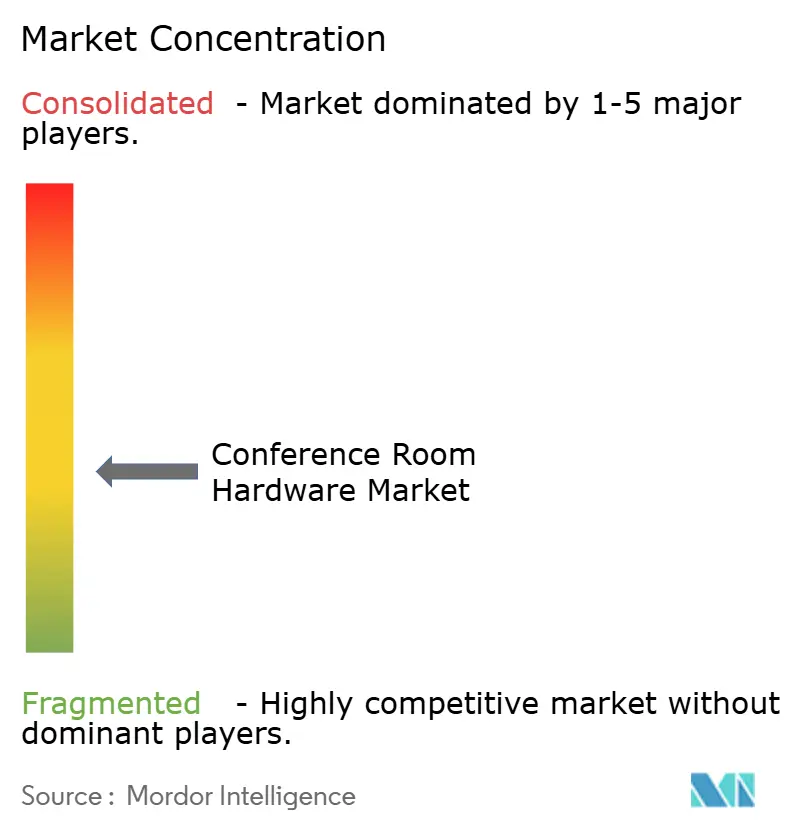
| Market Concentration | Medium |
Major Players *Disclaimer: Major Players sorted in no particular order Image © Mordor Intelligence. Reuse requires attribution under CC BY 4.0. | |
Conference Room Hardware Market Analysis by Mordor Intelligence
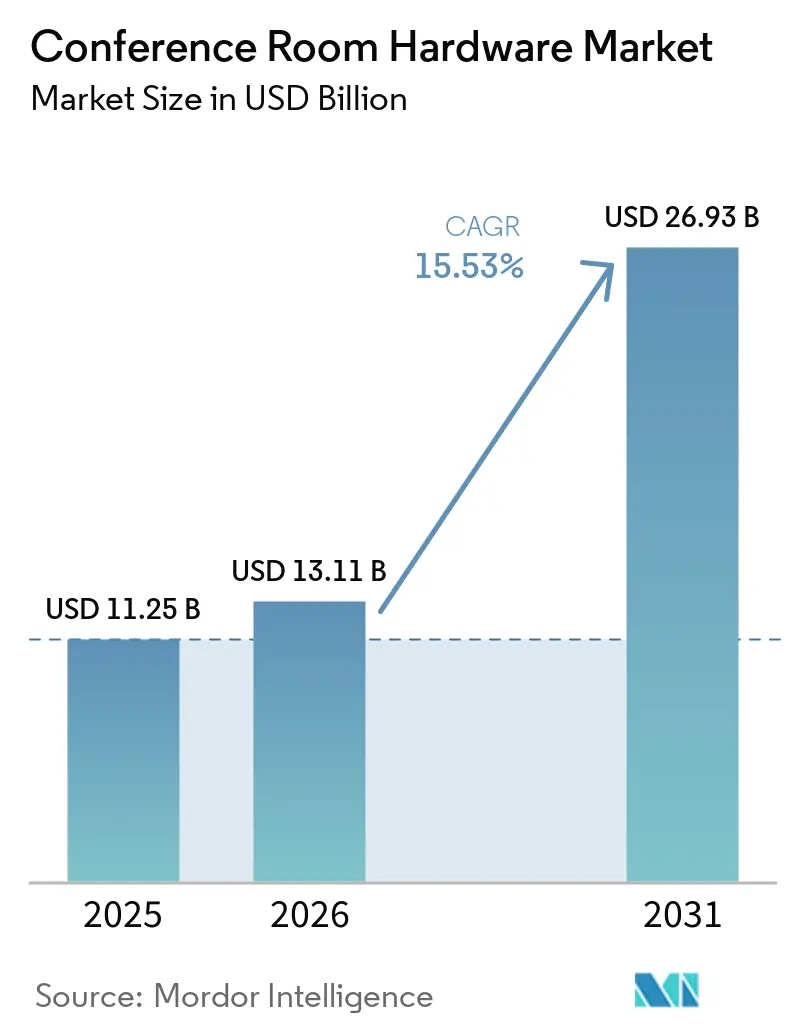
The conference room hardware market size was valued at USD 11.25 billion in 2025 and estimated to grow from USD 13.11 billion in 2026 to reach USD 26.93 billion by 2031, at a CAGR of 15.53% during the forecast period (2026-2031). An enduring hybrid-work culture is steering capital toward technology that levels the experience between in-person and remote participants, pushing enterprises to refresh cameras, microphones, and control interfaces more frequently. Seamless one-touch automation, artificial intelligence that auto-frames speakers and suppresses background noise, and vendor-neutral certification programs from Microsoft Teams and Zoom have shortened decision cycles. Meanwhile, memory chip shortages and tariff volatility are inflating costs, yet have not slowed adoption because collaboration has become mission-critical. Vendors able to combine wireless flexibility, AI features, and sustainability credentials are capturing share as organizations densify small spaces rather than build additional boardrooms.
Key Report Takeaways
- By hardware type, video conferencing devices led with 39.28% of the conference room hardware market share in 2025, while control and automation systems are expanding at a 17.11% CAGR through 2031.
- By room size, huddle and small meeting rooms accounted for a 47.11% share of the conference room hardware market size in 2025 and are advancing at a 16.53% CAGR through 2031.
- By end-user industry, commercial spaces held 60.11% revenue share in 2025, whereas education institutions are forecast to grow at a 16.81% CAGR to 2031.
- By connectivity, wired systems retained 50.92% share of the conference room hardware market size in 2025, yet wireless solutions are moving ahead at an 18.06% CAGR through 2031.
- By geography, North America commanded 35.84% of the conference room hardware market share in 2025, although Asia-Pacific is projected to expand at a 17.63% CAGR over 2026-2031.
Note: Market size and forecast figures in this report are generated using Mordor Intelligence’s proprietary estimation framework, updated with the latest available data and insights as of January 2026.
Market Trends and Insights
Drivers Impact Analysis of Conference Room Hardware Market*
| Driver | (~) % Impact on CAGR Forecast | Geographic Relevance | Impact Timeline |
|---|---|---|---|
| Accelerated Hybrid Work Models Driving Small-Room Hardware Upgrades | +4.2% | Global, strongest in North America and Europe | Medium term (2-4 years) |
| AI-Enabled Audio and Video Features Raising Refresh Demand | +3.8% | Global, led by North America and Asia-Pacific | Short term (≤ 2 years) |
| Declining USB Peripheral Costs Enabling SME Adoption | +2.1% | Global, highest in Asia-Pacific and South America | Medium term (2-4 years) |
| Vendor-Neutral Certification by UCaaS Platforms Boosting Hardware Replacement Cycles | +2.9% | Global, especially North America and Europe | Short term (≤ 2 years) |
| ESG and Energy-Efficient Room Devices Influencing Procurement Decisions | +1.3% | Europe and North America, spreading to Asia-Pacific | Long term (≥ 4 years) |
| 4K and 8K Camera and Ultra-Wide Display Adoption Enhancing Meeting Equity | +2.6% | North America and Asia-Pacific, spill-over to Europe | Medium term (2-4 years) |
| Source: Mordor Intelligence | |||
Accelerated Hybrid Work Models Driving Small-Room Hardware Upgrades
Hybrid work has become the default operating framework, prompting enterprises to convert unused areas into video-enabled huddle rooms seating 2 to 6 people. Huddle and small rooms already held 47.11% share in 2025 and are on pace for a 16.53% CAGR through 2031, reflecting a capital shift away from large boardrooms. New all-in-one bars featuring 360-degree video, AI speaker tracking, and USB-C docking simplify installation and support hot-desking. The result is a democratization of high-quality collaboration that reaches every level of the organization, trimming travel budgets and accelerating agile workflows.[1]
AI-Enabled Audio and Video Features Raising Refresh Demand
Artificial intelligence has migrated from differentiator to baseline expectation in conference room hardware, accelerating replacement cycles as legacy systems lack computational headroom for real-time processing. Logitech's Rally Bar and Rally Bar Mini, launched in 2025, integrate AI-driven auto-framing, speaker tracking, and noise suppression, delivering broadcast-quality video without manual camera adjustments.[2] Jabra's PanaCast 50 employs three 13-megapixel cameras and edge-based AI to generate a 180-degree panoramic field of view with intelligent zoom, ensuring remote participants can read body language and whiteboard content.
Declining USB Peripheral Costs Enabling SME Adoption
Component miniaturization and the spread of USB-C have cut camera, speaker, and microphone prices, allowing small and medium enterprises to deploy full-featured systems for USD 3,000-8,000 per room. Plug-and-play peripherals reduce the need for specialty installers, further lowering total costs. Uptake is most visible in Asia-Pacific and South America, where price sensitivity is high but hybrid work demands are rising.
Vendor-Neutral Certification by UCaaS Platforms Boosting Hardware Replacement Cycles
Open certification programs from Teams Rooms and Zoom Rooms guarantee that certified devices meet latency, resolution, and security benchmarks, giving IT leaders confidence in multi-vendor procurement. Certification reduces lock-in, accelerates purchasing, and sets performance floors that older endpoints cannot meet. The practice is revitalizing replacement cycles, especially in the fast-growing huddle room segment.
Restraints Impact Analysis of Conference Room Hardware Market*
| Restraint | (~) % Impact on CAGR Forecast | Geographic Relevance | Impact Timeline |
|---|---|---|---|
| High Total Cost of Ownership for Integrated Room Systems | -3.10% | Global, most acute for SMEs | Medium term (2-4 years) |
| Semiconductor Supply Chain Volatility and Tariff Uncertainty | -2.70% | Global, centered on Asia-Pacific manufacturing and North America imports | Short term (≤ 2 years) |
| Interoperability Challenges Between Legacy AV and Modern UC Platforms | -1.90% | North America and Europe | Medium term (2-4 years) |
| Growing Security and Privacy Compliance Burden in Meeting Spaces | -1.60% | Europe, North America, expanding to Asia-Pacific | Long term (≥ 4 years) |
| Source: Mordor Intelligence | |||
High Total Cost of Ownership for Integrated Room Systems
The total cost extends beyond the invoice for cameras and displays to include software licenses, network upgrades, and support, which can triple the five-year expenditure. Premium subscriptions for Teams Rooms add USD 2,400 per room over a standard lifecycle, while labor for complex boardrooms can reach USD 45,000. Vendors offering wireless presentation and self-configuring audio aim to trim these costs, yet capital hurdles still deter smaller organizations from full-scale rollouts.
Semiconductor Supply Chain Volatility and Tariff Uncertainty
A 300% spike in memory prices in 2026, driven by datacenter demand, has forced hardware makers to prioritize high-margin models, delaying entry-level launches. Simultaneously, shifting tariffs require duplicate inventories across regions, tying up working capital and stretching lead times from 6 to 16 weeks. Buyers respond by extending refresh intervals or choosing vendors with diversified manufacturing footprints.
*Our forecasts treat driver/restraint impacts as directional, not additive. The impact forecasts reflect baseline growth, mix effects, and variable interactions.
Conference Room Hardware Market Segment Analysis
By Hardware Type:
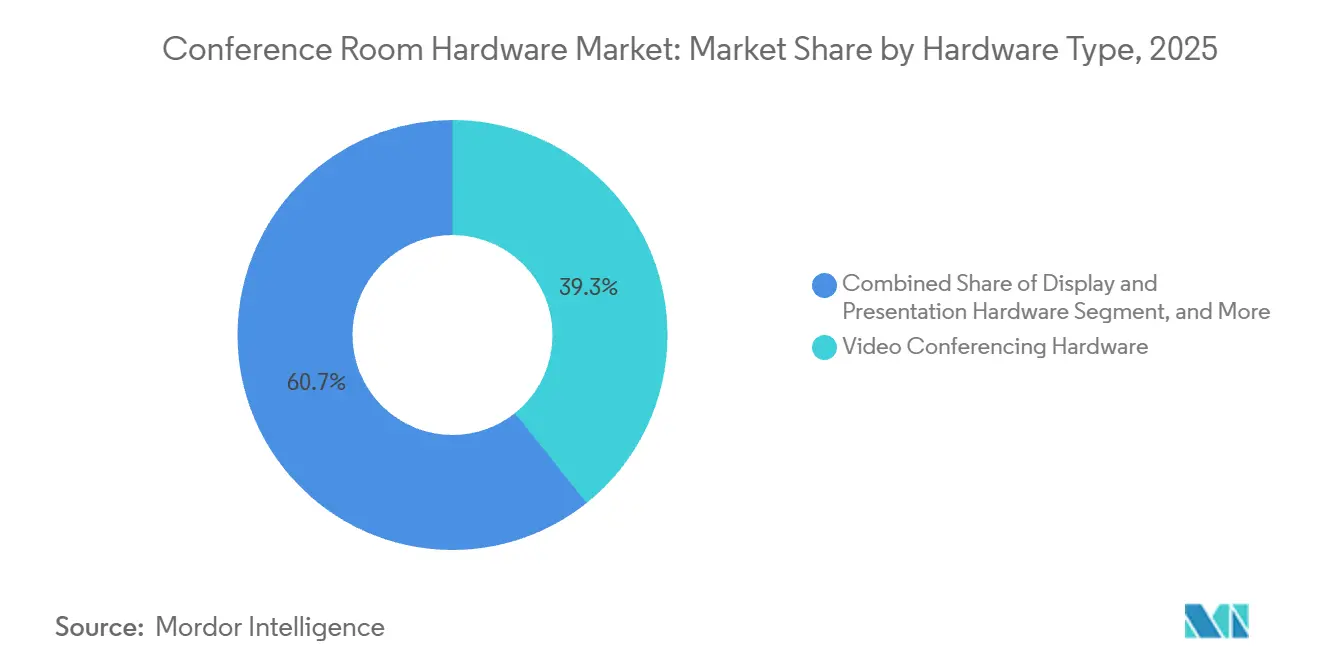
Control Systems Automate Meeting StartsVideo conferencing hardware held 39.28% market share in 2025, reflecting its role as the foundational element of any collaboration space, yet growth is moderating as the installed base matures and replacement cycles extend to 5-7 years for mid-range systems. Crestron's AutoMeasure technology, introduced in 2025, uses AI to analyze room acoustics and automatically configure audio processing parameters, reducing commissioning time from hours to minutes and lowering the total cost of ownership.
Control and automation systems are expanding at 17.11% CAGR during 2026-2031, outpacing the 15.53% overall market growth as enterprises prioritize one-touch meeting experiences that eliminate IT support calls and reduce setup friction. Display and presentation hardware is experiencing steady demand driven by the shift toward 4K and 8K resolution panels that enhance visual clarity for remote participants, while audio conferencing hardware benefits from the proliferation of beamforming microphone arrays that isolate voices in noisy open-plan environments. Other hardware types, including wireless presentation systems and USB peripherals, are gaining traction in bring-your-own-device scenarios where employees expect to connect personal laptops without proprietary dongles or software installations.

By Room Size:
Huddle Rooms Strengthen First-Mover AdvantageHuddle rooms and small meeting rooms commanded 47.11% market share in 2025 and are advancing at 16.53% CAGR through 2031, the fastest among all room sizes. Lower capital outlay, faster fit-outs, and alignment with agile team styles make these compact spaces the focal point of post-pandemic office redesigns. Medium rooms are experiencing moderate growth as organizations balance the need for departmental meeting spaces with budget constraints that favor smaller, more numerous installations.
Large rooms remain vital for board-level discussions and client presentations that demand immersive audio and multi-camera coverage, yet they account for only a small share of the conference room hardware market. Universities illustrate the trend as campuses repurpose study pods into video-enabled niches, proving that small-room investment carries over to education and healthcare settings. For instance, the University of Texas at Arlington deployed 150 huddle rooms in 2025 to support hybrid learning, selecting Logitech Rally Bar Mini systems for their plug-and-play USB connectivity and AI-driven speaker tracking.[3]
By End-User Industry:
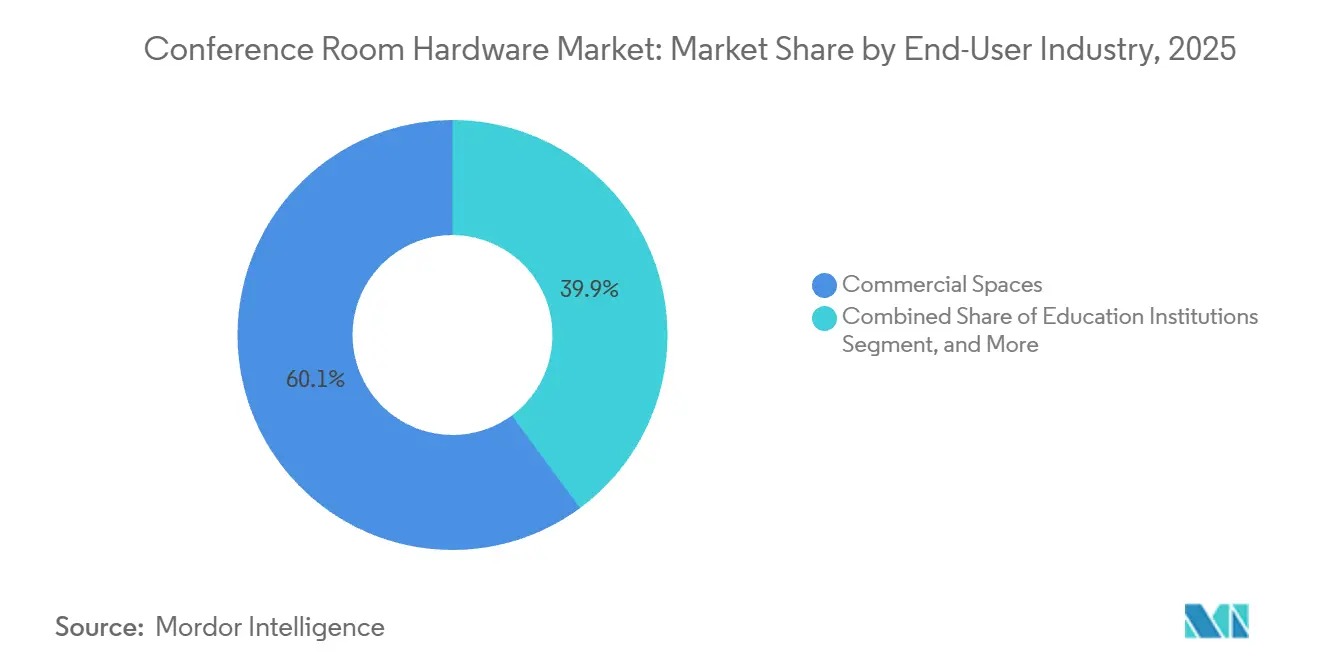
Education Surges on Hybrid Learning MandatesCommercial offices accounted for 60.11% of global revenue in 2025, but education is the standout growth sector, with a 16.81% CAGR forecast to 2031. Schools and universities are embedding video capability into classrooms to deliver synchronous instruction to remote learners and to future-proof against enrollment fluctuations. Otto von Guericke University in Germany selected Extron control systems for 75 classrooms, prioritizing centralized management and energy efficiency to align with institutional sustainability goals
The public sector and healthcare follow close behind, modernizing council chambers and teleconsultation suites. The conference room hardware industry is therefore broadening beyond corporate users, creating multi-vertical demand that cushions suppliers against macro-economic cycles. For instance, the University of Birmingham invested in Barco ClickShare wireless presentation systems to enable seamless content sharing in lecture halls.[4]
By Connectivity:
Wireless Accelerates on BYOD FlexibilityWireless connectivity solutions are expanding at 18.06% CAGR during 2026-2031, the fastest growth among all segmentation types, as enterprises prioritize bring-your-own-device flexibility and reduced installation complexity. Wired systems retained 50.92% market share in 2025, reflecting their continued dominance in large boardrooms and mission-critical applications where latency, bandwidth, and security requirements favor hardwired connections.
The wireless segment's rapid growth is driven by declining component costs, improved Wi-Fi 6 and Wi-Fi 6E performance, and the proliferation of USB-C docking solutions that consolidate power, video, and data over a single cable. However, wireless systems face adoption barriers in regulated industries like finance and healthcare, where data sovereignty and encryption requirements favor air-gapped wired networks.
Geography Analysis
North America Conference Room Hardware Market
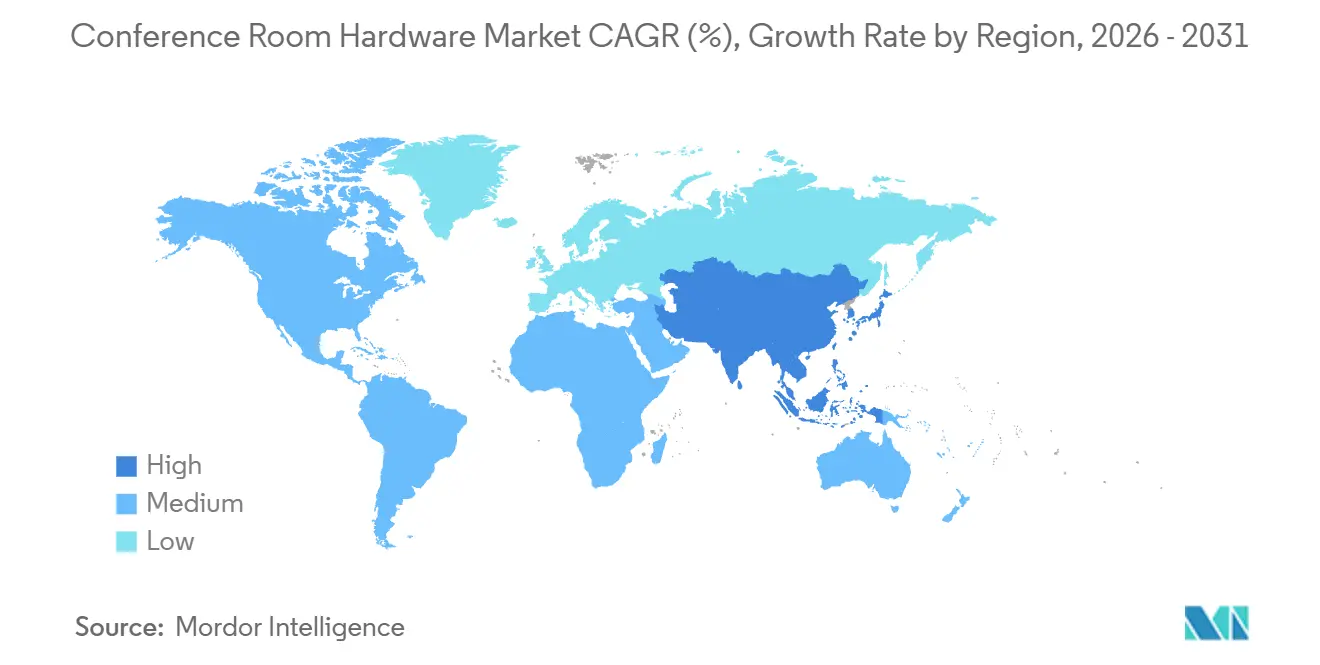
North America accounted for 35.84% of 2025 revenue in the conference room hardware market due to its early pivot to hybrid work and its broad installed base of Microsoft Teams Rooms. Growth in the region is steady rather than spectacular, as many enterprises pause new rollouts until semiconductor pricing stabilizes and sustainability metrics improve. This maturity also reflects a shift toward upgrading existing deployments rather than large-scale net-new installations.
APAC Conference Room Hardware Market
Asia-Pacific is the clear growth engine with a projected 17.63% CAGR over 2026-2031. Enterprise digitalization waves in China and India coincide with government smart-city projects in Japan and South Korea, bringing bulk orders for full-featured room kits. Local assembly plants and channel partners shorten lead times, giving regional manufacturers an edge against U.S. and European incumbents. This is further reinforced by strong SME adoption and public-sector digitization initiatives across emerging economies.
EMEA and LATAM Conference Room Hardware Market
Europe shows balanced momentum, helped by strict ESG policies that favor energy-efficient endpoints and circular-economy programs. Latin America, the Middle East, and Africa are smaller in absolute terms yet exhibit rising project counts in banking, oil and gas, and higher education. Currency volatility and import duties remain constraints, but wireless solutions that minimize installation effort are mitigating some cost hurdles. Additionally, regulatory alignment around data privacy and green procurement continues to shape vendor selection and deployment strategies.
Competitive Landscape
Established players like Logitech, Cisco, and Poly leverage brand recognition, UCaaS platform certifications, and global distribution networks to defend share in enterprise accounts, while emerging vendors like Neat, Yealink, and Huddly differentiate through AI-driven features, industrial design, and aggressive pricing that undercuts incumbents in huddle room segments. Strategic moves center on vertical integration, with vendors acquiring software capabilities to offer bundled room management, analytics, and support services that increase switching costs and recurring revenue.
Strategic partnership activity in the conference room hardware market centers on platform integration, such as Samsung's 2026 partnership with Cisco and Logitech to bundle large-format displays with certified cameras and soundbars, creating turnkey solutions for executive spaces. Ricoh’s 2025 pact with Neat extended the latter’s reach into managed-print clients, illustrating how office-equipment dealers are morphing into collaboration integrators.[5]
Patent litigation also shapes rivalry, highlighted by Barco’s 2024 action against Yealink over wireless presentation technology, underscoring the strategic importance of IP in differentiating collaboration hardware ecosystems. Such disputes can influence vendor selection decisions and delay product rollouts in highly competitive enterprise segments. Meanwhile, vendors are embedding AI accelerators at the edge to deliver real-time transcription and analytics without reliance on cloud services, reducing latency and recurring costs.
Conference Room Hardware Industry Leaders
-
Logitech International S.A.
-
Cisco Systems, Inc.
-
Crestron Electronics, Inc.
-
Barco NV
-
Sony Group Corporation
- *Disclaimer: Major Players sorted in no particular order
Conference Room Hardware Market Companies Covered in this Report
- Logitech International S.A.
- Cisco Systems, Inc.
- Sony Group Corporation
- Crestron Electronics, Inc.
- Barco NV
- DTEN Inc.
- Panasonic Holdings Corporation
- Shure Incorporated
- Sennheiser electronic GmbH & Co. KG
- Yamaha Corporation
- Biamp Systems, LLC
- ClearOne, Inc.
- Aver Information Inc.
- GN Audio A/S (Jabra)
- Huddly AS
- Yealink Network Technology Co., Ltd.
- Huawei Technologies Co., Ltd.
- ZTE Corporation
- Lifesize, Inc.
- Owl Labs, Inc.
Recent Industry Developments in Conference Room Hardware Market
- February 2026: Samsung Electronics announced a strategic partnership with Cisco and Logitech to develop large-format displays optimized for Microsoft Teams Rooms and Webex environments.
- January 2026: Shure introduced firmware updates for IntelliMix Bar Pro, adding real-time transcription and translation in 12 languages.
- December 2025: Jabra released the PanaCast 50 Room System, bundling a camera, audio, and control tablet for medium rooms.
- November 2025: Ricoh partnered with Neat to distribute Neat Bar and Neat Board devices through Ricoh’s global channels.
Global Conference Room Hardware Market Report Scope
The conference room hardware market refers to the global ecosystem of physical devices and integrated equipment that enable audio, video, and collaboration experiences in meeting spaces across enterprises, government organizations, and educational institutions. This includes conferencing cameras, microphones, speakers, soundbars, control panels, room compute units, and display systems that support both in-person and hybrid meetings.
The Conference Room Hardware Market Report is Segmented by Hardware Type (Video Conferencing Hardware, Display and Presentation Hardware, Audio Conferencing Hardware, Control and Automation Systems, and Other Hardware Type), Room Size (Huddle Rooms/Small Meeting Rooms, Medium Rooms, Large Rooms, and Other Room Sizes), End-user Industry (Commercial Spaces, Education Institutions, Government and Public Sector, Healthcare Facilities, and Other End-user Industries), Connectivity (Wired, Wireless, and Hybrid), and Geography (North America, South America, Europe, Asia-Pacific, Middle East, and Africa). The Market Forecasts are Provided in Terms of Value (USD).
Segmentation Overview
| Video Conferencing Hardware |
| Display and Presentation Hardware |
| Audio Conferencing Hardware |
| Control and Automation Systems |
| Other Hardware Type |
| Huddle Rooms/Small Meeting Rooms |
| Medium Rooms |
| Large Rooms |
| Other Room Sizes |
| Commercial Spaces |
| Education Institutions |
| Government and Public Sector |
| Healthcare Facilities |
| Other End-user Industries |
| Wired |
| Wireless |
| Hybrid |
| North America | United States |
| Canada | |
| Mexico | |
| South America | Brazil |
| Argentina | |
| Rest of South America | |
| Europe | Germany |
| United Kingdom | |
| France | |
| Italy | |
| Spain | |
| Russia | |
| Rest of Europe | |
| Asia-Pacific | China |
| Japan | |
| South Korea | |
| India | |
| Australia and New Zealand | |
| Rest of Asia-Pacific | |
| Middle East | Saudi Arabia |
| United Arab Emirates | |
| Turkey | |
| Rest of Middle East | |
| Africa | South Africa |
| Egypt | |
| Rest of Africa |
| By Hardware Type | Video Conferencing Hardware | |
| Display and Presentation Hardware | ||
| Audio Conferencing Hardware | ||
| Control and Automation Systems | ||
| Other Hardware Type | ||
| By Room Size | Huddle Rooms/Small Meeting Rooms | |
| Medium Rooms | ||
| Large Rooms | ||
| Other Room Sizes | ||
| By End-user Industry | Commercial Spaces | |
| Education Institutions | ||
| Government and Public Sector | ||
| Healthcare Facilities | ||
| Other End-user Industries | ||
| By Connectivity | Wired | |
| Wireless | ||
| Hybrid | ||
| By Geography | North America | United States |
| Canada | ||
| Mexico | ||
| South America | Brazil | |
| Argentina | ||
| Rest of South America | ||
| Europe | Germany | |
| United Kingdom | ||
| France | ||
| Italy | ||
| Spain | ||
| Russia | ||
| Rest of Europe | ||
| Asia-Pacific | China | |
| Japan | ||
| South Korea | ||
| India | ||
| Australia and New Zealand | ||
| Rest of Asia-Pacific | ||
| Middle East | Saudi Arabia | |
| United Arab Emirates | ||
| Turkey | ||
| Rest of Middle East | ||
| Africa | South Africa | |
| Egypt | ||
| Rest of Africa | ||
Key Questions Answered in the Report
How big is the conference room hardware market in 2026?
The conference room hardware market size is projected to reach USD 13.11 billion in 2026.
What is the expected growth rate for conference-room hardware from 2026 to 2031?
The market is forecast to post a 15.53% CAGR over 2026-2031.
Which room type is expanding fastest for collaboration hardware?
Huddle and small meeting rooms are advancing at a 16.53% CAGR through 2031.
Why is Asia-Pacific viewed as the highest-growth region?
Strong digitalization in China and India and smart-city investments in Japan and South Korea push the region to a 17.63% CAGR.
How are AI features influencing hardware refresh cycles?
Edge-based auto-framing, noise suppression, and real-time translation make three-year-old systems functionally obsolete, prompting faster replacements.