
Concrete Repair Mortar Market Size and Share
Market Overview
| Study Period | 2021 - 2031 |
|---|---|
| Market Size (2026) | USD 2.65 Billion |
| Market Size (2031) | USD 3.5 Billion |
| Growth Rate (2026 - 2031) | 5.66 % |
| Fastest Growing Market | Asia Pacific |
| Largest Market | Asia Pacific |
| Market Concentration | Medium |
Major Players *Disclaimer: Major Players sorted in no particular order Image © Mordor Intelligence. Reuse requires attribution under CC BY 4.0. | |
Concrete Repair Mortar Market Analysis by Mordor Intelligence
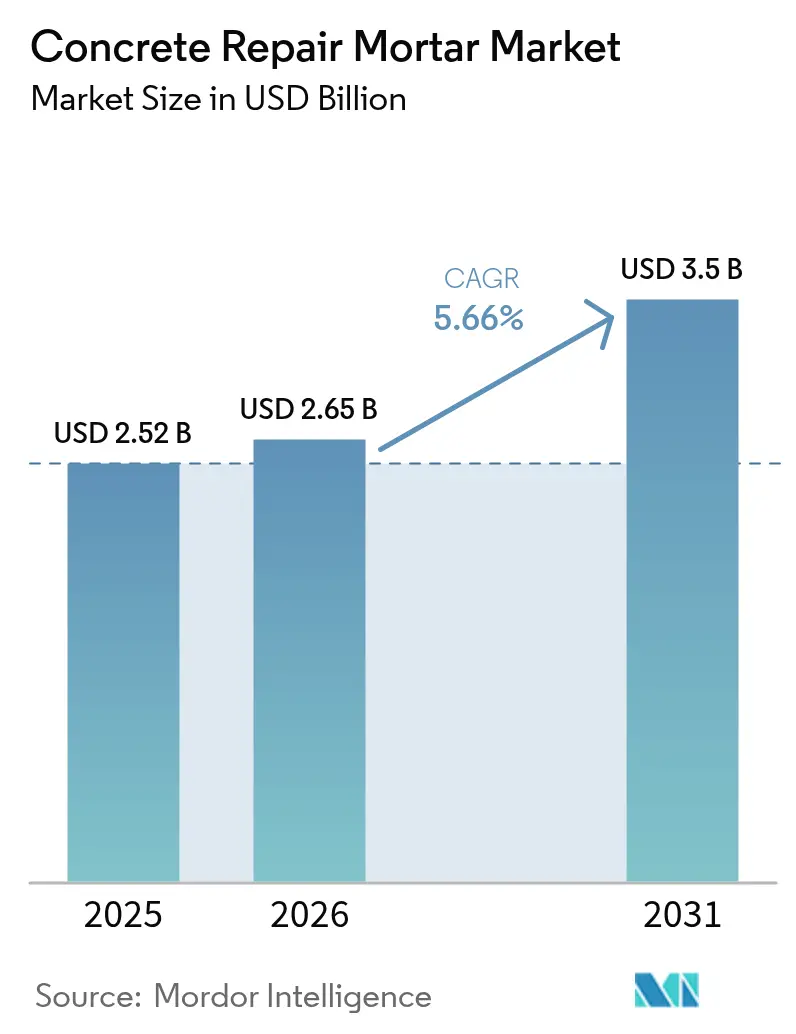
The Concrete Repair Mortar Market size was valued at USD 2.52 billion in 2025 and is estimated to grow from USD 2.65 billion in 2026 to reach USD 3.5 billion by 2031, at a CAGR of 5.66% during the forecast period (2026-2031). Aging infrastructure across developed economies, sizable public-sector rehabilitation budgets, and wider acceptance of polymer-modified formulations are steering the shift from reactive patching to planned life-cycle management. Regulatory pressure is mounting as Europe now mandates annual renovation of 3% of public buildings, while U.S. bridge owners tap the USD 40 billion Bridge Formula Program to fund rapid-setting overlay systems. Suppliers that bundle repair mortars with IoT-enabled sensors are capturing early mover advantage because asset owners value real-time carbonation data that extends inspection intervals.
Key Report Takeaways
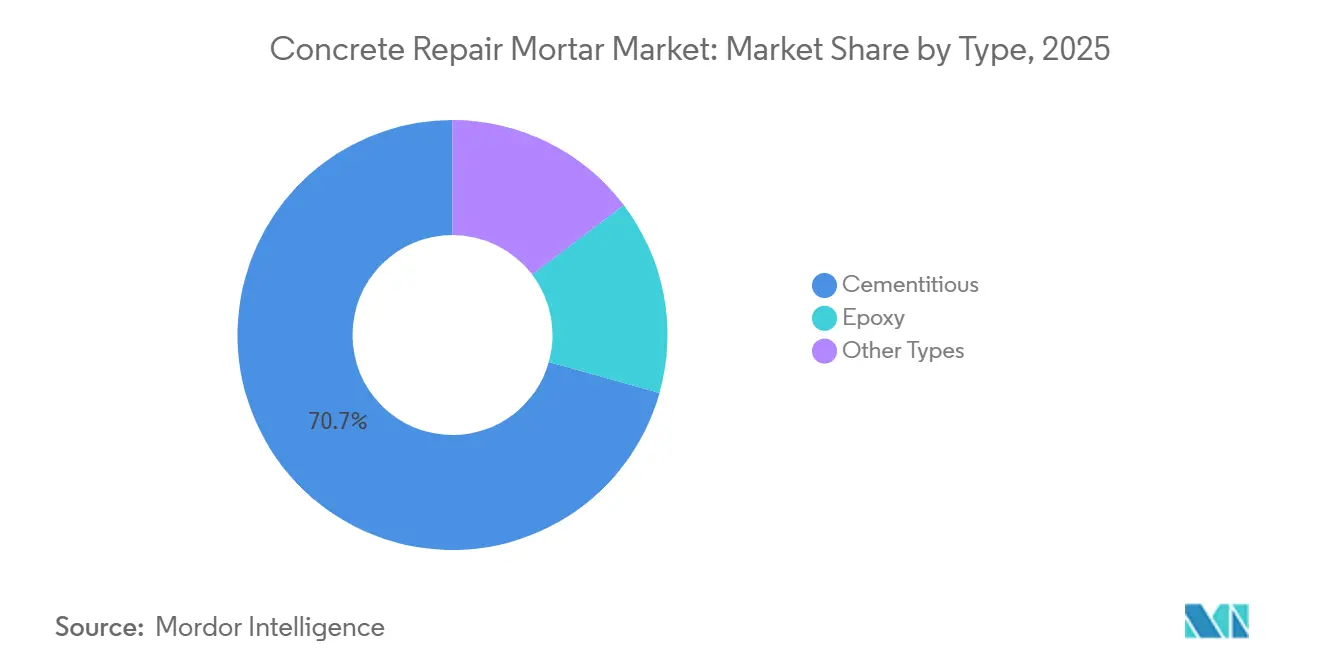
- By type, cementitious led with 70.65% concrete repair mortar market share in 2025 and is expanding at a 5.84% CAGR through 2031.
- By application method, spraying accounted for 61.44% of the concrete repair mortar market size in 2025 and is advancing at a 6.07% CAGR through 2031.
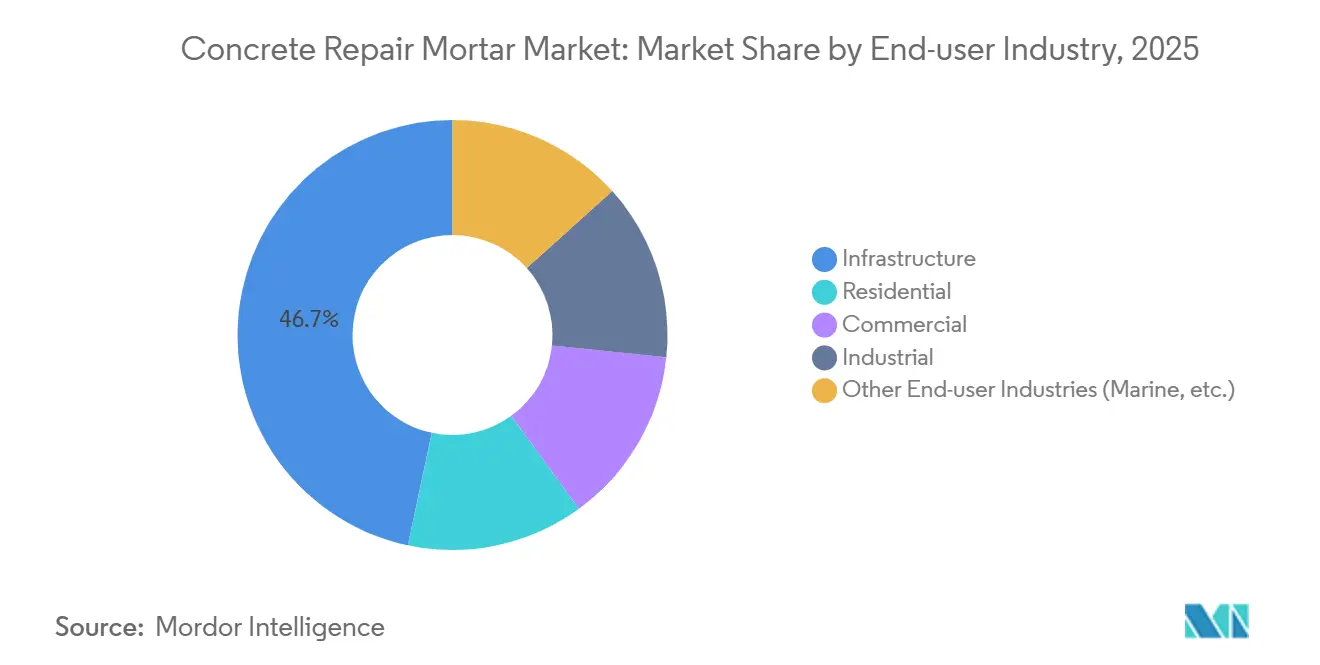
- By end-user industry, infrastructure captured 46.69% of the concrete repair mortar market size in 2025 while recording the fastest growth at a 5.91% CAGR through 2031.
- By geography, Asia-Pacific held a 37.65% of the concrete repair mortar market share in 2025 and is projected to post a 6.32% CAGR to 2031.
Note: Market size and forecast figures in this report are generated using Mordor Intelligence’s proprietary estimation framework, updated with the latest available data and insights as of 2026.
Market Trends and Insights
Drivers Impact Analysis of Concrete Repair Mortar Market*
| Driver | (~) % Impact on CAGR Forecast | Geographic Relevance | Impact Timeline |
|---|---|---|---|
| Aging transport infrastructure stock in Europe and North America | +1.5% | North America, Europe | Long term (≥ 4 years) |
| Expanding rehabilitation budgets for bridges and tunnels | +1.3% | Global, with concentration in North America, Europe, Asia-Pacific | Medium term (2-4 years) |
| Rapid adoption of polymer-modified and fiber-reinforced repair mortars | +1.0% | Global | Medium term (2-4 years) |
| Stringent building-safety codes mandating periodic maintenance | +0.8% | North America, Europe, developed Asia-Pacific markets | Long term (≥ 4 years) |
| Demand for ultra-low-carbon alkali-activated repair mortars in net-zero projects | +0.6% | Europe, select North America municipalities, early adopters in Asia-Pacific | Short term (≤ 2 years) |
| Source: Mordor Intelligence | |||
Aging Transport Infrastructure Stock in Europe and North America
Over 42,000 U.S. bridges now carry a structurally deficient rating, pushing owners toward high-performance overlays that add 15–25 years of service life without full replacement. Germany faces a similar backlog on 25,000 autobahn bridges erected before 1985, and EUR 2 billion a year is earmarked for polymer-modified rehabilitation[1]German Federal Ministry for Digital and Transport, “Bridge Rehabilitation Funding,” bmdv.bund.de . Condition-based inspection, enabled by ground-penetrating radar and half-cell mapping, lets owners intervene early, creating a steadier demand curve for suppliers. This diagnostic-driven model is widening the concrete repair mortar market because interventions occur before ratings slip below closure thresholds. Contractors consequently schedule work more predictably, smoothing labor deployment across seasons.
Expanding Rehabilitation Budgets for Bridges and Tunnels
The Infrastructure Investment and Jobs Act alone directs USD 40 billion to the Bridge Formula Program, and early grants favor rapid-setting polymer-modified mortars that keep traffic flowing overnight. New York State supplemented federal dollars with USD 450 million green bonds that specify low-carbon repair mixes for thruway structures to meet climate mandates. Europe’s Connecting Europe Facility dedicates EUR 33.7 billion through 2027, with tunnel upgrades consuming a rising share as fire-resistant linings become mandatory. Multi-year public budgets are underwriting long visibility for materials suppliers, though execution risk persists because labor shortages lengthen lead times.
Rapid Adoption of Polymer-Modified and Fiber-Reinforced Repair Mortars
Latex-modified cementitious mortars lower water-cement ratios, lifting bond strength 40–60% and allowing 5 mm thin-section repairs. Sika’s 2024 purchase of Kwik Bond Polymers delivered macro-synthetic fiber technology that replaces steel mesh, shrinking overlay labor by 30% and material weight by 15%. MAPEI’s Planitop range adds migrating corrosion inhibitors that double re-application intervals in chloride-rich settings. Hybrid microfiber–macrofiber blends now satisfy seismic energy-dissipation rules in California and Japan. Although polymer content raises material cost by up to 40%, payback occurs within five years on high-traffic assets because lane-closure penalties drop.
Stringent Building-Safety Codes Mandating Periodic Maintenance
The International Building Code 2021 requires facade inspections every ten years, with New York City and Miami-Dade imposing even tighter windows following high-profile failures. Miami-Dade’s 40-year recertification law has generated a queue of 1,200 towers needing polymer-modified repairs that promise 50-year durability. California seismic rules target 3,500 non-ductile concrete buildings for retrofit by 2025, spurring demand for fiber-reinforced mortars that restore shear capacity. Europe’s EN 1504 durability classes likewise push specifiers toward accredited products, filtering out low-compliance imports.
Restraints Impact Analysis of Concrete Repair Mortar Market*
| Restraint | (~) % Impact on CAGR Forecast | Geographic Relevance | Impact Timeline |
|---|---|---|---|
| Volatile prices of cement, epoxy resins and specialty admixtures | -0.7% | Global | Short term (≤ 2 years) |
| Stringent VOC and dust-emission regulations on job sites | -0.4% | North America, Europe, developed Asia-Pacific markets | Medium term (2-4 years) |
| Shortage of certified concrete-repair applicators and high labor costs | -0.5% | North America, Europe, Australia | Medium term (2-4 years) |
| Source: Mordor Intelligence | |||
Volatile Prices of Cement, Epoxy Resins, and Specialty Admixtures
Concrete-block prices jumped 5.8% quarter-over-quarter in Q2 2024 as kiln fuel costs and freight tariffs rose. Epoxy resins tracked crude oil, swinging 15–20% in Asia when cracker turnarounds tightened supply, forcing North American formulators to hold larger inventories. A 2024 fire that sidelined 12% of European capacity for calcium-nitrite inhibitors led to allocation regimes favoring long contracts, squeezing small buyers. Public owners on fixed multi-year budgets sometimes downgrade specifications when bids spike, risking long-term durability.
Stringent VOC and Dust-Emission Regulations on Job Sites
California’s Rule 1113 caps primers at 250 g/L VOC, nudging formulators to water-based chemistries that cure more slowly in humidity and raise labor time by 15%. Texas proposes parallel limits for 2027 that would phase out solvent-rich epoxies across Dallas–Fort Worth and Houston. OSHA silica limits require wet-cutting and respiratory gear, pushing contractors toward wet-mix shotcrete that satisfies dust rules but demands higher pump horsepower[2]Occupational Safety and Health Administration, “Crystalline Silica Final Rule,” osha.gov. Compliance costs add USD 50,000–100,000 in equipment per site, accelerating consolidation among contractors that can amortize outlays.
*Our forecasts treat driver/restraint impacts as directional, not additive. The impact forecasts reflect baseline growth, mix effects, and variable interactions.
Concrete Repair Mortar Market Segment Analysis
By Type:
Cementitious Anchor Market Share Through Substrate CompatibilityCementitious captured 70.65% revenue in 2025, demonstrating the highest concrete repair mortar market share because they bond seamlessly with Portland-cement substrates and meet installer familiarity thresholds. Within this category, latex additives slash permeability and enable 5 mm thin reinstatement layers on bridge decks. In contrast, epoxy systems, though smaller, command premiums above USD 15/kg in chloride-rich or chemical-spill settings where impermeability matters. Moisture-insensitive epoxies have recently widened their application window to damp substrates, a breakthrough that could lift epoxy’s portion of the concrete repair mortar market size by 2031.
Other chemistries remain niche. Methyl-methacrylate mortars reach 3,000 psi in two hours and suit overnight highway patches in dense corridors like the Washington Beltway. Magnesium-phosphate mixes cure below -10 °C, crucial for Canadian winter repairs. Regulatory filters are tightening: the EU’s REACH limits certain amines while California Proposition 65 spurs silica-free blends. Suppliers prepared with compliant formulations are better placed to defend or grow their concrete repair mortar market share across regulated geographies.



By Application Method:
Spraying Captures Vertical and Overhead RepairsSpraying delivered 61.44% revenue in 2025 and will expand at 6.07% as robotic rigs cut labor by half and generate consistent compaction. Field data show waste drops 30% when flow meters and automatic nozzles govern mix efficiency. Dry-mix variants still dominate mountainous or remote jobs lacking ready-mix access. Precision pouring remains the choice for horizontal floors where self-leveling mortars exceed FF50 flatness for automated warehouses, controlling 25% of the concrete repair mortar market size in slab remediation.
Manual troweling persists in low-value residential facade patches but is losing share because labor rates inflate. Dust rules pressure dry-mix adoption; wet-spray meets OSHA silica standards without costly tenting. Consequently, North American infrastructure projects now specify wet-mix on over 65% of bridge soffits, nudging spraying to further elevate its concrete repair mortar market share through 2031.
By End-user Industry:
Infrastructure Drives Predictable Repair CyclesInfrastructure accounted for 46.69% demand in 2025 and leads growth at 5.91% because bridge-management systems now trigger repairs once chloride ions reach 0.2% weight of cement or half-cell readings slip under -350 mV. The U.S. Bridge Formula Program ensures annual funding, letting departments award multi-year overlay contracts that stabilize volumes for suppliers.
Residential spikes stem from facade ordinances such as Miami-Dade’s 40-year rule, whereas commercial asset owners act when due diligence audits highlight deferred maintenance. Industrial plants want fast-cure, chemically resistant mortars; petrochemical floors demand sulfonic acid tolerance, while food processors need USDA clearance. Marine and wastewater jobs push chloride-diffusion below 2 × 10⁻¹² m²/s, favoring specialized vendors. These sub-sectors diversify concrete repair mortar market revenue streams even as infrastructure dominates volume.
Geography Analysis
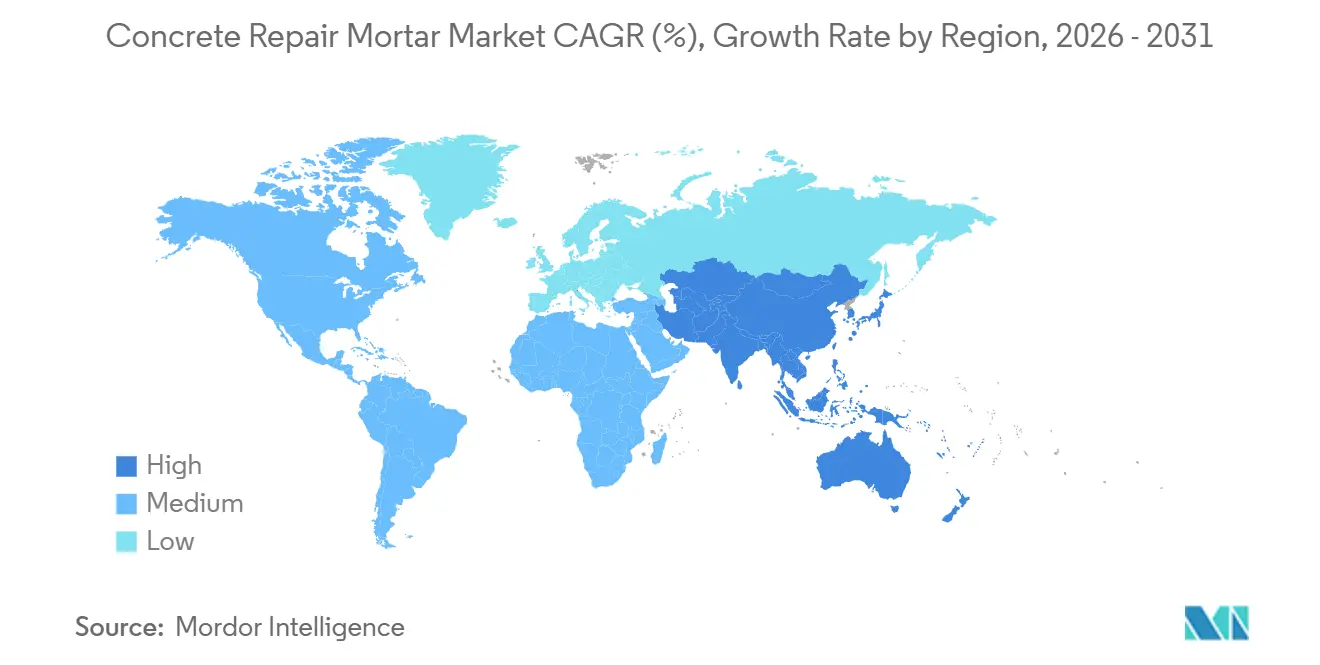
APAC Concrete Repair Mortar Market
Asia-Pacific commanded 37.65% of 2025 revenue, with a 6.32% CAGR forecast, making it the fastest contributor to the concrete repair mortar market. China’s highway network exceeds 177,000 km and many expressway bridges built before 2010 now reach first major rehab windows; provincial owners prefer polymer-modified mortars that extend cycles by 20 years and reduce lifecycle cost 30%. India’s National Infrastructure Pipeline allocates USD 1.4 trillion, 19% for urban rail that specifies fiber-shotcrete linings rated for 100-year durability. Indonesia’s 3,200-km Trans-Java tollway and Malaysia’s MRT spur Southeast Asian growth. Japan’s seismic mandates drive shrinkage-compensated mortars for 72% of bridges soon crossing 50-year age.
North America Concrete Repair Mortar Market
North America offers steady expansion anchored by the Infrastructure Investment and Jobs Act. The U.S. National Bridge Inventory lists 42,000 deficient bridges, and layer-funding with toll revenues secures a multiyear concrete repair mortar market. Canada channels CAD 33.5 billion through the Investing in Canada plan, emphasizing cold-weather mixes that hydrate at below 5 °C. Mexico’s near-shoring industrial corridor upgrades will add incremental demand once assets enter maintenance.
Europe Concrete Repair Mortar Market
Europe shows regulatory-led divergence. The Energy Performance of Buildings Directive compels 3% annual renovation of public stock, steering specifications toward alkali-activated binders with 80% lower emissions. Germany pours EUR 2 billion yearly into autobahn bridge overlays, while the UK’s carbon tool penalizes high-emission mortars on the Lower Thames Crossing. Southern Europe struggles with fiscal constraints, yet private owners in Spain and Italy comply with balcony-safety rules that favor epoxy injections.
South America Concrete Repair Mortar Market
South America’s concrete repair mortar market is tied to Brazilian and Chilean highway concessions that impose strict International Roughness Index limits and require six-hour reopening mixes. Argentina’s lithium brine plants demand sulfate-resistant mortars for ponds cycling -10 °C to 40 °C. Colombia’s 4G infrastructure program enters its first rehab phase, signaling fresh demand as tropical humidity accelerates joint wear.
MEA Concrete Repair Mortar Market
Middle-East and Africa add lumpy yet high-margin opportunities. Saudi Arabia’s NEOM and Red Sea mega-projects need UV-resistant mortars tolerating 50 °C swings, while UAE rail extensions specify epoxy track-bed repairs for 200-ton freight loads. Qatar’s performance contracts penalize premature failures, incentivizing fiber blends with 20-year warranties. South Africa’s ZAR 198 billion road-rehab backlog is price sensitive, nudging the use of locally blended cementitious mixes.

Regulatory Landscape
Regulation and standards are tightening around both performance qualification and sustainability disclosure for concrete repair mortars. In the European Union, the Construction Products Regulation (EU) 2024/3110 entered into force and has applied from January 8, 2026, increasing emphasis on verified environmental reporting, including Global Warming Potential for construction product families. That shift is starting to influence procurement for repair mortars in public renovation programs. EU-facing suppliers also align to EN 1504 durability and repair requirements, which continue to function as a technical compliance filter in building and infrastructure repair specifications.
In North America, codes and public-owner qualification frameworks remain key gatekeepers for market access. ACI CODE-562-25 (January 2025) and ACI SPEC-563-25 (March 2025) outline updated requirements for assessment and repair of existing concrete structures, while ASTM C928/C928M-25 (July 2025) updates the standard for rapid-hardening cementitious repair materials used in high-uptime infrastructure work. State DOT prequalification and material lists further formalize acceptance, including Texas DOTs DMS-4655 enforcement (as of September 24, 2025), MassDOT criteria for rapid-hardening cementitious products (January 2026), and Caltrans updates to its concrete structure repair guidance (June 2026), which collectively reinforce third-party testing, documented performance, and consistent batch control.
Value Chain Analysis
The value chain starts with upstream raw materials. For cementitious repair mortars, that includes cement and supplementary binders, while polymer systems rely on epoxy resins and hardeners, and specialty admixtures cover polycarboxylate ether (PCE) water reducers, corrosion inhibitors, shrinkage-compensating agents, and fibers. Formulators blend these inputs into application-specific systems (rapid-setting, polymer-modified, fiber-reinforced, and epoxy-based), with performance validation against standards (for example, ASTM C928 for rapid-hardening cementitious repair materials) serving as a critical step before products can access public-owner channels.
Manufacturers and blenders supply through contractor networks, construction-chemical distributors, and direct deliveries to infrastructure owners. Jobsite technical service and QA support are increasingly bundled into proposals, particularly for sprayed and shotcrete-based repairs. Downstream, certified applicators, specialty repair contractors, and infrastructure maintenance programs convert product demand into recurring consumption cycles, though DOT approved product lists and prequalification (including state-level lists in the United States) set a high barrier to entry and raise the value of documented test data and field support. Logistics and plant proximity matter because repair mortars are heavy and time-sensitive, which favors regional production and warehousing near major metropolitan areas and infrastructure corridors.
Competitive Landscape
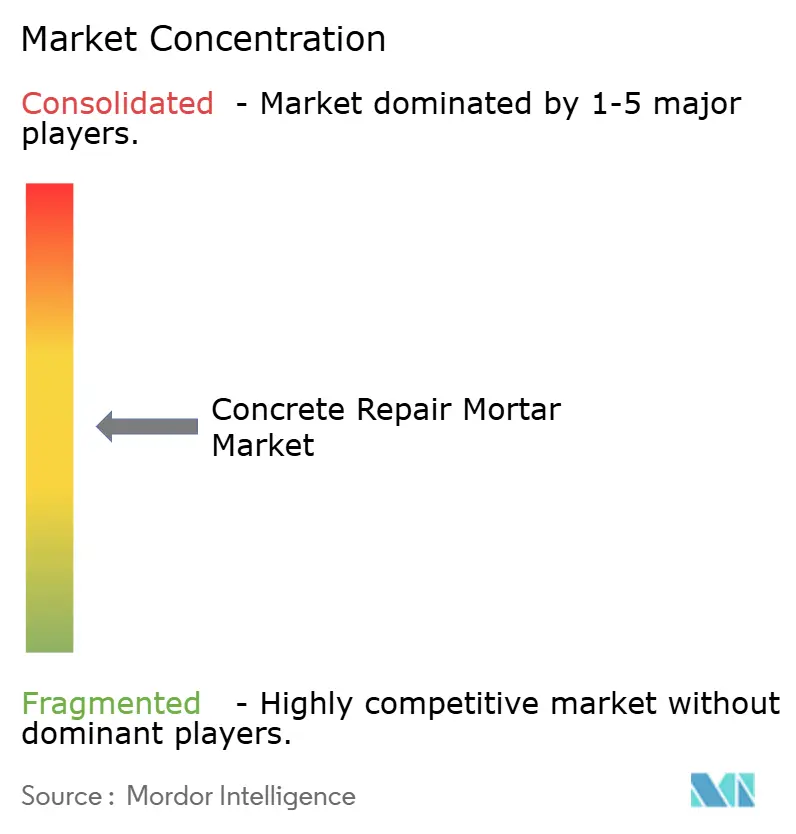
Competition is moderately concentrated: the five largest producers—Sika, MAPEI, Saint-Gobain, ARDEX GmbH, and The Euclid Chemical Company—generate 45–50% of global revenue. To differentiate, multinationals vertically integrate into admixtures and digital monitoring. Sika’s 2024 Kwik Bond Polymers buy unlocked proprietary macro-fibers and cross-selling lifted bundled sales; management targets a 15% revenue bump by 2027. MAPEI expanded Indonesian and Vietnamese plants to capture Southeast Asian demand while marketing Planitop low-carbon formulations eligible for LEED points. Saint-Gobain’s Weber unit commercialized 70% recycled alkali-activated mortars that meet France’s RE2020 caps.
White-space innovation centers on self-healing systems using bacteria encapsulation; early trials show 0.5 mm cracks seal autonomously and trim lifetime maintenance 25%. Flexcrete and Kryton inhabit marine niches, supplying chloride-resistant epoxy screeds over USD 15/kg under multi-year port contracts. Euclid Chemical’s patent on calcium-sulfoaluminate cements that hit 3,000 psi in four hours earned royalty deals with regional producers, creating high-margin recurring income. Robotics partnerships by BASF and Sika embed quality sensors into shotcrete rigs, countering skilled-labor shortages and appealing to contractors on lump-sum jobs.
Concrete Repair Mortar Industry Leaders
Sika AG
Saint-Gobain
MAPEI S.p.A.
ARDEX GmbH
The Euclid Chemical Company
- *Disclaimer: Major Players sorted in no particular order
Concrete Repair Mortar Market Companies Covered in this Report
- Adhesives Technology Corporation (ATC)
- ARDEX GmbH
- ChemCo Systems
- Flexcrete Technologies Ltd
- Heidelberg Materials (Hanson Repair)
- Kryton International Inc.
- MAPEI S.p.A.
- MC-Bauchemie
- Pidilite Industries Ltd
- Polycote
- Remmers GmbH
- Saint-Gobain
- Sika AG
- Tarmac
- The Euclid Chemical Company
- W. R. Meadows Inc.

Market Opportunities and Future Outlook
Low-carbon and documented-environmental-performance repair mortars present a clear whitespace area, with compliance increasingly shaping procurement decisions. The EU Construction Products Regulation (EU) 2024/3110, applying from January 8, 2026, increases demand for standardized environmental reporting, including Global Warming Potential, for construction product families. That dynamic is prompting suppliers to broaden product ranges that can be specified under public renovation and infrastructure programs without repeated rework of declarations. Specification frameworks such as ACI CODE-562-25 and ACI SPEC-563-25 are also raising the baseline for assessment-driven repair design, which favors manufacturers that supply complete system documentation (substrate prep, bonding, curing, corrosion mitigation) and field verification support.
Execution constraints are additionally opening room for approaches that reduce labor intensity and simplify qualification on public projects. DOT material qualification and approved lists (including TxDOT DMS-4655, MassDOT rapid-hardening criteria, and Caltrans repair guidance updates in 2026) reinforce demand for repeatable, independently tested products and can reward suppliers that invest in localized manufacturing, consistent batch control, and faster lead times for rapid-setting repair systems used in overnight and short-closure windows. Differentiation is moving beyond bagged mortar to engineered fiber reinforcement, rapid-strength binders, and more integrated condition-assessment workflows as owners shift toward life-cycle maintenance programs rather than reactive patching.
Recent Industry Developments in Concrete Repair Mortar Market
- May 2026: Sika opened a large-scale automated mortar production plant in Bridgeton, New Jersey, to supply repair, leveling, and technical mortars and shotcrete systems for the northeastern United States. The site is positioned to serve major metropolitan corridors including New York, Boston, Philadelphia, and Washington, DC, improving lead times and supply reliability for time-critical rehabilitation work.
- June 2025: MC-Bauchemie introduced Nafufill RM 10 Rapid, a fast-setting repair mortar aimed at quick concrete and masonry restoration. The product targets short turnaround maintenance by enabling rapid recoating readiness while maintaining high strength and frost resistance for indoor and outdoor repairs.
- September 2024: MAPEI introduced The Zero Line, a carbon-neutral range of construction products that includes concrete repair mortars alongside adhesives and waterproofing systems. The launch expanded the availability of lower-impact options for owners and contractors seeking durability-focused repair materials aligned with environmental targets.


Concrete Repair Mortar Market Report Scope and Research Methodology
Market Definition and Coverage
For this study, the concrete repair mortar market covers ready to use mortar systems that are applied to repair, rebuild, and protect damaged concrete elements in buildings and civil structures, measured in value terms at the point of sale.
Scope exclusions: We exclude new concrete mixes, general cement and aggregates sold for fresh pours, and standalone surface coatings or sealers that are not sold as repair mortars.
Segments Covered in This Report
- By Type
- Cementitious
- Epoxy
- Other Types
- By Application Method
- Spraying
- Pouring
- Manual
- By End-user Industry
- Infrastructure
- Residential
- Commercial
- Industrial
- Other End-user Industries (Marine, etc.)
- By Geography
- Asia-Pacific
- China
- India
- Japan
- South Korea
- Indonesia
- Malaysia
- Thailand
- Vietnam
- Rest of Asia-Pacific
- North America
- United States
- Canada
- Mexico
- Europe
- Germany
- United Kingdom
- France
- Italy
- Spain
- NORDIC Countries
- Russia
- Turkey
- Rest of Europe
- South America
- Brazil
- Argentina
- Colombia
- Rest of South America
- Middle-East and Africa
- Saudi Arabia
- United Arab Emirates
- Qatar
- Egypt
- South Africa
- Rest of Middle-East and Africa
- Asia-Pacific
Data Sources, Market Sizing, and Validation
Desk Research
Desk work starts by mapping the demand pool to construction maintenance and rehabilitation activity, and then translating that activity into repair mortar consumption. Public sources used to set the boundary and macro direction include those from groups such as the American Concrete Institute (ACI) and ASTM standards references, the International Energy Agency (IEA) for building renovation indicators, and the World Bank for infrastructure investment signals.
We also pull country level construction output series and permitting signals from sources such as the US Census Bureau, Eurostat, and national statistics offices, which helps keep regional splits realistic. Company annual reports, product technical data sheets, and investor updates are used to understand typical product positioning, channel mix, and price ranges for cementitious and epoxy repair mortars. Where needed, paid subscriptions for company financials, patent databases, and shipment level import and export checks are used to confirm directionality, not to replace field validation. The desk research sources listed here are illustrative, and many other public documents and datasets are also referenced for data collection, validation, and clarification.
Primary Interviews and Surveys
Primary inputs are used to confirm how repair mortars are specified and purchased across infrastructure owners, contractors, applicators, and distribution partners, and then to stress test the price and volume assumptions that come from desk work. Since this is a global market, we collect views across APAC, EMEA, and the Americas so regional differences in repair cycles, labor practices, and product preferences can be reflected in the model.
Distribution of primary research fieldwork respondents
| Company type | Respondent position | Region |
|---|---|---|
| Top tier: 30% | CXOs: 13% | APAC: 46% |
| Mid tier: 55% | Functional/Unit leaders: 29% | EMEA: 32% |
| Smaller Players: 15% | Managers: 58% | Americas: 22% |
Market-Sizing & Forecasting
The core sizing approach is top-down, where construction repair and rehabilitation activity is reconstructed by region and then filtered through repair intensity and mortar adoption rates to reach an addressable value pool. At the end, selective bottom-up checks are used, such as sampled contractor usage patterns, distributor channel checks, and a simple ASP x volume build using common packaging sizes and typical project consumption ranges.
Inputs that matter in this market include the share of spending that goes to maintenance versus new build, the frequency of concrete deterioration and repair cycles, infrastructure rehabilitation budgets, the split between cementitious and epoxy repair needs, and the share of work done by spray versus hand applied methods (which changes waste and yield). Pricing is handled with an explicit ASP ladder by region and product family, and then adjusted for mix shifts toward polymer modified and higher performance formulations. For forecasting, scenario analysis is used around infrastructure funding momentum, renovation activity, and price normalization, and then it is reconciled to a central outlook agreed during expert discussions. When bottom-up signals are missing in smaller countries, we bridge gaps using per capita construction maintenance indicators and distributor coverage proxies before totals are rebalanced.
Data Validation & Update Cycle
Outputs are validated through triangulation across independent signals, such as regional construction repair spending direction, product mix trends, and implied per project consumption ranges, which helps identify overstatement early. If a country level result looks unusual, it is reviewed against exchange rate timing, price outliers, and sudden shifts in infrastructure plans, and then we re-contact sources when the gap cannot be explained cleanly.
A second analyst review is completed before sign off so assumptions, arithmetic, and split logic are checked line by line. Reports are refreshed annually, and interim updates are made when a material event changes demand or pricing. Before delivery, a fresh pass is performed to ensure the numbers reflect the latest available public indicators and field feedback.
Mordor Intelligence's Concrete Repair Mortar Market Sizing Compared With Other Published Estimates
Published market sizes for concrete repair mortar often vary because the boundary is not always drawn the same way, and because pricing and currency choices can move the value even when volumes are similar. Differences also come from how each model treats infrastructure versus building repair activity, and how quickly assumptions are refreshed after raw material price swings.
When the timing of exchange rates and the ASP update calendar are handled differently, the same demand picture can produce a noticeably different USD total, and this is one reason the spread shows up in the table. In addition, some estimates apply aggressive renovation scenarios or include adjacent construction chemicals, while the refresh-led checks on pricing, mix, and country splits used by Mordor Intelligence tend to keep the value tied to repair mortar only and aligned to the stated base year.
Benchmark comparison
| Source | Market Size | Gaps in Research Methodology |
|---|---|---|
| Mordor Intelligence | USD 2.65 B (2026) | |
| Regional Consultancy A | USD 2.53 B (2024) | Uses an earlier base year and may not fully roll forward the ASP step-up seen in higher performance mortars, so the value can stay lower even if repair activity is steady. |
| Trade Journal B | USD 4.00 B (2026) | Often includes a wider construction repair chemicals basket and applies a higher growth case, which can lift the 2026 value beyond what a repair mortar-only scope would support. |
Overall, the gaps are mainly explained by what is counted as repair mortar, how prices are updated by product family, and which exchange rate timing is used for USD conversion. By keeping the steps traceable to repair activity, mix, and region level ASP logic, the resulting market size stays easier to reproduce and stress test during validation conversations.


Key Questions Answered in the Report
What is the size of the concrete repair mortar market?
The concrete repair mortar market stands at USD 2.65 billion in 2026 and is forecast to reach USD 3.50 billion by 2031 at a 5.66% CAGR.
Which region shows the fastest growth for concrete repair mortars?
Asia-Pacific leads with a projected 6.32% CAGR through 2031, buoyed by highway and metro-rail rehabilitation in China, India, and Southeast Asia.
Why are polymer-modified mortars gaining share?
Latex or acrylic modifiers improve bond strength, cut permeability, and allow thin repairs, delivering payback within five years on high-traffic assets.
How do VOC regulations affect product selection?
Caps such as California’s 250 g/L limit shift demand toward water-based or low-solvent epoxies, lengthening cure times but ensuring regulatory compliance.
Page last updated on:


 Your data is secure and never sold or shared.


