
Commercial Aircraft Lavatory System Market Size and Share
Market Overview
| Study Period | 2020 - 2031 |
|---|---|
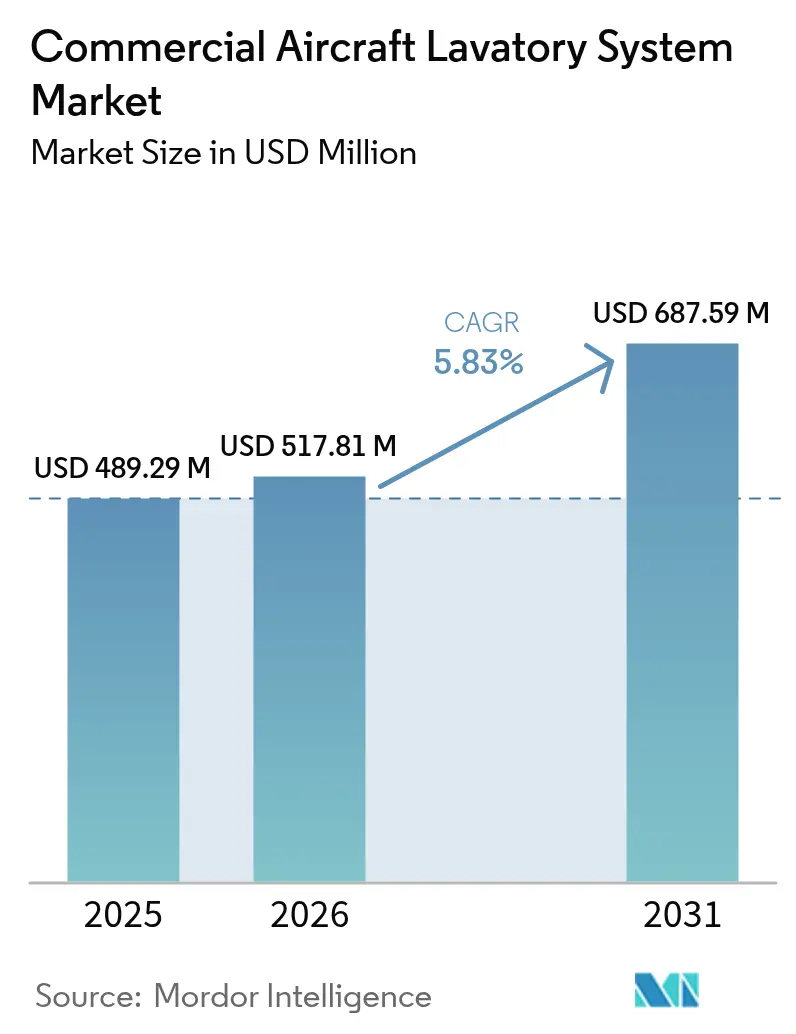
| Market Size (2026) | USD 517.81 Million |
| Market Size (2031) | USD 687.59 Million |
| Growth Rate (2026 - 2031) | 5.83 % |
| Fastest Growing Market | Asia Pacific |
| Largest Market | North America |
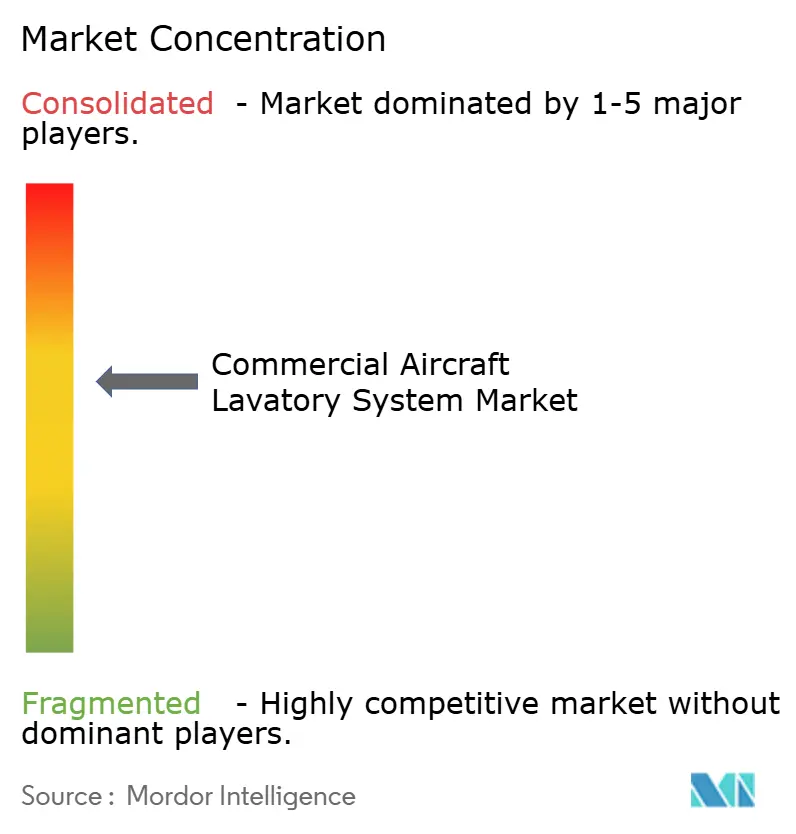
| Market Concentration | Medium |
Major Players *Disclaimer: Major Players sorted in no particular order Image © Mordor Intelligence. Reuse requires attribution under CC BY 4.0. | |
Commercial Aircraft Lavatory System Market Analysis by Mordor Intelligence
The commercial aircraft lavatory system market size is expected to grow from USD 489.29 million in 2025 to USD 517.81 million in 2026 and is forecast to reach USD 687.59 million by 2031 at 5.83% CAGR over 2026-2031. Steady backlogs for single-aisle programs, airline demand for hygiene upgrades, and new mandates for accessibility are expected to propel near-term growth. Touchless fixtures move from niche to mainstream as fleet operators target reduced maintenance and faster turnarounds. Cabin densification pressures designers to deliver lighter, slimmer modules without compromising functionality. Retrofit opportunities expand because airlines favor extending asset life while meeting rules for passengers with reduced mobility. Supply-chain bottlenecks and certification timelines are the primary headwinds, yet tier-one suppliers continue to secure long-term contracts that lock in pricing and technology roadmaps.
Key Report Takeaways
- By aircraft type, narrowbody platforms led with 45.87% revenue share in 2025, while regional jets posted the fastest projected 6.86% CAGR to 2031.
- By lavatory technology, vacuum systems held an 82.31% share in 2025, whereas hybrid solutions are forecasted to climb at a 7.39% CAGR through 2031.
- By component, lavatory modules commanded a 53.72% share in 2025, while sinks, faucets, and accessories are set to expand at a 6.35% CAGR to 2031.
- By fit type, linefit installations accounted for 62.64% of the commercial aircraft lavatory system market share in 2025, while retrofit activities are projected to advance at a 7.05% CAGR through 2031.
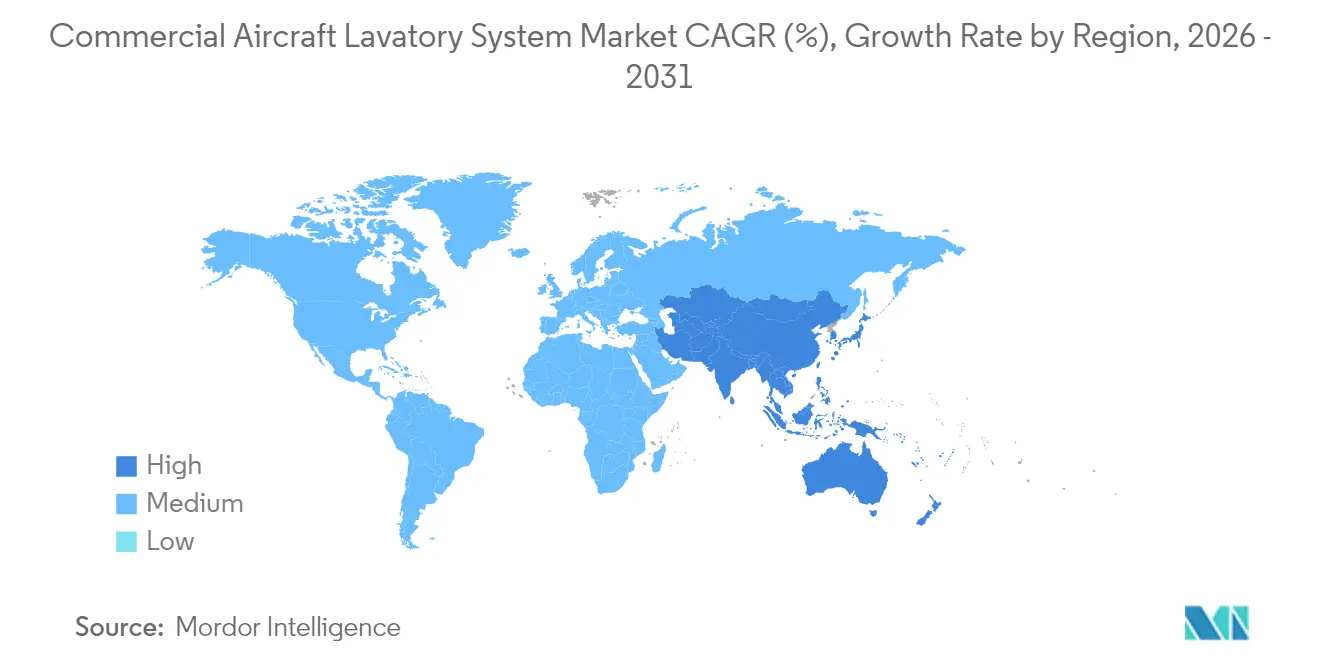
- By geography, North America contributed 33.55% of the revenue in 2025, whereas the Asia-Pacific region is on track for a 6.74% CAGR between 2026 and 2031.
Note: Market size and forecast figures in this report are generated using Mordor Intelligence’s proprietary estimation framework, updated with the latest available data and insights as of 2026.
Market Trends and Insights
Drivers Impact Analysis of Commercial Aircraft Lavatory System Market*
| Driver | ( ~ ) % Impact on CAGR Forecast | Geographic Relevance | Impact Timeline |
|---|---|---|---|
| Increased airline adoption of touchless lavatory technologies | +1.2% | Global, early uptake in North America and Europe | Short term (≤ 2 years) |
| Sustained growth in single-aisle aircraft deliveries over the long term | +0.8% | Global, with concentration in Asia-Pacific and North America | Long term (≥ 4 years) |
| Rising demand for lavatory retrofits to support Person-with-Reduced-Mobility (PRM) accessibility standards | +0.6% | North America and EU | Medium term (2-4 years) |
| Cabin densification trends driving demand for space-efficient lavatory designs | +0.4% | Global high-density routes | Medium term (2-4 years) |
| Mandates promoting water-efficient vacuum toilet technologies | +0.3% | EU and North America | Long term (≥ 4 years) |
| Industry shift toward circular economy with recyclable lavatory module designs | +0.2% | Led by EU, expanding to North America | Long term (≥ 4 years) |
| Source: Mordor Intelligence | |||
Increased Airline Adoption of Touchless Lavatory Technologies
Airlines accelerated trials of sensor-based faucets, flush actuators, and waste lids after 2020, and most tier-one carriers now require touch-free options on all new deliveries. Collins Aerospace will begin shipping fully modular, touchless units for the B737 program in early 2025, providing operators with a catalog solution that reduces retrofit downtime.[1]Collins Aerospace, “Boeing Selects Collins as Next-Generation Lavatory Supplier,” collinsaerospace.com JAMCO Corporation holds the majority of wide-body lavatories and embeds contactless fixtures across B777 and B787 lines. Airlines perceive added value in lower cleaning cycles and fewer unserviceable events, which feed directly into on-time performance metrics. OEMs report that kits integrating micro-LED mood lighting and antimicrobial finishes command price premiums yet face minimal resistance from buyers. Certification pathways for sensor assemblies are established, so near-term barriers are primarily related to supply logistics rather than regulatory issues.
Sustained Growth in Single-Aisle Aircraft Deliveries Over the Long Term
Boeing delivered 348 airplanes in 2024, and Airbus shipped 766 units, filling order books that now extend over a decade in some variants.[2] Airbus, “Airbus Reports 766 Commercial Aircraft Deliveries in 2024,” aircraft.airbus.com Lavatory system vendors, therefore, enjoy multi-year production visibility that supports tooling investment. Single-aisle jets increasingly cover 1,500-3,000-mile sectors, and higher time-in-seat drives passenger demand for larger facilities. Embraer’s 20-year outlook predicts 10,500 sub-150-seat deliveries, which broadens the addressable fleet for compact lavatory modules. Sustained throughput appears resilient to temporary supply chain friction as airlines pay escalated prices to secure slots.
Rising Demand for Lavatory Retrofits to Support PRM Accessibility Standards
The US Department of Transportation (DoT) requires an accessible lavatory on every new single-aisle aircraft with 125 or more seats delivered after October 2026. European Regulation 1107/2006 enforces parallel guidelines for carriers operating within the European Union. Diehl’s Space³ concept, which widens the doorway to 36 inches, exemplifies modular designs that enlarge the compartment only when needed. Airlines favor retrofit kits that maintain seat count, using plug-and-play door mechanisms and collapsible partitions. Demand is strongest in North America, where rule enforcement dates are imminent, yet EU carriers are rapidly aligning to avoid patchwork fleets.
Cabin Densification Trends Driving Demand for Space-Efficient Lavatory Designs
Low-cost operators push seat counts to the structural limit, as demonstrated by the 197-seat B737 MAX 200 layout. Airbus answered with Smart Lav for the A320 family, which relocates systems to reclaim floor area. Lavatory suppliers now ship ultra-slim shrouds, lighter toilet bowls, and shared wall plumbing fixtures that meet the 95th percentile male occupancy envelope. A 25-pound weight savings per aircraft translates into fuel advantages that airlines quantify in route bids. The densification strategy is most acute on short-haul routes, and vendors optimize installation speed to align with 40-minute turnarounds.
Restraints Impact Analysis of Commercial Aircraft Lavatory System Market*
| Restraint | ( ~ ) % Impact on CAGR Forecast | Geographic Relevance | Impact Timeline |
|---|---|---|---|
| Weight constraints limiting the integration of advanced lavatory features | −0.5% | Global | Short term (≤ 2 years) |
| Certification delays for next-generation antimicrobial and hygiene materials | −0.4% | Global | Medium term (2-4 years) |
| Capital expenditure delays by airlines due to macroeconomic uncertainty | −0.3% | Emerging markets | Short term (≤ 2 years) |
| Onboard potable water limitations affecting ultra-long-haul lavatory operations | −0.2% | Worldwide long-haul routes | Medium term (2-4 years) |
| Source: Mordor Intelligence | |||
Weight Constraints Limiting the Integration of Advanced Lavatory Features
Fuel burn increases by about 0.3% for every 100 pounds carried on short-haul sectors, allowing weight penalties to offset the economic benefits of upgraded interiors. Airlines frequently adopt water load planning to cut 440 lbs tied to overfilling tanks, but this strategy sets a hard ceiling on new feature mass. Collins Aerospace’s Agile vacuum unit trims structural weight by 50% without sacrificing reliability across 30 million flight hours. Boeing’s recycled carbon panels shave 25 lbs per 737 shipset yet involve complex lay-up processes that constrain output.
Certification Delays for Next-Generation Antimicrobial and Hygiene Materials
New ISO 7581:2023 protocols require dry-state efficacy testing, extending validation timelines for embedded biocides. The FAA also proposes performance-based fire rules that add another layer of test permutations. Recaro predicts approval for recycled foams no earlier than late 2024, illustrating typical delay horizons. With uncertainty surrounding certification costs and timing, airlines are postponing orders for touchless ultraviolet lighting and self-cleaning coatings.
*Our forecasts treat driver/restraint impacts as directional, not additive. The impact forecasts reflect baseline growth, mix effects, and variable interactions.
Commercial Aircraft Lavatory System Market Segment Analysis
By Aircraft Type:
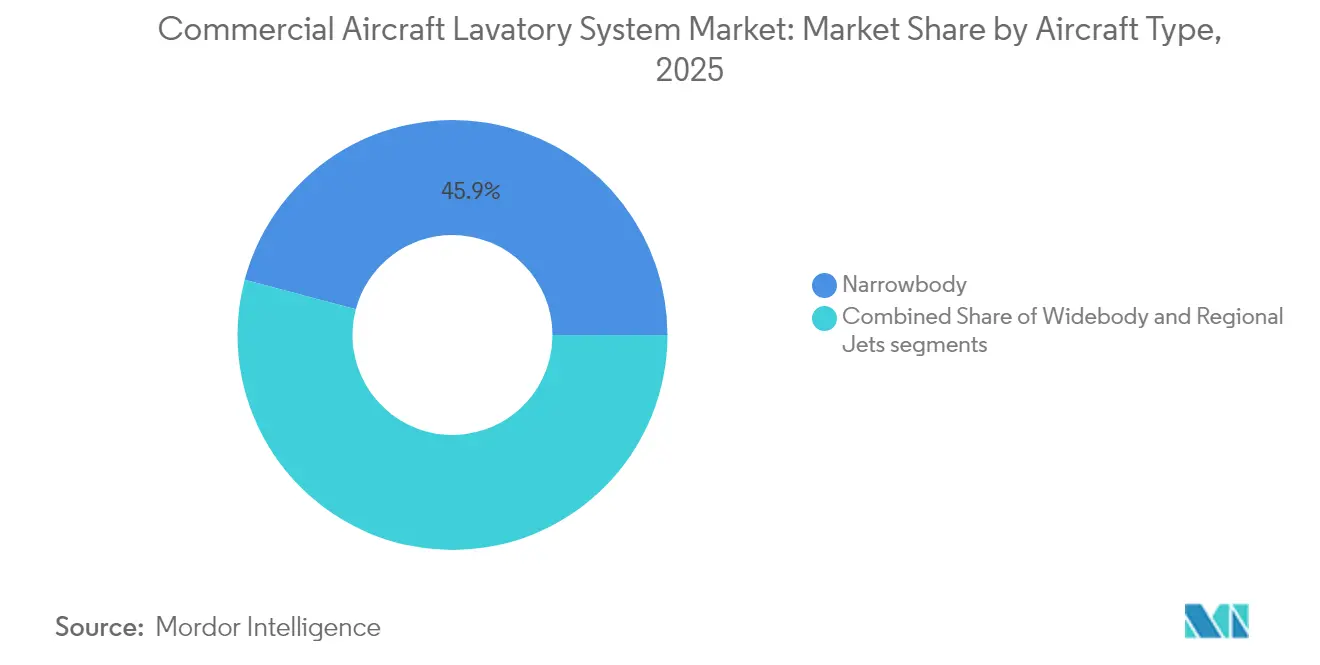
Narrowbody Dominance Drives Market MomentumNarrowbody aircraft controlled 45.87% of the commercial aircraft lavatory system market share in 2025, a lead from record A320 and 737 output and rising use on routes exceeding 3,000 miles. Regional jets provide the highest 6.86% CAGR because carriers deploy sub-150-seat equipment to match fluctuating demand while preserving schedule frequency. The commercial aircraft lavatory system market size for narrowbody platforms is projected to grow consistently through 2031 as backlog conversion accelerates.
Growth factors differ across segments. Single-aisle types feature slimmer wall structures, which require lavatory modules that fit snugly within the tighter fuselage contours. Collins Aerospace’s linefit agreement for the B737 family secures forward commitment through 2034. Widebody fleets concentrate on retrofit because cabin refresh cycles align with heavy checks around year 8. JAMCO leverages its exclusive positions on the B787 and B777 to test new bidet functions that could be migrated into single-aisle models later in the decade. Regional OEMs are increasingly adopting standard part numbers that enable cross-family stocking, thereby lowering operator inventory.



By Lavatory Technology:
Vacuum Systems Lead Innovation WaveVacuum solutions contributed 82.31% revenue in 2025, confirming their status as the default selection for most new builds. Airlines favor these systems because they use 80% less water, thereby reducing block fuel burn and maintenance costs. Hybrid architectures are expected to expand at a 7.39% CAGR as airlines trial Diehl’s greywater reuse module, which redirects hand-wash drainage for flushing, resulting in a 210 kg reduction on long-haul rotations. Prototype data indicate a payback period of 18 months for twin-aisle fleets.
The commercial aircraft lavatory system market continues to see R&D efforts focused on improving pump efficiency and controlling odors. Collins Aerospace’s Agile platform records a 50% weight reduction compared with legacy bowls while maintaining 30 million flight hours of reliability. Competitive responses include modular ejector pumps that share parts across biz-jet and commercial lines, lowering cost. Recirculating technology holds a small share for niche operators needing increased flush counts on very short segments where water uplift is less critical.
By Component:
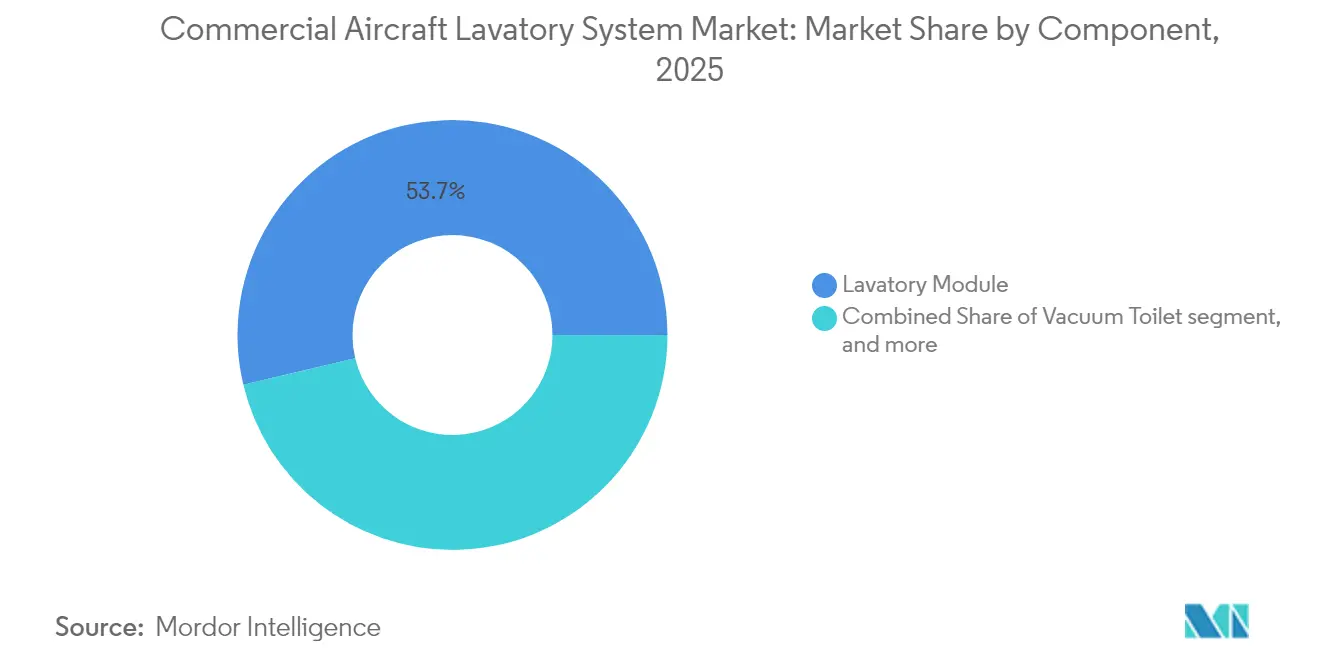
Lavatory Modules Drive Integration TrendsLavatory modules accounted for 53.72% of 2025 revenue, as OEMs and airlines prefer one-piece monuments that expedite assembly. The commercial aircraft lavatory system market size associated with modules is expected to rise as widebody upgrades line up for 2026 dock slots. Growth in sinks, faucets, and accessories at a 6.35% CAGR reflects heightened hygiene expectations that emerged during the pandemic. Touchless spigots, sensor-operated soap dispensers, and anti-splash basins are among the most recent additions to linefit specifications.
Component vendors underscore interchangeability. Airbus selected standardized plumbing harnesses on the A350 retrofit program, reducing installation hours by 30%. JAMCO integrates LED mood lighting into faucets, raising perceived cabin quality without adding bulk. Modular fasteners allow technicians to swap bowls in under one hour, a vital metric for low-cost carriers operating tight schedules.
By Fit Type:
Retrofit Growth Accelerates Fleet ModernizationLinefit installations accounted for 62.64% of 2025 revenue and are expected to remain dominant, thanks to a guaranteed backlog conversion at Airbus and Boeing. However, retrofits will advance at 7.05% CAGR through 2031 because airlines cannot wait for new slots and must comply with accessibility mandates on current hulls. Safran’s Aircraft Interiors division posted 25.2% sales growth in 2024, mostly from retrofit service orders that bundled lavatory, galley, and seat upgrades.
Retrofit kits prioritize minimal downtime. Collins produces a B737 Advanced Lavatory package that ships as a single crate with pre-wired electrical and data looms, enabling overnight hangar swaps. Airlines target annualized returns through ancillary revenue such as premium-economy upgrades linked to improved cabin ambiance. A robust PMA ecosystem further reduces costs by authorizing third-party parts that meet the exact specifications.
Geography Analysis
North America Commercial Aircraft Lavatory System Market
North America generated 33.55% of the revenue in 2025, following the acceleration of fleet standardization programs by carriers that integrate touchless fixtures and meet future accessibility deadlines. The commercial aircraft lavatory system market benefits from Boeing’s domestic manufacturing base and a dense MRO network that supports rapid retrofit execution. New US regulations promote technology adoption, ensuring that replacement cycles remain brisk even during periods of macroeconomic volatility.
APAC Commercial Aircraft Lavatory System Market
The Asia-Pacific region exhibits the highest 6.74% CAGR outlook, as regional traffic rebounds to pre-2020 levels and carriers like IndiGo, AirAsia, and China Eastern firm orders for hundreds of single-aisle units. Mixed-fleet strategies couple narrowbodies with regional jets, expanding the installed base for compact lavatory solutions. Domestic suppliers emerge in China, yet quality benchmarks keep Western vendors active through joint ventures. Nations like India establish soft rules that encourage accessible cabin designs, thereby reinforcing the retrofit potential across older fleets.
EMEA Commercial Aircraft Lavatory System Market
Europe’s share remains sizable, underpinned by robust environmental regulations and incentives for a circular economy. EU operators are leading trials of recyclable flax composites, which align with upcoming disclosure requirements under the Corporate Sustainability Reporting Directive. The Middle East registers double-digit twin-aisle orders that favor premium lavatory monuments with custom finishes. Africa experiences sporadic growth tied to fleet renewals by Ethiopian Airlines and others, yet limited MRO capacity moderates the velocity of retrofits.

Regulatory Landscape
Commercial aircraft lavatory systems are governed by cabin safety and interior-material rules enforced primarily by the FAA and EASA, shaping both monument design and the qualification burden for subcomponents. In the United States, 14 CFR 25.854 requires lavatory fire protection, including smoke detection and automatic fire suppression for waste disposal receptacles, supported by FAA fire-safety minimum performance standards for automatic fire extinguishers. In Europe, EASA CS-26.160 addresses lavatory fire protection for in-service aircraft, reinforcing retrofit demand for compliant detection and extinguishing solutions in lavatory and waste-bin areas.
Material selection and assembly design also need to satisfy flammability requirements for compartment interiors (for example, 14 CFR 25.853 and CS 25.853, plus related operating rules such as 14 CFR 121.312), which affect panels, liners, seals, and accessory housings used in lavatory modules. Certification pathways are influenced by FAA-EASA cooperation under the U.S.-EU airworthiness Technical Implementation Procedures, which support mutual recognition for certain findings while still requiring rigorous documentation and configuration control at the component and installation level. Accessibility rulemaking in the United States, referenced in DOT actions on accessible lavatories for single-aisle aircraft, aligns with the report context of a compliance trigger for new single-aisle deliveries after October 2026 and drives geometry changes and validation work for PRM-capable lavatory layouts.
Value Chain Analysis
The value chain starts with materials and engineered parts for monuments and water and waste systems, including lightweight composite or thermoplastic panels, fire-resistant liners, seals, and hardware, as well as vacuum toilets, ejectors/pumps, valves, sensors, and controllers. These inputs feed tier-one integrators such as Collins Aerospace (RTX), Safran Cabin, JAMCO, and Diehl, which design and assemble lavatory modules, certify them to FAA/EASA requirements, and deliver them as linefit shipsets to Airbus, Boeing, and regional OEMs, or as retrofit kits to airline and independent MRO channels. Final installation is performed at OEM final assembly lines for linefit, and during scheduled checks or cabin refresh events for retrofit, with provisioning of spares and consumables forming an aftermarket tail.
Key constraints and leverage points cluster around certification and supply continuity for specialized components, where concentration in qualified sources can extend lead times and complicate change control. The chain also depends on approved-parts governance and traceability, as highlighted by FAA actions such as the 2025 unapproved-parts notice relating to lavatory flush switch assemblies and modification kits, which can force quarantines and revalidation work across operators and MRO inventories. Large suppliers increasingly bundle adjacent cabin systems (lavatories with galleys and stowage) to secure multi-year positions, while geographic diversification of production footprints (for example, Safran Cabin manufacturing capability in Rokycany, Czech Republic, alongside established European sites) helps align output ramp plans and service-level commitments for OEM and airline programs.
Competitive Landscape
The commercial aircraft lavatory system market exhibits moderate consolidation, with RTX Corporation, Safran Group, and JAMCO Corporation collectively accounting for the majority of the market revenue. Collins Aerospace, a part of RTX Corporation, leverages vertically integrated vacuum pumps, module structures, and aftermarket services to anchor supplier positions at Boeing and Airbus lines. Safran records a 25.2% expansion in interior revenue in 2024 by bundling galleys and lavatories, creating package deals that are attractive to full-service carriers.[4]Safran, “Safran Reports Full-Year 2024 Results,” safran-group.com JAMCO Corporation secures a 50% widebody share through sole-source deals on the B787 and B777 programs, ensuring steady retrofit demand when first-generation Dreamliners enter heavy maintenance checks.
Second-tier firms, such as Diehl Stiftung & Co. KG and Lufthansa Technik AG, compete on niche features, including greywater reuse, antibacterial coatings, and lightweight composites. Regulatory certification intensifies barriers to entry, and the lengthy approval processes of the FAA and EASA discourage smaller contenders. PMA parts introduce cost competition, mainly in consumables such as valves or seats, rather than full monuments.
Supply chain disruptions persist. Natixis reports that lead times are extending to 30 months for specific avionics and composite materials, forcing airlines to pre-purchase spares. Vendors with diversified sourcing across Asia and Europe mitigate delays and capture incremental market share. Strategic actions include Safran’s acquisition of electromechanical actuation assets from Woodward, enhancing vertical control over water and waste actuators.
Commercial Aircraft Lavatory System Industry Leaders
Safran Group
JAMCO Corporation
Diehl Stiftung & Co. KG
Geven SpA
RTX Corporation
- *Disclaimer: Major Players sorted in no particular order
Commercial Aircraft Lavatory System Market Companies Covered in this Report
- Collins Aerospace (RTX Corporation)
- Safran
- JAMCO Corporation
- Diehl Stiftung & Co. KG
- Hong Kong Aircraft Engineering Company Limited (HAECO)
- Yokohama Rubber Co., Ltd.
- Geven SpA
- Satys SA
- CIRCOR International, Inc.
- FACC AG
- EnCore Corporate, Inc. (The Boeing Company)
- MAC Aero Interiors ( Magnetic Group)
- Lufthansa Technik AG
- Aviation Technical Services (ATS)
Read Analysis of Commercial Aircraft Lavatory System Companies

Market Opportunities and Future Outlook
Accessibility compliance and higher-density cabin layouts create room for lavatory concepts that deliver PRM functionality without permanent seat-count penalties. The US DOT requirement cited in the report context for accessible lavatories on new single-aisle aircraft delivered after October 2026 elevates demand for adaptable layouts, exemplified by Diehl Aviation's Space3 inclusive lavatory program, which is positioned for airline revenue service before the end of 2026, with a narrowbody-compatible version under development. This supports opportunities for retrofit-friendly door mechanisms, partitions, and monument architectures that minimize downtime and preserve commonality across fleets.
Sustainability and operating-cost reduction also open opportunities in water-saving and weight-reduction technologies for both new deliveries and retrofits. Diehl Aviation completed a three-month in-service evaluation of its ECO Grey Water Reuse System on SWISS-operated Boeing 777 aircraft, which demonstrates a route to reduce potable water uplift and aircraft weight while keeping a retrofit option available. Adoption can accelerate for long-haul fleets where water carriage and servicing are material. On the competitive and supply side, consolidation and footprint expansion support supplier investment cases: JAMCO's acquisition of Schueschke strengthens access to the Airbus supply chain for cabin interiors, and Diehl's manufacturing expansion in Mexico and Romania adds capacity options that can support higher OEM build rates while reducing exposure across a single region for certified lavatory modules and subassemblies.
Recent Industry Developments in Commercial Aircraft Lavatory System Market
- June 2026: Safran Cabin marked the 70th anniversary of its Herborn, Germany site, a long-standing hub for designing and manufacturing aircraft cabin interiors including lavatories. The milestone underscored Safran's embedded industrial base for certified lavatory modules and supports sustained linefit and retrofit output in a period of higher OEM production demand.
- August 2025: The FAA issued a Suspected Unapproved Parts notification concerning certain lavatory flush switch assemblies and modification kits associated with Safran Cabin, Inc. that lacked required production approval over the referenced period. This action tightened scrutiny on parts traceability and conformity, increasing compliance workload for operators and MROs and reinforcing the advantage of suppliers with robust approved-production and documentation systems.
- April 2024: JAMCO Corporation and JAXA unveiled a Metamorphic Lavatory concept for widebody aircraft aimed at improving accessibility for passengers with reduced mobility. The concept highlighted active R&D toward configurable lavatory geometry, aligning with emerging accessibility requirements and informing future product roadmaps for both linefit and retrofit applications.


Commercial Aircraft Lavatory System Market Report Scope and Research Methodology
Market Definition and Coverage
This market covers the value of lavatory systems installed on commercial aircraft, including the main system modules and parts needed to deliver water, manage waste, and support safe lavatory operation across the cabin.
Scope exclusions: Military aircraft, business jets, and general aviation lavatory equipment are excluded from this sizing.
Segments Covered in This Report
- By Aircraft Type
- Narrowbody
- Widebody
- Regional Jets
- By Lavatory Technology
- Vacuum
- Recirculating
- Hybrid/Others
- By Component
- Lavatory Module
- Vacuum Toilet
- Water and Waste Management System
- Sinks, Faucets, and Accessories
- By Fit Type
- Linefit
- Retrofit
- By Geography
- North America
- United States
- Canada
- Mexico
- Europe
- United Kingdom
- France
- Germany
- Italy
- Rest of Europe
- Asia-Pacific
- China
- India
- Japan
- South Korea
- Rest of Asia-Pacific
- South America
- Brazil
- Rest of South America
- Middle East and Africa
- Middle East
- United Arab Emirates
- Saudi Arabia
- Rest of Middle East
- Africa
- South Africa
- Rest of Africa
- Middle East
- North America
Data Sources, Market Sizing, and Validation
Desk Research
Desk research helped us map demand drivers and set realistic input ranges before the model was built. Public sources such as FAA and EASA airworthiness directives, ICAO air traffic statistics, IATA traffic and fleet outlook publications, and aircraft OEM backlog and delivery updates were used to understand fleet growth and cabin retrofit cycles.
We also reviewed sources such as UN Comtrade trade codes for relevant components, airport and civil aviation authority releases, patent databases for lavatory technology changes, and peer reviewed papers on vacuum and waste handling systems (to interpret which changes are truly material). Company filings, investor presentations, and trusted aviation press were then used to cross-check program exposure and aftermarket activity, and a paid subscription for company financials and for aerospace program tracking was used selectively to validate timelines and installed-base logic. The desk sources named above are illustrative only and not exhaustive, and other public documents were also referred to for collection, validation, and research clarification.
Primary Interviews and Surveys
Primary interviews were used to test how aircraft are configured and maintained in practice, and to refine the assumptions behind linefit versus retrofit demand and typical replacement timing. We spoke with a mix of lavatory system suppliers, aircraft component specialists, MRO stakeholders, and airline engineering and procurement respondents across major aviation regions so gaps from public data could be filled, then triangulated across roles.
Distribution of primary research fieldwork respondents
| Company type | Respondent position | Region |
|---|---|---|
| Top tier: 27% | CXOs: 12% | APAC: 47% |
| Mid tier: 52% | Functional/Unit leaders: 33% | EMEA: 32% |
| Smaller Players: 21% | Managers: 55% | Americas: 21% |
Market-Sizing & Forecasting
For sizing, a top-down build was done by reconstructing the delivered and in-service commercial fleet and then translating it into lavatory shipsets and replacement demand by aircraft category. The model starts with aircraft deliveries, fleet-in-service, and utilization signals, and it converts these into expected lavatory counts per aircraft and annual change-outs, where the main clause becomes the final market value.
To keep the totals realistic, selective bottom-up approximations were used as checkpoints, such as sampled price per shipset, channel checks on retrofit kits, and exposure patterns by aircraft program. Key inputs used (illustrative) include aircraft delivery outlook and backlog, narrow-body versus wide-body mix, linefit share versus retrofit share, cabin reconfiguration frequency, and inflation-adjusted pricing for major subassemblies. When public data was missing for smaller fleets or older programs, ratios from comparable aircraft families were applied and then reviewed in primary calls.
Forecasting relied on scenario analysis, supported by expert consensus on delivery ramps, retrofit intensity, and replacement cycles, followed by sensitivity checks on pricing progression and program timing.
Data Validation & Update Cycle
Outputs were validated through multiple checks so unusual jumps could be explained before sign-off. We compared modeled demand with independent indicators such as delivery timing, fleet utilization shifts, and retrofit announcements, and then re-checked any large variances at the aircraft type and region level.
A second analyst review was used to confirm assumptions, currency handling, and arithmetic consistency, and follow-up calls were triggered when interview feedback conflicted with desk signals. The report is refreshed annually, and interim updates are made when material events occur, such as delivery disruptions or certification-driven retrofit waves. Before publication, a final pass is completed so clients receive the latest updated view.
Mordor Intelligence's Commercial Aircraft Lavatory System Market Estimate Compared With Other Published Estimates
It is normal to see different market sizes for the same topic, even when the title looks identical, because scope and sizing steps vary in small but important ways. Differences usually show up around what aircraft types are counted, whether retrofit demand is treated separately from linefit, and how pricing is moved across the forecast years.
Mordor Intelligence excludes business jet and military aircraft lavatory systems from this report, which helps explain why some published totals look larger even when the product description sounds similar. Gaps can also come from how many lavatories per aircraft are assumed by configuration, whether the model uses deliveries only or also includes the in-service fleet for aftermarket demand, and if currency conversion timing is refreshed consistently for the current year.
Benchmark comparison
| Source | Market Size | Gaps in Research Methodology |
|---|---|---|
| Mordor Intelligence | USD 517.81 M (2026) | |
| Industry Marketplace A | USD 430.62 M (2024) | Uses a different base year and forecast window, and the public summary does not clearly separate linefit versus retrofit demand, which can shift totals when replacement timing is handled differently. |
| Global Consultancy B | USD 396.90 M (2024) | The estimate is presented for a broader aircraft lavatory system market without a clear commercial-only constraint in the public summary, and it also applies a lower long-range growth rate, which compresses the value trajectory. |
Taken together, the spread is mainly explained by aircraft coverage, the chosen starting year, and how replacement demand is converted from the installed fleet into annual revenue. With the same fleet and retrofit signals updated on a consistent cadence, the sizing steps remain easy to track and repeat when new delivery and utilization data is released.


Key Questions Answered in the Report
What is the 2026 value of the commercial aircraft lavatory system market?
The commercial aircraft lavatory system market size is USD 517.81 million in 2026.
How fast will demand grow through 2031?
Forecasts indicate a 5.83% CAGR, reaching USD 687.59 million by 2031.
Which aircraft type currently generates the most lavatory system revenue?
Narrowbody platforms lead with 45.87% share in 2025.
Why are retrofit programs accelerating now?
Airlines must comply with new accessibility mandates and favor shorter ground times, making quick-install retrofit kits attractive.
Which region is expected to post the highest growth rate?
Asia-Pacific, projected at a 6.74% CAGR through 2031 due to large order backlogs and fleet expansions.
Who are the key suppliers dominating this space?
Collins Aerospace (RTX Corporation), Safran, and JAMCO Corporation collectively capture more than half of total revenue.
Page last updated on:





