
Cinnamon Market Size and Share
Cinnamon Market Analysis by Mordor Intelligence
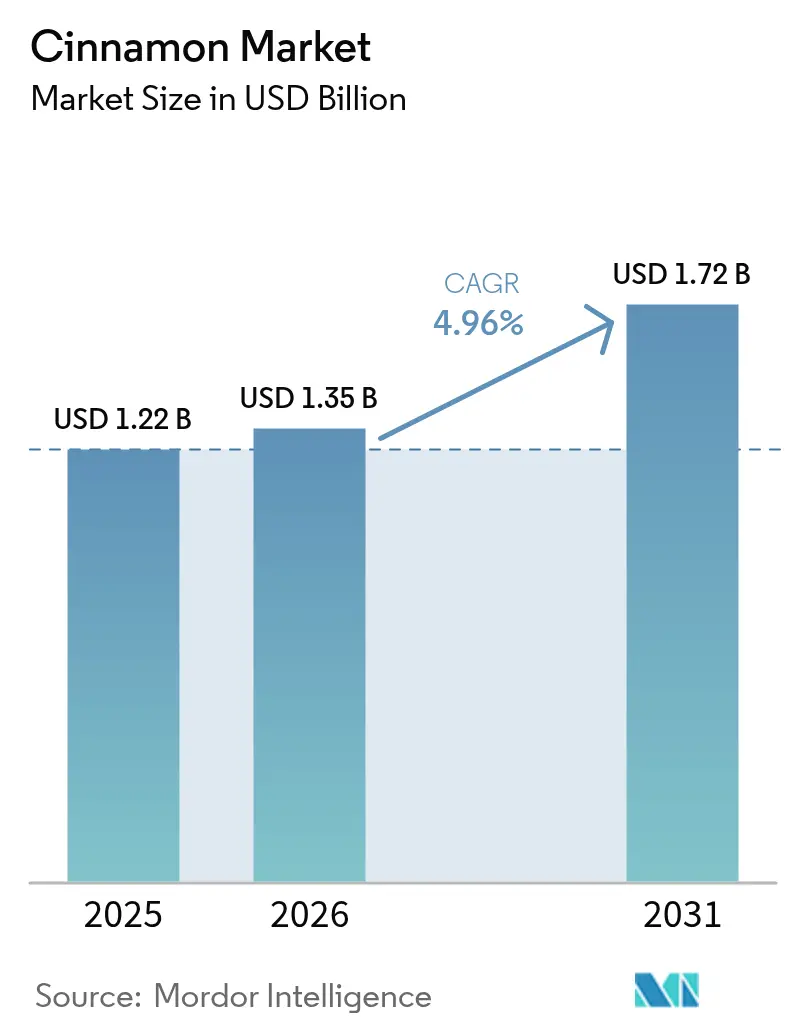
The cinnamon market size is projected to be USD 1.22 billion in 2025, USD 1.35 billion in 2026, and reach USD 1.72 billion by 2031, growing at a CAGR of 4.96% from 2026 to 2031. Asia-Pacific continued to dominate the cinnamon market in 2025, accounting for the majority of global revenue, as Sri Lanka, Indonesia, and China consolidated their supply chains for both cassia and ceylon grades. Demand accelerated in nutraceutical supplements that position cinnamon’s polyphenols as natural blood-glucose moderators, while clean-label oat and almond dairy lines replaced synthetic vanillin with water-extracted cinnamon oleoresin to improve flavor and antioxidative stability. Functional beverage formulators introduced sparkling waters, kombuchas, and cold-brew coffees infused with standardized cinnamon extracts, further recasting the spice from a culinary staple to a metabolic-health ingredient. Blockchain documentation at the farm and container levels began to shrink the price gap between commodity cassia and pharmaceutical-grade ceylon, giving cooperatives an incentive to digitize smallholder supply chains.
Key Report Takeaways
- By geography, Asia-Pacific held 67.3% of the cinnamon market share in 2025, while Africa is forecast to expand at a 4.5% CAGR through 2031, as Madagascar scales certified organic exports.
Note: Market size and forecast figures in this report are generated using Mordor Intelligence’s proprietary estimation framework, updated with the latest available data and insights as of 2026.
Global Cinnamon Market Trends and Insights
Drivers Impact Analysis*
| Driver | (~) % Impact on CAGR Forecast | Geographic Relevance | Impact Timeline |
|---|---|---|---|
| Expanding nutraceutical launches focused on blood-glucose control | +0.9% | Global with emphasis on North America and Europe | Medium term (2-4 years) |
| Rising demand for clean-label flavoring in plant-based dairy alternatives | +0.7% | North America, Europe, and urban Asia-Pacific | Medium term (2-4 years) |
| Innovations in functional beverage formats | +0.6% | Global, early adoption in North America and Asia-Pacific | Short term (≤ 2 years) |
| Robust growth of e-commerce spice retailing in emerging economies | +0.7% | India, Indonesia, China, spill-over to Middle East and Africa | Long term (≥ 4 years) |
| Commercial scale-up of cinnamon leaf oil for active food packaging | +0.4% | North America, Europe, and Japan | Long term (≥ 4 years) |
| Blockchain-based farm-to-market traceability premiums | +0.3% | Pilot sites in Sri Lanka, Madagascar, and Indonesia | Long term (≥ 4 years) |
| Source: Mordor Intelligence | |||
Expanding Nutraceutical Launches Focused on Blood-Glucose Control
The study published in the National Institute of Health in 2023, indicating that consuming 1 to 6 grams of cinnamon can reduce fasting plasma glucose levels by up to 29 milligrams per deciliter, has led supplement formulators to prioritize water-soluble extracts standardized to 10% polyphenols. This has driven increased interest in cinnamon's potential health benefits, particularly for managing blood sugar levels[1]. A 2024 study published in the American Journal of Clinical Nutrition examined the glucose-regulating effects of daily cinnamon consumption with regular meals, highlighting its potential role in dietary interventions for glucose control. European capsule brands have cited coumarin-related warnings from the European Food Safety Authority to justify premium pricing for Ceylon cinnamon formulas, as Ceylon cinnamon contains lower levels of coumarin than other varieties. In these regions, the cinnamon market is experiencing increased demand driven by competition among buyers from multiple sectors, resulting in multi-year offtake agreements and tighter supply conditions. This growing demand underscores the importance of sustainable sourcing and supply chain management to meet market needs.
Rising Demand for Clean-Label Flavoring in Plant-Based Dairy Alternatives
North American and Western European oat, almond, and coconut dairy processors increased oleoresin purchases in 2025 as they transitioned away from synthetic vanillin. In 2024, Miyoko’s Creamery introduced Cinnamon Brown Sugar Oat Milk Butter to create a "nostalgic" flavor profile for its cultured oat milk base, targeting consumers seeking nut-free, dairy-free alternatives. The European Union's Farm to Fork agenda, which requires a 50% reduction in synthetic pesticide use by 2030, has accelerated the adoption of botanical flavor systems that also function as natural preservatives[2]. In the United States, retailers observed higher sales velocity for plant-based dairy products flavored with cinnamon than with chocolate or vanilla, indicating growing mainstream consumer acceptance. These trends collectively expand the cinnamon market's presence within the rapidly growing alternative-dairy segment.
Robust Growth of E-Commerce Spice Retailing in Emerging Economies
Digital platforms in India and Indonesia have significantly increased cinnamon retail penetration over the past few years. Organic Ceylon cinnamon sticks, which are priced at a premium compared to conventional cassia powder, have demonstrated notably higher conversion rates. In Indonesia, subscription services offering curated monthly spice boxes have contributed to a substantial rise in cassia exports to expatriate households. At the same time, Chinese marketplaces have experienced a significant growth in cinnamon-related search queries, indicating rising consumer interest. Transparent product listings that include details such as coumarin levels and plantation coordinates are enabling smallholder cooperatives to bypass intermediaries, securing better margins and supporting ongoing structural changes in the cinnamon market.
Blockchain-Based Farm-to-Market Traceability Premiums
Distributed-ledger pilots in Sri Lanka and Madagascar tracked every transaction from the plot to the export container, allowing buyers to verify the origin, harvest date, and coumarin assays, while enabling premium payments that were significantly higher compared to unverified lots. Sri Lanka’s Export Development Board facilitated the onboarding of a large number of farmers, thereby reducing rejection costs commonly associated with cassia adulteration. In Madagascar, a considerable group of smallholders was connected through the initiative, enabling access to European organic markets and contributing to a notable increase in farmer revenues. However, the per-kilogram transaction fees remain a challenge for growers who rely on subsistence farming. Nevertheless, early adopters in the cinnamon market have indicated that the higher premiums they earn are sufficient to offset these costs within a single harvest cycle.
Restraints Impact Analysis*
| Restraint | (~) % Impact on CAGR Forecast | Geographic Relevance | Impact Timeline |
|---|---|---|---|
| Persistent pest-related yield losses in smallholder plantations | −0.5% | India, Indonesia, and Sri Lanka | Medium term (2-4 years) |
| Rising coumarin-related safety scrutiny on cassia varieties | −0.4% | Europe, North America, and Japan | Long term (≥ 4 years) |
| Increasing availability of synthetic flavor substitutes | −0.4% | Global with prominence in bakery and confectionery | Medium term (2-4 years) |
| Higher certification compliance costs | −0.3% | Asia-Pacific and African smallholder regions | Long term (≥ 4 years) |
| Source: Mordor Intelligence | |||
Rising Coumarin-Related Safety Scrutiny on Cassia Varieties
The European Food Safety Authority has established a tolerable daily intake of 0.1 milligrams of coumarin per kilogram of body weight, a threshold that is exceeded by just 1 gram of cassia cinnamon. Germany’s Federal Institute for Risk Assessment has recommended limiting cassia consumption to 0.5 grams per day, prompting retailers to include coumarin content on product labels. Advocates for supplements have petitioned the United States Food and Drug Administration to mandate the disclosure of coumarin levels, aiming for consistency with European regulations. A study published by the European Commission in September 2025 states that 9.6% of the samples exceeded the maximum limit of 2 mg/kg for lead, as established by European food safety legislation. Additionally, 31 of the analyzed samples were identified as potentially hazardous to children due to their high coumarin content[3]. These developments are driving importers to prioritize low-coumarin Ceylon cinnamon, influencing demand patterns within the cinnamon market.
Increasing Availability of Synthetic Flavor Substitutes
Synthetic cinnamaldehyde, offered at lower prices than natural cinnamon oil, has gained significant market share in the global flavor-compounding segment, particularly in mass-market bakery and confectionery applications. Flavor stability over a 24-month shelf life and uniform intensity make synthetics attractive amid the volatility of natural oils. Perfume-grade synthetic coumarin, while banned from food use in the United States, diverts demand from natural spice extraction by occupying fragrance pathways. Natural cinnamon suppliers are countering by emphasizing antioxidant and antimicrobial functions not replicable by synthetics. Nevertheless, economic downturns could push cost-sensitive manufacturers to increase synthetic uptake, compressing margins in the cinnamon market.
*Our forecasts treat driver/restraint impacts as directional, not additive. The impact forecasts reflect baseline growth, mix effects, and variable interactions.
Geography Analysis
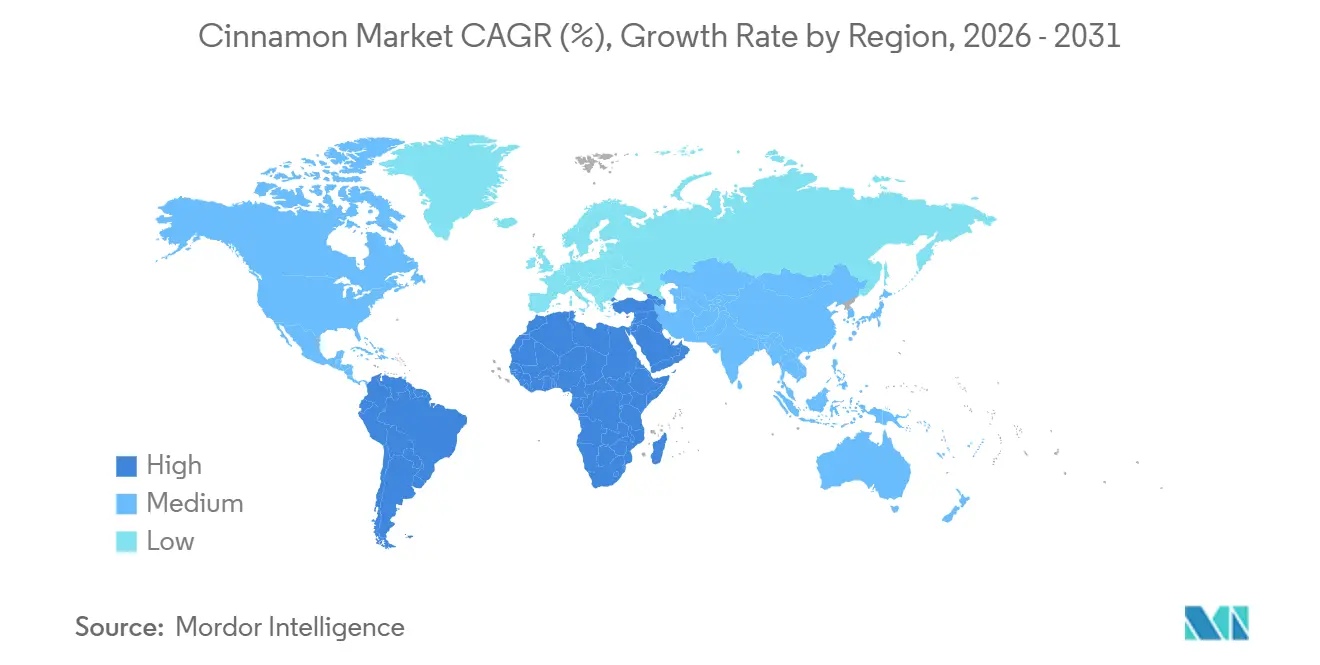
Asia-Pacific is the largest geography, accounting for 67.3% of the cinnamon market share in 2025, anchored by Sri Lanka’s export of 19,546 metric tons of cinnamon and Indonesia’s 55,204 metric tons of cassia harvest in 2024. According to the Food and Agriculture Organization, China produced 94,215.7 metric tons domestically, most of which were consumed for traditional medicine use and snack production, while India’s consumption climbed on the back of Ayurvedic supplement sales and e-commerce penetration. According to the ITC Trade Map, Vietnam exported 66,190 metric tons of cinnamon in 2024 to countries globally, where flavor houses value its essential oil yield.
Africa posted the fastest regional expansion at a 4.5% CAGR through 2031, driven by Madagascar’s 4,071 metric tons of exports in 2024, as estimated by ITC Trade Map. Grant funding from the African Development Bank is supporting the development of additional agricultural land in Analanjirofo, aiming to boost agricultural productivity and support local economies. However, delays at the port in Toamasina continue to cause extended lead times, impacting the timely transportation of goods and creating logistical challenges for exporters. South Africa has increased its imports of cinnamon to address the rising demand driven by its expanding processed-food industry, which relies heavily on spices for flavoring and preservation. Meanwhile, demand in Morocco has remained consistent as cassia continues to play a key role in enhancing traditional spice blends, which are integral to the country’s culinary heritage and cultural identity.
North America and Europe remained significant consumption regions outside the Asia-Pacific market. The United States emerged as a major importer, with a notable increase in the share of Ceylon cinnamon as supplement manufacturers moved away from coumarin-related risks. This shift was driven by growing awareness of coumarin's potential health impacts, prompting a preference for Ceylon cinnamon in dietary supplements. Germany also recorded substantial imports, with guidance from the Federal Institute for Risk Assessment (BfR) encouraging retailers to transition to Ceylon cinnamon for products intended for children and pregnant women. This transition was further supported by consumer demand for safer and higher-quality ingredients in food products. In the Middle East, countries such as the United Arab Emirates and Saudi Arabia were prominent buyers, with cassia accounting for the bulk of imports due to its widespread use in traditional cuisines and beverages. Brazil also imported cinnamon primarily for use in bakery fillings, reflecting the growing application of cinnamon in the food processing industry.
Regulatory Landscape
Food safety and quality compliance is tightening around heavy metals, adulteration, and coumarin exposure, raising the bar for exporters serving the EU, North America, and Japan. In September 2025, the European Commission Joint Research Centre reported widespread non-compliance in cinnamon on the EU market, including lead exceedances against the EU maximum limit of 2 mg/kg and elevated coumarin risks in some samples. This reinforces the need for batch testing, origin verification, and tighter supplier qualification.
International standard setting is also moving toward clearer specifications for cinnamon trade. In October 2025, the Codex Alimentarius Committee on Spices and Culinary Herbs (CCSCH) advanced work on cinnamon standards under dried barks, and Codex-level moves on lead maximum levels for dried bark/cinnamon are increasingly used as reference points in buyer specifications. In China, the national standard GB/T 42780-2023 for cassia products (effective December 1, 2023) formalized quality grading and inspection protocols, while in the United States the FDA has continued enforcement actions and public health alerts linked to elevated lead in ground cinnamon, intensifying scrutiny for importers and private-label brands.
Value Chain Analysis
The cinnamon value chain starts with smallholder cultivation, harvesting, and peeling (quills or bark), followed by aggregation through village collectors and dealers, baling, primary processing (cleaning, drying, grading, grinding), and secondary processing into higher-value derivatives such as essential oils and oleoresins, before export and downstream use in food, beverages, nutraceuticals, and personal care. Production remains fragmented at the farm level, while greater consolidation among exporters and large processors allows them to finance lab testing, traceability systems, and certifications required by multinational buyers.
Post-harvest handling and compliance are key friction points. Inconsistent quality and seasonal variability, limited processing technology, and certification costs create losses and constrain market access for smallholders, while SPS and technical barriers in the EU and the United States raise requirements around residues and contaminants, including lead. Operational delays can also stem from phytosanitary and customs documentation cycles and from volatile freight conditions, extending lead times from origin hubs such as Sri Lanka and Indonesia to destination markets. These constraints support the shift toward organized cooperatives, contract-linked aggregation, and more value-added processing closer to origin.
Competitive Landscape
Production remains fragmented among smallholders, while export volumes are becoming more consolidated due to rising certification and traceability requirements that raise capital thresholds. In 2025, Sri Lanka's largest exporters accounted for a significant share of outbound shipments, reflecting their ability to meet stringent export standards and to leverage economies of scale. In Indonesia, cooperatives managed the cassia trade, playing a pivotal role in organizing smallholder production and ensuring market access. Additionally, European importers acquired equity stakes in upstream estates to secure compliant supply, hedge against risks related to coumarin exposure, and strengthen their position in the value chain.
Technology adoption marks a strategic divide. Leading exporters deploy GPS harvest mapping, drone pest detection, and machine-vision grading that together win price premiums. Pharmaceutical-grade extract production, antimicrobial leaf-oil capacity, and direct-to-consumer retailing represent white-space arenas where incumbents underinvest. The cinnamon market is also watching synthetic biology firms ferment cinnamaldehyde at lab scale, a potential cost disruptor post-2028.
Disruption extends to blockchain cooperatives such as the Ceylon Cinnamon Cooperative, which boosted farmer income after onboarding members in 2025. Certification norms like the International Organization for Standardization 22000 food-safety systems and Rainforest Alliance agricultural standards have become minimum entry requirements for European and North American buyers, raising the hurdle for informal traders and consolidating future market share around better-capitalized entities.
Market Opportunities and Future Outlook
A visible opportunity is expanding export value through consolidation, compliance, and value-added processing rather than bulk bark trade. The Vietnam Pepper and Spice Association reported that Vietnam led global cinnamon exports by economic value in 2025, with 120,295 tons valued at USD 300.2 million, illustrating how structured export ecosystems and processing hubs can lift realized value even when upstream production remains dispersed across smallholders.
Digital agronomy and traceability are also opening opportunities in quality assurance and supply stability, particularly where pest pressure and safety scrutiny intersect. Research initiatives in Sri Lanka have moved from concept to field validation, including an AI-enabled mobile assistant for precision cinnamon farming reporting yield improvement and water savings in trials, and CINNOVA-style monitoring approaches focused on disease detection and bark maturity assessment. Combined with buyer requirements for lab-verified quality and batch tracking in developed markets, these tools support differentiation of low-coumarin, tested lots and help exporters and cooperatives target higher-margin end uses such as standardized nutraceutical extracts and functional beverage ingredients.
Recent Industry Developments
- July 2026: Sri Lanka’s Department of Cinnamon Development reported record May 2026 prices for Alba-grade cinnamon (Rs 7,000 per kg) alongside higher export earnings in the first five months of 2026 versus the same period in 2025. The pricing environment increased incentives for growers and exporters to prioritize premium grading, testing, and compliant lots that capture higher margins.
- July 2025: Pussalla Agri Ventures inaugurated a cinnamon processing facility in Kosgama, Sri Lanka, to expand value-added output such as quills, powder, and essential oils. Added processing capacity supports tighter quality control and helps shift exports toward higher-value formats demanded by food, flavor, and nutraceutical buyers.
- May 2024: Sweetmore Bakeries completed its acquisition of wholesale cinnamon roll manufacturer Sweet Eddie’s Inc. to broaden its retail and foodservice portfolio. The deal strengthened downstream demand linkage for cinnamon-based bakery applications and improved scale in commercial production of cinnamon-forward products.
Research Methodology Framework and Report Scope
Market Definition and Coverage
For this methodology, the cinnamon market is measured as the value of cinnamon traded and consumed for use as a spice ingredient and flavor input, covering commonly traded varieties and forms, and counted at the point where it is sold into commercial channels.
Scope exclusions: This sizing does not treat synthetic flavor chemicals as cinnamon, and it also keeps unrelated spices, blends, and finished branded food products outside the market value.
Segmentation Overview
- By Geography
- North America
- United States
- Production Analysis (Area Harvested, Yield, and Production Volume)
- Consumption Analysis (Consumption Value and Volume)
- Import Market Analysis (Import Value, Volume, and Key Supplying Markets)
- Export Market Analysis (Export Value, Volume, and Key Destination Markets)
- Wholesale Price Trend Analysis and Forecast
- Regulatory Framework
- List of Key Players
- Logistics and Infrastructure
- Seasonality Analysis
- Mexico
- Production Analysis (Area Harvested, Yield, and Production Volume)
- Consumption Analysis (Consumption Value and Volume)
- Import Market Analysis (Import Value, Volume, and Key Supplying Markets)
- Export Market Analysis (Export Value, Volume, and Key Destination Markets)
- Wholesale Price Trend Analysis and Forecast
- Regulatory Framework
- List of Key Players
- Logistics and Infrastructure
- Seasonality Analysis
- Canada
- Production Analysis (Area Harvested, Yield, and Production Volume)
- Consumption Analysis (Consumption Value and Volume)
- Import Market Analysis (Import Value, Volume, and Key Supplying Markets)
- Export Market Analysis (Export Value, Volume, and Key Destination Markets)
- Wholesale Price Trend Analysis and Forecast
- Regulatory Framework
- List of Key Players
- Logistics and Infrastructure
- Seasonality Analysis
- United States
- Europe
- Germany
- Production Analysis (Area Harvested, Yield, and Production Volume)
- Consumption Analysis (Consumption Value and Volume)
- Import Market Analysis (Import Value, Volume, and Key Supplying Markets)
- Export Market Analysis (Export Value, Volume, and Key Destination Markets)
- Wholesale Price Trend Analysis and Forecast
- Regulatory Framework
- List of Key Players
- Logistics and Infrastructure
- Seasonality Analysis
- United Kingdom
- Production Analysis (Area Harvested, Yield, and Production Volume)
- Consumption Analysis (Consumption Value and Volume)
- Import Market Analysis (Import Value, Volume, and Key Supplying Markets)
- Export Market Analysis (Export Value, Volume, and Key Destination Markets)
- Wholesale Price Trend Analysis and Forecast
- Regulatory Framework
- List of Key Players
- Logistics and Infrastructure
- Seasonality Analysis
- France
- Production Analysis (Area Harvested, Yield, and Production Volume)
- Consumption Analysis (Consumption Value and Volume)
- Import Market Analysis (Import Value, Volume, and Key Supplying Markets)
- Export Market Analysis (Export Value, Volume, and Key Destination Markets)
- Wholesale Price Trend Analysis and Forecast
- Regulatory Framework
- List of Key Players
- Logistics and Infrastructure
- Seasonality Analysis
- Spain
- Production Analysis (Area Harvested, Yield, and Production Volume)
- Consumption Analysis (Consumption Value and Volume)
- Import Market Analysis (Import Value, Volume, and Key Supplying Markets)
- Export Market Analysis (Export Value, Volume, and Key Destination Markets)
- Wholesale Price Trend Analysis and Forecast
- Regulatory Framework
- List of Key Players
- Logistics and Infrastructure
- Seasonality Analysis
- Russia
- Production Analysis (Area Harvested, Yield, and Production Volume)
- Consumption Analysis (Consumption Value and Volume)
- Import Market Analysis (Import Value, Volume, and Key Supplying Markets)
- Export Market Analysis (Export Value, Volume, and Key Destination Markets)
- Wholesale Price Trend Analysis and Forecast
- Regulatory Framework
- List of Key Players
- Logistics and Infrastructure
- Seasonality Analysis
- Germany
- Asia-Pacific
- China
- Production Analysis (Area Harvested, Yield, and Production Volume)
- Consumption Analysis (Consumption Value and Volume)
- Import Market Analysis (Import Value, Volume, and Key Supplying Markets)
- Export Market Analysis (Export Value, Volume, and Key Destination Markets)
- Wholesale Price Trend Analysis and Forecast
- Regulatory Framework
- List of Key Players
- Logistics and Infrastructure
- Seasonality Analysis
- India
- Production Analysis (Area Harvested, Yield, and Production Volume)
- Consumption Analysis (Consumption Value and Volume)
- Import Market Analysis (Import Value, Volume, and Key Supplying Markets)
- Export Market Analysis (Export Value, Volume, and Key Destination Markets)
- Wholesale Price Trend Analysis and Forecast
- Regulatory Framework
- List of Key Players
- Logistics and Infrastructure
- Seasonality Analysis
- Japan
- Production Analysis (Area Harvested, Yield, and Production Volume)
- Consumption Analysis (Consumption Value and Volume)
- Import Market Analysis (Import Value, Volume, and Key Supplying Markets)
- Export Market Analysis (Export Value, Volume, and Key Destination Markets)
- Wholesale Price Trend Analysis and Forecast
- Regulatory Framework
- List of Key Players
- Logistics and Infrastructure
- Seasonality Analysis
- Indonesia
- Production Analysis (Area Harvested, Yield, and Production Volume)
- Consumption Analysis (Consumption Value and Volume)
- Import Market Analysis (Import Value, Volume, and Key Supplying Markets)
- Export Market Analysis (Export Value, Volume, and Key Destination Markets)
- Wholesale Price Trend Analysis and Forecast
- Regulatory Framework
- List of Key Players
- Logistics and Infrastructure
- Seasonality Analysis
- Sri Lanka
- Production Analysis (Area Harvested, Yield, and Production Volume)
- Consumption Analysis (Consumption Value and Volume)
- Import Market Analysis (Import Value, Volume, and Key Supplying Markets)
- Export Market Analysis (Export Value, Volume, and Key Destination Markets)
- Wholesale Price Trend Analysis and Forecast
- Regulatory Framework
- List of Key Players
- Logistics and Infrastructure
- Seasonality Analysis
- China
- South America
- Brazil
- Production Analysis (Area Harvested, Yield, and Production Volume)
- Consumption Analysis (Consumption Value and Volume)
- Import Market Analysis (Import Value, Volume, and Key Supplying Markets)
- Export Market Analysis (Export Value, Volume, and Key Destination Markets)
- Wholesale Price Trend Analysis and Forecast
- Regulatory Framework
- List of Key Players
- Logistics and Infrastructure
- Seasonality Analysis
- Argentina
- Production Analysis (Area Harvested, Yield, and Production Volume)
- Consumption Analysis (Consumption Value and Volume)
- Import Market Analysis (Import Value, Volume, and Key Supplying Markets)
- Export Market Analysis (Export Value, Volume, and Key Destination Markets)
- Wholesale Price Trend Analysis and Forecast
- Regulatory Framework
- List of Key Players
- Logistics and Infrastructure
- Seasonality Analysis
- Peru
- Production Analysis (Area Harvested, Yield, and Production Volume)
- Consumption Analysis (Consumption Value and Volume)
- Import Market Analysis (Import Value, Volume, and Key Supplying Markets)
- Export Market Analysis (Export Value, Volume, and Key Destination Markets)
- Wholesale Price Trend Analysis and Forecast
- Regulatory Framework
- List of Key Players
- Logistics and Infrastructure
- Seasonality Analysis
- Brazil
- Middle East
- United Arab Emirates
- Production Analysis (Area Harvested, Yield, and Production Volume)
- Consumption Analysis (Consumption Value and Volume)
- Import Market Analysis (Import Value, Volume, and Key Supplying Markets)
- Export Market Analysis (Export Value, Volume, and Key Destination Markets)
- Wholesale Price Trend Analysis and Forecast
- Regulatory Framework
- List of Key Players
- Logistics and Infrastructure
- Seasonality Analysis
- Saudi Arabia
- Production Analysis (Area Harvested, Yield, and Production Volume)
- Consumption Analysis (Consumption Value and Volume)
- Import Market Analysis (Import Value, Volume, and Key Supplying Markets)
- Export Market Analysis (Export Value, Volume, and Key Destination Markets)
- Wholesale Price Trend Analysis and Forecast
- Regulatory Framework
- List of Key Players
- Logistics and Infrastructure
- Seasonality Analysis
- United Arab Emirates
- Africa
- South Africa
- Production Analysis (Area Harvested, Yield, and Production Volume)
- Consumption Analysis (Consumption Value and Volume)
- Import Market Analysis (Import Value, Volume, and Key Supplying Markets)
- Export Market Analysis (Export Value, Volume, and Key Destination Markets)
- Wholesale Price Trend Analysis and Forecast
- Regulatory Framework
- List of Key Players
- Logistics and Infrastructure
- Seasonality Analysis
- Madagascar
- Production Analysis (Area Harvested, Yield, and Production Volume)
- Consumption Analysis (Consumption Value and Volume)
- Import Market Analysis (Import Value, Volume, and Key Supplying Markets)
- Export Market Analysis (Export Value, Volume, and Key Destination Markets)
- Wholesale Price Trend Analysis and Forecast
- Regulatory Framework
- List of Key Players
- Logistics and Infrastructure
- Seasonality Analysis
- South Africa
- North America
Data Sources, Market Sizing, and Validation
Desk Research
Desk research was used to map the global supply and trade flows first, and then to anchor realistic price and volume ranges that a market model can rely on. We referred to public sources such as FAOSTAT for agriculture output, UN Comtrade for trade statistics, the International Trade Centre for trade and tariff context, and USDA and national agriculture ministries for crop and spice updates.
To keep the numbers practical, secondary inputs were also taken from customs and port releases, food safety and regulatory notes (for example, coumarin related limits), and company filings and investor presentations where cinnamon is discussed as part of ingredients or sourcing. Select paid subscriptions for company financials and an import-export shipment-level database were used only to validate exporter lists, shipment patterns, and price direction checks. This list is not exhaustive, and other public sources were also used during data collection, validation, and research clarification.
Primary Interviews and Surveys
Primary work focused on validating what gets sold as cinnamon in real procurement, how form factors move across channels, and how prices shift by origin and grade. We spoke with a mix of growers and exporters, ingredient traders, food and beverage buyers, and regional distributors across APAC, EMEA, and the Americas, so gaps from public data could be addressed and key assumptions could be confirmed.
Distribution of primary research fieldwork respondents
| Company type | Respondent position | Region |
|---|---|---|
| Top tier: 26% | CXOs: 13% | APAC: 46% |
| Mid tier: 56% | Functional/Unit leaders: 39% | EMEA: 30% |
| Smaller Players: 18% | Managers: 48% | Americas: 24% |
Market-Sizing & Forecasting
Sizing starts with a top-down build that reconstructs demand using production and trade data, which is then adjusted for re-exports and consumption patterns to avoid double counting across hubs. We then corroborate the totals using selective bottom-up approximations, such as sampled exporter and importer price quotes, channel checks with ingredient traders, and simple volume times average selling price calculations for key corridors.
Inputs that matter most for cinnamon include harvested output trends in major origin countries, export and import volumes by HS codes linked to cinnamon, wholesale price movement and seasonality, mix shifts between Ceylon and cassia type material, and usage pull from food, beverage, and nutraceutical formulations. Where a clean price series is not available, gaps are handled by using adjacent period averages and interview-confirmed spreads by grade and origin, followed by sensitivity checks on the final value. Forecasts are built using scenario analysis around supply shocks, price normalization, and demand growth rates that respondents expect in their procurement plans, and then the trajectory is cross-checked against trade momentum signals.
Data Validation & Update Cycle
Validation is done by comparing model outputs against independent signals, including trade balance consistency, implied per-capita consumption ranges, and price-volume relationships that should hold over time. Outliers are reviewed, and if a variance is material, assumptions are revisited and the relevant interviewees are re-contacted so the logic stays consistent.
Before sign-off, the model is reviewed in steps by another analyst to confirm units, currency conversions, and year mapping are correct, and that any adjustments are documented. Reports are refreshed annually, and interim updates are made when major crop events, regulation changes, or sharp price movements occur. Right before delivery, a fresh scan is completed so clients receive the most current view supported by the latest available data.
Mordor Intelligence's Cinnamon Market Size Compared Against Other Published Estimates
It is normal to see different cinnamon market values across published sources, even when they look like they are talking about the same product. The spread usually comes from what is counted as cinnamon, which year is treated as the base, how prices are converted into USD, and how trade hubs and re-exports are handled.
Some estimates use earlier base years or lean more on broad application narratives that can pull in adjacent ingredient formats and inflate the total. For Mordor Intelligence, the value is tied back to production plus net trade signals and then filtered through price and volume checks, so re-export loops and non-cinnamon substitutes do not quietly expand the number.
Benchmark comparison
| Source | Market Size | Gaps in Research Methodology |
|---|---|---|
| Mordor Intelligence | USD 1.35 B (2026) | |
| Global Research Publisher A | USD 1.06 B (2024) | Uses an earlier base year and a different price deck, and it may not fully normalize trade hub re-exports, which shifts the value lower for some regions and years. |
| Industry Consultancy B | USD 1.30 B (2024) | Takes a broad application-led view that can blend together powder, extracts, and oils without a clear trade-linked reconciliation, and currency timing choices can also move the USD total. |
The table shows that year selection and what gets grouped into the cinnamon bucket are the main reasons the figures do not line up. By keeping the sizing tied to observable production and trade flows and then stress-testing prices and re-export effects, we end up with a number that is easier to track, explain, and update as new supply and demand signals come in.
Key Questions Answered in the Report
What is the forecast value of the cinnamon market by 2031?
The cinnamon market is projected to reach USD 1.72 billion by 2031, expanding at a 4.96% CAGR from 2026 to 2031.
Which region currently accounts for the largest share of worldwide cinnamon demand?
Asia-Pacific leads, providing 67.3% of global revenue in 2025 thanks to strong production and consumption in Sri Lanka, Indonesia, and China.
Why are supplement makers moving from cassia to Ceylon cinnamon?
European and North American regulators restrict coumarin intake, so brands prefer low-coumarin Ceylon cinnamon to meet safety guidelines and justify premium pricing.
How is e-commerce reshaping cinnamon sales in emerging economies?
Online platforms in India and Indonesia captured 22% of cinnamon retail volume in 2025, allowing direct-to-consumer brands to bypass middlemen and offer traceable, organic products.
What benefit does blockchain traceability bring to cinnamon supply chains?
Distributed-ledger systems verify origin and quality data, earning farmers and exporters 12%-18% price premiums while reducing documentation fraud.
Which synthetic alternative challenges natural cinnamon oil in flavor formulations?
Synthetic cinnamaldehyde, priced about 40% below natural oil, has taken 12% of global flavor-compounding demand, especially in cost-sensitive bakery and confectionery products.