
Chinese Gaming Industry Size and Share
Market Overview
| Study Period | 2019 - 2030 |
|---|---|
| Base Year For Estimation | 2024 |
| Forecast Data Period | 2025 - 2030 |
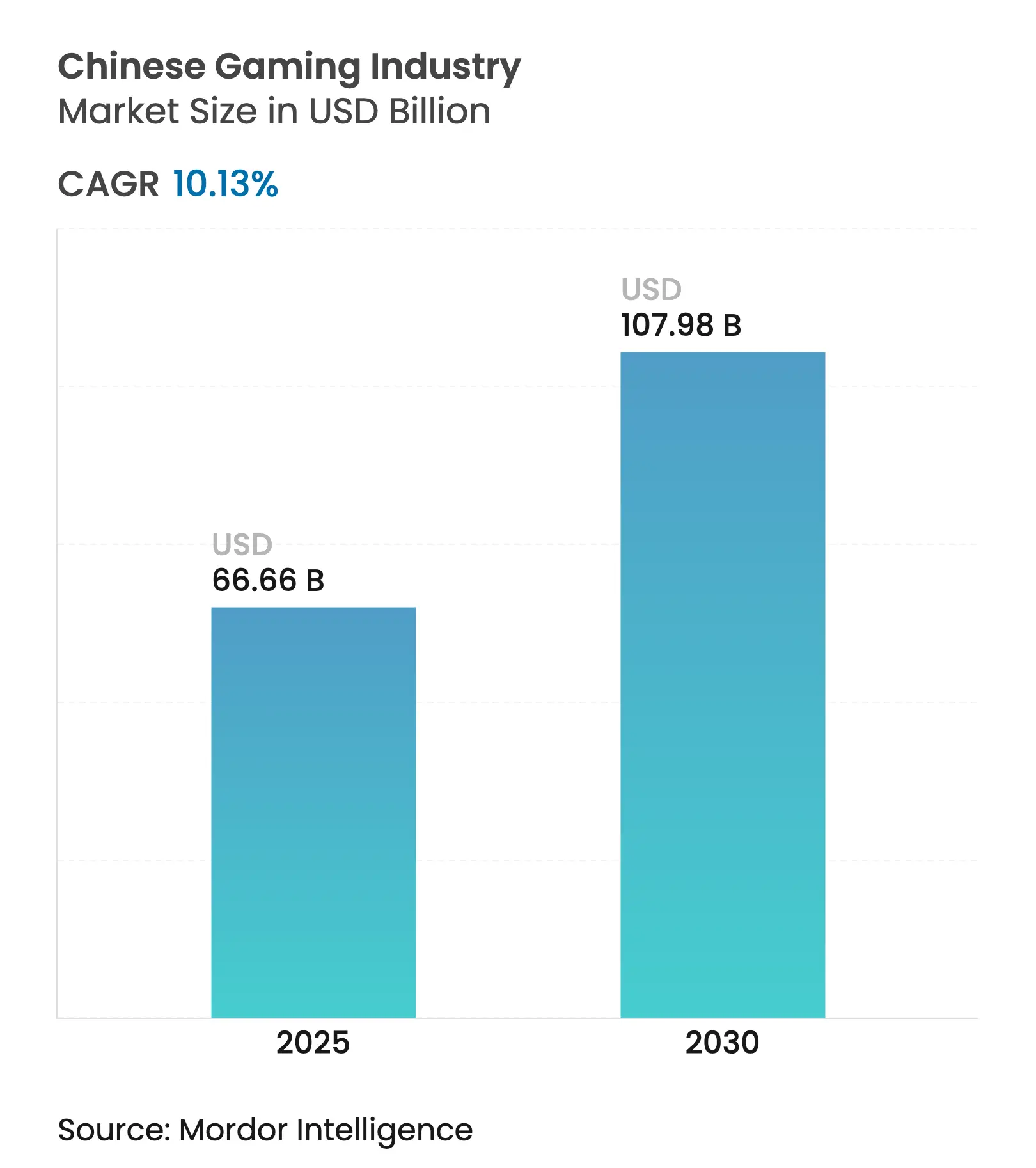
| Market Size (2025) | USD 66.66 Billion |
| Market Size (2030) | USD 107.98 Billion |
| Growth Rate (2025 - 2030) | 10.13 % CAGR |
| Market Concentration | Medium |
Major Players *Disclaimer: Major Players sorted in no particular order. Image © Mordor Intelligence. Reuse requires attribution under CC BY 4.0. |

Chinese Gaming Industry Analysis by Mordor Intelligence
The Chinese gaming market size is estimated at USD 66.66 billion in 2025 and is on course to reach USD 107.98 billion by 2030, advancing at a 10.13% CAGR over 2025-2030. Strong domestic demand, rising 5G penetration and steady regulatory relaxation underpin the expansion. Mobile titles dominate spending, yet console releases are accelerating as consumers seek premium, story-driven experiences. Digital yuan pilots lower payment friction and open fresh monetization routes, while local studios leverage Chinese mythology to build globally resonant intellectual property. Esports sponsorships, especially from fast-moving consumer-goods brands, deepen engagement and diversify revenue. Meanwhile, international sales grow in double digits as leading publishers launch culturally adapted content abroad.
Key Report Takeaways
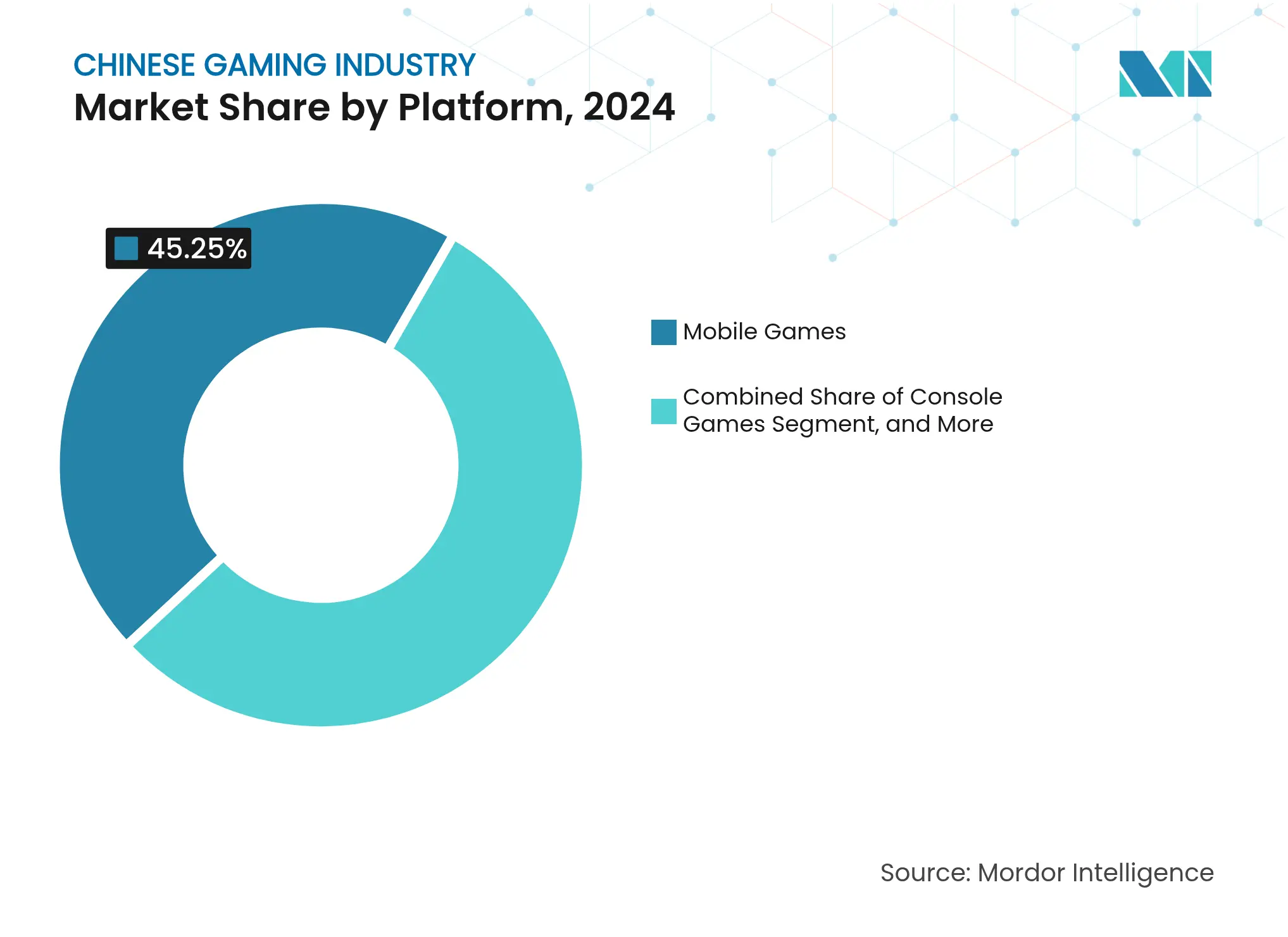
- By gaming platform, mobile titles captured 45.25% revenue share in 2024; cloud gaming is projected to expand at a 12.13% CAGR to 2030 China Audio-Video and Digital Publishing Association.
- By revenue model, free-to-play held 54% of the Chinese gaming market share in 2024, while subscription services show the fastest growth trajectory at 24% CAGR through 2030 J.P. Morgan.
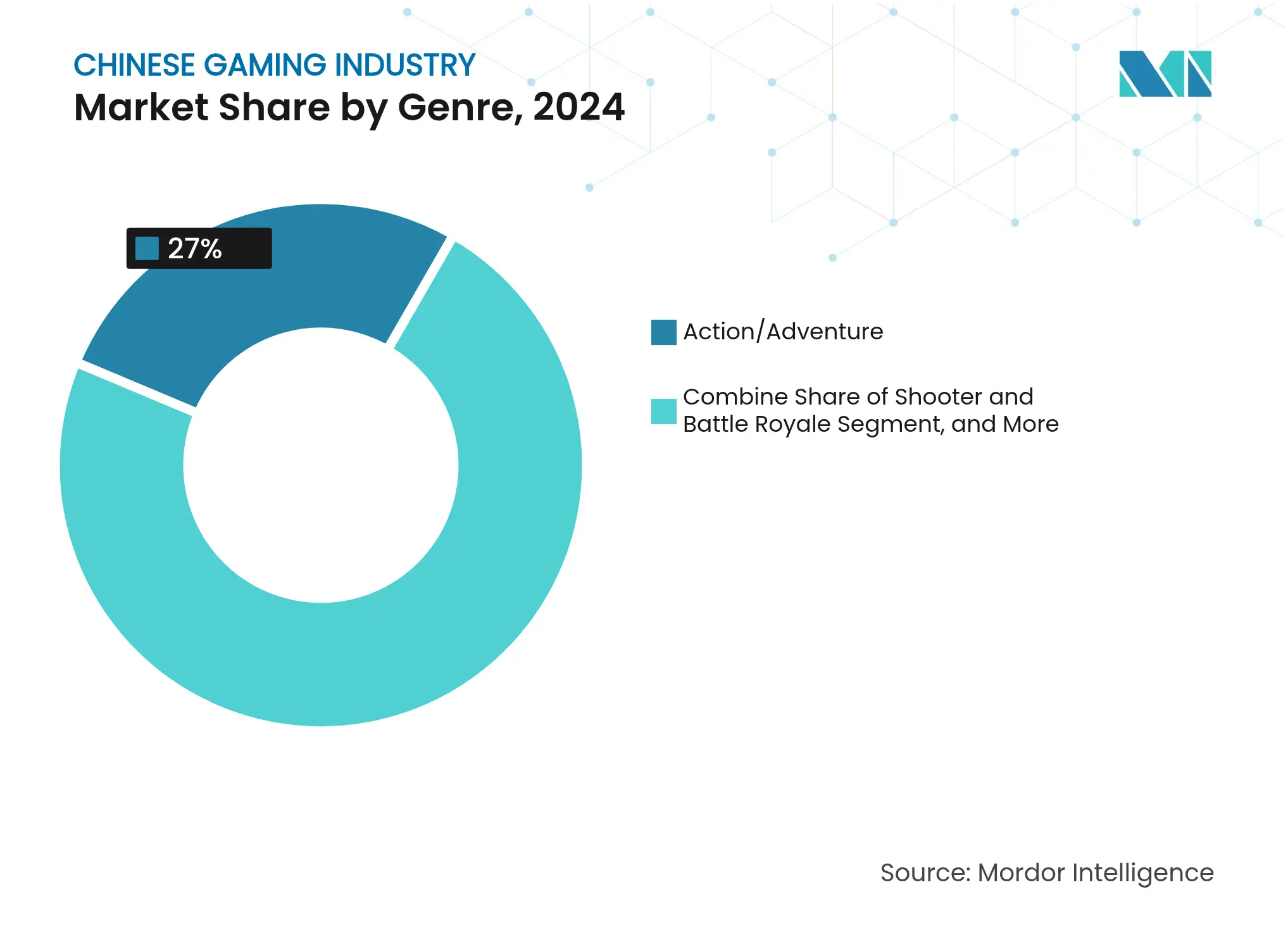
- By genre, action/adventure commanded 27% of the Chinese gaming market size in 2024; the “others” category is forecast to rise at an 18% CAGR between 2025-2030 BBC.
- By player age, the 18-35 cohort led with 38% revenue contribution in 2024; the under-18 segment is set to climb at a 12% CAGR to 2030 despite play-time limits
Chinese Gaming Industry Trends and Insights
Drivers Impact Analysis
| Driver | (~) % Impact on CAGR Forecast | Geographic Relevance | Impact Timeline |
|---|---|---|---|
5G rollout boosting low-latency play | +1.90% | Tier-1 and coastal provinces | Long term (≥ 4 years) |
Esports sponsorship surge | +1.40% | Nationwide, hubs in Shanghai and Chengdu | Medium term (2-4 years) |
Digital Yuan in micro-payments | +1.10% | Mainland China and Hong Kong corridors | Medium term (2-4 years) |
Cultural IP exports | +0.90% | United States, Japan, South Korea | Long term (≥ 4 years) |
Young, tech-savvy demographic | +0.80% | Nationwide, strongest in urban centers | Long term (≥ 4 years) |
| Source: Mordor Intelligence | |||
5G rollout boosting low-latency play
China finished 2024 with more than 800 million 5G connections, representing 45% of all mobile lines. Ultra-low latency now supports competitive shooters and real-time multiplayer titles that previously required PC-grade networks. Operators project that 5G will add USD 260 billion to national GDP by 2030, widening disposable-income pools for game spending. The anticipated quadrupling of mobile data traffic further encourages developers to introduce console-quality graphics on smartphones. Cloud-rendering partnerships, such as miHoYo’s investment in Well-Link Technologies, help overcome device limits and broaden the addressable user base.
Esports sponsorship surge
The domestic esports scene moved into mainstream advertising portfolios after Edward Gaming generated USD 690,000 from Valorant weapon skins alone Esports Advocate. Brands targeting affluent Gen-Z consumers view tournament streams as cost-effective media with high conversion. China’s dedicated VALORANT Champions Tour league, launched in 2024 with ten partner teams, underlines institutional support Esports Insider. Winning the 2024 world championship elevated local teams’ profile internationally, drawing fresh sponsors from beverages, apparel and personal electronics.
Digital Yuan in micro-payments
By mid-2023, cumulative e-CNY transactions topped USD 250 billion Clyde & Co. Partnerships between the People’s Bank of China and platforms such as WeChat Pay remove card-network fees, allowing publishers to keep a larger revenue share. At the 19th Asian Games, athletes used e-CNY wallets to pay for game-related merchandise in seconds, validating ease of use. Cross-border wallet functionality tested in Hong Kong presents a template for seamless tourist spending on Chinese titles.
Cultural IP exports driving overseas adoption
Studios weave folklore, wuxia themes and historical epics into modern mechanics, creating franchises that resonate at home and abroad. Localization teams adapt narrative arcs for regional sensibilities, and partnerships with foreign distributors streamline compliance. Successful releases establish long-tail licensing revenue and strengthen soft-power initiatives.
Restraints Impact Analysis
| Restraint | (~) % Impact on CAGR Forecast | Geographic Relevance | Impact Timeline |
|---|---|---|---|
Quota-based content approvals | −1.6% | Nationwide; higher risk for foreign IP | Short term (≤ 2 years) |
Cloud-service GPU shortages | −1.0% | Peak-season demand nationwide | Short term (≤ 2 years) |
Rising user-acquisition costs | −0.7% | Major ad networks; tier-1 cities | Medium term (2-4 years) |
| Source: Mordor Intelligence | |||
Quota-based content approvals
The National Press and Publication Administration restricts monthly license grants, pushing back release calendars for both domestic and foreign developers. Sudden halts in late 2023 unsettled publisher confidence and disclosed the need for clearer timelines. Foreign studios now depend on local partners to adjust plotlines, rename characters and reveal loot-box odds. The uncertainty trims about 1.6 percentage points from the growth trajectory of the Chinese gaming market.
Cloud-service GPU shortages
Worldwide demand for AI training and cryptocurrency mining tightens supply of ray-tracing chips that power high-end cloud gaming. Service providers report performance dips during Lunar-New-Year holidays and blockbuster launches. The resulting latency spikes can erode player retention, especially for competitive genres, prompting large publishers to co-invest in data-center capacity[2].
Segment Analysis
By Gaming Platform: Mobile Strength Tested by Rising Console Appeal
Mobile software generated CNY 238.2 billion (USD 32.7 billion) in 2024, equal to 45.25% of the Chinese gaming market size. Affordable 5G plans, wide handset ownership, and curated app stores keep engagement high, while live operations tailored to national holidays extend play cycles. Nonetheless, user-acquisition costs continue to rise, prompting studios to experiment with cross-play ecosystems that blend mobile, PC, and console access. Console revenues remain smaller but are projected to move at a 12.13% CAGR through 2030, the fastest of any platform category. Relaxed hardware import duties and cloud streaming lower entry barriers, and households with growing disposable incomes view consoles as shared entertainment centers. The diverging trends suggest that consoles will erode mobile’s dominance, yet the Chinese gaming market will remain mobile-first throughout the decade.
Growth in console adoption is reshaping content strategies. Premium launches now receive simultaneous PC ports to maximize audience, and publishers bundle exclusive skins to reward early adopters. Cloud-based trials let undecided players sample high-fidelity experiences without upfront hardware costs, supporting broader conversion funnels. Retailers in Shanghai and Guangzhou report higher foot traffic for next-generation devices during shopping festivals, confirming a gradual but steady shift toward living-room play.
Note: Segment shares of all individual segments available upon report purchase
By Revenue Model: Subscriptions Challenge Free-to-Play Primacy
Free-to-play titles held 54% of the Chinese gaming market share in 2024 as evergreen hits refined season-pass and cosmetic-item rotations. Yet policymakers’ scrutiny of gacha mechanics and a maturing audience’s appetite for complete experiences encourage alternative billing formats. Subscription passes bundle legacy libraries with day-one releases and offer cross-device cloud saves, delivering perceived value against unpredictable micro-transaction spend. Market estimates signal a mid-twenties CAGR for subscription revenue, well above overall sector growth, positioning it as a credible challenger to ad-supported and free-to-play models.
Publishers also revisit buy-to-play pricing, especially for story-driven action adventures that showcase domestic folklore. Integration with the digital yuan reduces payment friction and supports tiered pricing for deluxe editions, making premium content accessible to a wider income spectrum. Smaller teams experimenting with one-off price tags benefit from predictable cash flow, while larger firms fold subscription perks into loyalty ecosystems spanning video, music and social communities.
By Genre: Action-Adventure Anchors Revenue amid Hybrid Experiments
Action-adventure titles commanded 27% of 2024 spending and remain the flagship genre for cultural storytelling. Developers employ motion-capture cinematics and orchestral scores to elevate production values, reinforcing the genre’s status as an entertainment benchmark. Cross-media tie-ins with film studios and theme-park attractions amplify merchandising potential and lengthen franchise life cycles. Meanwhile, hybrid genres that merge survival, social-deduction and idle mechanics proliferate on super-apps, lowering development risk and reaching tens of millions of casual players. The experimental space diversifies the Chinese gaming market and challenges incumbents to defend screen time with continuous innovation.
Roguelike shooters and party games that fit short mobile sessions gain traction among commuters in metropolitan transit systems. Competitive idle battlers allow asynchronous play, easing time-pressure on older demographics. Developers gather user-behavior data to refine balancing patches and season passes, leveraging analytics to keep retention high. In this climate, action-adventure remains the revenue anchor, but experimental hybrids shape future preferences and technology investment priorities.
Note: Segment shares of all individual segments available upon report purchase
By Player Age Group: Young Adults Lead Spend While Minors Expand Fastest
Players aged 18-35 generated the largest share of revenue in 2024, reflecting rising urban incomes and the normalization of gaming as mainstream leisure. Co-operative experiences, live esports events and influencer communities reinforce loyalty among this cohort. Growth in professional employment also lifts demand for narrative-rich titles that deliver a cinematic break from daily routines.
The under-18 segment records the quickest expansion despite mandated play-time caps. Parents gravitate toward educational sandboxes and creativity tools that align with curriculum goals. Hardware makers embed real-name verification and parental dashboards to comply with regulation while preserving engagement. Over the forecast period, content that matures alongside these young users is likely to compound lifetime value and lift the long-run Chinese gaming market size.
Geography Analysis
Domestic revenue reached USD 44.8 billion in 2024, representing 35.2% of global game spending . Shanghai, Beijing and Guangzhou function as development and esports hubs, hosting flagship conventions that attract hundreds of thousands of attendees. Coastal provinces display higher average spend per user, while interior regions log faster gamer growth as smartphone adoption rises.
International sales climbed 13.4% year-on-year to CNY 18.6 billion (USD 2.55 billion) in 2024 with the United States, Japan and South Korea as top destinations [3]. Localization teams adapt mechanics to foreign age-rating standards, and partnerships with regional publishers help navigate distribution channels. Mythology-based narratives resonate in Asian markets, while super-hero collaborations drive traction in North America.
Government 5G projects lifted network coverage to 83% of the population by end-2023 [1]. Improved rural connectivity narrows urban-rural gameplay gaps and unlocks new demand in western provinces. Local tourism boards leverage game settings for destination marketing, hosting themed festivals that boost regional economies. These geographic dynamics underscore the uneven yet expanding footprint of the Chinese gaming market.

Reports are available across multiple geographies.
Gain in-depth market insights across regions to support informed decisions.
Competitive Landscape
Market Concentration
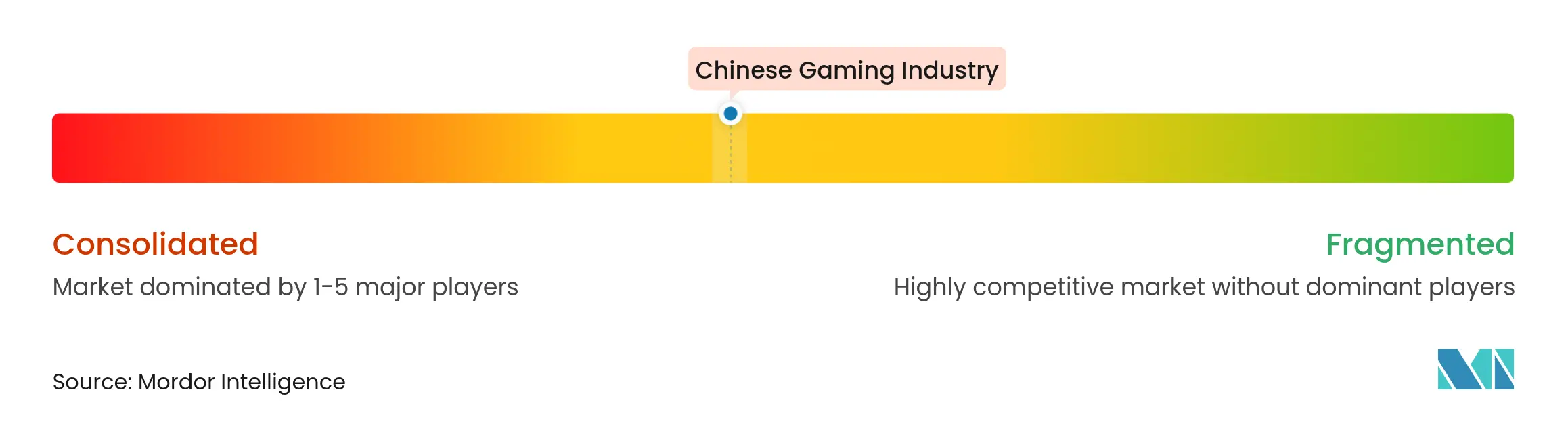
Tencent remains the largest domestic publisher by revenue, followed by NetEase, with both leveraging deep live-service expertise and vast social ecosystems. Tencent’s recent pivot toward controlling stakes in independent studios signals a push for fuller intellectual-property ownership. NetEase invests in traditional-culture motifs to satisfy content guidelines and differentiate its catalog.
Rising studios such as miHoYo and Game Science narrow the gap by focusing on single-title excellence and by integrating cloud technology to manage peak demand. Their success demonstrates that targeted innovation can challenge incumbents even in a scale-dependent arena. Publishers increasingly embed patriotic themes and corporate-social-responsibility features to align with regulators and to build goodwill among parents.
Hardware shortages prompt vertical integration as leading firms co-fund data-center expansions with telecom partners. The resulting technical barriers elevate capital requirements for new entrants, consolidating influence among the top tier. Nevertheless, mid-size studios gain visibility through influencer marketing and niche community engagement, keeping competitive pressure alive within the Chinese gaming market.
Chinese Gaming Market Leaders

*Disclaimer: Major Players sorted in no particular order
Recent Industry Developments
- April 2025: China’s gaming industry booked record 2024 revenue of CNY 325.8 billion (USD 44.8 billion)
- April 2025: China greenlit 127 new games, with Tencent Games' Path of Exile: Ascension among the approvals.
Table of Contents for Chinese Gaming Market Report
1. INTRODUCTION
- 1.1 Study Assumptions and Market Definition
- 1.2 Scope of the Study
2. RESEARCH METHODOLOGY
3. EXECUTIVE SUMMARY
4. MARKET LANDSCAPE
- 4.1 Market Overview
- 4.2 Market Drivers
- 4.2.1 Rapid Expansion of 5G Infrastructure Enabling Low-Latency Mobile Gaming
- 4.2.2 Escalating Esports Sponsorship Spending by Chinese Consumer-Goods Brands
- 4.2.3 Government-Backed Digital Yuan Pilots Powering In-Game Micro-Payments
- 4.2.4 Tier-3 and Below City Broadband Roll-outs Unlocking New Gamer Cohorts
- 4.2.5 Cross-Border IP Licensing Deals Boosting AAA Title Imports
- 4.3 Market Restraints
- 4.3.1 Quota-Based Content Censorship Causing Launch Delays for Foreign Titles
- 4.3.2 Cloud-Service GPU Shortages During Peak Seasons
- 4.3.3 Intensifying Talent Poaching Driving Up Game-Engineer Salaries
- 4.4 Technological Outlook
- 4.5 Porter's Five Forces Analysis
- 4.5.1 Bargaining Power of Suppliers
- 4.5.2 Bargaining Power of Buyers
- 4.5.3 Threat of New Entrants
- 4.5.4 Threat of Substitutes
- 4.5.5 Intensity of Competitive Rivalry
5. MARKET SIZE AND GROWTH FORECASTS (VALUE)
- 5.1 By Gaming Platform
- 5.1.1 Mobile Games
- 5.1.2 PC Games (Downloaded/Box and Browser)
- 5.1.3 Console Games
- 5.1.4 Cloud Gaming
- 5.1.5 VR/AR Gaming
- 5.2 By Revenue Model
- 5.2.1 Free-to-Play (F2P)
- 5.2.2 Pay-to-Play / Premium
- 5.2.3 Subscription and Game-Pass
- 5.3 By Genre
- 5.3.1 Action/Adventure
- 5.3.2 Shooter and Battle Royale
- 5.3.3 Role-Playing (RPG/MMORPG)
- 5.3.4 Sports and Racing
- 5.3.5 Others
- 5.4 By Player Age Group
- 5.4.1 <18 Years
- 5.4.2 18-35 Years
- 5.4.3 36-50 Years
- 5.4.4 >50 Years
6. COMPETITIVE LANDSCAPE
- 6.1 Strategic Developments
- 6.2 Vendor Positioning Analysis
- 6.3 Company Profiles (includes Global level Overview, Market level overview, Core Segments, Financials as available, Strategic Information, Products and Services, and Recent Developments)
- 6.3.1 Tencent Holdings Ltd.
- 6.3.2 NetEase Inc.
- 6.3.3 Shanghai miHoYo Network Technology Co. Ltd.
- 6.3.4 Perfect World Co. Ltd.
- 6.3.5 37 Interactive Entertainment
- 6.3.6 Lilith Games
- 6.3.7 Kingsoft Corporation (Seasun)
- 6.3.8 Giant Network Group Co. Ltd.
- 6.3.9 Beijing Kunlun Tech Co. Ltd.
- 6.3.10 Shanda Games
- 6.3.11 Yoozoo Games
- 6.3.12 FunPlus International
- 6.3.13 TapTap (XD Inc.)
- 6.3.14 CMGE Technology Group Ltd.
- 6.3.15 iDreamSky Technology Holdings
- 6.3.16 G-bits Network Technology
- 6.3.17 Shanghai Moonton Technology
- 6.3.18 Nuverse (ByteDance)
- 6.3.19 Bilibili Inc.
- 6.3.20 NetDragon Websoft Holdings
7. MARKET OPPORTUNITIES AND FUTURE OUTLOOK
- 7.1 White-space and Unmet-Need Assessment
Chinese Gaming Industry Report Scope
Chinese gaming is defined as playing electronic games conducted through multiple means, such as computers, mobile phones, consoles, or other mediums altogether. There is an increasing prevalence of high-speed internet connections, especially in emerging economies, making online gaming practical for more people in recent years. The research scope encompasses segmentation by gaming types, such as consoles, PC browsers, and mobile games.
The market sizes and forecasts are provided in terms of value (USD million) for all the above segments.
| By Gaming Platform | Mobile Games |
| PC Games (Downloaded/Box and Browser) | |
| Console Games | |
| Cloud Gaming | |
| VR/AR Gaming | |
| By Revenue Model | Free-to-Play (F2P) |
| Pay-to-Play / Premium | |
| Subscription and Game-Pass | |
| By Genre | Action/Adventure |
| Shooter and Battle Royale | |
| Role-Playing (RPG/MMORPG) | |
| Sports and Racing | |
| Others | |
| By Player Age Group | <18 Years |
| 18-35 Years | |
| 36-50 Years | |
| >50 Years |
