
Market Overview
| Study Period | 2021 - 2031 |
|---|---|
| Forecast Data Period | 2026 - 2031 |
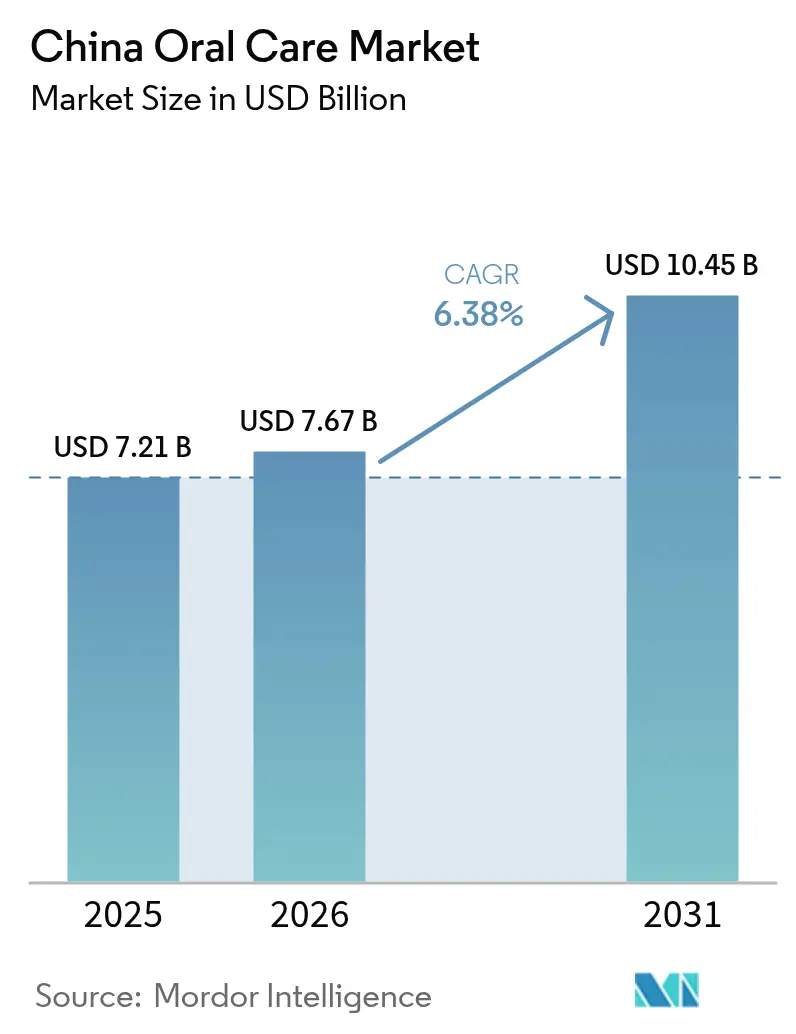
| Base Year Market Size (2025) | USD 7.21 Billion |
| Market Size (2026) | USD 7.67 Billion |
| Market Size (2031) | USD 10.45 Billion |
| Growth Rate (2026 - 2031) | 6.38 % |
| Market Concentration | Medium |
Major Players
*Disclaimer: Major Players sorted in no particular order Image © Mordor Intelligence. Reuse requires attribution under CC BY 4.0. |
|
China Oral Care Market Analysis by Mordor Intelligence
The China oral care market size was valued at USD 7.21 billion in 2025 and estimated to grow from USD 7.67 billion in 2026 to reach USD 10.45 billion by 2031, at a CAGR of 6.38% during the forecast period (2026-2031). Rapid premiumization among Gen-Z consumers, nationwide oral-health education under Healthy China 2030, and tighter CSAR product‐quality standards are the primary forces sustaining growth. Digital commerce is widening access for niche brands, while functional and probiotic formulations are broadening category boundaries. Manufacturers that combine ingredient transparency with omnichannel reach are capturing disproportionate gains, even as raw-material cost volatility and evolving consumer skepticism toward traditional Chinese medicine (TCM)[1]China State Administration for Market Regulation, “Toothpaste Notification Requirements,” https://www.samr.gov.cn/ temper near-term margins. Competitive intensity is therefore shifting toward science-backed claims, agile supply chains, and value-added packaging aligned with sustainability expectations.
Key Report Takeaways
- By product type, toothpaste led with 49.42% revenue share in 2025; mouthwashes and rinses are advancing at a 6.52% CAGR to 2031.
- By ingredient, conventional formulations held 89.45% of the China oral care market share in 2025; natural and organic variants are projected to expand at a 6.88% CAGR through 2031.
- By end user, the adult segment accounted for 85.62% share of the China oral care market size in 2025; children’s segment is projected to grow at a 7.38% CAGR through 2031.
- By distribution channel, supermarkets and hypermarkets captured 35.72% share in 2025; online retail stores are forecast to expand at a 7.12% CAGR between 2026 and 2031.
Note: Market size and forecast figures in this report are generated using Mordor Intelligence’s proprietary estimation framework, updated with the latest available data and insights as of 2026.
China Oral Care Market Trends and Insights
Drivers Impact Analysis*
| Driver | % Impact on CAGR Forecast | Geographic Relevance | Impact Timeline |
|---|---|---|---|
| Premiumisation wave led by Gen-Z consumers | +0.9% | Tier-1 and Tier-2 cities, with spillover to emerging markets | Medium term (2-4 years) |
| Government-led oral-health education campaigns (Healthy China 2030) | +0.7% | National, with concentrated impact in rural and underserved regions | Long term (≥ 4 years) |
| Regulatory shift: CSAR toothpaste notification tightening quality standards | +0.8% | National, with immediate compliance requirements for all manufacturers | Short term (≤ 2 years) |
| Functional & probiotic formulations backed by local R&D | +0.6% | Urban centers with high disposable income and health consciousness | Medium term (2-4 years) |
| Water-scarcity push for water-free chewable & mousse formats | +0.5% | Northern China and water-stressed regions, expanding to sustainability-conscious urban markets | Medium term (2-4 years) |
| Rapid growth of cross-border social-commerce platforms boosting niche brands | +0.7% | National, with higher penetration in Tier-1 cities and digitally native demographics | Short term (≤ 2 years) |
| Source: Mordor Intelligence | |||


Premiumisation Wave Led by Gen-Z Consumers
Gen-Z consumers are reshaping China's oral care landscape through their willingness to pay premium prices for products that align with their values and aesthetic preferences. This demographic shift extends beyond traditional oral hygiene to encompass skinification trends, where oral care products incorporate beauty ingredients like niacinamide and botanical extracts previously reserved for cosmetics. The premiumization wave has enabled brands to command higher margins while investing in sophisticated packaging, sustainable formulations, and personalized product offerings that resonate with digitally native consumers who research ingredients extensively before purchasing.
Government-Led Oral Health Education Campaigns (Healthy China 2030)
The Healthy China 2030 initiative has transformed oral health from an individual concern into a systematic public health priority, with government-sponsored education campaigns reaching rural populations previously underserved by preventive dental care messaging[2]China State Administration for Market Regulation. "Toothpaste Notification Requirements." Accessed September 28, 2025. https://www.samr.gov.cn/. This policy framework has established oral health metrics within broader healthcare quality indicators, incentivizing local governments to invest in community education programs and school-based preventive initiatives. The campaign's emphasis on early intervention and regular dental checkups has created sustained demand for daily oral care products, particularly in regions where traditional attitudes toward dental care were reactive rather than preventive.
Regulatory Shift: CSAR Toothpaste Notification Tightening Quality Standards
The China State Administration for Market Regulation's enhanced toothpaste notification requirements have elevated industry quality standards while creating competitive advantages for manufacturers with robust compliance capabilities. These regulations mandate detailed ingredient disclosure, efficacy substantiation, and safety testing protocols that exceed previous requirements, effectively raising barriers to entry for smaller manufacturers while validating the quality positioning of established brands[3]Hui Ling dang, New Zealandhttps://www.nutraingredients-asia.com/Article/2025/07/03/new-zealands-blis-technologies-looks-to-expand-sales-of-oral-probiotics-in-china/?utm_source=RSS_Feed&utm_medium=RSS&utm_campaign=RSS. The regulatory shift has accelerated consolidation among domestic manufacturers who lack the technical and financial resources to meet enhanced compliance standards, while simultaneously creating opportunities for international brands with proven regulatory expertise.
Functional & Probiotic Formulations Backed by Local R&D
Chinese manufacturers are investing heavily in functional oral care formulations that incorporate probiotics, traditional Chinese medicine extracts, and targeted therapeutic ingredients supported by domestic research institutions. BLIS Technologies' expansion into China with clinically-validated oral probiotic strains BLIS K12 and BLIS M18 exemplifies the market's receptivity to science-backed functional ingredients that address specific oral health concerns beyond basic cleaning. This trend reflects consumer sophistication in ingredient evaluation and willingness to invest in products that deliver measurable health benefits rather than generic oral hygiene maintenance.
Restraints Impact Analysis*
| Restraint | % Impact on CAGR Forecast | Geographic Relevance | Impact Timeline |
|---|---|---|---|
| Rising raw-material costs (sorbitol, packaging resin) | -0.4% | National, with greater impact on domestic manufacturers with limited pricing power | Short term (≤ 2 years) |
| Stricter fluoride & whitening-agent limits under CSAR | -0.3% | National, affecting all manufacturers with fluoride-based formulations | Short term (≤ 2 years) |
| Growing consumer scepticism of TCM efficacy claims | -0.3% | National, with concentrated impact on heritage brands positioning on traditional formulations | Medium term (2-4 years) |
| Proliferation of copy-cat brands causing price erosion and IP disputes | -0.2% | National, with higher impact in online channels and lower-tier cities | Medium term (2-4 years) |
| Source: Mordor Intelligence | |||
Stricter Fluoride & Whitening-Agent Limits Under CSAR
Enhanced regulatory oversight under CSAR's toothpaste notification system has imposed stricter limits on fluoride concentrations and whitening agents, forcing manufacturers to reformulate products while maintaining efficacy claims. These regulatory changes reflect growing consumer safety concerns and alignment with international standards, yet create compliance costs and potential performance trade-offs that impact product positioning and pricing strategies. The fluoride limits particularly affect children's toothpaste formulations, where manufacturers must balance safety requirements with cavity prevention efficacy, while whitening agent restrictions challenge brands that built market presence on cosmetic benefits rather than therapeutic outcomes.
Proliferation of Copy-Cat Brands Causing Price Erosion and IP Disputes
The proliferation of copycat brands leveraging similar packaging, ingredient claims, and brand positioning has intensified price competition while creating intellectual property disputes that drain resources from innovation and marketing investments. This phenomenon is particularly pronounced in online marketplaces where enforcement of trademark and design patents remains challenging, enabling low-cost manufacturers to capitalize on established brands' market development efforts. The copycat trend undermines brand differentiation and premium positioning strategies, forcing legitimate manufacturers to invest heavily in legal protection and consumer education while competing against products that offer similar visual appeal at significantly lower prices, ultimately compressing industry margins and reducing incentives for genuine innovation.
*Our forecasts treat driver/restraint impacts as directional, not additive. The impact forecasts reflect baseline growth, mix effects, and variable interactions.
Segment Analysis
By Product Type: Toothpaste Dominance Faces Diversification Pressure
Toothpaste maintains commanding market leadership with 49.42% share in 2025, yet mouthwashes and rinses are emerging as the fastest-growing segment at 6.52% CAGR through 2031, reflecting consumer adoption of comprehensive oral care routines beyond basic brushing. This diversification trend is driven by increased awareness of gum health, bad breath concerns, and the convenience of portable oral care solutions for busy urban lifestyles. Toothbrushes represent a stable but mature segment focused on electric toothbrush adoption and premium manual brush innovations, while the "Others" category encompasses emerging formats like oral care tablets, foam formulations, and specialized products for specific conditions.
The product type evolution reflects broader consumer sophistication in oral health management, with mouthwashes gaining traction as complementary products rather than occasional-use items. Lion Corporation's recent launch of Systema SP-T Mouthrinse with dual antiseptics (cetylpyridinium chloride and isopropyl methylphenol) exemplifies the scientific advancement driving category growth. Water-scarcity concerns are also spurring innovation in water-free formats, including chewable tablets and mousse formulations that appeal to environmentally conscious consumers while addressing practical usage constraints in water-stressed regions.



By Ingredient: Natural Formulations Challenge Conventional Dominance
Conventional formulations retain overwhelming market dominance with 89.45% share in 2025, yet natural and organic variants are accelerating at 6.88% CAGR through 2031, driven by Gen-Z consumer preferences for clean-label products and sustainability concerns. This growth trajectory reflects a fundamental shift in consumer values, where ingredient transparency and environmental impact increasingly influence purchasing decisions alongside traditional efficacy considerations. The natural segment encompasses botanical extracts, mineral-based formulations, and probiotic ingredients that appeal to health-conscious consumers seeking alternatives to synthetic chemicals.
The ingredient landscape is experiencing innovation pressure from both directions, with conventional formulations incorporating more sophisticated active ingredients while natural products enhance their efficacy through advanced extraction techniques and synergistic combinations. CEELIKE's 5% hydroxyapatite toothpaste tablets demonstrate how natural mineral ingredients can deliver clinical benefits traditionally associated with synthetic compounds. The regulatory environment under CSAR's enhanced notification requirements favors manufacturers who can substantiate ingredient claims through clinical evidence, regardless of whether formulations are conventional or natural, creating opportunities for science-backed natural products while challenging unsubstantiated traditional claims.
By End User: Adult Segment Stability Contrasts with Children's Growth Momentum
The adult segment commands 85.62% market share in 2025, reflecting the demographic reality of China's consumer base and the established oral care habits of working-age populations. However, the children's segment demonstrates the highest growth potential at 7.38% CAGR through 2031, driven by parental investment in preventive oral care and government education initiatives that emphasize early intervention. This growth differential reflects changing attitudes toward pediatric oral health, where parents increasingly view children's oral care as a long-term health investment rather than a basic hygiene requirement.
Children's segment growth is supported by product innovation tailored to younger users, including flavor varieties, educational packaging, and formulations that address specific pediatric oral health concerns such as cavity prevention during tooth development. The segment benefits from the Healthy China 2030 initiative's emphasis on school-based oral health education, which has elevated parental awareness of preventive care importance. Adult segment stability masks internal dynamics, including premiumization trends among urban professionals and the emergence of specialized products for aging-related oral health concerns such as gum recession and tooth sensitivity, creating opportunities for targeted product development within the larger demographic category.

By Distribution Channel: Digital Transformation Accelerates Omnichannel Evolution
Supermarkets and hypermarkets maintain 35.72% market share in 2025, leveraging their established consumer relationships and product discovery advantages, yet online retail channels are growing at 7.12% CAGR through 2031 as digital-native consumers embrace e-commerce convenience and product variety. This channel evolution reflects broader retail transformation in China, where consumers increasingly expect seamless omnichannel experiences that combine online research with flexible purchasing and delivery options. Traditional retail channels remain important for impulse purchases and product trial, while online platforms excel in product education, customer reviews, and subscription-based repeat purchases.
The distribution landscape is being reshaped by cross-border e-commerce platforms like Tmall Global, which enable international brands to enter China without establishing local operations, and social commerce platforms like Douyin Mall, which integrate influencer marketing with direct purchasing capabilities. Convenience and grocery stores serve as critical touchpoints for daily-use products, while pharmacies and drug stores are gaining importance as consumers seek professional guidance for specialized oral health concerns. The channel diversification creates opportunities for brands to optimize their distribution strategies based on target demographics and product positioning, with premium brands leveraging online channels for brand storytelling while mass-market products focus on traditional retail accessibility.
Geography Analysis
Tier-1 cities such as Beijing, Shanghai, Guangzhou, and Shenzhen anchor premium demand through higher disposable incomes and early-adopter mindsets. Imports and probiotic innovations first debut here before cascading to Tier-2 locales like Hangzhou and Chengdu, where aspirational consumption catches up fast. Rising property and childcare costs nevertheless temper discretionary spend, prompting value-rich mid-tier SKUs alongside luxury lines. Central and western provinces present volume upside as Healthy China 2030 funds rural clinics and oral-health education.
With baseline penetration lower, each point of household adoption adds significant tonnage to the China oral care market. Local brands exploit logistical proximity and culturally aligned flavors, whereas multinationals rely on e-commerce to bypass distribution gaps. Supply hubs such as Jiangsu’s Hangji township manufacture one-third of global toothbrush output. Proximity to resin back-integration and export ports reduces landed costs, enhancing international competitiveness. Compliance enforcement varies, driving regional variability in CSAR approval timelines. Firms that master province-specific nuances scale more efficiently across China’s diverse landscape.
Regulatory Landscape
China regulates toothpaste under the Provisions for Toothpaste Regulation (SAMR Decree No. 71), effective since December 1, 2023, with oversight under the National Medical Products Administration (NMPA) framework aligned to CSAR. The regime places requirements on product filing (notification), ingredient transparency, safety assessment, and efficacy substantiation for claims. It also requires manufacturers to operate a quality management system consistent with GMP for Cosmetics.
Regulatory activity continued through 2025-2026, with policy direction moving toward more standardized safety and labeling requirements, including pilots for electronic labeling introduced in late 2025 and ongoing consultation and revision cycles for mandatory national (GB) standards impacting toothpaste ingredients and safety. In January 2026, the China Oral Care Industry Association (COCIA) released T/COCIA 6-2026 covering technical requirements for functional mouthwash-type products alongside mandatory national standards.
Competitive Landscape
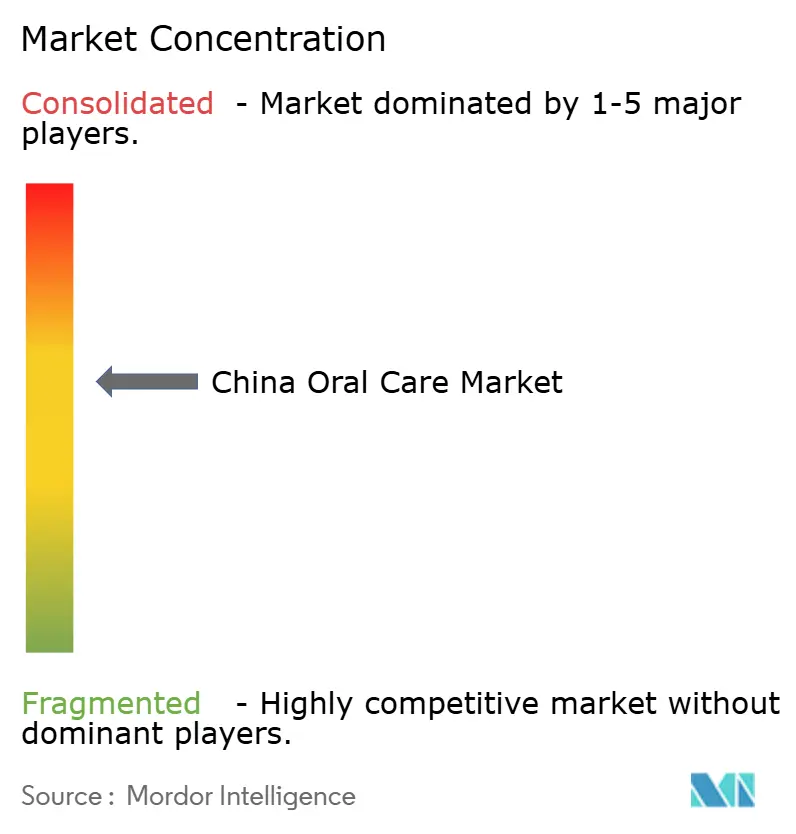
The China oral care market registers a concentration score of 6, indicating moderate consolidation. Procter & Gamble leads through Crest and Oral-B, blending global formulation expertise with local flavor variants. Yunnan Baiyao leverages TCM heritage but now augments claims with clinical trials to counter skepticism. Haleon recently assumed full ownership of its Chinese consumer healthcare venture to tighten decision cycles and diversify away from joint-venture constraints.
Strategic priorities pivot from price to science and speed. Lion Corporation’s Systema SP-T range pushes glycyrrhizinic acid dipotassium salt for microbiome balance, distributed through dental clinics to validate professional endorsement. Usmile scales electric brushes via gamified loyalty apps, while Philips Sonicare tailors brush-head bundles to local plaque profiles. Cross-border social commerce offers insurgent brands immediate exposure without brick-and-mortar investment. Yet CSAR enforcement curbs dubious claims, raising entry thresholds. Competitive advantage thus rests on robust R&D, agile regulatory teams, and omnichannel storytelling that resonates with diverse Chinese subcultures.
China Oral Care Industry Leaders
-
Procter & Gamble
-
Yunnan Baiyao Grou
-
Colgate-Palmolive
-
Hawley & Hazel (Darlie)
-
Guangzhou Weimeizi
- *Disclaimer: Major Players sorted in no particular order

Market Opportunities and Future Outlook
Compliance-led premiumization is creating whitespace for brands that can turn CSAR-aligned filing discipline into credible, science-backed positioning, particularly in categories where safety and claim substantiation matter most, including kids toothpaste, whitening, and functional or probiotic adjuncts such as mouthwashes and rinses.
Local manufacturing and supply chain localization are becoming a more visible competitive lever as multinationals increase China-based capacity to tailor formulations and packaging to local preferences and expand addressable demand beyond tier-1 cities. In March 2026, Haleon announced a GBP 65 million investment to build a new oral health manufacturing facility in the Lingang Special Area of Shanghai, signaling continued capital deployment behind oral-care production and portfolio expansion inside China. In parallel, NMPA launched a public consultation in March 2026 for the first mandatory national safety standard, General Technical Requirements for Toothpaste Safety (consultation ending May 29, 2026), which centers near-term opportunity on compliant product renovation, pediatric-safe design, and stronger QA systems. Smaller, less-resourced brands face greater difficulty matching that compliance depth.
Recent Industry Developments
- March 2026: Haleon announced a GBP 65 million investment to build a new oral health manufacturing facility in the Lingang Special Area of Shanghai, signaling continued capital deployment behind oral-care production and portfolio expansion inside China. The project expands domestic manufacturing capability and supports portfolio localization to meet local demand, aligning with the broader move toward local-capacity strategies.
- December 2025: China initiated a pilot program for cosmetic electronic labels that also covers toothpaste under the CSAR-aligned management approach. This accelerates digital-ready packaging and traceability, benefiting brands that can incorporate regulatory content updates and compliance documentation into omnichannel retail workflows.
- May 2024: The National Medical Products Administration (NMPA) published updated regulatory communication clarifying implementation under the toothpaste regulation framework effective since December 2023. The guidance reinforces the market transition toward filing discipline, efficacy substantiation for claims, and tighter quality management expectations across domestic and imported brands.


Research Methodology Framework and Report Scope
Market Definition and Coverage
This market covers the value of consumer oral care products sold in China that are used for everyday mouth hygiene, including cleaning, breath care, and basic prevention of common dental issues.
Scope exclusions: Dental clinic procedures and professional services, along with prescription-only therapeutic treatments, are excluded from this market sizing.
Segmentation Overview
-
By Product Type
- Toothpaste
- Mouthwashes and Rinses
- Toothbrushes
- Others
-
By Ingredient
- Conventional
- Natural/Organic
-
By End User
- Kids/Children
- Adult
-
By Distribution Channel
- Supermarkets / Hypermarkets
- Convenience / Grocery Stores
- Pharmacies and Drug Stores
- Online Retail Stores
- Other Channels
Data Sources, Market Sizing, and Validation
Desk Research
Desk research was used to set the market context and create a clean fact base before the model was built. We reviewed public sources such as China customs trade statistics for relevant product groupings, National Bureau of Statistics of China releases on consumer spending, and health-related publications from the National Health Commission.
To keep assumptions practical, we also checked trade association and standards information (for example, oral health and consumer goods associations), peer-reviewed dental public health articles, and brand-owner disclosures such as annual reports and investor presentations. In addition, we used paid subscriptions focused on company financials and intelligence, patent databases, and shipment-level import and export records selectively to fill gaps where public reporting is thin. These desk research sources are illustrative, and many other public materials were also reviewed for data collection, validation, and clarification.
Primary Interviews and Surveys
Primary work was used to pressure-test the sizing logic against real market behavior, especially where public data does not clearly show channel mix and pricing. We spoke with manufacturers, distributors, retailers, dental professionals, and category specialists across China to confirm product coverage, typical price ladders, and the pace of premiumization in key formats. The respondent input was then used to cross-check desk inputs, close information gaps, and align the final numbers to a consistent set of assumptions.
Distribution of primary research fieldwork respondents
| Company type | Respondent position |
|---|---|
| Top tier: 37% | CXOs: 14% |
| Mid tier: 46% | Functional/Unit leaders: 41% |
| Smaller Players: 17% | Managers: 45% |
Market-Sizing & Forecasting
Sizing starts with a top-down build where consumer spending and category splits are reconstructed into an oral care demand pool for China, and then mapped into products sold through key retail and online channels. Once the first cut is formed, we corroborate it using selective bottom-up approximations, such as sampled average selling prices multiplied by observed volume ranges and channel checks, which helps us adjust totals when a single input appears overstated.
The model uses a small set of repeatable inputs that can be validated, including population and urbanization trends, oral care penetration and usage frequency, online share within personal care retail, observed pricing tiers and mix shifts (mass to premium), and promotional intensity that can temporarily change value sales. For forecasting, we use scenario analysis supported by simple time-series smoothing on the main drivers, and then refine the outlook using expert expectations on premiumization, product innovation, and channel expansion. Where bottom-up checks are incomplete for smaller categories, gaps are handled through ratio-based allocation from better-tracked product groups and rechecked through interviews before finalizing.
Data Validation & Update Cycle
Outputs are validated through triangulation across multiple signals, so a single data point does not control the final market size. We run variance checks across years, review price and volume movements for consistency with known retail and trade patterns, and flag any jumps that do not match channel or macro indicators.
Before sign-off, the model and assumptions go through multi-step analyst reviews, and respondents are re-contacted when a key input shifts or when conflicting inputs appear. Reports are refreshed annually, with interim updates triggered by material events such as major regulation changes, sudden demand shocks, or meaningful channel disruptions. Right before delivery, a final review pass is completed so clients receive the latest updated view.
Mordor Intelligence's China Oral Care Market Size Measured Against Other Published Estimates
Published market values for China oral care can differ quite a lot because firms do not always count the same product basket, they may use different base years, and they often treat pricing and channel mix in different ways. Differences also show up when one estimate is updated more recently than another, especially in categories where premium products and online sales shift quickly.
Dental clinic services sit outside Mordor Intelligence's scope, which can create a visible spread versus estimates that blend retail oral care with professional dental spending or broader oral health categories. Other common gap drivers include converting local currency to USD using different timing, using aggressive or conservative price progression, and applying national averages that do not reflect the real split between offline retail and e-commerce in China.
Benchmark comparison
| Source | Market Size | Gaps in Research Methodology |
|---|---|---|
| Mordor Intelligence | USD 7.67 B (2026) | |
| Industry Publisher A | USD 7.95 B (2024) | Uses an earlier base year and a longer horizon, and its coverage language is broad enough that some readers may interpret it as including adjacent oral health spending, which can shift totals versus a retail-product-only view. |
| Research Group B | USD 3.85 B (2024) | Looks materially lower, which is often linked to a narrower counted basket (for example, focusing on a subset of core products) and/or using a different channel capture approach that can understate online value in fast-growing categories. |
Taken together, the spread mainly comes from what gets counted as oral care and how pricing and channel weights are carried forward across years. Our approach keeps the size traceable to clear demand indicators, realistic price ladders, and checks that are repeatable with public context and expert validation.


Key Questions Answered in the Report
What is the current value of the China oral care market?
The China oral care market is valued at USD 7.67 billion in 2026 and is projected to reach USD 10.45 billion by 2031.
Which product category is growing fastest in China?
Mouthwashes and rinses are the fastest, expanding at a 6.52% CAGR through 2031.
How will Healthy China 2030 affect oral-care demand?
Government education campaigns are lifting preventive awareness, driving consistent upticks in daily product usage, especially in rural regions.
Which distribution channel offers the highest growth potential?
Online retail platforms are growing at a 7.12% CAGR as livestreaming and cross-border e-commerce widen brand access.
Page last updated on:





