
Market Overview
| Study Period | 2020 - 2031 |
|---|---|
| Forecast Data Period | 2026 - 2031 |
| Base Year Market Size (2025) | USD 84.55 Billion |
| Market Size (2026) | USD 87.55 Billion |
| Market Size (2031) | USD 104.23 Billion |
| Growth Rate (2026 - 2031) | 3.55 % |
| Market Concentration | Medium |
Major Players *Disclaimer: Major Players sorted in no particular order Image © Mordor Intelligence. Reuse requires attribution under CC BY 4.0. | |
China Major Home Appliances Market Analysis by Mordor Intelligence
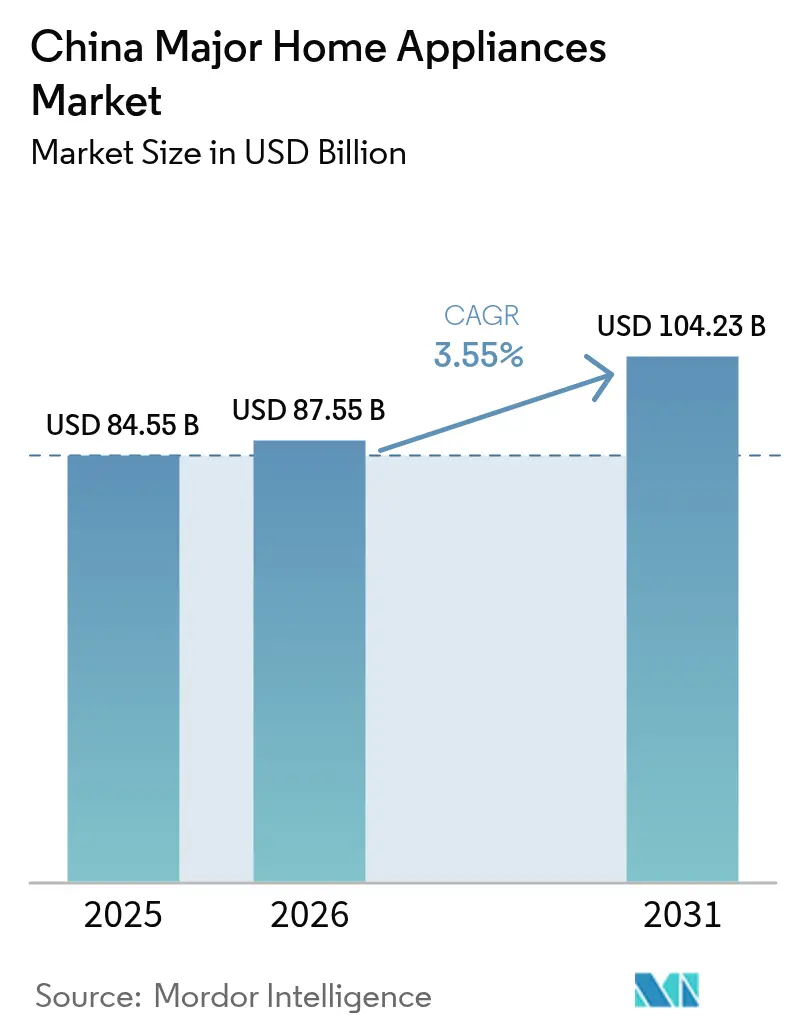
China major home appliances market size in 2026 is estimated at USD 87.55 billion, growing from 2025 value of USD 84.55 billion with 2031 projections showing USD 104.23 billion, growing at 3.55% CAGR over 2026-2031. Rising middle-class spending power, policy-led replacement schemes, and rapid uptake of smart living solutions sustain demand even as the industry enters a mature phase. Government trade-in incentives introduced in 2024 lifted refrigerator retail volume by 5.4% and value by 8.5%, signaling the immediate impact of consumption subsidies[1]. Domestic manufacturers now dominate sales, helped by extensive local distribution networks and cost advantages, while international brands defend niche premium positions. Online channels remain an engine of structural change because digital discovery, price transparency, and livestream sales keep shifting consumer journeys away from legacy retail formats. At the same time, raw-material inflation and decarbonisation investments compress margins, forcing producers to automate plants, redesign supply chains, and move up the value curve through AI-enabled features and ecosystem services.
Key Report Takeaways
- By product category, refrigerators led with 27.50% revenue share of the China major home appliances market in 2025; dishwashers are projected to deliver the fastest 4.05% CAGR to 2031.
- By region, East China accounted for a 33.10% share of the China major home appliances market in 2025, while South Central China is forecast to expand at a 3.7% CAGR through 2031.
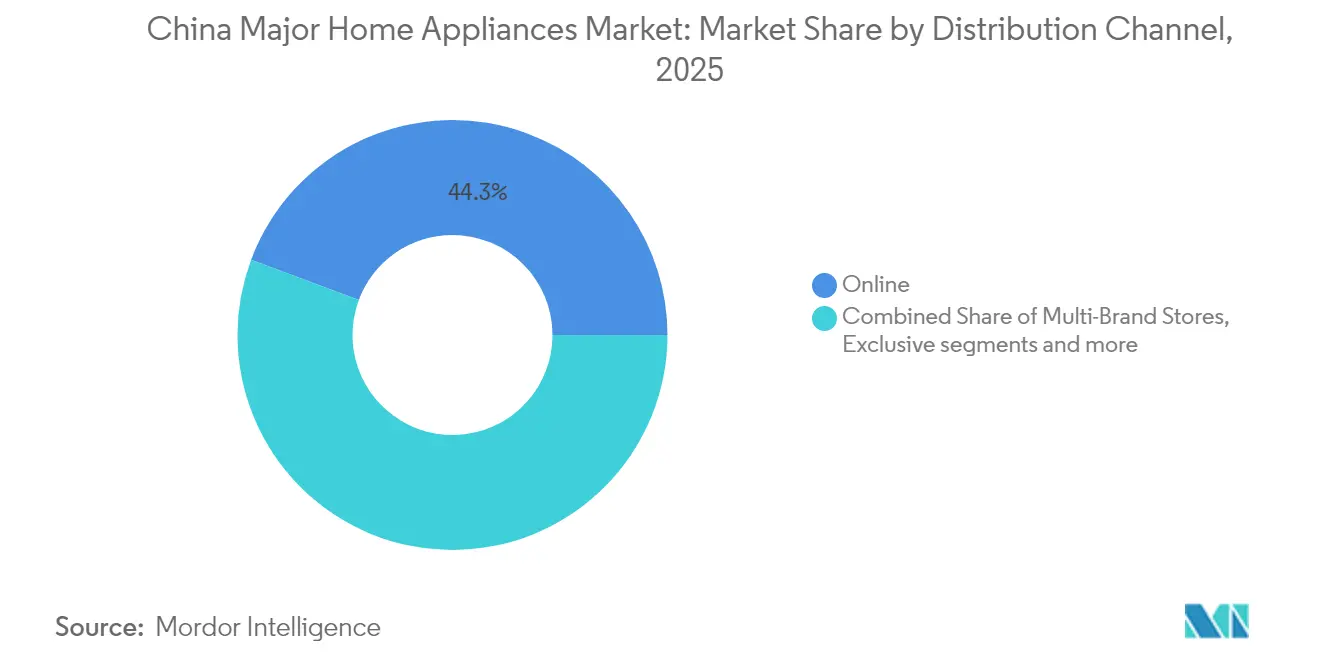
- By distribution channel, online platforms captured 44.30% of the China major home appliances market share in 2025 and are advancing at a 4.75% CAGR to 2031.
Note: Market size and forecast figures in this report are generated using Mordor Intelligence’s proprietary estimation framework, updated with the latest available data and insights as of 2026.
China Major Home Appliances Market Trends and Insights
Drivers Impact Analysis*
| Driver | (~) % Impact on CAGR Forecast | Geographic Relevance | Impact Timeline |
|---|---|---|---|
| Rising disposable income & urbanization | +0.8% | National, stronger in Tier-2 & 3 cities | Medium term (2-4 years) |
| Rapid adoption of smart/IoT-enabled appliances | +1.2% | East China & major urban centres, expanding to lower tiers | Long term (≥ 4 years) |
| Government incentives for green appliances | +0.6% | National, focus in developed regions | Short term (≤ 2 years) |
| Rising housing completions & renovations | +0.4% | East China, South Central China, metro areas | Medium term (2-4 years) |
| Strong e-commerce & omnichannel distribution | +0.7% | National, higher penetration in urban areas | Short term (≤ 2 years) |
| Source: Mordor Intelligence | |||
Rising Disposable Income and Urbanization
Per-capita disposable income climbed to CNY 41,314 (USD 5,700) in 2024, up 5.3% year on year, with rural growth outpacing urban for a second consecutive year. That convergence opens fresh pools of first-time buyers in lower-tier cities where appliance ownership trails metropolitan averages. Manufacturers respond by widening distribution footprints and tailoring entry-level smart models to local spending thresholds. Rising housing completions in emerging metropolitan clusters further stimulate purchases as new homeowners prioritize durable goods, especially air conditioners and refrigerators. The combination of income growth and accelerated urban migration, therefore, underpins structural demand across the China major home appliances market.
Rapid Adoption of Smart and IoT-Enabled Appliances
Smart functionality has shifted from novelty to a core purchase criterion. Haier’s U+ Smart Life Platform connects refrigerators, washers, ovens, and air conditioners into scene-based routines and has recorded more than 20 million active users by 2023, with most adopters in Gen Z and millennial urban households [2]. Generative AI now powers predictive maintenance, adaptive temperature zones, and personalised usage analytics that widen value beyond basic connectivity. Younger consumers view intelligent appliances as lifestyle infrastructure, which justifies premium pricing and raises average selling prices across categories. The AWE 2025 fair showcased over 1,000 brands focused on AI living concepts, proving industry-wide commitment to embedded intelligence. As software ecosystems mature, recurring service revenues will complement hardware margins and differentiate market leaders.
Government Incentives for Green Appliances
A national trade-in scheme launched in 2024 subsidises the replacement of energy-intensive refrigerators and air conditioners, stimulating immediate sales while accelerating the retirement of legacy stock. The initiative helped lift refrigerator volume despite macro headwinds, illustrating how policy can override cyclical softness. Meanwhile, new safety and efficiency standards effective in 2026 compel firms to redesign product lines using low-GWP refrigerants and advanced insulation. Compliance expenditure pressures cash flow but also weeds out sub-scale competitors, consolidating share among technology leaders with established R&D pipelines.
Strong E-Commerce and Omnichannel Distribution
Digital retail captured 45% of the China major home appliances market in 2024, cementing the channel as the dominant route to market [3]. Livestream demonstrations, user-generated reviews, and instant couponing compress decision cycles and drive higher conversion versus store-only journeys. Traditional retailers respond by integrating online order fulfilment, click-and-collect, and AR showrooms that replicate product interaction. Manufacturers adopt platform-specific bundles and limited-time launches to harness traffic peaks such as Singles’ Day, while flagship brand outlets pivot to service-experience hubs for installation, repair, and smart-home tutorials.
Restraints Impact Analysis*
| Restraint | (~) % Impact on CAGR Forecast | Geographic Relevance | Impact Timeline |
|---|---|---|---|
| Raw material & component cost fluctuation | –0.9% | National, high impact on manufacturing hubs | Short term (≤ 2 years) |
| Urban Tier-1/2 market saturation causing price wars | –0.7% | East China & top metro areas | Medium term (2-4 years) |
| Supply-chain decarbonization cost inflation | –0.4% | National, export-oriented factories | Long term (≥ 4 years) |
| Intensified price competition & margin pressure | –0.6% | National, all segments | Medium term (2-4 years) |
| Source: Mordor Intelligence | |||
Raw-Material and Component Cost Fluctuation
Copper and aluminium price swings inflated production outlays during 2024, with Hisense flagging a material hit to margin due to metal cost spikes [4]. Concurrent US tariffs on Chinese refrigerators, dishwashers, and related components amplify volatility for export-oriented firms. In June 2025, the US raised most tariffs on imported steel and aluminum to 50%, aiming to limit China’s expanding influence in global trade. Manufacturers hedge risk through multi-region sourcing, forward contracts, and accelerated automation to trim labour content. Nonetheless, recurrent cost pass-through remains challenging in price-sensitive domestic tiers, dampening profit elasticity across the Chinese major home appliances market.
Urban Tier-1 & 2 Market Saturation Causing Price Wars
In mature metropolitan areas, replacement cycles lengthen and brand substitution intensifies, triggering promotional battles that erode unit profitability. Domestic air-conditioner shipments slipped 1.5% in 2024 even as nationwide exports grew, confirming diminishing incremental demand in saturated enclaves. Precision marketing and differentiated smart features partly offset discount pressure, yet the fundamental slack in first-install demand continues to compress operating leverage. Firms, therefore, redirect growth strategies to lower-tier cities, cross-border expansion, and premium niches to stabilise earnings.
*Our forecasts treat driver/restraint impacts as directional, not additive. The impact forecasts reflect baseline growth, mix effects, and variable interactions.
Segment Analysis
By Product: Refrigerators Lead, Dishwashers Accelerate
Refrigerators retained a commanding 27.50% share of the China major home appliances market in 2025 owing to essential-use status, higher average ticket, and continuous energy-efficiency upgrades. Large-capacity multi-door models with AI freshness management and embedded cameras extend replacement rationale among affluent households. Manufacturers advertise nutrient-preserving zones, automated defrost cycles, and eco-friendly refrigerants to differentiate premium lines. Meanwhile, the segment benefits from government subsidies tied to energy ratings, which shorten payback periods for upgrades. Enhanced insulation materials and inverter compressors also reduce lifetime operating cost, adding to value perception.
Dishwashers record the fastest 4.05% CAGR through 2031 as societal norms around kitchen hygiene evolve. Penetration remains below 10% nationally, leaving significant headroom compared with developed economies. Rising single-patient and dual-income households in urban cores translate to limited time for manual dishwashing, elevating demand for compact built-ins and countertop models. The China major home appliances market size for dishwashers is expected to expand steadily as manufacturers localise spray-arm designs, mould-resistant interiors, and low-noise motors for apartment living. The Siemens Intelligent Clean Cube launch underlines ongoing innovation in water-efficiency and targeted grease removal, which strengthens consumer confidence in adoption. Export-oriented producers also favour the segment because dishwasher demand remains less cyclical than discretionary kitchen electronics internationally. Washing machines and air conditioners show flatter volume trajectories, but shift to heat-pump dryers and variable-frequency compressors supports margin protection. Ovens, steamers, and combination cookers benefit from the growing middle-class cooking culture and home-baking popularity ignited during pandemic restrictions. Freezers ride export momentum, particularly to Southeast Asian and African markets where cold-chain infrastructure upgrades increase commercial orders. Overall, a gradual mix move toward smart, integrated, and aesthetically aligned appliances elevates average selling price and cushions volume maturity pressures in legacy categories.


By Distribution Channel: Online Dominance Reshapes Retail
Online platforms accounted for 44.30% of China major home appliances market sales in 2025 and will outpace all offline formats at a 4.75% CAGR through 2031. Heavy traffic promotions and social-commerce livestreams compress awareness and conversion into a single session, boosting impulse upgrades. Gigabyte-level broadband plus 5G rollout enhance product video quality, allowing shoppers to assess interior components and installation requirements virtually. Algorithmic recommendation engines amplify cross-sell rates by bundling appliances with compatible smart-home devices.
Omnichannel remains critical because many large appliances still require tactile evaluation and post-sale services. Retailers transform showrooms into experience centres where customers schedule VR demonstrations, confirm cabinet cut-outs, and arrange same-day installation. The China major home appliances market size for offline exclusive brand outlets is stabilising as these stores shift from revenue hubs to service nodes that secure lifetime customer value. Hypermarkets and multi-brand electronics chains rationalise footprints but invest in rapid-delivery micro-warehouses to defend convenience advantages. Ultimately, success relies on seamless stock visibility, unified pricing, and integrated loyalty programmes that allow consumers to navigate effortlessly across digital and physical touchpoints.
Geography Analysis
East China led the China major home appliances market with a 33.10% revenue share in 2025, due to higher disposable incomes, tech-savvy consumers, and dense retail networks. The area’s manufacturing clusters in Guangdong, Zhejiang, and Jiangsu cut logistics costs and speed product launches, while local authorities offer rebates for low-carbon production upgrades. Premium refrigerator and washing-machine lines record above-average uptake here because shoppers value convenience, smart connectivity, and status signaling. Importantly, corporate fleet replacement programmes for rental apartments and furnished offices reinforce base demand outside household channels.
South Central China is projected to register the fastest 3.7% CAGR from 2026 to 2031. Urbanisation in Wuhan, Changsha, and Zhengzhou pulls rural households into mid-income brackets, adding millions of first-time buyers. Housing starts in these cities incorporate modern kitchen and laundry layouts that require built-in appliances, therefore boosting dishwasher and oven penetration. Rising consumer credit availability also encourages bundled purchases during property handover, shortening the replacement cycle relative to wealthier regions. North China remains sizeable due to Beijing and Tianjin's purchasing power, although demand tilts toward premium smart variants rather than basic equipment. Southwestern provinces benefit from tourism-led economic growth that spurs hotel and rental renovation projects, supporting institutional procurement of refrigerators, washing machines, and commercial freezers. Northeast China faces slower wage growth and population decline, so manufacturers focus on value positioning and extended-warranty offers. Northwestern regions offer long-term upside as Belt and Road investments improve road and e-commerce delivery infrastructure; early market entrants cultivate loyalty through affordable smart packages geared to newly electrified rural areas. Regional diversification therefore mitigates saturation risk and underpins steady aggregate expansion for the China major home appliances market.
Value Chain Analysis
The value chain starts upstream with metals (steel, copper, aluminum), plastics, and electronic components (including IGBTs and control boards), along with core mechanical parts such as compressors and motors. China’s leading OEMs (notably Midea, Haier, and Gree) are highly integrated across component production, assembly, and product software, which helps them manage input-cost volatility and roll out platform-based product refreshes, including inverter compressors and connected-control modules across multiple categories.
Manufacturing capacity is concentrated in large clusters that connect suppliers, OEM plants, and logistics: the Pearl River Delta (Midea, Gree), the Yangtze River Delta (including Haier and Bosch/Siemens footprints), and the Jiaodong Peninsula (Hisense, Aucma). This supports dense localized ecosystems and faster replenishment cycles. Downstream, route-to-market splits between national e-commerce platforms and omnichannel offline networks, with online retail acting as a key demand and pricing signal through bundled promotions, livestream selling, and rapid product launches. For major appliances, installation, after-sales service, spare parts, and recycling or trade-in networks are central value-capture points because they shape replacement decisions and support upgrade programs tied to energy-efficiency requirements. Policy-led trade-ins rolled out nationally from 2024 further tighten the link between retail transaction data, verification, and fulfillment readiness, increasing the premium on agile inventory positioning and service coverage during subsidy windows.
Competitive Landscape
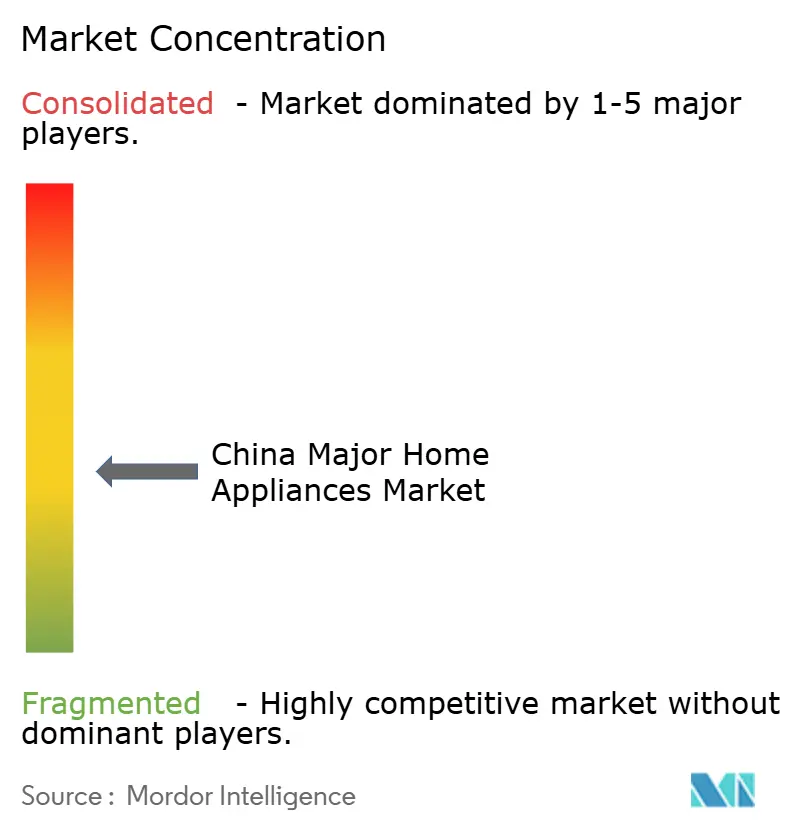
Market concentration is moderately fragmented. Their integrated R&D, component manufacturing, and omnichannel distribution ecosystems produce consistent cost and speed advantages over smaller peers. Midea and Hisense announced a strategic pact in May 2025 that pools AI algorithms, robotic logistics, and overseas plant capacity to accelerate smart manufacturing scale economies.
Competition now revolves around software ecosystems that bind multiple product categories into a unified interface. Haier’s Smart Home App integrates voice control, predictive maintenance, and energy optimisation, encouraging multi-product ownership within brand boundaries. Midea’s industrial internet platform drives factory digital twins that cut defect rates and compress delivery cycles, reinforcing the firm’s price competitiveness without sacrificing margin. Gree leverages precision air-conditioning expertise to cross-sell dehumidifiers, heaters, and air purifiers, capturing indoor-climate wallet share. Foreign entrants concentrate on premium niches; Bosch-Siemens aims at high-income dishwasher adopters, while Panasonic focuses on health-oriented refrigerators with nano-water mist preservation systems.
Cost inflation accelerates automation plans across the industry. Haier’s Qingdao mega-plant runs AI-guided flexible lines that can switch between 80 SKU variations without downtime, shortening time-to-market for customized orders. Environmental mandates push all majors to adopt green factories powered by rooftop solar and recycled water, positioning sustainability as both a license to operate and a marketing asset within the Chinese major home appliances market.
China Major Home Appliances Industry Leaders
-
Haier Group Corporation
-
Midea Group
-
Gree Electric Appliances, Inc.
-
Hisense Group Co., Ltd.
-
TCL Corporation
- *Disclaimer: Major Players sorted in no particular order
Market Opportunities and Future Outlook
Policy-backed replacement demand creates near-term space for manufacturers and retailers that can align SKUs, compliance documentation, and channel execution with national and local subsidy rules. In 2026, the national consumer-goods trade-in framework covers six home-appliance categories (refrigerators, washing machines, televisions, air conditioners, computers, and water heaters), with a subsidy of 15% of the final sale price capped at CNY 1,500 per item. Local programs can add support for smart-home and aging-friendly products, which favors companies with broad portfolios, faster model turnover, and the ability to package eligible products into high-conversion online promotions and omnichannel trade-in offers.
Standards-driven upgrading is another concrete opportunity area because new requirements push product redesign around energy efficiency, safety, and recyclability. SAMR’s March 2025 action plan to accelerate quality and safety standard upgrades, including revisions across a large set of national standards by end-2025, reinforces demand for higher-efficiency, smarter, and more environmentally compliant models that meet trade-in qualification and retailer eligibility filters. With online channels already accounting for 44.30% of sales in 2025, brands that combine smart ecosystems (apps, predictive maintenance, interoperability) with verified compliance and stronger service networks can improve mix while reducing returns. Offline brand stores can also deepen revenue through installation, extended warranty, and recycling services tied to replacement programs.
Recent Industry Developments
- June 2026: Haier launched its AI-powered Seeker series in Chongqing, positioning autonomous task management and connected workflows as a mainstream upgrade driver in major appliances. The release points to faster convergence of AI software, sensors, and core white goods, increasing competitive pressure on domestic peers to strengthen ecosystem capabilities and service-led differentiation.
- May 2026: Midea introduced a HarmonyOS-integrated smart air conditioner in collaboration with Huawei, linking a high-volume category to a widely used operating ecosystem. The collaboration strengthens interoperability and app-based control as purchase criteria, and it raises the value of platform partnerships for driving attach rates across connected-home products.
- September 2024: BSH Home Appliances highlighted Siemens Intelligent Clean Cube technology at the China Dishwasher Industry Summit, reinforcing dishwasher innovation around cleaning performance and efficiency. This supports broader category education in a market where dishwasher penetration remains relatively low, encouraging premium feature adoption through demonstrable performance claims.
Research Methodology Framework and Report Scope
Market Definition and Coverage
This market covers the value of major home appliances sold in China, focused on large household appliances like refrigerators, freezers, washing machines, dishwashers, ovens, air conditioners, and range hoods, counted across common sales channels.
Scope exclusions: Small countertop appliances, handheld devices, personal-care gadgets, and televisions are excluded from this sizing.
Segmentation Overview
- By Product
- Refrigerators
- Freezers
- Washing Machines
- Dishwashers
- Ovens (Incl. Combi & Microwave)
- Air Conditioners
- Other Major Home Appliances (range hoods, cooktops, etc.)
- By Distribution Channel
- Multi-Brand Stores
- Exclusive Brand Outlets
- Online
- Other Distribution Channels
- By Geography
- East China
- Southwestern China
- North China
- South Central China
- Northeast China
- Northwestern China
Data Sources, Market Sizing, and Validation
Desk Research
Desk work starts with a clean fact base on appliance demand, production, and trade flows in China, then aligns definitions so like is compared with like. In practice, we rely on public sources such as China customs trade statistics for category flows, the National Bureau of Statistics of China for household and retail indicators, and policy documents tied to appliance trade-in and energy-efficiency programs.
To make the model usable at a product level, we also review releases from industry bodies such as the China Household Electrical Appliances Association, plus corporate annual reports, investor presentations, and reputable press coverage on category launches and pricing moves. Where needed, we use paid subscriptions for company financials and news screening, and we check patent databases to track feature shifts that can affect average selling prices. The sources listed here are illustrative, and many other references were used for data collection, validation, and clarification during the work.
Primary Interviews and Surveys
Primary discussions were used to confirm what is counted as a major appliance in real channel reporting, and to validate the split between offline and online sales in China. We spoke with manufacturers, distributors, retailers, and category experts across key demand pockets, then used their inputs to close gaps on pricing, replacement cycles, and policy-driven demand spikes.
Distribution of primary research fieldwork respondents
| Company type | Respondent position |
|---|---|
| Top tier: 25% | CXOs: 18% |
| Mid tier: 55% | Functional/Unit leaders: 29% |
| Smaller Players: 20% | Managers: 53% |
Market-Sizing & Forecasting
For the core sizing, we use a top-down approach where appliance demand is reconstructed from China category-level shipment and retail signals, then converted into value using validated price bands by appliance type. Totals are cross-checked with selective bottom-up approximations, such as sampled ASP multiplied by category volumes, and channel checks that reflect online versus store-led mixes.
Key inputs used in the model include annual unit sales and replacement intensity for large appliances, penetration of air conditioners across climate zones, export versus domestic sales direction, mix shifts toward higher energy-efficiency models, and promotional effects tied to trade-in programs. Since pricing can move quickly in China, ASPs are not treated as a flat average, and they are adjusted using observed list-price movement, discounting cycles, and expert feedback.
Forecasts are built using scenario analysis, where variables such as housing completion trends, disposable income direction, and policy continuity around trade-ins are stress-tested, then agreed into a base case through interviews. When bottom-up data is incomplete for smaller channels, we fill gaps using share-based allocations anchored to the most consistent public series, and we re-check that the implied unit economics stay reasonable.
Data Validation & Update Cycle
Outputs are validated in a few steps so the final numbers do not rely on one data stream. We compare the model totals against independent signals like retail value reports, trade and production direction, and channel momentum, then investigate any variance that looks out of range for a category.
Before sign-off, the work is reviewed across analysts, and any material assumption change triggers follow-up questions with relevant experts. The report is refreshed annually, and interim updates are made when major policy shifts or demand shocks occur. Right before delivery, a final pass is completed so clients receive the latest updated view.
Mordor Intelligence's China Major Home Appliances Market Size Measured Against Other Published Estimates
Published market sizes for China major home appliances can look far apart even when they appear to cover the same topic, mainly because the counted product set and the sales measure are not always consistent. Differences also come from the base year used, the currency timing used for conversion, and whether policy-led demand surges are smoothed or taken as-is.
In this study, the biggest gap drivers are whether air conditioners and built-in cooking products are counted alongside core white goods, and whether the estimate tracks retail market value versus factory shipments. Another common reason is that some figures blend major and small appliances under one headline, which inflates totals and changes the implied pricing curve, especially when online discounting is heavy.
Benchmark comparison
| Source | Market Size | Gaps in Research Methodology |
|---|---|---|
| Mordor Intelligence | USD 87.55 B (2026) | |
| Market Research Publisher A | USD 50.50 B (2024) | Uses a narrower product basket centered on core white goods and a different base year, which can exclude categories like air conditioners or range hoods that raise the total value in broader definitions. |
| Industry Association B | USD 123.66 B (2024) | Represents a wider retail-market total for home appliances, which can include additional categories beyond major appliances and may be stated in local currency before conversion, making comparisons sensitive to scope and FX timing. |
Taken together, the spread is mainly explained by what is included in the appliance list and whether the value reflects retail sell-through or another measure. When the scope is kept to major appliances and checked against channel and pricing signals, the estimate stays easier to reproduce year to year, which is the approach applied by Mordor Intelligence.
Key Questions Answered in the Report
What is the current value of the China major home appliances market?
The market is worth USD 87.55 billion in 2026.
How fast will the China major home appliances market grow through 2031?
It is projected to expand at a 3.55% CAGR, reaching USD 104.23 billion by 2031.
Which product category leads sales in the China major home appliances market?
Refrigerators lead with a 27.50% revenue share in 2025.
Which region shows the fastest growth outlook?
South Central China is expected to register a 3.7% CAGR from 2026 to 2031.
How large is the online channel in appliance retail?
Online platforms captured 44.30% of market sales in 2025 and are growing at 4.75% CAGR.
What is the main challenge for manufacturers over the next two years?
Raw-material cost volatility, particularly in copper and aluminium, is the most immediate headwind.