
Market Overview
| Study Period | 2019 - 2031 |
|---|---|
| Forecast Data Period | 2026 - 2031 |
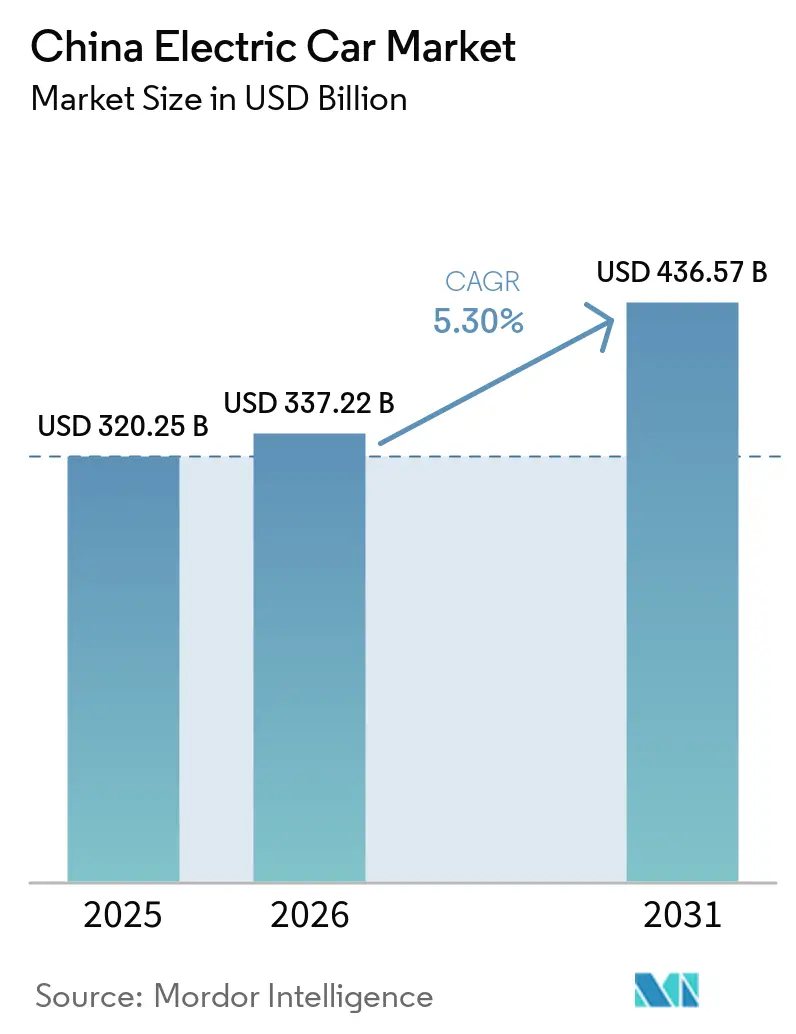
| Base Year Market Size (2025) | USD 320.25 Billion |
| Market Size (2026) | USD 337.22 Billion |
| Market Size (2031) | USD 436.57 Billion |
| Growth Rate (2026 - 2031) | 5.30 % |
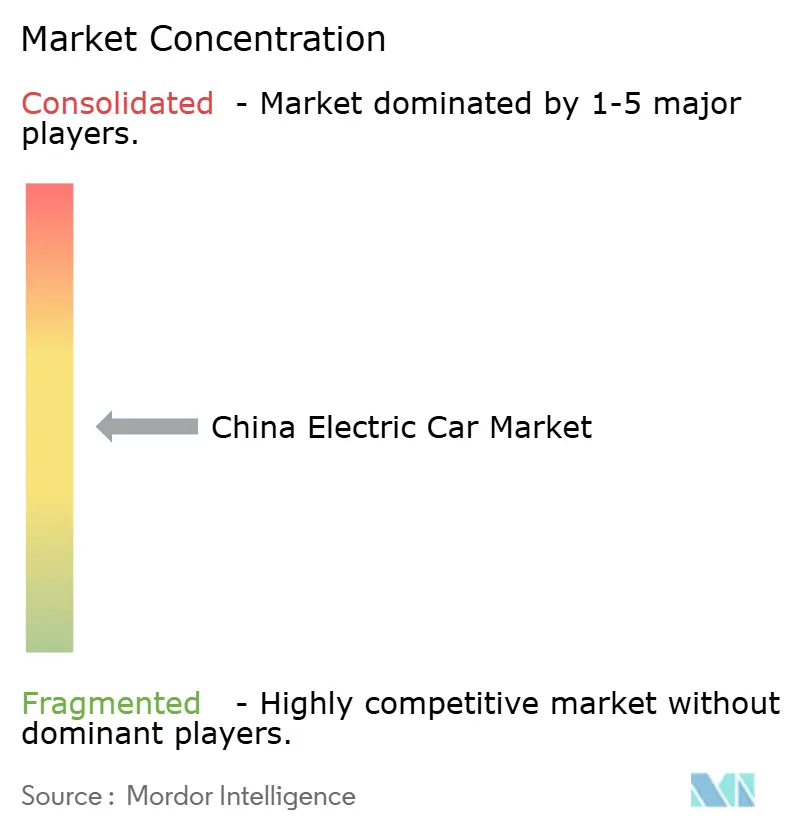
| Market Concentration | Medium |
Major Players *Disclaimer: Major Players sorted in no particular order Image © Mordor Intelligence. Reuse requires attribution under CC BY 4.0. | |
China Electric Car Market Analysis by Mordor Intelligence
The China electric car market size was valued at USD 320.25 billion in 2025, is estimated at USD 337.22 billion in 2026, and is projected to reach USD 436.57 billion by 2031, growing at a CAGR of 5.30% from 2026 to 2031. This pace signals the sector’s transition from hyper-growth to a steadier replacement-and-fleet-driven phase. Battery pack prices are consistently dropping, further widening the total cost of ownership gap compared to internal combustion vehicles, even after national purchase subsidies have ended. In Shenzhen and Guangzhou, vehicle-to-grid pilots enable owners to earn income from grid balancing, reducing ownership costs over time. Public chargers are being introduced in tier-3 cities at a significant rate, tapping into demand that larger metropolitan areas have so far been the only markets to serve.
Key Report Takeaways
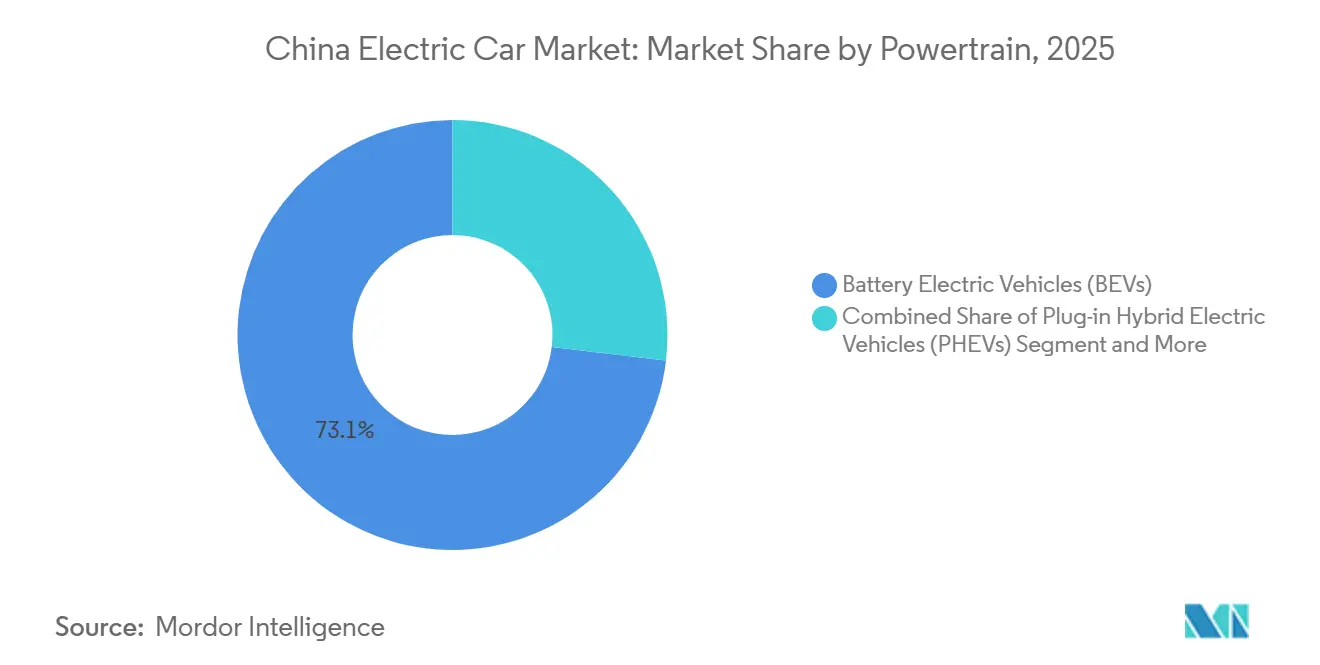
- By powertrain, battery-electric vehicles held 73.12% of the Chinese electric car market share in 2025, while fuel-cell and hybrid electric vehicles posted the highest projected CAGR at 11.25% through 2031.
- By vehicle class, sedans led with 43.05% revenue share in 2025; multi-purpose vehicles are forecast to advance at a 7.45% CAGR through 2031.
- By price band, entry models captured 49.11% of the Chinese electric car market size in 2025, whereas the luxury tier is expanding at a 6.71% CAGR to 2031.
- By battery chemistry, lithium-iron-phosphate packs commanded 57.24% of the Chinese electric car market share in 2025, and nickel-manganese-cobalt packs are projected to grow at an 8.03% CAGR through 2031.
- By motor architecture, permanent-magnet synchronous motors accounted for a 65.13% share of the China electric car market size in 2025, while others (SRM, axial flux, etc.) are set to climb at a 6.15% CAGR through 2031.
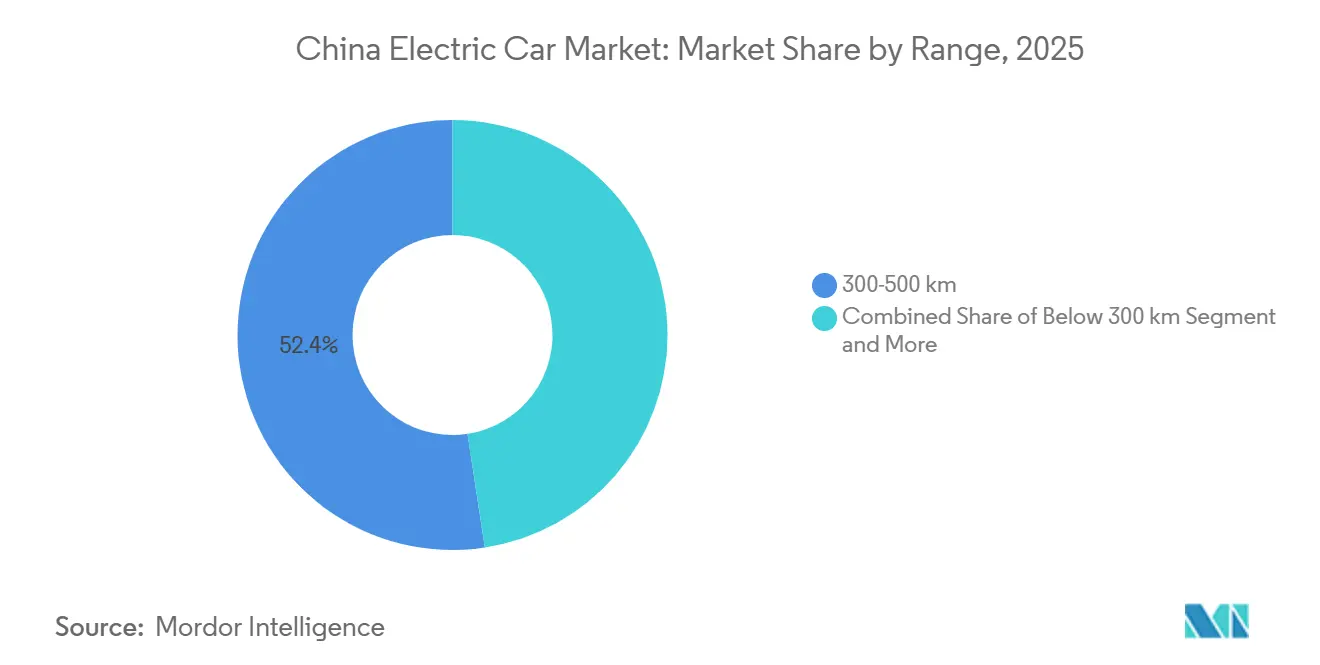
- By range, cars covering 300-500 km accounted for a 52.35% share in 2025, while the above 500 km segment is set to grow at an 8.45% CAGR by 2031.
- By customer type, private ownership accounted for a 75.22% share in 2025, while fleet and commercial cars will advance at a 7.84% CAGR through 2031.
Note: Market size and forecast figures in this report are generated using Mordor Intelligence’s proprietary estimation framework, updated with the latest available data and insights as of January 2026.
China Electric Car Market Trends and Insights
Drivers Impact Analysis*
| Driver | (~) % Impact on CAGR Forecast | Geographic Relevance | Impact Timeline |
|---|---|---|---|
| Sliding Battery-supply Cost | +1.2% | National, strongest in Tier-2 and Tier-3 cities | Medium term (2-4 years) |
| City-level Zero-Emission Zones | +0.9% | Beijing, Shanghai, Shenzhen, Guangzhou, Chengdu, Hangzhou | Medium term (2-4 years) |
| Smart-Charging and V2G pilots | +0.8% | Guangdong, Jiangsu, Zhejiang; pilot rollouts in Sichuan, Hubei | Medium term (2-4 years) |
| Tier-3 Charger Build-out | +0.7% | Anhui, Jiangxi, Henan, Guangxi | Short term (≤ 2 years) |
| Carbon-Trading Scheme for OEM Fleets | +0.6% | National, higher compliance costs in coal-heavy provinces | Long term (≥ 4 years) |
| Grid-Balancing payments for EV | +0.5% | Jiangsu, Guangdong, Shandong | Long term (≥ 4 years) |
| Source: Mordor Intelligence | |||
Battery-Supply Cost Curve Keeps Sliding Beyond 10 %/Yr (Post-2026 Learning Rate)
In late 2025, CATL and BYD unveiled deals for battery packs at significantly reduced costs. This marked a continued trend of declining expenses, with projections suggesting that entry-level electric vehicle prices could soon align with those of their gasoline counterparts. By vertically integrating the production of cathode and anode materials, manufacturers are further reducing their material costs. This strategy is nudging automakers to position their lower-margin vehicle trims in Tier-2 and Tier-3 showrooms, where consumers are more price-sensitive. The Ministry of Industry and Information Technology forecasts that as costs continue to drop, electric vehicles will capture a significant portion of China's light-vehicle sales in the coming years. With decreasing prices, the Chinese electric car market is not only reaching new customer demographics but also hastening the phase-out of older internal-combustion vehicles.
City-Level Zero-Emission Zones Covering Above 40 % of GDP by 2029
Between 2027 and 2029, Beijing, Shanghai, Shenzhen, and Guangzhou will anchor zero-emission zones, significantly influencing the national economy. License-plate lotteries and congestion privileges are nudging buyers towards electric models. Hangzhou and Chengdu are gearing up with similar ordinances, and even smaller metros are taking note of the traffic and air-quality benefits. Taxi fleet owners and corporate shuttle services are accelerating their procurement plans to ensure continued access, driving up demand for purpose-built commercial EVs. This widespread adoption, crossing municipal boundaries, is broadening the geographical and demographic reach of China's electric car market.
Smart-Charging and V2G Monetization Pilots Unlock Extra TCO Delta
In mid-2025, Shenzhen's grid operator started incentivizing EV owners for energy discharged during peak evening hours. This initiative quickly found its way to cities like Guangzhou and Suzhou. Fleet operators, especially those with ride-hailing and delivery vans, stand to gain the most. These vehicles, often idling during peak grid stress, can generate significant additional income. By 2027, guidelines from the National Energy Administration will introduce standardized bidirectional-charging protocols. This move will empower aggregators to amplify their ancillary-service revenue streams [1]. Thanks to this added income, ownership costs over several years can decrease notably, accelerating the shift towards corporate electrification. Thus, the Chinese electric car market is not just seeing reduced fueling expenses but is also tapping into these lucrative cash-flow opportunities.
Tier-3 Cities Reach 30 % Charging-Pole/EV Ratio Through Private Cap-Ex
In 2025, independent operators like Teld and Star Charge drove significant growth by adding a large number of public charging poles across Anhui, Jiangxi, and Henan. Streamlined land-use permits reduced build timelines, enabling operators to achieve profitability within a few years. This expansion improved the pole-to-vehicle ratio, easing range anxiety for new buyers. Projections for the period between 2026 and 2031 indicate that Tier-3 markets will play an increasingly important role in the growth of electric-vehicle sales. This strategy is expanding China's electric car market, reaching beyond its coastal megacities to a wider population.
Restraints Impact Analysis*
| Restraint | (~) % Impact on CAGR Forecast | Geographic Relevance | Impact Timeline |
|---|---|---|---|
| Critical Mineral Export Controls | -0.9% | National, acute pressure on premium NMC producers | Medium term (2-4 years) |
| Margin Squeeze w.r.t Subsidies Sunset | -0.7% | National, heaviest on mid-tier brands | Short term (≤ 2 years) |
| Peak Load Constraints Cut Charger Uptime | -0.6% | Jiangsu, Zhejiang, Guangdong, Shandong | Short term (≤ 2 years) |
| LFP Vehicle Residual Value Uncertainty | -0.5% | National, most acute in fleet and leasing channels | Medium term (2-4 years) |
| Source: Mordor Intelligence | |||
Tightening Critical-Mineral Export Controls from Africa and Indonesia
In 2024, Indonesia's continued ban on unprocessed nickel exports caused a significant increase in battery-grade prices. Concurrently, Zimbabwe and the Democratic Republic of Congo imposed taxes on lithium concentrates, squeezing refinery margins for Chinese cathode manufacturers. Additionally, China's broadened graphite licensing regulations in early 2024 have made it more challenging for foreign producers to secure anode supplies. While automakers reliant on nickel-rich chemistries grapple with substantial cost hikes, those favoring lithium-iron-phosphate benefit from assured domestic feedstock. This landscape is spurring research and development into sodium-ion and solid-state alternatives, backed by funding from the 14th Five-Year Plan. As a result, the fragility of the supply chain is moderating optimistic projections for China's electric car market.
OEM Margin Squeeze as Subsidy Phase-Out Overlaps Euro-7-Style Rules
At the end of 2022, national purchase subsidies came to an end, removing significant financial benefits that buyers had previously received. At the same time, compliance with stricter emissions and safety regulations has increased costs for manufacturers. By early 2026, mid-tier brands like Chery and Great Wall experienced a squeeze, with their operating margins shrinking considerably, leading to discussions of potential mergers or market exits. While larger players are turning to vertical integration as a hedge, the ongoing pricing wars across the industry are putting a damper on profitability, casting a shadow on the near-term growth of China's electric car market.
*Our forecasts treat driver/restraint impacts as directional, not additive. The impact forecasts reflect baseline growth, mix effects, and variable interactions.
Segment Analysis
By Powertrain: Fuel-Cell Momentum Creates a High-Growth Niche
Battery-electric vehicles dominated 73.12% of 2025 volume, but fuel-cell and hybrid models carry the fastest 11.25% CAGR outlook to 2031 as hydrogen corridors sprout along the Yangtze and Pearl River Deltas. In 2025, Shanghai significantly expanded its hydrogen station network, while Guangdong allocated substantial funding for further development. In areas with limited infrastructure, buyers continue to prefer plug-in hybrids; notably, BYD’s DM-i architecture remains a dominant choice in the PHEV segment. In Foshan, fuel-cell taxis and light trucks demonstrate rapid refueling capabilities, offering a distinct advantage over batteries. This underscores the collaborative role of diverse powertrains in broadening China's electric car market.
Range-extender hybrids will lose ground once charger density approaches parity nationwide, but they remain a critical bridge technology today. Non-plug-in hybrids now fall outside green-license-plate eligibility, nudging Toyota and Honda to re-evaluate lineups. Government procurement guidelines favor zero-emission drivetrains, effectively capping further hybrid growth. Nonetheless, fuel-cell deployment in long-haul and high-duty cycles broadens use-case coverage, carving new subsegments within the China electric car market size forecast.

By Vehicle Class: MPV Adoption Reflects Family Preferences
Sedans captured 43.05% of 2025 sales, yet multi-purpose vehicles post a 7.45% CAGR through 2031, the fastest among body styles. In Tier-2 and Tier-3 cities, multi-generational households prioritize spacious interiors. BYD's Song Max and Denza D9 have gained significant traction in the MPV market [2]. While SUVs remain a prominent segment, their growth is slowing due to challenges like congestion and limited parking.
Hatchbacks have seen a decline in popularity, except for price-leading models like Wuling's Mini EV. Industry projections suggest that MPVs will surpass hatchbacks in popularity in the coming years, driven by evolving demographics and an expanding range of electric vehicle offerings. As the focus of mobility transitions from solo commuting to family outings, the Chinese electric car market is adjusting its product lineup to resonate with these changing living standards.
By Price Band: Premiumization Outpaces Mid-Range Growth
In 2025, entry-tier cars, primarily models priced for budget-conscious commuters, captured a significant 49.11% share of China's electric car market. Meanwhile, luxury models experienced steady growth at a CAGR of 6.71%, driven by NIO, Li Auto, and foreign brands establishing localized production for premium EVs.
Mid-range electric vehicles are feeling the squeeze. Entry-level trims are adopting advanced technology features, while luxury brands are adjusting their prices downward to maintain sales volume. The trend of premiumization is most pronounced in Tier-1 metropolitan areas, where higher disposable incomes make EVs a lifestyle choice. This division highlights the stratification of the Chinese electric car market, both in terms of income and features.
By Battery Chemistry: LFP Cost Edge vs. NMC Energy Density
Lithium-iron-phosphate secured a 57.24% share in 2025, due to pack prices below USD 70 per kilowatt-hour and robust safety performance. BYD's Blade platform, which utilizes a cell-to-pack approach, powered a significant number of vehicles in 2025. Nickel-manganese-cobalt chemistries, however, grow at an 8.03% CAGR by 2031 because energy-dense packs attract premium buyers.
In Q4 2025, sodium-ion cells entered mass production, targeting entry-level city cars with modest range requirements. The industry ministry anticipates a notable share for sodium-ion in the future, bolstering the resilience of China's electric car market supply chain. Consequently, the choice of chemistry serves as a means for segmentation and risk hedging, rather than a universal solution.
By Motor Architecture: Rare-Earth Supply Shapes Adoption
Permanent-magnet synchronous motors delivered 65.13% of 2025 shipments, improving real-world efficiency by up to 12% versus induction alternatives. China controls most rare-earth refining capacity, insulating local automakers from price swings. Induction motors, favored by Tesla for their lower rare-earth content, held a notable share. Switched reluctance, axial, and other motor designs are set to grow with the fastest CAGR of 6.15% through 2031.
Provincial grants fund axial-flux and switched-reluctance R&D to diversify supply risks. Zhejiang’s Inovance shipped a significant number of axial-flux units in 2025, signaling momentum for magnet-light designs. The motor landscape, therefore, widens technology options and cushions the Chinese electric car market against raw-material bottlenecks.
By Range: 500 km-Plus Segments Address Long-Haul Use Cases
Models offering 300-500 kilometers still account for 52.35% of 2025 registrations, but 500 km-plus vehicles grow fastest at 8.45% CAGR. NIO’s 1,000-km ET7 showcases semi-solid-state potential, while BYD’s Han proves LFP can reach 610 km with aero and drivetrain efficiency.
The expansion of public fast-charging stations significantly reduces range anxiety. This enables automakers to optimize battery sizes based on actual driving patterns. Consequently, the Chinese electric car market evolves, catering not just to short commutes but also to long-distance highway journeys, addressing a wider spectrum of mobility demands.
By Customer Type: Fleet Uptake Follows Rising TCO Advantage
Private buyers represented 75.22% of sales in 2025, but fleet and commercial segments are set to grow at 7.84% CAGR to 2031, outpacing household demand. In 2025, ride-hailing giants significantly expanded their electric car fleets. Similarly, leading logistics companies have made notable progress in electrifying their last-mile delivery operations.
Driven by national directives, government fleets are aiming for substantial electrification in the coming years. Fleet operators prioritize factors like residuals and charger uptime over brand prestige, often favoring models that offer long-term warranties. As fleet adoption grows, it diversifies the Chinese electric car market, moving beyond consumer sentiment.
Geography Analysis
In 2025, despite constituting only a small percentage of the population, Tier-1 cities dominated electric vehicle registrations, a feat attributed to incentives like license-plate exemptions and the establishment of zero-emission zones. Leading the charge, Guangdong province emerged as a frontrunner, capitalizing on early mandates set by Shenzhen. Meanwhile, Tier-2 cities, notably Hangzhou and Chengdu, made significant contributions, bolstered by provincial incentives and an extensive rollout of charging stations.
Tier-3 regions, holding a notable share, are projected to experience steady growth as their infrastructure begins to match coastal standards. Registrations in Anhui surged, driven by competitive pricing from local automakers and subsidies for rural buyers. Regions like Jiangsu and Zhejiang, benefiting from their closeness to battery suppliers, also made substantial additions to the market.
While western provinces lag behind, Sichuan's abundant hydropower is attracting fresh investments in batteries, potentially spurring greater EV adoption. National strategists predict that by 2030, Tier-3 regions will match Tier-1 in EV penetration, diminishing the urban-rural divide that has long influenced China's electric vehicle landscape [3].
Competitive Landscape
In 2025, leading brands like BYD, SAIC-GM-Wuling, and Tesla dominated a significant portion of unit sales, leaving a competitive share for numerous challengers. This dynamic has ignited price wars and accelerated model refreshes. BYD, through its vertical integration of batteries, motors, and power electronics, maintains strong profitability. In contrast, mid-tier competitors, grappling with lower profitability, find themselves in talks of consolidation.
Strategically, BYD’s models, the Dolphin and Seagull, target affordability for the masses. Meanwhile, NIO justifies its premium pricing through battery-swap convenience and a concierge after-sales service. Addressing concerns over residual value, CATL introduces a blockchain-based battery passport, elevating suppliers to pivotal platform roles.
Xiaomi disrupts the market by successfully launching its sedan model, cleverly bundling car sales with its smartphone ecosystem. Predictions indicate that in the coming years, several mid-tier brands may either merge or exit, further consolidating market share among larger players. This trend underscores a pivotal shift: in the Chinese electric car arena, technology, rather than hardware, stands as the key battleground.
China Electric Car Industry Leaders
-
BYD Auto Co., Ltd.
-
SAIC-GM-Wuling Automobile Co. Ltd.
-
Tesla, Inc.
-
Zhejiang Geely Holding Group Co., Ltd.
-
GAC Aion New Energy Automobile Co., Ltd.
- *Disclaimer: Major Players sorted in no particular order
Recent Industry Developments
- August 2026: BYD confirmed that the Da Han sedan will debut in China at the 2026 Chengdu Auto Show on August 21. The company will also reveal pricing when presales begin. The 5.3-meter sedan features rear-wheel steering, an electric range of up to 1,008 km, and a combined peak power output of 570 kW (764 hp).
- August 2026: Avatr Technology (Chongqing) Co., Ltd. (Avatr) announced the official launch of its all-new five-seat luxury SUV, the Avatr 07L, on August 8. The model is available in three battery-electric vehicle (BEV) variants, featuring rear-wheel-drive (RWD) and all-wheel-drive (AWD) configurations.
- July 2026: Dongfeng eπ announced the official launch of its all-new eπ M8 full-size six-seat SUV. Available with battery-electric and range-extended powertrains, the eπ M8 is offered in five variants, with prices ranging from CNY 179,800 (USD 25,000) to CNY 219,800 (USD 30,500).
- July 2026: SAIC-GM-Wuling (SGMW) announced the official launch of the all-new Xingguang L, a mid-to-large plug-in hybrid six-seat SUV. Available in three variants, prices for this model range from CNY 112,800 (USD 15,700) to CNY 135,800 (USD 18,900).
China Electric Car Market Report Scope
The scope includes segmentation by powertrain (battery electric vehicles, plug-in hybrid electric vehicles, fuel cell electric vehicles and hybrid electric vehicles), vehicle class (hatchback, sedan, sports utility vehicle/crossover, and multi-purpose vehicle), price band (entry, mid-range, premium, and luxury), battery chemistry (lithium iron phosphate, lithium nickel manganese cobalt oxide, lithium nickel cobalt aluminum oxide, and others), motor architecture (permanent magnet synchronous motors, induction motors, and others), range (below 300 km, 300-500 km, and above 500 km), and customer type (private, fleet and commercial, and government/municipal). Market size and growth forecasts are presented by value in USD and by volume in units.
By Powertrain
| Battery Electric Vehicles (BEVs) |
| Plug-in Hybrid Electric Vehicles (PHEVs) |
| Fuel Cell Electric Vehicles (FCEVs) and Hybrid Electric Vehicles (HEVs) |
By Vehicle Class
| Hatchback |
| Sedan |
| Sports Utility Vehicle (SUV)/Crossover |
| Multi-Purpose Vehicle (MPV) |
By Price Band
| Entry |
| Mid-Range |
| Premium |
| Luxury |
By Battery Chemistry
| Lithium Iron Phosphate (LFP) |
| Lithium Nickel Manganese Cobalt Oxide (NMC) |
| Lithium Nickel Cobalt Aluminum Oxide (NCA) |
| Others |
By Motor Architecture
| Permanent Magnet Synchronous Motors (PMSM/IM) |
| Induction Motors (IM) |
| Others (SRM, Axial Flux, etc.) |
By Range
| Below 300 km |
| 300-500 km |
| Above 500 km |
By Customer Type
| Private |
| Fleet and Commercial |
| Government / Municipal |
| By Powertrain | Battery Electric Vehicles (BEVs) |
| Plug-in Hybrid Electric Vehicles (PHEVs) | |
| Fuel Cell Electric Vehicles (FCEVs) and Hybrid Electric Vehicles (HEVs) | |
| By Vehicle Class | Hatchback |
| Sedan | |
| Sports Utility Vehicle (SUV)/Crossover | |
| Multi-Purpose Vehicle (MPV) | |
| By Price Band | Entry |
| Mid-Range | |
| Premium | |
| Luxury | |
| By Battery Chemistry | Lithium Iron Phosphate (LFP) |
| Lithium Nickel Manganese Cobalt Oxide (NMC) | |
| Lithium Nickel Cobalt Aluminum Oxide (NCA) | |
| Others | |
| By Motor Architecture | Permanent Magnet Synchronous Motors (PMSM/IM) |
| Induction Motors (IM) | |
| Others (SRM, Axial Flux, etc.) | |
| By Range | Below 300 km |
| 300-500 km | |
| Above 500 km | |
| By Customer Type | Private |
| Fleet and Commercial | |
| Government / Municipal |
Market Definition
- Vehicle Type - The category includes passenger cars.
- Vehicle Body Type - This include various body types such as Hatchbacks, Sedans, Sports Utility Vehicles, and Multi-purpose Vehicles.
- Fuel Category - The category exclusively covers electric propulsion systems, including various types such as HEV (Hybrid Electric Vehicles), PHEV (Plug-in Hybrid Electric Vehicles), BEV (Battery Electric Vehicles), and FCEV (Fuel Cell Electric Vehicles).
| Keyword | Definition |
|---|---|
| Electric Vehicle (EV) | A vehicle which uses one or more electric motors for propulsion. Includes cars, buses, and trucks. This term includes all-electric vehicles or battery electric vehicles and plug-in hybrid electric vehicles. |
| BEV | A BEV relies completely on a battery and a motor for propulsion. The battery in the vehicle must be charged by plugging it into an outlet or public charging station. BEVs do not have an ICE and hence are pollution-free. They have a low cost of operation and reduced engine noise as compared to conventional fuel engines. However, they have a shorter range and higher prices than their equivalent gasoline models. |
| PEV | A plug-in electric vehicle is an electric vehicle that can be externally charged and generally includes all-electric vehicles as well as plug-in hybrids. |
| Plug-in Hybrid EV | A vehicle that can be powered either by an ICE or an electric motor. In contrast to normal hybrid EVs, they can be charged externally. |
| Internal combustion engine | An engine in which the burning of fuels occurs in a confined space called a combustion chamber. Usually run with gasoline/petrol or diesel. |
| Hybrid EV | A vehicle powered by an ICE in combination with one or more electric motors that use energy stored in batteries. These are continually recharged with power from the ICE and regenerative braking. |
| Commercial Vehicles | Commercial vehicles are motorized road vehicles designed for transporting people or goods. The category includes light commercial vehicles (LCVs) and medium and heavy-duty vehicles (M&HCV). |
| Passenger Vehicles | Passenger cars are electric motor– or engine-driven vehicles with at least four wheels. These vehicles are used for the transport of passengers and comprise no more than eight seats in addition to the driver’s seat. |
| Light Commercial Vehicles | Commercial vehicles that weigh less than 6,000 lb (Class 1) and in the range of 6,001–10,000 lb (Class 2) are covered under this category. |
| M&HDT | Commercial vehicles that weigh in the range of 10,001–14,000 lb (Class 3), 14,001–16,000 lb (Class 4), 16,001–19,500 lb (Class 5), 19,501–26,000 lb (Class 6), 26,001–33,000 lb (Class 7) and above 33,001 lb (Class 8) are covered under this category. |
| Bus | A mode of transportation that typically refers to a large vehicle designed to carry passengers over long distances. This includes transit bus, school bus, shuttle bus, and trolleybuses. |
| Diesel | It includes vehicles that use diesel as their primary fuel. A diesel engine vehicle have a compression-ignited injection system rather than the spark-ignited system used by most gasoline vehicles. In such vehicles, fuel is injected into the combustion chamber and ignited by the high temperature achieved when gas is greatly compressed. |
| Gasoline | It includes vehicles that use gas/petrol as their primary fuel. A gasoline car typically uses a spark-ignited internal combustion engine. In such vehicles, fuel is injected into either the intake manifold or the combustion chamber, where it is combined with air, and the air/fuel mixture is ignited by the spark from a spark plug. |
| LPG | It includes vehicles that use LPG as their primary fuel. Both dedicated and bi-fuel LPG vehicles are considered under the scope of the study. |
| CNG | It includes vehicles that use CNG as their primary fuel. These are vehicles that operate like gasoline-powered vehicles with spark-ignited internal combustion engines. |
| HEV | All the electric vehicles that use batteries and an internal combustion engine (ICE) as their primary source for propulsion are considered under this category. HEVs generally use a diesel-electric powertrain and are also known as hybrid diesel-electric vehicles. An HEV converts the vehicle momentum (kinetic energy) into electricity that recharges the battery when the vehicle slows down or stops. The battery of HEV cannot be charged using plug-in devices. |
| PHEV | PHEVs are powered by a battery as well as an ICE. The battery can be charged through either regenerative breaking using the ICE or by plugging into some external charging source. PHEVs have a better range than BEVs but are comparatively less eco-friendly. |
| Hatchback | These are compact-sized cars with a hatch-type door provided at the rear end. |
| Sedan | These are usually two- or four-door passenger cars, with a separate area provided at the rear end for luggage. |
| SUV | Popularly known as SUVs, these cars come with four-wheel drive, and usually have high ground clearance. These cars can also be used as off-road vehicles. |
| MPV | These are multi-purpose vehicles (also called minivans) designed to carry a larger number of passengers. They carry between five and seven people and have room for luggage too. They are usually taller than the average family saloon car, to provide greater headroom and ease of access, and they are usually front-wheel drive. |
Research Methodology
Mordor Intelligence follows a four-step methodology in all its reports.
- Step-1: Identify Key Variables: To build a robust forecasting methodology, the variables and factors identified in Step-1 are tested against available historical market numbers. Through an iterative process, the variables required for market forecast are set and the model is built based on these variables.
- Step-2: Build a Market Model: Market-size estimations for the historical and forecast years have been provided in revenue and volume terms. Market revenue is calculated by multiplying the sales volume with their respective average selling price (ASP). While estimating ASP factors like average inflation, market demand shift, manufacturing cost, technological advancement, and varying consumer preference, among others have been taken into account.
- Step-3: Validate and Finalize: In this important step, all market numbers, variables, and analyst calls are validated through an extensive network of primary research experts from the market studied. The respondents are selected across levels and functions to generate a holistic picture of the market studied.
- Step-4: Research Outputs: Syndicated Reports, Custom Consulting Assignments, Databases & Subscription Platforms.


