
Heat Recovery Steam Generator Market Size and Share
Market Overview
| Study Period | 2021 - 2031 |
|---|---|
| Market Size (2026) | USD 1.59 Billion |
| Market Size (2031) | USD 2.02 Billion |
| Growth Rate (2026 - 2031) | 5.01 % |
| Fastest Growing Market | Asia Pacific |
| Largest Market | Asia Pacific |
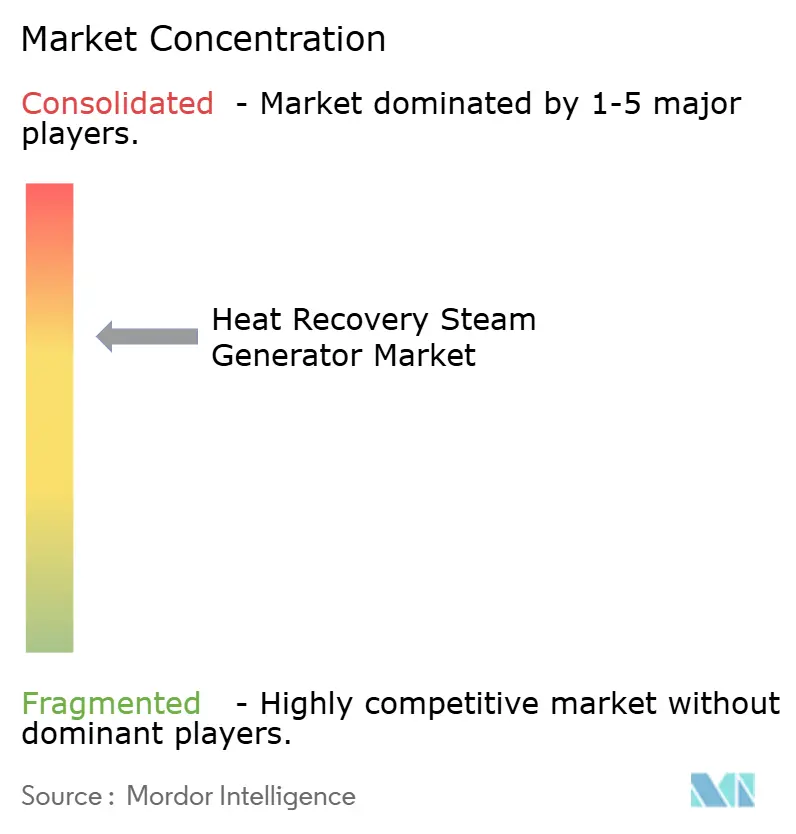
| Market Concentration | Medium |
Major Players *Disclaimer: Major Players sorted in no particular order Image © Mordor Intelligence. Reuse requires attribution under CC BY 4.0. | |
Heat Recovery Steam Generator Market Analysis by Mordor Intelligence
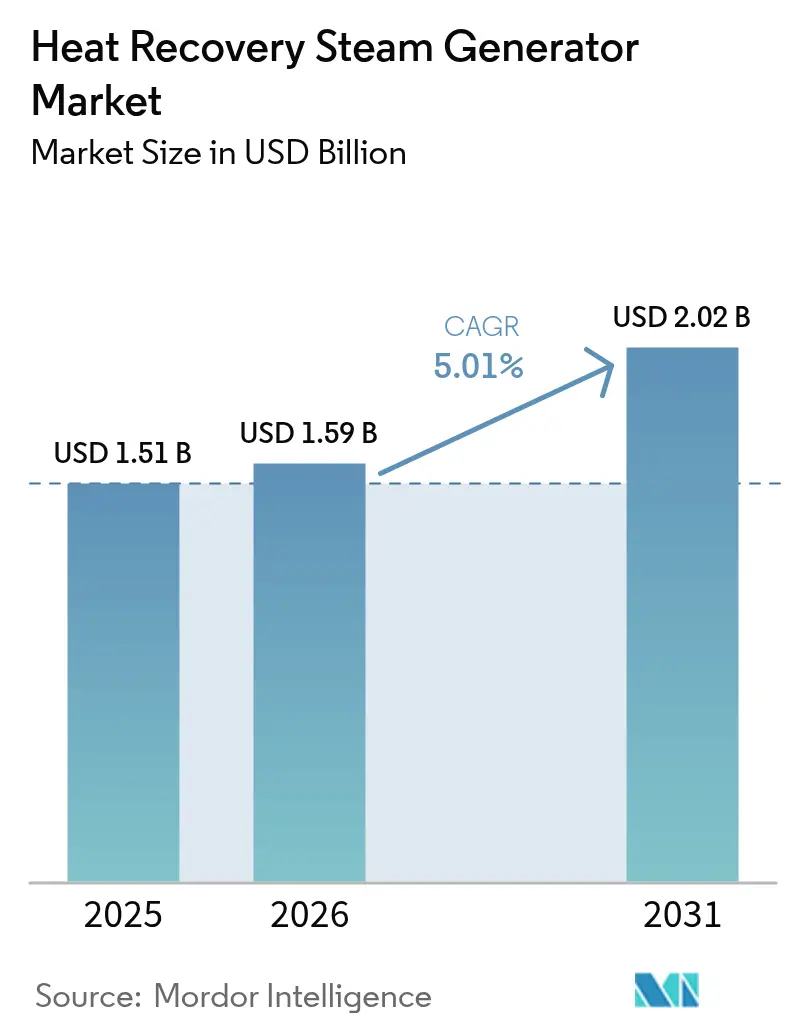
The Heat Recovery Steam Generator market size is expected to grow from USD 1.51 billion in 2025 to USD 1.59 billion in 2026 and is forecast to reach USD 2.02 billion by 2031 at 5.01% CAGR over 2026-2031.
Demand resilience is anchored in rising combined-cycle gas-turbine (CCGT) additions, stricter industrial emissions regulations, and the operational cost advantage of harvesting waste heat in power and process industries. Manufacturers are prioritizing flexible, hydrogen-ready designs that can cycle frequently without compromising reliability. Parallel investments in carbon-capture-ready CCGT plants widen the addressable base, while modular LNG, refining, and data-center micro-cogeneration projects create new pockets of opportunity. Supply-chain tightness around high-pressure drums, finned-tube modules, and skilled fabrication labor is lengthening delivery schedules, reinforcing the value proposition of vendors with integrated manufacturing footprints and long-term service programs.
Key Report Takeaways
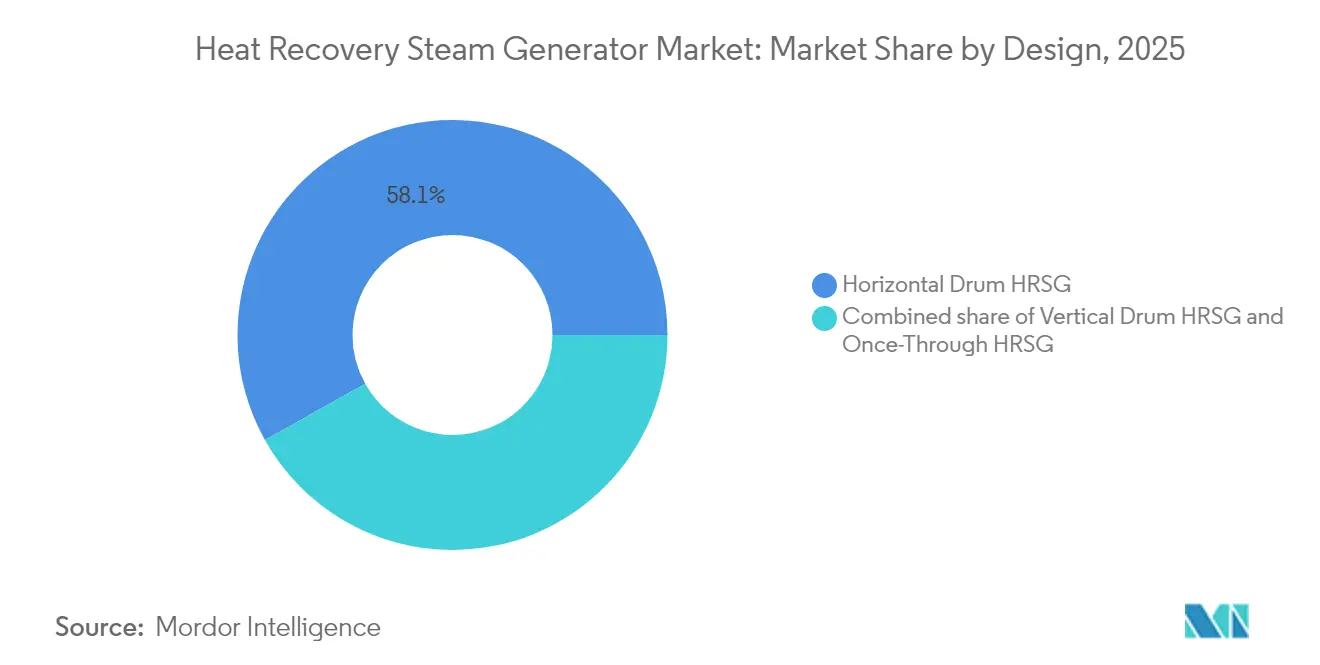
- By design, horizontal drum HRSGs commanded 58.12% share of the heat recovery steam generator market size in 2025, while once-through technology is forecast to accelerate at 6.46% CAGR through 2031.
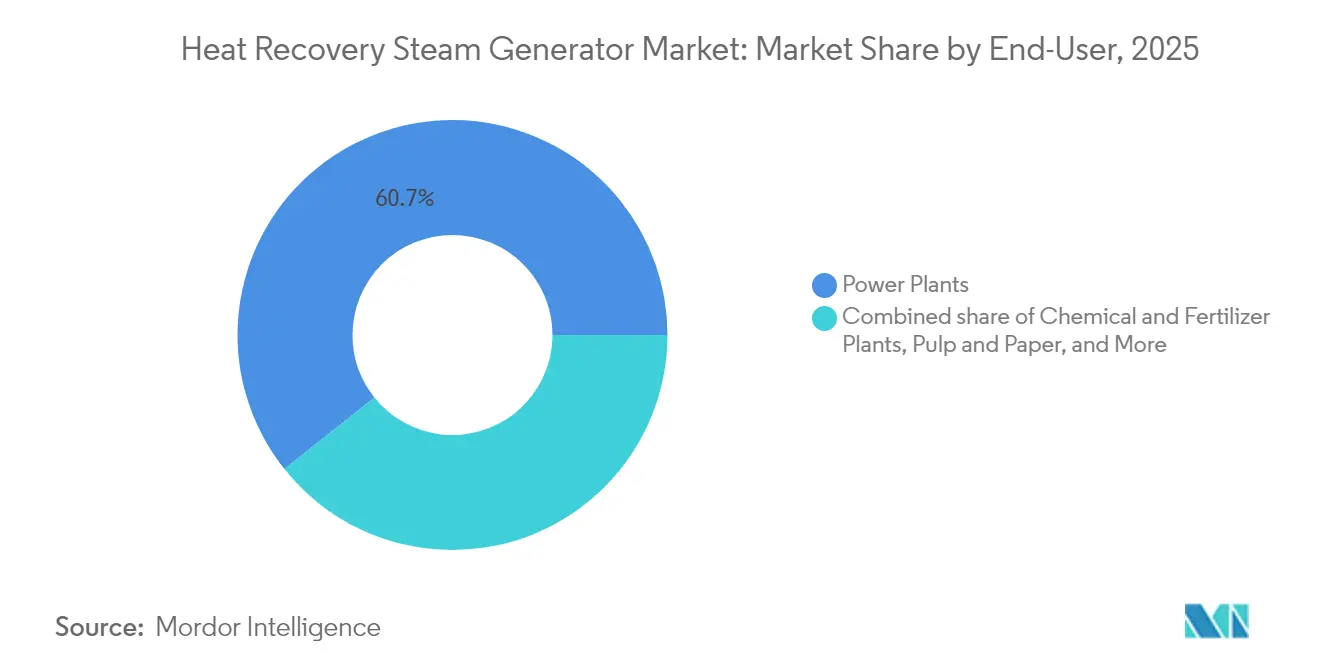
- By end user, power plants held 60.72% of the heat recovery steam generator market share in 2025, whereas chemical and fertilizer facilities are projected to register the highest CAGR of 6.12% from 2026 to 2031.
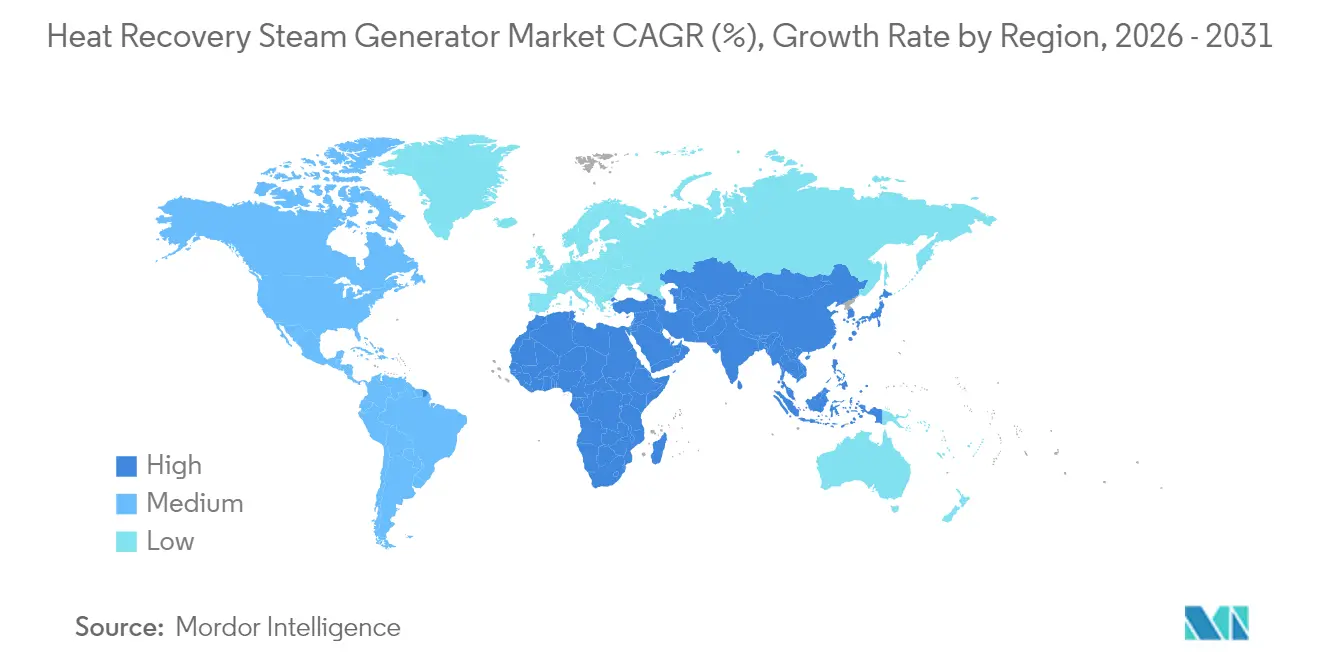
- By geography, the Asia-Pacific region led with a 42.55% revenue share in 2025; it is expected to outpace others at a 5.73% CAGR through 2031.
- GE Vernova, Siemens Energy, and Mitsubishi Power collectively accounted for over 45% of shipments in 2024, underscoring a moderately concentrated supplier landscape.
Note: Market size and forecast figures in this report are generated using Mordor Intelligence’s proprietary estimation framework, updated with the latest available data and insights as of 2026.
Market Trends and Insights
Drivers Impact Analysis of Heat Recovery Steam Generator Market*
| Driver | (~) % Impact on CAGR Forecast | Geographic Relevance | Impact Timeline |
|---|---|---|---|
| Expansion of CCGT capacity pipeline | 1.20% | Global, with concentration in Asia-Pacific and Middle East | Medium term (2-4 years) |
| Industrial emission-reduction mandates | 0.90% | Global, strongest in North America and Europe | Long term (≥ 4 years) |
| Operational-cost pressure in O&G & chemicals | 0.70% | Global, particularly Middle East and North America | Short term (≤ 2 years) |
| CO₂-capture integration boosting low-pressure steam demand | 0.60% | North America and Europe, expanding to Asia-Pacific | Long term (≥ 4 years) |
| Modular LNG plants adopting compact HRSGs | 0.40% | Global, with focus on Qatar, Australia, and US Gulf Coast | Medium term (2-4 years) |
| Data-center micro-cogeneration deployment | 0.30% | North America and Europe, early adoption in Asia-Pacific | Medium term (2-4 years) |
| Source: Mordor Intelligence | |||
Expansion of CCGT Capacity Pipeline
Global developers anticipate commissioning more than 18.7 GW of new combined-cycle capacity in the United States by 2028, with parallel multigigawatt programs also advancing in Saudi Arabia, Qatar, and China.[1] Project sponsors are specifying HRSGs that tolerate wider exhaust-gas temperatures from hydrogen-capable turbines and integrate exhaust-gas recirculation to cut carbon-capture costs by 6%.[2] As turbine backlogs extend to 2029, utilities are placing early equipment orders, shifting the competitive advantage toward vendors with captive module fabrication capabilities. The robust pipeline provides multi-year revenue visibility for the heat recovery steam generator market, although schedule risk remains tied to turbine availability and financing milestones. Design complexity is trending upward because owners demand rapid starts, part-load efficiency, and materials resilience under high-hydrogen combustion gases.
Industrial Emission-Reduction Mandates
The US Environmental Protection Agency now requires 90% CO₂ abatement for long-run coal and new baseload gas plants by 2032, prompting industrial campuses to retrofit or build cogeneration plants centered on HRSG technology.[3] European chemical producers, exemplified by BASF’s 160 MW heat-pump-steam complex in Germany, illustrate how mandates convert environmental compliance into energy-efficiency investments. Facilities pursuing net-zero pathways incorporate triple-pressure HRSGs that feed both process steam and solvent-based capture units. Chemical and fertilizer operators seek configurations compatible with amine regeneration loads, enabling them to comply without jeopardizing throughput. Early movers who master permitting and technology integration benefit from lower lifetime compliance costs and potential carbon credit upside.
Operational-Cost Pressure in O&G & Chemicals
Volatile LNG price expectations near USD 13 per million British thermal units for 2025 squeeze margins for refineries and petrochemical plants.[4] Installing turbine-HRSG cogeneration schemes yields fuel savings of USD 5 million per year for a 12 MWe module and achieves up to 100% energy efficiency improvements over fired boilers. Operators also monetize surplus electricity during market peaks, turning cost centers into revenue contributors. Flexibility remains critical; plant managers prefer once-through HRSGs that track variable steam loads without drum-level constraints. These economics underpin a sustained flow of retrofit awards, particularly in US Gulf Coast petrochemical corridors and Middle East refining hubs.
CO₂-Capture Integration Boosting Low-Pressure Steam Demand
Carbon-capture pilots that pair molten-carbonate fuel cells with HRSGs show 90% CO₂ removal while raising net plant output by 42% versus amine systems. Capture solvers demand stable low-pressure steam, a profile naturally provided by multi-pressure HRSGs, thereby displacing auxiliary boilers. Steam-methane reformer complexes utilizing sequential combustion and HRSG heat recovery can achieve a thermal efficiency of 38.9%, producing hydrogen and power within a shared capture scheme. Industrial clusters in Alberta and Rotterdam, which pool CO₂ pipelines, amplify economies of scale, reinforcing HRSG adoption curves through 2030. Vendors offering integrated capture-ready drums and space allowances command pricing premiums yet face minimal short-term competition due to engineering barriers.
Restraints Impact Analysis of Heat Recovery Steam Generator Market*
| Restraint | (~) % Impact on CAGR Forecast | Geographic Relevance | Impact Timeline |
|---|---|---|---|
| High CAPEX & long pay-back vs alternatives | -0.80% | Global, particularly acute in emerging markets | Short term (≤ 2 years) |
| Gas-price volatility dampening CCGT FIDs | -0.60% | Global, with regional variations based on gas supply dynamics | Short term (≤ 2 years) |
| Materials corrosion under high-H₂ turbine exhaust | -0.40% | Global, affecting hydrogen-ready installations | Medium term (2-4 years) |
| Limited skilled HRSG fabrication capacity | -0.30% | Global, concentrated in manufacturing hubs | Medium term (2-4 years) |
| Source: Mordor Intelligence | |||
High CAPEX & Long Pay-Back vs Alternatives
The typical CCGT equipped with a triple-pressure HRSG costs USD 0.25 million per MW more than an open-cycle plant, extending payback periods to 8-12 years in low-capacity-factor grids. Developers in Southeast Asia and Africa face higher financing spreads, tilting procurement toward less efficient but cheaper OCGT sets. Growth in the heat recovery steam generator market, therefore, tends to favor jurisdictions that offer capacity payments or energy-efficiency incentives. Multilateral lenders attempt to bridge the gap with green-bond frameworks, yet disbursement timelines can delay order intake.
Gas-Price Volatility Dampening CCGT FIDs
Commodity swings triggered by geopolitical tensions push gas-forward curves into steep contango, unsettling revenue models for merchant CCGT assets. Lenders raise debt-service coverage ratios, and independent power producers defer final investment decisions, directly reducing near-term HRSG bookings. Integrated utilities with regulated cost recovery remain less exposed; however, even they are reevaluating project timings to align with contracted LNG supplies. Price volatility also clouds the competitiveness of gas-to-power in renewables-heavy grids, periodically shifting preference toward battery storage or demand-side management.
*Our forecasts treat driver/restraint impacts as directional, not additive. The impact forecasts reflect baseline growth, mix effects, and variable interactions.
Heat Recovery Steam Generator Market Segment Analysis
By Design:
Once-Through Flexibility Gains GroundOnce-through HRSGs, although still a minority, are projected to grow at a 6.46% CAGR through 2031, while drum-type systems accounted for 58.12% of the 2025 revenue. Horizontal drum units retain dominance in base-load CCGT blocks because they provide consistent steam purity and proven durability. Vertical drums serve space-constrained retrofit sites, particularly inside refineries. The heat recovery steam generator market size for once-through units is projected to rise from USD 0.49 billion in 2026 to USD 0.67 billion by 2031, reinforcing supplier focus on quick-start architectures. Startup curves of under 30 minutes enable plant operators to chase peak pricing windows, whereas drum systems still average 60 to 90 minutes. Hydrogen-blend pilots indicate lower chloride-induced stress corrosion on once-through tube circuitry, positioning the design as a hedge against future fuel shifts. That said, water-quality demands remain stringent; owners are investing in condensate polishing skids to safeguard turbine blades.
Horizontal drum HRSGs will continue to dominate the larger slice of the heat recovery steam generator market, as mega-scale CCGT projects exceeding 800 MW tend to opt for familiar layouts and economies of scale. OEMs package triple-pressure with reheat trains to maximize combined-cycle output beyond 64% net efficiency, as validated by Thailand’s 5,300 MW M701JAC cluster. Enhancements, such as 3D-printed low-pressure economizer fins and advanced T91 steel headers, mitigate fatigue from cycling, thereby extending service intervals. Over the forecast horizon, incremental upgrades ask smart soot-blowing and infrared tube monitoring will prolong the competitive life of drum configurations, even as once-through units proliferate in mid-merit plants.

By End User:
Chemicals Propel Incremental DemandPower plants represented 60.72% of 2025 shipments, translating into a heat recovery steam generator market size of USD 0.92 billion. In contrast, chemicals and fertilizers posted the highest 6.12% CAGR, rising from USD 0.23 billion in 2026 to USD 0.31 billion in 2031. Chemical complexes pursue cogeneration revamps to offset gas cost spikes and comply with tightening carbon budgets. Ammonia producers retrofit single-pressure HRSGs on synthesis-gas turbines, shaving steam-reformer fuel by 12%. Refineries continue to anchor a stable demand base by replacing aging package boilers with turbine-HRSG trains that co-produce power and 55 bar steam. Data-center operators explore 5-10 MWe micro-cogeneration skids to cut scope-2 emissions while harvesting low-grade heat for absorption chillers.
Other industrial users, including those in the metals, pulp, and paper sectors, leverage HRSGs within biomass-hybrid systems to monetize process off-gases. Steelmakers in India integrate HRSGs with coke-oven gas turbines, achieving 25% internal power self-sufficiency. Food-grade CO₂ producers adopt HRSGs to supply reboiler duty for purification columns, capturing additional margin streams. Although power generation retains scale dominance, diversified industrial adoption underwrites a broader revenue plateau that protects suppliers from utility investment cyclicality.
Geography Analysis
APAC Heat Recovery Steam Generator Market
Asia-Pacific continues to headline both market share and growth velocity. The region generated 42.55% of global 2025 revenue, and its 5.73% CAGR promises an incremental USD 0.22 billion by 2031, supported by multi-gigawatt CCGT expansions in China, India, Vietnam, and Thailand. China’s Huizhou hydrogen-ready CHP block exemplifies how developers future-proof assets for 50% H₂ firing, embedding once-through HRSGs with advanced fin-tube alloys. India’s national hydrogen mission is spurring the commissioning of cogeneration retrofits with dual-fuel turbines in Gujarat and Odisha. Japan’s fleet-renewal projects favor compact vertical-drum HRSGs for brownfield grid-balancing plants, aided by local content incentives.
North America Heat Recovery Steam Generator Market
North America leverages replacement cycles and emissions standards to sustain demand. The Environmental Protection Agency’s 90% CO₂ rule accelerates repowering of coal sites with CCGT-HRSG blocks that include spare pads for solvent regeneration exchangers. US Gulf Coast refineries embrace once-through HRSGs on aeroderivative turbines to hedge against LNG price volatility and carbon pricing proposals. Canada’s Alberta industrial carbon-capture hub contracts HRSG suppliers for waste-to-energy plants integrating post-combustion capture, expanding non-utility use cases.
Europe Heat Recovery Steam Generator Market
Europe pursues decarbonization through high-efficiency, hydrogen-blend-capable HRSGs. Germany’s phase-out of unabated coal drives utilities to order triple-pressure, reheat systems with exhaust-gas recirculation for capture readiness. The Netherlands incentivizes combined heat-and-power upgrades in greenhouse horticulture, opening a niche segment for compact two-pressure HRSGs paired with small frame turbines. Supply-chain reliance on Asian pressure-part fabricators, however, exposes European projects to logistics delays, propelling interest in localized module assembly.
Middle East Heat Recovery Steam Generator Market
The Middle East records accelerating orders linked to Vision 2030 and industrial diversification. Saudi Arabia’s 7.2 GW CCGT pipeline specifies carbon-capture-ready HRSGs rated for 46 bar low-pressure steam to accommodate solvent regeneration, signaling design upgrades beyond conventional evaporator banks. Qatar’s North Field LNG expansion opts for compact HRSGs on aeroderivative turbines to maximize modular integration. United Arab Emirates utilities emphasize service contracts that guarantee 98% availability, funneling after-sales revenues to OEMs.
South America and Africa Heat Recovery Steam Generator Market
South America and Africa remain nascent but promising. Brazil tenders gas-fired thermal capacity to back solar and wind, including Bahia plants fitted with locally fabricated vertical-drum HRSGs to satisfy content rules. Nigeria and Mozambique evaluate small CCGT packages for industrial parks, but financing hurdles persist. Nonetheless, regional gas discoveries position both continents as long-term growth candidates once infrastructure matures.
Regulatory Landscape
Heat recovery steam generators (HRSGs) sit at the intersection of boiler safety rules and air-emissions compliance, so permitting and certification remain a key purchase prerequisite for both utility and industrial cogeneration projects. In the United States, HRSG installations that function as boilers or process heaters are governed by US EPA air rules such as NESHAP for major sources (40 CFR Part 63 Subpart DDDDD) and related New Source Performance Standards under 40 CFR Part 60 for fossil fuel-fired generating units, driving requirements for monitoring, burner management, and NOx/CO control around duct firing and supplementary combustion systems.
On the technical and performance side, buyers commonly specify recognized codes and standards to reduce lifecycle and acceptance-testing risk. API STD 534 (3rd edition, May 2024) is an industry benchmark for water-tube, drum-type HRSG design, materials, fabrication, and testing for combustion turbine exhaust applications, while ASME PTC 4.4 is used for performance test protocols for gas-turbine HRSGs. In Europe, Directive (EU) 2024/1785 amending the Industrial Emissions Directive tightens the compliance framework for industrial installations, creating a defined update cycle for emission limit values and associated best-available-technique alignment as Member States move toward national implementation by July 2026.
Competitive Landscape
Market concentration is moderate. GE Vernova, Siemens Energy, and Mitsubishi Power combined accounted for more than 45% of 2024 shipments, leveraging complete turbine-to-stack portfolios and bundled long-term service agreements. These giants differentiate through digital performance suites, hydrogen-blend credentials, and experience integrating carbon-capture auxiliaries. GE Vernova’s USD 600 million US plant upgrade will increase heavy-duty turbine output to 70-80 units annually by 2026, strengthening its position in captive HRSG pairing. Siemens Energy bets on additive-manufactured burners and exclusive SMR steam turbine deals to widen the addressable markets beyond conventional thermal power.
Tier-two fabricators, such as BHI and Babcock & Wilcox, secure a share in regional turnkey contracts, especially where local content quotas are applied. BHI’s KRW 67 billion Fuji Electric partnership extends its presence in Japan, underpinning a backlog through 2031. Babcock & Wilcox’s 39% bookings rise in 2024 reflects diversified exposure across waste-to-energy and industrial decarbonization niches.
Supply scarcity in high-pressure finned-tube modules and a limited pool of ASME S-stamp workshops elevate barriers to entry. Some utilities now reserve fabrication slots years ahead, effectively locking out late entrants and encouraging vendor consolidation. Private-equity investors eye roll-up opportunities among specialized shops that build harps, transition ducts, and casing modules. Meanwhile, service revenues climb as operators sign performance-based contracts covering smart soot blowing, tube fouling analytics, and remote condition monitoring.
Strategic moves increasingly pivot on fuel flexibility. Vendors trial 100% hydrogen burners and ammonia-cracking inserts, anticipating post-2030 decarbonization mandates. Modular skid designs target LNG trains and data center cogeneration, where footprint and fast-track delivery outweigh the complexity of multiple pressures. Players able to bundle financing and lifecycle guarantees win bids in capital-constrained emerging markets, reinforcing the importance of downstream service ecosystems.
Heat Recovery Steam Generator Industry Leaders
-
General Electric (GE Vernova)
-
Siemens Energy AG
-
Mitsubishi Power
-
Thermax Ltd.
-
Nooter/Eriksen
- *Disclaimer: Major Players sorted in no particular order
Heat Recovery Steam Generator Market Companies Covered in this Report
- General Electric (GE Vernova)
- Siemens Energy AG
- Mitsubishi Power (MHI Group)
- Thermax Ltd.
- Nooter/Eriksen
- Doosan Enerbility
- CMI Energy
- Babcock & Wilcox Enterprises
- NEM Energy (John Cockerill)
- Harbin Boiler Co.
- BHI Co., Ltd.
- Kelvion Holding GmbH
- Alfa Laval AB
- AC BOILERS S.p.A.
- Sofinter S.p.A.
- Vogt Power International
- Struthers Energy & Power
- CMU Energy Solutions
- Mersen S.A.
- HTC Technologies
Market Opportunities and Future Outlook
Coal-to-gas conversions and high-efficiency combined-cycle builds create clearer scope for HRSG suppliers that can deliver fast-start, flexible steam systems while localizing pressure-part fabrication where lead times are tight. A 2026 proof point is the wave of new combined-cycle projects in Europe and Eurasia: GE Vernova and ENKA brought the 852 MW Kirklareli plant in Turkiye into commercial operation using a triple-pressure HRSG, and ORLEN synchronized the Grudziadz CCGT in Poland to the national grid in July 2026, extending the near-term pipeline for HRSGs and related service contracts.
Hydrogen readiness and carbon-capture integration are also reshaping specifications, pushing demand toward once-through or advanced multi-pressure configurations with controls and materials suited to wider exhaust conditions. Hydrogen combustion trials in CHP settings point to engineering needs around emissions control and heat-recovery stability at higher blends, which supports demand for integrated SCR/FGR interfaces and tighter thermal management. On the supplier side, project awards such as John Cockerill signing a June 2026 contract with Ansaldo Energia to design and supply an HRSG for a 460 MW combined-cycle plant in Ptolemais, Greece (a lignite-to-gas conversion) reflect momentum in retrofit-driven markets where execution speed and packaged engineering support influence vendor selection.
Recent Industry Developments in Heat Recovery Steam Generator Market
- July 2026: Mitsubishi Power announced it had received a contract to supply boilers for a heavy oil to natural gas fuel conversion project at existing thermal power plants in Saudi Arabia. The award reinforces the role of boiler and heat-recovery equipment in fuel-switch programs, expanding addressable demand beyond new-build CCGT sites and into brownfield conversions.
- April 2025: Duke Energy and GE Vernova agreed to procure up to 11 US-built 7HA gas turbines, supporting GE Vernova's USD 600 million manufacturing expansion tied to HA-class equipment supply. Greater turbine production capacity strengthens the execution pipeline for paired HRSG packages and long-term service attachments across multi-unit combined-cycle programs.
- October 2024: Mitsubishi Power completed a 5,300 MW natural-gas-fired plant project in Thailand built around eight M701JAC units and associated HRSGs, delivering combined-cycle efficiency around 64%. Commissioning highlighted continued preference for large, proven multi-pressure HRSG configurations in mega-scale CCGT blocks, and these results are used as benchmarks that influence specification trends in Asia-Pacific.
Heat Recovery Steam Generator Market Report Scope and Research Methodology
Market Definition and Coverage
For this study, the heat recovery steam generator (HRSG) market is defined as the revenue earned from new HRSG units and related engineered supply packages installed behind gas turbines or other hot exhaust sources to produce steam for power or industrial use.
Scope exclusions: Standalone steam boilers, pure waste heat boilers not sold as HRSG systems, and long-term plant O&M services are excluded from the market value.
Segments Covered in This Report
- By Design
- Horizontal Drum HRSG
- Vertical Drum HRSG
- Once-Through HRSG
- By End User
- Power Plants
- Oil and Gas Facilities
- Chemical and Fertilizer Plants
- Metal and Mining
- Pulp and Paper
- Other Industrial Users
- By Geography
- North America
- United States
- Canada
- Mexico
- Europe
- Germany
- United Kingdom
- France
- Italy
- NORDIC Countries
- Russia
- Rest of Europe
- Asia-Pacific
- China
- India
- Japan
- South Korea
- ASEAN Countries
- Rest of Asia-Pacific
- South America
- Brazil
- Argentina
- Rest of South America
- Middle East and Africa
- Saudi Arabia
- United Arab Emirates
- South Africa
- Rest of Middle East and Africa
- North America
Data Sources, Market Sizing, and Validation
Desk Research
Desk research was used to set the practical boundaries of what counts as an HRSG sale and to build starting points for demand signals by region and end use. We typically referred to public energy and power statistics such as those from the International Energy Agency, the US Energy Information Administration, the US EPA greenhouse gas programs, and Eurostat. These sources help link combined cycle additions and industrial heat recovery activity to equipment demand.
To convert these signals into an addressable market, we also reviewed company annual reports and investor presentations, project announcements from grid operators and utilities, and technical papers and standards published through organizations such as ASME. Patent databases were checked to see where design improvements are being emphasized. In addition, we used selective paid subscriptions for company financials, news, and contract tracking only to confirm timing and ownership of large project awards. The desk sources listed here are not exhaustive, and many other public references were used for data collection, cross-checking, and clarification.
Primary Interviews and Surveys
Primary work was done through expert interviews and structured surveys with EPC participants, HRSG component suppliers, plant operators, and consultants who track combined cycle and cogeneration projects across key regions. We used these discussions to confirm what is being purchased (newbuild versus replacement), how pricing moves with materials and configuration, and where actual shipment timing sits compared with announced project schedules.
Distribution of primary research fieldwork respondents
| Company type | Respondent position | Region |
|---|---|---|
| Top tier: 33% | CXOs: 14% | APAC: 39% |
| Mid tier: 51% | Functional/Unit leaders: 32% | EMEA: 37% |
| Smaller Players: 16% | Managers: 54% | Americas: 24% |
Market-Sizing & Forecasting
Sizing was first built using a top-down approach where combined cycle capacity additions, announced plant conversions, and industrial cogeneration activity were converted into an HRSG demand pool by region. Those demand pools were then translated into value using configuration mix and pricing logic that is commonly seen in procurement, followed by an adjustment for the share of projects that shift across years.
To keep the outputs realistic, selective bottom-up approximations were used as a cross-check, such as roll-ups of installed project counts in active construction pipelines and sampled average selling price ranges by pressure level and duty. Inputs that mattered most in this market included gas turbine based generation additions, retirement and replacement rates of older HRSG trains, project lead times, steel and alloy cost direction that affects quoted prices, and the split of utility versus industrial CHP orders. Where direct volumes were not visible, gaps were handled with region-level average unit value ranges that were validated through interviews and then applied to verified project counts.
Forecasts were developed using scenario analysis anchored on expected power demand growth, grid emissions policies, and the pace of combined cycle investments. The scenario outputs were narrowed using the consensus view shared by primary respondents. The final forecast path was checked for practicality against typical procurement cycles, so growth is not overstated in years where engineering and construction bottlenecks tend to limit deliveries.
Data Validation & Update Cycle
Model outputs were checked against independent signals such as new combined cycle order announcements, commissioning timelines, and regional power sector capital spending trends, and then variances were reviewed before finalizing. When a number looked unusual, we revisited assumptions, rechecked unit values, and re-contacted selected experts to understand whether the change was real or driven by timing noise.
Before sign-off, the work goes through multi-step analyst review where calculations, currency conversions, and year mapping are revalidated. Reports are refreshed annually, with interim updates when major policy shifts, large plant award clusters, or sudden materials cost changes materially affect HRSG pricing or delivery schedules. Right before delivery, a final pass is performed so clients receive the latest view available.
Mordor Intelligence's Heat Recovery Steam Generator Market Size Compared With Other Published Estimates
Published market sizes for HRSGs can look different because the included revenue items are not always the same, and because some models treat project timing and price changes in their own way. Differences usually come from whether replacement HRSGs are counted, how EPC scope is handled, and which year is used as the base for currency and materials pricing.
By tracking project-level commissioning windows and refreshing steel and alloy related price assumptions, Mordor Intelligence keeps the 2026 market value tied to delivered HRSG scope, while some sources lean more on announced pipelines or apply a broader boiler boundary that lifts totals.
Benchmark comparison
| Source | Market Size | Gaps in Research Methodology |
|---|---|---|
| Mordor Intelligence | USD 1.59 B (2026) | |
| Global Consultancy A | USD 1.71 B (2026) | Uses a higher assumed configuration mix and pricing curve in 2026, and tends to count a wider share of engineered balance-of-plant value inside the HRSG line item. |
| Industry Publisher B | USD 1.40 B (2025) | Anchors the base year earlier and applies conservative ASP progression, and it also reduces the counted demand pool by filtering out retrofit and replacement orders in several regions. |
The table shows that most of the spread is explained by what gets counted in the equipment scope and how the model maps announced projects into delivered-year revenue. With clear boundary rules, a repeatable set of input indicators, and cross-checks from interviews, the estimate stays easy to trace back to plant activity and practical pricing ranges.
Key Questions Answered in the Report
What is the current size of the heat recovery steam generator market?
The market is valued at USD 1.59 billion in 2026 and is projected to reach USD 2.02 billion by 2031.
Which region dominates the heat recovery steam generator market?
Asia-Pacific leads with 42.55% revenue share in 2025 and also records the fastest 5.73% CAGR through 2031.
Which design type is growing fastest?
Once-through HRSG technology posts the highest 6.46% CAGR, driven by rapid-start capability and hydrogen-fuel readiness.
Why are chemical and fertilizer plants adopting HRSGs?
Stricter emission mandates and energy-cost pressures push these facilities to install HRSG-based cogeneration systems that cut fuel use and CO₂ output.
How does carbon-capture integration affect HRSG demand?
Capture processes require large volumes of low-pressure steam, making multi-pressure HRSGs the preferred source and expanding long-term demand.
Who are the major players in the heat recovery steam generator market?
GE Vernova, Siemens Energy, and Mitsubishi Power collectively hold over 45% of global shipments, supported by integrated turbine-to-stack offerings and long-term service agreements.