
Market Overview
| Study Period | 2019 - 2031 |
|---|---|
| Forecast Data Period | 2026 - 2031 |
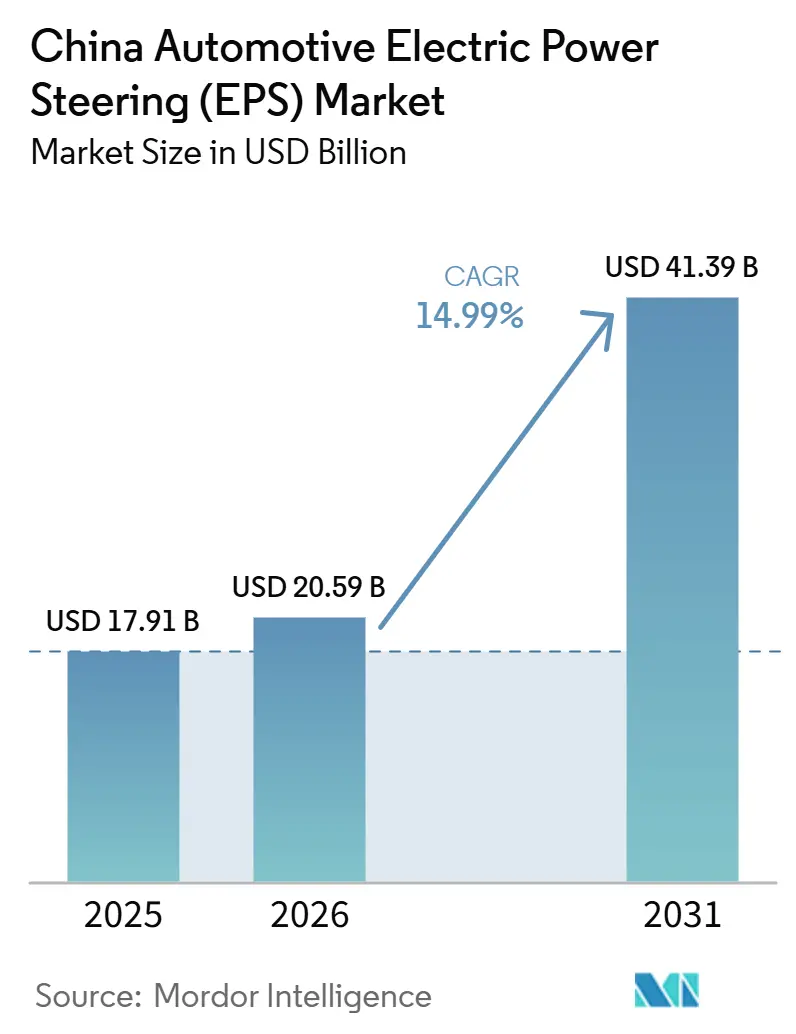
| Base Year Market Size (2025) | USD 17.91 Billion |
| Market Size (2026) | USD 20.59 Billion |
| Market Size (2031) | USD 41.39 Billion |
| Growth Rate (2026 - 2031) | 14.99 % |
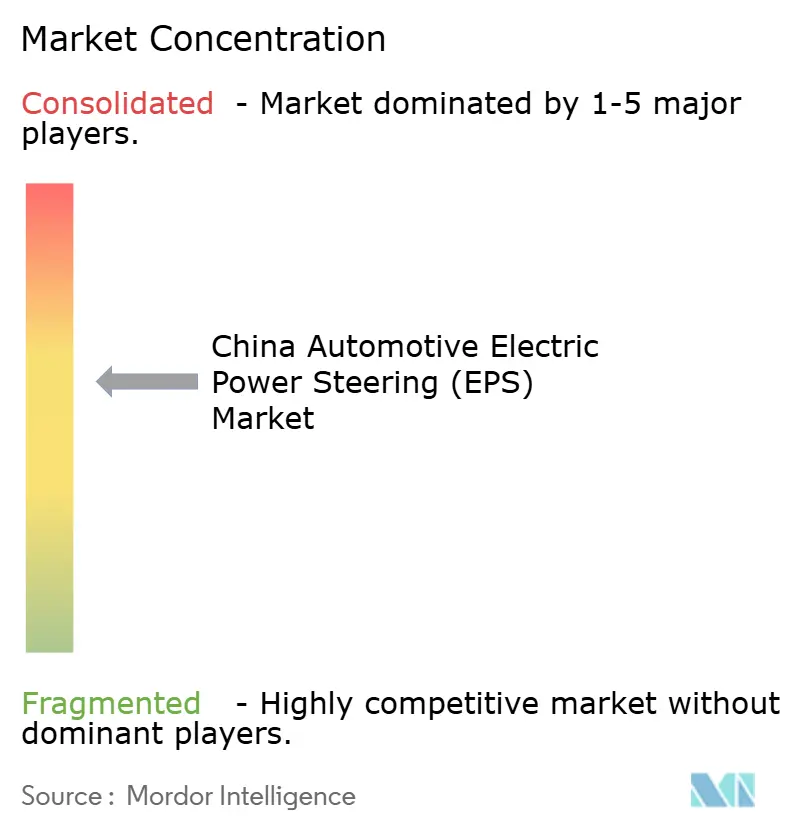
| Market Concentration | Medium |
Major Players *Disclaimer: Major Players sorted in no particular order Image © Mordor Intelligence. Reuse requires attribution under CC BY 4.0. | |
China Automotive Electric Power Steering (EPS) Market Analysis by Mordor Intelligence
The Chinese automotive electric power steering market size was valued at USD 17.91 billion in 2025 and is estimated to grow from USD 20.59 billion in 2026 to reach USD 41.39 billion by 2031, at a CAGR of 14.99% during the forecast period (2026-2031). The Chinese automotive electric power steering market is being shaped by the shift toward new energy vehicle programs, which need electrically driven steering systems. New energy vehicle sales reached 16.49 million units in China during 2025, and their share exceeded the new passenger vehicle sales, supporting demand for EPS in new vehicle platforms. Fuel-efficiency rules and assisted-driving functions are also changing steering specifications, because they increase demand for electronically controlled systems. Suppliers are responding by investing in higher-torque systems, software, sensors, and steer-by-wire capabilities rather than relying only on conventional column systems. The Chinese automotive electric power steering market also faces longer validation cycles and a dependence on advanced electronic components, which favor suppliers with established engineering, testing, and safety capabilities.
Key Report Takeaways
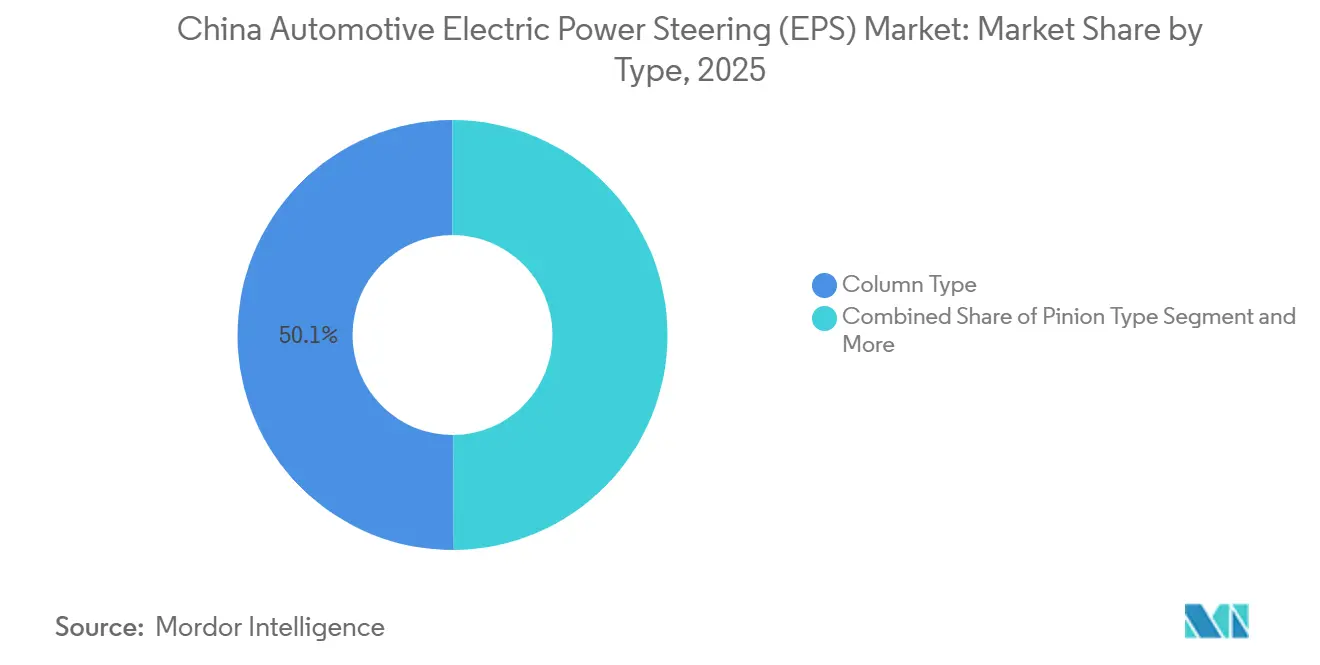
- By type, column EPS held 50.14% of the China automotive electric power steering market share in 2025, while dual-pinion EPS is forecast to grow at a 16.22% CAGR through 2031.
- By component type, the steering column accounted for 49.11% of the Chinese automotive electric power steering market share in 2025, while torque and position sensors are forecast to expand at a 15.84% CAGR through 2031.
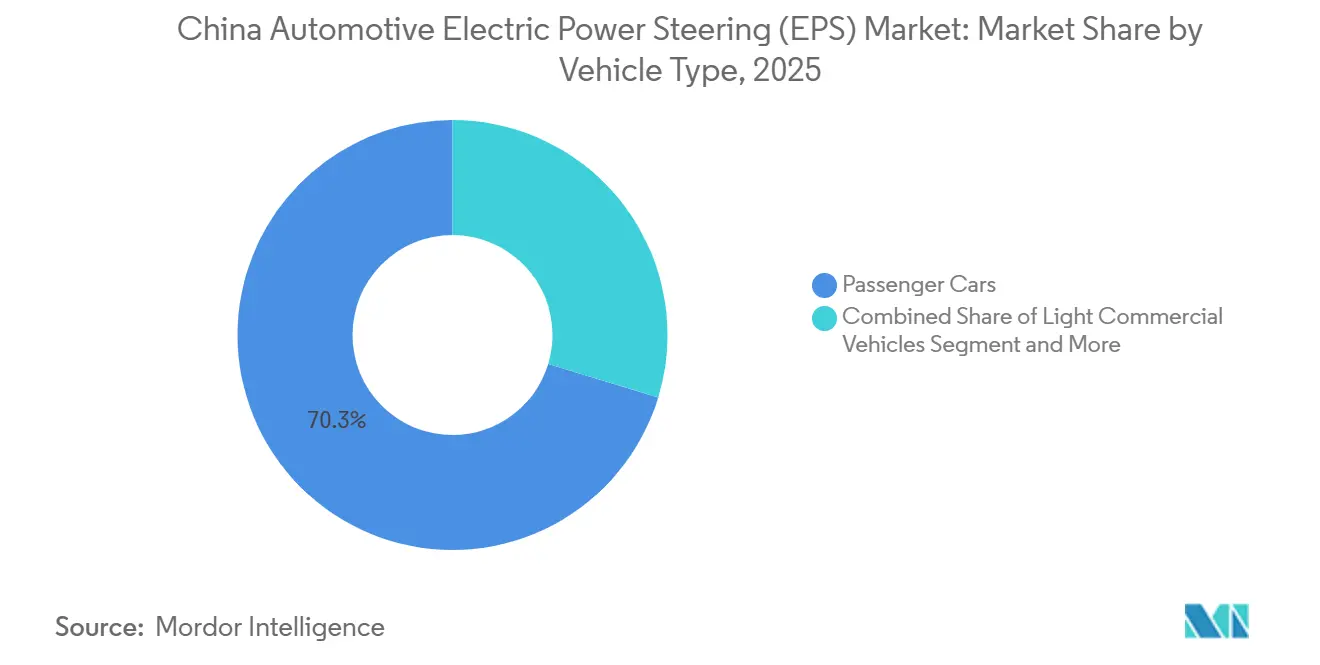
- By vehicle type, passenger cars commanded 70.33% share in 2025, while light commercial vehicles are projected to grow at a 16.75% CAGR through 2031.
- By propulsion type, internal combustion engine vehicles retained 65.25% share in 2025, while battery electric vehicles are projected to grow at a 19.34% CAGR through 2031.
Note: Market size and forecast figures in this report are generated using Mordor Intelligence’s proprietary estimation framework, updated with the latest available data and insights as of January 2026.
China Automotive Electric Power Steering (EPS) Market Trends and Insights
Drivers Impact Analysis*
| Driver | (~) % Impact on CAGR Forecast | Geographic Relevance | Impact Timeline |
|---|---|---|---|
| Vehicle Electrification and Hybridization | +3.8% | National, with strong demand in Yangtze River Delta and Greater Bay Area OEM clusters | Long term (≥ 4 years) |
| ADAS-Enabled Steering Functions | +2.9% | National, led by coastal NEV OEM clusters | Long term (≥ 4 years) |
| Efficiency and Emission Requirements | +2.4% | National, with compliance activity in Shanghai, Guangzhou, and Chengdu OEM hubs | Medium term (2-4 years) |
| Adoption of Steer-by-Wire | +1.6% | National, with early adoption in the Yangtze River Delta and Beijing technology corridors | Medium term (2-4 years) |
| High-Torque Steering Demand | +1.3% | National, with early demand in Chongqing, Guangzhou, and Xi'an LCV production hubs | Short term (≤ 2 years) |
| Steering Calibration and Feature Personalization | +1.1% | National, concentrated in Shanghai and Shenzhen software and automotive corridors | Long term (≥ 4 years) |
| Source: Mordor Intelligence | |||
Vehicle Electrification and Hybridization
China’s new energy vehicle penetration exceeded a major share of new passenger vehicle sales in 2025, while domestic new energy vehicle sales reached 16.49 million units. EPS is necessary on battery-electric vehicle platforms because the conventional engine-driven hydraulic pump is not available. This moves EPS from an optional equipment choice to a basic platform requirement for many new vehicle programs. Larger battery packs also increase steering-assist demands, especially in longer-range electric vehicles and sport utility vehicles. Those requirements support the use of dual-pinion and rack-assist designs when column systems cannot provide the required continuous torque. The China automotive electric power steering market benefits from this shift because each new electrified platform creates a defined requirement for electrically controlled steering, across mass-market cars, premium vehicles, sport utility vehicles, delivery fleets, and other models that are moving away from hydraulic arrangements, while these programs also require suppliers to coordinate steering specifications early with battery placement, vehicle weight, chassis geometry, motor capacity, electronic controls, production timing, and their customers’ planned model ranges.
ADAS-Enabled Steering Functions
L2+ assisted-driving systems reached an 87.4% installation rate in domestic new energy passenger cars during January through April 2026 [1]. The Ministry of Industry and Information Technology also reported that L2 driver-assist penetration reached 69% across new passenger car sales in early 2026. Lane keeping, automated parking, and lane-change functions require accurate electronic steering control. This gives EPS a central role in assisted-driving vehicle architecture rather than treating it as an isolated mechanical subsystem. Higher-function systems use additional sensors, control units, and software components compared with baseline column configurations. The Chinese automotive electric power steering market is therefore moving toward systems that can support vehicle automation requirements and stricter functional control needs, with steering response, sensor accuracy, software calibration, and control-unit capability becoming connected purchasing considerations for OEM engineering teams. The Chinese automotive electric power steering market also requires a reliable link between steering inputs, vehicle control functions, safety monitoring, vehicle testing, and routine operation across different road and weather conditions.
Fuel-Efficiency and Emission-Reduction Requirements
China implemented mandatory national fuel-consumption standards on January 1, 2026, under the country’s vehicle efficiency framework. The framework targets a corporate average fuel consumption of 3.3 L/100 km for passenger vehicles by 2030 [2]. EPS avoids the continuous load of a belt-driven hydraulic pump, which makes it relevant to vehicle efficiency programs. The Stage 4 fuel-consumption framework also extends fleet-average targets to light commercial vehicle manufacturers, increasing the relevance of EPS in a segment that historically used hydraulic steering. The Chinese automotive electric power steering market, therefore, gains support from compliance needs as well as from buyer preferences. The Chinese automotive electric power steering market is relevant across vehicle categories because fleet efficiency objectives apply to passenger and commercial platforms, even though their vehicle duty cycles, powertrains, annual volumes, and steering loads differ. This creates a more stable basis for system adoption across passenger and light commercial vehicle programs, because steering-system selection is linked to fleet efficiency targets, powertrain choices, vehicle certification work, and the expected operating costs of each new platform.
Rising Adoption of Steer-by-Wire Architectures
China’s GB 17675-2025 steering standard became effective on July 1, 2026, and removed the previous requirement for a mechanical steering linkage. The change enables commercial deployment of full steer-by-wire architectures when systems meet the required safety and redundancy provisions. The standard was developed with participation from major Chinese automakers, technology companies, and joint-venture vehicle operations, as stated in the supplied research. Nexteer entered mass production of its first full drive-by-wire chassis for a Chinese new energy vehicle OEM in April 2026 [3]. This move shows that advanced steering is moving from development work into production programs. It also raises the importance of suppliers that can combine steering hardware, electronics, software, and functional-safety engineering, while providing the validation records, systems integration, production discipline, and long-term program support expected by vehicle manufacturers.
Restraints Impact Analysis*
| Restraint | (~) % Impact on CAGR Forecast | Geographic Relevance | Impact Timeline |
|---|---|---|---|
| Development and Validation Costs | -1.5% | National, most acute for Tier-2 and domestic suppliers outside major OEM clusters | Long term (≥ 4 years) |
| Reliability Under Harsh Conditions | -1.1% | National, with higher exposure in northeast and northwest China | Medium term (2-4 years) |
| Semiconductor and Motor-Controller Supply | -0.9% | National, with import-dependent procurement concentrated in coastal manufacturing zones | Short term (≤ 2 years) |
| Limited Retrofitting Options | -0.5% | National | Short term (≤ 2 years) |
| Source: Mordor Intelligence | |||
High Development and Validation Costs
Dual-pinion, rack-assist, and steer-by-wire systems require longer engineering and validation work than basic EPS products. The supplied research identifies certification cycles of 18-36 months under ISO 26262 for these systems. Suppliers must fund redundant hardware, diagnostic software, test processes, and external safety assessment before volume production. China Automotive Systems reported USD 365.3 million in Henglong passenger-vehicle steering revenue for 2025, illustrating the scale of the steering operations supporting these programs. Smaller domestic suppliers can find it difficult to match these multi-year investment commitments. The China automotive electric power steering market consequently gives scaled suppliers a stronger position in advanced systems, even as demand expands, because their earlier investments can be spread across more programs, larger production volumes, wider customer relationships, and several generations of steering technology. The Chinese automotive electric power steering market may therefore see smaller suppliers focus on selected components or established EPS products where technical entry requirements and engineering costs are more manageable.
Electronic-System Reliability Under Harsh Operating Conditions
EPS electronic controls must perform across China’s diverse operating environments, including severe cold in the northeast and intense heat in the northwest. These conditions increase the importance of thermal management, sealing, power-system protection, and vehicle-level validation. Steering control units and motor controllers must maintain dependable torque assistance under sustained heat, humidity, road spray, and repeated temperature changes. China’s GB/T 45829-2025 standard sets fault-injection scenarios for EPS systems, including motor stall, electronic control unit failure, and power open-circuit conditions. Suppliers may need separate validation programs for cold, heat, and humid operating conditions. These requirements can extend development schedules and increase system qualification budgets for the Chinese automotive electric power steering market, especially when a supplier must assess the full system across several regional climates, vehicle applications, power demands, durability conditions, and customer-specific test protocols.
*Our forecasts treat driver/restraint impacts as directional, not additive. The impact forecasts reflect baseline growth, mix effects, and variable interactions.
Segment Analysis
By Type: Dual-Pinion Gains Ground Against Column EPS Dominance
Column EPS held 50.14% of the Chinese automotive electric power steering market size in 2025, supported by its fit with high-volume passenger cars. These vehicles commonly require a cost-conscious steering package with sufficient assist for normal urban driving. Column designs remain relevant in lower-priced vehicle programs where compact packaging and lower system cost are important. Their limits become clearer when heavier electric vehicles require higher continuous steering torque. The Chinese automotive electric power steering industry continues to depend on column EPS for volume, even as vehicle specifications become more demanding, because the design remains familiar to manufacturers, practical for compact vehicles, and suitable for many high-volume passenger-car applications where torque needs remain moderate.
Dual-pinion EPS is the fastest-growing type, with a forecast CAGR of 16.22% through 2031. Its motor position allows assist force to act closer to the rack, improving its suitability for higher-load applications. This configuration can also reduce the transfer of motor vibration through the steering column. Premium and mid-range new energy vehicle programs increasingly require these performance characteristics. Rack-assist EPS serves a related role in performance electric vehicles and electrified light commercial vehicles, where weight distribution and response requirements are more demanding and vehicle engineers place greater value on high-assist capability, stable response, direct rack support, and predictable steering feel.

By Component Type: Sensors and Software Redefine EPS Value
The steering column accounted for 49.11% of component revenue in 2025, reflecting the extensive installed base of column EPS in mass-market passenger vehicles. The component remains a core physical part of an EPS system and continues to benefit from vehicle production volumes. Its leading position also reflects the long presence of column-based designs in China’s passenger vehicle fleet. These established applications still support the Chinese automotive electric power steering market size for conventional components. However, vehicle electrification and assisted-driving functions are changing the relative value of electronic components within each system, because sensors, control units, motors, power electronics, diagnostics, and calibration software must work together to deliver the precise response required by modern vehicle platforms.
Torque and position sensors are forecast to grow at a 15.84% CAGR through 2031, making them the fastest-growing component group. Their role expands when assisted-driving functions need more precise steering-angle and torque information. Electronic control units, motors, and power electronics are also being adapted to meet changing insulation, heat management, and control requirements. Software calibration has become more important as suppliers seek to tailor steering response and support new vehicle functions, allowing individual vehicle programs to set different steering characteristics while meeting the control, safety, comfort, and assisted-driving requirements defined by each OEM.
By Vehicle Type: LCV Electrification Opens an EPS Demand Channel Beyond Passenger Cars
Passenger cars commanded 70.33% of the Chinese automotive electric power steering market in 2025. This share reflects the large volume of passenger vehicles and the widespread use of EPS in new energy passenger platforms. Sport utility vehicles are particularly important because battery weight increases their steering torque requirements. These vehicles can require dual-pinion or rack-assist systems instead of basic column configurations. Passenger-car demand therefore supports both high-volume EPS shipments and the demand for more capable steering designs, since the category includes small urban vehicles, family sedans, sport-utility vehicles, premium electric models, and other platforms with notably different steering-assist requirements.
Light commercial vehicles are forecast to grow at a 16.75% CAGR through 2031, the fastest pace among vehicle types. This growth reflects their gradual electrification and the replacement of hydraulic steering in new programs. China Automotive Systems’ Jiulong commercial-vehicle steering revenue grew 28.9% year over year in 2025. Heavy commercial vehicles and buses remain smaller sources of demand. Still, electrified fleet programs provide further reasons to specify electrically controlled steering, particularly when operators and vehicle makers seek greater efficiency, more consistent assist, lower mechanical losses, and compatibility with new electronic vehicle functions.
By Propulsion Type: BEV Platforms Compress the ICE Advantage Faster Than Expected
Internal combustion engine vehicles retained 65.25% of demand in 2025, reflecting their continued presence in light commercial vehicles, export-oriented sedans, and fleet applications. This installed base continues to support the Chinese automotive electric power steering market as it transitions to electrified propulsion. EPS can also offer efficiency benefits in conventional vehicles, so demand is not limited to battery electric models. However, the composition of new vehicle programs is shifting toward electrified platforms. This shift changes the technical requirements that suppliers need to meet in future vehicle awards, including higher torque capability, improved noise control, stronger thermal performance, more capable electronics, validated software, and system designs adaptable to battery-electric and hybrid vehicle layouts.
Battery electric vehicles are the fastest-growing propulsion segment, with a projected CAGR of 19.34% through 2031. These vehicles require electrically controlled steering and may need greater continuous assist because of battery weight. They also require close management of motor noise because engine sound does not mask steering-system noise. Plug-in hybrid vehicle requirements are changing as qualification rules affect product planning and platform design. Hybrid vehicles remain part of the transition, while battery electric vehicles provide the clearest direction for new EPS engineering investment, as their steering requirements influence motor selection, control-unit design, sensor integration, acoustic performance, and the validation work required before new programs enter series production.
Geography Analysis
The Yangtze River Delta is a major center of demand in China's automotive electric power steering market because it combines vehicle manufacturing, new energy vehicle production, and a dense supplier base. Anhui led Chinese provincial vehicle output in 2025 with 3.686 million vehicles, including 1.79 million new energy vehicle [4]. Hefei ranked first among Chinese cities in new energy vehicle production from January to November 2025. Jiangsu and Zhejiang also added production depth to the region in 2025. Nexteer operates an Asia-Pacific technical center in Suzhou and opened a smart manufacturing and testing facility in Changshu in January 2025.
Shanghai emerged as a major contributor to the China automotive electric power steering market in 2025, supported by its strong vehicle and new energy vehicle production base. The city hosts Tesla’s Gigafactory and SAIC IM, which support demand for new energy vehicle steering systems. ZF’s Zhangjiagang campus houses China production lines for EPS and steer-by-wire systems, backed by significant campus investment. Guangdong remained another important production center in 2025, supported by operations from BYD, GAC Aion, and XPeng. The Greater Bay Area connects vehicle assembly with electronics and software capabilities, supporting demand for assisted-driving-ready steering systems. It also brings vehicle manufacturers closer to suppliers that support electronic controls, sensing, software development, high-volume production, and fast program coordination.
Chongqing strengthened its position as a key production hub in 2025, supported by the rising output of new energy vehicles. The Sichuan-Chongqing cluster benefits from local manufacturing and a growing base of automotive and intelligent-driving suppliers. Beijing maintained a strong vehicle production base in 2025, while its vehicle makers increased their focus on assisted-driving-ready systems. Wuhan strengthened Central China’s position when Dongfeng received certification for a self-developed steer-by-wire system in June 2026. Northwest production areas also remain important because their operating conditions support steering-system heat and durability validation. These areas provide a demanding environment for assessing thermal protection, controller performance, sealing integrity, motor behavior, and reliable assist delivery before manufacturers deploy systems across broader national vehicle programs.
Competitive Landscape
The Chinese automotive electric power steering market is moderately consolidated among system integrators and more fragmented among component suppliers. It includes companies with different roles, from full-system design and vehicle integration to component supply, testing support, electronics, software development, and manufacturing for specific customer programs.
JTEKT, Nexteer, ZF, and Bosch have established positions in high-torque EPS, assisted-driving-ready systems, and steer-by-wire development. China Automotive Systems and Zhejiang Shibao are important domestic suppliers in volume-oriented column EPS programs. Nexteer reported expansion in dual-pinion and rack-assist EPS bookings in China, together with steer-by-wire and rear-wheel steering program wins with Chinese OEMs. These moves show a focus on higher-value steering programs and advanced vehicle architectures. Bosch reached a February 2026 agreement with NIO covering steer-by-wire and chassis-control technologies across NIO, Onvo, and Firefly brands. These initiatives place global suppliers in vehicle programs that require integrated steering, chassis, electronics, and software capabilities, and they reflect the need to coordinate safety functions, actuator behavior, control software, chassis response, vehicle integration, and production readiness during new-model development.
Software-defined steering introduces an additional area of competition, as calibration and functional control influence the driving experience and assisted-driving performance. Semiconductor suppliers can gain influence by co-developing electronic control architectures with EPS integrators. GB 17675-2025 requires safety documentation, redundancy review, and random verification testing, which can make entry more difficult for smaller suppliers. Dongfeng’s June 2026 certification for a self-developed steer-by-wire system shows that some vehicle makers are pursuing more direct control over advanced steering technology.
China Automotive Electric Power Steering (EPS) Industry Leaders
-
JTEKT Corporation
-
Robert Bosch GmbH
-
Nexteer Automotive
-
ZF Friedrichshafen AG
-
NSK Ltd.
- *Disclaimer: Major Players sorted in no particular order
Recent Industry Developments
- May 2026: Japanese machinery company Nabtesco announced the launch of a mass-produced all-electric power steering system for the Chinese electric vehicle market. The system reduces the effort required to steer and is touted as the world’s first mass-produced all-electric power steering system. It primarily targets large commercial electric vehicles and similar applications.
- September 2025: Nexteer Automotive and the Administrative Committee of Suzhou Industrial Park signed an MoU to establish Nexteer’s Suzhou Smart Manufacturing Project. Nexteer will acquire 10 hectares of land in Suzhou to build a company-owned smart manufacturing base with approximately 70,000 square meters of building area. Upon completion, the company will relocate from its leased Suzhou facility to the new site, expanding capacity for advanced motion control solutions, including Electric Power Steering.
China Automotive Electric Power Steering (EPS) Market Report Scope
The scope includes segmentation by type (column type, pinion type, dual-pinion type, and rack-assist type), component type (steering column, steering rack and mechanical assembly, torque and position sensors, steering motor, electronic control unit, power electronics, software and calibration, and other component types), vehicle type (passenger cars [hatchbacks, sedans, sport utility vehicles, and coupes], light commercial vehicles, heavy commercial vehicles, buses and coaches), and propulsion type (internal combustion engine vehicles, hybrid electric vehicles, plug-in hybrid electric vehicles, and battery electric vehicles). Market size and growth forecasts are presented by value in USD.
By Type
| Column Type |
| Pinion Type |
| Dual-Pinion Type |
| Rack-Assist Type |
By Component Type
| Steering Column |
| Steering Rack and Mechanical Assembly |
| Torque and Position Sensors |
| Steering Motor |
| Electronic Control Unit |
| Power Electronics |
| Software and Calibration |
| Other Component Types |
By Vehicle Type
| Passenger Cars | Hatchbacks |
| Sedans | |
| Sport Utility Vehicles | |
| Coupes | |
| Light Commercial Vehicles | |
| Medium and Heavy Commercial Vehicles | |
| Buses and Coaches |
By Propulsion Type
| Internal Combustion Engine Vehicles |
| Hybrid Electric Vehicles |
| Plug-in Hybrid Electric Vehicles |
| Battery Electric Vehicles |
| By Type | Column Type | |
| Pinion Type | ||
| Dual-Pinion Type | ||
| Rack-Assist Type | ||
| By Component Type | Steering Column | |
| Steering Rack and Mechanical Assembly | ||
| Torque and Position Sensors | ||
| Steering Motor | ||
| Electronic Control Unit | ||
| Power Electronics | ||
| Software and Calibration | ||
| Other Component Types | ||
| By Vehicle Type | Passenger Cars | Hatchbacks |
| Sedans | ||
| Sport Utility Vehicles | ||
| Coupes | ||
| Light Commercial Vehicles | ||
| Medium and Heavy Commercial Vehicles | ||
| Buses and Coaches | ||
| By Propulsion Type | Internal Combustion Engine Vehicles | |
| Hybrid Electric Vehicles | ||
| Plug-in Hybrid Electric Vehicles | ||
| Battery Electric Vehicles | ||
Key Questions Answered in the Report
What is the forecast growth rate for China automotive electric power steering through 2031?
The China automotive electric power steering market is forecast to grow at a 14.99% CAGR from 2026 to 2031, reaching USD 41.39 billion by 2031. The forecast reflects rising demand for electronically controlled steering across new vehicle programs.
What is driving demand for electric power steering in China?
New energy vehicle adoption, fuel-efficiency requirements, assisted-driving functions, and steer-by-wire deployment are supporting demand. These factors influence platform design, steering-system content, supplier selection, and the expected timing of future model launches.
Which EPS type is growing the fastest in China?
Dual-pinion EPS is forecast to grow at a 16.22% CAGR through 2031 because it is suited to higher-torque vehicle applications, including heavier battery-electric passenger vehicles and selected light commercial vehicle programs.
Which vehicle group has the fastest EPS demand growth?
Light commercial vehicles are forecast to grow at a 16.75% CAGR through 2031 as electrification expands in the segment. The shift supports greater use of EPS in applications that historically relied on hydraulic steering.