
Cast Iron Cookware Market Size and Share
Market Overview
| Study Period | 2020 - 2031 |
|---|---|
| Market Size (2026) | USD 4.86 Billion |
| Market Size (2031) | USD 6.86 Billion |
| Growth Rate (2026 - 2031) | 7.15 % |
| Fastest Growing Market | Asia-Pacific |
| Largest Market | North America |
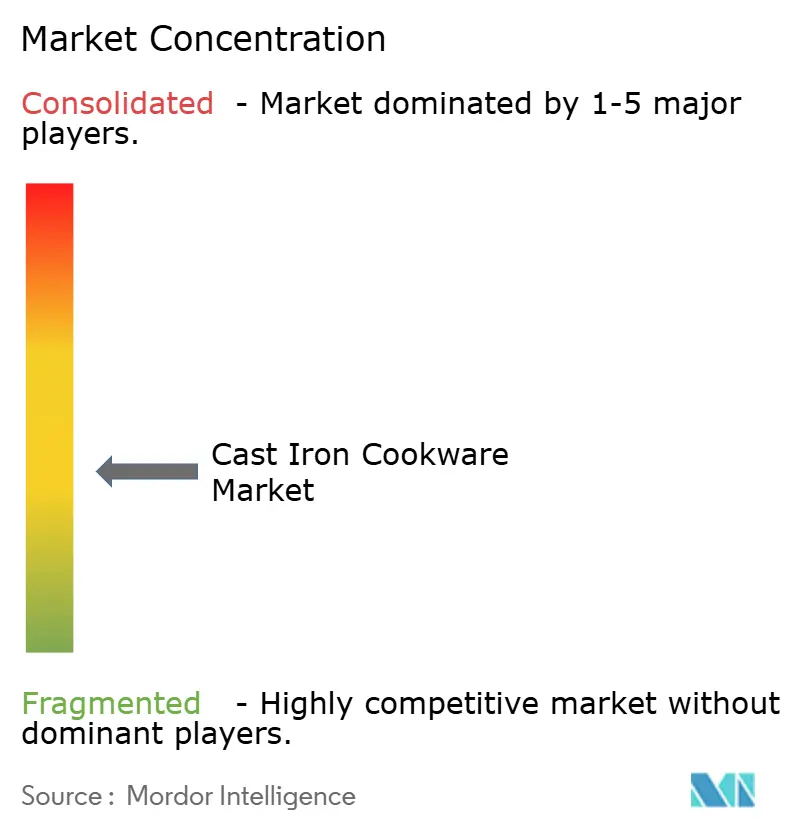
| Market Concentration | Medium |
Major Players *Disclaimer: Major Players sorted in no particular order Image © Mordor Intelligence. Reuse requires attribution under CC BY 4.0. | |
Cast Iron Cookware Market Analysis by Mordor Intelligence
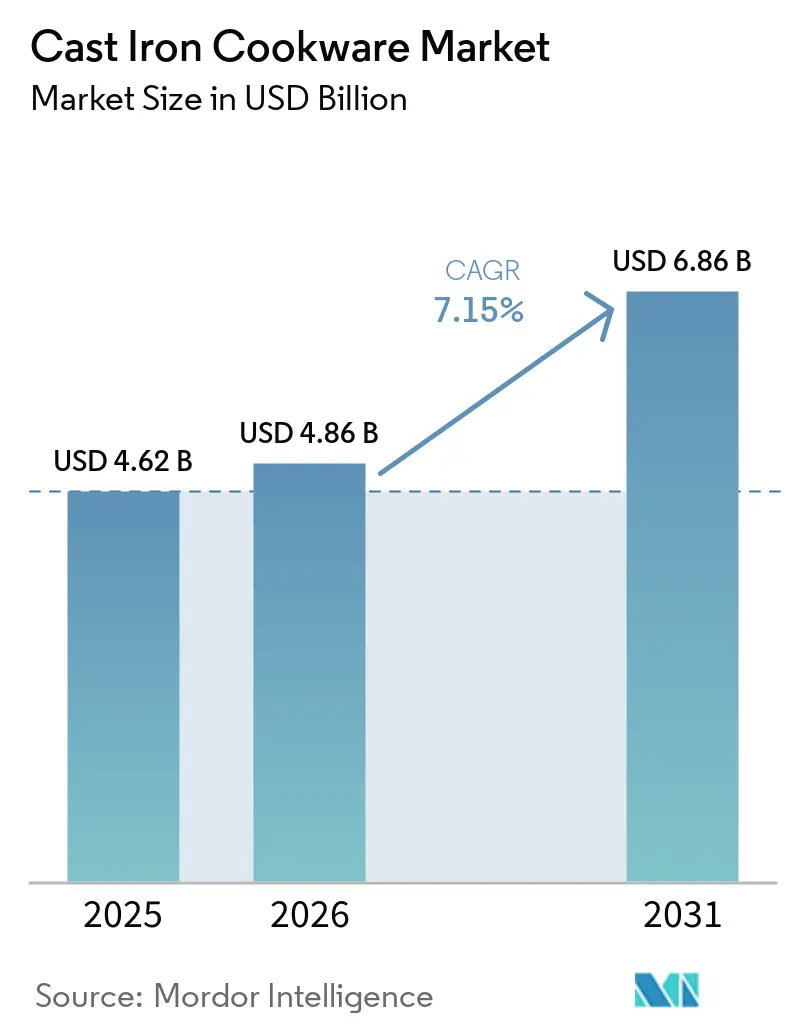
The cast iron cookware market size was valued at USD 4.62 billion in 2025 and is estimated to grow from USD 4.86 billion in 2026 to reach USD 6.86 billion by 2031, at a CAGR of 7.15% during the forecast period (2026-2031). The cast iron cookware market is benefiting from a steady shift toward cookware materials seen as durable, chemically stable, and suited to repeated household use, especially as scrutiny of PFAS in non-stick cookware has become more visible in the United States and Europe. Demand is also supported by a home-cooking pattern that remained firm through 2025, with cookware and bakeware sales rising 4%, indicating that consumers are still willing to spend on kitchen tools that can move across stovetop, oven, and table settings[1]HFN Digital, “Housewares State of Industry Report Reveals Pockets of Strength,” Home Furnishings News, hfndigital.com. Digital retail is widening access to the cast iron cookware market, as online channels accounted for 60% of home and housewares purchases in 2025, giving established and premium brands more room to explain product quality, heritage, and use cases through visual merchandising. The cast iron cookware market is also gaining support from premium buying behavior, because brands with strong provenance and long product life are better placed to defend pricing, while manufacturers that improve digital marketing and direct sales are putting themselves in a stronger position for margin retention. At the same time, the cast iron cookware market still faces pressure from raw material costs, product weight, and channel shifts that favor direct brands over wholesale-led suppliers, meaning operational discipline will remain important through the forecast period.
Key Report Takeaways
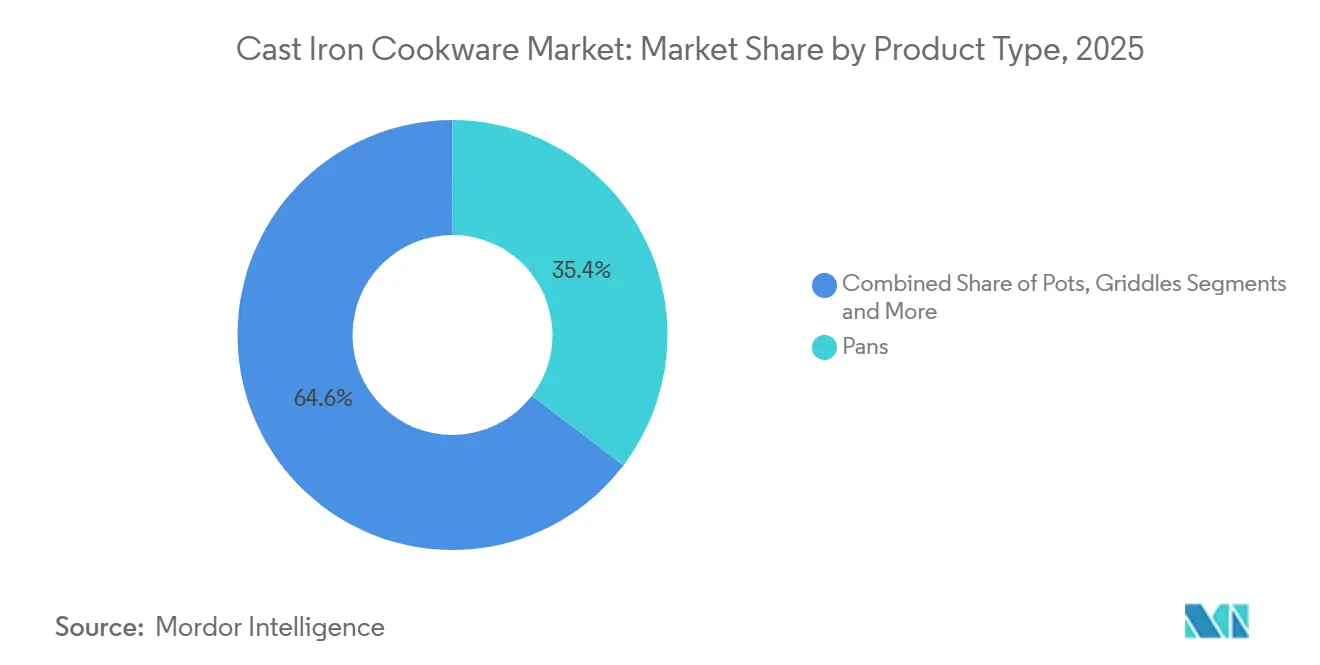
- By product type, pans held 35.37% of the cast iron cookware market share in 2025, while Dutch ovens and casseroles are forecast to expand at 7.83% CAGR through 2031.
- By coating type, enamel-coated products accounted for 43.62% share of the cast iron cookware market size in 2025, while seasoned products are advancing at 7.41% CAGR through 2031.
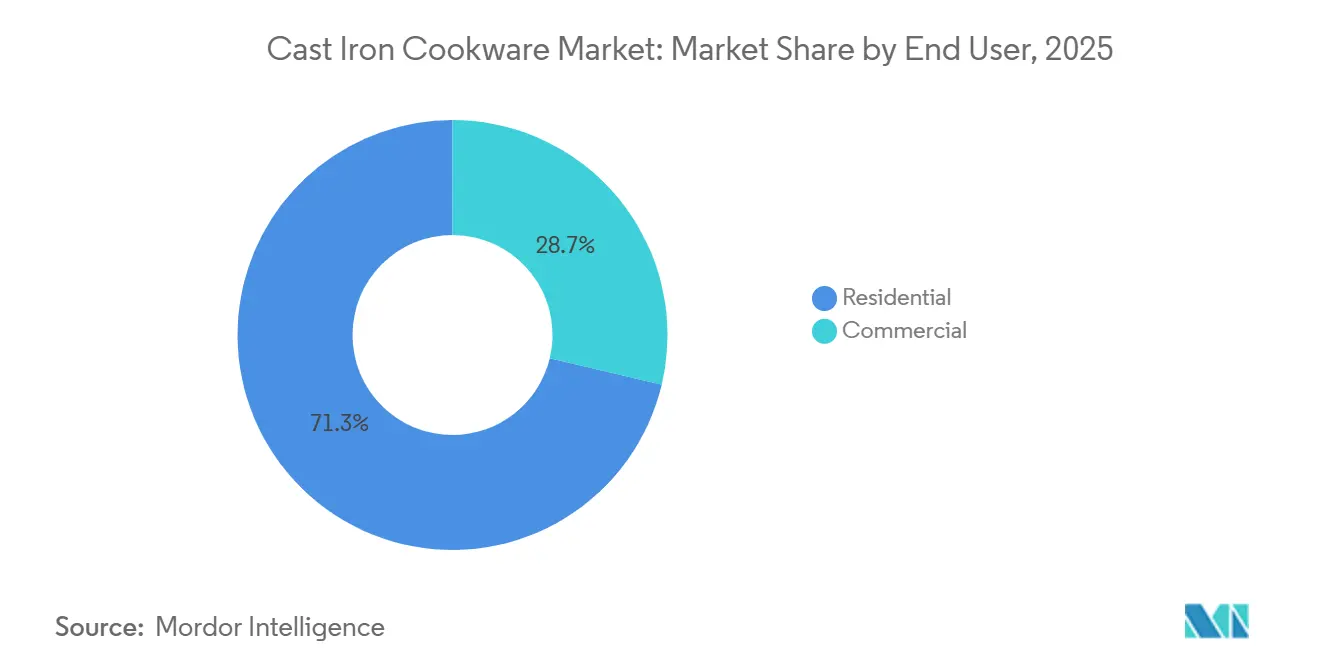
- By end user, residential users represented 71.28% of the cast iron cookware market size in 2025, while commercial users are projected to grow at 7.72% CAGR through 2031.
- By distribution channel, B2C channels commanded 75.94% of the cast iron cookware market size in 2025, while B2B channels are forecast to record the highest CAGR at 7.58% through 2031.
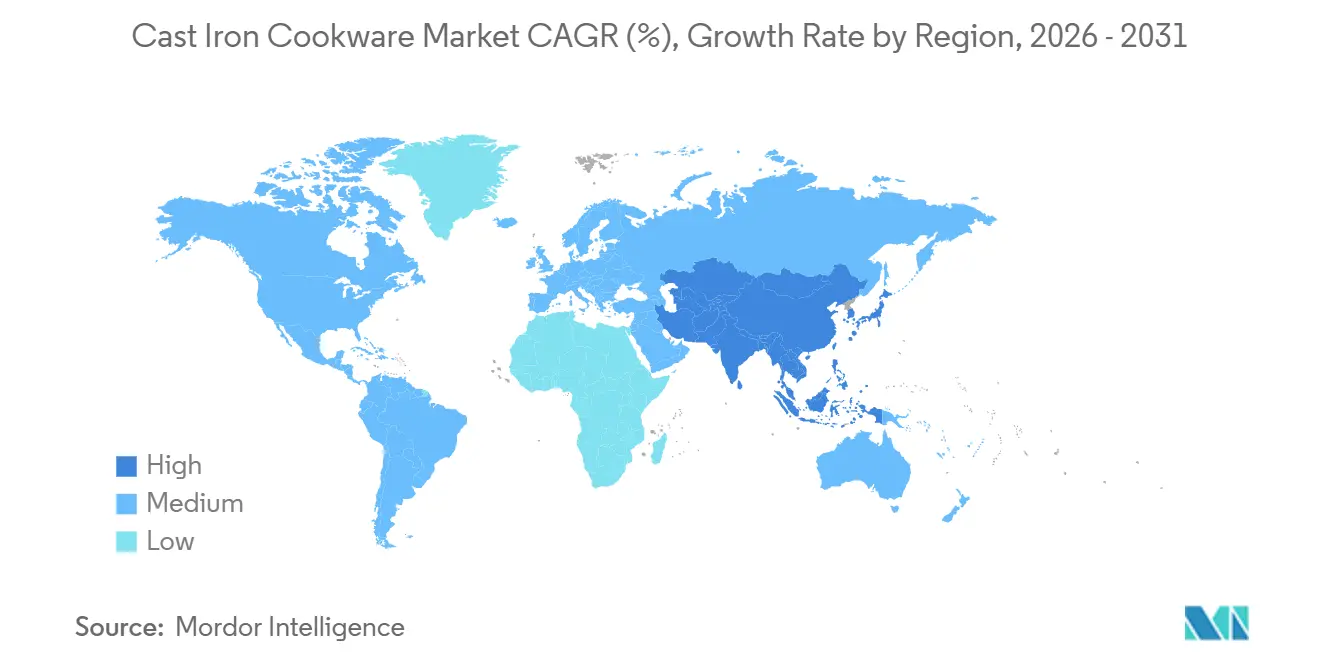
- By geography, North America held 35.00% of the cast iron cookware market share in 2025, while Asia-Pacific is projected to expand at 8.15% CAGR through 2031.
Note: Market size and forecast figures in this report are generated using Mordor Intelligence’s proprietary estimation framework, updated with the latest available data and insights as of January 2026.
Market Trends and Insights
Drivers Impact Analysis of Cast Iron Cookware Market*
| Driver | (~) % Impact on CAGR Forecast | Geographic Relevance | Impact Timeline |
|---|---|---|---|
| Long Product Life and Reusability of Cast Iron Cookware | +0.9% | Global, with peak intensity in North America and Europe | Short term (≤ 2 years) |
| Rising Home Cooking, Gourmet Cooking, and Culinary Experimentation | +1.5% | Global, concentrated in North America, Europe, and APAC urban centers | Short term (≤ 2 years) |
| Growing Consumer Preference for Premium and Heirloom-Quality Cookware | +1.1% | North America and Western Europe, with early-stage signals in APAC | Medium term (2-4 years) |
| Superior Heat Retention and Multi-Method Cooking Performance | +0.8% | Global | Short term (≤ 2 years) |
| Expansion of E-Commerce and Direct-to-Consumer Cookware Sales | +1.0% | North America, Europe, APAC core, with spillover to MEA | Medium term (2-4 years) |
| Growth of Outdoor Cooking, Camping, and Specialty Culinary Applications | +0.6% | North America, Australia, Northern Europe | Medium term (2-4 years) |
| Source: Mordor Intelligence | |||
Long Product Life and Reusability of Cast Iron Cookware
Cast iron's practical longevity argument has sharpened considerably as PFAS-related regulatory scrutiny removes the low price and convenience of disposable non-stick cookware from the competitive equation. By March 2026, nearly 100 PFAS bills had been introduced across 23 United States states, with an additional 280 bills carried over from 2025, creating legislative momentum that institutionalizes uncoated, inert-surface cookware as the durable default[2]Plastic Detox, “Cast Iron vs Stainless Steel vs Ceramic Cookware (2026)” Plastic Detox, plasticdetox.org. The supplied draft also links longevity to lower lifetime ownership costs and to continued use for many years when seasoning and rust control are properly handled. Practical durability matters across income groups because it allows cast iron to compete not only as a premium product but also as a rational replacement choice for households seeking fewer repeat purchases over time. The cast iron cookware market also benefits from the health-related narrative around uncoated cooking surfaces, as bare cast iron is often viewed as a cleaner, simpler option than synthetic-coated alternatives. Brands that keep their messaging centered on product life, safe material positioning, and everyday usability are therefore likely to hold stronger consumer trust than brands that rely mainly on visual styling.
Rising Home Cooking, Gourmet Cooking, and Culinary Experimentation
The cast iron cookware market is still being boosted by a home-cooking trend that has not faded since the pandemic, as consumers continue to treat kitchen activities as a normal part of daily life rather than a temporary habit. In 2025, cookware and bakeware sales rose 4%, and baking ingredients outsold ready-to-eat baked goods for the first time since 1980, indicating that households are still investing in tools for scratch cooking and oven-based preparation. That pattern supports cast iron because the material can move across the stovetop, oven, and serving settings without requiring several specialized vessels, which improves its appeal in smaller kitchens and in households that prefer multi-use products. The cast iron cookware market also aligns with a more experimental cooking style, as consumers use cookware for searing, baking, roasting, braising, and open-fire cooking in the same purchase cycle. This broad use profile matters across age groups because it supports both first-time buyers who want one dependable pan and experienced home cooks who want heavier formats like casseroles and Dutch ovens. The result is a category that keeps drawing repeat attention even when overall household budgets remain selective, because the product still maps well to daily use, gifting, and aspirational cooking behavior.
Growing Consumer Preference for Premium and Heirloom-Quality Cookware
The cast iron cookware market is also benefiting from premium buying behavior, as consumers in mature markets increasingly treat cookware as a long-lasting household item rather than a simple low-cost kitchen replacement. Premium cast iron brands are better placed to capture this demand when they combine material quality with brand history, local manufacturing stories, and product lines that hold visual appeal over time. This dynamic supports stronger direct sales economics, because premium cookware brands can explain craftsmanship, finish quality, and care needs more clearly in owned channels than in standard wholesale settings[3]Groupe SEB, “Result Down in 2025, Launch of a Plan to Return to Our Profitable Growth Trajectory,” BusinessWire, businesswire.com. The supplied draft also points to collectible behavior and color-led product cycles, indicating that buyers are not only replacing cookware but also purchasing for gifting, display, and repeat use across occasions. That matters for the cast iron cookware market because premium formats tend to carry wider gross margin room and lower direct price competition than basic lightweight cookware. It also means the market can grow in value even when unit expansion is more measured, because higher-priced products account for a larger share of demand.
Expansion of E-Commerce and Direct-to-Consumer Cookware Sales
The cast iron cookware market is being reshaped by e-commerce, because online sales channels make it easier for brands to explain seasoning, cleaning, heritage, and performance through images, video, and product education. In 2025, 60% of home and housewares purchases were made online, up from 58% in 2024, which confirms that digital shopping is not a side channel for cookware and is now central to category access. That shift favors brands with strong digital content and clear positioning, because cast iron often needs more explanation than disposable or lightly differentiated cookware. Groupe SEB's 2026 Rebound Plan placed digital marketing and online sales among its core priorities, which shows that large cookware groups are treating digital execution as an operating requirement rather than a marketing add-on. Lodge's factory store expansion in Louisiana also supports this point, as physical touchpoints can help drive product discovery. At the same time, the broader sales system increasingly relies on digital conversion and repeat purchase behavior. The cast iron cookware market is therefore seeing a stronger divide between brands that can manage both direct storytelling and multi-channel fulfillment, and brands that remain too dependent on third-party retail.
Restraints Impact Analysis of Cast Iron Cookware Market*
| Restraint | (~) % Impact on CAGR Forecast | Geographic Relevance | Impact Timeline |
|---|---|---|---|
| High Weight and Difficult Handling of Cast Iron Cookware | -0.8% | Global, most acute for aging demographics in North America and Europe | Short term (≤ 2 years) |
| Maintenance Requirements, Including Seasoning and Rust Prevention | -0.6% | Global, with the highest friction among APAC new adopters | Short term (≤ 2 years) |
| Higher Upfront Cost Compared With Lightweight Cookware Alternatives | -0.5% | APAC, MEA, South America, especially in price-sensitive segments | Medium term (2-4 years) |
| Competition From Non-Stick, Stainless Steel, and Aluminum Cookware | -0.9% | Global | Medium term (2-4 years) |
| Source: Mordor Intelligence | |||
High Weight and Difficult Handling of Cast Iron Cookware
Adoption of cast-iron cookware remains limited due to its weight. Compared to aluminum or many non-stick alternatives, cast iron cookware is significantly heavier. A standard skillet or Dutch oven can be cumbersome, making it less easy to use for some consumers and reducing the likelihood of frequent use after the initial purchase. This issue is especially relevant for older consumers, for users with lower upper-body strength, and for households that prioritize fast lifting, storage, and dishwasher-compatible cleanup over thermal performance. Manufacturers are trying to address that problem through lighter engineering, and the draft points to Lodge Blacklock and TTK Prestige Castlite as examples of products designed to reduce handling strain while maintaining core heat-retention benefits. Even so, lighter cast iron formats often sit at higher price points, which means the feature that improves accessibility does not always broaden reach for value-sensitive buyers. The cast iron cookware market will therefore continue to lose some casual users unless brands show why a heavier purchase can still offer better lifetime value than several replacement cycles in lighter cookware.
Competition From Non-Stick, Stainless Steel, and Aluminum Cookware
The cast iron cookware market also faces steady pressure from stainless steel, ceramic-coated non-stick, aluminum, and carbon steel products that perform many of the same cooking tasks with less effort to handle. This competitive pressure intensifies when buyers rank convenience above durability, because alternative materials often heat up faster, weigh less, and require less upkeep in everyday use. The regulatory backdrop does support cast iron over some coated cookware. Still, it does not guarantee that substitution will flow only into cast iron, because stainless steel and PFAS-free ceramic options also benefit from the same safety discussion. That is why large cookware groups often maintain broad portfolios across several materials rather than relying solely on cast iron, which slows cast iron's share gains within diversified companies[4]Groupe SEB, “2024, Sustained Growth and Results Improvement,” Nasdaq, nasdaq.com. In commercial kitchens, stainless steel also offers advantages for operations that require faster temperature changes, lower weight, and easier high-volume cleaning. The cast iron cookware market, therefore, advances fastest where its strengths are harder to match, including bread baking, searing, outdoor cooking, table presentation, and premium residential formats that buyers associate with quality and long life.
*Our forecasts treat driver/restraint impacts as directional, not additive. The impact forecasts reflect baseline growth, mix effects, and variable interactions.
Cast Iron Cookware Market Segment Analysis
By Product Type:
Everyday Skillets Lead Share, Premium Formats Drive Growth MomentumPans held 35.37% of the 2025 cast iron cookware market, which made them the largest product category and the most common entry point for first-time household buyers. This lead reflects broad price coverage, because pans are available in accessible mass formats as well as polished artisan versions that target premium buyers who want surface refinement, heritage styling, and long-term ownership. The cast iron cookware industry also benefits from the skillet's role as the most versatile everyday format, as it supports frying, searing, baking, reheating, and oven finishing in a single vessel. That practical versatility matters in residential kitchens where buyers often want one product that covers several cooking tasks without adding storage complexity. Pans also translate well across regions, because they fit both traditional retail selling and digital channels, where simple form factors are easier to compare on price, finish, and size.
Dutch ovens and casseroles are forecast to grow at a 7.83% CAGR from 2026 to 2031, making them the fastest-growing product type in the cast iron cookware market. Their growth is being supported by oven-based cooking, gifting, premium kitchen presentation, and the wider use of cookware as a visible household item rather than a purely functional tool. The supplied draft links this category to bread baking, kitchen-to-table dining, and higher-income purchase behavior, which helps explain why value growth can remain firm even when unit movement is more selective. Griddles, grill pans, and bakeware form the middle layer of the product mix and benefit directly from outdoor cooking and open-fire use, which broadens the cast iron cookware market beyond indoor household demand. Pots remain stable through replacement and commercial demand, while other specialty forms serve enthusiasts in markets where culinary traditions and brand loyalty sustain smaller subcategories over the long term.



By Coating Type:
Enamel Commands Value Share, Seasoned Accelerates On AccessibilityEnamel-coated products accounted for 43.62% of the market in 2025, making them the largest coating type in the cast iron cookware market. This lead comes from a mix of corrosion resistance, easier maintenance, broad color options, and strong acceptance in premium retail formats where design and table presentation shape conversion. Enamel also helps remove one of the category's biggest friction points, because buyers do not need to build an initial seasoning layer before regular use. That matters in the cast iron cookware industry because many newer users want the heat-retention and durability benefits of cast iron without having to adopt a more demanding care routine from the first day. Premium brands have been especially successful here because enamel supports repeat purchase behavior through color extensions, gifting, and visually differentiated collections.
Seasoned products are projected to grow at a 7.41% CAGR through 2031, making them the fastest-growing coating type in the cast iron cookware market. Their momentum comes from factory pre-seasoning, which lowers the setup barrier that historically kept some first-time buyers away from bare cast iron. This makes seasoned cookware a strong bridge between old category use habits and newer convenience expectations, especially in markets where consumers want durable materials at more accessible price points than premium enamel formats. Unseasoned cookware remains a smaller but stable niche, serving experienced users and some professional buyers who prefer to control the seasoning process themselves. A simple trade-off is therefore helping the cast iron cookware market size for seasoned formats: manufacturers can preserve the traditional material profile while removing just enough friction to widen adoption among households moving away from coated non-stick cookware.
By End User:
Residential Commands Demand, Commercial Builds FasterResidential users accounted for 71.28% of 2025 demand, confirming households as the primary base of the cast iron cookware market. Home kitchens remain the category's strongest demand center because cast iron fits everyday cooking, gifting, kitchen display, and long replacement cycles better than many commercial environments that prioritize lighter tools and faster cleaning. The supplied draft also ties residential demand to weddings, holidays, and status buying, which means part of the category volume is not linked solely to direct household need or immediate replacement. That matters because it gives the market a broader buying base across daily use, premium purchases, and special occasions. Residential demand is also helped by the fact that cast iron products often remain visible in kitchens and dining settings, which reinforces attachment, word of mouth, and repeat purchase across accessory or size upgrades.
Commercial users are forecast to grow at a 7.72% CAGR from 2026 to 2031, making them the fastest-growing end-user segment in the cast iron cookware market. This expansion is tied to foodservice growth in Asia-Pacific and Latin America, as well as the need for durable cookware in operations that run long hours and require longer replacement cycles. The draft also highlights cloud kitchens and ghost kitchens as a meaningful B2B demand source, because these formats buy through organized procurement and favor tools that can tolerate repeated high-heat use. Commercial buyers usually evaluate cost over years of service rather than first purchase price alone, which can improve cast iron's case even when the category starts from a smaller share base. The cast iron cookware market share held by residential buyers remains much larger. Still, commercial growth is important because it brings a steadier institutional demand layer and can support larger-scale procurement for manufacturers with stronger B2B distribution.
By Distribution Channel:
B2C Maintains Volume Dominance, B2B Gains Strategic MomentumB2C channels accounted for 75.94% of 2025 revenues, keeping consumer retail as the dominant distribution channel for the cast iron cookware market. This reflects the category's long dependence on household buying, gift purchasing, specialty kitchen stores, digital marketplaces, and direct brand websites that target home users rather than institutional accounts. The rise in e-commerce reinforced this structure, because online channels made it easier for buyers to compare coatings, sizes, weights, and brand stories before making a purchase. Specialty retail still matters for premium enamel items and higher-ticket Dutch ovens, because tactile displays and in-person brand exposure can improve conversion rates for products that often carry higher prices. Lodge's Louisiana factory store shows how physical brand spaces can support the cast iron cookware market without changing the broader fact that most purchase discovery and repeat buying increasingly rely on digital systems.
B2B channels are projected to grow at a 7.58% CAGR through 2031, making them the fastest-growing route to market in the cast iron cookware market. This shift is tied to foodservice operators, hospitality groups, caterers, and cloud kitchen models that are becoming more structured in procurement and more focused on asset life over time. B2B buying differs from B2C because product appearance matters less than durability, temperature retention, and replacement economics under repeated use. That gives cast iron a clear advantage in some commercial settings, even though the product remains too heavy or too slow to change for parts of institutional cooking. The cast iron cookware market is therefore moving toward a more balanced channel mix, where B2C still accounts for the majority of revenue. At the same time, B2B becomes a more strategic growth channel for manufacturers with established commercial networks.
Geography Analysis
North America Cast Iron Cookware Market
North America accounted for 35.00% of the global cast iron cookware market in 2025, which made it the largest regional contributor by value. The region's leadership comes from strong household familiarity with cast iron, a deep installed base of specialty and mass retail channels, and the presence of long-established brands that keep the category visible across price tiers. Lodge remains a major anchor in the United States, and its factory store expansion in Louisiana showed that brand-led physical retail still has value when it supports regional reach and reinforces direct engagement with buyers. Regulatory pressure on PFAS in cookware also supports the regional outlook, as public discussion is pushing more buyers toward cookware materials seen as durable and chemically stable. This does not remove competition from stainless steel or ceramic-coated cookware, but it does keep the cast iron cookware market in a favorable position when buyers reassess coated products.
Europe Cast Iron Cookware Market
Europe held the second-largest share of the cast iron cookware market, supported by strong culinary traditions and a premium view of long-life kitchen goods across France, Germany, the United Kingdom, Italy, and the Nordic countries. The region benefits from a premium manufacturing heritage, as brands such as Staub and Le Creuset are tied to local production narratives that help defend pricing and reinforce product quality in consumers' eyes. Staub's FutureFoundry project in Merville, France, with an investment of EUR 42 million (USD 46.2 million), demonstrates that European producers are still investing in foundry modernization and lower-emission production systems as part of their long-term positioning. Germany also remains relevant, as the national kitchen sector stabilized at EUR 5.63 billion (USD 6.2 billion) in 2025, supporting demand for durable, investment-grade kitchen equipment in a market known for quality-oriented buying behavior. Europe, therefore, provides the cast iron cookware market with a strong premium base, where provenance, design quality, and material trust can matter as much as utility.
APAC, MEA and South America Cast Iron Cookware Market
Asia-Pacific is projected to grow at 8.15% CAGR from 2026 to 2031, making it the fastest-growing region in the cast iron cookware market. Growth in the region is linked to household trade-up from aluminum and low-end cookware, broader premiumization in urban centers, and the rise of foodservice formats that are building more organized procurement systems. India stands out because TTK Prestige committed INR 500 crore (USD 60 million) to expansion and has continued to position cast iron as one of its core premium growth categories. The cast iron cookware market in Asia-Pacific is also supported by the region's dual role as both a major manufacturing base and a rising consumption zone, which means demand growth can be reinforced by simultaneous product development and local brand building. The Middle East and Africa remain earlier-stage markets. At the same time, South America adds incremental volume, but Asia-Pacific offers the clearest long-term expansion path because household upgrading and foodservice growth are moving together.

Competitive Landscape
The cast iron cookware market shows moderate concentration at the premium end and broader fragmentation across volume and mid-priced segments, meaning a small set of well-known brands has the strongest visibility. At the same time, many other players compete by price, channel, or regional focus. Lodge Manufacturing Company and Le Creuset remain central names in the category, because both combine long brand histories with clear product positioning and multi-channel reach that newer entrants still find difficult to match. Groupe SEB is the most diversified global participant in the cast iron cookware market, since it manages several cookware brands across more than 150 countries and connects residential and professional demand through a wide distribution network. The group's acquisition of La Brigade de Buyer in early 2025 strengthened its position in professional culinary. It expanded its premium cookware coverage, demonstrating how larger companies are using portfolio depth to defend share rather than relying on a single material category. This leaves the cast iron cookware market open to focused specialists that can move faster in one category, especially when they have a sharper direct-to-consumer message than broader cookware groups.
Competition is increasingly shaped by product engineering and digital execution rather than by foundry scale alone, because consumers are comparing weight, finish, usability, and brand identity more closely than before. Lodge has responded with lighter Blacklock designs and branded retail expansion. At the same time, TTK Prestige moved into lighter cast iron with the Castlite line, showing that manufacturers are directly addressing the weight barrier rather than treating it as a fixed category condition. Groupe SEB also launched its 2026 Rebound Plan, with a strong focus on digital marketing, online sales, industrial efficiency, and SKU discipline, signaling that operating execution is becoming as important as brand legacy in the cast iron cookware market. These moves matter because premium cast iron buyers often want more product education, and digital strength can directly improve conversion, loyalty, and margin retention. As a result, the market is rewarding brands that combine strong material credibility with simpler user onboarding, better storytelling, and tighter control over channel economics.
At the premium artisan end, brands such as Smithey Ironware and FINEX continue to challenge larger players by emphasizing refined surfaces, craftsmanship, and small-batch production, even though their scale remains narrower than that of the heritage leaders. Mid-market brands without a clear direct presence or a distinct performance claim face the most pressure, because they compete against low-cost imports on one side and premium brands with a stronger identity on the other. Fissler and BergHOFF still hold defensible design-led niches in Europe. At the same time, Victoria and Tramontina remain relevant in value-oriented and regional use cases, which keeps the cast iron cookware market broad even when top-tier visibility is concentrated. The main competitive fault lines through 2031 are likely to be lightweight product innovation, stronger B2B access in Asia-Pacific, and the ability to convert digital discovery into repeat direct sales.
Cast Iron Cookware Industry Leaders
Lodge Cast Iron
Le Creuset
Staub
Tramontina
Victoria
- *Disclaimer: Major Players sorted in no particular order
Cast Iron Cookware Market Companies Covered in this Report
- Lodge Cast Iron
- Le Creuset
- Staub
- Tramontina
- Victoria
- Meyer Corporation
- Made In Cookware
- Groupe SEB
- Cuisinart
- Camp Chef
- The Vollrath Company, L.L.C.
- Fissler
- Field Company
- TTK Prestige Ltd.
- Emile Henry
- BergHOFF
- Smithey Ironware Company
- FINEX Cast Iron Cookware Co.
- Skeppshult
- Lodge Manufacturing Company

Recent Industry Developments in Cast Iron Cookware Market
- March 2026: TTK Prestige opened the Sri T.T. Jagannathan Innovation Center in Bengaluru, investing INR 15 crore (approximately USD 1.66 million). The center focuses on accelerating the development of cookware made from cast iron, stainless steel, and ceramics. Along with a revamped research and development center in Hosur, the infrastructure is expected to halve product development lead times and strengthen Prestige's position in materials innovation within the kitchen sector in India.
- March 2026: TTK Prestige introduced the Ferrocast FLO Smooth Finish Cast Iron range. The range is factory-preseasoned, induction-compatible, and comes with a lifetime warranty. It is designed for health-conscious urban consumers in India transitioning from aluminum cookware. The smooth finish delivers near-nonstick performance and addresses usability challenges in entry-level cast-iron cookware.
- February 2026: Groupe SEB implemented the Rebound Plan, targeting annualized savings of USD 235.26 million (EUR 200 million) by the end of 2027. The plan aims to achieve 5% annual organic sales growth and a 10% operating margin. It focuses on accelerating innovation, improving digital marketing, rationalizing stock-keeping units, and enhancing industrial efficiency.


Global Cast Iron Cookware Market Report Scope
Cast iron cookware is heavy-duty cookware valued for its exceptional heat retention, durability, and versatility across various cooking surfaces. Unlike alternative materials like aluminum or stainless steel, which cool down quickly, cast iron provides steady, uniform heat distribution ideal for long-simmering, searing, and baking. The cast iron cookware market is segmented by product type, coating type, end user, distribution channel, and geography. By product type, the market is segmented into pans, pots, Dutch ovens and casseroles, griddles, grill pans, bakeware, and other cookware products. By coating type, the market is segmented into enamel-coated, seasoned, and unseasoned. By end user, the market is segmented into residential and commercial. By distribution channel, the market is segmented into B2C channels (further breakdown includes hypermarkets and supermarkets, specialty stores, home centers, online, and other distribution channels) and B2B channels. By geography, the market is segmented into North America, South America, Europe, Asia-Pacific, and the Middle East & Africa. The report provides the market size in USD for all the above-mentioned segments.
| Pans |
| Pots |
| Dutch Ovens and Casseroles |
| Griddles |
| Grill Pans |
| Bakeware |
| Other Cookware Products |
| Enamel Coated |
| Seasoned |
| Unseasoned |
| Residential |
| Commercial |
| B2C Channels | Hypermarkets and Supermarkets |
| Specialty Stores | |
| Home Centers | |
| Online | |
| Other Distribution Channels | |
| B2B Channels |
| North America | Canada |
| United States | |
| Mexico | |
| South America | Brazil |
| Peru | |
| Chile | |
| Argentina | |
| Rest of South America | |
| Europe | United Kingdom |
| Germany | |
| France | |
| Spain | |
| Italy | |
| BENELUX (Belgium, Netherlands, Luxembourg) | |
| NORDICS (Denmark, Finland, Iceland, Norway, Sweden) | |
| Rest of Europe | |
| Asia-Pacific | India |
| China | |
| Japan | |
| Australia | |
| South Korea | |
| South-East Asia | |
| Rest of Asia-Pacific | |
| Middle East & Africa | United Arab Emirates |
| Saudi Arabia | |
| South Africa | |
| Nigeria | |
| Rest of Middle East & Africa |
| By Product Type | Pans | |
| Pots | ||
| Dutch Ovens and Casseroles | ||
| Griddles | ||
| Grill Pans | ||
| Bakeware | ||
| Other Cookware Products | ||
| By Coating Type | Enamel Coated | |
| Seasoned | ||
| Unseasoned | ||
| By End User | Residential | |
| Commercial | ||
| By Distribution Channel | B2C Channels | Hypermarkets and Supermarkets |
| Specialty Stores | ||
| Home Centers | ||
| Online | ||
| Other Distribution Channels | ||
| B2B Channels | ||
| By Geography | North America | Canada |
| United States | ||
| Mexico | ||
| South America | Brazil | |
| Peru | ||
| Chile | ||
| Argentina | ||
| Rest of South America | ||
| Europe | United Kingdom | |
| Germany | ||
| France | ||
| Spain | ||
| Italy | ||
| BENELUX (Belgium, Netherlands, Luxembourg) | ||
| NORDICS (Denmark, Finland, Iceland, Norway, Sweden) | ||
| Rest of Europe | ||
| Asia-Pacific | India | |
| China | ||
| Japan | ||
| Australia | ||
| South Korea | ||
| South-East Asia | ||
| Rest of Asia-Pacific | ||
| Middle East & Africa | United Arab Emirates | |
| Saudi Arabia | ||
| South Africa | ||
| Nigeria | ||
| Rest of Middle East & Africa | ||


Key Questions Answered in the Report
What is the 2026 value of the cast iron cookware market?
The cast iron cookware market is estimated at USD 4.86 billion in 2026 and is projected to reach USD 6.86 billion by 2031 at a 7.15% CAGR.
Which product category leads cast iron cookware sales?
Pans led the category with 35.37% share in 2025, reflecting their role as the most common first purchase and most versatile everyday format.
Which type of cast iron cookware coating is growing the fastest?
Seasoned products are projected to expand at a 7.41% CAGR through 2031, as factory-preseasoning lowers the setup barrier for new users.
Why is North America the largest regional contributor?
North America held 35.00% share in 2025, supported by strong household familiarity, long-established brands, broad retail access, and rising scrutiny of PFAS-based cookware.
Which buyer group is expanding faster, residential or commercial?
Residential buyers still dominate with 71.28% share in 2025, but commercial demand is growing faster at 7.72% CAGR through 2031 as foodservice and cloud kitchen procurement expand.
What is changing competition in cast iron cookware?
Lightweight product innovation, stronger digital selling, and wider B2B access are shaping competition, with examples including Lodge retail expansion, Groupe SEB's digital push, and TTK Prestige's Castlite launch.
Page last updated on:





