
Care Management Solutions Market Size and Share
Market Overview
| Study Period | 2020 - 2031 |
|---|---|
| Market Size (2026) | USD 20.44 Billion |
| Market Size (2031) | USD 37.73 Billion |
| Growth Rate (2026 - 2031) | 13.04 % |
| Fastest Growing Market | Asia Pacific |
| Largest Market | North America |
| Market Concentration | Medium |
Major Players *Disclaimer: Major Players sorted in no particular order Image © Mordor Intelligence. Reuse requires attribution under CC BY 4.0. | |
Care Management Solutions Market Analysis by Mordor Intelligence
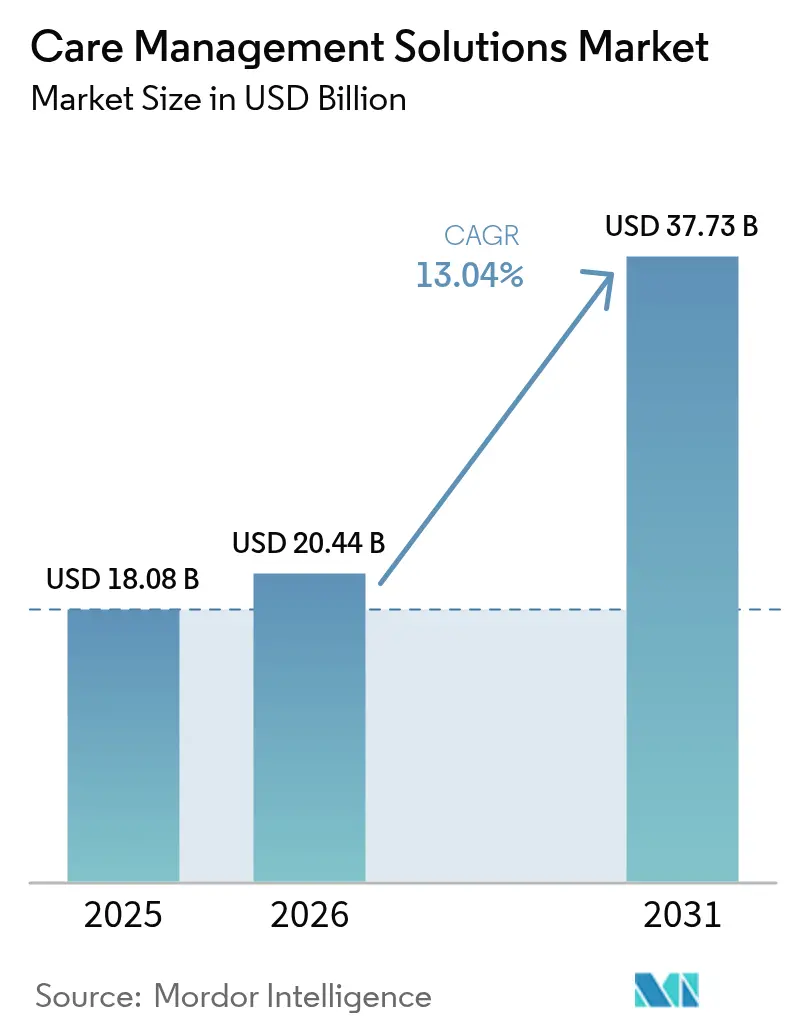
Care management solutions market size in 2026 is estimated at USD 20.44 billion, growing from 2025 value of USD 18.08 billion with 2031 projections showing USD 37.73 billion, growing at 13.04% CAGR over 2026-2031. This growth is rooted in the global shift to value-based reimbursement, mounting cost-containment pressure, and new rules that forbid AI from making coverage decisions without human review. Cloud-first deployments, social-determinants analytics, and predictive risk-stratification engines are rapidly moving from optional upgrades to baseline requirements, while cybersecurity incidents have heightened executive focus on data-protection features. Although algorithm-bias laws raise compliance costs, they reward vendors that can prove transparency and fairness, giving innovation-oriented platforms a clear commercial edge.
Key Report Takeaways
- By component, software held 71.78% revenue share in 2025, while services are projected to expand at a 16.09% CAGR through 2031.
- By delivery mode, cloud-based platforms commanded 67.10% of the care management solutions market share in 2025 and are forecast to grow at 14.96% CAGR.
- By function, disease and case management contributed 37.35% share in 2025, whereas social-determinants analytics is set to climb at a 16.32% CAGR.
- By end user, payers led with 53.82% share in 2025, while providers will post the fastest 13.98% CAGR to 2031.
- By geography, North America dominated with 45.05% share in 2025; Asia-Pacific is on track for a 13.78% CAGR, the fastest worldwide.
Note: Market size and forecast figures in this report are generated using Mordor Intelligence’s proprietary estimation framework, updated with the latest available data and insights as of 2026.
Market Trends and Insights
Drivers Impact Analysis of Care Management Solutions Market*
| Driver | (~) % Impact on CAGR Forecast | Geographic Relevance | Impact Timeline |
|---|---|---|---|
| Rising geriatric population & chronic-disease burden | +2.8% | Global, concentrated in North America & Europe | Long term (≥ 4 years) |
| Global shift to value-based reimbursement models | +3.2% | North America & EU leading, APAC emerging | Medium term (2-4 years) |
| Cost-containment pressure on payers & providers | +2.1% | Global, acute in North America | Short term (≤ 2 years) |
| AI-driven predictive risk-stratification adoption | +1.9% | North America & EU core, spill-over to APAC | Medium term (2-4 years) |
| Integration of social-determinants-of-health data sets | +1.4% | North America leading, EU following | Long term (≥ 4 years) |
| Government incentives & funding for health-IT modernization | +1.8% | Global, US federal programs leading | Short term (≤ 2 years) |
| Source: Mordor Intelligence | |||
Rising Geriatric Population & Chronic-Disease Burden
The graying of the population is swelling demand for coordinated chronic-care programs that stretch across primary, acute, and post-acute settings. Chronic conditions already account for 90% of healthcare spending in the United States. Health systems are deploying AI tools that flag at-risk seniors days before hospitalization, as seen at West Tennessee Healthcare, which saved USD 5 million by optimizing discharge plans. Remote-patient-monitoring platforms layered onto care-management suites now detect early deterioration and adjust treatment in real time. Post-acute providers use embedded analytics to automate documentation and reduce readmissions.
Global Shift to Value-Based Reimbursement Models
CMS aims to move every Medicare member into a value-based arrangement by 2030, a target that accelerates investment in population-health analytics capable of tracking quality metrics and managing downside risk. Specialty disease programs built on capitated payments allow narrower risk pools and deeper coordination. Oregon’s Primary Care VBP model adds equity-focused quality measures that reward providers for closing care gaps linked to social determinants.[1]Oregon Health Authority Staff, “Primary Care Value-Based Payment Model,” Oregon Health Authority, oregon.gov Analytics that reconcile clinical and claims data are therefore transitioning from nice-to-have dashboards to core contracting tools, as AlohaCare demonstrated by reclaiming 12,500 staff hours and raising referral completion rates.
Cost-Containment Pressure on Payers & Providers
Medical inflation is projected to run 7-8% in 2025, double historical norms, prompting rapid uptake of automation that trims administrative overhead tmgworkcomp.com. Optum’s Integrity One boosted coding productivity by 20% during pilots, underscoring returns that AI can deliver in revenue-cycle functions. Escalating bills for GLP-1 drugs and gene therapies amplify urgency for utilization-management analytics that steer costly therapies to the highest-value patients. Provider groups also lean on real-time documentation capture to free clinicians from clerical work while improving note accuracy.
AI-Driven Predictive Risk-Stratification Adoption
Two-thirds of US health systems now run predictive models to guide resource allocation. Arcadia’s Care Manager funnels algorithm-generated task lists to nurses so they focus on patients with the greatest likelihood of adverse events. Federal rules under HTI-1 compel vendors to document risk-management practices and make model information available to users, spurring more rigorous governance frameworks. Yet only 61% of hospitals validate model accuracy and 44% audit for bias, signaling room for services that help providers operationalize responsible-AI policies.
Restraints Impact Analysis of Care Management Solutions Market*
| Restraint | (~) % Impact on CAGR Forecast | Geographic Relevance | Impact Timeline |
|---|---|---|---|
| High up-front integration & change-management costs | -1.8% | Global, acute in smaller systems | Short term (≤ 2 years) |
| Cyber-security & privacy-breach concerns | -2.1% | Global, heightened in North America | Medium term (2-4 years) |
| Emerging algorithm-bias & health-equity regulations | -1.2% | North America & EU | Medium term (2-4 years) |
| Interoperability hurdles from fragmented EHR ecosystems | -1.6% | Global, severe in fragmented markets | Long term (≥ 4 years) |
| Source: Mordor Intelligence | |||
High Up-Front Integration & Change-Management Costs
Smaller hospitals face six-figure licensing fees and must also budget for workflow redesign, data migration, and multi-year staff training. Tight margins make it hard to fund specialized population-health roles needed to extract full value from new platforms. Phased rollouts and cloud subscriptions lighten infrastructure loads, yet total cost of ownership remains a gating factor for many mid-tier systems.
Cyber-Security & Privacy-Breach Concerns
The 2024 ransomware attack on Change Healthcare exposed more than 100 million records and cost UnitedHealth hundreds of millions of dollars, highlighting systemic vulnerabilities. Average breach costs in the sector now stand at USD 9.77 million, steering capital toward threat-detection tools instead of expansion projects continued attacks by groups like Rhysida fuel board-level scrutiny of any cloud deal.
*Our forecasts treat driver/restraint impacts as directional, not additive. The impact forecasts reflect baseline growth, mix effects, and variable interactions.
Care Management Solutions Market Segment Analysis
By Component:
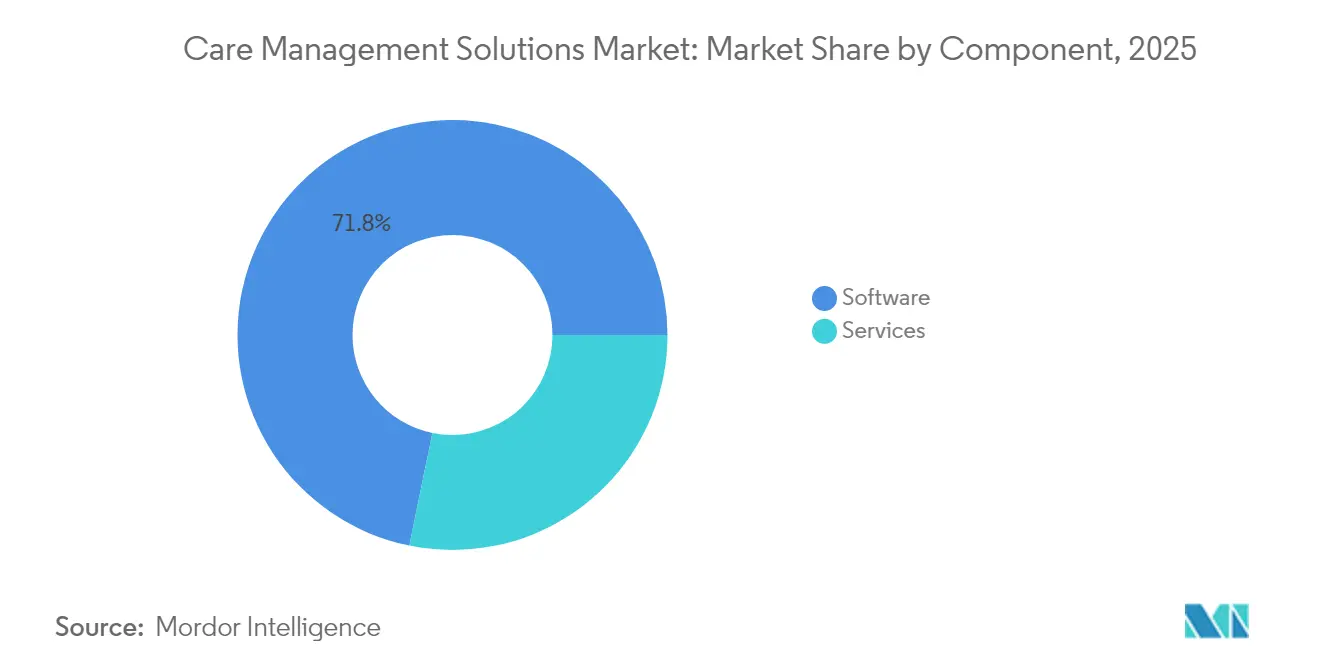
Services Drive Implementation ExcellenceIn 2025, software modules anchored the segment with 71.78% share, reflecting the central role of population-health analytics and care-coordination dashboards in enterprise strategies. The care management solutions market size for services reached USD 5.1 billion in 2025 and is projected to outpace software with a 16.09% CAGR as hospitals seek external expertise for implementation, optimization, and staff training. Consulting teams guide value-based-care transitions, configure predictive-model libraries, and certify compliance with emerging AI regulations. Managed services increasingly bundle clinical staffing, quality reporting, and community-partner coordination, turning recurring fees into sticky revenue streams.
Demand for business-process outsourcing is also climbing as payers offload prior-authorization queues and care-gap outreach to specialized vendors. Providers value post-deployment education that keeps staff current on new workflows, which boosts platform utilization rates and strengthens renewal cycles. The growing reliance on outside expertise positions service vendors to shape purchasing requirements and deepen client lock-in, reinforcing their strategic importance within the broader care management solutions market.



By Delivery Mode:
Cloud Platforms Enable Scalable InnovationCloud and SaaS options captured 67.10% share in 2025 and will grow at a 14.96% CAGR, underscoring their unmatched scalability for remote-monitoring feeds, AI pipelines, and multi-site user bases. The care management solutions market size tied to on-premise licenses is shrinking as CIOs shift capital budgets toward subscription models that deliver continuous upgrades and lower infrastructure risk. Private-cloud hosting still appeals to organizations with strict data-sovereignty mandates, yet the speed of feature releases on multi-tenant SaaS is widening the innovation gap.
Cloud-native platforms embed AI services that small organizations could not otherwise afford, making advanced risk-stratification and natural-language processing broadly accessible. They also facilitate real-time data exchange under nationwide information-blocking rules, driving broader network effects. Vendors bundle high-availability SLAs and managed security layers that exceed what many provider IT teams can build internally, accelerating cloud adoption across the care management solutions market.
By Function:
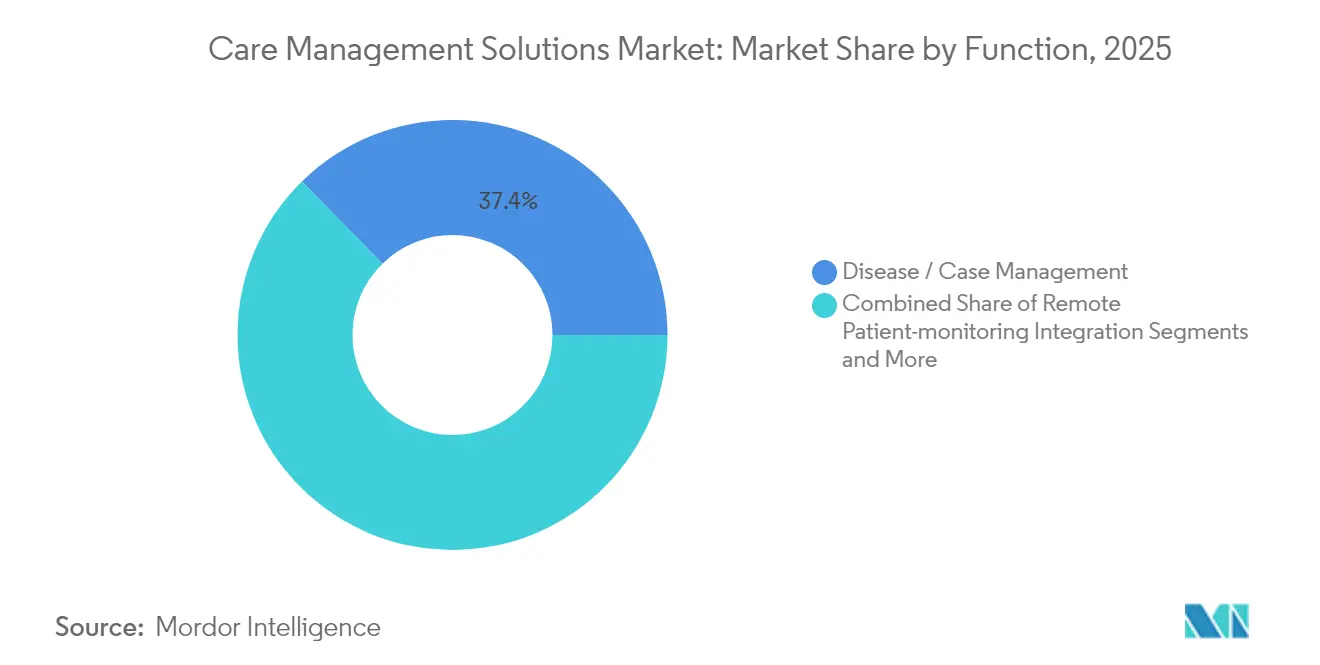
Social-Determinants Analytics Reshape Care DeliveryDisease and case-management modules remained the largest slice at 37.35% in 2025, fueled by chronic-care coordination mandates. However, social-determinants analytics and risk-stratification tools will post the fastest 16.32% CAGR, reflecting payers’ and providers’ intent to target non-clinical drivers of utilization. The segment accounts for 22.45% of the care management solutions market size today but is on pace to nearly double by 2031. Vendors that integrate housing, food, and transportation records inside patient timelines improve predictive accuracy and unlock new reimbursement streams anchored in health equity.
Utilization-management engines sustain steady growth as specialty drugs and gene therapies raise financial stakes. AI monitors prior-authorization volumes, flags high-cost claims for clinical review, and suggests alternative care paths. Transitional-care workflows also gain prominence as hospitals tie readmission avoidance targets to value-based contracts, creating downstream demand for post-discharge monitoring and caregiver engagement features inside the broader care management solutions market.
By End User:
Providers Accelerate Care Coordination AdoptionPayers dominated with 53.82% share in 2025, driven by commercial insurers and government programs that fund multi-year population-health investments. Nonetheless, provider organizations will register the fastest 13.98% CAGR as hospitals, physician groups, and ACOs take on greater financial risk. Many providers now own or participate in health plans, blurring traditional boundaries and amplifying internal demand for integrated analytics. Provider demand is further amplified by the HOME-Health final rule that incentivizes aging-in-place services, creating reimbursement tailwinds for home-based care-management suites.
Self-insured employers emerge as influential buyers seeking lower total cost of care, while pharmaceutical firms leverage care-management data to run adherence programs and real-world-evidence studies. These shifts broaden the addressable care management solutions market, fostering competition among vendors to package modular offerings for an expanding universe of stakeholders.
Geography Analysis
North America, EMEA and APAC Care Management Solutions Market
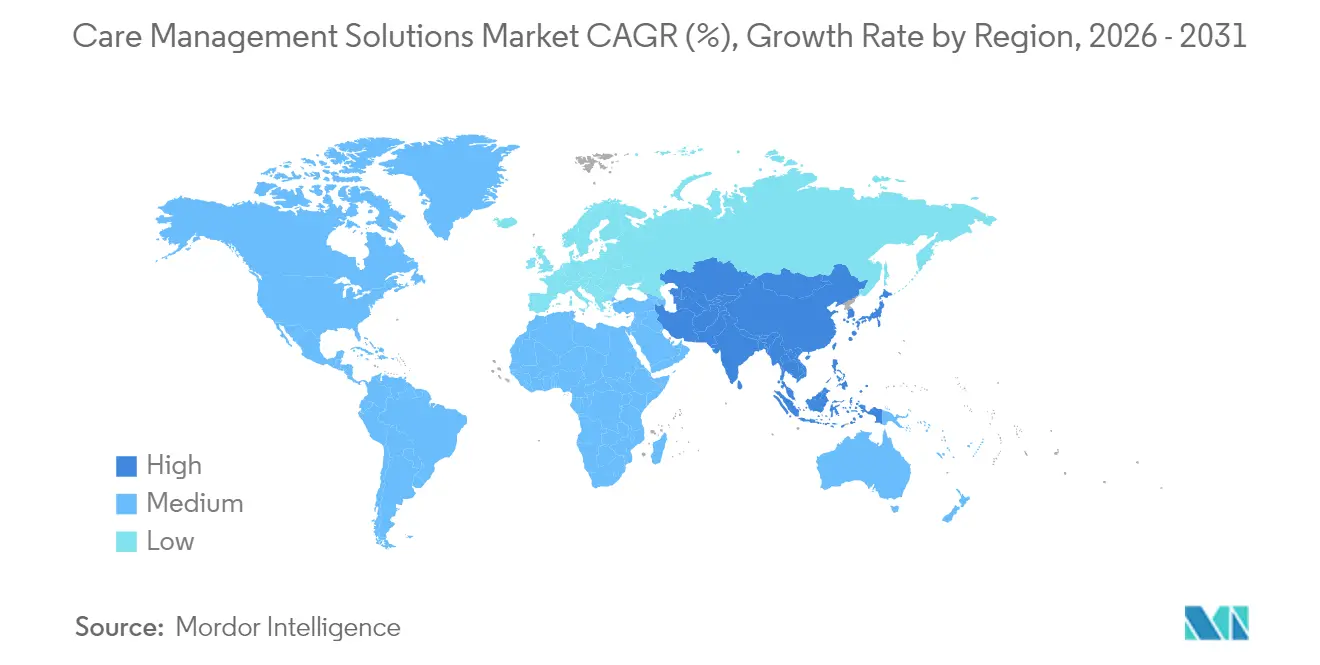
North America led the care management solutions market with 45.05% share in 2025 owing to well-funded health-IT infrastructure and firm regulatory pushes toward interoperability. Federal allocations of USD 1.3 billion for Medicare cybersecurity incentives and USD 86 million for ONC interoperability grants underscore continued policy backing. Programs like Making Care Primary extend ten-year payment guarantees that ease small-practice adoption barriers. Canada follows with provincial digital-health roadmaps, while Mexico invests in national analytics hubs that connect social-service agencies to hospital networks.Europe holds a solid second position, with Germany, the United Kingdom, and France spearheading digitization agendas. The EU AI Act, effective in 2024, mandates transparency, risk catalogs, and post-market monitoring for clinical algorithms, steering procurement toward platforms that can document bias-mitigation steps. Nordic countries leverage unified national EHRs to pilot population-level prediction tools, whereas Southern Europe focuses on chronic-disease management for rapidly aging populations. Eastern European markets show slower uptake due to fragmented funding but represent future growth pockets.Asia-Pacific is the fastest-growing region at a 13.78% CAGR. China’s provincial payers now fund cloud-based disease-management pilots, and India’s Ayushman Bharat Digital Mission creates APIs that invite private-sector apps into public health schemes. Australia’s My Health Record expansion drives interoperability mandates that align well with cloud-native care-management offerings. Kaiser Permanente’s deployment of Innovaccer’s AI platform in Washington state illustrated how cross-regional best practices in predictive analytics can be replicated in APAC joint ventures. The Middle East and Africa remain nascent but show pockets of rapid uptake in Gulf Cooperation Council nations and South Africa, where national insurers fund coordinated-care pilots to alleviate specialist shortages.

Regulatory Landscape
In the United States, care management platforms are being pushed toward standardized, API-driven exchange by ONC and CMS actions that touch both clinical and administrative workflows. In April 2026, CMS released a proposed rule on Interoperability Standards and Prior Authorization for Drugs, elevating electronic prior authorization and related health IT requirements for payers, and reinforcing the need for certified, standards-aligned integrations into EHR and payer systems. ONC further tightened the standards pathway in June 2026 by publishing its 2026 SVAP-approved standards set, including USCDI Version 6 and updated HL7 FHIR Da Vinci implementation guides that support electronic prior authorization workflows, with legacy versions set on a timed sunset path (older versions slated to expire by January 1, 2028).
In Europe, requirements are converging on cross-border health data use and higher-assurance governance for AI used in healthcare operations. The EU AI Act (Regulation (EU) 2024/1689) establishes a harmonized framework for AI systems, including healthcare applications, raising the bar for transparency and risk controls that vendors must document. Separately, the European Health Data Space regulation (Regulation (EU) 2025/327, adopted in February 2025) anchors harmonized electronic health data exchange and patient control across EU member states, shaping procurement requirements for platforms that handle longitudinal care plans, analytics, and secondary-use data permissions.
Value Chain Analysis
The value chain for care management solutions starts with core inputs such as clinical and claims data, interoperability standards (FHIR, including payer-provider administrative exchange profiles), and increasingly social determinants of health (SDOH) resource networks used for closed-loop referrals. Vendors productize these inputs into software modules (care coordination, disease/case management, utilization management, SDOH analytics, and workflow automation) and related services, then distribute through direct enterprise sales to payers and providers, channel partnerships with EHR and clearinghouse ecosystems, and implementation partners that handle configuration, data mapping, training, and managed operations.
A key constraint sits in the integration and transaction layer, where interoperability remains uneven across behavioral health, post-acute, and community-based organizations, and where onboarding and fees can slow scale-out. Partnerships show where value is being added: HealthEdge integrated Unite Us into GuidingCare (February 2025) to connect medical management with social care workflows; Availity and Vim partnered (June 2025) to surface risk and quality gaps inside provider EHR workflows; and Findhelp and AIDA Healthcare announced an integration partnership (December 2025) to automate acute-to-post-acute transitions and referral workflows. These linkages concentrate influence among vendors that control payer connectivity, EHR-embedded experiences, and SDOH referral closure, while services firms capture recurring revenue from governance, workflow redesign, and continuous optimization.
Competitive Landscape
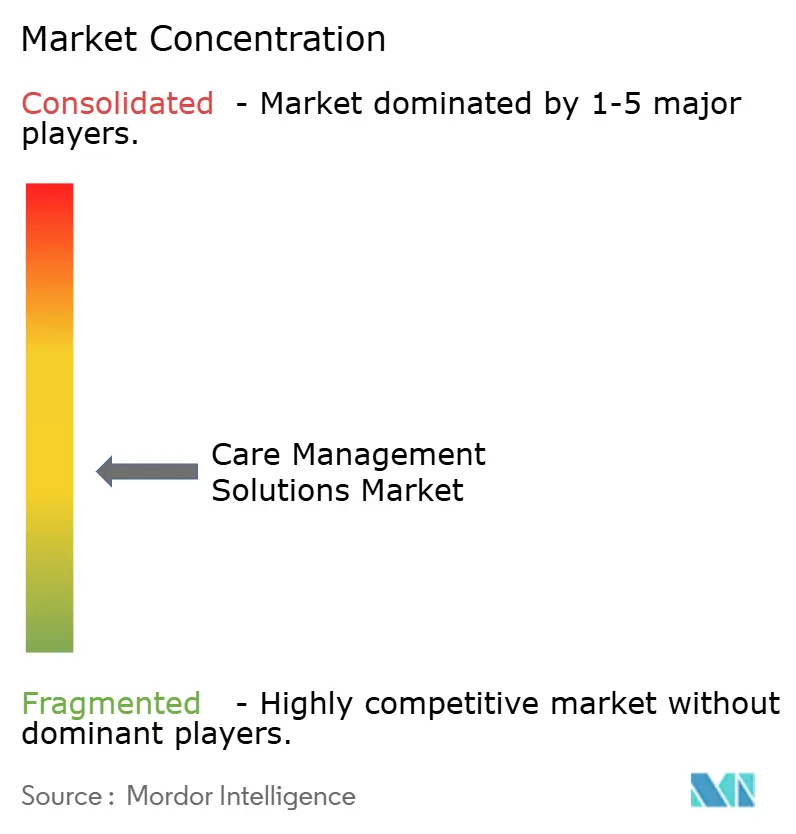
The care management solutions market is moderately fragmented. Optum, Epic Systems, and ZeOmega anchor the top tier by combining broad functionality with tight EHR links. ZeOmega secured Best in KLAS for the fourth consecutive year and was named a leader in the PEAK Matrix 2024, reinforcing the market value of user satisfaction and outcomes evidence. Epic embeds AI across more than 100 projects, integrating ambient documentation and risk prediction directly into physician workflows, which deepens customer lock-in. Optum blends analytics, claims, and pharmacy benefits to offer end-to-end population-health services.
Mid-tier players differentiate through niche analytics, behavioral-health integration, or social-determinants data aggregation. Start-ups leverage cloud-native microservices that slot into existing infrastructures, often partnering with incumbent EHR vendors for distribution. Consolidation intensified in 2024 when Elevance Health announced a USD 2.7 billion deal for CareBridge to bolster home-and-community-based service coordination. Partnerships around responsible-AI toolkits have multiplied as vendors race to meet HTI-1 transparency requirements.
Competitive focus has shifted toward proof of bias-mitigation, low-code interface builders, and pre-configured care-path libraries for specific chronic conditions. Vendors that streamline deployment for under-resourced community hospitals are gaining share, while those tied to heavy on-premise stacks are losing ground as the care management solutions market pivots to SaaS.
Care Management Solutions Industry Leaders
EPIC Corporation Inc.
Veradigm
Cognizant
Unitedhealth Group (Optum)
Allscripts
- *Disclaimer: Major Players sorted in no particular order
Care Management Solutions Market Companies Covered in this Report
- UnitedHealth Group (Optum)
- ZeOmega
- Cognizant (Trizetto)
- Epic Systems
- Medecision
- EXL Service
- Veradigm
- Innovaccer
- HealthEdge
- Infosys
- Centene (Evolve)
- Casenet
- Athenahealth
- Lightbeam Health
- I2I Systems
- InfoMC
- IBM Phytel
- Arcadia
- NextGen Healthcare
- Cerner (Oracle Health)
- Allscripts (Altera)
- Health Catalyst

Market Opportunities and Future Outlook
Payment and standards changes are creating whitespace for platforms that can operationalize technology-enabled chronic care and reduce administrative friction across payer-provider networks. CMS launched the 10-year ACCESS (Advancing Chronic Care with Effective, Scalable Solutions) Model with a performance period beginning in July 2026, testing outcome-aligned payments for technology-enabled chronic care, which raises demand for end-to-end capabilities that connect care planning, outreach, documentation, and outcomes reporting across settings. In parallel, CMS published an April 2026 proposed rule on Interoperability Standards and Prior Authorization for Drugs, reinforcing electronic prior authorization and updated standards requirements, and expanding the addressable need for payer-facing utilization workflows, FHIR-based connectivity, and AI-assisted work queues that still keep human oversight in the loop.
Industry moves also point to consolidation and expansion around home-based and connected care, supported by device and data plumbing for longitudinal programs. ChartSpan completed its acquisition of Validic in June 2026 to combine clinical services with device and IoT data infrastructure, and Integrated Home Care Services acquired Dina in May 2026 to expand in-home benefit management and care coordination. On the demand-generation side, Lark Healths July 2026 partnership with Samsung to deliver AI-powered chronic disease management programs to seniors via Samsung Health (starting in Q3 2026) underscores the commercial pull toward consumer-grade engagement layers that integrate with payer and provider care management operations. These proof points favor vendors with pre-built integrations (EHR, clearinghouse, device data), workflow automation for prior authorization and care gaps, and SDOH referral closure to support whole-person care models.
Recent Industry Developments in Care Management Solutions Market
- May 2026: Cognizant opened TriZetto Unify to AI agents for administrative workflows, beginning with electronic prior authorization use cases. The move aligns payer operations platforms with the industry push toward more automated, standards-driven prior authorization and reduced manual backlogs.
- May 2026: Veradigm launched Veradigm Health Network Architecture to give independent practices a unified view across clinical, financial, and operational data. The launch targets a persistent adoption barrier in care management, namely fragmented data and workflow fragmentation between smaller providers and payer programs.
- August 2025: Cognizant debuted the TriZetto AI Gateway to support broader AI integration across healthcare administrative and operational workflows. This expands the tooling layer payers and their partners use to embed AI into claims, care management, and utilization workflows without rebuilding core platforms.


Care Management Solutions Market Report Scope and Research Methodology
Market Definition and Coverage
This market covers the revenues earned from care management solutions that help payers and providers plan, coordinate, and monitor patient care, including software platforms and the related services needed to deploy and run them across care programs.
Scope exclusions: We exclude stand-alone scheduling tools, generic EHR modules that are not sold as care management, and simple patient portal functions that do not support care planning, risk stratification, or coordination workflows.
Segments Covered in This Report
- By Component
- Software
- Care-management platform software
- Population-health analytics modules
- Services
- Consulting & implementation
- Post-deployment support & training
- Business-process outsourcing (BPO)
- Software
- By Delivery Mode
- Cloud-based / SaaS
- Web-based (private hosting)
- On-premise licensed
- By Function
- Chronic care management
- Disease / case management
- Utilization & cost management
- Social-determinants analytics & risk stratification
- Remote patient-monitoring integration
- Transitional care / care-coordination workflows
- By End User
- Healthcare Payers
- Commercial insurers
- Government payers (Medicare / Medicaid)
- Self-insured employers
- Healthcare Providers
- Hospitals & integrated delivery networks (IDNs)
- Physician groups & accountable care organizations (ACOs)
- Post-acute / home-health agencies
- Other Stakeholders
- Third-party administrators
- Pharma & life-science companies
- Public-health agencies
- Healthcare Payers
- By Geography
- North America
- United States
- Canada
- Mexico
- Europe
- Germany
- United Kingdom
- France
- Italy
- Spain
- Rest of Europe
- Asia-Pacific
- China
- Japan
- India
- Australia
- South Korea
- Rest of Asia-Pacific
- Middle East and Africa
- GCC
- South Africa
- Rest of Middle East and Africa
- South America
- Brazil
- Argentina
- Rest of South America
- North America
Data Sources, Market Sizing, and Validation
Desk Research
Desk research was used to map the demand pool and set realistic boundaries for what gets counted as care management solutions revenue. We reviewed public sources such as CMS publications (including value-based care and quality program materials), CDC chronic disease statistics, OECD health expenditure indicators, and WHO health system datasets, alongside payer and provider policy updates that affect adoption.
To ground pricing and commercialization assumptions, we also used company filings, annual reports, investor presentations, and reputable press coverage on health IT spending and care coordination initiatives. Where helpful, paid subscriptions for company financials and news intelligence, and for patent databases, were used to cross-check product focus and investment direction. The sources listed above are illustrative, and additional public references were used for data collection, cross-checking, and clarification.
Primary Interviews and Surveys
Primary conversations were conducted with a mix of solution executives, delivery leaders, payer and provider operations users, and implementation partners, so that assumptions on both software and services could be checked against real purchase and rollout practices. Because this is a global market, we balanced input across APAC, EMEA, and the Americas to validate deployment mix (cloud versus on-premise), typical contract structures, and the functions that are most often bought together.
Distribution of primary research fieldwork respondents
| Company type | Respondent position | Region |
|---|---|---|
| Top tier: 36% | CXOs: 13% | APAC: 43% |
| Mid tier: 42% | Functional/Unit leaders: 37% | EMEA: 34% |
| Smaller Players: 22% | Managers: 50% | Americas: 23% |
Market-Sizing & Forecasting
Our sizing uses a top-down build that reconstructs addressable spending from payer and provider care program adoption, then converts it into solution revenue using penetration and average contract values. To keep the totals realistic, the outputs are corroborated with selective bottom-up checks, including sampled contract value references, channel feedback on typical implementation scope, and a limited roll-up of visible supplier revenues where disclosure allows.
Key model inputs included chronic disease burden trends (which shape case load), value-based reimbursement momentum, cloud deployment share in care management software, the software-to-services mix, and the payer versus provider end-user split. We also tracked functional purchase patterns such as disease and case management, utilization and cost management, and social determinants analytics, since bundle rates can shift average deal size.
For forecasting, scenario analysis was used and tied to leading indicators that respondents could validate, including budget allocation for population health, regulatory push for outcomes reporting, and the pace of cloud migration in healthcare IT. Where bottom-up signals were incomplete in certain countries, we applied gaps through regional benchmarks and then re-tested them with interview feedback before finalizing the totals.
Data Validation & Update Cycle
Validation is done by checking whether the model outputs align with independent signals such as health IT spending direction, care program enrollment trends, and the observed mix of software subscriptions versus professional services. Any large variance triggers a second pass on assumptions such as pricing ramps, deployment mix, and the split across payer and provider buying centers, followed by follow-up calls where needed.
Before sign-off, the work is reviewed in multiple steps so calculation logic, currency handling, and year alignment remain consistent across regions. Reports are refreshed annually, and interim updates are done when major policy changes, reimbursement shifts, or large market events could materially move adoption. Right before delivery, a final update pass is completed so the published view reflects the latest available information.
Mordor Intelligence's Care Management Solutions Market Size Measured Against Other Published Estimates
Published market numbers for care management solutions can be far apart because each publisher uses its own boundary for what is counted and how revenue is recognized. Differences also come from the base year used, how software versus services are treated, and whether adjacent categories like broader population health tools are included.
The benchmark table shows a spread that is mostly explained by scope and revenue treatment. In Mordor Intelligence's model, the total is counted only for purpose-built care management software and the directly linked services, instead of folding in broader patient engagement suite revenue or remote monitoring hardware revenue. Currency conversion timing and refresh cadence also matter in a software market where subscription pricing and cloud mix can change during the year, and that is reflected in how the figures compare.
Benchmark comparison
| Source | Market Size | Gaps in Research Methodology |
|---|---|---|
| Mordor Intelligence | USD 20.44 B (2026) | |
| Trade Publisher A | USD 23.16 B (2025) | Uses a different base year and a wider component mix that groups patient engagement and remote monitoring software alongside core care management, and it applies consumption-value accounting that can pull forward near-term totals. |
| Industry Research Firm B | USD 13.16 B (2024) | Starts from an earlier base year and appears to apply a narrower capture of enterprise deployments, with less clarity on service attach rates and on how web-based versus cloud delivery is priced and counted. |
Looking across the three figures, the gap is best read as a boundary issue first and a timing issue second. By keeping inputs tied to care program adoption, contract value logic, and realistic software to services splits, the final market size stays traceable to common demand signals and can be repeated when assumptions are updated.


Key Questions Answered in the Report
What is the projected size of the care management solutions market by 2031?
The market is expected to reach USD 37.73 billion by 2031 at a 13.04% CAGR.
Why are cloud platforms growing so quickly in this space?
Cloud delivery supports scalable AI services, eases interoperability, and lowers upfront infrastructure costs, driving a 14.96% CAGR for cloud deployments.
Which functional area is expanding fastest?
Social-determinants analytics and risk-stratification tools will grow at a 16.32% CAGR as payers and providers target non-clinical drivers of health.
How are new regulations affecting AI-enabled care management?
Rules such as the EU AI Act and California’s bias law require transparency and human oversight, raising compliance costs but favoring vendors with robust governance.
Which region offers the highest growth potential through 2031?
Asia-Pacific is set to expand at 13.78% CAGR, propelled by large-scale digital-health investments in China, India, and Australia.
Page last updated on:


 Your data is secure and never sold or shared.


