
Market Overview
| Study Period | 2021 - 2032 |
|---|---|
| Forecast Data Period | 2027 - 2032 |
| Base Year Market Size (2025) | USD 1.09 Billion |
| Market Size (2027) | USD 1.15 Billion |
| Market Size (2032) | USD 1.47 Billion |
| Growth Rate (2027 - 2032) | 5.06 % |
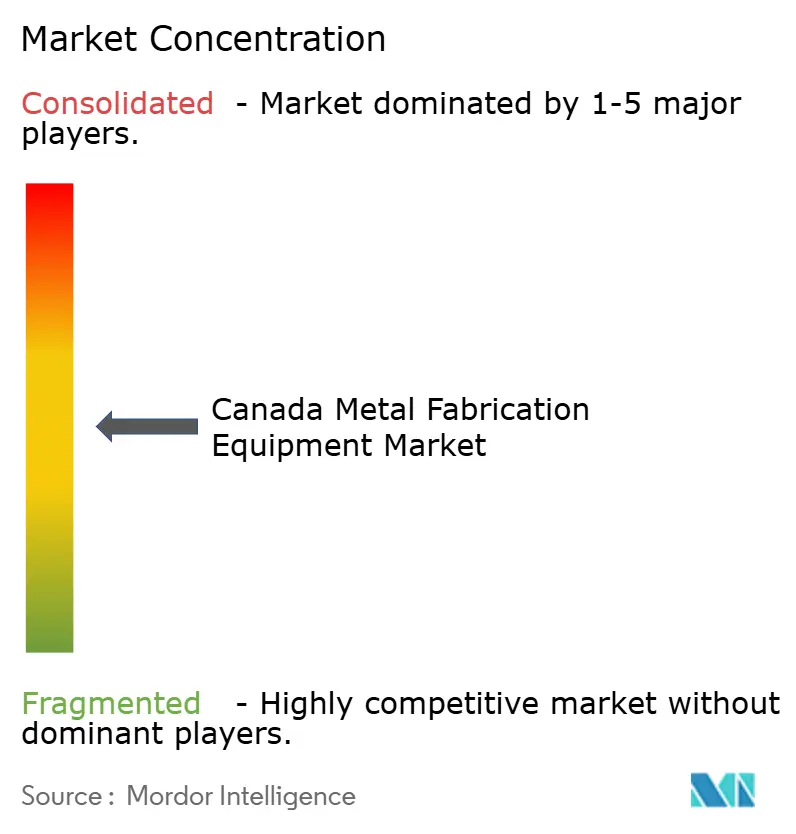
| Market Concentration | Medium |
Major Players *Disclaimer: Major Players sorted in no particular order Image © Mordor Intelligence. Reuse requires attribution under CC BY 4.0. | |
Canada Metal Fabrication Equipment Market Analysis by Mordor Intelligence
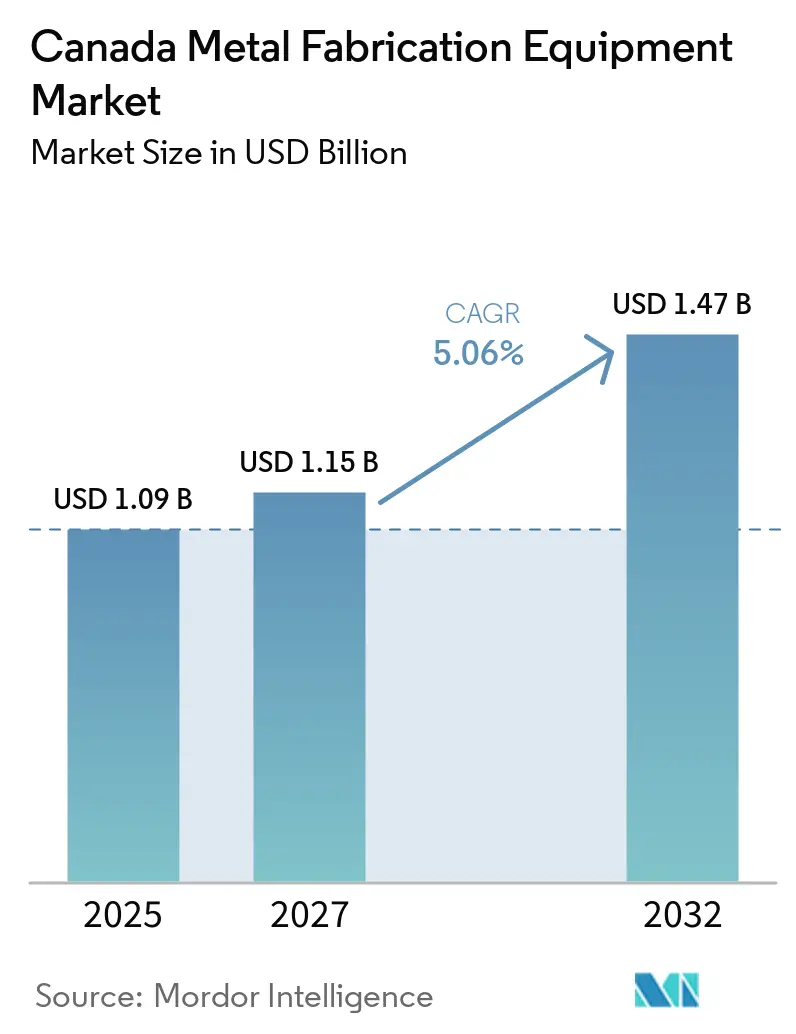
The Canada Metal Fabrication Equipment Market size is projected to expand from USD 1.09 billion in 2026 and USD 1.15 billion in 2027 to USD 1.47 billion by 2032, registering a CAGR of 5.06% between 2027 and 2032.
The Canada metal fabrication equipment market is supported by EV supply-chain investment, public infrastructure programs, defense procurement, and resource-sector projects. These demand sources require fabricators to expand production capacity while meeting tighter quality, traceability, material, and delivery specifications. The expansion of domestic manufacturing and reshoring initiatives is also encouraging fabricators to replace aging equipment and invest in higher-productivity machinery, particularly where imported components and cross-border supply disruptions expose capacity risks. Equipment demand is shifting toward fiber-laser cutters, electric press brakes, CNC machining centers, and robotic welding cells, reflecting the need for faster processing, greater precision, lower energy consumption, and reduced dependence on manual labor. Automation is becoming particularly relevant for repetitive cutting, bending, welding, and material-handling operations, allowing fabricators to increase throughput without proportionally expanding their workforce. This raises the value of a typical equipment order and favors suppliers that combine machines, software, automation, financing, and local service. Demand is also moving toward integrated production systems that provide machine monitoring, production scheduling, predictive maintenance, and digital quality tracking rather than standalone equipment.
Key Report Takeaways
- By equipment type, Cutting & Blanking Equipment held 35.1% of the Canada metal fabrication equipment market share in 2026, while Finishing & Post-Processing Equipment is forecast to grow at a 7.0% CAGR through 2032.
- By end-user industry, Construction & Infrastructure held 41.0% of Canada metal fabrication equipment market size 2026 demand, while Other Industries is forecast to grow at a 6.2% CAGR through 2032.
- By province, Ontario held 44.0% of 2026 demand, while British Columbia is forecast to grow at a 6.5% CAGR through 2032.
Note: Market numbers in this report are based on Mordor Intelligence's proprietary estimation framework, which combines nine months of actuals with Q4 projections for base year 2026.
Canada Metal Fabrication Equipment Market Trends and Insights
Drivers Impact Analysis*
| Driver | (~) % Impact on CAGR Forecast | Geographic Relevance | Impact Timeline |
|---|---|---|---|
| Surging Demand for Fabricated Components from Canada’s Automotive and EV Supply Chains | +1.2% | Ontario, including Windsor, Guelph, and Oshawa | Short term (≤ 2 years) |
| Infrastructure Renewal Driving Demand for Structural Metal Fabrication Equipment | +1.0% | National, concentrated in Ontario, British Columbia, and Québec | Medium term (2-4 years) |
| Expansion of Aerospace and Defense Fabrication Capacity in Canada | +0.8% | Québec, Ontario, and Manitoba | Medium term (2-4 years) |
| Mining and Energy Project Development Supporting Heavy Metal Fabrication Activity | +0.7% | Alberta and British Columbia | Long term (≥ 4 years) |
| Government-Led Investments in Domestic Manufacturing Capacity and Industrial Automation | +0.6% | National, with early gains in Ontario, British Columbia, and Québec | Short term (≤ 2 years) |
| Increasing Demand for High-Precision Fabrication in Advanced Manufacturing | +0.5% | Ontario, Québec, and Alberta | Medium term (2-4 years) |
| Source: Mordor Intelligence | |||
Surging Demand for Fabricated Components from Canada’s Automotive and EV Supply Chains
Ontario’s automotive cluster is undergoing substantial capital retooling, which is increasing demand for cutting, forming, and robotic welding equipment in the Canada metal fabrication equipment market. Linamar announced a CAD 1.1 billion (USD 0.8 billion) investment in Ontario EV powertrain, eAxle, and semiconductor packaging operations in January 2025. Minth Group also committed USD 300 million for a Windsor battery-housing plant that is expected to begin mass production in late 2026 or early 2027.[1] Battery-enclosure production needs precision aluminum forming and laser blanking. The tighter specifications can make older machines unsuitable even where production volume remains steady. This creates replacement demand in the Canada metal fabrication equipment market and broadens equipment spending beyond additions to physical output.
Infrastructure Renewal Driving Demand for Structural Metal Fabrication Equipment
Canada’s Budget 2025 commits CAD 115 billion (USD 84.0 billion) over 5 years to infrastructure, supporting the structural steel work that requires cutting, forming, and welding equipment.[2] Ontario’s Ministry of Transportation issued a November 2025 policy memo that favors Canadian steel supply for transportation work.[3] The policy supports domestic fabrication capacity and increases the relevance of certified welding systems. Public projects also require more detailed material and welding records. Fabricators serving these projects have a stronger reason to invest in fiber-laser cutters and electric press brakes that support process control. This pattern supports equipment replacement and higher use of installed machinery in the Canada metal fabrication equipment market.
Expansion of Aerospace and Defense Fabrication Capacity in Canada
Aerospace and defense procurement is increasing the demand for precision machining and welding systems in the Canada metal fabrication equipment market. Canada awarded Bombardier a CAD 753 million (USD 550.0 million) contract in December 2025 for 6 Global 6500 multi-role aircraft, with the first delivery planned for 2027. Boeing committed CAD 110 million (USD 80.3 million) to Québec’s Espace Aéro innovation zone in October 2025. These programs reinforce Montréal’s role in precision manufacturing. Suppliers working on qualified aerospace programs need 5-axis CNC machining centers and laser welding systems with consistent process records. Early equipment investment can help fabricators qualify before long-term supply agreements are set.
Mining and Energy Project Development Supporting Heavy Metal Fabrication Activity
Mining and energy projects support demand for heavy-plate cutting, pressure-vessel fabrication, and structural assembly equipment. Canada’s energy regulator reported that LNG Canada began commercial LNG exports from Kitimat in June 2025. Natural Resources Canada lists 138 mining-related projects with CAD 117.1 billion (USD 85.5 billion) in potential investment in its 2024 to 2034 project inventory. Gold, copper, and nickel projects require equipment suited to heavy structures and pressure-rated fabrication. This activity strengthens demand for plasma cutting, submerged-arc welding, and high-capacity assembly systems in the Canada metal fabrication equipment market. It also gives domestic fabricators a reason to develop capabilities that can serve large resource projects.
Restraints Impact Analysis*
| Restraint | (~) % Impact on CAGR Forecast | Geographic Relevance | Impact Timeline |
|---|---|---|---|
| Skilled Welder and Fabrication Technician Shortages Constraining Equipment Utilization | -0.7% | National, most acute in Ontario and British Columbia | Long term (≥ 4 years) |
| High Upfront Cost of CNC, Laser, and Robotic Fabrication Systems | -0.5% | National, especially SME-heavy Ontario and Québec | Medium term (2-4 years) |
| Limited Automation Budgets Among Canada’s Small and Mid-Sized Fabricators | -0.4% | National, concentrated in Ontario, Alberta, and Québec | Short term (≤ 2 years) |
| High Electricity and Operating Costs for Energy-Intensive Fabrication Processes | -0.3% | Ontario, Alberta, and British Columbia | Medium term (2-4 years) |
| Source: Mordor Intelligence | |||
Skilled Welder and Fabrication Technician Shortages Constraining Equipment Utilization
The shortage of qualified welding personnel limits how quickly fabricators can use installed equipment at full capacity. Employment and Social Development Canada forecasts 25,600 job openings for welders and related machine operators from 2024 to 2033 against 25,000 projected job seekers. The CWB Group expects certification requirements to exceed completions in many provinces between 2024 and 2028. Canada’s Job Bank rates fabrication-welder prospects as limited in Ontario and British Columbia for 2025 to 2027. The gap is not only a matter of headcount because experienced certified welders are also needed to operate integrated CNC welding cells efficiently. This encourages automation spending in the Canada metal fabrication equipment market, although the shortage can delay installation and ramp-up.
High Upfront Cost of CNC, Laser, and Robotic Fabrication Systems
Fiber lasers, automated CNC press brakes, and robotic welding cells require sizable capital commitments. Budget 2025 proposes a Productivity Super-Deduction that would reduce the manufacturing and processing marginal effective tax rate from 8.6% to 0.4% and offer 100% first-year expensing for eligible machinery acquired before 2030. The government estimates average annual support of CAD 2.7 billion (USD 2.0 billion) through accelerated depreciation. These measures lower the after-tax cost of investment, but they do not remove the initial cash-flow burden for smaller shops. The Canada metal fabrication equipment market, therefore, has room for leasing, and Equipment-as-a-Service offers that convert large purchases into recurring operating payments. Suppliers with financing, installation, and service support can reduce a key barrier for small and mid-sized fabricators.
*Our forecasts treat driver/restraint impacts as directional, not additive. The impact forecasts reflect baseline growth, mix effects, and variable interactions.
Segment Analysis
By Equipment Type: Cutting Equipment Leads, Finishing Systems Grow Fastest
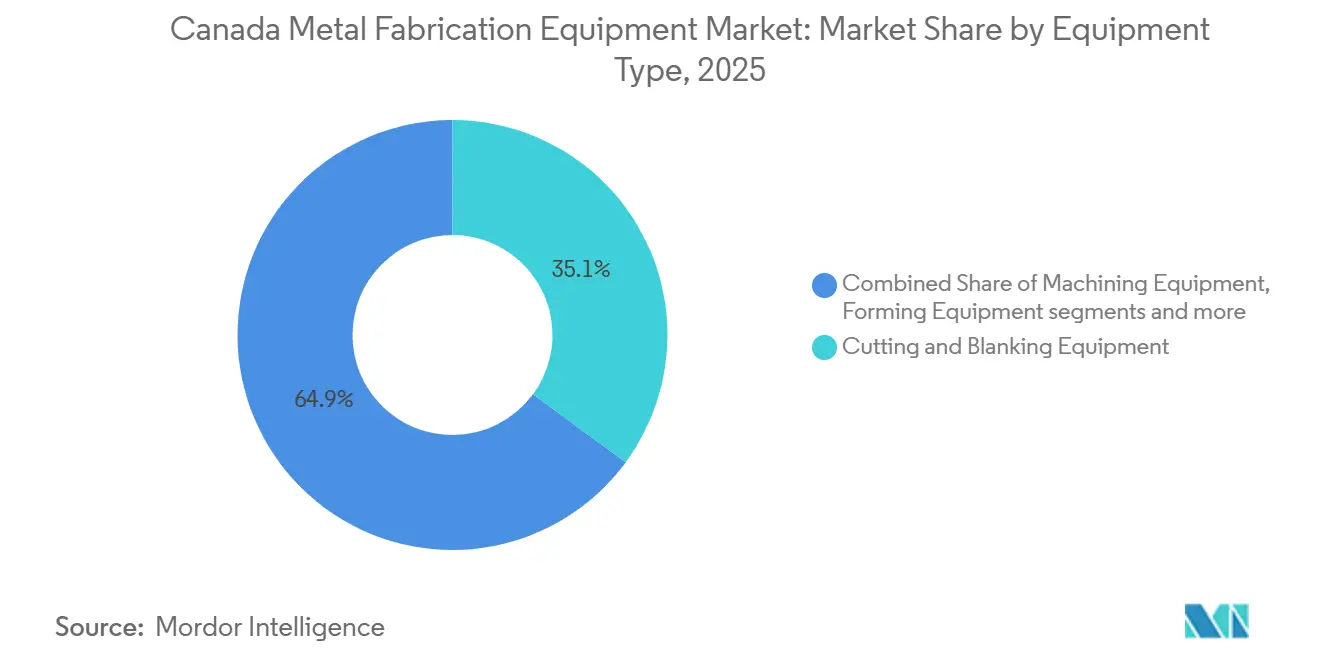
Cutting & Blanking Equipment held 35.1% of the Canada metal fabrication equipment market in 2026. Fiber lasers have displaced many CO₂ platforms because they use less electricity and fewer consumables while processing aluminum and reflective alloys. The equipment type serves automotive suppliers, structural-steel shops, and general fabricators. Machining Equipment is the second-largest category and includes CNC machining centers, turning lathes, and grinding systems. Forming Equipment ranks third and includes CNC press brakes, stamping presses, and roll-forming lines.
In the Canada metal fabrication equipment market, Finishing & Post-Processing Equipment is forecast to record a 7.0% CAGR from 2027 to 2032. Federal procurement requirements and Ontario fabrication rules make surface treatment and digital traceability more important to contract eligibility. Shot blasting systems, anodizing lines, heat-treatment furnaces, and deburring cells are increasingly included in fabrication-line requests. Welding & Joining Equipment includes arc, resistance, laser, and mechanical joining platforms, while cobots are gaining relevance where labor is scarce. The Canadian metal fabrication equipment industry is therefore seeing demand across several technologies rather than dependence on one equipment format.

By End-User Industry: Infrastructure Still Commands the Largest Slice
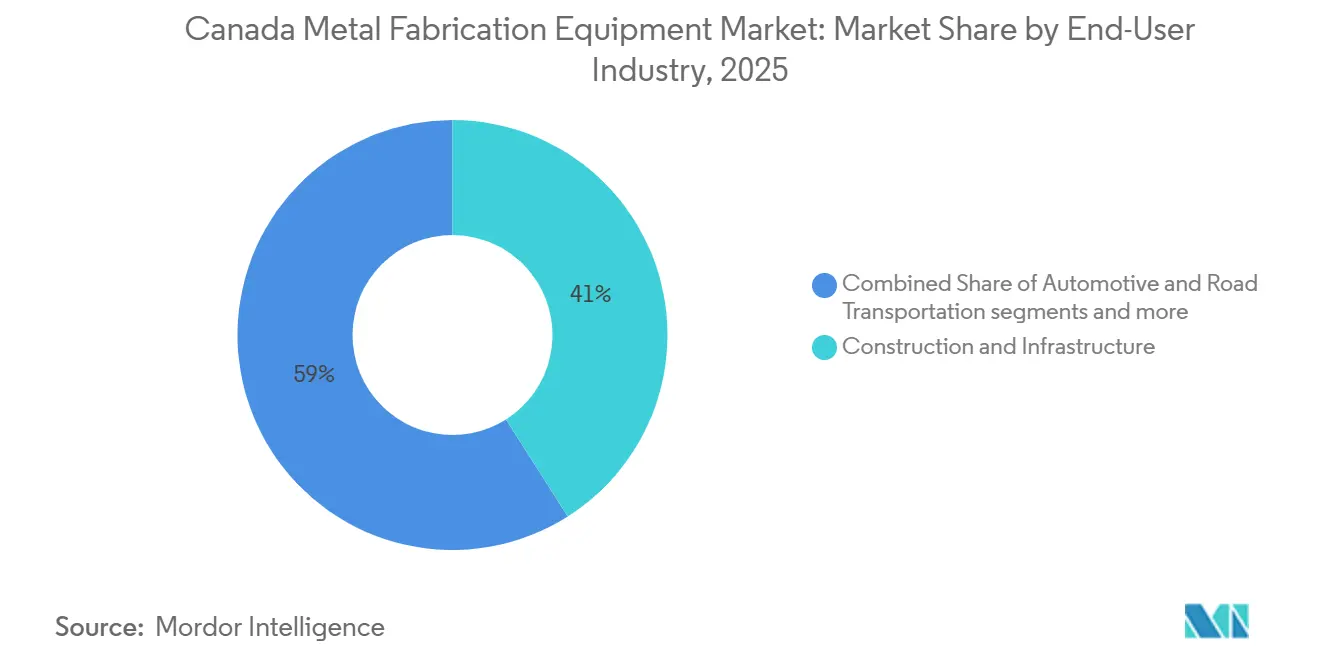
Construction & Infrastructure accounted for 41.0% of the Canada metal fabrication equipment market size in 2026. Transit corridors, bridge replacement, and clean-energy grid projects support the use of large cutting tables, roll-forming lines, and multi-pass welding stations. General Metal Fabrication & Job Shops form the second-largest user group and generate recurring requirements for tooling and consumables. Industrial Machinery, Automotive, and Energy users need different equipment configurations. Machinery producers use multi-spindle machining centers, automotive suppliers use precision laser blanking, and energy projects use pressure-rated welding cells.
Other Industries is forecast to grow at a 6.2% CAGR from 2027 to 2032. The category includes cleantech hardware, hydrogen refueling infrastructure, datacenter steelwork, and remote-site modular-building fabrication. These applications create fabrication demand that traditional end-user classifications do not fully capture. Boeing’s CAD 20 million (USD 14.6 million) Winnipeg freezer-facility expansion in June 2025 supported higher output of aerospace structural assemblies. Aerospace, defense, electrical equipment, shipbuilding, and marine activity also require specialized fabrication. The Canadian metal fabrication equipment industry benefits when fabricators serve 3 or more end markets because diversified operations are less exposed to a pause in any 1 procurement cycle.
Geography Analysis
In the Canada metal fabrication equipment market, British Columbia’s 6.5% CAGR from 2027 to 2032 makes it the fastest-growing provincial market. LNG activity, hydrogen projects, and modular construction support demand for cryogenic-grade piping, pressure-vessel skids, and orbital welding systems. Canada Energy Regulator data confirms that commercial LNG exports began from Kitimat in June 2025. Alberta’s energy sector depth supports steady demand for heavy-plate cutting and pressure-vessel welding. Alberta reported CAD 8.6 billion (USD 6.3 billion) in manufacturing sales in February 2025.
Ontario held 44.0% of 2026 demand and remains the primary competitive center for the Canada metal fabrication equipment market. EV supply-chain projects support a replacement cycle in forming, cutting, and precision-welding equipment. Minth Group’s Windsor project provides a direct example of new regional demand for aluminum forming and laser blanking. Statistics Canada recorded CAD 32 billion (USD 23.4 billion) in Ontario manufacturing sales in February 2025. Québec complements Ontario with aerospace-focused demand for precision machining and traceable laser welding.
Manitoba, Saskatchewan, and Atlantic Canada form smaller but stable demand centers. Manitoba’s bridge pipeline supports heavy-beam plasma cutting and multi-pass welding among regional fabricators. A May 2025 Manitoba bridge contract for steel plate girders shows continued project activity. Saskatchewan’s mining base creates recurring demand for pressure-vessel and conveyor-structure fabrication. Atlantic Canada supports stainless-steel welding and surface-finishing demand through defense infrastructure and fisheries-processing modernization. These regions need specialized configurations rather than the high-volume laser and press-brake systems common in Ontario.
Competitive Landscape
The Canada metal fabrication equipment market exhibits a medium level of market concentration. TRUMPF, AMADA, Bystronic, DMG MORI, and Lincoln Electric form the leading competitive group. Competition increasingly depends on automation integration, software capability, and service-network density rather than machine specifications alone. TRUMPF introduced the TruLaser 3040 Bevel Cut Edition at FABTECH Canada 2026, combining automated weld-preparation cutting with a reduced downstream finishing step. Strong local technical support matters because smaller fabricators often need help with commissioning, maintenance, and programming.
TRUMPF announced plans to assemble press brakes for North American buyers at a Connecticut smart factory starting in the summer of 2026. This can shorten delivery times for Canadian customers compared with distribution-only suppliers. Lincoln Electric and FANUC are expanding the addressable robotic welding base through collaborative systems that suit smaller fabricators. Hypertherm introduced the Hyamp cartridge for the Powermax125 in July 2026, targeting thick-metal cutting with a single-piece consumable. These moves address labor constraints and operating consistency alongside machine capacity.
Equipment-as-a-Service and aftermarket optimization are opportunities for small fabricators without the budget for outright purchases. Machitech Automation and Westway Machinery Ltd can address this need through regional support and capacity-based commercial models. Public structural contracts increasingly require certified welding and digitally traceable quality records. This favors connected software platforms over standalone machine suppliers. The Canada metal fabrication equipment market remains competitive because customers compare technology, financing, installation support, and long-term service in the same purchase.
Canada Metal Fabrication Equipment Industry Leaders
-
TRUMPF Inc.
-
AMADA CO., LTD
-
Bystronic AG
-
DMG MORI Inc.
-
Lincoln Electric
- *Disclaimer: Major Players sorted in no particular order
Recent Industry Developments
- October 2026: FANUC America demonstrated advanced automated welding, CRX collaborative robotics, and LR-10iA/10 laser processing cells at FABTECH 2026, positioning AI-enabled robotic systems as viable throughput solutions for fabricators constrained by the skilled-welder shortage.
- July 2026: Hypertherm Associates launched the Hyamp cartridge for the Powermax125 plasma system, a single-piece consumable engineered for heavy-use thick-metal cutting, reducing setup errors and streamlining operator training for structural-steel fabricators across Canada.
- June 2026: TRUMPF showcased the TruBend 3000 press brake, TruLaser 3040 Bevel Cut Edition, and TruPunch 5000 at FABTECH Canada 2026 in Toronto, reinforcing its product-refresh cycle for the Canadian market.
- December 2025: Canada’s Defense Investment Agency awarded a CAD 753 million (USD 550.0 million) contract to Bombardier for 6 Global 6500 multi-role aircraft with first delivery in 2027, initiating a multi-year defense precision-machining and structural-fabrication cycle across Ontario and Québec supply chains.
Canada Metal Fabrication Equipment Market Report Scope
The Canada Metal Fabrication Equipment Market Report is Segmented by Equipment Type (Cutting & Blanking Equipment, Machining Equipment, Forming Equipment, Welding & Joining Equipment, and more), by End-User Industry (Automotive & Road Transportation, Aerospace & Defense, Shipbuilding & Marine, and more), by Province (Ontario, Québec, Alberta, British Columbia, and Others). The Market Forecasts are Provided in Terms of Value (USD).
By Equipment Type
| Cutting & Blanking Equipment | Laser Cutting Machines |
| Punching & Blanking Machines | |
| Shearing & Notching Machines | |
| Sawing & Cut-Off Machines | |
| Plasma & Oxy-Fuel Cutting Machines | |
| Waterjet Cutting Machines | |
| Other Cutting Equipment (Combination Cutting & Blanking Machines, etc.) | |
| Machining Equipment | Machining Centers & Milling Machines |
| Lathes & Turning Centers | |
| Grinding, Honing & Lapping Machines | |
| Drilling, Boring & Tapping Machines | |
| Electrical Discharge Machining (EDM) Equipment | |
| Other Machining Equipment (Gear Manufacturing Machine Tools, Combination Machining Systems, Other Non-Conventional Machining Equipment, etc.) | |
| Forming Equipment | Stamping & Forming Presses |
| Forging Equipment | |
| Press Brakes & Folding Machines | |
| Roll Forming Machines & Lines | |
| Tube, Pipe & Profile Bending Machines | |
| Other Forming Equipment (Plate & Profile Rolling Machines, Hydroforming, Spinning, Stretch Forming, etc.) | |
| Welding & Joining Equipment | Arc Welding Equipment |
| Resistance Welding Equipment | |
| Laser Welding Equipment | |
| Mechanical Joining Equipment (Riveting, Clinching, etc.) | |
| Other Welding & Joining Equipment (Oxy-Fuel, Electron-Beam, Friction Welding, etc.) | |
| Finishing & Post-Processing Equipment | Metal Coating, Plating & Anodizing Equipment |
| Metal Heat Treatment Equipment | |
| Polishing, Buffing & Surface Finishing Equipment | |
| Shot Blasting & Surface Preparation Equipment | |
| Deburring & Edge Finishing Equipment | |
| Other Finishing & Post-Processing Equipment | |
| Integrated Multi-Process Fabrication Systems | Integrated Cutting & Forming Systems |
| Other Integrated Multi-Process Fabrication Systems |
By End-User Industry
| Automotive & Road Transportation |
| Aerospace & Defense |
| Construction & Infrastructure |
| Industrial Machinery & Equipment |
| Energy, Power & Oil & Gas |
| Electrical, Electronics & Appliances |
| Shipbuilding & Marine |
| General Metal Fabrication & Job Shops |
| Other Industries |
By Province
| Ontario |
| Québec |
| Alberta |
| British Columbia |
| Others |
| By Equipment Type | Cutting & Blanking Equipment | Laser Cutting Machines |
| Punching & Blanking Machines | ||
| Shearing & Notching Machines | ||
| Sawing & Cut-Off Machines | ||
| Plasma & Oxy-Fuel Cutting Machines | ||
| Waterjet Cutting Machines | ||
| Other Cutting Equipment (Combination Cutting & Blanking Machines, etc.) | ||
| Machining Equipment | Machining Centers & Milling Machines | |
| Lathes & Turning Centers | ||
| Grinding, Honing & Lapping Machines | ||
| Drilling, Boring & Tapping Machines | ||
| Electrical Discharge Machining (EDM) Equipment | ||
| Other Machining Equipment (Gear Manufacturing Machine Tools, Combination Machining Systems, Other Non-Conventional Machining Equipment, etc.) | ||
| Forming Equipment | Stamping & Forming Presses | |
| Forging Equipment | ||
| Press Brakes & Folding Machines | ||
| Roll Forming Machines & Lines | ||
| Tube, Pipe & Profile Bending Machines | ||
| Other Forming Equipment (Plate & Profile Rolling Machines, Hydroforming, Spinning, Stretch Forming, etc.) | ||
| Welding & Joining Equipment | Arc Welding Equipment | |
| Resistance Welding Equipment | ||
| Laser Welding Equipment | ||
| Mechanical Joining Equipment (Riveting, Clinching, etc.) | ||
| Other Welding & Joining Equipment (Oxy-Fuel, Electron-Beam, Friction Welding, etc.) | ||
| Finishing & Post-Processing Equipment | Metal Coating, Plating & Anodizing Equipment | |
| Metal Heat Treatment Equipment | ||
| Polishing, Buffing & Surface Finishing Equipment | ||
| Shot Blasting & Surface Preparation Equipment | ||
| Deburring & Edge Finishing Equipment | ||
| Other Finishing & Post-Processing Equipment | ||
| Integrated Multi-Process Fabrication Systems | Integrated Cutting & Forming Systems | |
| Other Integrated Multi-Process Fabrication Systems | ||
| By End-User Industry | Automotive & Road Transportation | |
| Aerospace & Defense | ||
| Construction & Infrastructure | ||
| Industrial Machinery & Equipment | ||
| Energy, Power & Oil & Gas | ||
| Electrical, Electronics & Appliances | ||
| Shipbuilding & Marine | ||
| General Metal Fabrication & Job Shops | ||
| Other Industries | ||
| By Province | Ontario | |
| Québec | ||
| Alberta | ||
| British Columbia | ||
| Others | ||
Key Questions Answered in the Report
What is the Canadian metal fabrication equipment outlook?
The sector is projected to rise from USD 1.09 billion in 2026 to USD 1.47 billion by 2032, at a 5.06% CAGR. Demand is supported by EV supply-chain investment, public infrastructure spending, aerospace and defense procurement, and capital programs in mining and energy.
Which equipment category has the largest share in Canada?
Cutting & Blanking Equipment leads with a 35.1% share in 2026. Fiber-laser systems are widely used because they process aluminum, structural steel, and reflective alloys with lower electricity and consumable requirements than older CO₂ equipment.
Which equipment category is growing fastest?
Finishing & Post-Processing Equipment is projected to grow at a 7.0% CAGR through 2032. Surface treatment, deburring, heat treatment, and digital traceability are becoming more important where fabricators pursue public and higher-specification contracts.
Which end-user sector purchases the most fabrication equipment?
Construction & Infrastructure holds 41.0% of the 2026 demand. Transit, bridge replacement, and grid projects support orders for large cutting tables, roll-forming lines, and multi-pass welding equipment.
Which province is the largest buyer of metal fabrication equipment?
Ontario holds 44.0% of 2026 demand because of its automotive supply chain, broad manufacturing base, and concentration of fabricator businesses. British Columbia is the fastest-growing province, at a 6.5% CAGR through 2032, with LNG, hydrogen, and modular-construction activity supporting specialized fabrication requirements. Québec remains important because aerospace suppliers need precision CNC machining and traceable welding processes.
What is limiting equipment adoption by smaller Canadian fabricators?
High equipment costs and shortages of qualified welders limit adoption. Tax measures, leasing, automation, and Equipment-as-a-Service models can reduce the initial capital and operating barriers for smaller fabrication shops.