
Canada Flexible Plastic Packaging Market Size and Share
Market Overview
| Study Period | 2020 - 2031 |
|---|---|
| Forecast Data Period | 2026 - 2031 |
| Base Year Market Size (2025) | USD 6.42 Billion |
| Market Size (2026) | USD 6.65 Billion |
| Market Size (2031) | USD 7.98 Billion |
| Growth Rate (2026 - 2031) | 3.71 % |
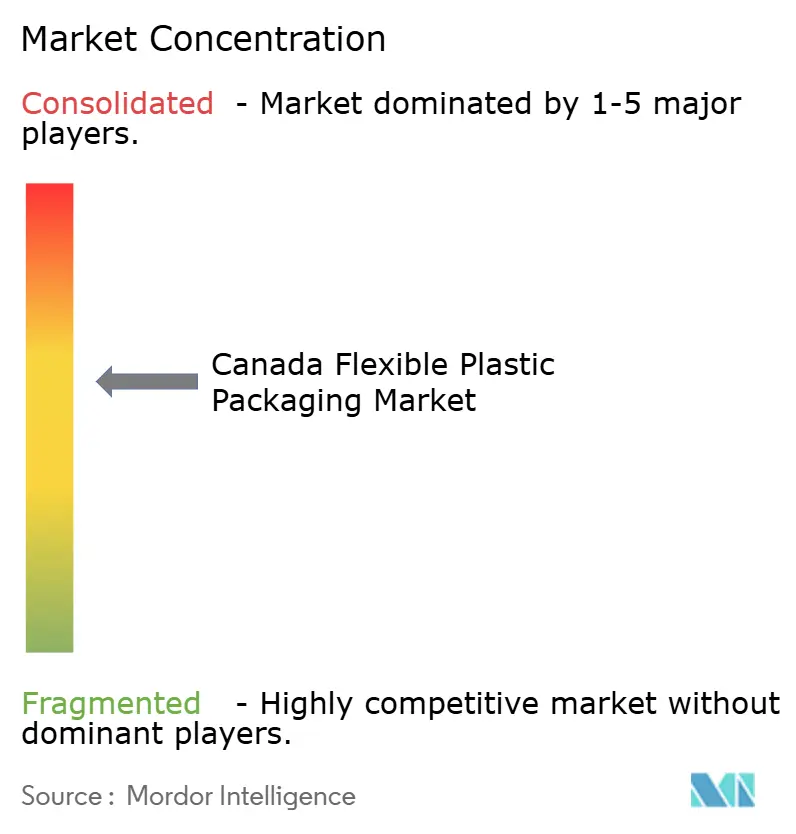
| Market Concentration | Medium |
Major Players *Disclaimer: Major Players sorted in no particular order Image © Mordor Intelligence. Reuse requires attribution under CC BY 4.0. | |
Canada Flexible Plastic Packaging Market Analysis by Mordor Intelligence
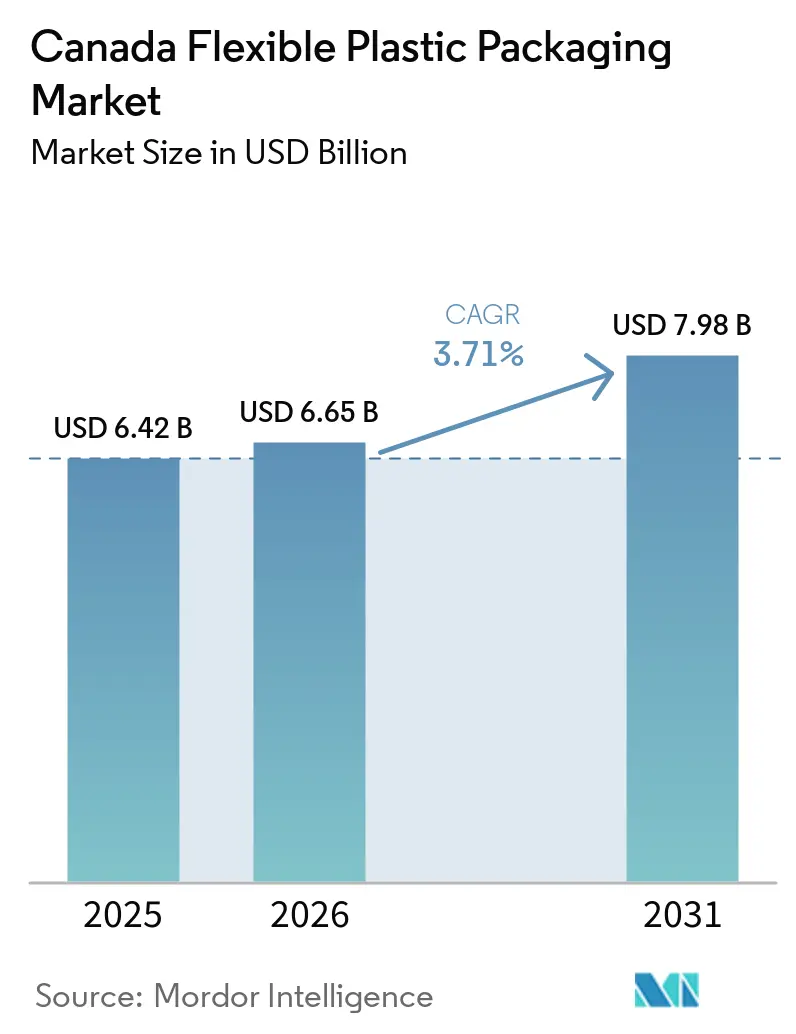
The Canada Flexible Plastic Packaging Market size was valued at USD 6.42 billion in 2025 and estimated to expand from USD 6.65 billion in 2026 to reach USD 7.98 billion by 2031, at a CAGR of 3.71% during the forecast period (2026-2031). Food processors, protein packers, and e-commerce sellers are selecting pouches, films, and bags because these formats use less material and reduce freight weight. Canada’s long distribution routes also support flexible formats, which can be more practical than glass and rigid plastic for national retail supply. Demand is shifting toward barrier films and single-material structures as producers address product protection and recycling requirements. Extended producer responsibility programs are raising the value of traceable material choices and recyclable designs. Consolidation is increasing the pressure on regional converters to compete through application knowledge, service, and specialized formats rather than volume alone.
Key Report Takeaways
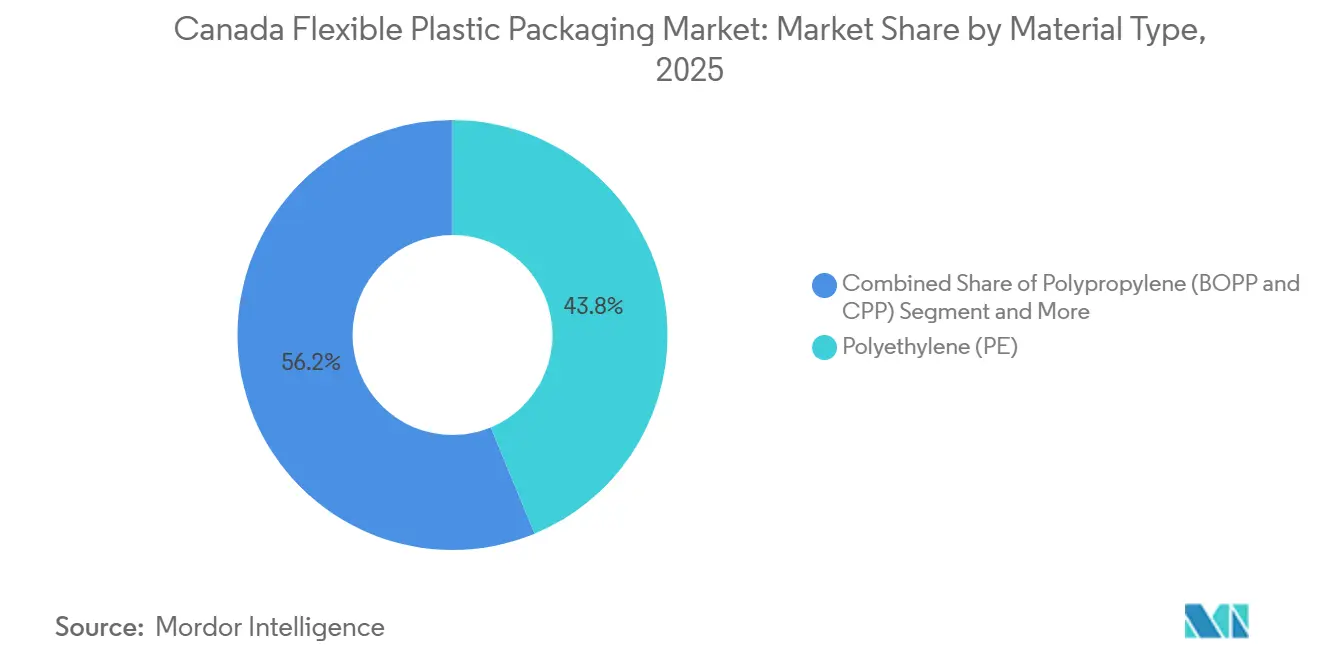
- By material type, polyethylene held 43.76% of the Canada Flexible Plastic Packaging Market share in 2025, while polypropylene is projected to expand at a 5.17% CAGR through 2031.
- By product type, pouches accounted for 46.13% of the Canada Flexible Plastic Packaging Market share in 2025, while films and wraps are projected to expand at a 4.86% CAGR through 2031.
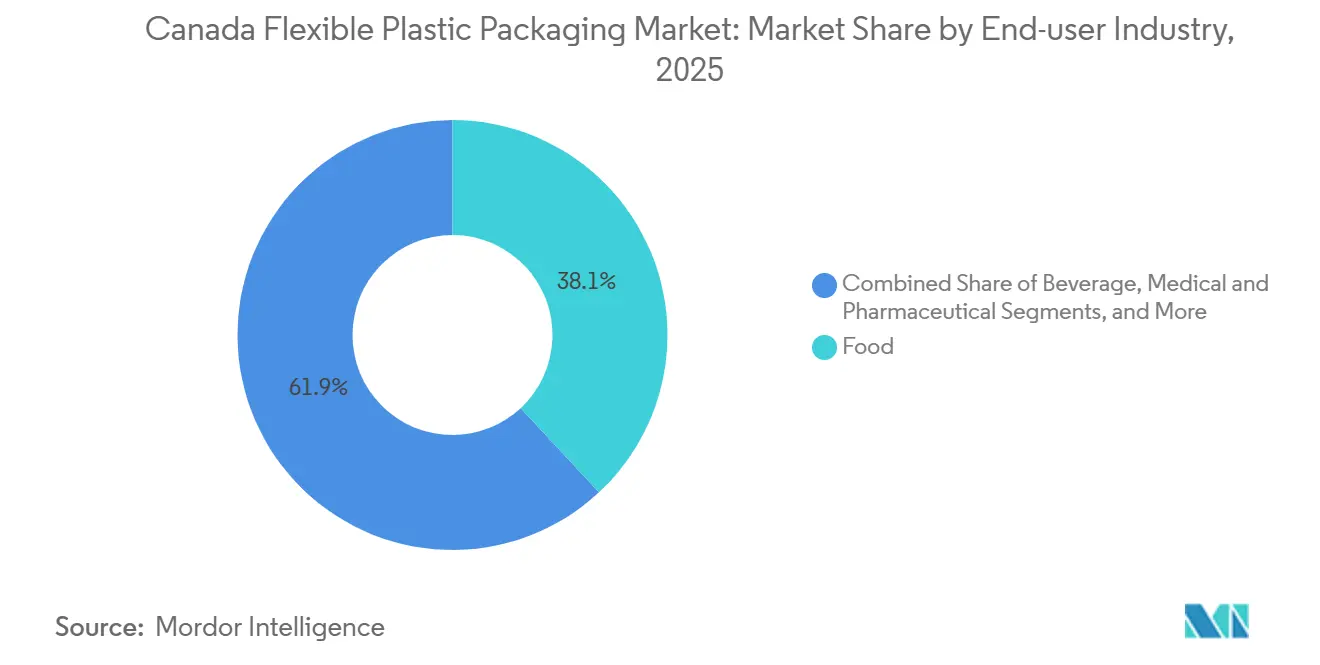
- By end-user industry, food held 38.07% share in 2025, while medical and pharmaceutical applications are projected to expand at a 5.52% CAGR through 2031.
- By distribution channel, direct sales held 58.81% share in 2025, while indirect sales channels are projected to expand at a 3.87% CAGR through 2031.
Note: Market size and forecast figures in this report are generated using Mordor Intelligence’s proprietary estimation framework, updated with the latest available data and insights as of January 2026.
Worldwide, activity is shaped by contributions from multiple countries and regions, with Canada representing one among them. The global report on flexible plastic packaging market by Mordor Intelligence reflects how these countries and regional layers combine into a single system.
Canada Flexible Plastic Packaging Market Trends and Insights
Drivers Impact Analysis*
| Driver | (~) % Impact on CAGR Forecast | Geographic Relevance | Impact Timeline |
|---|---|---|---|
| Food Shelf-Life Extension and High-Barrier Packaging Demand | +0.9% | National, concentrated in Ontario, Quebec, and Alberta processing hubs | Medium term (2-4 years) |
| Convenience and Portion-Control Packaging Demand | +0.7% | National, strongest in urban centers across Ontario, British Columbia, and Quebec | Short term (≤ 2 years) |
| E-Commerce and Parcelization Growth | +0.7% | National, with early gains in Toronto, Vancouver, Montreal, and Calgary | Short term (≤ 2 years) |
| Extended Producer Responsibility and Recycled-Content Investment | +0.6% | Ontario, Quebec, British Columbia, Alberta, and the national trajectory | Long term (≥ 4 years) |
| Cannabis Packaging Redesign for Child Resistance and Barrier Performance | +0.3% | National, concentrated in licensed producer hubs in Ontario and British Columbia | Medium term (2-4 years) |
| Resin-Level Traceability and Bilingual Digital Packaging Information | +0.2% | National, with compliance influence amplified in Quebec | Medium term (2-4 years) |
| Source: Mordor Intelligence | |||
Food Shelf-Life Extension and High-Barrier Packaging Demand
The move from rigid trays and metal cans toward barrier flexible formats is supporting demand in Canadian protein and frozen-food applications. Ethylene-vinyl alcohol, or EVOH, multilayer films are used for oxygen-sensitive meat, poultry, dairy, and seafood products. Case-ready formats and modified-atmosphere packaging require films that preserve product quality across retail distribution. Major grocery retailers are also expanding private-label fresh and deli offerings, which increases the need for consistent shelf-life performance. Converters must meet current product-protection requirements while developing recyclable alternatives that can work under recyclability-based fee schedules. The Canadian Food Inspection Agency oversees food safety requirements that affect food packaging use and food-contact compliance.
Convenience and Portion-Control Packaging Demand
Canada’s population aged 65 and older represented 19% of the population in 2025, supporting demand for single-serve and portion-controlled formats. Stand-up pouches with zipper closures are used across snacks, pet food, frozen foods, and personal care products. Smaller urban homes can make compact, flexible packs more practical than bulky, rigid containers for some households. Retailers also benefit from the ability of pouches to fit more products within available shelf space. These needs support short-run digital printing for specialty food, supplement, and cannabis products. The Canada Flexible Plastic Packaging Market therefore benefits when brands seek smaller pack sizes, faster product changes, and formats that maintain shelf presentation.
E-Commerce and Parcelization Growth
E-commerce represented 7.1% of Canadian retail trade in March 2026, based on Statistics Canada’s retail trade measure.[1] Online orders require lightweight mailer pouches, protective films, and materials that can protect goods across long delivery distances. Direct delivery changes supply patterns because individual shipments need their own primary or secondary flexible containment. Cross-border shopping also exposes domestic brands to packaging standards used by larger international sellers. This comparison is encouraging investment in printable and protective mailer films for direct-to-consumer products. The Canada Flexible Plastic Packaging Market has a clear opportunity where package appearance and package performance can influence returns and repeat purchases.
Extended Producer Responsibility and Recycled-Content Investment
Packaging extended producer responsibility programs operate across 9 provinces and the Yukon, creating a broad policy basis for design changes. Ontario completed its transition to full producer responsibility for the Blue Box program on January 1, 2026.[2] Flexible plastic packaging had a 4% recycling rate nationally in 2022, according to the Canada Plastics Pact’s 2024 progress report. This gap makes recyclable single-material structures more important for converters and brand owners. Provincial fee structures are increasing the financial importance of designs that work with collection and recycling systems. Federal Plastics Registry reporting requires producers to report plastics placed on the Canadian market, including material categories and quantities.
Restraints Impact Analysis*
| Restraint | (~) % Impact on CAGR Forecast | Geographic Relevance | Impact Timeline |
|---|---|---|---|
| tructures and Low Flexible-Packaging Recycling Rates | -0.6% | National, with acute pressure in Ontario and Quebec | Long term (≥ 4 years) |
| Virgin-Resin Price Volatility | -0.5% | National, with cost pass-through concentrated in commodity film applications | Short term (≤ 2 years) |
| Higher Costs for Sustainable Inks, Adhesives, and Coatings | -0.3% | Ontario, Quebec, and British Columbia | Medium term (2-4 years) |
| Provincial Variation in EPR Data and Packaging-Labeling Requirements | -0.2% | National, amplified for companies operating across multiple provinces | Long term (≥ 4 years) |
| Source: Mordor Intelligence | |||
Complex Multilayer Structures and Low Flexible-Packaging Recycling Rates
Flexible plastic packaging has a circularity gap that provincial programs are still addressing at scale. The Canada Plastics Pact reported that only 4% of flexible plastic packaging was recycled nationally in 2022.[3] Multilayer packs can combine polyethylene, nylon, EVOH, and adhesive layers to protect food and pharmaceutical products. These layers are difficult for existing material recovery facilities to separate and recycle. Producers that cannot demonstrate compatible designs can face higher fees in regulated provincial programs. The Canada Plastics Pact’s flexible packaging roadmap identifies collection, sorting, and recycling investments needed to improve outcomes.
Virgin-Resin Price Volatility
Resin cost volatility can quickly affect converter margins because polyethylene is the largest material category in the Canada Flexible Plastic Packaging Market. Price increases in polyethylene and polypropylene raise the cost of commodity films, bags, and higher-performance packaging grades. Converters with integrated extrusion capacity or established supply agreements can be better positioned than buyers that depend on short-cycle purchases. Cost pressure also complicates negotiations with food, healthcare, and consumer-product customers that seek stable package prices. Higher input costs can widen the cost difference between conventional materials and recyclable alternatives. This issue may delay some format changes even when regulatory requirements and customer demand favor recyclable film structures.
*Our forecasts treat driver/restraint impacts as directional, not additive. The impact forecasts reflect baseline growth, mix effects, and variable interactions.
Segment Analysis
By Material Type: Polyethylene Retains Volume Dominance, Polypropylene Accelerates
Polyethylene held 43.76% of the Canada Flexible Plastic Packaging Market share in 2025, supported by its balance of cost, seal performance, flexibility, and cold-temperature handling. It is widely used in frozen-food, produce, and dairy applications that need dependable performance throughout storage, handling, and distribution. Linear low-density polyethylene and high-density polyethylene support shrink, stretch, and lidding formats for food products. Those formats also serve protein processors across Canada’s beef, pork, and poultry supply chains, in both domestic and export-oriented operations. Its broad application base makes polyethylene central to the established demand for flexible film in both everyday food packaging and higher-volume processing lines.
Polypropylene is projected to expand at a 5.17% CAGR through 2031, making it the fastest-growing material segment in the Canada Flexible Plastic Packaging Market. Biaxially oriented polypropylene and cast polypropylene provide heat resistance and clarity for retort packaging, pharmaceutical blister lidding, and specialty snack films. Converters in Ontario and Quebec are adapting lines for acrylic-barrier BOPP structures that can support provincial recyclability requirements and customer performance needs. Polyvinyl chloride remains in select pharmaceutical and protective-film applications, although sustainability guidance is limiting its role in new-format development. EVOH supports high-value meat, seafood, and ready-meal applications, while bioplastics such as polylactic acid, polyhydroxyalkanoate, and polybutylene succinate are emerging in premium retail and foodservice uses where brands can absorb added cost.

By Product Type: Films and Wraps Scale on Recyclability Credentials, Pouches Sustain Leadership
Pouches accounted for 46.13% of the Canada Flexible Plastic Packaging Market share in 2025 and remained the leading product format. Stand-up pouches are widely used in snacks, pet food, frozen products, and personal care items that require convenient handling and shelf presentation. Resealable zipper pouches are common in premium dry food and confectionery packaging, while flat and pillow pouches are used in high-volume food applications where unit cost is a key factor. Their lightweight construction, retail versatility, and compatibility with different filling systems support demand from both established and newer brands. Pouches accommodate a wide range of products without requiring as much material as many rigid alternatives, which supports their established position.
Films and wraps are projected to expand at a 4.86% CAGR through 2031 in the Canada Flexible Plastic Packaging Market. The category includes shrink, stretch, lidding, and machine-direction-oriented polyethylene structures used across food, beverage, and industrial applications. MDO-PE is gaining use as a recyclable-compatible alternative to conventional multilayer laminates in protein and produce packaging. Amcor commercialized AmPrima Plus, a recycle-ready dairy packaging for Agropur, in February 2026, demonstrating that a single-material structure can meet cheese-packaging performance requirements. Bags continue to serve bakery, produce, and agricultural applications, while other product types include specialty tubing, roll stock, and medical-grade substrates used in sterile packaging.
By End-User Industry: Food Anchors Volume, Medical and Pharmaceutical Drives Value
Food held 38.07% of the Canada Flexible Plastic Packaging Market share in 2025, making it the largest end-user category. Meat, poultry, seafood, frozen meals, confectionery, and dairy products use a broad range of pouches, bags, and films. Frozen foods and protein products require high-barrier multilayer and modified-atmosphere structures, while dry foods, cereals, candy, pet food, produce, and dairy add demand across standard and premium formats. Food processors also need packaging that supports retail shelf life, product visibility, cold-chain distribution, and reliable seals during packing operations. These varied requirements keep food at the core of packaging volume and product-development activity in Canada.
Medical and pharmaceutical packaging is projected to expand at a 5.52% CAGR through 2031, the fastest end-user trajectory in the Canada Flexible Plastic Packaging Market. Sterile barrier systems require validation and documented performance for medical device packaging, while Health Canada guidance addresses the regulatory framework for medical device establishment licensing and related quality-system obligations. An aging population supports ongoing demand for drug blister films, device pouches, hospital supply packaging, and related protective materials. Beverage applications use flexible materials in multipack shrink films, secondary containment, and spouted pouches, while personal care brands are increasing the use of refill pouches. Agricultural, construction, and industrial users drive demand for stretch films, grain bags, vapor barriers, and protective materials for specialized applications.
By Distribution Channel: Direct Sales Dominate, Indirect Channels Scale on E-Commerce Tailwinds
Direct sales held 58.81% of the Canada Flexible Plastic Packaging Market share in 2025 and remained the primary distribution channel. Large converters use this model to supply food processors, retailers, and pharmaceutical manufacturers through ongoing, specification-focused relationships. These engagements involve barrier performance, printing, package engineering, approvals, and changes to product formats or operating requirements. Direct engagement can shorten product development cycles, reduce qualification risks, and provide larger customers with closer technical support and more consistent specifications. The model remains important where package performance, regulatory requirements, order volume, and supply reliability are complex.
Indirect sales channels are projected to expand at a 3.87% CAGR through 2031 in the Canada Flexible Plastic Packaging Market. Distributors, brokers, and platform-based suppliers serve small- and mid-sized food brands, specialty producers, and cannabis-licensed producers that may not meet direct-purchase thresholds. Online quoting and order-management systems allow digital-first converters to process shorter runs without traditional minimum order levels. British Columbia and Alberta have many small food producers and licensed producers that require varied package formats, while online distributors aggregate pouches, shrink films, and agricultural packaging. Margin pressure remains a limitation, as distributors must absorb increases in converter costs while meeting the pricing requirements of smaller buyers.
Geography Analysis
Ontario and Quebec are the main production bases for the Canada Flexible Plastic Packaging Market, supported by food processing, pharmaceutical manufacturing, and consumer goods activity. The Greater Toronto Area and the Hamilton-Niagara corridor are home to food and beverage processors that require pouches, barrier films, and medical packaging substrates. Quebec’s dairy, poultry, and pork processing activity supports food-packaging demand, while bilingual labeling affects package engineering for products distributed across Canada. Converters in Ontario and Quebec are investing in digital printing and shorter packaging runs as retailers seek smaller packs and faster product turnover.
Western Canada is the fastest-growing regional cluster, led by British Columbia, Alberta, and the Prairie Provinces. British Columbia’s produce and seafood processors use modified-atmosphere and high-barrier vacuum packaging, and collection infrastructure is encouraging investment in mono-material structures. Alberta’s beef and pork processors create demand for vacuum bags and shrink films, while Saskatchewan and Manitoba use agricultural films, gusseted bags, and stretch films for grain and fertilizer handling. Winpak, headquartered in Winnipeg, serves food and medical packaging customers in this regional base and across Canada.
Atlantic Canada and the northern territories represent a smaller but distinct demand base within the Canada Flexible Plastic Packaging Market. Nova Scotia, New Brunswick, and Newfoundland support seafood and processed-food packaging needs, including lobster and fish exports that require vacuum and modified-atmosphere packaging. Northern supply chains require films that can perform in temperatures below -30°C, and these performance requirements can influence specifications for wider food and industrial distribution.
Competitive Landscape
The Canada Flexible Plastic Packaging Market is consolidating among large converters while regional and mid-sized companies continue to serve specialized applications. ProAmpac completed its acquisition of TC Transcontinental Packaging for USD 1.51 billion in March 2026.[4] The transaction added capability in dairy, meat, medical, and pharmaceutical packaging. ProAmpac stated that the combined company operates more than 80 manufacturing sites and employs 11,000 people. This scale can strengthen the company’s position in applications that require reliable supply, technical support, and specialized materials.
Amcor’s combination with Berry Global closed in 2025, creating a platform that reported USD 23 billion in annual revenue and USD 285 million in integration synergies in fiscal 2026. The company expects the combination to strengthen its polyethylene shrink, flexible food, and healthcare packaging capabilities. Amcor also partnered with Kelpi in June 2026 to develop seaweed-based barrier coatings for fiber-based packaging. These actions show that large companies are combining scale with work on recyclable and bio-based barrier materials. Novolex’s USD 6.7 billion acquisition of Pactiv Evergreen further reduced the number of independent volume converters available to customers seeking domestic supply options.
Winpak focuses on modified-atmosphere and protein packaging and has integrated extrusion capability. The company budgeted USD 70 million to USD 80 million for 2026 capital expenditures, including converting and extrusion equipment upgrades. Covertech Flexible Packaging, Emmerson Packaging, and Polykar Industries retain positions through proximity and format specialization in their regional markets. Bilingual connected packaging may offer a route to premium pricing for cannabis, natural health product, and food customers that need compliant digital labeling.
Consolidated Market with Strong Global Players
The flexible packaging market in Canada exhibits a relatively consolidated structure dominated by multinational corporations with extensive manufacturing capabilities and broad product portfolios. These global players leverage their research and development capabilities, established distribution networks, and economies of scale to maintain competitive advantages. Regional players carve out niches through specialized product offerings and strong local customer relationships, though they face increasing pressure from larger competitors. The market has witnessed significant consolidation through mergers and acquisitions, as larger companies seek to expand their technological capabilities and geographic reach.
The competitive landscape is characterized by a mix of diversified packaging conglomerates and specialized flexible packaging manufacturers. Major global players often operate through multiple divisions serving various end-user industries, while specialized players focus on specific market segments or technologies. Merger and acquisition activity has been particularly strong in recent years, with companies seeking to acquire complementary technologies, enhance sustainability capabilities, and strengthen their position in key end-user markets like food and beverage, healthcare, and personal care.
Innovation and Sustainability Drive Future Success
For established players to maintain and expand their market share, a focus on sustainable flexible packaging solutions and technological innovation is crucial. Companies must invest in research and development to create recyclable and eco-friendly products while maintaining performance characteristics. Building strong relationships with key customers through collaborative innovation and customized solutions helps defend against competitive pressures. Vertical integration and operational efficiency improvements are essential to manage costs and maintain pricing flexibility, while strategic acquisitions can help consolidate market position and acquire new capabilities.
Emerging players can gain ground by focusing on niche markets and specialized applications where larger competitors may be less active. Success factors include developing innovative solutions for specific end-user needs, particularly in growing segments like e-commerce packaging. Companies must navigate increasing regulatory pressure regarding plastic waste and recycling, making sustainability credentials increasingly important for market success. The risk of substitution from alternative packaging materials necessitates continuous innovation in product performance and sustainability features. End-user concentration in sectors like food and beverage requires strong customer relationship management and the ability to meet stringent quality and performance requirements.
Canada Flexible Plastic Packaging Industry Leaders
-
Amcor plc
-
Winpak Ltd.
-
ProAmpac Holdings Inc.
-
Sealed Air Corporation
-
Mondi plc
- *Disclaimer: Major Players sorted in no particular order
Recent Industry Developments
- August 2026: Amcor reported Q4 fiscal 2026 results, confirming USD 23 billion in annual revenue and USD 285 million in Berry Global integration synergies achieved in fiscal 2026, approximately 10% ahead of initial projections. Management indicated the combined portfolio is capturing new North American customer wins across food and healthcare flexible packaging categories, with the bulk of the 3-year USD 650 million synergy target expected to be realized from 2027 onward.
- June 2026: Amcor announced a partnership with UK-based startup Kelpi to develop seaweed-based barrier coatings for fiber-based packaging materials. The collaboration explores bio-based coatings designed to provide oxygen- and moisture-barrier performance compatible with recycling streams, directly addressing the recyclability gap in high-barrier flexible formats that face scrutiny under Canadian EPR fee frameworks.
- May 2026: Amendments to British Columbia's Extended Producer Responsibility Regulation came into effect on May 7, 2026, narrowing the exclusion for flexible-plastic packaging to residential food-containment products, cling wrap, sandwich bags, and freezer bags. The change expands producer accountability for all other flexible packaging categories and extends material-management deadlines through December 2033, broadening the scope of converters and brand owners required to manage end-of-life for flexible formats.
- March 2026: ProAmpac completed its acquisition of TC Transcontinental Packaging from TC Transcontinental, TSX TCL.A and TCL.B, for USD 1.51 billion. The combined entity operates over 80 manufacturing sites globally and 11,000 employees, with added capabilities in dairy, meat, medical, and pharmaceutical packaging and manufacturing presence across North America, South America, the United Kingdom, and New Zealand.
Canada Flexible Plastic Packaging Market Report Scope
The Canada Flexible Plastic Packaging Market Report is Segmented by Material Type (Polyethylene (PE), Polypropylene (BOPP and CPP), Polyvinyl Chloride (PVC), Ethylene-Vinyl Alcohol (EVOH), Bioplastics (PLA, PHA, PBS), and Other Material Types), Product Type (Pouches [Stand-Up Pouches, and Flat and Pillow Pouches], Bags (Gusseted, Wicketed), Films and Wraps (Shrink, Stretch, Lidding, MDO-PE), and Other Product Types), End-user Industry (Food [Frozen Foods, Dry Foods and Cereals, Meat, Poultry and Seafood, Candy and Confectionery, Pet Food, Fresh Produce, Dairy Products, and Other Food Products], Beverage, Personal and Household Care, Medical and Pharmaceutical, and Other End-user Industries), and Distribution Channel (Direct Sales, and Indirect Sales). The Market Forecasts are Provided in Terms of Value (USD).
| Polyethylene (PE) |
| Polypropylene (BOPP and CPP) |
| Polyvinyl Chloride (PVC) |
| Ethylene-Vinyl Alcohol (EVOH) |
| Bioplastics (PLA, PHA, PBS) |
| Other Material Types |
| Pouches | Stand-Up Pouches |
| Flat and Pillow Pouches | |
| Bags (Gusseted, Wicketed) | |
| Films and Wraps (Shrink, Stretch, Lidding, MDO-PE) | |
| Other Product Types |
| Food | Frozen Foods |
| Dry Foods and Cereals | |
| Meat, Poultry and Seafood | |
| Candy and Confectionery | |
| Pet Food | |
| Fresh Produce | |
| Dairy Products | |
| Other Food Products | |
| Beverage | |
| Personal and Household Care | |
| Medical and Pharmaceutical | |
| Other End-user Industries |
| Direct Sales |
| Indirect Sales |
| By Material | Polyethylene (PE) | |
| Polypropylene (BOPP and CPP) | ||
| Polyvinyl Chloride (PVC) | ||
| Ethylene-Vinyl Alcohol (EVOH) | ||
| Bioplastics (PLA, PHA, PBS) | ||
| Other Material Types | ||
| By Product | Pouches | Stand-Up Pouches |
| Flat and Pillow Pouches | ||
| Bags (Gusseted, Wicketed) | ||
| Films and Wraps (Shrink, Stretch, Lidding, MDO-PE) | ||
| Other Product Types | ||
| By End-user Industry | Food | Frozen Foods |
| Dry Foods and Cereals | ||
| Meat, Poultry and Seafood | ||
| Candy and Confectionery | ||
| Pet Food | ||
| Fresh Produce | ||
| Dairy Products | ||
| Other Food Products | ||
| Beverage | ||
| Personal and Household Care | ||
| Medical and Pharmaceutical | ||
| Other End-user Industries | ||
| By Distribution Channel | Direct Sales | |
| Indirect Sales | ||
Key Questions Answered in the Report
What is the size of the Canada flexible plastic packaging market?
The sector was valued at USD 6.42 billion in 2025, is estimated at USD 6.65 billion in 2026, and is forecast to reach USD 7.98 billion by 2031 at a 3.71% CAGR. The outlook reflects mature packaging demand and continued investment in performance films, lightweight formats, and recyclable structures.
Which material leads flexible plastic packaging in Canada?
Polyethylene led with a 43.76% share in 2025 because it is widely used in food, produce, dairy, shrink, stretch, and lidding applications. Its cold-temperature flexibility, seal performance, and broad availability keep it relevant for processors that serve long distribution routes.
Which packaging product has the largest share in Canada?
Pouches held a 46.13% share in 2025, supported by use in snacks, pet food, frozen products, and personal care products. Stand-up, flat, and pillow formats allow brands to select a design suited to product protection, shelf display, and filling-line needs.
Which end-user application is expanding fastest?
Medical and pharmaceutical packaging is projected to expand at a 5.52% CAGR through 2031, supported by sterile barrier and medical-device packaging requirements. Drug blister films, device pouches, and hospital supply formats require documented package performance and reliable protection during storage and distribution.
How do extended producer responsibility programs affect flexible plastic packaging?
Producer responsibility programs increase the importance of recyclable structures, material traceability, and reporting because producers are responsible for packaging placed on the market. This encourages converters and brand owners to consider single-material films, resin information, collection compatibility, and provincial reporting requirements early in package development.
Which regions create the strongest packaging demand in Canada?
Ontario and Quebec are the main production base, while Western Canada is the fastest-growing regional cluster due to food, seafood, protein, and agricultural packaging needs. Atlantic Canada and northern areas also require high-performance films for seafood exports, cold-chain logistics, and distribution in low temperatures.