
Market Overview
| Study Period | 2020 - 2031 |
|---|---|
| Forecast Data Period | 2026 - 2031 |
| Base Year Market Size (2025) | USD 49.03 Billion |
| Market Size (2026) | USD 50.77 Billion |
| Market Size (2031) | USD 60.44 Billion |
| Growth Rate (2026 - 2031) | 3.55 % |
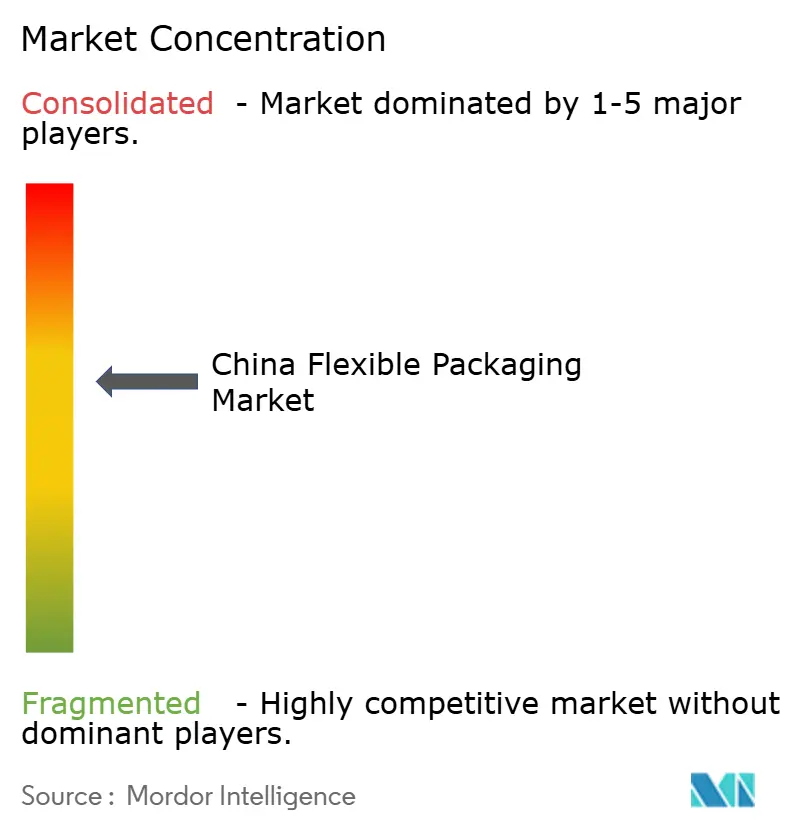
| Market Concentration | Medium |
Major Players *Disclaimer: Major Players sorted in no particular order Image © Mordor Intelligence. Reuse requires attribution under CC BY 4.0. | |
China Flexible Packaging Market Analysis by Mordor Intelligence
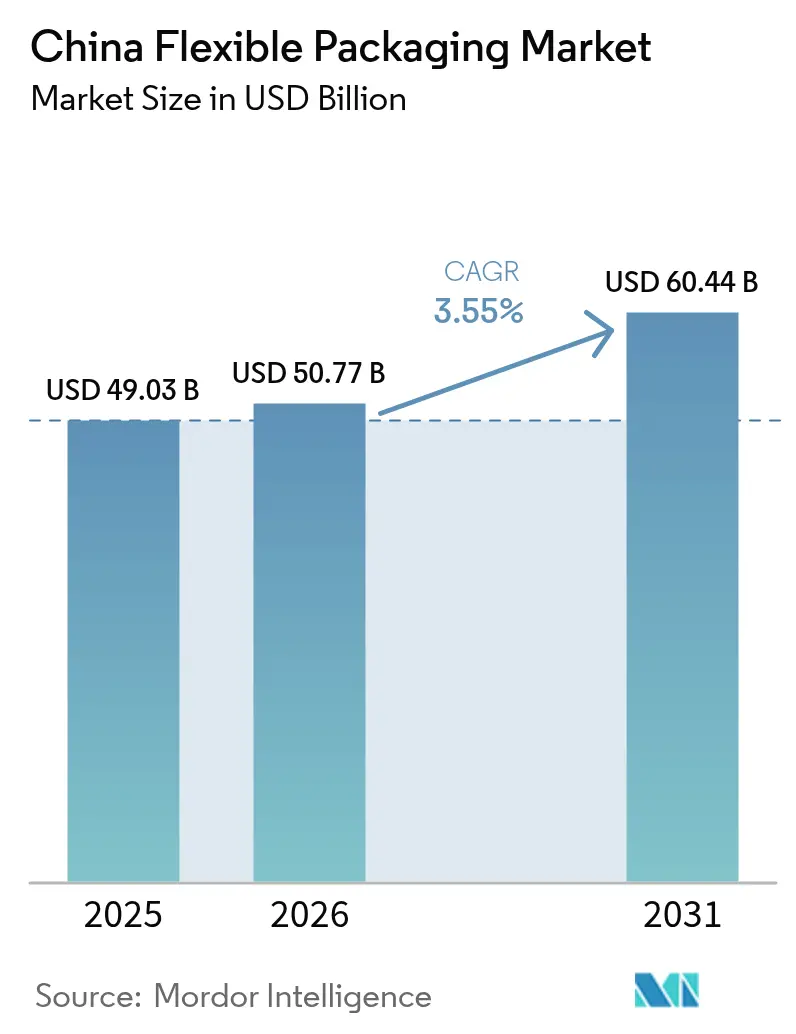
China flexible packaging market size in 2026 is estimated at USD 50.77 billion, growing from 2025 value of USD 49.03 billion with 2031 projections showing USD 60.44 billion, growing at 3.55% CAGR over 2026-2031. Steady growth is underpinned by sustained e-commerce expansion, wider cold-chain coverage, and rising regulatory scrutiny that is steering converters toward mono-material films and certified recycled content. Logistics platforms now specify puncture-resistant mailers, retailers are phasing out non-recyclable laminates, and personal-care brands demand short-run graphic customization, all of which funnel incremental value toward converters with advanced extrusion and digital-printing assets. Petrochemical oversupply keeps resin prices volatile, compressing margins for commodity formats, yet it simultaneously frees capital for firms willing to reposition around premium, high-barrier structures. Competitive intensity is sharpening as multinational incumbents defend share against agile domestic rivals that can match print quality while quoting faster lead times, especially for pilot SKUs targeting tier-2 and tier-3 cities. Overall, the China flexible packaging market is at a strategic crossroads where sustainability mandates are no longer optional and speed-to-market has become a decisive differentiator.
Key Report Takeaways
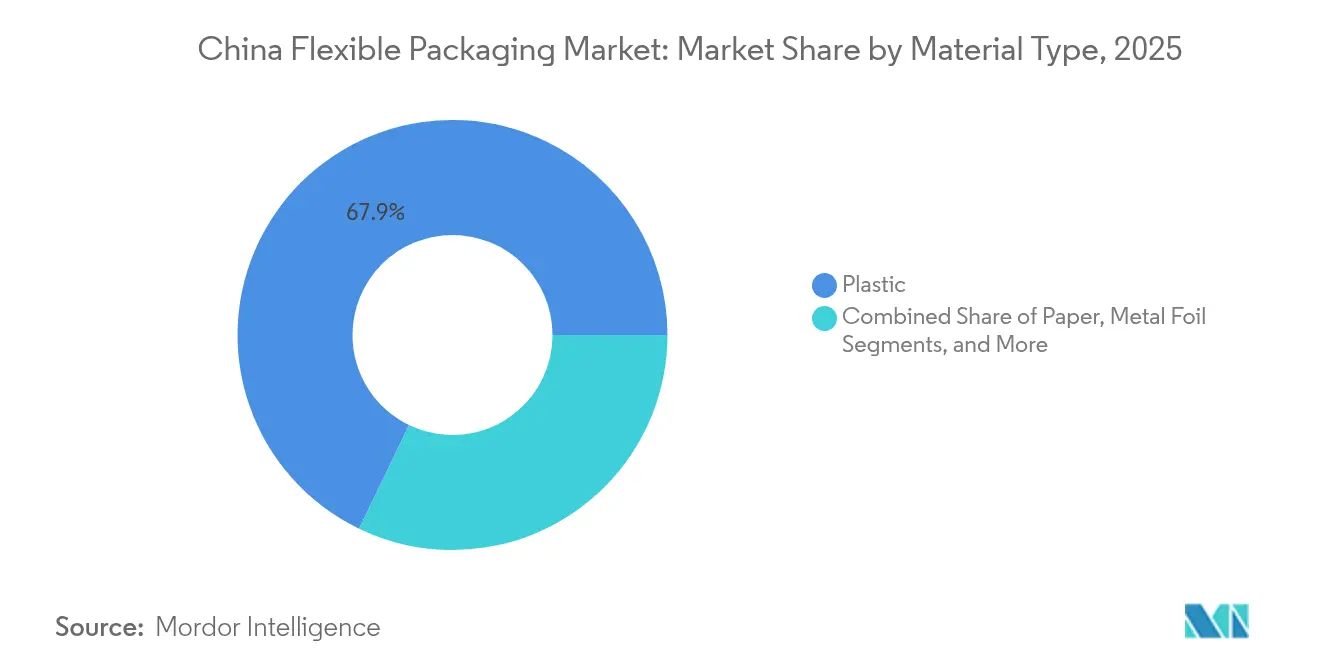
- By material type, plastic materials held 67.85% of China flexible packaging market share in 2025, while bioplastics are forecast to expand at a 5.32% CAGR through 2031.
- By product type, bags and pouches accounted for 47.10% of revenue in 2025, whereas sachets and stick packs are projected to grow at a 4.52% CAGR to 2031.
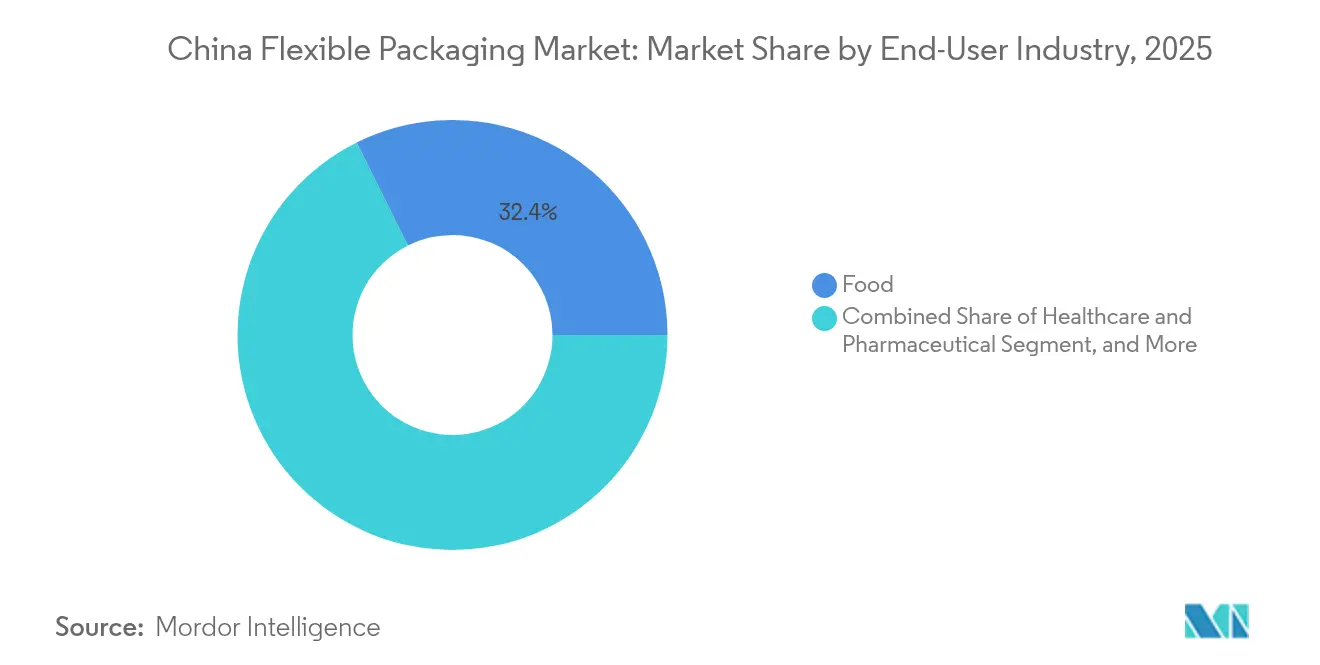
- By end-user industry, food dominated with a 32.35% share in 2025, yet personal care and cosmetics are advancing at a 5.45% CAGR to 2031.
- By printing technology, flexography commanded 45.20% of 2025 revenue, while digital printing is poised for a 5.70% CAGR through 2031.
Note: Market size and forecast figures in this report are generated using Mordor Intelligence’s proprietary estimation framework, updated with the latest available data and insights as of 2026.
China Flexible Packaging Market Trends and Insights
Drivers Impact Analysis*
| Driver | (~) % Impact on CAGR Forecast | Geographic Relevance | Impact Timeline |
|---|---|---|---|
| Rising Demand for E-Commerce Ready Packaging | +0.8% | National, concentrated in tier-1 and tier-2 cities | Short term (≤ 2 years) |
| Government Push for Green Manufacturing | +0.6% | Coastal provinces (Jiangsu, Zhejiang, Guangdong) | Medium term (2-4 years) |
| Cold-Chain Logistics Expansion | +0.7% | Tier-2 and tier-3 cities nationwide | Short term (≤ 2 years) |
| Domestic FMCG Brands Seeking Differentiation | +0.5% | Tier-1 cities | Medium term (2-4 years) |
| High-Barrier Monomaterial Film Innovation | +0.4% | Yangtze River Delta, Pearl River Delta | Long term (≥ 4 years) |
| Private-Equity Capital Inflow | +0.3% | Jiangsu, Zhejiang, Shandong | Medium term (2-4 years) |
| Source: Mordor Intelligence | |||
Rising Demand for E-Commerce Ready Packaging
E-commerce logistics generated CNY 6.4 trillion (USD 0.91 trillion) in the first three quarters of 2024, up 4.2% year-on-year, prompting platforms to mandate mailers that survive conveyor handling and doorstep drop-offs without tearing. Converters have responded with co-extruded polyethylene-polyamide films that boost puncture resistance yet preserve heat-seal speed, enabling fulfillment centers to process an extra 8–10 parcels per minute. Freight operators favor flexible mailers because a unit weighs 40–50% less than a similar-sized corrugated box, cutting both carbon output and surcharges tied to dimensional weight. Brands add QR-code traceability and holographic seals, which elevate tooling costs beyond the reach of small converters lacking digital presses. The result is a bifurcated China flexible packaging market where premium e-commerce formats command 15–20% pricing power while commodity pillow packs chase volume. Large converters installing nanographic presses create an insurmountable moat around short-run orders, tightening the supply chain for last-mile durable mailers.
Government Push for Green Manufacturing in Packaging
The State Council’s 2024 Extended Producer Responsibility rules make brand owners financially accountable for post-consumer collection, accelerating demand for mono-polyethylene and polypropylene films that pass curbside recyclability tests.[1]State Council of China, “Extended Producer Responsibility Guidelines 2024,” www.gov.cn Coastal provinces with earlier enforcement clocks are auditing converter lines quarterly, and fines for non-compliant laminate structures rose 35% in 2024 over 2023. Brand procurement teams now score suppliers on recycled-content disclosure, nudging tier-1 converters to publish life-cycle inventory data and pursue ISO 14001 certifications. Smaller inland players face capital-expenditure barriers as each line retrofit costs USD 2–4 million, forcing them to cede multinational accounts or accept price erosion. Post-consumer resin suppliers have begun issuing food-contact compliant grades, giving early adopters a 3–4 percentage-point margin lift. Over the medium term, the new rules entrench a sustainability premium inside the China flexible packaging market while sidelining firms that continue to rely on mixed-material laminates.
Proliferation of Cold-Chain Logistics for Fresh Food Delivery
Rapid urbanization and higher disposable income push fresh seafood, meat, and dairy subscriptions that need films functioning from −18 °C to +4 °C without condensation failure. Platforms such as Meituan and Ele.me enlarged refrigerated-warehouse space 22% in 2024, adding demand for high-barrier mono-polyethylene pouches that match EVOH performance but remain mechanically recyclable. Nano-clay additives lower oxygen-transmission rates below 5 cm³/m²/day, a threshold once attainable only with metallized layers. Brands in tier-2 hubs trial tamper-evident, resealable designs that keep integrity during two freeze–thaw cycles, extending shelf life and allowing cross-regional shipping. Converters with peel-seal expertise secure contracts at 10–12% price premiums. The cold-chain build-out also widens geographic coverage of the China flexible packaging market, shifting order volumes from coastal mega-cities toward inland city clusters where cold storage was previously scarce.
Growth of Domestic FMCG Brands Requiring Differentiated Packs
Home-grown brands such as Tingyi, Uni-President, and Want Want use Instagram-ready packs to stand out, spurring adoption of matte finishes, holographic foils, and thermochromic inks that demand exacting presswork. A matte-finish stand-up pouch helped Tingyi raise retail price points 12–15% versus legacy pillow packs without a sales slowdown. Digital presses like HP Indigo narrow-web units supply serialized SKUs for regional promotions, shrinking time-to-shelf from six weeks to two. Converters able to print variable data in a single pass capture micro-segments from KOL-driven livestream sales that spike volumes unpredictably. The shift toward shorter runs reinforces digital’s ascendancy inside the China flexible packaging market, as flexographic setups fight declining average order sizes.
Restraints Impact Analysis*
| Restraint | (~) % Impact on CAGR Forecast | Geographic Relevance | Impact Timeline |
|---|---|---|---|
| Single-Use Plastics Ban Roadmap | −0.5% | Coastal provinces (Jiangsu, Zhejiang, Guangdong, Fujian) | Medium term (2-4 years) |
| Volatile Petrochemical Feedstock Prices | −0.4% | Petrochemical clusters in Shandong, Jiangsu, Zhejiang | Short term (≤ 2 years) |
| Recycling Infrastructure Gaps in Inland Cities | −0.3% | Tier-3 and tier-4 cities in Henan, Anhui, Hunan, Sichuan | Long term (≥ 4 years) |
| Rigid Sustainable Alternatives | −0.2% | Beverage and personal-care segments nationwide | Medium term (2-4 years) |
| Source: Mordor Intelligence | |||
Stringent Single-Use Plastics Ban Roadmap
Provincial regulators scheduled phase-outs of non-recyclable multilayer films by 2026, demanding 85% recovery rates for flexible formats.[2]Ministry of Ecology and Environment, “Plastic Waste Management Guidelines 2024,” mee.gov.cn Lines that still laminate polyethylene with polyamide risk de-listing from supermarket shelves in Jiangsu and Zhejiang. Retooling a seven-layer extrusion line costs USD 2–4 million, weighing on firms with thin cash cushions. Some converters migrate production inland to skirt audits, but brand owners increasingly insist on site visits and ISO-14001 certificates, closing the loophole. The policy gap between coastal and inland regions fragments the China flexible packaging market, with advanced players nudging ahead while late adopters watch margin erosion.
Volatile Petrochemical Feedstock Prices
China added 18.7 million tpa of polypropylene and polyethylene capacity between 2024 and 2026, flipping into a net exporter and driving price swings that stretch converter working capital. Spot prices whipsawed by 3–5% within weeks in 2024, undermining fixed-price contracts. Large converters leverage multi-year supply frame agreements with Sinopec to secure a 3–5% cost edge, yet mid-tier firms struggle to hedge. Feedstock gyrations shift procurement teams to weekly quoting, clogging project pipelines and delaying innovation investment across the China flexible packaging market.
*Our forecasts treat driver/restraint impacts as directional, not additive. The impact forecasts reflect baseline growth, mix effects, and variable interactions.
Segment Analysis
By Material Type: Bioplastics Scale While Plastics Remain Dominant
Plastic still owns 67.85% of China flexible packaging market share in 2025, propelled by polyethylene’s balance of seal strength and cost efficiency. Bioplastics, though comparatively small, are pacing at a 5.32% CAGR because consumer goods companies must hit 30% renewable-content pledges by 2028. The China flexible packaging market size for bioplastics in personal care is projected to rise sharply as brand owners willingly absorb the 20-30% cost premium. Polyethylene holds sway in staple food pouches and e-commerce mailers, aided by expansion of post-consumer resin grades that cut virgin usage without sacrificing machinability. Polypropylene’s clarity secures beverage overwraps, while polyethylene-terephthalate and polyamide appear in barrier-critical lines such as seafood packs. Over the forecast horizon, resin demand bifurcates between low-cost commodity films and high-barrier, mono-material solutions that satisfy recycling audits.
Bioplastics adoption centers on tier-1 cosmetic aisles, where polylactic-acid sachets convey clean-label cues. Moisture sensitivity challenges are gradually mitigated by multi-layer PLA-coated papers that withstand high-humidity logistics. Converters experimenting with starch-blend films bank on premium margin upside even at slower line speeds. Metal-foil laminates retreat to pharmaceutical niches as oxygen-barrier monomaterial designs mature. Taken together, material dynamics underscore how sustainability triggers value shifts inside the China flexible packaging market, spurring converters to recalibrate asset footprints toward recyclable or renewable substrates.



By Product Type: Sachets Surge as Bags Retain Scale
Bags and pouches delivered 47.10% of 2025 revenue, reflecting entrenched usage across snacks, frozen meat, and pet food. Sachets and stick packs, however, clock the fastest 4.52% CAGR as households gravitate toward single-serve convenience, especially in lower-tier cities. China flexible packaging market size for sachets in electrolyte powder alone is forecast to double by 2031 on the back of gym culture and direct-to-consumer beverage sachets. Stand-up pouches remain king where reclosing, spouts, or zippers extend product life once opened, but portion packs thrive on impulse buys and e-commerce sample bundles.
Digital printing fuels sachet customization, letting brands test micro-SKUs without cylinder cost, while Landa’s S10P platform pushes variable data at near flexographic speeds. Films and wraps face slowing growth as integrated e-commerce fulfilment reduces secondary overwrap needs. Labels and shrink sleeves gain in premium beverages, aided by tactile lacquers and anti-counterfeit inks. Overall, product-mix evolution reinforces the China flexible packaging market’s shift toward lightweight, portion-aligned formats that fit modern lifestyles.
By End-User Industry: Personal Care Gains Momentum Over Food Volume
Food held a commanding 32.35% revenue slice in 2025 thanks to daily consumption and diverse pouch formats. Yet personal care and cosmetics are projected to outstrip food with a 5.45% CAGR because domestic beauty startups weaponize packaging as a branding canvas. China flexible packaging industry players report order books tilting toward shampoo pouches, facial-mask sachets, and body-lotion tubes that feature metallic accents and soft-touch varnish. Within food, frozen snacks and ready-to-eat meals enjoy barrier-film upgrades that curb freezer burn, while dairy brands test spouted pouches for on-the-go yogurt.
Healthcare applications deliver steady demand for child-resistant closures that meet National Medical Products Administration standards, securing long-term contracts for converters proficient in multi-layer blister webs. Agricultural seed pouches rely on UV-stable films as rural mechanization expands. The duality of high-volume food versus high-margin personal care shapes capacity allocation across the China flexible packaging market, with converters hedging between volume stability and premium upside.
By Printing Technology: Digital Ascends While Flexography Holds the Base
Flexography still captures 45.20% of 2025 revenue, valued for its speed and low ink cost per impression. Yet digital presses post a 5.70% CAGR, driven by brand fascination with personalized sleeves and serialized QR codes linking to loyalty apps. The China flexible packaging market size for digital output is forecast to triple by 2031 as run lengths shrink and SKU counts escalate. Rotogravure preserves its niche in photo-grade confectionery foils where color fidelity trumps plate cost, but setup lead times lag fast-fashion launch schedules.
Converters embrace a hybrid floor plan, dedicating flexo to long runs while reserving digital lines for micro-batch drops. This dual gear strategy demands capital depth yet pays off with 15-20% price premiums on variable-data jobs. Regulatory pressure on solvent emissions nudges flexo presses toward water-based inks, further raising conversion costs. Digital platforms, by contrast, satisfy both speed and sustainability checklists, amplifying their pull across the China flexible packaging market.
Geography Analysis
Coastal strongholds in the Yangtze River Delta generate roughly 35-40% of national converter capacity, benefiting from feedstock proximity, port access, and front-line compliance expertise. The Pearl River Delta adds another 25-30%, specializing in high-barrier electronics wraps and pharma sachets, sectors that reward defect-free coating lines. Inland provinces such as Shandong and Sichuan scale plants to serve regional FMCG brands yet wrestle with recycling shortfalls that delay post-consumer resin uptake.
Tier-1 cities Beijing, Shanghai, Guangzhou, Shenzhen set the premium tone for differentiated packs, with e-commerce penetration surpassing 70%. Tier-2 hubs like Hangzhou and Chengdu see the fastest cold-chain build-out, translating into mono-PE pouches outfitted for low-temperature logistics. Lower-tier cities lag 15-20 percentage points behind national waste-collection targets, constraining closed-loop film streams and elevating virgin-resin reliance. Geographic disparities thus produce a two-speed China flexible packaging market, in which coastal clusters chase compliance premiums while inland zones compete primarily on unit cost.
Regulatory Landscape
China’s flexible packaging demand is increasingly shaped by national standards and State Council-led waste governance, tightening requirements on material safety and recyclability. For food-contact applications, oversight by the National Health Commission (NHC) and the State Administration for Market Regulation (SAMR) has intensified, including the March 2025 first amendment to GB 9685 that strengthens additive restrictions, and an August 29, 2025 WTO-notified draft standard for General Safety Requirements of Food Contact Materials and Articles intended to replace GB 4806.1-2016 and GB 4806.13-2023.
In 2026, compliance broadened from product safety to packaging minimization and express and e-commerce packaging governance. The State Council’s Solid Waste Comprehensive Governance Action Plan (issued January 2026) targets stricter limits on express delivery packaging and excessive commodity packaging, while SAC/SAMR-backed standards updates moved into effect, including GB/T 18706-2025 (effective January 1, 2026) and GB/T 21661-2025 (effective May 1, 2026). For e-commerce supply chains, SB/T 11266-2026 on green packaging technologies and management requirements (effective July 1, 2026) raises expectations for circular management and clearer packaging-component control, pushing converter transitions toward mono-material structures, compliant inks and adhesives, and auditable documentation for brand-owner procurement reviews.
Value Chain Analysis
The China flexible packaging value chain begins with upstream petrochemical and specialty-material inputs, led by PE and PP resins, additives, and inks and adhesives used in gravure, flexographic, and digital processes. Midstream converters run extrusion (including high-barrier film structures), printing, lamination (including solventless options), slitting, and pouch-making, then supply applications across food, personal care and cosmetics, healthcare and pharmaceutical, and e-commerce mailers. Volatility in resin pricing and supply allocation, combined with tighter requirements for food-contact formulations (GB 9685 and the GB 4806 family), has increased the value of qualified sourcing, QC systems, and long-term supply agreements for scale players.
Downstream, brand owners, retailers, and logistics platforms are exerting more influence through specifications for recyclable structures and traceable claims, linking packaging decisions to Extended Producer Responsibility implementation and express packaging controls. Collection and recycling remain binding constraints, especially for multilayer and high-barrier structures where sorting and delamination are difficult. That is pushing redesign toward mono-material films compatible with existing recovery streams and toward certified recycled-content supply where acceptable for target applications. Industry programs and standards under the Packaging Industry Development Plan (2021-2025), along with evolving green design evaluation benchmarks, are drawing more converters into collaboration with material suppliers, recyclers, and testing labs to validate performance (seal integrity, barrier, migration) while meeting lower-VOC production and recyclability expectations.
Competitive Landscape
Multinationals Amcor, Mondi, Sealed Air, Tetra Pak retain high-barrier niches in pharma and aseptic dairy, leveraging global GMP certifications to secure multinational accounts. Domestic leaders such as Southern Packaging Group, Zhejiang Chengde, and Jiangsu Caihua counter with faster cycle times and region-specific design support, narrowing perceived quality gaps. Amcor’s April 2025 investment to add rotogravure and digital lines targets premium healthcare and personal-care packs where technical compliance justifies higher margins.[3]Amcor Plc, “China Expansion Announcement 2025,” amcor.com Conversely, Huhtamaki shuttered two plants in 2024, signaling an exit from commodity laminate formats to focus on molded fiber.
Jingfeng’s grab of Greatview expands retort-pouch reach, and Jiangsu Caihua’s stake in a digital-print specialist shores up short-run capability. Technology remains the battlefield; converters deploying machine-vision inspection have trimmed scrap by 12–15%, enhancing bids on high-volume snack packs. Going forward, hybrid print lines, monomaterial barrier films, and recycled-content verification will separate winners from laggards in the China flexible packaging market.
China Flexible Packaging Industry Leaders
Amcor Plc
Mondi Plc
Sealed Air Corporation
Huhtamaki Oyj
Tetra Pak International SA
- *Disclaimer: Major Players sorted in no particular order

Market Opportunities and Future Outlook
Regulatory tightening around express and e-commerce packaging, together with buyer-led sustainability scorecards, is creating opportunities for converters that can industrialize recyclable, mono-material high-barrier structures without compromising seal performance for cold-chain and last-mile handling. SB/T 11266-2026 (effective July 1, 2026) codifies green packaging management requirements for e-commerce, while the State Council’s January 2026 Solid Waste Comprehensive Governance Action Plan targets excessive and non-compliant packaging in fast-moving channels. These changes tend to reward suppliers that can deliver puncture-resistant mono-PE mailers, recyclable barrier pouches, and documentation-ready packaging-component control that brand owners can audit.
Capability investments and compliance infrastructure also support higher-margin positioning in segments where technical validation and export-readiness matter. Amcor’s actions in China provide a concrete signal: its July 2026 commencement of a major expansion at the Dongguan flexible packaging facility (including added manufacturing space and an automated warehouse) is aligned to recycle-ready packaging solutions, and its China-based Asia Pacific Innovation Center laboratory receiving CNAS accreditation in May 2026 supports test-data recognition across many countries. For the broader converter base, the opportunity centers on upgrading printing and lamination toward lower-emission processes, building in-house testing and traceability, and scaling short-run and variable-data work for domestic FMCG and personal care brands that need frequent SKU changes and anti-counterfeit features.
Recent Industry Developments
- July 2026: Amcor commenced a major expansion project at its flexible packaging facility in Dongguan, China, adding 7,000 square meters of manufacturing space and an automated warehouse, with completion targeted for July 2027. The upgrade strengthens local capacity for recycle-ready formats and supports faster service levels for multinational and domestic brand owners operating high-mix portfolios.
- May 2026: Amcor’s Asia Pacific Innovation Center laboratory in China received China National Accreditation Service (CNAS) accreditation, enabling its test data to be recognized across 116 countries. This improves the company’s ability to support customers on performance testing and compliance documentation for regulated end uses such as food and healthcare packaging.
- April 2025: Amcor announced an investment to expand rotogravure and digital capacity in Jiangsu, targeting pharmaceutical and personal-care packs. The added capability supports higher-specification packs that require tighter quality control and shorter turnaround times as brand owners increase SKU proliferation.


Research Methodology Framework and Report Scope
Market Definition and Coverage
This market covers flexible packaging sold and used within China, where the pack is made from flexible materials and supplied as films, wraps, pouches, sachets, labels, or similar formats for consumer and industrial end uses.
Scope exclusions: Hard packaging formats (such as rigid bottles, jars, cans, and corrugated boxes) and pure machinery or equipment sales are not counted in this market value.
Segmentation Overview
- By Material Type
- Plastic
- Polyethylene (PE)
- Polypropylene (PP)
- Polyethylene Terephthalate (PET)
- Polyamide (PA)
- Other Plastics
- Paper
- Metal Foil
- Bioplastics and Compostable Materials
- Plastic
- By Product Type
- Bags and Pouches
- Films and Wraps
- Sachets and Stick Packs
- Labels and Sleeves
- By End-User Industry
- Food
- Meat, Poultry and Seafood
- Confectionery and Bakery
- Dairy Products
- Snacks
- Frozen Food
- Other Food Products
- Beverage
- Alcoholic
- Non-Alcoholic
- Healthcare and Pharmaceutical
- Personal Care and Cosmetics
- Agriculture and Horticulture
- Other End-Use Industries
- Food
- By Printing Technology
- Flexography
- Rotogravure
- Digital Printing
- Other Printing Technologies
Data Sources, Market Sizing, and Validation
Desk Research
Desk work started with a clean view of China packaging demand and the material system behind flexible packs, then narrowed the included categories to formats that are flexible by design. We referred to public sources such as China Customs trade statistics, the National Bureau of Statistics of China, UN Comtrade, and FAO, along with technical papers in packaging journals that describe structure shifts such as barrier layers and mono-material moves.
To anchor the model to observable industry behavior, we also used company annual reports, investor presentations, and reputable press releases to track capacity additions, resin and foil availability cues, and exposure in food, beverage, and healthcare packaging. Where available, subscription datasets focused on company financials and import-export shipment level records were used to sanity-check directional volume signals and pricing movements. These sources are illustrative and not exhaustive, since other public documents were also reviewed for data collection, validation, and clarification.
Primary Interviews and Surveys
Interviews and surveys with Chinese packaging converters, material suppliers, distributors, brand-side buyers, and end-user specialists help clarify ASP movement, material substitution, capacity use, purchasing patterns, and demand gaps identified in desk research. Respondents provide China-specific checks on how resin prices, product mix, and end-use demand affect flexible packaging purchases. Their responses are compared with secondary indicators before assumptions and final analysis are adjusted.
Distribution of primary research fieldwork respondents
| Company type | Respondent position |
|---|---|
| Top tier: 30% | CXOs: 18% |
| Mid tier: 45% | Functional/Unit leaders: 32% |
| Smaller Players: 25% | Managers: 50% |
Market-Sizing & Forecasting
The market is sized using a top-down approach where packaging demand is reconstructed from end-use activity in China and then filtered into flexible formats, followed by checks against supply-side signals. Since flexible packaging is closely tied to food and beverage output, pharma and personal care volumes, and the e-commerce shipping mix, those indicators were treated as the starting demand pool and then translated into format level value.
A set of inputs was used to keep the model practical and repeatable, including flexible pack penetration by end use, the mix shift between films versus pouches, the share of high-barrier laminates, resin and aluminum foil pricing direction, and printing technology uptake that changes conversion cost. Average selling price logic was built by pairing typical structure costs with observed pricing bands by format, and then converting to USD using consistent exchange-rate timing to avoid overstating volatility.
For forecasting, scenario analysis was applied around a base case that reflects expected demand in packaged food, healthcare, and e-commerce, since these drivers do not move in a straight line every year. Bottom-up approximations were used selectively, such as sampled converter output ranges and channel checks on pouch and film pricing, and then gaps were handled by applying conservative ranges when primary feedback showed inconsistent reporting across smaller facilities.
Data Validation & Update Cycle
Outputs are validated through triangulation across demand indicators, pricing signals, and trade and capacity cues, and then the numbers are reviewed for unusual jumps that do not match observed market events. When a variance is detected, assumptions are re-checked, and respondents are re-contacted if the gap is tied to pricing, material substitution, or a sudden end-use demand change.
Before sign-off, another analyst reviews the calculations and the logic behind key drivers so the storyline stays consistent with the data. The report is refreshed each year, and interim updates are done when material events occur, such as sharp resin price movement or a regulatory change that impacts structure choice. Right before delivery, a final pass is completed so clients receive an updated view based on the latest available public releases and fresh primary inputs.
Mordor Intelligence's China Flexible Packaging Market Size Compared With Other Published Estimates
Published market values for China flexible packaging often differ, even when they appear to cover the same topic, because the timing, pricing logic, and what gets counted as flexible packaging are not handled the same way. Differences also show up when one study starts from a single base year estimate while another emphasizes a longer forecast window and backfills history with broad averages.
In our work, the spread is usually explained by how average selling prices are built for pouches versus films, when the currency conversion is applied, and whether the model is refreshed after major resin and foil price moves. When exchange-rate timing and ASP updates are aligned to a clear annual refresh and then checked against trade signals and end-use demand behavior, it helps prevent inflation of value that comes from mixing price levels from different months, which is a step kept consistent in Mordor Intelligence.
Benchmark comparison
| Source | Market Size | Gaps in Research Methodology |
|---|---|---|
| Mordor Intelligence | USD 49.03 B (2025) | |
| Regional Consultancy A | USD 46.20 B (2024) | Uses an earlier base year and a longer study window, and the stated CAGR period starts later, which can carry forward pre-shift price levels for films and laminates without re-benchmarking the annual ASP set. |
| Industry Publisher B | USD 25.62 B (2024) | Appears to apply a narrower counted value pool for flexible packaging, with limited transparency on which formats and converted structures are included, which can undercount higher value pouches, labels, and barrier laminates. |
The comparison shows that year selection and the mechanics of pricing and currency conversion can swing the value even before forecasting assumptions are debated. By tying the model to visible demand activity, packaging mix shifts, and repeatable ASP steps that are rechecked during updates, the sizing stays traceable and easier to reconcile with real market signals.


Key Questions Answered in the Report
How large is the China flexible packaging market in 2026?
The market is valued at USD 50.77 billion in 2026.
What is the expected growth rate for Chinas flexible packs to 2031?
Revenue is projected to rise at a 3.55% CAGR to USD 60.44 billion by 2031.
Which material segment in Chinese flexible packs is growing the fastest?
Bioplastics and compostable materials are expanding at a 5.32% CAGR through 2031.
Why are sachets gaining popularity in China?
Single-serve convenience, e-commerce sampling, and lower-tier city demand push sachet volumes at a 4.52% CAGR.
How is regulation influencing packaging choices?
Extended Producer Responsibility mandates and provincial plastics bans shift demand toward recyclable mono-material films and higher recycled content.
Which printing technology is set for the strongest growth?
Digital printing is forecast to grow 5.70% annually because it supports short-run, personalized packaging needs.
Page last updated on:


 Your data is secure and never sold or shared.


