
Market Overview
| Study Period | 2019 - 2031 |
|---|---|
| Forecast Data Period | 2026 - 2031 |
| Base Year Market Size (2025) | USD 381.19 Million |
| Market Size (2026) | USD 391.67 Million |
| Market Size (2031) | USD 448.57 Million |
| Growth Rate (2026 - 2031) | 2.75 % |
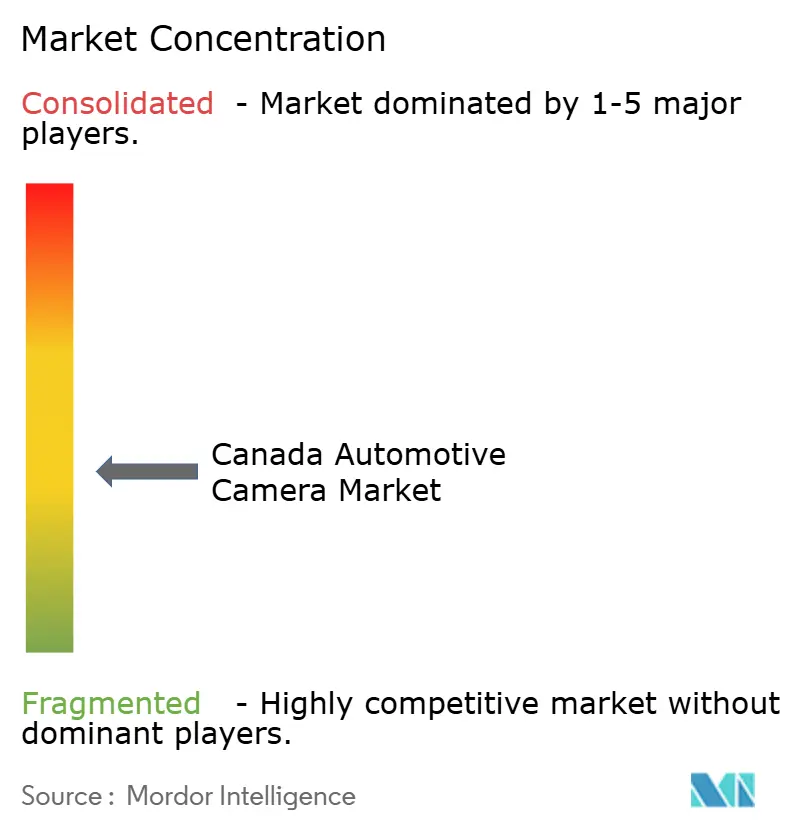
| Market Concentration | Medium |
Major Players *Disclaimer: Major Players sorted in no particular order Image © Mordor Intelligence. Reuse requires attribution under CC BY 4.0. | |
Canada Automotive Camera Market Analysis by Mordor Intelligence
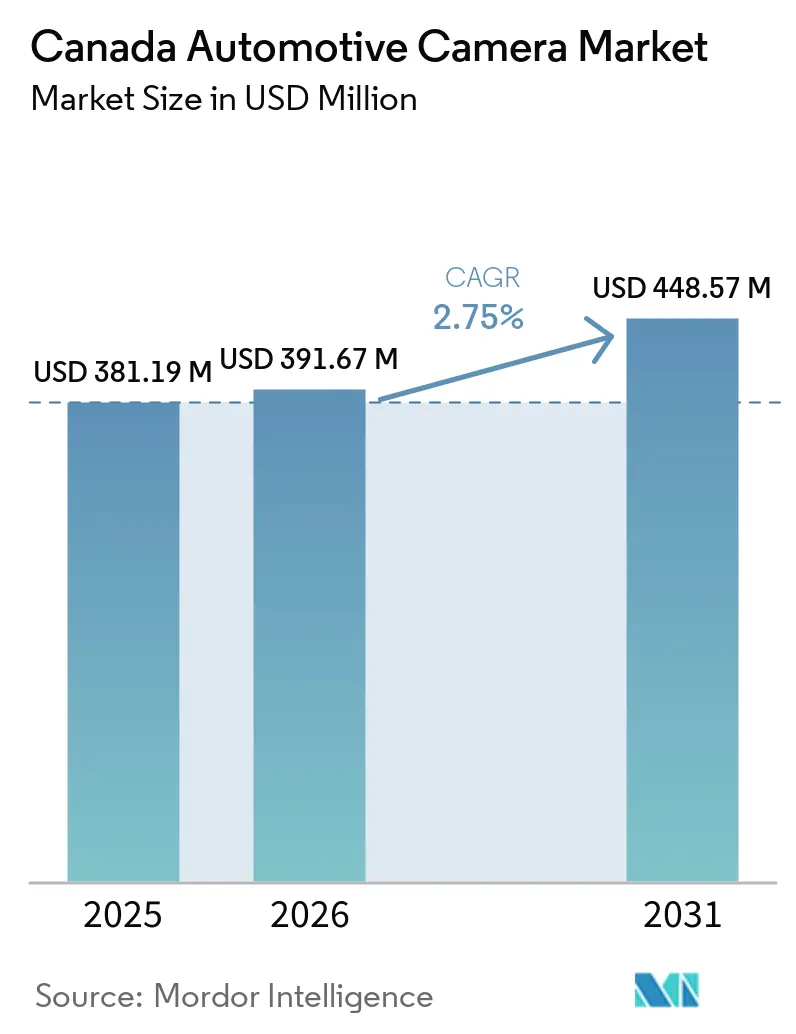
The Canada automotive camera market was valued at USD 381.19 million in 2025 and estimated to grow from USD 391.67 million in 2026 to reach USD 448.57 million by 2031, at a CAGR of 2.75% during the forecast period (2026-2031). Incremental value creation now shifts from regulation-driven rear-view units to sensing modules embedded in Level 2+ and higher ADAS suites. Automakers are moving toward camera-only perception stacks that eliminate the need for ultrasonic and radar hardware. At the same time, insurers offer premium discounts to fleets that retrofit telematics-enabled in-cabin cameras and cover installation costs for up to 2 years. Provincial zero-carbon bus programs are incorporating 360-degree camera arrays into their electric fleets, and Tier-1 suppliers are leveraging federal and provincial R&D tax credits to tailor optics for Canadian winter lighting conditions. Persistent hurdles include snow-induced image degradation, which requires heated housings, and patchy 5G coverage, which delays the full return on investment for V2X-ready camera architectures.
Key Report Takeaways
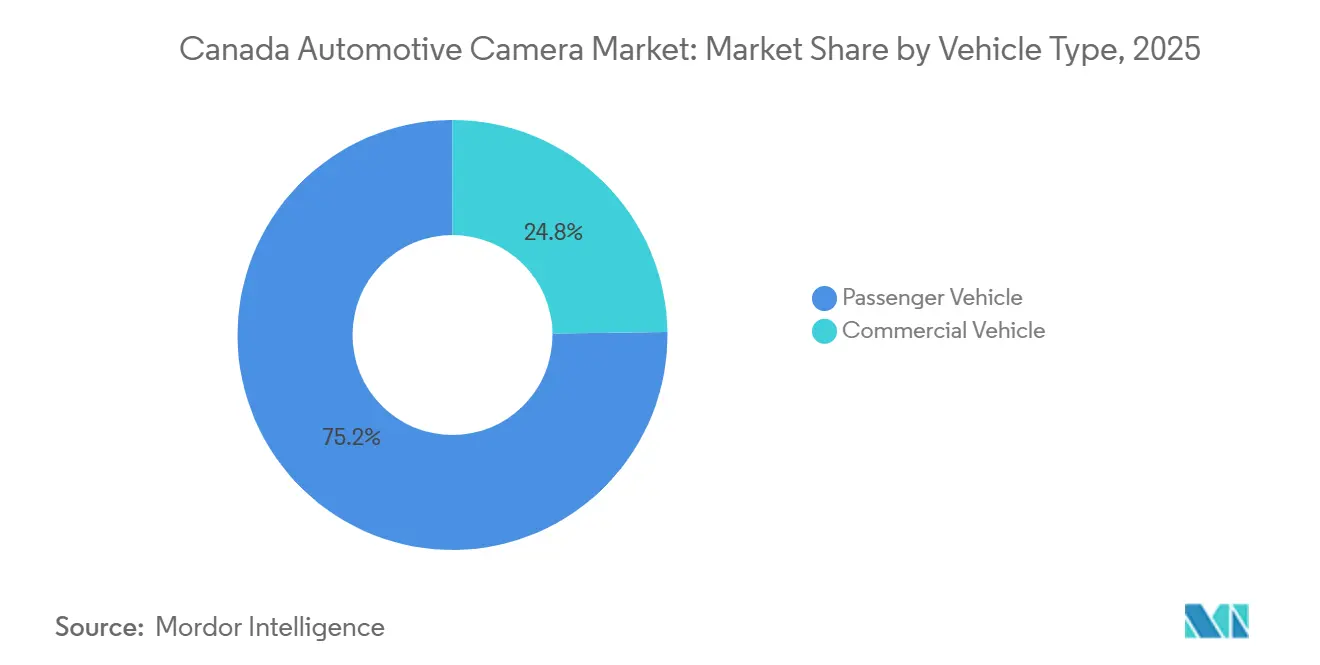
- By vehicle type, passenger vehicles held 75.23% of the Canadian automotive camera market share in 2025, while commercial vehicles are projected to post the fastest CAGR at 4.28% through 2031.
- By camera type, viewing cameras led with a 62.07% share in 2025, while sensing cameras are projected to post a 4.31% CAGR through 2031.
- By sales channel, OEM-Fit installations captured an 83.18% share in 2025, while aftermarket retrofits are projected to show the highest CAGR of 4.74% from 2025 to 2031.
- By application, ADAS accounted for 48.19% of the Canadian automotive camera market size in 2025, whereas driver monitoring systems are poised to grow at a 4.98% CAGR over the forecast horizon.
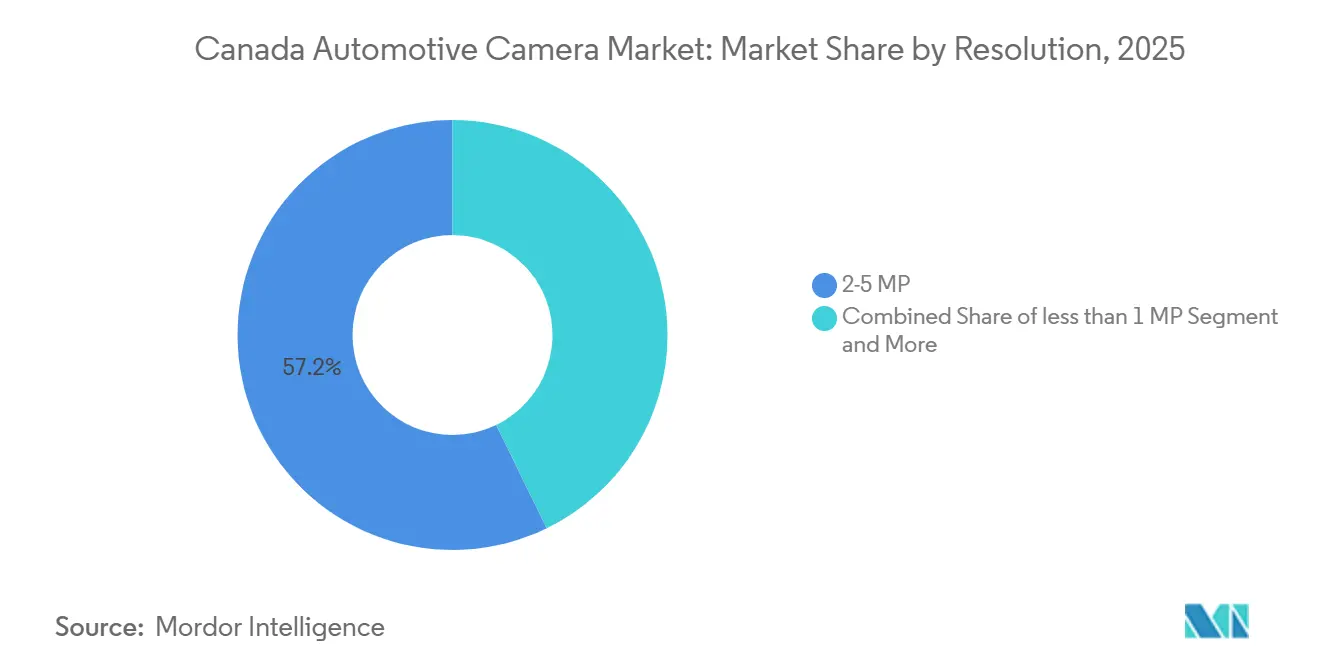
- By resolution, the 2–5-megapixel segment dominated with a 57.22% share in 2025; however, above-5-megapixel sensors are expected to climb at a 5.07% CAGR through 2031.
- By mounting location, front-mounted cameras commanded a 35.92% share in 2025, whereas interior-mounted units are projected to register the quickest CAGR at 4.83% over 2026–2031.
Note: Market size and forecast figures in this report are generated using Mordor Intelligence’s proprietary estimation framework, updated with the latest available data and insights as of January 2026.
Canada Automotive Camera Market Trends and Insights
Drivers Impact Analysis*
| Driver | (~) % Impact on CAGR Forecast | Geographic Relevance | Impact Timeline |
|---|---|---|---|
| Rising OEM Fitment Rates for L2+/L3 ADAS Suites | +0.8% | National, concentrated in Ontario assembly plants | Medium term (2-4 years) |
| Shift to Camera-Only ADAS Architectures in EV Platforms | +0.6% | National, led by EV adoption in British Columbia, Quebec | Medium term (2-4 years) |
| Insurance-Premium Discounts Tied to In-Cabin Telematics Footage | +0.5% | National, strongest in Ontario, Quebec, British Columbia | Medium term (2-4 years) |
| Transport Canada's Mandatory Rear-Visibility Rule Enforcement | +0.4% | National, with compliance baseline established | Short term (≤ 2 years) |
| Tier-1 Suppliers' Localized R&D Tax Credits Unlocking Custom Camera Modules | +0.4% | National, concentrated in Ontario, Quebec R&D hubs | Long term (≥ 4 years) |
| Province-Level Zero-Carbon Incentives Accelerating Electric Buses With 360° Cameras | +0.3% | Ontario, Quebec, British Columbia transit authorities | Long term (≥ 4 years) |
| Source: Mordor Intelligence | |||
Rising OEM Fitment Rates for L2+/L3 ADAS Suites
The adoption of L2+ features in Canadian new vehicle sales has increased significantly, resulting in a substantial rise in camera content per vehicle, as these systems rely on multiple exterior sensors for their functionality. Cadillac models produced in Oshawa have introduced the Ultra Cruise system, enhancing advanced driver-assistance capabilities. Additionally, the Mobileye SuperVision platform, which incorporates numerous cameras, is gaining traction through integration partnerships with Magna [1]“SuperVision Technical Overview,”, Mobileye, mobileye.com. This growing demand for advanced systems has driven a notable rise in the average cost of camera materials.
Shift to Camera-Only ADAS Architectures in EV Platforms
Tesla's Vision strategy opted to eliminate ultrasonic sensors, leading to a reduction in production costs per vehicle[2]“Transition to Tesla Vision,”, Tesla, tesla.com. This strategic shift encouraged competing electric vehicle programs in Ontario and Quebec to adopt innovative approaches, such as experimenting with eight-camera perception systems. Advanced imagers from Sony and OmniVision have been incorporated to replicate the functionality previously provided by radar data. To address environmental challenges such as snow and ice, manufacturers have introduced heated lens housings, which have resulted in a marginal increase in the overall module cost. This evolution underscores the industry's emphasis on striking a balance between cost efficiency and technological advancements.
Transport Canada Rear-Visibility Rule Enforcement
The CMVSS 111 mandate required backup cameras to be included in all light-duty vehicles, resulting in a notable reduction in installation costs over time. This regulation also streamlined the integration of harnesses, enabling the adoption of more advanced multi-camera systems in the future [3]“Motor Vehicle Safety Regulations, CMVSS 111,” , Transport Canada, tc.canada.ca. Additionally, a new rule mandating the use of perimeter cameras for school buses is expected to drive steady demand. However, the market is increasingly focusing on the development and export of high-value sensing modules, which are often designed to comply with U.S. homologation standards, reflecting a shift toward more sophisticated technologies.
Tier-1 Suppliers' Localized R&D Tax Credits Unlocking Custom Camera Modules
Localized R&D tax credits significantly reduce innovation costs for Tier-1 suppliers and accelerate the production of custom camera modules optimized for Canada’s unique driving environments. By lowering the financial risk associated with specialized engineering, these incentives enable suppliers to develop advanced vision systems, including heated lenses to address ice buildup, thermal imaging for low-visibility blizzards, and rugged casings resistant to heavy road salt. As automakers adopt durable, tailored safety solutions to comply with Canadian regulations and meet consumer expectations for winter safety, the availability of locally engineered, cost-effective custom modules is expected to increase procurement volumes and support long-term demand in the Canadian automotive camera market.
Restraints Impact Analysis*
| Restraint | (~) % Impact on CAGR Forecast | Geographic Relevance | Impact Timeline |
|---|---|---|---|
| Low Winter-Temperature Image-Degradation Issues | -0.5% | National, most acute in Alberta, Manitoba, Saskatchewan, northern Ontario | Short term (≤ 2 years) |
| Patchy 5G/V2X Roadside Infrastructure Delaying Sensor-Fusion ROI | -0.4% | Rural provinces, northern Ontario, remote British Columbia, Atlantic Canada | Long term (≥ 4 years) |
| High ASP Versus Ultrasonic Sensors in Entry-Level Trims | -0.3% | National, concentrated in price-sensitive passenger-vehicle segments | Medium term (2-4 years) |
| Data-Privacy Compliance Costs Under Québec Bill-64 | -0.2% | Quebec, with spillover to national fleet operators | Medium term (2-4 years) |
| Source: Mordor Intelligence | |||
Low Winter-Temperature Image Degradation Issues
Snow and ice significantly degrade detection performance in icy conditions, requiring OEMs to incorporate heated housings that consume additional energy and increase overall camera system costs. These housings are crucial to ensure reliable performance in adverse weather conditions. On the other hand, thermal alternatives offer exceptional functionality during extreme weather events, such as blizzards. However, their high cost makes them better suited to premium vehicles and specific public transportation applications, where advanced performance justifies the investment.
Patchy 5G/V2X Roadside Infrastructure Delaying ROI
National 5G coverage has made significant advancements, yet connectivity gaps in less-served regions continue to impede the smooth transfer of data essential for cooperative perception. The substantial costs associated with implementing roadside units have slowed the pace of widespread commercial adoption. As a result, camera-ADAS systems are required to function independently, without leveraging cloud-based support for enhanced performance.
*Our forecasts treat driver/restraint impacts as directional, not additive. The impact forecasts reflect baseline growth, mix effects, and variable interactions.
Segment Analysis
By Vehicle Type: Commercial Fleets Drive Camera Density
Commercial vehicles are expected to outpace passenger cars at a 4.28% growth rate, as fleet operators value multi-camera telematics that unlock insurance benefits. Passenger vehicles accounted for 75.23% of the Canadian automotive camera market in 2025, but camera additions were mainly mandated rearview cameras and mid-tier ADAS upgrades. The Canadian automotive camera industry sees electric transit programs in Ontario and Quebec specifying six-camera arrays on buses, which lifts the average content to USD 680 per commercial unit.
Light commercial vans and pickups are increasingly equipped with four-camera surround-view packages, while Class 8 tractors integrate up to eight cameras for lane-keeping and driver monitoring. Hyundai Mobis secured a 3.5 million-unit supply deal with Stellantis, which underpins fleet momentum. The Canadian automotive camera market is expected to continue relying on high-density applications for incremental revenue through 2031.


By Camera Type: Sensing Modules Capture ADAS Upside
Viewing cameras still led 62.07% of Canada's automotive camera market share in 2025 due to CMVSS 111, yet sensing modules posted a 4.31% expansion as OEMs pivot toward perception-ready architectures. The Canadian automotive camera market benefits when Mobileye SuperVision or ZF Smart Camera 6 adds eight-megapixel sensing to a single module, boosting unit value to USD 120-200.
Convergence designs that combine driver monitoring and road sensing in a single enclosure further reduce wiring weight. Legacy viewing units stay relevant for entry-level trims and retrofits, but their revenue stake erodes as software-defined vehicles favor smart cameras that can receive over-the-air updates.
By Application: Driver Monitoring Gains Regulatory Momentum
ADAS functions commanded 48.19% of camera revenue in 2025; however, driver monitoring is the fastest-growing segment at a 4.98% CAGR, as EU GSR 2 rules are also applicable to export-bound Canadian platforms. Insurers reinforce the trend by demanding distraction detection for maximum premium cuts. The Canadian automotive camera market is seeing interior modules migrate from luxury brands to volume SUVs, where Gentex mirror-based solutions minimize dash clutter.
Parking and surround-view packages grow in parallel with SUV popularity. However, once cameras saturate mid-tier trims, growth shifts to in-cabin analytics that prove ROI through safer driving and lower claims costs.
By Resolution: High-Megapixel Sensors Enable Long-Range Detection
In 2025, cameras boasting 2-5 MP held a dominant 57.22% market share. Meanwhile, cameras exceeding the 5 MP threshold are projected to witness a growth rate of 5.07%, capitalizing on the industry's shift towards a camera-centric focus. Notably, Sony's Pregius and OmniVision's OX imagers have achieved the 8 MP milestone, boasting an impressive 120-dB dynamic range that enhances detection capabilities beyond 150 meters. As OEMs standardize on the 5 MP format, units with less than 1 MP are becoming obsolete, ensuring a smoother upgrade path for future software functionalities. Consequently, the Canadian automotive camera market is increasingly reliant on sensor suppliers adept at countering price erosion while navigating the complexities of evolving specifications.
By Sales Channel: Aftermarket Retrofit Gains Fleet Traction
In 2025, OEM-Fit units captured an 83.18% market share. However, the aftermarket is witnessing the fastest growth, climbing at 4.74%. This surge is driven by fleets retrofitting dashcams to take advantage of insurer discounts. Retrofitting a dashcam typically costs between USD 200 and 400, with a payback period of just two years. While Quebec's privacy compliance introduces challenges, rapid installations are evident in the corridors of Ontario and British Columbia. The Canadian automotive camera market is primarily driven by OEMs; however, the expanding aftermarket kits are broadening the addressable market, particularly for vehicles manufactured before 2018.
By Mounting Location: Interior Cameras Lead Growth
Front-facing modules still dominate with 35.92% share; however, interior cameras show a 4.83% CAGR due to driver monitoring mandates and fleet telematics. Combined front-plus-interior designs from Continental cut hardware counts, further propelling cabin adoption. The Canada automotive camera market recognizes privacy hurdles, yet regulatory and insurance incentives keep the interior segment on a steeper curve than exterior peers.
Geography Analysis
Ontario remains a significant contributor to Canada's automotive camera market, supported by the presence of major assembly lines from Ford, GM, and Stellantis, as well as Magna's local module plants. Quebec plays a key role in the market, driven by the operations of Lion Electric and the province's focus on expanding its electric vehicle fleet. British Columbia also contributes meaningfully, with CleanBC incentives encouraging the integration of advanced camera systems, such as 360-degree cameras, into electric buses.
Provincial green-bus grants in Ontario and Quebec provide substantial subsidies for electric buses, covering a significant portion of the additional costs. These grants have accelerated the adoption of multi-camera systems, reducing the timeline for widespread implementation. The prairie provinces face challenges such as harsh winters and limited 5G infrastructure, which have slowed investments in Advanced Driver-Assistance Systems (ADAS). Similarly, Atlantic Canada has experienced slower growth due to comparable infrastructure limitations.
National regulations like CMVSS 111 ensure consistent demand for automotive cameras across provinces, while alignment with U.S. standards under FMVSS 111 simplifies cross-border homologation processes. Consequently, the Canadian automotive camera market is concentrated around the research hubs in Ontario and Quebec, with additional growth opportunities emerging in regions where provincial zero-emission initiatives are driving investments in electric fleets.
Competitive Landscape
In the Canadian automotive camera market, key players include Magna, Mobileye, Valeo, Continental, and Bosch, which leverage their expertise in integrating optics, silicon, and perception software. Magna, headquartered in Aurora, benefits from its ability to conduct rapid cold-weather validations, particularly advantageous given its proximity to the Detroit Three assembly plants. Continental has developed an innovative single-housing road-plus-driver camera that reduces wiring complexity and associated costs. Valeo, through its collaboration with Teledyne FLIR, has introduced ASIL-B thermal imaging technology, which performs exceptionally well in snowy conditions. ZF's Smart Camera 6 highlights the industry's transition toward hardware that is both upgradable and connected to centralized electronic and electrical backbones.
On the local front, LeddarTech, a Canadian disruptor, is capitalizing on SR&ED tax credits to advance its camera-lidar fusion algorithms, which are explicitly tailored for challenging conditions such as fog and snow. Sunny Optical focuses on offering budget-friendly aftermarket units but faces difficulties in gaining traction with original equipment manufacturers. The competitive landscape underscores a race among suppliers to integrate hardware, software, and validation processes, aiming to simplify integration challenges for OEMs. Success in the Canadian automotive camera market depends on achieving a delicate balance between cost efficiency and maintaining high performance in winter conditions. This dynamic is expected to influence research and development strategies in the years to come.
Canada Automotive Camera Industry Leaders
Continental AG
Robert Bosch GmbH
Mobileye
Magna International Inc.
Valeo SA
- *Disclaimer: Major Players sorted in no particular order

Recent Industry Developments
- February 2026: The Government of Canada is prioritizing the development of the full value chain for next-generation vehicles, including automotive camera technologies. Through targeted strategic investments, Canada is positioning itself as a global leader in vehicle electrification, autonomous and self-driving technologies, and the battery supply chains that will support the future of mobility.
- February 2025: In a significant move, LeddarTech has been chosen by a top-tier global OEM to supply fusion and perception software for the OEM's 2028 model-year ADAS program. Following an in-depth assessment, the customer opted for LeddarVision on their mainstream commercial vehicle platform. LeddarVision's edge lies in its enhanced performance and efficiency, adeptly handling a multi-modal sensor system that integrates both cameras and radars. Furthermore, its scalability across diverse models and sensor setups made it the preferred choice.


Canada Automotive Camera Market Report Scope
The Canada automotive camera market report is segmented by vehicle type (passenger vehicle and commercial vehicle), camera type (viewing and sensing), application (ADAS, and more), resolution (up to 1 MP, 2-5 MP, and above 5 MP), sales channel (OEM-fit and aftermarket), mounting location (front, rear, side, and interior/in-cabin). The market forecasts are provided in terms of value (USD).
By Vehicle Type
| Passenger Vehicle | Hatchback |
| Sedan | |
| Sport Utility Vehicle (SUV) | |
| Multi-Purpose Vehicle (MPV) | |
| Commercial Vehicle | Light Commercial Vehicle (LCV) |
| Medium and Heavy Commercial Vehicle (M&HCV) |
By Camera Type
| Viewing Camera |
| Sensing Camera |
By Application
| ADAS |
| Parking and Surround View |
| Driver Monitoring |
By Resolution
| Up to 1 MP |
| 2-5 MP |
| Above 5 MP |
By Sales Channel
| OEM-Fit |
| Aftermarket |
By Mounting Location
| Front |
| Rear |
| Side |
| Interior/In-Cabin |
| By Vehicle Type | Passenger Vehicle | Hatchback |
| Sedan | ||
| Sport Utility Vehicle (SUV) | ||
| Multi-Purpose Vehicle (MPV) | ||
| Commercial Vehicle | Light Commercial Vehicle (LCV) | |
| Medium and Heavy Commercial Vehicle (M&HCV) | ||
| By Camera Type | Viewing Camera | |
| Sensing Camera | ||
| By Application | ADAS | |
| Parking and Surround View | ||
| Driver Monitoring | ||
| By Resolution | Up to 1 MP | |
| 2-5 MP | ||
| Above 5 MP | ||
| By Sales Channel | OEM-Fit | |
| Aftermarket | ||
| By Mounting Location | Front | |
| Rear | ||
| Side | ||
| Interior/In-Cabin | ||


Key Questions Answered in the Report
How large is the Canada automotive camera market in 2025?
It is valued at USD 381.19 million in 2025, with projections of USD 448.57 million by 2031.
Which camera segment is expanding fastest?
Sensing modules lead growth at a 4.31% CAGR as automakers migrate to perception-ready ADAS stacks.
How does 5G coverage affect advanced camera systems?
Ncomplete 5G and V2X infrastructure outside major corridors delay cooperative perception ROI, forcing stand-alone camera designs until at least 2027.
What challenges limit camera performance in Canadian winters?
Snow and ice cut detection ranges by up to 50%, prompting heated housings and hydrophobic coatings that raise unit cost.
Page last updated on:





