
Market Overview
| Study Period | 2020 - 2032 |
|---|---|
| Forecast Data Period | 2027 - 2032 |
| Base Year Market Size (2026) | USD 0.41 Billion |
| Market Size (2027) | USD 0.43 Billion |
| Market Size (2032) | USD 0.55 Billion |
| Growth Rate (2027 - 2032) | 5.05 % |
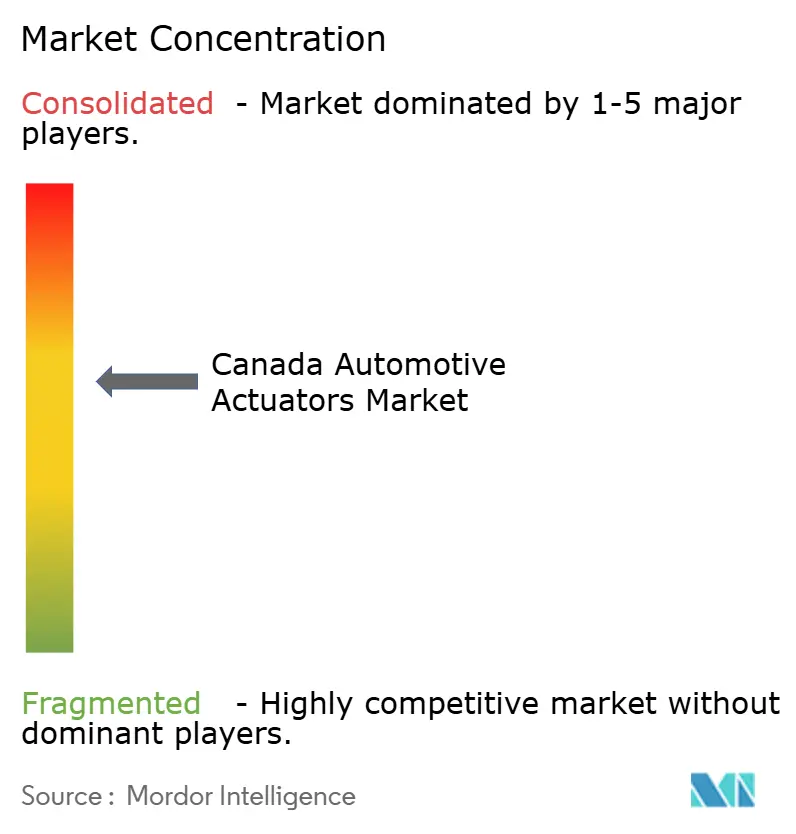
| Market Concentration | Medium |
Major Players *Disclaimer: Major Players sorted in no particular order Image © Mordor Intelligence. Reuse requires attribution under CC BY 4.0. | |
Canada Automotive Actuators Market Analysis by Mordor Intelligence
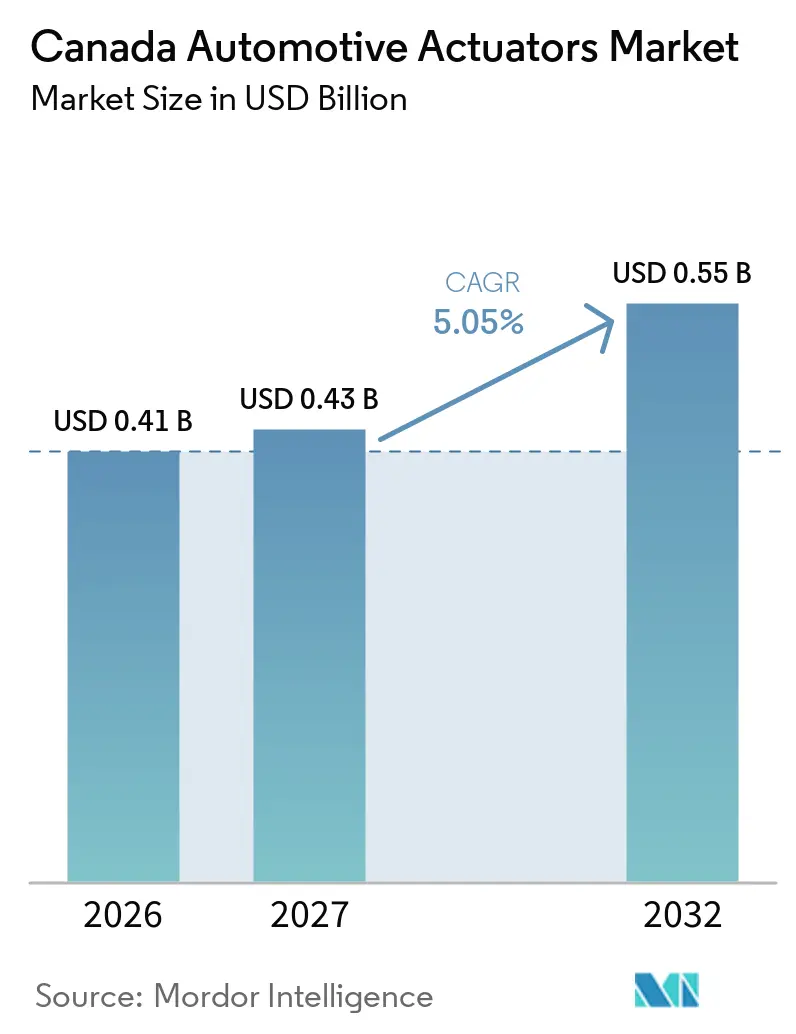
The Canada automotive actuators market size is USD 0.41 billion in 2026 and is expected to grow from USD 0.43 billion in 2027 to reach USD 0.55 billion by 2032, at a CAGR of 5.05% from 2027 to 2032. Federal zero-emission vehicle requirements are shifting OEM specifications toward electric actuator assemblies used in thermal management, brake modulation, and energy recovery. Electrical designs lead current demand because vehicle makers are applying them across throttle, seat, and closure functions. Ontario and Quebec remain central to this shift because they combine vehicle assembly with planned investments in electric vehicles and batteries. Suppliers are therefore competing on integrated hardware, software diagnostics, and supply resilience rather than on component volume alone. The Canadian automotive actuators market also faces near-term exposure to rare-earth inputs and the concentration of production on a limited number of OEM platforms.
Key Report Takeaways
- By actuator technology, electrical actuators accounted for 59.13% of Canada's automotive actuator market revenue in 2026 and are expected to grow at a 7.75% CAGR through 2032.
- By motion type, linear actuators held 66.04% of Canada's automotive actuator market revenue in 2026, while rotary actuators are projected to grow at an 8.13% CAGR through 2032.
- By application type, throttle held 26.12% of Canada's automotive actuator market revenue in 2026, while seat adjustment is projected to grow at a 9.22% CAGR through 2032.
- By vehicle propulsion, battery electric vehicles held 36.25% of Canada's automotive actuator market revenue in 2026 and are projected to grow at a 13.18% CAGR through 2032.
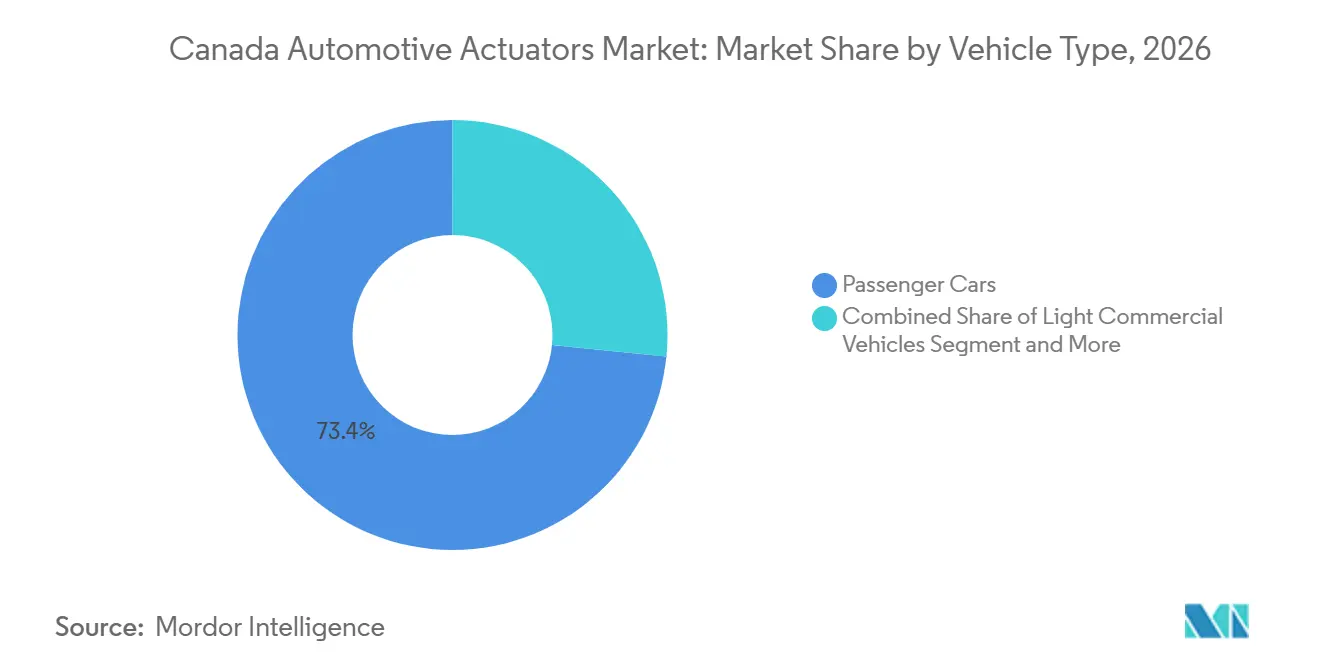
- By vehicle type, passenger cars held 73.41% of Canada's automotive actuator market revenue in 2026, while off-highway and special-purpose vehicles are projected to grow at a 7.04% CAGR through 2032.
- By sales channel, OEMs held 83.16% of Canada's automotive actuator market revenue in 2026, while the aftermarket is projected to grow at a 6.35% CAGR through 2032.
Note: Market numbers in this report are based on Mordor Intelligence's proprietary estimation framework, which combines nine months of actuals with Q4 projections for base year 2026.
Canada Automotive Actuators Market Trends and Insights
Drivers Impact Analysis*
| Driver | (~) % Impact on CAGR Forecast | Geographic Relevance | Impact Timeline |
|---|---|---|---|
| Electrification and Thermal Management Actuation | +1.5% | National, concentrated in Ontario and Quebec OEM assembly corridors | Medium term (2-4 years) |
| Integration of Safety and Comfort Features | +1.0% | National, with early traction in Ontario passenger car and SUV platforms | Medium term (2-4 years) |
| Canadian EV and Battery Manufacturing Expansion | +0.6% | Ontario and Quebec, including Windsor, St. Thomas, Alliston, Bécancour, and Montréal region | Long term (≥ 4 years) |
| Need for Software-Defined and Diagnosable Actuators | +0.5% | National, aligned with OEM software-platform rollouts | Long term (≥ 4 years) |
| Localization Across Ontario and Quebec | +0.4% | Ontario and Quebec manufacturing clusters | Medium term (2-4 years) |
| Winter Conditions Accelerating Replacement Demand | +0.3% | National, with greatest intensity in Quebec, Ontario, and Prairie provinces | Short term (≤ 2 years) |
| Source: Mordor Intelligence | |||
Growth in Vehicle Electrification and Thermal Management Actuation
Vehicle electrification is expanding the number of actuator points installed on each platform. Battery electric vehicles use actuators in battery thermal circuits, active aerodynamic surfaces, and regenerative brake valve assemblies. These functions do not have direct equivalents in conventional internal-combustion configurations. Ontario has attracted more than CAD 46 billion (approximately USD 32 billion) in automotive and EV manufacturing investments over the prior 5 years [1]. That investment supports a pipeline of vehicle programs that can sustain demand for thermal-control components. The Canadian automotive actuators market consequently favors suppliers that can combine HVAC damper motors, coolant valve controls, and heat-pump control elements within broader thermal systems.
Increasing Integration of Safety and Comfort Features
Shared electronic architectures are increasing the number of comfort and safety functions that use actuators. Active suspension, multi-axis seat adjustment, and power door closure are moving beyond premium vehicle trims. Software-defined platforms can lower the cost of integrating these functions across a broader product range. Higher actuator content per vehicle can partly offset pressure from flat new-vehicle sales. Suppliers that deliver combined sensor-and-actuator modules are better positioned to compete for Canadian assembly programs.
Expansion of Canadian EV and Battery Manufacturing Capacity
Canada’s expanding battery manufacturing base supports future demand linked to new electric vehicle specifications. PowerCo is developing a battery cell factory in St. Thomas, Ontario, with production targeted for 2027. The project strengthens the connection between battery supply, locally assembled vehicles, and demand for thermal-management actuation.
Rising Need for Software-Defined and Diagnosable Actuators
ISO 17978-3:2026, published in March 2026, addresses service-oriented vehicle diagnostics. The standard raises the importance of actuators that can communicate internal status, health signals, and fault information through service-oriented interfaces. This requirement is more demanding than legacy diagnostic approaches that rely solely on fault codes. Software-defined vehicle programs in Ontario can use this information for over-the-air updates and remote diagnostics strategies. The Canadian automotive actuators market gives added value to suppliers that embed compliant diagnostic capabilities in their products. These capabilities can also support service activity across a vehicle’s operating life rather than limiting supplier revenue to the original component sale.
Restraints Impact Analysis*
| Restraint | (~) % Impact on CAGR Forecast | Geographic Relevance | Impact Timeline |
|---|---|---|---|
| Validation and Compliance Costs | -0.8% | National, amplified by Transport Canada Motor Vehicle Safety Standards certification requirements | Medium term (2-4 years) |
| Imported Electronics, Motors, and Rare-Earth Inputs | -0.6% | National, with supply origins concentrated in China and Southeast Asia | Short term (≤ 2 years) |
| Concentration of Vehicle Assembly | -0.4% | Ontario and Quebec, with high platform-specific revenue concentration | Medium term (2-4 years) |
| Corrosion, Salt Exposure, and Low-Temperature Requirements | -0.3% | National, with the largest cost burden in Ontario, Quebec, and Atlantic provinces | Short term (≤ 2 years) |
| Source: Mordor Intelligence | |||
High Validation and Compliance Costs for Safety-Critical Actuators
Brake, steering, and suspension actuators require extensive validation when they are used in safety-critical systems. This work can extend qualification periods and add substantial costs for each supplier and platform. Such requirements create a higher barrier for smaller actuator specialists. They can also slow the commercialization of steer-by-wire and brake-by-wire technology. Vertically integrated Tier 1 suppliers can spread these costs across a broader product portfolio, thereby reinforcing their position in software-defined vehicle programs.
Dependence on Imported Electronics, Motors and Rare-Earth Inputs
Canadian manufacturers remain exposed to imported electronics, motors, and rare-earth inputs used in permanent-magnet motor systems. The Government of Canada committed significant investment to Ucore Rare Metals’ Kingston processing facility in October 2025. Domestic processing capacity will take time to develop, so supply risk remains relevant in the short term. The constraint can affect manufacturing continuity as well as input costs. MAHLE introduced a permanent-magnet-free MCT motor in September 2026, showing one engineering response to this exposure. The Canadian automotive actuators market will reward motor and actuator designs that reduce dependence on constrained materials.
*Our forecasts treat driver/restraint impacts as directional, not additive. The impact forecasts reflect baseline growth, mix effects, and variable interactions.
Segment Analysis
By Actuator Technology: Electrical Designs Set Specification Standards
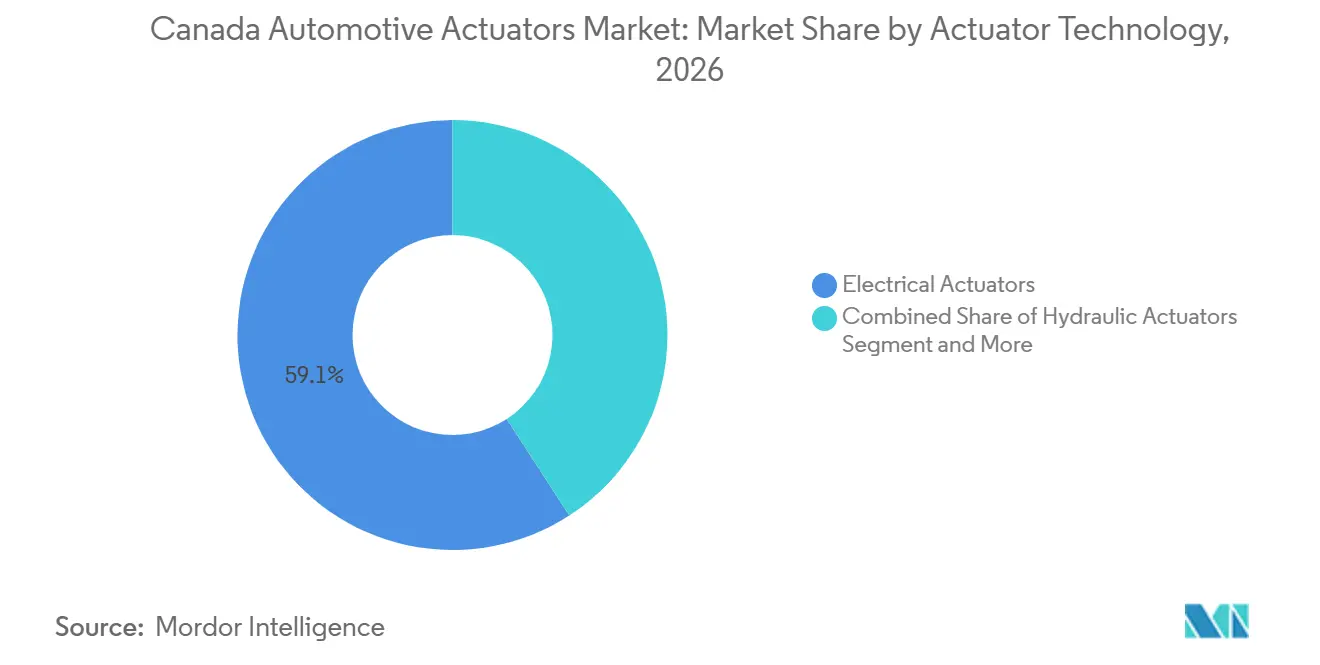
Electrical actuators accounted for 59.13% of the 2026 Canadian automotive actuators market revenue and are set to grow at a 7.75% CAGR. OEMs use brushless DC and AC motor configurations across throttle, seat, and closure applications. Electrical designs are displacing hydraulic and pneumatic alternatives across several passenger-vehicle functions. Hydraulic designs raise concerns about fluid leakage in flat-floor battery-electric vehicle architectures. Pneumatic systems remain relevant for certain commercial vehicle brake and door functions. Electromechanical actuators are also used in higher-load transmission shift and active-suspension applications.
Electrical technology serves a broad range of functions, which helps suppliers apply common design and manufacturing capabilities across programs. Piezoelectric and shape-memory-alloy actuators remain lower-volume technologies used in precision fuel injection and aerodynamic trim. Schaeffler presented an expanded component offering following its integration of Vitesco Technologies at ACT Expo 2025. That portfolio direction reflects the advantage of serving several actuator categories from a single supplier relationship. Software-enabled actuators also need to address cybersecurity requirements, which favors established suppliers with broader validation resources. The Canadian automotive actuators industry is therefore moving toward electrical systems that combine mechanical function, sensing, and electronic control.

By Motion Type: Linear Scale, Rotary Gaining Velocity
Linear actuators accounted for 66.04% of Canada's automotive actuators market revenue in 2026. Their lead comes from their use in seat positioning, throttle bodies, HVAC doors, and suspension height control. Rotary actuators are the fastest-growing motion type and are forecast to expand at an 8.13% CAGR through 2032. Steer-by-wire and brake-by-wire designs require rotational output without traditional mechanical steering-column or pedal linkages. This use case is increasing attention on rotary designs for future chassis systems.
ZF’s announced steer-by-wire production program with Mercedes-Benz shows how software-coordinated chassis systems can support this transition. MAHLE Linear designs will continue to benefit from the growth of power seating, especially in forward-aft and height-adjustment axes. The two motion types, therefore, address different vehicle functions rather than representing a simple replacement cycle. The Canadian automotive actuators market supports both as vehicle architectures incorporate more powered functions.
By Application Type: Comfort Functions Outrunning Powertrain Staples
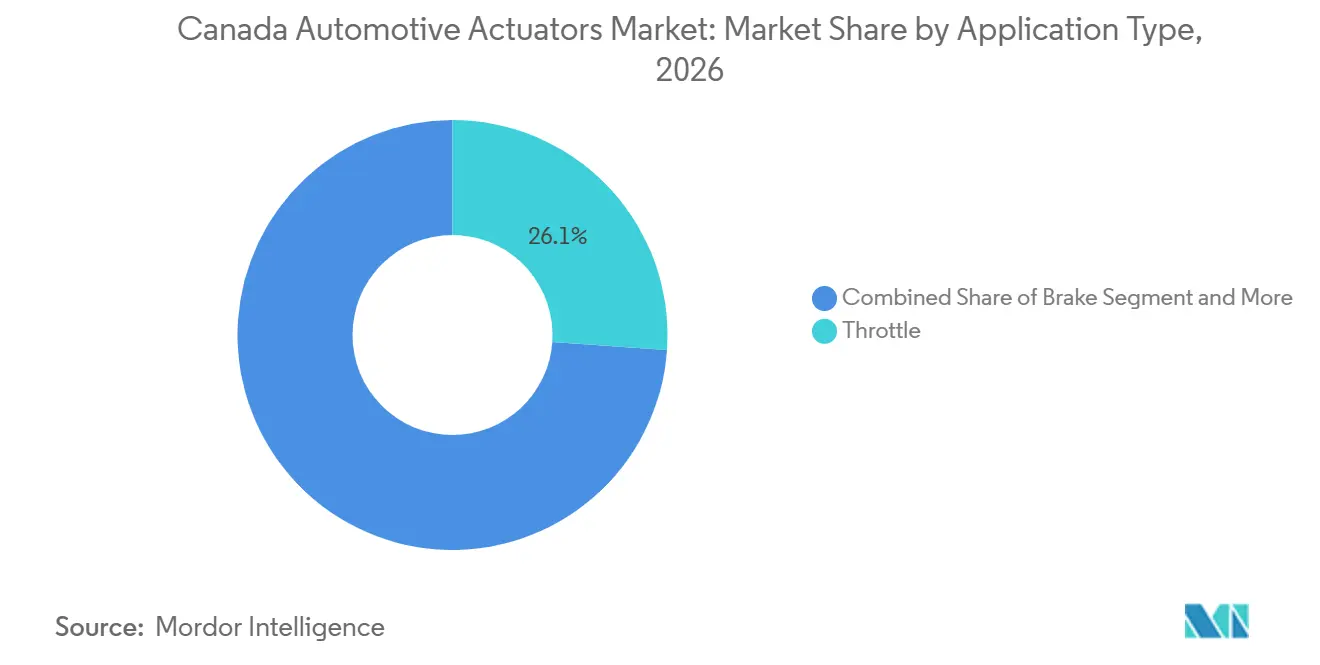
Throttle accounted for 26.12% of Canada's automotive actuators market revenue in 2026, the largest share among applications. Seat adjustment is forecast to grow at a 9.22% CAGR through 2032, the fastest application rate provided. Power seats use multiple actuator axes for forward-back, height, and position control. Battery electric vehicle designers are standardizing multi-position seating across more mid-range trims. This increases the number of comfort actuators fitted to individual vehicles.
Seat-position data can also support driver-monitoring functions, making the component relevant to vehicle safety systems. Brake actuators are gaining importance as electromechanical parking brakes and brake-by-wire arrangements become more common. HVAC and thermal actuators are increasingly used as battery-electric vehicle thermal systems require more valve-control points than internal-combustion systems. Door and closure actuators retain a production-volume link, while suspension and chassis actuators serve a smaller, higher-value tier. Mirror and lighting actuators provide a stable demand that is less dependent on major powertrain changes. The Canadian automotive actuators market size for comfort applications benefits from the wider shift toward software-integrated vehicle functions.
By Vehicle Propulsion: BEV Intensity Redefines Per-Vehicle Economics
Battery electric vehicles held 36.25% of Canada's automotive actuators market revenue in 2026 and are forecast to grow at a 13.18% CAGR through 2032. This rate makes battery electric vehicles the fastest-growing propulsion segment. Each vehicle requires actuation for battery thermal management, active aerodynamic flap control, regenerative brake valves, and electric comfort functions. These functions increase actuator content relative to comparable internal-combustion vehicles. The Canadian automotive actuators market share held by battery electric vehicles reflects both this higher component intensity and vehicle demand.
Internal-combustion engine and hybrid vehicles continue to support demand for throttle, exhaust-gas recirculation, variable valve timing, and transmission actuators. Hybrids also add complexity to thermal management, increasing actuator requirements. Plug-in hybrid and fuel-cell vehicles remain smaller propulsion categories. Fuel-cell vehicle use in Canada is limited mainly to fleet and transit demonstrations. Ontario and Quebec's hydrogen infrastructure investments support the conditions for longer-term adoption. Suppliers with cross-platform engineering capability can serve internal-combustion, hybrid, plug-in hybrid, and battery electric variants using related component families.
By Vehicle Type: Passenger Cars Dominate, Off-Highway Emerging
Passenger cars held 73.41% of Canada's automotive actuators market revenue in 2026. Toyota’s Cambridge and Woodstock facilities and Honda’s Alliston plant remain important to Canadian production throughput. Toyota and Honda accounted for a major share of Canada’s total vehicle production in 2025. This concentration connects passenger-car actuator demand to a limited number of major assembly programs. Light commercial vehicles constitute a distinct, meaningful demand base, while medium- and heavy-duty vehicles require more specialized actuator portfolios.
Off-highway and special-purpose vehicles are forecast to grow at a 7.04% CAGR through 2032. Their growth is linked to the electrification of agricultural, mining, and municipal equipment. Linamar reported record sales performance in 2026 and cited production across Ontario facilities in its second-quarter release. The company’s manufacturing depth and electrification programs support its position in adjacent off-highway and light-commercial supply chains. Electric equipment in mining and energy can offer a higher-specification opportunity despite smaller production volumes. The Canadian automotive actuators market depends on suppliers adapting product designs to the durability needs of these applications.
By Sales Channel: OEM Concentration, Aftermarket Accelerated by Climate
OEMs accounted for 83.16% of Canada's automotive actuators market revenue in 2026. This position reflects long-term sourcing agreements and the integration of actuators into vehicle platforms. A platform award at a major Canadian assembly site can provide multiyear revenue. Loss of an award can have a disproportionate effect because the assembly base is concentrated. The OEM channel consequently favors suppliers that meet demanding quality, validation, and integration requirements.
The aftermarket is forecast to expand at a 6.35% CAGR through 2032. Winter road conditions in Quebec, Ontario, and the Prairie provinces accelerate wear from salt corrosion, thermal cycling, and seal degradation. Actuator replacement is more frequent in these regions than in milder climates. The aftermarket provides suppliers with a path to recurring demand beyond original vehicle production—the Canadian automotive actuators market benefits from this replacement cycle, even where OEM vehicle volumes vary.
Geography Analysis
Ontario anchors the Canadian automotive actuators market because it hosts most domestic OEM assembly capacity and a concentrated base of Tier 1 and Tier 2 suppliers. Toyota and Honda held a substantial share of vehicles produced in Canada in 2025. Their facilities in Cambridge, Woodstock, and Alliston support local demand for production-linked actuator systems. Ford, General Motors, and Stellantis also maintain assembly operations in Oakville, Oshawa, and Windsor.
PowerCo’s St. Thomas battery cell factory is targeting production in 2027. Minth Group announced plans for an auto parts facility in Windsor in April 2025. These developments reinforce Ontario’s supply-chain role. Honda’s postponed Alliston electric-vehicle value-chain plan reduces near-term visibility into demand for that program. Ontario nevertheless remains the principal manufacturing center for the Canadian automotive actuators market.
Quebec contributes through battery materials, transportation electrification, and commercial-vehicle activity rather than high-volume final assembly. Nova Bus production in Saint-Eustache supports recurring demand for door, brake, and HVAC actuators in transit configurations. British Columbia, the Prairie provinces, and Atlantic Canada have lower direct OEM assembly output but meaningful aftermarket demand. Mining, forestry, and energy fleets in Alberta, Saskatchewan, and British Columbia create demand for off-highway and special-purpose equipment. Atlantic provinces face high replacement needs because road salt and temperature changes place additional stress on actuator systems. These regional differences mean suppliers should not treat Canadian demand as uniform.
Competitive Landscape
The Canadian automotive actuators market is moderately concentrated in the OEM supply tier. Robert Bosch, Denso, Continental, ZF Friedrichshafen, and Aptiv have platform-level sourcing relationships supported by lengthy qualification processes and integration software. Magna International and Linamar add proximity to Canadian manufacturing and are expanding their electrification capabilities. Magna reported that it was scaling its driver-monitoring system and winning high-voltage hybrid and EV programs with multiple OEM customers in 2025. The aftermarket is more fragmented than the OEM channel.
Schaeffler has broadened its aftermarket offering by integrating Vitesco products into its Vehicle Lifetime Solutions portfolio. This move extends coverage across air intake, fuel supply, and emissions actuation. ZF is pursuing software-coordinated chassis systems through its Chassis 2.0 approach and 2026 steer-by-wire production program. MAHLE is differentiating its motor technology through a permanent-magnet-free design that mitigates exposure to rare-earth supply risks. These strategies place software capability and material resilience alongside traditional manufacturing scale.
Nidec’s AMEC business showcased seat adjustment, brake comfort, and steering actuator technologies at Auto China 2026. This adds competitive pressure from precision-motor specialists in comfort and safety applications. The product direction of leading suppliers centers on actuator hardware, embedded diagnostics, and designs that reduce material exposure.
Canada Automotive Actuators Industry Leaders
-
Robert Bosch GmbH
-
Denso Corporation
-
Johnson Electric Holdings Limited
-
AUMOVIO SE
-
ZF Friedrichshafen AG
- *Disclaimer: Major Players sorted in no particular order
Recent Industry Developments
- August 2026: Nexteer Automotive introduced its High-Mount Direct-Drive Steer-by-Wire (SbW) Hand-Wheel Actuator, known as HMDD, to provide automakers with greater cockpit design flexibility as vehicle architectures transition toward software-defined vehicles. The compact actuator integrates a high-mount motor, direct-drive responsiveness, and a stationary hub to deliver a premium steering feel and scalable integration.
- April 2026: Nidec's Automotive Motors & Electronic Controls (AMEC) business unit showcased next-generation seat adjustment, brake comfort, and steering actuator technologies at Auto China 2026. With revenues exceeding USD 2.2 billion globally, AMEC's continued R&D investment signals increasing competitive intensity in the comfort and safety actuator segments, which are posting the fastest growth in the Canadian market.
Canada Automotive Actuators Market Report Scope
The scope includes segmentation by actuator technology (electrical actuators, electromechanical actuators, hydraulic actuators, pneumatic actuators, piezoelectric actuators, and shape memory alloy actuators), motion type (linear actuators and rotary actuators), application type (throttle, brake, transmission/drivetrain, seat adjustment, door/closure, HVAC and thermal management, suspension and chassis, and mirror and lighting), vehicle propulsion (internal combustion engine vehicles, hybrid electric vehicles, battery electric vehicles, plug-in hybrid electric vehicles, and fuel cell electric vehicles), vehicle type (passenger cars, light commercial vehicles, medium- and heavy-duty commercial vehicles, and off-highway and special-purpose) and sales channel (original equipment manufacturers and aftermarket). Market size and growth forecasts are presented in USD by value.
By Actuator Technology
| Electrical Actuators |
| Electromechanical Actuators |
| Hydraulic Actuators |
| Pneumatic Actuators |
| Piezoelectric Actuators |
| Shape-Memory-Alloy Actuators |
By Motion Type
| Linear Actuators |
| Rotary Actuators |
By Application Type
| Throttle |
| Brake |
| Transmission / Drivetrain |
| Seat Adjustment |
| Door / Closure |
| HVAC & Thermal |
| Suspension & Chassis |
| Mirror & Lighting |
By Vehicle Propulsion
| Internal Combustion Engine Vehicles |
| Hybrid Electric Vehicles |
| Battery Electric Vehicles |
| Plug-in Hybrid Electric Vehicles |
| Fuel-Cell Electric Vehicles |
By Vehicle Type
| Passenger Cars |
| Light Commercial Vehicles |
| Medium- and Heavy-Duty Commercial Vehicles |
| Off-Highway & Special-Purpose |
By Sales Channel
| Original Equipment Manufacturers |
| Aftermarket |
Cross-Segmentation Analysis
| Vehicle Type by Motion Type |
| Vehicle Type by Sales Channel |
| By Actuator Technology | Electrical Actuators |
| Electromechanical Actuators | |
| Hydraulic Actuators | |
| Pneumatic Actuators | |
| Piezoelectric Actuators | |
| Shape-Memory-Alloy Actuators | |
| By Motion Type | Linear Actuators |
| Rotary Actuators | |
| By Application Type | Throttle |
| Brake | |
| Transmission / Drivetrain | |
| Seat Adjustment | |
| Door / Closure | |
| HVAC & Thermal | |
| Suspension & Chassis | |
| Mirror & Lighting | |
| By Vehicle Propulsion | Internal Combustion Engine Vehicles |
| Hybrid Electric Vehicles | |
| Battery Electric Vehicles | |
| Plug-in Hybrid Electric Vehicles | |
| Fuel-Cell Electric Vehicles | |
| By Vehicle Type | Passenger Cars |
| Light Commercial Vehicles | |
| Medium- and Heavy-Duty Commercial Vehicles | |
| Off-Highway & Special-Purpose | |
| By Sales Channel | Original Equipment Manufacturers |
| Aftermarket | |
| Cross-Segmentation Analysis | Vehicle Type by Motion Type |
| Vehicle Type by Sales Channel |
Key Questions Answered in the Report
How large will be the Canada automotive actuators market by 2032?
The Canada automotive actuators market size is forecast to reach USD 0.55 billion by 2032, reflecting a 5.05% CAGR over 2027-2032.
Which actuator technology leads Canadian vehicle demand?
Electrical actuators lead with 59.13% of 2026 revenue because they serve throttle, seating, and closure functions.
Which vehicle propulsion type is growing fastest for actuator demand?
Battery electric vehicles are forecast to grow at a 13.18% CAGR through 2032 and held 36.25% of 2026 revenue.
Why is the automotive actuator aftermarket growing in Canada?
The aftermarket is forecast to grow at a 6.35% CAGR as winter conditions, road salt, thermal cycling, and seal degradation increase replacement demand.