
Market Overview
| Study Period | 2019 - 2031 |
|---|---|
| Market Size (2026) | USD 28.83 Billion |
| Market Size (2031) | USD 38.67 Billion |
| Growth Rate (2026 - 2031) | 6.05 % |
| Fastest Growing Market | Asia Pacific |
| Largest Market | Asia Pacific |
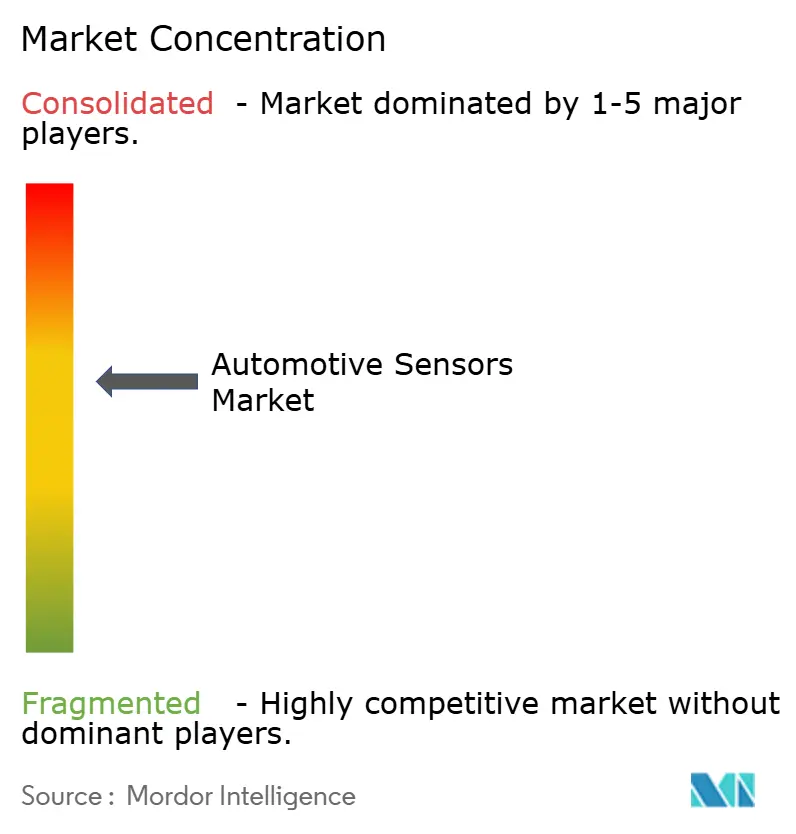
| Market Concentration | Medium |
Major Players *Disclaimer: Major Players sorted in no particular order Image © Mordor Intelligence. Reuse requires attribution under CC BY 4.0. | |
Automotive Sensors Market Analysis by Mordor Intelligence
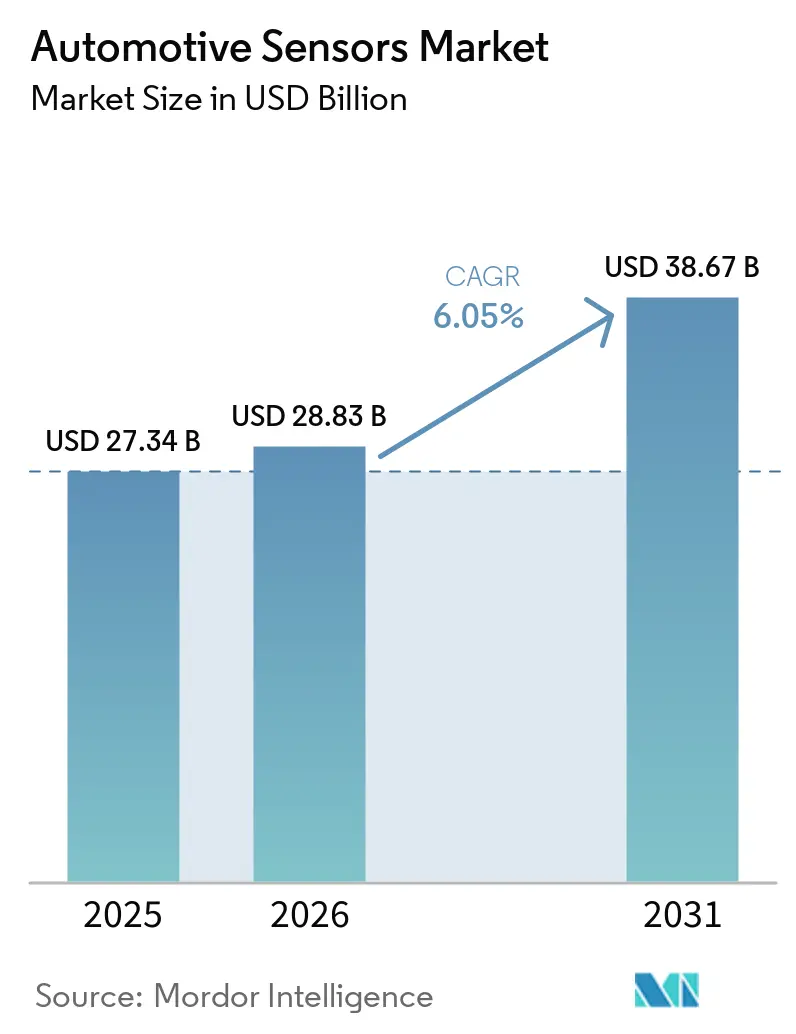
The automotive sensor market size was valued at USD 27.34 billion in 2025 and estimated to grow from USD 28.83 billion in 2026 to reach USD 38.67 billion by 2031, at a CAGR of 6.05% during the forecast period (2026-2031). Solid growth reflects the rising sensor content per vehicle, as Euro 7 on-board monitoring and the United States' automatic-emergency-braking rules make redundant detection arrays mainstream, even in entry-level trims. Inertial measurement units (IMUs) remain pivotal because electronic stability control and Level 2+ ADAS now ship standard on 60% of North American light vehicles, while real-time battery-temperature sensing is scaling with fast-charging 800-volt platforms. Falling Micro-Electro-Mechanical Systems (MEMS) average selling prices (ASPs) accelerate adoption in sub-USD 15,000 cars sold across India and Southeast Asia, helping the automotive sensor market penetrate cost-sensitive tiers. Meanwhile, usage-based insurance programs that utilize accelerometers and GPS are increasing telematics volume and generating recurring data service revenues for fleet operators.
Key Report Takeaways
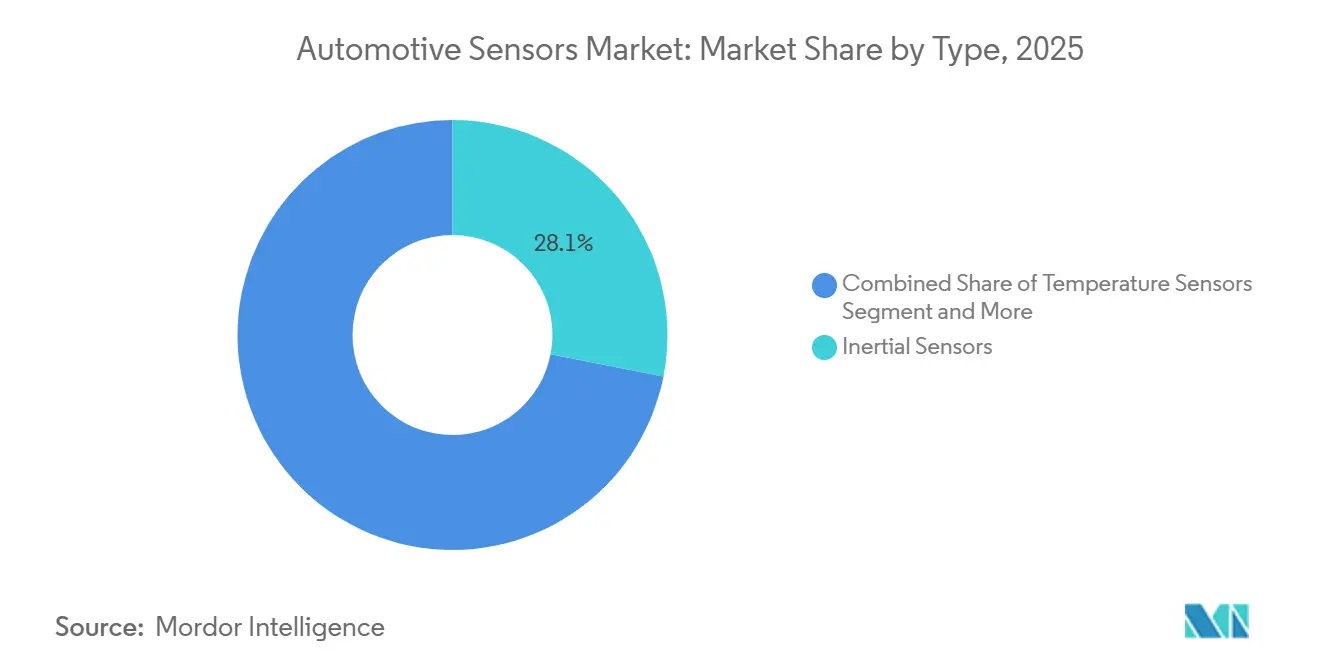
- By type, inertial sensors led the automotive sensors market, accounting for 28.13% of the share in 2025, and are projected to grow at a 6.47% CAGR through 2031.
- By application, the powertrain segment held 40.55% of the automotive sensors market size in 2025, while telematics recorded the fastest growth rate of 8.86% through 2031.
- By vehicle type, passenger cars accounted for 71.18% of the revenue share in 2025; commercial vehicles are expected to expand at a 7.15% CAGR through 2031.
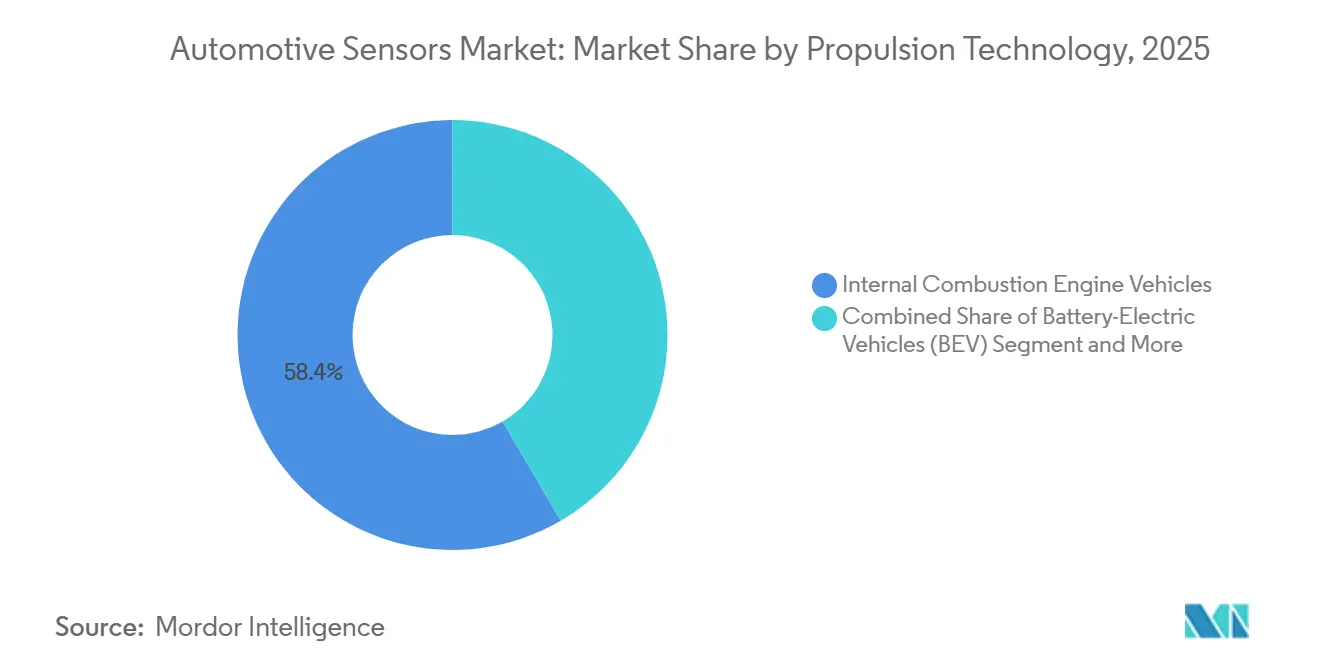
- By propulsion technology, internal combustion engine vehicles held 58.40% of the automotive sensors market size in 2025; fuel-cell electric cars are projected to grow at a 24.50% CAGR to 2031.
- By sales channel, OEM-fitted sensors dominated with an 88.20% share in 2025; the aftermarket segment is expected to advance at a 12.40% CAGR through 2031.
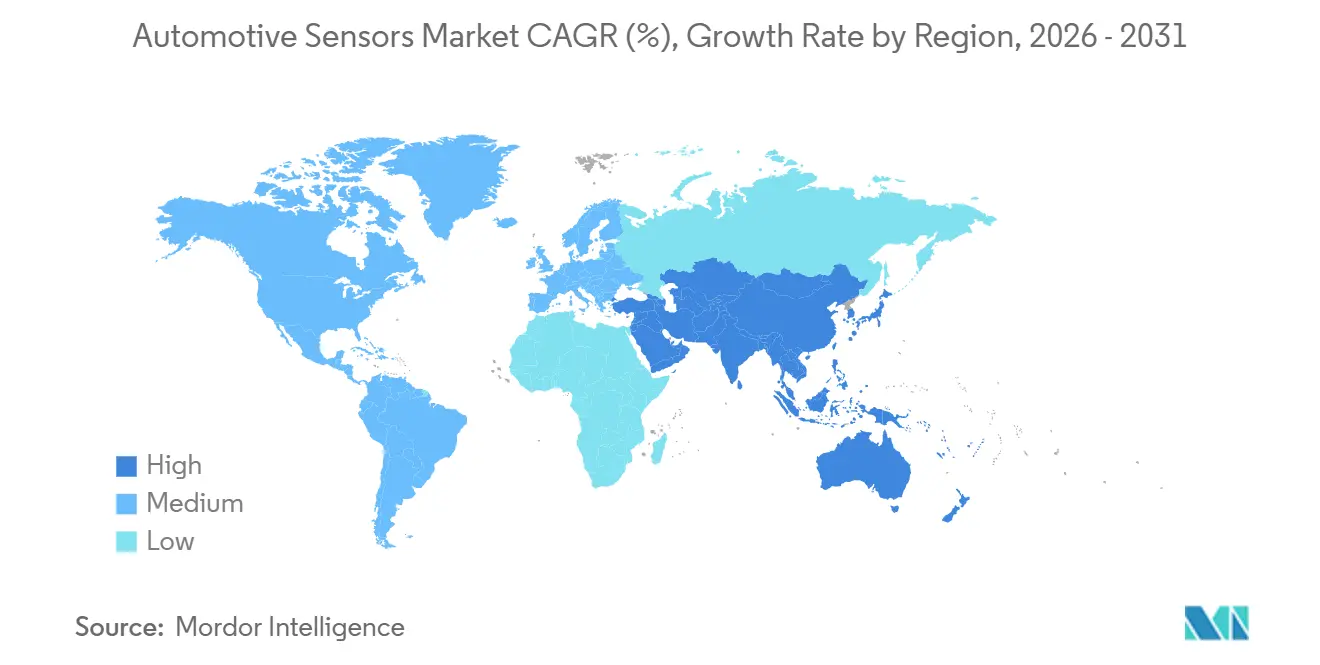
- By geography, the Asia-Pacific region captured a 42.30% revenue share in 2025 and is projected to advance at a 9.10% CAGR through 2031.
Note: Market size and forecast figures in this report are generated using Mordor Intelligence’s proprietary estimation framework, updated with the latest available data and insights as of January 2026.
Market Trends and Insights
Drivers Impact Analysis of Automotive Sensors Market*
| Driver | (~) % Impact on CAGR Forecast | Geographic Relevance | Impact Timeline |
|---|---|---|---|
| ADAS and Autonomous-Driving Sensors | +1.8% | Global, led by North America and Europe | Medium term (2-4 years) |
| EV Thermal-Battery Sensing Boom | +1.5% | Asia-Pacific core, expanding to North America | Medium term (2-4 years) |
| Emission and Safety Mandates for Pressure/Gas Sensors | +1.2% | Global, strongest in Europe and China | Short term (≤ 2 years) |
| Falling MEMS ASP Driving Adoption | +0.9% | Global, cost-sensitive markets first | Long term (≥ 4 years) |
| OTA-Ready Self-Diagnostic Sensors | +0.6% | Premium markets, gradual mainstream | Long term (≥ 4 years) |
| Usage-Based Insurance Telematics Demand | +0.4% | North America and Europe primarily | Medium term (2-4 years) |
| Source: Mordor Intelligence | |||


ADAS and Autonomous-Driving Sensor Proliferation
New regulations mandate that United States light vehicles include automatic emergency braking systems capable of detecting pedestrians at night, requiring manufacturers to enhance their forward-looking sensor suites [1]“Federal Motor Vehicle Safety Standard No. 127 Automatic Emergency Braking,”, National Highway Traffic Safety Administration, nhtsa.gov. Approvals for advanced driving systems, such as highway certifications, necessitate triple-redundant clusters, significantly increasing perception hardware costs. The transition from single-technology systems to hybrid radar-camera architectures is becoming more prominent with advancements in imaging-radar programs. However, research continues to highlight false-positive rates in current systems, emphasizing the need for higher-resolution lidar and thermal imaging. Additionally, updates to functional-safety standards are broadening audits to include cybersecurity, which extends validation processes but strengthens vendor positions in the market. In parallel, automotive wheel speed sensors remain important for vehicle dynamics and safety functions, supplying wheel-rotation data that supports ABS, traction control, and electronic stability control alongside newer perception technologies.
Electric Vehicle (EV) Thermal-Battery Sensing Boom
Global production of battery-electric vehicles has increased significantly, with each car incorporating multiple temperature probes across cells and coolant loops to prevent thermal runaway incidents. China's updated standards require real-time monitoring at the cell level, resulting in a notable increase in sensor counts compared to earlier models. Research from the European Union's Joint Research Centre highlights that distributed thermal sensing can substantially reduce catastrophic failures during crash scenarios [2]“Thermal Runaway Mitigation in Li-Ion Packs,”, Joint Research Centre, ec.europa.eu. In response to these developments, STMicroelectronics introduced advanced MEMS thermistors designed for high-voltage packs. Despite the growing share of pure electric vehicles, the demand for thermal sensors remains strong, particularly with the use of dual-zone cooling in plug-in hybrids. Additionally, updated standards now require tests for thermal-propagation resistance, emphasizing the importance of co-located pressure and temperature devices.
Emission and Safety Mandates Driving Pressure/Gas Sensors
The Euro 7 regulations will soon come into effect for new cars, introducing stricter particulate and NOx thresholds compared to the previous standards. This change requires the adoption of advanced zirconia sensors. Similarly, the United States Environmental Protection Agency (USEPA) is implementing new standards that significantly reduce particulate limits, driving the need for dual-sensor configurations in diesel vehicles. In addition, China is fully enforcing its updated standards, which align closely with Euro 6d-ISC-FCM, further expanding the global market for addressable sensors. Bosch has developed a particulate-matter module that uses laser scattering technology to predict filter regeneration, enhancing service intervals. Suppliers with expertise in ceramic substrates, such as Continental and NGK NTK, are now benefiting from higher pricing due to their specialized knowledge.
Falling Micro-Electro-Mechanical Systems (MEMS) ASP Enabling Mass Adoption
The average selling prices for automotive-grade accelerometers have declined due to increased die output from advanced wafer lines. This price reduction has enabled the adoption of electronic stability control and tire-pressure monitoring in India’s affordable automotive segment, driven by new safety mandates. Bosch’s six-axis accelerometer has been introduced at a significantly lower cost compared to its predecessor. Additionally, STMicroelectronics’ accelerometer, featuring on-chip machine-learning capabilities, has reduced microcontroller overhead, facilitating predictive maintenance in fleet telematics. In North America, affordable aftermarket kits have become widely available, driving replacement demand as original sensors near the end of their battery life.
Restraints Impact Analysis of Automotive Sensors Market*
| Restraint | (~) % Impact on CAGR | Geographic Relevance | Impact Timeline |
|---|---|---|---|
| Sensor Costs in Mass-Market Vehicles | -1.1% | Global, acute in emerging markets | Short term (≤ 2 years) |
| Wafer-Supply Volatility | -0.8% | Global, concentrated in Asia-Pacific | Medium term (2-4 years) |
| ADAS Liability Delays | -0.5% | North America and Europe primarily | Medium term (2-4 years) |
| Privacy Limits on Data Monetization | -0.3% | Europe and select jurisdictions | Long term (≥ 4 years) |
| Source: Mordor Intelligence | |||
Semiconductor Wafer-Supply Volatility
Automotive-grade lead times remain significantly higher than pre-pandemic levels, causing delays in new-model launches [3]“Global Semiconductor Equipment Outlook 2025,”, SEMI, semi.org. While new fabs by Intel and Taiwan Semiconductor Manufacturing Company (TSMC) in Arizona are expected to enhance domestic capacity, the automotive qualification process is delaying substantial volume relief. Europe's Chips Act aims to increase the region's share of the semiconductor market. However, foundries continue to prioritize logic nodes, leaving sensor-specific production lines limited. Tier-1 suppliers are increasing inventory buffers, which is straining working capital and reducing returns. This approach places smaller vendors with weaker financial resources at a disadvantage. Consequently, dual-sourcing strategies are now widely adopted, even for long-life AEC-Q100 components.
Sensor Cost Pressure on Mass-Market Vehicles
Manufacturers targeting affordable retail prices are reducing sensor sets, limiting ADAS features to higher trims, and slowing their expansion into emerging markets. Original equipment manufacturers (OEMs) in Latin America are pushing for significant price reductions on sensor modules, which has negatively impacted tier-1 gross margins and restricted R&D budgets. High-voltage current sensors required for advanced electric vehicles are more expensive than their standard counterparts, delaying their adoption outside premium brands. The aftermarket is also experiencing intense pricing pressure, with generic tire-pressure monitoring replacements significantly undercutting OEM parts. To maintain market share, suppliers are increasingly offering bundled calibration services and extended warranties, shifting their focus from hardware margins to service revenue.
*Our forecasts treat driver/restraint impacts as directional, not additive. The impact forecasts reflect baseline growth, mix effects, and variable interactions.
Automotive Sensors Market Segment Analysis
By Type:
Inertial Dominance Anchors Stability and NavigationInertial devices commanded 28.13% of the 2025 revenue within the automotive sensor market size and are expected to advance at a 6.47% CAGR to 2031 as global electronic stability control and sensor-fusion stacks standardize on six-axis IMUs. Bosch's SMI240 and Murata's steer-by-wire gyroscopes exemplify the industry's shift toward ASIL D-certified firmware, enabling minimal drift and withstanding extreme shocks. Temperature sensors, with multiple units in each electric vehicle battery pack, adeptly manage rapid thermal gradients during fast charging. Pressure modules play a crucial role, from monitoring tire pressure to regenerating diesel particulate filters in compliance with evolving standards. While commoditized speed sensors are vital for anti-lock braking systems and traction control, Hall-effect current transducers, designed for high-voltage packs, are carving out lucrative niches for companies like Allegro and Melexis.
The sensor landscape also features level, position, and gas sensors. Although ultrasonic parking aids may soon be overshadowed by high-resolution cameras, throttle-position and crankshaft sensors are poised to remain relevant, bolstered by a significant global fleet of internal combustion vehicles. Gas sensors, particularly those for NOx and particulate detection, are experiencing a resurgence in demand due to stricter regulations, granting companies like Continental and NGK NTK enhanced pricing leverage. In anticipation of updated standards, suppliers are integrating cybersecurity features into next-gen sensor chips, not only distinguishing their premium products but also bolstering the overall automotive sensor market.


By Application:
Powertrain Dominance Faces Telematics DisruptionPowertrain modules retained 40.55% of the revenue in 2025, due to the continued demand for oxygen, manifold-pressure, and crankshaft sensors in the motor vehicle sensor industry, which are still required on internal-combustion engines.. Yet telematics sensors represent the fastest-growing slice of the automotive sensor market, with an 8.86% CAGR driven by usage-based insurance and fleet analytics that monetize accelerometer, GPS, and cellular data.
As overall vehicle production rises, so too do body electronics, devices responding to rain, ambient light, and occupancy. Meanwhile, as smartphone-based access becomes more prevalent, vehicle security modules see a corresponding uptick. While the share of powertrains may wane due to the phasing out of exhaust-gas sensors in EVs, the introduction of voltage and thermal sensing in battery-management systems offers a counterbalance to this decline. Predictive-maintenance data harnessed from telematics has demonstrated its ability to reduce fleet downtime, underscoring the economic rationale for investing in sensors. Responding to the need for enhanced safety, ISO 26262 now requires telematics modules to have redundant signal paths. This addition, while raising the bill of materials, guarantees a fail-silent operation even during connectivity disruptions.
By Vehicle Type:
Commercial Fleets Accelerate Sensor AdoptionPassenger cars accounted for 71.18% of 2025 demand, reflecting widespread mandates for anti-lock braking systems, electronic stability control, and tire-pressure monitoring systems across 90% of global production. Commercial vehicles, however, are forecasted to grow at a 7.15% CAGR, the fastest within the automotive sensor industry, as fleets seek to lower their total cost of ownership through telematics and predictive maintenance.
Heavy-duty NOx standards, which are expected to be implemented in 2027 in the United States, require the use of dual sensors. Meanwhile, European rules add lane-keeping and emergency braking capabilities to new trucks, embedding inertia and perception hardware typically reserved for premium passenger cars. China’s 450,000 new-energy commercial vehicles delivered in 2024 carry mandatory thermal-runaway detection arrays. The installed commercial fleet is also older; average truck age tops 12 years in North America, so aftermarket retrofits for blind-spot and tire-pressure detection enlarge lifetime sensor revenue.
By Propulsion Technology:
FCEV’s Explosive TrajectoryInternal-combustion platforms still accounted for 58.40% of 2025 shipments; however, their share is expected to decline as battery-electric and plug-in hybrid vehicles gain market share. Battery-electric vehicles require dense current, voltage, and thermal arrays, raising content per unit. Plug-in hybrids remain relevant in Asia and North America, sustaining dual sensor sets for engine and battery. Fuel-cell electric vehicles are projected to post a 24.50% CAGR, the highest within the automotive sensor market, although from a low base, as hydrogen refueling stations surpassed 1,000 worldwide in 2024.
Toyota's Mirai and Hyundai's NEXO are equipped with hydrogen leak detectors, high-pressure transducers, and stack humidity monitors. These features comply with ISO standards for hydrogen safety. Due to the stringent safety requirements for hydrogen, fuel-cell electric vehicles (FCEVs) incorporate more sensors compared to battery electric vehicles. However, the impact on overall revenue remains limited until production volumes reach a significant scale.
By Sales Channel:
Aftermarket Gains Retrofit MomentumOriginal-equipment fitment accounted for 88.20% of 2025 revenue, underscoring the manufacturer's control over safety-critical modules. The aftermarket is expected to grow at a 12.40% CAGR through 2031 as collision-repair shops invest USD 30,000–50,000 in calibration rigs to meet insurer requirements after windshield or bumper replacement. Bosch’s 2024 automated ADAS alignment system cuts calibration time by two-thirds and anchors share in high-volume United States service chains.
Tire-pressure monitoring batteries have a predictable replacement cycle. In North America, where vehicles are typically older, sales of oxygen and mass-airflow sensors are strong. Recent regulations in Europe are expected to expand the aftermarket by granting independent shops access to diagnostic tools. While the aftermarket is poised for growth, the automotive sensor market will continue to have an OEM-focused structure, as integrated radar and lidar clusters, due to their calibration complexities and associated liabilities, remain under the control of original equipment manufacturers.
Geography Analysis
APAC Automotive Sensors Market
The Asia-Pacific led the automotive sensor market with 42.30% revenue in 2025 and is forecasted to grow at a 9.10% CAGR through 2031. China's new-energy vehicle sales, now mandated to include cell-level thermal monitoring under updated regulations, have propelled the market. In India, a production-linked incentive is facilitating local MEMS assembly and reducing import bills for tier-2 suppliers. In Japan, ADAS penetration has increased significantly, driven by the use of imaging sensors from DENSO and Sony. Meanwhile, South Korea's Samsung and SK Hynix are expanding their regional MEMS foundry capacity.
North America and Europe Automotive Sensors Market
While North America and Europe account for a significant share of shipments, their growth is expected to slow as vehicle production stabilizes and sensor usage in premium trims nears saturation. The United States Infrastructure Investment and Jobs Act is backing public charging points, which is likely to boost the demand for sensors in EV chargers. With stricter thresholds for NOx and particulates, companies such as Continental and Bosch are experiencing a consistent demand for gas sensors. Both North America and Europe are striving for semiconductor independence, as evident from Intel's investments in Arizona and the European Chips Act. However, the automotive sector's qualification process lags behind consumer electronics, leading to a continued reliance on Asian production.
MEA and South America Automotive Sensors Market
South America and the Middle East and Africa, which account for a smaller share of the market, are poised for faster growth. Brazil's incentives are bolstering the adoption of ESC and TPMS. Turkey's export vehicles, now equipped with EU-compliant ADAS, are driving local demand for sensors. Despite smaller production volumes, South Africa's adoption of stricter diesel regulations and the Gulf Cooperation Council's luxury fleet are both increasing the sensor count per vehicle. Argentina, while banking on currency stability for recovery, still presents an aftermarket opportunity due to its aging vehicle fleet.

Regulatory Landscape
Automotive sensor demand is being shaped by safety and automated-driving rulemaking, along with software and cybersecurity compliance. In the United States, NHTSA progressed automated-driving oversight through research and rulemaking activities, and in March 2026 published a proposed amendment to FMVSS 103 and 104 to except ADS-equipped vehicles without manual controls from legacy visibility requirements (comments due April 15, 2026). This reinforces the move to ADS-specific compliance pathways, while still relying on robust perception and monitoring sensor suites.
In Europe and other UNECE-participating markets, UNECE regulations on cybersecurity and software updates (R155 and R156) became fully mandatory for all new vehicles produced from July 2024, extending requirements beyond newly type-approved vehicles. The change pushes sensor nodes and ECUs toward secured interfaces and managed update processes. At the global level, UNECE WP.29 approved a framework in June 2026 that legally enables fully autonomous driving systems, increasing emphasis on system-level validation for sensor fusion, diagnostics, and fail-operational performance across global platforms.
Value Chain Analysis
The automotive sensors value chain starts with semiconductor and MEMS design, moves through wafer fabrication, packaging and test, and module integration, and then reaches Tier-1 system assembly and OEM installation. After installation, calibration, diagnostics, and replacement are supported through dealer and independent aftermarket networks. The chain includes global semiconductor vendors (e.g., Infineon, NXP, STMicroelectronics), sensor and module leaders (e.g., Bosch, Continental, DENSO), and specialized perception suppliers, with qualification (AEC-Q and functional safety such as ISO 26262) extending lead times and making it harder to substitute quickly during supply disruptions.
Recent sourcing patterns show OEMs and Tier-1s tightening control over perception and compute-heavy sensor stacks through direct partnerships and manufacturing diversification. Examples in the report context include Aeva and LG Innotek entering a strategic collaboration supported by a USD 50 million investment (July 2025), BYD selecting RoboSense as an exclusive LiDAR supplier for multiple new EV models (March 2026), and ECARX with TPK signing a binding memorandum to co-develop the ORCA LiDAR platform, with future mass production planned at TPK facilities in Thailand (May 2026). These moves sit alongside the report's cited constraints, including mature-node capacity tightness for automotive-grade chips, and the working-capital impact of higher inventory buffers and dual-sourcing for long-life components.
Competitive Landscape
In the automotive sensor market, Bosch, DENSO, and Continental command a significant share of market revenues. Their positions span multiple stages, from wafer fabrication to module validation. Reflecting the industry's capital intensity, Bosch is investing in a new fabrication plant. As the industry pivots toward software-defined vehicles, Tier-1 suppliers are co-developing sensor platforms with OEMs and protecting aftermarket positions through calibration services and extended warranties.
In this evolving landscape, niche opportunities are attracting specialists. Allegro MicroSystems and Melexis supply application-specific current and magnetic-position ICs for advanced vehicle systems, and faster design cycles can provide an advantage over broader-line suppliers. Solid-state lidar companies such as Luminar and Aeva are also pursuing more direct OEM engagement, which can simplify supply chains and alter profit distribution. Patent filings in sensor fusion are increasing, with emphasis on software that differentiates performance as hardware becomes more standardized.
With updated standards, cybersecurity is becoming more important in sensor nodes. While this increases compliance costs, it can strengthen the position of suppliers with embedded security intellectual property. OEMs are also increasingly procuring semiconductors directly from vendors such as Infineon and STMicroelectronics, integrating components in-house and increasing pressure on traditional module suppliers. For smaller entrants, rigorous validation requirements and long design-win cycles continue to favor companies with strong balance sheets and global support capabilities.
Automotive Sensors Industry Leaders
Continental AG
NXP Semiconductors NV
Robert Bosch GmbH
Infineon Technologies AG
DENSO Corporation
- *Disclaimer: Major Players sorted in no particular order
Automotive Sensors Market Companies Covered in this Report
- Robert Bosch GmbH
- DENSO Corporation
- Continental AG
- Infineon Technologies AG
- NXP Semiconductors NV
- Sensata Technologies PLC
- Texas Instruments Inc.
- Analog Devices Inc.
- Aptiv PLC
- ST Microelectronics NV
- Valeo SA
- Honeywell International Inc.
- Allegro MicroSystems LLC
- Murata Manufacturing Co.
- ON Semiconductor Corporation
- TE Connectivity Ltd.
- Autoliv Inc.

Market Opportunities and Future Outlook
Opportunities are expanding around standardized sensor-to-fusion interfaces and higher-bandwidth, software-defined architectures that reduce integration friction across ADAS and automated-driving platforms. In June 2026, ISO published ISO 23150-20:2026, defining a logical interface between sensors and data fusion units for automated driving. That standard supports multi-supplier sensor stacks and creates whitespace for vendors supplying compliant sensors, interface ICs, and validation toolchains aligned with functional safety and cybersecurity requirements.
Supply-chain regionalization and EV power electronics capacity additions also create new attachment points for sensor and semiconductor content tied to electrification and centralized compute. Bosch started sample production of silicon carbide semiconductors at its Roseville, California facility in July 2026, supported by a USD 225 million US CHIPS Act subsidy as part of a USD 2 billion transformation project. This should improve localized availability of critical power devices used across EV platforms and charging-related electronics, where sensing and monitoring content is rising. At the same time, OEM sourcing actions show adoption momentum for higher-content perception hardware, including RoboSense securing a 500,000-unit LiDAR order from FAW Toyota in June 2026, which points to scaling factory-installed perception sensors beyond pilot volumes and strengthens adjacent demand for thermal, inertial, and diagnostic sensors needed for redundancy and health monitoring.
Recent Industry Developments in Automotive Sensors Market
- April 2026: Robert Bosch GmbH introduced ultrasonic chipsets TB193 and TB293 that provide raw sensor data for AI-based parking assistance and support the Versatile Automotive Sensor Interface (VASI) bus. The release aligns ultrasonic sensing with centralized, software-defined architectures by increasing data accessibility and easing sensor integration at the ECU/domain level.
- February 2026: NXP Semiconductors completed the sale of its MEMS sensors business line for USD 900 million. The divestment sharpened NXP's focus on processors and networking for software-defined vehicles, changing competitive dynamics for sensor suppliers that previously interfaced with NXP MEMS roadmaps and supply commitments.
- May 2025: Continental AG reached a production milestone of 200 million radar sensors. The scale milestone underscores radar's transition into mass-market ADAS fitment, reinforcing volume-driven cost-down pressure and raising the bar for manufacturing yield, functional safety validation, and supply continuity among competing sensor module vendors.


Automotive Sensors Market Report Scope and Research Methodology
Market Definition and Coverage
This market captures revenue from sensors designed and qualified for use in passenger and commercial vehicles, where they measure or detect conditions and feed signals to vehicle control, powertrain, emissions, comfort, and safety systems.
Scope exclusions: We exclude stand-alone consumer gadgets and workshop-only test-bench sensors that are not installed on vehicles and are not used for on-road operation.
Segments Covered in This Report
- By Type
- Temperature Sensors
- Pressure Sensors
- Speed Sensors
- Level / Position Sensors
- Magnetic Sensors
- Gas Sensors
- Inertial Sensors
- By Application
- Powertrain
- Body Electronics
- Vehicle Security Systems
- Telematics
- By Vehicle Type
- Passenger Cars
- Commercial Vehicles
- By Propulsion Technology
- Internal Combustion Engine (ICE) Vehicles
- Battery-Electric Vehicles (BEV)
- Plug-in Hybrid Vehicles (PHEV)
- Fuel-cell Electric Vehicles (FCEV)
- By Sales Channel
- OEM-fitted Sensors
- Aftermarket
- By Geography
- North America
- United States
- Canada
- Rest of North America
- South America
- Brazil
- Argentina
- Rest of South America
- Europe
- Germany
- United Kingdom
- France
- Russia
- Rest of Europe
- Asia-Pacific
- China
- Japan
- India
- South Korea
- Rest of Asia-Pacific
- Middle East and Africa
- Turkey
- Gulf Cooperation Council (GCC)
- South Africa
- Rest of Middle East and Africa
- North America
Data Sources, Market Sizing, and Validation
Desk Research
Desk research was used to set the outer limits of demand and to keep unit assumptions realistic before the model was built. We referenced public vehicle production and registration series, trade and tariff statistics, and road safety and emissions rulemaking, which shape sensor penetration and replacement needs.
Sources reviewed included materials from national transport and vehicle registration agencies, road safety regulators, customs and trade statistics portals, and standards bodies for vehicle safety and EMC testing, along with peer-reviewed engineering journals covering MEMS and sensing technologies. We also reviewed company annual reports, investor presentations, and trusted automotive press coverage, then filled gaps using paid subscriptions for company financials and intelligence, news and financials, patent databases, and shipment-level import and export data where it helped validate supply-chain direction. The desk sources listed here are illustrative only, and many other public and internal references were also used for data collection, validation, and clarification during the work.
Primary Interviews and Surveys
Primary interviews and surveys were carried out to confirm sensor fitment assumptions, pricing ranges, and how content per vehicle is changing with ADAS, electrification, and software-defined architectures. We spoke with participants across the value chain (component suppliers, module integrators, OEM-linked stakeholders, and downstream service and calibration ecosystems), and coverage was balanced across APAC, EMEA, and the Americas so regional mix effects could be checked.
Distribution of primary research fieldwork respondents
| Company type | Respondent position | Region |
|---|---|---|
| Top tier: 27% | CXOs: 18% | APAC: 40% |
| Mid tier: 54% | Functional/Unit leaders: 28% | EMEA: 33% |
| Smaller Players: 19% | Managers: 54% | Americas: 27% |
Market-Sizing & Forecasting
Sizing was started from a top-down demand pool, where vehicle production and parc signals are translated into sensor demand by applying fitment rates and average sensor content by platform, and then adjusting for replacement cycles. Once that total was obtained, selective bottom-up checks were used to corroborate it, such as rolling up sampled supplier revenue pools by sensor families and testing implied ASP times volume for key applications.
The model relies on inputs that can be tracked and reviewed each year, including global and regional light vehicle and commercial vehicle production, ADAS feature take rates (which shift camera and radar sensing needs), electrification mix by powertrain, average sensors per vehicle by architecture trend, and repair and calibration activity that affects replacement demand. Pricing is handled through a blended ASP logic that separates higher-value sensing used in driver assistance from high-volume commodity sensing, and currency conversion is applied consistently so timing does not distort comparisons.
For forecasting, scenario analysis was used, because the market is sensitive to regulation timing, ADAS bundling rates, and the speed of EV penetration, and these inputs were aligned to the consensus ranges shared by industry respondents. Where bottom-up visibility was limited in smaller countries or niche applications, gaps were handled by applying penetration proxies from comparable vehicle mixes, followed by reasonableness checks against regional production and import patterns.
Data Validation & Update Cycle
Outputs were triangulated by comparing the model against independent signals like vehicle build trends, feature adoption timelines, and supplier commentary on demand, and then variances were investigated before results were finalized. When unusual jumps were observed, assumptions behind fitment, replacement, or ASP were revisited, and targeted re-contacts were triggered to confirm what changed and whether it was temporary.
Each deliverable passes through multi-step analyst review, where calculations are rechecked and the narrative is aligned to the final numbers so there are no hidden shifts in definition. Reports are refreshed annually, with interim updates when material events occur, and then a final pre-release pass is completed so clients receive the most current view available at delivery.
Mordor Intelligence's Automotive Sensors Market Size Compared Against Other Published Estimates
Published market values for automotive sensors can differ even when the topic label looks the same, because different sources do not always agree on what counts as an automotive sensor and how pricing should be treated across regions and years.
The main gap comes from whether only component-level sensing is counted or if higher-value ADAS perception content and replacement-driven demand are bundled into the same total, and then priced using blended ASP steps that are not kept consistent by year. For this market, the 2026 value is built from vehicle production and parc signals mapped to fitment and replacement cycles, followed by cross-checks against supplier-side revenue direction, a scope and timing discipline applied by Mordor Intelligence.
Benchmark comparison
| Source | Market Size | Gaps in Research Methodology |
|---|---|---|
| Mordor Intelligence | USD 28.83 B (2026) | |
| Global Consultancy A | USD 37.80 B (2024) | Uses a different base year and constant-dollar treatment, and presents OEM and aftermarket channels together, which can shift totals when currency timing and replacement cycle assumptions are not aligned to one base year. |
| Regional Consultancy B | USD 52.49 B (2025) | Appears to apply a broader scope and faster adoption assumptions across a longer horizon, and does not clearly show how commodity sensors and premium ADAS sensing are separated when building blended ASPs, which can lift the base-year value. |
Taken together, the spread is mainly explained by scope width, year selection, and how pricing and replacement are handled rather than by calculation style alone. Keeping the model tied to clear demand indicators (vehicles built, features fitted, and replacements expected) makes the totals easier to reproduce and review as platforms and regulations evolve.


Key Questions Answered in the Report
What is the current value of the automotive sensor market?
The automotive sensor market size was USD 28.83 billion in 2026 and is forecast to reach USD 38.67 billion by 2031.
Which sensor type holds the largest share?
Inertial devices such as accelerometers and gyroscopes led with 28.13% share in 2025 and are advancing at a 6.47% CAGR.
Which region is expanding the fastest?
Asia-Pacific is growing at 9.10% CAGR through 2031, driven by China’s electric-vehicle production surge and India’s localization push.
How will fuel-cell vehicles affect sensor demand?
Fuel-cell electric vehicles are set for a 24.50% CAGR to 2031, adding hydrogen-specific leak and pressure sensors that raise content per vehicle.
Why is the aftermarket growing quicker than OEM fitment?
Collision-repair ADAS calibration and predictable TPMS battery replacements are boosting aftermarket revenues at a 12.40% CAGR.
Page last updated on:





