
Market Overview
| Study Period | 2020 - 2031 |
|---|---|
| Forecast Data Period | 2026 - 2031 |
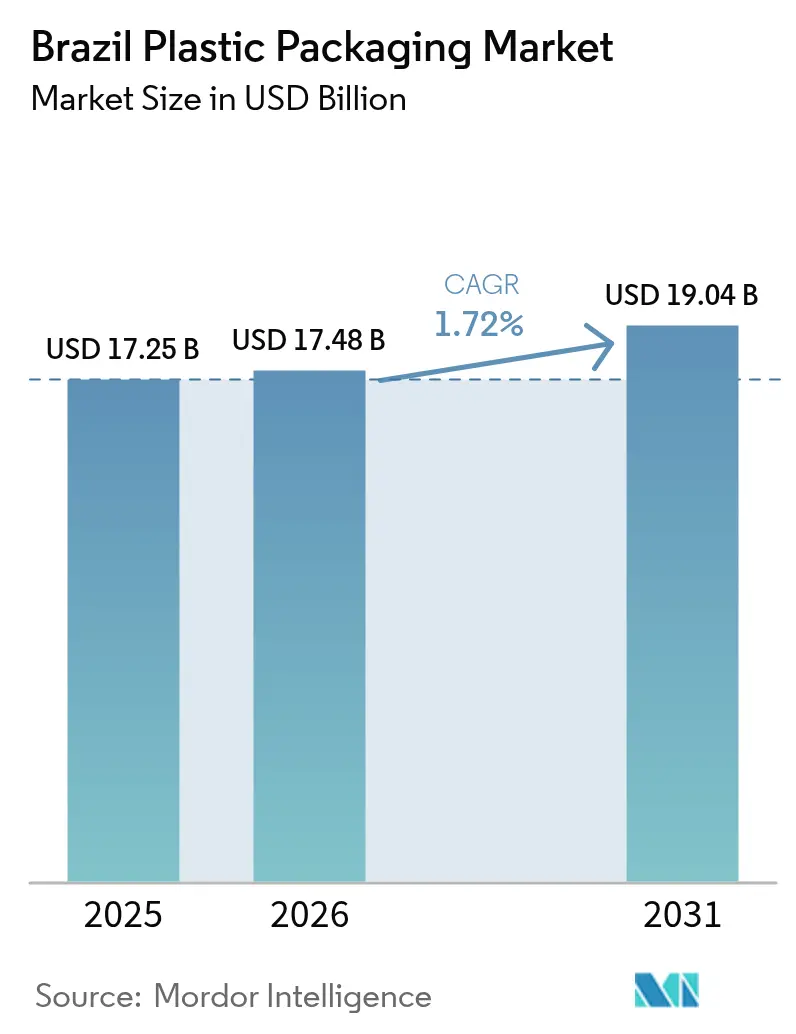
| Base Year Market Size (2025) | USD 17.25 Billion |
| Market Size (2026) | USD 17.48 Billion |
| Market Size (2031) | USD 19.04 Billion |
| Growth Rate (2026 - 2031) | 1.72 % |
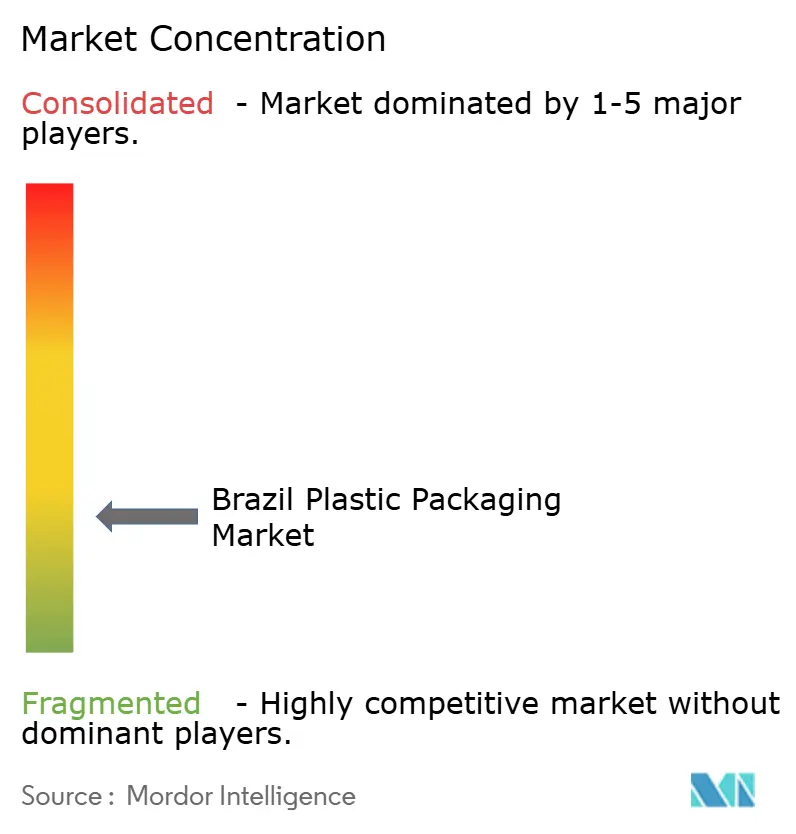
| Market Concentration | Low |
Major Players *Disclaimer: Major Players sorted in no particular order Image © Mordor Intelligence. Reuse requires attribution under CC BY 4.0. | |
Brazil Plastic Packaging Market Analysis by Mordor Intelligence
The Brazil plastic packaging market size is expected to increase from USD 17.25 billion in 2025 to USD 17.48 billion in 2026 and reach USD 19.04 billion by 2031, growing at a CAGR of 1.72% over 2026-2031. Rising recovery rates and recycled-content mandates, a feedstock-cost edge from sugarcane ethanol, and e-commerce-driven demand for cube-efficient formats are nudging the market away from pure volume toward higher-value solutions. Presidential Decree 12,688 obliges converters to reach 22% post-consumer recycled content by 2026, accelerating investments in near-infrared sorting and decontamination lines. São Paulo and Rio de Janeiro beverage-bottle deposit schemes are improving polyethylene terephthalate bale purity, while municipal bans on expanded polystyrene trays are steering quick-service outlets toward molded-fiber and polypropylene alternatives. Bio-attributed polyethylene derived from domestic ethanol now carries a single-digit premium over fossil grades, enabling price-sensitive food and retail uses without eroding converter margins.
Key Report Takeaways
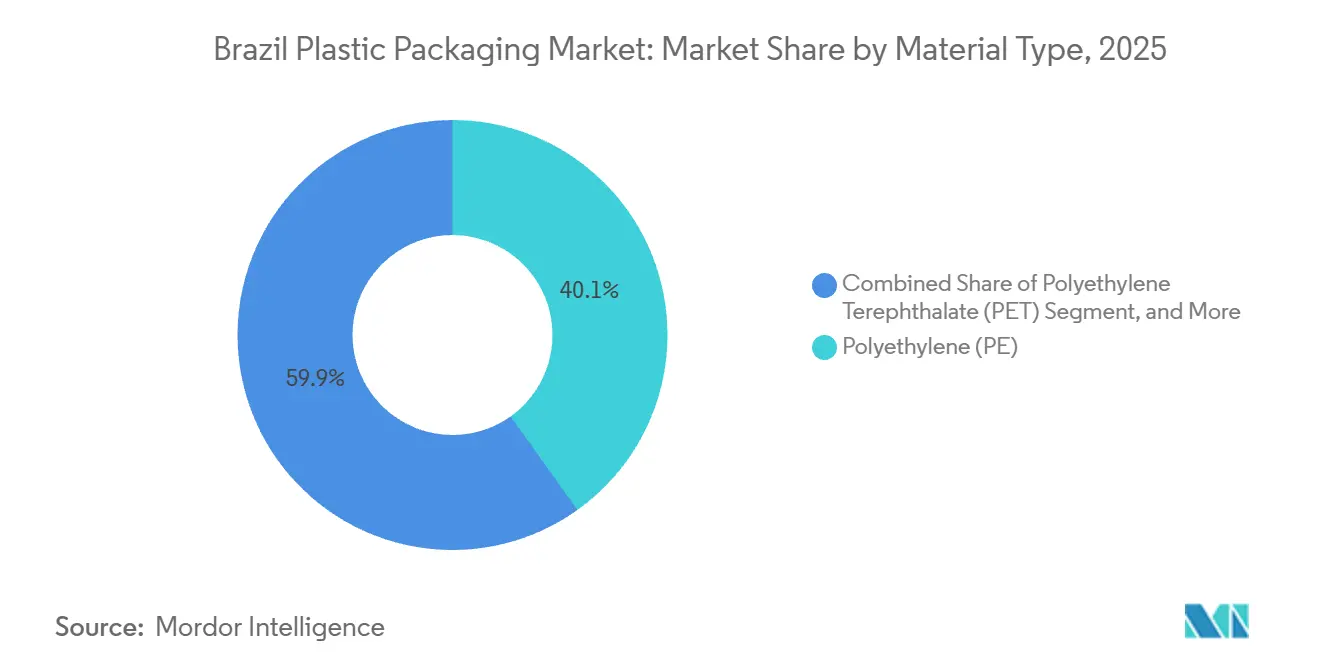
- By material type, polyethylene led with 40.13% of the Brazil plastic packaging market share in 2025, whereas polyethylene terephthalate is projected to record the fastest 2.21% CAGR through 2031.
- By packaging type, flexible formats accounted for 53.42% of the Brazil plastic packaging market size in 2025, while the rigid segment is set to trail as flexible solutions grow at a 2.46% CAGR.
- By product form, pouches and sachets captured 32.37% share in 2025, yet films and wraps are forecast to expand at a market-leading 2.63% CAGR to 2031.
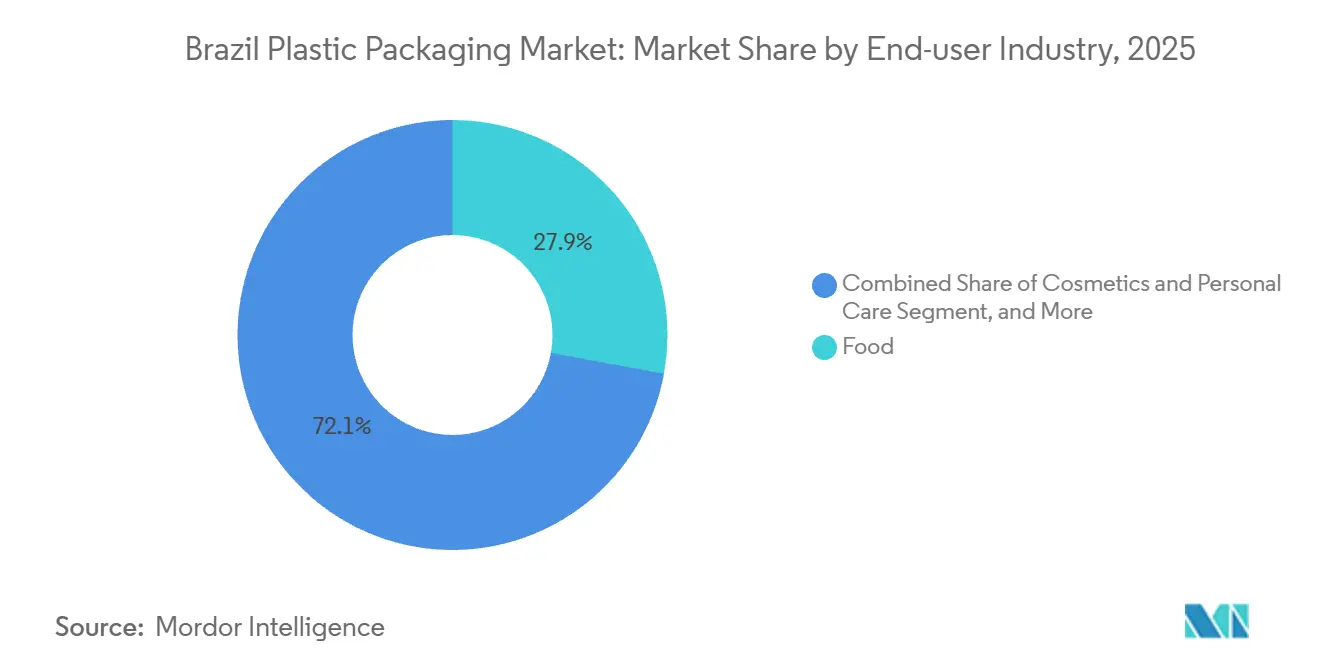
- By end-user industry, food retained the largest 27.88% share in 2025, and cosmetics and personal care is anticipated to advance at the fastest 3.01% CAGR.
- By manufacturing process, extrusion accounted for 29.54% of market share in 2025, whereas thermoforming is poised for the highest 3.12% CAGR on the back of in-mold labeling adoption.
Note: Market size and forecast figures in this report are generated using Mordor Intelligence’s proprietary estimation framework, updated with the latest available data and insights as of 2026.
Brazil Plastic Packaging Market Trends and Insights
Drivers Impact Analysis*
| Driver | (~) % Impact on CAGR Forecast | Geographic Relevance | Impact Timeline |
|---|---|---|---|
| Sustainable-Material Mandates from ANVISA And CONAMA | +0.5% | National, early enforcement in São Paulo, Rio de Janeiro, Brasília | Medium term (2-4 years) |
| Rapid E-Commerce Cold-Chain Expansion | +0.4% | National, concentrated in Southeast and South regions | Short term (≤ 2 years) |
| Brand-Owner Pledges For ≥ 25% PCR By 2028 | +0.3% | National, led by multinational FMCG and cosmetics brands | Medium term (2-4 years) |
| Petrochemical Feedstock Advantage from Domestic Ethanol | +0.2% | National, anchored by São Paulo and Rio Grande do Sul ethanol hubs | Long term (≥ 4 years) |
| Blockchain-Enabled Traceability Pilots Elevating Premium SKUs | +0.1% | National, early adoption in cosmetics and premium food | Medium term (2-4 years) |
| Tax Incentives on Bagasse-Based Bioplastics | +0.1% | National, R and D in São Paulo and Minas Gerais | Long term (≥ 4 years) |
| Source: Mordor Intelligence | |||
Sustainable-Material Mandates from ANVISA and CONAMA
Presidential Decree 12,688 instituted legally binding reverse-logistics goals, compelling 32% recovery and 22% post-consumer recycled content by 2026.[1] Companion ANVISA technical note RDC 326/2024 authorizes recycled polyethylene terephthalate and high-density polyethylene in direct food contact, provided converters validate closed-loop traceability and migration compliance under ISO 15632. Converters are therefore re-tooling with near-infrared sorting and super-clean decontamination systems that meet stringent food-grade thresholds. Brand owners risk penalties for unverifiable recycled-content claims, pushing them toward certified suppliers. Pending Bill PL 5321/2025 aims to hard-wire minimum recycled-content levels, signaling that voluntary targets will likely become statutory over the next decade.
Rapid E-Commerce Cold-Chain Expansion
Brazil’s e-grocery penetration reached 8% of food retail in 2025, doubling since 2020 as shoppers favor doorstep delivery for chilled proteins and dairy. Fulfillment centers now specify high-barrier flexible pouches that extend ambient cold life from four to twelve hours, reducing reliance on reefer vans and lowering diesel spend. Amcor’s AmFiber paper-polyethylene laminate arrived in early 2025 to serve this niche, offering curbside recyclability where mixed-fiber collection is available. Government grants worth BRL 500 million (USD 95 million) under a May 2025 biorefinery roadmap support pilot plants for bio-based barrier coatings that can displace imported ethylene-vinyl alcohol within three years. These developments reinforce demand for lighter, cube-efficient flexible packs.
Brand-Owner Pledges for ≥ 25% PCR by 2028
Grupo Boticário and Natura anchored public commitments to source at least 25% post-consumer resin by 2028, triggering a procurement pull that reshapes resin supply chains.[2] Braskem responded by earmarking 30% of its polyethylene capacity for mechanical and bio-attributed grades by 2027. However, food-grade recycled polypropylene remains scarce because its low density hampers automatic separation, leaving converters dependent on virgin inputs. Without local licensing of NextLooPP’s advanced dissolution technology, the circularity gap for yoghurt cups and microwaveable trays persists.
Petrochemical Feedstock Advantage from Domestic Ethanol
Braskem’s 260,000 t/y bio-based polyethylene plant in Triunfo sources ethanol under fixed-price contracts that detach resin prices from Brent crude swings, narrowing the premium over fossil grades to roughly 5%. The 2025 Tax Reform delivered a 60% levy reduction for bio-attributed plastics, further tilting cost economics, while the Brazilian Sustainable Taxonomy now qualifies such resins for green-bond funding. These fiscal incentives underpin plans for brownfield debottlenecks that could lift domestic bio-polyethylene output beyond 350,000 t/y by 2028.
Restraints Impact Analysis*
| Restraint | (~) % Impact on CAGR Forecast | Geographic Relevance | Impact Timeline |
|---|---|---|---|
| Municipal Waste-Collection Gaps in Tier-3 Cities | −0.3% | National, acute in North and Northeast regions | Medium term (2-4 years) |
| Consumer Backlash Against Single-Use EPS Trays | −0.2% | National, focused in São Paulo, Rio de Janeiro, Santos | Short term (≤ 2 years) |
| Shortage of Food-Grade rPP Supply | −0.1% | National, dairy and ready-meal converters | Medium term (2-4 years) |
| Currency Volatility Hampering Resin Price Pass-Through | −0.1% | National, import-dependent converters | Short term (≤ 2 years) |
| Source: Mordor Intelligence | |||
Municipal Waste-Collection Gaps in Tier-3 Cities
Only 25.7% of Brazilian municipalities operated segregated collection in 2024, leaving mixed-waste landfills that contaminate recyclables with organic leachate. Quality-certified feedstock is thus concentrated in São Paulo and Rio de Janeiro, while converters in Manaus and Belém import recycled polyethylene terephthalate at double-digit freight premiums. A USD 120 million Inter-American Development Bank loan approved in 2024 will finance fifteen regional sorting hubs, but commissioning extends to 2027, delaying compliance with 2026 reverse-logistics targets. The geographic imbalance suppresses circular-economy momentum outside the industrial heartland.
Consumer Backlash Against Single-Use EPS Trays
Municipal bans on expanded polystyrene food-service packaging took effect in São Paulo, Rio de Janeiro, and Santos during 2024, citing marine-litter concerns.[3] Quick-service chains pivoted to molded-fiber clamshells and polypropylene trays, stranding roughly BRL 80 million (USD 15 million) in legacy tooling and prompting layoffs at three regional converters. Surveys conducted in February 2025 show 68% of metropolitan consumers associate expanded polystyrene with environmental harm, even when fiber alternatives carry a larger carbon footprint. The perception gap accelerates polystyrene’s structural decline and raises packaging costs for value-meals.
*Our forecasts treat driver/restraint impacts as directional, not additive. The impact forecasts reflect baseline growth, mix effects, and variable interactions.
Segment Analysis
By Material Type: Deposit Schemes Propel PET Uptake
Polyethylene terephthalate secured a 2.21% forecast CAGR to 2031 as São Paulo and Rio de Janeiro deposit laws guarantee clean bale supply that meets ANVISA’s food-contact purity thresholds. Polyethylene retained 40.13% share in 2025, buoyed by flexible films and a feedstock advantage from sugarcane ethanol that limits cost volatility. The Brazil plastic packaging market size for polyethylene formats will remain dominant, yet polyethylene terephthalate growth outpaces as brand owners seek bottle-to-bottle loops. Polypropylene’s recycling lag stems from density-driven cross-contamination, keeping recycled content below 20% and constraining circular ambitions. Polystyrene continues to lose ground after municipal bans eliminated single-use trays, redirecting demand to polypropylene and molded fiber. Other resins such as polyamide fill niche high-barrier roles where regulatory thresholds limit substitution.
Indorama Ventures’ 15,000 t/y expansion in Indaiatuba now channels post-consumer polyethylene terephthalate into premium bottle-grade pellets that command 20% price premiums over fiber markets. Meanwhile, the NextLooPP dissolution pathway for food-grade recycled polypropylene lacks Brazilian licensing, perpetuating shortfalls for yogurt cups and ready-meal trays. Combined with Decree 12,688’s 22% recycled-content mandate, these dynamics pull resin sourcing toward certified mechanical and chemical streams and reinforce investment in bale-quality infrastructure.

By Packaging Type: Flexible Formats Trim Last-Mile Costs
Flexible plastic packaging captured 53.42% share in 2025, and will grow at a 2.46% CAGR through 2031 as grocery e-commerce platforms prioritize cube-efficient pouches that reduce diesel consumption in last-mile deliveries. High-barrier films with ethylene-vinyl alcohol cores extend shelf life for chilled proteins and dairy, enabling ambient delivery across peri-urban corridors. The Brazil plastic packaging market share for rigid formats remains solid in carbonated drinks and household chemicals, where drop impact and internal pressure require bottles and jars. Amcor’s curbside-recyclable AmFiber laminate aims to unlock fiber-film diversion but faces collection-system limitations outside the top metropolitan areas. Government-funded biorefinery pilots converting bagasse into barrier coatings could lower flexible-film input costs within three years, reducing the price gap with rigid options and further lifting flexible uptake.
Klabin’s BRL 200 million (USD 38 million) investment to laminate kraft paper with bio-polyethylene positions the firm to integrate pulp, polymer, and conversion under one roof. Vertical integration promises margin capture along the value chain while offering brand owners drop-in alternatives to metallized structures. Rigid converters must therefore pivot toward lightweighting and refillable innovations to defend share against flexible encroachment.
By Product Form: Films And Wraps Outpace On Cold-Chain Efficiency
Films and wraps are on track for a 2.63% CAGR through 2031, benefiting from multilayer constructions that keep chilled proteins within microbiological limits without active refrigeration. The Brazil plastic packaging market size for pouches and sachets stood at 32.37% in 2025, supported by single-serve coffee, condiments, and personal-care SKUs whose portion control matches fast-paced urban lifestyles. Bottles and jars dominate beverage service under deposit-return schemes, while trays see material substitution away from expanded polystyrene toward polypropylene and molded fiber. Agricultural bulk bags compete against low-cost woven polypropylene imports from Asia, challenging domestic converters to add value through UV stabilization and traceability features.
A sugarcane-bagasse cryogel developed in April 2025 offers expanded-polystyrene-level drop protection at 30% lower basis weight, enabling electronics exporters to reduce freight spend by double digits. ANVISA’s January 2026 consultation on refillable cosmetics packs signals regulatory openness to multiple-use containers, which could reshape form-factor demand and push converters to adopt modular closure systems.
By End-User Industry: Refillable Push Elevates Cosmetics
Food accounted for 27.88% of demand in 2025, underpinned by chilled-protein growth and e-grocery penetration. Yet cosmetics and personal care are set to post a 3.01% CAGR as refillable mandates and premium bio-polymer launches spur innovation. The Brazil plastic packaging market for beverages benefits from a deposit-return system for food-grade polyethylene terephthalate with purity exceeding 95%, facilitating closed-loop bottle recycling. Pharmaceutical and healthcare packs must meet ANVISA serialization under RDC 157/2017, sustaining demand for tamper-evident blisters.
Industrial bulk remains a stronghold of woven polypropylene thanks to its stacking strength and UV resistance. Consumer surveys expose a gap between refillable awareness (75%) and purchase behavior (22%), suggesting regulatory nudges will drive scale adoption. IFF’s research lab opened in August 2025 to explore bio-based fragrance encapsulation, which may reduce the need for virgin polymers in fine-fragrance packages.
By Manufacturing Process: In-Mold Labeling Spurs Thermoforming
Thermoforming eyes a 3.12% CAGR as dairy brands adopt in-mold labels that merge decoration and wall structure in one step, eliminating adhesives and boosting recycling yields. Extrusion dominated 29.54% of 2025 production across blown-film grocery bags, mulch, and stretch wrap. Injection molding retains leadership in closures, where high thread precision is critical, while blow molding delivers lightweight polyethylene terephthalate bottles, whose average unit weight fell by 12.5% between 2020 and 2025. Rotational and compression molding serve niche industrial containers.
Huhtamaki’s 2024 expansion added two high-speed thermoforming lines capable of producing 120 million yogurt cups per year. The expansion aims to achieve premium shelf appeal through full-coverage label fusion. The Recircula Brasil blockchain platform now audits recycled-content declarations across multiple processes, elevating transparency and discouraging greenwashing.
Geography Analysis
São Paulo, Rio de Janeiro, and Minas Gerais together host about 65% of converter capacity and 70% of certified post-consumer resin supply, reflecting mature selective-collection systems and proximity to branded fast-moving consumer goods hubs. The South region, anchored by Paraná, Santa Catarina, and Rio Grande do Sul, benefits from sugarcane and forestry biomass corridors that feed bio-attributed polyethylene and kraft-paper laminates, reducing feedstock freight. Northeast and North states lag with selective collection in just 12% of municipalities, forcing converters to ship recycled feedstock from the Southeast at premiums that erode competitiveness. Central-West zones like Goiás and Mato Grosso are emerging as agricultural-film extrusion centers, leveraging soybean and corn processors’ need for high-barrier export pouches.
Reverse-logistics targets set by Decree 12,688 will chiefly be met in wealthier regions, widening compliance gaps. IDB-funded hubs scheduled to open by 2027 aim to narrow the deficit but arrive after the 2026 benchmark, risking penalty exposure for converters dependent on under-served cities. Municipal polystyrene bans in coastal metropoles pressurized converters without thermoforming diversification, spurring capacity redeployment toward polypropylene or molded-fiber lines in the Southeast.
The Brazilian Sustainable Taxonomy designates bio-based polyethylene a transition asset eligible for green-bond issuance, catalyzing brownfield retrofits in São Paulo and Rio Grande do Sul. E-commerce penetration hits double digits in the Southeast and South, generating demand for ambient-cold pouches, whereas tier-3 northern municipalities continue to rely on heavier rigid containers due to infrastructure inertia. Over the forecast horizon, infrastructural homogeneity rather than product-design innovation may prove the chief regional differentiator in the Brazil plastic packaging market.
Regulatory Landscape
Brazilian plastic packaging regulation is anchored by the National Solid Waste Policy (PNRS, Law 12.305/2010) and its implementing Decree 10.936/2022, which codify shared responsibility and reverse logistics obligations across the value chain. The compliance bar tightened with Federal Decree 12.688/2025, which sets mandatory national targets for the 2026 base year, including 32% packaging recovery and 22% minimum post-consumer recycled (PCR) content, pushing brand owners and converters from voluntary commitments into auditable programs.
In May 2026, the Ministry of the Environment and Climate Change (MMA) issued Comunicado LR - DGR/MMA No. 002/2026 to operationalize Decree 12.688/2025, including clarification on reporting timing for the 2026 base-year targets (submissions due by 30 July 2027). For food-contact applications, ANVISA continues to set the safety overlay through its packaging regularization and notification rules (including IN 281/2024) and related food-contact resolutions, sustaining dual compliance needs where recycled-content goals must be met alongside traceability and migration requirements.
Value Chain Analysis
The Brazil plastic packaging value chain starts with feedstocks and resin production (virgin and bio-attributed polymers, plus mechanically recycled PCR), then moves through compounding and converting (extrusion, injection, blow molding, and thermoforming) into formats such as films, pouches, bottles, and trays for food, beverage, personal care, healthcare, and industrial end users. Trade bodies such as ABIPLAST, ABIEF, and ABRE support standardization and technical guidance, while large brand owners increasingly specify certified PCR and traceability as procurement conditions, shaping converter investment priorities.
Downstream, distribution runs through FMCG filling lines and retail and e-commerce channels. The end-of-life loop depends on municipal collection, waste management firms, and waste-picker cooperatives that supply sorting and baling to recyclers. PNRS obligations reinforced by Decree 10.936/2022 and Decree 12.688/2025 make reverse logistics a core operating layer rather than an add-on, which elevates the role of accredited managing entities, auditing, and digital reporting. Bottlenecks persist in food-grade PCR availability and consistency, making decontamination, sorting yield, and documentation critical value-capture points for the most regulated applications.
Competitive Landscape
The Brazilian plastic packaging market is fragmented. Multinationals Amcor, Mondi, and Sealed Air compete alongside domestic specialists such as Klabin, Braskem, and Termotécnica. Strategic focus has migrated toward post-consumer resin certification, blockchain traceability, and low-carbon feedstocks rather than pure capacity additions. The proposed Amcor-Berry Global merger awaits antitrust clearance, which may require divestitures of film plants to safeguard competition. White-space remains around food-grade recycled polypropylene, where shortages force converters to blend virgin resin above 80%, and around refillable cosmetics packaging, pending ANVISA guidelines.
Mango Materials supplies methane-derived polyhydroxyalkanoate to Natura’s Biome line, showcasing vertical integration that bypasses fossil chains. Recircula Brasil's electronic-invoice seals enable real-time verification of recycled-content claims, pressuring tier-2 converters lacking capital for certification upgrades to consolidate or exit price-squeezed commodity segments. AptarGroup’s October 2025 purchase of Sommaplast secures closure know-how and locks in dispensing-system capacity for multinational beauty brands. Technology bifurcation is evident: tier-1 players deploy near-infrared sorters, decontamination reactors, and in-mold labeling, while cash-constrained rivals compete on price, accelerating the market shakeout.
Mid-tier converters are pivoting toward niche plays in bio-attributed resins and blockchain-verified supply chains to escape commodity-film price wars. Platforms such as Recircula Brasil now reward converters that upload electronic-invoice seals with preferential access to branded fast-moving consumer goods tenders, pressuring laggards to retrofit lines for traceability compliance. At the same time, contract manufacturers that once relied on low-margin grocery-bag extrusion are shifting toward custom thermoforming services for dairy and ready-meal brands, an upgrade path made viable by equipment leasing programs backed by the Brazilian Development Bank.
Brazil Plastic Packaging Industry Leaders
-
Amcor plc
-
Mondi plc
-
Huhtamäki Oyj
-
Sealed Air Corporation
-
Sonoco Products Company
- *Disclaimer: Major Players sorted in no particular order
Market Opportunities and Future Outlook
The biggest near-term whitespace is compliance-driven circularity infrastructure created by Decree 12.688/2025, which mandates 22% PCR content and 32% recovery for the 2026 base year and requires reverse logistics systems across manufacturers, importers, distributors, and retailers. The May 2026 MMA Comunicado LR - DGR/MMA No. 002/2026 adds operational clarity, including reporting timing, which favors solutions that can document chain-of-custody, reconcile mass balance where applicable, and verify recycled-content claims at SKU level. This opens room for certified PCR supply, traceability platforms, and managing-entity services.
Product and material redesign opportunities are also visible where regulation and consumer pressure constrain incumbent plastics, including substitution away from EPS in food service and a shift toward recyclable mono-material flexible structures to simplify sorting. On the alternatives side, Melhoramentos operates the Biona compostable fiber-based packaging facility in Camanducaia (Minas Gerais) with capacity of 80 million units per year, indicating a commercial route for fiber formats in applications where plastic reduction targets or local restrictions are binding. Investments linked to ethanol-based and bio-attributed polymers also remain relevant, as the Central Bank sustainable taxonomy and fiscal incentives improve access to green finance and support material shifts without forcing converters to abandon existing processing assets.
Recent Industry Developments
- June 2026: Amcor installed three Moda rotary vacuum chamber sealing systems at Barra Mansa Alimentos in Brazil, replacing nine belt chamber machines to raise throughput and improve pack consistency. The change tightens packaging materials requirements to equipment and technical service for protein packaging, reinforcing supplier lock-in and performance-driven purchasing.
- June 2025: Amcor confirmed that AmFiber Performance Paper is recyclable in Brazil's mixed-paper recycling stream after testing with local consultants and recyclers. This validation supports broader use of paper-based laminates in applications competing with flexible plastics, especially where retailers and brand owners demand locally verifiable end-of-life pathways.
- August 2024: The Inter-American Development Bank approved a USD 120 million loan to finance 15 regional sorting hubs in Brazil, with commissioning extending to 2027. The program targets structural feedstock constraints for PCR by expanding sorting capacity and improving bale quality, directly shaping the availability of compliant recycled inputs for converters.
Research Methodology Framework and Report Scope
Market Definition and Coverage
For this methodology, the Brazil plastic packaging market covers packaging products made primarily from plastic resins that are used to protect, contain, and transport goods across consumer and industrial supply chains in Brazil, measured in value terms.
Scope exclusions: We exclude non-plastic packaging materials (such as paper, metal, and glass) and purely service-only activities that do not result in a plastic packaging product sale.
Segmentation Overview
- By Material Type
- Polyethylene (PE)
- Polypropylene (PP)
- Polyethylene Terephthalate (PET)
- Polystyrene and EPS
- Other Material Types
- By Packaging Type
- Flexible Plastic Packaging
- Rigid Plastic Packaging
- By Product Form
- Bottles and Jars
- Trays and Containers
- Pouches and Sachets
- Bags and Sacks
- Films and Wraps
- Other Product Forms
- By End-User Industry
- Food
- Beverage
- Pharmaceuticals and Healthcare
- Cosmetics and Personal Care
- Industrial
- Other End-user Industries
- By Manufacturing Process
- Extrusion
- Injection Molding
- Blow Molding
- Thermoforming
- Other Manufacturing Processes
Data Sources, Market Sizing, and Validation
Desk Research
Desk research began with public data series that help anchor demand and supply signals for plastic packaging in Brazil. We referenced sources such as IBGE industrial statistics, Comex Stat trade data from Brazil, UN Comtrade mirror trade series for cross-checking, and public releases from sector bodies such as ABIPLAST and ABIEF. These inputs helped us sanity-check movement in packaging-related activity and the direction of resin-linked pricing.
To keep the model grounded, we also reviewed company filings, investor presentations, and reputable press coverage for capacity additions, plant expansions, and packaging mix commentary. In addition, we used paid subscriptions for company financials and intelligence, and for shipment-level import and export checks when public data granularity was not enough for a clean validation pass. The desk sources listed here are illustrative, and many other public references were used to collect data, verify it, and clarify open questions.
Primary Interviews and Surveys
Primary work was used to fill gaps that desk research cannot answer cleanly, such as realistic average selling price ranges by packaging form and how resin movements pass through to packaging pricing. We spoke with industry participants across the resin to conversion chain and with large packaging buyers in Brazil, and then aligned assumptions across end uses like food, beverage, healthcare, personal care, and industrial goods.
These discussions helped confirm what is counted as plastic packaging revenue, test utilization and product mix assumptions, and correct outlier trends seen in trade or production series before finalizing the market build.
Distribution of primary research fieldwork respondents
| Company type | Respondent position |
|---|---|
| Top tier: 30% | CXOs: 19% |
| Mid tier: 51% | Functional/Unit leaders: 34% |
| Smaller Players: 19% | Managers: 47% |
Market-Sizing & Forecasting
Sizing started with a top-down build that reconstructs Brazil demand from packaging consumption drivers and conversion output signals, and then converts it into value using pricing assumptions that can be explained and checked. Selective bottom-up approximations were added to corroborate totals, such as sampling converter revenue bands, checking channel pricing for common formats, and validating implied volumes against trade and production cues. When cross-checks did not line up, we adjusted the totals.
Key inputs in the model included resin cost direction for PE, PP, PET, and PS and EPS families, the split between flexible and rigid packaging, the mix of common forms like bottles and jars, trays and containers, pouches and sachets, bags and sacks, and films and wraps, and demand momentum from end uses such as food, beverage, healthcare, personal care, and industrial goods. When a variable could not be observed directly, we used interview-backed ranges and conservative interpolation so gaps did not distort the totals.
For forecasting, scenario analysis was used because packaging demand in Brazil can shift with consumer spending, packaged food output, and the pace of material substitution. The base case was then selected through expert checks on expected capacity utilization, price pass-through timing from resins to packaging, and realistic format mix changes rather than assuming one straight-line path.
Data Validation & Update Cycle
Checks were applied in layers so the final numbers remain consistent and sensible. We compared outputs against independent signals like trade flows, resin price direction, and publicly reported production or revenue indicators, and then reviewed any variance that looked too large for the market context.
Before sign-off, the model logic and calculations were reviewed by another analyst, and follow-up calls were triggered when an assumption moved outside the ranges that interviewees considered workable. The report is refreshed annually, with interim updates when material events occur, such as sharp resin price swings, packaging regulation changes, or major capacity additions. Right before delivery, we do a final pass so clients receive the latest updated view.
Mordor Intelligence's Brazil Plastic Packaging Market Estimate Compared With Other Published Estimates
Published market values for Brazil plastic packaging often do not match because each publisher uses its own scope, base-year timing, and price progression assumptions. Currency conversion timing and how often inputs are refreshed can also shift the final number even when the market narrative sounds similar.
Some external figures lean toward narrower slices, such as specific packaging formats or limited end uses, which naturally compresses the total. Other estimates are built from older year series without rechecking resin-linked pass-through and format mix changes, and that can hold values down even when volumes are rising.
Benchmark comparison
| Source | Market Size | Gaps in Research Methodology |
|---|---|---|
| Mordor Intelligence | USD 17.25 B (2025) | |
| Industry Data Portal A | USD 9.22 B (2025) | This figure is consistent with a narrower definition that can undercount parts of rigid packaging and some non-consumer end uses, and it is not clear how average selling prices are updated when resin prices move. |
| Industry Data Portal B | USD 8.96 B (2024) | This value is for an earlier year and appears to rely on a long historical series without clear revalidation of price progression, which can miss recent pass-through effects and mix shifts across bottles, films, and pouches. |
The table highlights that the biggest spread comes from what is included and the year the value is anchored to, not from a single growth-rate assumption. Some estimates focus mainly on flexible packaging value, and then rigid formats and industrial demand are not fully captured, and Mordor Intelligence counts plastic packaging across both flexible and rigid forms in Brazil with price updates tied to resin-linked pass-through checks and annual refreshes.
Key Questions Answered in the Report
How large is the Brazil plastic packaging market in 2026?
The market is expected to reach USD 17.48 billion in 2026.
What CAGR is forecast for Brazil’s plastic packaging through 2031?
The market is projected to grow at a 1.72% CAGR between 2026 and 2031.
Which packaging type is expanding fastest in Brazil?
Flexible formats, especially high-barrier films, are forecast to rise at a 2.46% CAGR through 2031.
Why is polyethylene terephthalate gaining share?
Deposit-return schemes in major cities secure clean bottle bales, driving a 2.21% CAGR for polyethylene terephthalate through 2031.
What regulation most influences recycled content in Brazil?
Presidential Decree 12,688 mandates 22% post-consumer recycled content in plastic packaging by 2026.
Which end-use segment is set for the quickest growth?
Cosmetics and personal care packaging is expected to expand at a 3.01% CAGR on the back of refillable-pack initiatives.