
Bluetooth Beacons Market Size and Share
Market Overview
| Study Period | 2019 - 2030 |
|---|---|
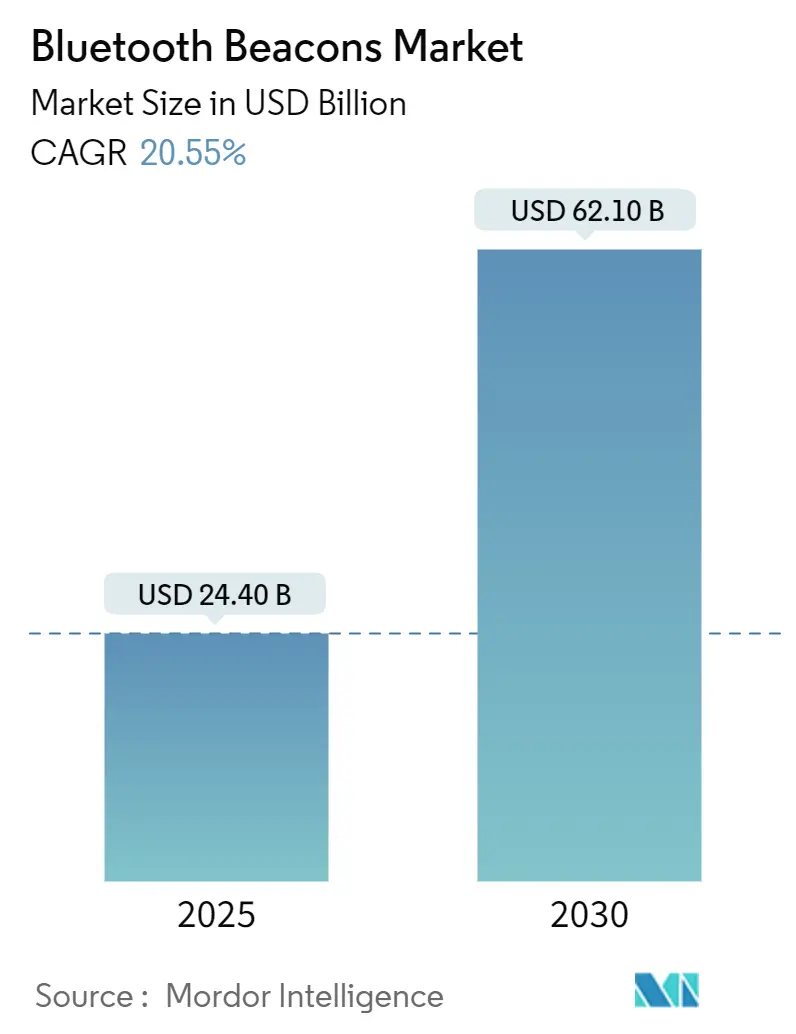
| Market Size (2025) | USD 24.40 Billion |
| Market Size (2030) | USD 62.10 Billion |
| Growth Rate (2025 - 2030) | 20.55 % |
| Fastest Growing Market | Asia Pacific |
| Largest Market | North America |
| Market Concentration | Low |
Major Players
*Disclaimer: Major Players sorted in no particular order Image © Mordor Intelligence. Reuse requires attribution under CC BY 4.0. |
|
Bluetooth Beacons Market Analysis by Mordor Intelligence
The Bluetooth beacons market size stands at USD 24.40 billion in 2025 and is projected to climb to USD 62.10 billion by 2030, advancing at a 20.55% CAGR. Rising smartphone saturation, sub-meter-accuracy indoor positioning demands, and smart-city infrastructure programs keep the Bluetooth beacons market on a fast expansion track. Hardware spending dominates as enterprises prioritize physical infrastructure, yet services grow quickest because organizations increasingly outsource analytics, maintenance, and integration. Regional momentum splits between North America’s mature deployments and Asia-Pacific’s greenfield smart-city roll-outs. Technological convergence with ultra-wideband (UWB) and Wi-Fi real-time location services (RTLS) continues to enhance accuracy while preserving Bluetooth’s low-power advantage. Competitive intensity remains moderate as diversified global brands, specialist beacon vendors, and IoT platform providers pursue vertical market niches and hybrid connectivity solutions.
Key Report Takeaways
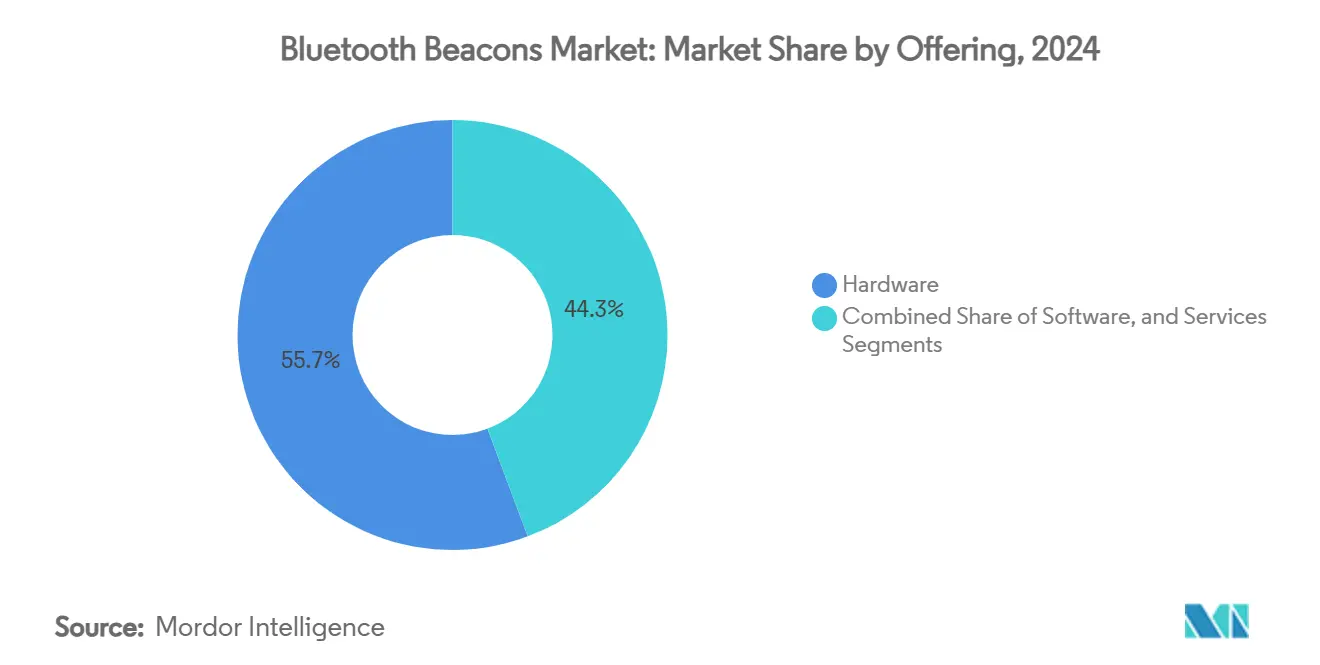
- By offering, hardware commanded 55.7% of the Bluetooth beacons market share in 2024.
- By connectivity, Bluetooth Low Energy accounted for 81% share of the Bluetooth beacons market size in 2024.
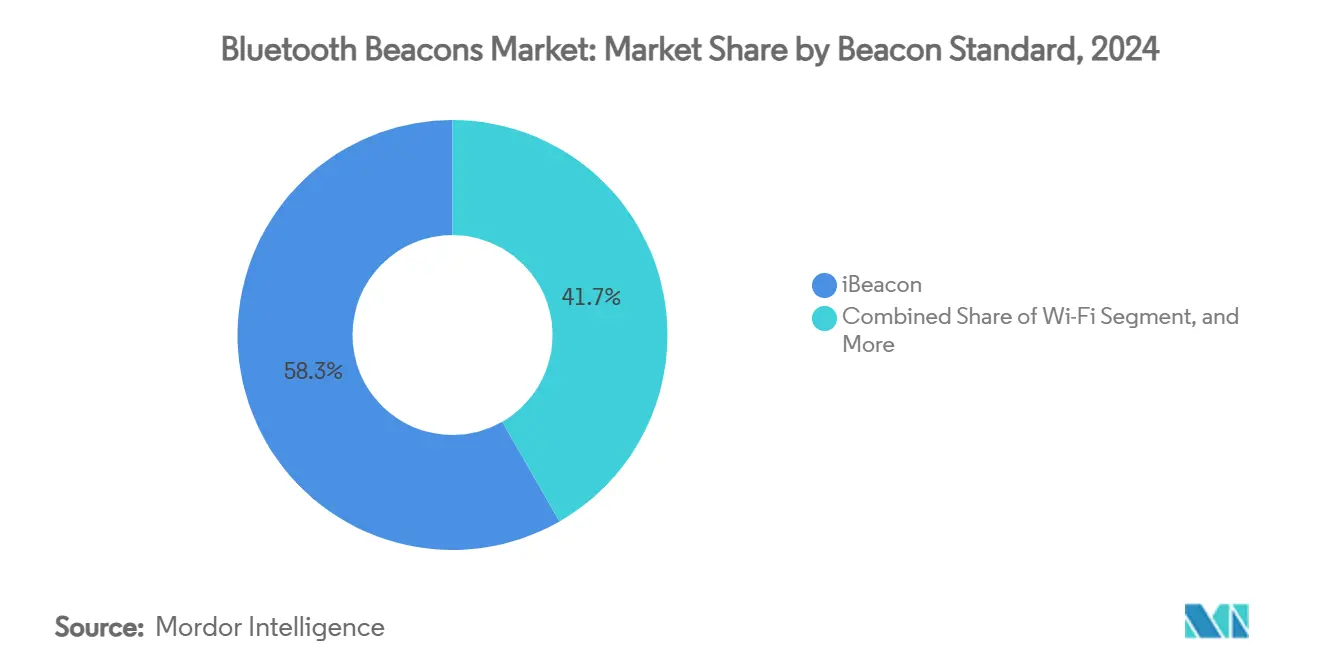
- By beacon standard, iBeacon captured 58.3% share of the Bluetooth beacons market size in 2024.
- By application, retail led with 24.3% of the Bluetooth beacons market share in 2024 while healthcare is projected to record a 20.6% CAGR through 2030.
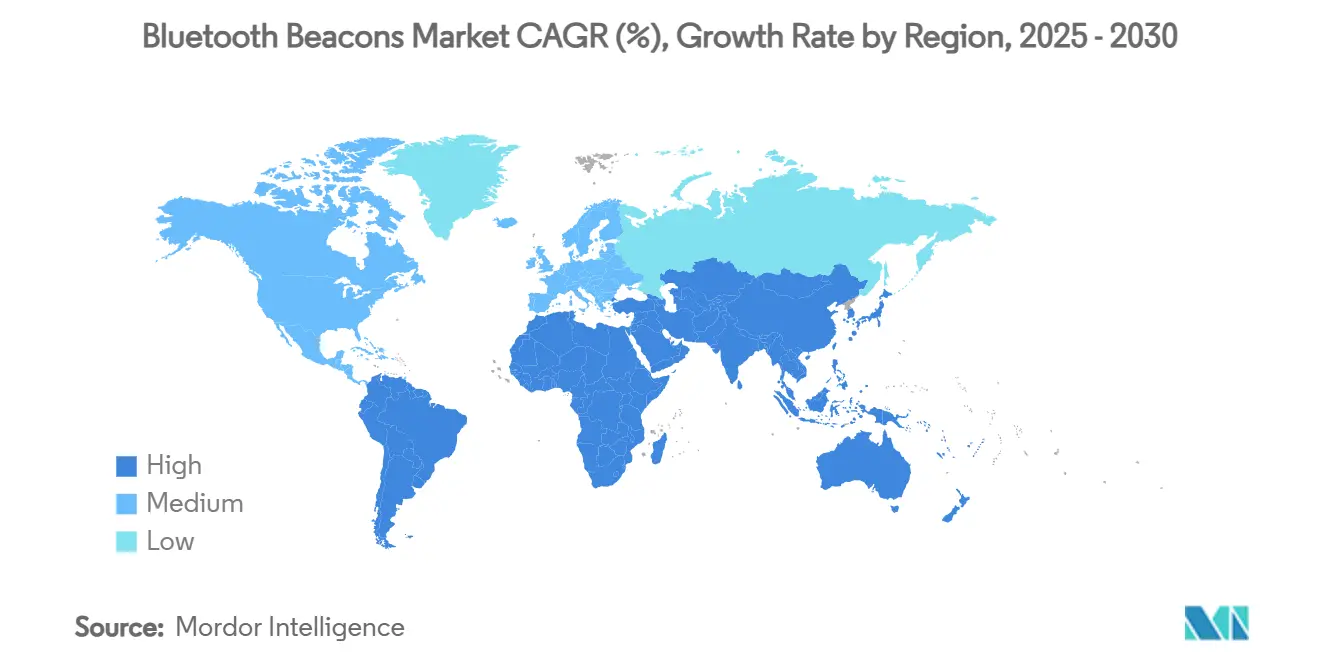
- By geography, North America held 36% revenue share in 2024; Asia-Pacific is forecast to advance at a 21% CAGR to 2030.
Market Trends and Insights
Drivers Impact Analysis of Bluetooth Beacons Market*
| Driver | (~) % Impact on CAGR Forecast | Geographic Relevance | Impact Timeline |
|---|---|---|---|
| Proliferation of BLE-enabled smartphones | +4.2% | Global; APAC leadership | Short term (≤ 2 years) |
| Retail demand for proximity marketing and analytics | +3.8% | North America and EU core markets | Medium term (2-4 years) |
| Adoption in transportation and logistics asset tracking | +3.1% | Global; industrial hubs | Medium term (2-4 years) |
| Government smart-city indoor-navigation programs | +2.9% | APAC and EU | Long term (≥ 4 years) |
| UWB-assisted BLE hybrids enabling < 1 m accuracy | +2.7% | North America and EU | Medium term (2-4 years) |
| Cross-venue beacon-orchestration API standardization | +1.8% | Global enterprises | Long term (≥ 4 years) |
| Source: Mordor Intelligence | |||
Proliferation of BLE-enabled Smartphones
Smartphone ubiquity places Bluetooth radio chips in nearly every consumer pocket, creating a ready-made anchor for high-volume beacon interactions. Device makers such as Apple and Samsung consistently showcase beacon-powered use cases at flagship events, validating the technology’s mainstream profile.[1]Location-based service suppliers now build on-channel sounding techniques to deliver sub-meter precision without additional infrastructure, magnifying the Bluetooth beacons market’s addressable scope. Rapid 5G adoption improves bandwidth for real-time analytics, reinforcing confidence in beacon analytics platforms. As Asia-Pacific crosses 1.8 billion mobile subscribers, regional developers accelerate pilot roll-outs in transit, retail, and campus environments. The resulting network effect lifts hardware refresh cycles and professional-services demand in the Bluetooth beacons market.
Retail Demand for Proximity Marketing and Analytics
Large retailers deploy beacons to trigger context-aware promotions that raise in-store dwell time and incremental sales. The Golden State Warriors reported a 69% jump in seat-upgrade revenue after installing beacons across Oracle Arena. Mergers such as SK Planet’s USD 200 million acquisition of Shopkick illustrate continued strategic interest in beacon-enabled shopper engagement. Retailers increasingly integrate loyalty apps with indoor heat-mapping to optimize staff allocation and merchandising. Privacy-by-design consent frameworks help preserve opt-in rates as GDPR-aligned disclosures become standard. Together these elements keep store chains investing in differentiated experiences that rely on beacon precision and scalability, fueling transactions in the Bluetooth beacons market.
Adoption in Transportation and Logistics Asset Tracking
Freight forwarders, airports, and manufacturers attach BLE tags to pallets, containers, and tools to reduce loss and shrinkage. Link Labs combines Bluetooth and GPS to maintain condition visibility for temperature-sensitive cargo across multimodal journeys. Logistics operators cite labor savings and fewer search-and-rescue stops once zone-based alerts surface asset location events. However, large fleets require thousands of tags, elevating planning complexity and battery-replacement costs. Ruggedized industrial beacons with UWB overlays mitigate RF interference inside metal-dense facilities. Growing proof-points encourage chief supply-chain officers to enlarge pilot budgets, underpinning unit shipments within the Bluetooth beacons market.
Government Smart-City Indoor-Navigation Programs
Municipalities embed beacons inside transit hubs, museums, and civic buildings to improve accessibility for visually impaired citizens and streamline wayfinding. Korea’s Mobility-as-a-Service platform meshes beacons with AI video analytics to orchestrate multimodal journeys across Seoul. European airports test visible-light communication (VLC) coupled with beacons to guide passengers through security lanes at peak volume. Public procurement cycles generate volume orders that stabilize hardware cost curves. Over time, civic authorities codify API and battery-disposal standards, creating blueprints transferable to private facility operators. Resulting network density anchors the long-term growth trajectory of the Bluetooth beacons market.
Restraints Impact Analysis of Bluetooth Beacons Market*
| Restraint | (~) % Impact on CAGR Forecast | Geographic Relevance | Impact Timeline |
|---|---|---|---|
| Privacy regulations and opt-in fatigue | −2.8% | EU and North America | Short term (≤ 2 years) |
| Substitution threat from Wi-Fi RTT and UWB IPS | −2.1% | Global advanced markets | Medium term (2-4 years) |
| Beacon-fleet OPEX / hidden TCO | −1.9% | Global enterprises | Medium term (2-4 years) |
| Battery-disposal and e-waste compliance pressure | −1.6% | EU and regulated markets | Long term (≥ 4 years) |
| Source: Mordor Intelligence | |||
Privacy Regulations and Opt-in Fatigue
Analysis of 52 scanning SDKs found that 86% collected sensitive identifiers, inviting regulator scrutiny and triggering user skepticism. Retailers experience declining push-notification engagement as consumers trim app permissions. Firms respond by embedding granular consent layers and anonymization modules, yet these upgrades raise integration timelines and legal bills. Region-specific legislation—CCPA in California or GDPR in Europe—forces multi-tenant architectures that segregate data by jurisdiction, complicating analytics pipelines. While compliance investments curb near-term margins, they help preserve trusted customer relationships and thereby safeguard long-run revenue in the Bluetooth beacons market.
Substitution Threat from Wi-Fi RTT and UWB Indoor-Positioning Systems
Wi-Fi access-point firmware upgrades deliver meter-level accuracy without new infrastructure, tempting budget-constrained facility managers. At the premium end, UWB achieves centimeter-scale precision inside flagship smartphones, eclipsing legacy beacons in use cases such as augmented-reality navigation. Still, Bluetooth beacons retain cost, power, and ecosystem advantages in mixed-device environments. Many operators respond by layering BLE with Wi-Fi RTT or UWB, positioning beacons as flexible signaling back-bones rather than obsolete point solutions. Convergence thus mitigates outright substitution but slows solo-radio expansion in the Bluetooth beacons market.
*Our forecasts treat driver/restraint impacts as directional, not additive. The impact forecasts reflect baseline growth, mix effects, and variable interactions.
Bluetooth Beacons Market Segment Analysis
By Offering:
Hardware Foundation Enables Service UpsideHardware contributed USD 13.60 billion of the Bluetooth beacons market size in 2024, translating to a 55.7% revenue share thanks to enterprise roll-outs spanning retail chains, hospitals, and industrial sites. Battery lifecycle limits and continued RF environment tuning guarantee recurring refreshes, keeping hardware vendors’ pipelines active. Services, however, is moving ahead at a 21.7% CAGR through 2030 as more customers outsource installation, analytics, and data-driven workflow optimization. This shift encourages beacon specialists to pivot toward subscription models, leveraging cloud dashboards and AI engines to secure sticky revenue. Software remains a pivotal mid-layer that harmonizes multi-radio data flows into applications such as CRM triggers or nurse-call automation. As professional-services margins widen, competition intensifies between integrators, telcos, and pure-play beacon firms across the Bluetooth beacons market.
Industrial deployments typify hardware complexity. Automotive plants specify rugged IP67 casings and temperature-tolerant batteries, favoring vendors like Inpixon whose hybrid UWB-BLE tags meet Industry 4.0 durability thresholds. In hospitals, Kontakt.io pairs beacons with AI algorithms to predict bed turnover, translating sensor density into measurable labor savings. Collectively, these scenarios illustrate how once-off hardware budgets convert into multi-year managed-service engagements, reinforcing growth momentum for the broader Bluetooth beacons market.

By Connectivity:
BLE Dominance Faces Hybrid UpswingBluetooth Low Energy represented 81% of the Bluetooth beacons market size in 2024 as its ultra-low-power profile aligns well with multi-year battery life goals. Smartphone interoperability ensures immediate user-side readiness, making BLE the default option for venues starting their indoor-positioning journey. Yet heterogeneous facilities find pure BLE’s 3-5 m accuracy insufficient for surgical-instrument tracing or AGV path planning. Hybrid connectivity segments—blending BLE with UWB, NFC, or LTE-M—are scaling at a 22.1% CAGR, reflecting new-build factories and high-value medical assets that demand sub-meter precision. Compelling total-cost arithmetic arises when shared infrastructure supports both coarse and fine positioning, thereby widening addressable spend inside the Bluetooth beacons market.
Standards bodies help hybrid adoption by certifying interface layers. FiRa UWB profiles guarantee handset-anchor handshake integrity, while Omlox maps coordinate systems so BLE and UWB tags speak the same language.[2] Cloud platforms auto-reconcile the streams, letting software teams pivot fully to workflow design instead of RF troubleshooting. Consequently, procurement leaders evaluate beacons not simply by tag price but by multi-radio coexistence and roadmap transparency, a key differentiator in the Bluetooth beacons market.
By Beacon Standard:
iBeacon Leadership Amid Open-Source GrowthApple’s iBeacon held 58.3% share of the Bluetooth beacons market size in 2024, owing to early arrival, tight iOS integration, and extensive developer libraries. For brand marketers, App Store reach plus background scan permissions make iBeacon an attractive default. Yet enterprises with mixed device fleets increasingly gravitate to open AltBeacon or multiframe Eddystone, pushing “Others” to a 21.4% CAGR. AltBeacon’s transparent spec permits in-house security scrutiny, a must for hospitals subject to HIPAA audits. Emerging cross-platform SDKs translate beacon packets into universal JSON, trimming build cycles for Android and iOS simultaneously. This pluralistic landscape lowers entry barriers, spreading unit volumes more evenly and sustaining innovation within the Bluetooth beacons market.
Standards diversification also fuels hardware customization. Museums adopt Eddystone URL frames for frictionless “physical web” tours that avoid mandatory app downloads. Logistics operators embed AltBeacon telemetry fields for temperature and shock data, marrying location with condition monitoring. Vendors that bundle configurable firmware win contracts where one-size-fits-all approaches fall short. End-users thus view beacon standards as strategic levers in their digital-transformation agendas, reinforcing resilient demand across the Bluetooth beacons market.
By Application:
Retail Core Expands Toward Healthcare SurgeRetail contributed 24.3% of the Bluetooth beacons market share in 2024, leveraging dwell-time analytics, line-bust alerts, and personalized promotions. Chains embed beacons near endcaps, enabling real-time A/B testing of merchandising layouts. Still, healthcare is projected to escalate at a 20.6% CAGR through 2030 as hospitals chase asset-tracking ROI, patient-flow optimization, and compliance with nurse-call response mandates. Transportation hubs deploy beacons for gate-change alerts, while industrial players attach tags to forklifts to improve overall equipment effectiveness. Education, events, and smart-city nodes fill out the diversified funnel, assuring multi-vertical resilience inside the Bluetooth beacons market.
Vertical maturity levels differ. Retail has passed proof-of-concept and now optimizes omnichannel orchestration—merging beacon pings with computer-vision shelf scans for granular planogram compliance. Hospitals remain earlier on the curve but show stronger budget expansion once initial pilots validate payback. In logistics yards, beacons prevent trailer mis-slotting, saving diesel idling and demurrage fees. These cross-vertical successes maintain investor enthusiasm, prompting funding rounds such as Kontakt.io’s USD 47.5 million raise to accelerate healthcare AI modules. Collective evidence cements the long-run uplift of the Bluetooth beacons market.
Geography Analysis
North America Bluetooth Beacons Market
North America generated 36% of 2024 revenue, driven by early enterprise pilots that evolved into coast-to-coast roll-outs for big-box retailers, stadiums, and teaching hospitals. Regulatory pressure under ADA accessibility statutes motivates indoor-navigation add-ons, particularly across airports and public campuses. Funding availability also accelerates experimentation: U.S. sports franchises pair beacons with dynamic ticket-pricing algorithms to monetize in-venue footfall. Encountering privacy statutes at state level, operators standardize consent flows that later serve as templates abroad. These lessons create professional-services export opportunities for North-American integrators, further knitting global influence for the Bluetooth beacons market.
APAC Bluetooth Beacons Market
Asia-Pacific will post a 21% CAGR to 2030, underpinned by 1.8 billion mobile subscribers contributing USD 880 billion to GDP.[3] Smart-city budgets in Korea and Japan embed beacons in multimodal mobility corridors, while China’s mega-malls adopt tags to drive hyperlocal loyalty promotions. Indian airports pivot to beacon-augmented DigiYatra boarding systems that trim queue times. Government procurement often bundles LED lighting with Bluetooth beacons to amortize installation labor across two systems. As a result, domestic manufacturing bases for tags and gateways expand, lowering supply-chain risk and bolstering the Bluetooth beacons industry across the region.
Europe Bluetooth Beacons Market
Europe grows steadily on the strength of GDPR-compliant healthcare and industrial automation projects, even as privacy strings tighten feasibility windows. EU battery regulation drives eco-design momentum that may soon spread internationally. Automotive OEM clusters in Germany integrate hybrid UWB-BLE for tool-tracking, while Nordic retailers pilot Eddystone for cashier-less micro-stores. Despite macroeconomic headwinds, EU research grants subsidize R&D into low-impact materials, reinforcing supplier capacity and helping differentiate European vendors in the global Bluetooth beacons market.
Competitive Landscape
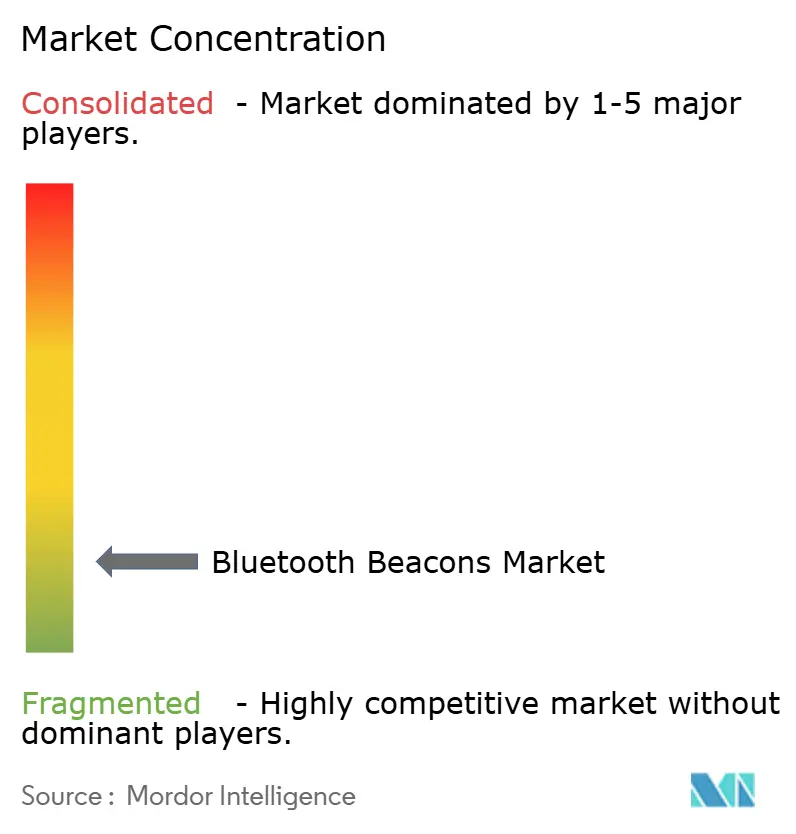
Fragmentation defines the Bluetooth beacons market, where few vendors exceed double-digit share, yet brand equity and ecosystem control still matter. Apple preserves influence through iOS APIs and native iBeacon libraries, leveraging handset dominance to guide solution roadmaps. Specialist players such as Kontakt.io, Estimote, and Gimbal carve out vertical niches, differentiating via cloud analytics and ready-made workflow templates. Network infrastructure incumbents Cisco and Aruba fold beacon telemetry into Wi-Fi monitoring suites, courting IT departments that prefer single-pane management. Semiconductor suppliers Qualcomm and NXP embed configurable packet formats to serve hybrid BLE-UWB devices, expanding hardware addressable market.
Strategic thrusts center on vertical depth. Kontakt.io’s new executive hires target U.S. hospital penetration, combining AI triage dashboards with plug-and-play RTLS anchors. Meanwhile, Cisco re-aligns its Spaces SKU roster to simplify adoption paths for mid-market enterprises, underscoring platform rationalization amid IoT portfolio sprawl. Start-ups explore battery-less energy-harvesting tags that slash OPEX, while Asian ODMs produce white-label beacons for partners eager to own branding without factory overhead. As standards converge, differentiation migrates to software, data science, and domain expertise-a dynamic that will keep entry barriers moderate across the Bluetooth beacons market.
Collaboration outpaces antagonism. The Omlox consortium’s 1,700-strong membership blends traditional RTLS suppliers with cloud hyperscalers, ensuring interoperability and cross-sell synergies. Commercial alliances extend to semiconductor roadmaps that align UWB and BLE coexistence strategies for 2026 phone releases. Venture capital remains available for domain specialists; Goldman Sachs’ backing of Kontakt.io confirms institutional belief in healthcare-centric growth. Overall, vendor jockeying fuels continuous innovation yet keeps price pressure manageable, sustaining healthy gross margins within the Bluetooth beacons market.
Bluetooth Beacons Industry Leaders
-
Kontakt Micro-Location Sp. Z.o.o.
-
Estimote, Inc.
-
Cisco Systems, Inc. (Meraki)
-
Hewlett Packard Enterprise
-
Samsung Electronics Co., Ltd.
- *Disclaimer: Major Players sorted in no particular order
Bluetooth Beacons Market Companies Covered in this Report
- Apple Inc.
- Kontakt Micro-Location Sp. Z.o.o.
- Estimote, Inc.
- Cisco Systems, Inc. (Meraki)
- Infillion Inc. (Gimbal)
- Portable Technology Solutions, LLC (BlueCats)
- Sensoro Co., Ltd.
- Hewlett Packard Enterprise
- Shenzhen Minew Technologies Co., Ltd.
- Radius Networks, Inc.
- Uniqode Phygital, Inc. (Beaconstac)
- Samsung Electronics Co., Ltd.
- Nordic Semiconductor ASA
- Quuppa Oy
- Roximity, Inc.
- HID Global Corporation
- Swirl Networks, Inc.
- Onyx Beacon SRL
- ACCENT ADVANCED SYSTEMS, S.L.U.
Recent Industry Developments in Bluetooth Beacons Market
- January 2025: Kontakt.io hired three executives to drive AI innovation and U.S. hospital growth, reinforcing its healthcare focus.
- December 2024: Cisco revealed end-of-sale for selected Spaces PIDs effective Mar 2025, streamlining ordering while maintaining functionality.
- November 2024: Link Labs launched BLE-based hospital asset-tracking solutions for real-time equipment visibility.
- October 2024: Samsung showcased connected retail experiences at NRF 2024, integrating beacons with IBM Weather and FastSensor analytics.
Global Bluetooth Beacons Market Report Scope
Segmentation Overview
| Hardware |
| Software |
| Services |
| Bluetooth Low Energy (BLE) |
| Wi-Fi |
| Hybrid (BLE + UWB/NFC/LTE-M) |
| iBeacon |
| Eddystone |
| AltBeacon and More |
| Retail and Omnichannel Commerce |
| Transportation and Logistics |
| Healthcare and Life Sciences |
| Hospitality and Entertainment |
| BFSI and Corporate Campuses |
| Education |
| Sports Arenas and Stadiums |
| Smart Cities and Public Spaces |
| Industrial and Manufacturing |
| Other Applications |
| North America | United States |
| Canada | |
| Mexico | |
| Europe | Germany |
| United Kingdom | |
| France | |
| Italy | |
| Spain | |
| Rest of Europe | |
| Asia-Pacific | China |
| Japan | |
| India | |
| South Korea | |
| Australia | |
| Rest of Asia-Pacific | |
| South America | Brazil |
| Argentina | |
| Rest of South America | |
| Middle East and Africa | Saudi Arabia |
| United Arab Emirates | |
| South Africa | |
| Egypt | |
| Rest of Middle East and Africa |
| By Offering | Hardware | |
| Software | ||
| Services | ||
| By Connectivity | Bluetooth Low Energy (BLE) | |
| Wi-Fi | ||
| Hybrid (BLE + UWB/NFC/LTE-M) | ||
| By Beacon Standard | iBeacon | |
| Eddystone | ||
| AltBeacon and More | ||
| By Application | Retail and Omnichannel Commerce | |
| Transportation and Logistics | ||
| Healthcare and Life Sciences | ||
| Hospitality and Entertainment | ||
| BFSI and Corporate Campuses | ||
| Education | ||
| Sports Arenas and Stadiums | ||
| Smart Cities and Public Spaces | ||
| Industrial and Manufacturing | ||
| Other Applications | ||
| By Geography | North America | United States |
| Canada | ||
| Mexico | ||
| Europe | Germany | |
| United Kingdom | ||
| France | ||
| Italy | ||
| Spain | ||
| Rest of Europe | ||
| Asia-Pacific | China | |
| Japan | ||
| India | ||
| South Korea | ||
| Australia | ||
| Rest of Asia-Pacific | ||
| South America | Brazil | |
| Argentina | ||
| Rest of South America | ||
| Middle East and Africa | Saudi Arabia | |
| United Arab Emirates | ||
| South Africa | ||
| Egypt | ||
| Rest of Middle East and Africa | ||
Key Questions Answered in the Report
What is the current valuation of the Bluetooth beacons market?
The Bluetooth beacons market size is USD 24.40 billion in 2025, with a forecast to reach USD 62.10 billion by 2030.
Which segment grows fastest in the Bluetooth beacons market?
Services—covering analytics, integration, and maintenance—is expanding at a 21.7% CAGR as enterprises shift from capex hardware buying toward managed solutions.
Why are hybrid UWB-BLE deployments gaining traction?
Hybrid architectures deliver sub-meter accuracy that pure BLE cannot achieve, satisfying precision demands in manufacturing and healthcare while retaining BLE’s low-power benefits.
How do privacy regulations impact beacon roll-outs?
GDPR and similar statutes require explicit consent for location tracking, increasing compliance costs and pushing vendors to adopt privacy-by-design architectures.
Which region will lead growth through 2030?
Asia-Pacific posts the fastest regional CAGR at 21% thanks to smart-city programs, expanding mobile economies, and large-scale public infrastructure investments.