
Bluetooth Speaker Market Size and Share
Market Overview
| Study Period | 2020 - 2031 |
|---|---|
| Market Size (2026) | USD 21.93 Billion |
| Market Size (2031) | USD 53.79 Billion |
| Growth Rate (2026 - 2031) | 19.65 % |
| Fastest Growing Market | Asia-Pacific |
| Largest Market | Asia Pacific |
| Market Concentration | Medium |
Major Players
*Disclaimer: Major Players sorted in no particular order Image © Mordor Intelligence. Reuse requires attribution under CC BY 4.0. |
|
Bluetooth Speaker Market Analysis by Mordor Intelligence
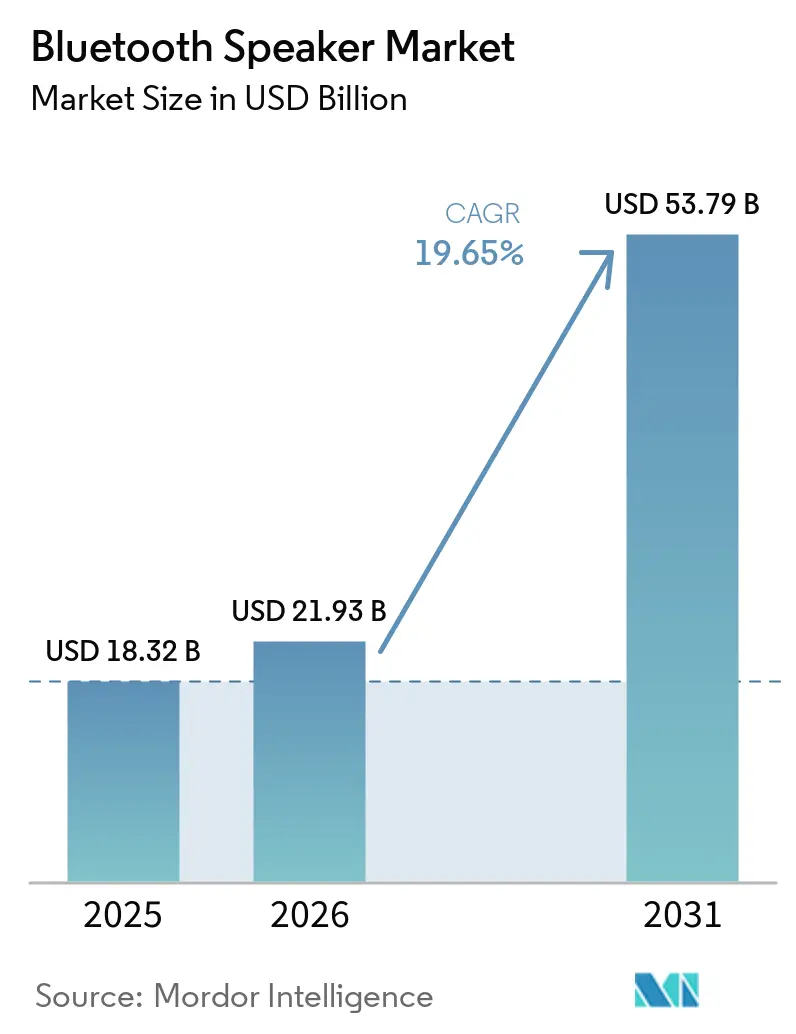
The Bluetooth Speaker Market size was valued at USD 18.32 billion in 2025 and estimated to grow from USD 21.93 billion in 2026 to reach USD 53.79 billion by 2031, at a CAGR of 19.65% during the forecast period (2026-2031).
Robust demand stems from smart-home adoption, mass music-streaming uptake, battery cost declines, and the commercialization of Bluetooth LE Audio, each widening the addressable user base while shortening replacement cycles. Asia-Pacific leads current unit volumes thanks to competitive manufacturing clusters and a rapidly expanding middle class, while North America and Europe deliver premium average selling prices (ASPs) on the back of early smart-home penetration. Voice-assistant–enabled models are the fastest-growing category, yet Bluetooth-only speakers still represent the largest sub-segment because they deliver a simple, low-latency experience that does not rely on Wi-Fi. Competitive dynamics are shifting toward consolidation as established brands purchase luxury audio houses to secure patented technologies and brand cachet, thereby raising entry barriers for commodity players.
Key Report Takeaways
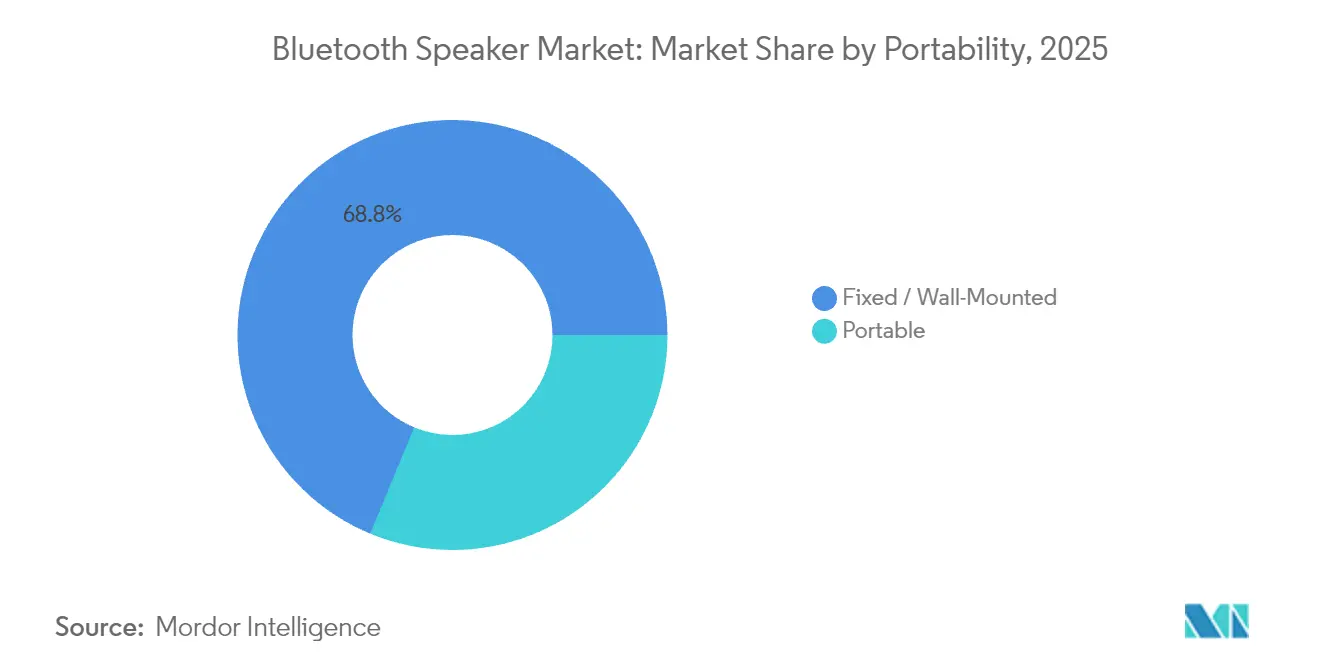
- By portability, fixed and wall-mounted units captured 68.75% of the Bluetooth speaker market share in 2025; portable speakers are advancing at a 21.95% CAGR through 2031.
- By application, residential solutions accounted for 60.55% of the market size in 2025 and are expanding at a 21.85% CAGR to 2031.
- By connectivity technology, Bluetooth-only designs held 57.10% share of the Bluetooth speaker market in 2025, while smart speakers with voice assistants posted the fastest 21.35% CAGR through 2031.
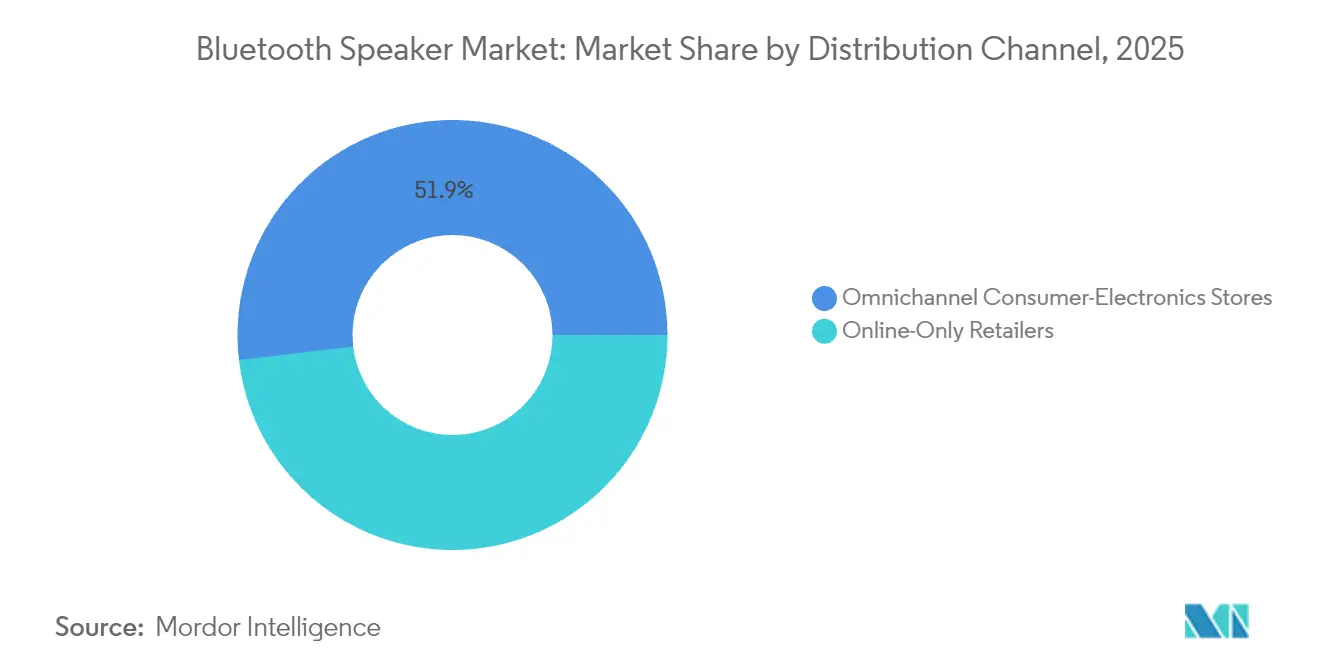
- By distribution channel, omnichannel consumer-electronics stores led with 51.85% revenue share in 2025; online-only retailers are growing at a 21.55% CAGR to the end of the decade.
- By price range, the USD 50-199 mid-range bracket commanded 44.55% share of the Bluetooth speaker market size in 2025, whereas economy models under USD 50 record the highest 21.25% CAGR.
- By geography, Asia-Pacific held 31.45% of market share in 2025 and is projected to post a 21.15% CAGR, the fastest among all regions.
Note: Market size and forecast figures in this report are generated using Mordor Intelligence’s proprietary estimation framework, updated with the latest available data and insights as of 2026.
Market Trends and Insights
Drivers Impact Analysis of Bluetooth Speaker Market*
| Driver | (~) % Impact on CAGR Forecast | Geographic Relevance | Impact Timeline |
|---|---|---|---|
| Rapid adoption of smart-home ecosystems | +3.0% | North America, Europe, East Asia | Medium term (2-4 years) |
| Expansion of music-streaming subscriptions | +2.4% | Global, notably APAC and North America | Short term (≤ 2 years) |
| Falling ASPs of lithium-ion batteries | +1.6% | Global manufacturing hubs | Long term (≥ 4 years) |
| Outdoor recreation and van-life boom | +2.0% | North America, Europe, Australia | Medium term (2-4 years) |
| Bluetooth LE Audio and Auracast roll-out | +2.8% | Developed markets worldwide | Medium term (2-4 years) |
| Growing demand for immersive classroom audio | +1.8% | Global, strongest in APAC | Long term (≥ 4 years) |
| Source: Mordor Intelligence | |||
Rapid Adoption of Smart-Home Ecosystems
Seamless interoperability delivered by the Matter standard elevates Bluetooth speakers from stand-alone entertainment devices to multifunction smart-home hubs. Amazon’s 2025 Echo Show range illustrates the shift by embedding Fire TV services, auto-framing video communications, and full Matter, Zigbee, and Thread support in a single unit. Inter-brand compatibility lowers switching costs and drives premium replacement demand as households unify lighting, HVAC, and security control via voice-enabled speakers. Chinese ODM platforms such as LegatoXP shorten product development cycles, letting second-tier brands enter the smart-home space with smaller engineering budgets. Collectively, these forces accelerate household penetration, intensify brand competition, and enlarge the total volume opportunity for the Bluetooth speaker market.
Expansion of Music-Streaming Subscriptions
Music-streaming services surpassed 750 million paid subscribers in 2024, boosting demand for hardware capable of high-resolution and spatial-audio playback. As codecs such as LC3, LDAC, and aptX Lossless mature, users recognize audible quality deltas between legacy devices and next-generation speakers, prompting replacement purchases. Subscription platforms also encourage multi-device plans that natively support group listening, thereby favoring multi-room speakers over single-speaker setups. Streaming’s recurring revenue model fosters promotional bundling, where discounted speakers act as customer-acquisition vehicles, further stimulating hardware volumes throughout the forecast window.
Bluetooth LE Audio and Auracast Roll-out
Auracast broadcast audio transforms point-to-point Bluetooth into a one-to-many architecture, permitting a single smartphone, TV, or kiosk to serve multiple speakers or earbuds simultaneously[1]Jason Marcel, “Auracast Broadcast Audio Will Deliver Life-Changing Audio Experiences,” Bluetooth SIG, bluetooth.com. Samsung has shipped Auracast-ready Galaxy S24 handsets and Neo QLED televisions, while JBL, Marshall, and Sennheiser have pushed over-the-air updates to compatible speakers. Mass adoption reduces latency, boosts battery life, and unlocks public-venue use cases such as silent concerts, airport broadcasts, and assistive listening, all expanding the addressable market. Vendors that certify early gain first-mover reputational advantages and greater pricing power, elevating the overall Bluetooth speaker market growth trajectory.
Outdoor Recreation and Van-Life Boom
Post-pandemic lifestyle shifts toward camping, overlanding, and remote work accelerate demand for IP67-rated, shock-resistant speakers that deliver 20-plus hours of battery life. The global mobile-living economy exceeded SEK 200 billion in 2024 as consumers invested in high-durability accessories to accompany recreational vehicles[2]Dometic Group, “Annual and Sustainability Report 2023,” dometic.com . Brands capitalize by releasing rugged lines such as JBL PartyBox or Marshall Willen II, both commanding premium ASPs that cushion margin compression elsewhere. Social-media communities amplify experiential marketing, converting lifestyle imagery into purchase intent more effectively than traditional feature-centric advertising. As van-life culture spreads to Europe and Australia, demand for durable Bluetooth speakers enjoys a sustained multi-year lift.
Restraints Impact Analysis of Bluetooth Speaker Market*
| Restraint | (~) % Impact on CAGR Forecast | Geographic Relevance | Impact Timeline |
|---|---|---|---|
| Rampant counterfeiting and piracy | -1.2% | Emerging markets worldwide | Short term (≤ 2 years) |
| Margin erosion from price wars | -0.8% | Global, high in budget tier | Medium term (2-4 years) |
| Safety recalls tied to battery fires | -0.6% | North America and EU | Short term (≤ 2 years) |
| Stricter EU EMI limits for >30 W models | -0.4% | European Union | Long term (≥ 4 years) |
| Source: Mordor Intelligence | |||
Rampant Counterfeiting and Piracy
Unauthorized factories replicate popular designs, flooding e-commerce channels with low-quality imitations that undercut legitimate brands on price and erode consumer trust[3]Sabine Carrell, “Counterfeiting in the Electronics Industry: A Threat to Innovation and Safety,” Scribos, scribos.com. Counterfeits often omit essential safety circuits, raising the risk of battery fires and accelerating brand-protection expenditures for authentication technologies, blockchain labeling, and legal enforcement. While premium players deploy security holograms and supply-chain tracing, smaller vendors lack capital for large-scale monitoring, exposing them to revenue leaks and reputational damage.
Safety Recalls Tied to Battery Fires
High-energy-density lithium-ion cells can enter thermal runaway if poorly engineered, prompting proposed U.S. legislation that empowers regulators to mandate nationwide recalls for non-compliant products. Manufacturers now face extra certification steps—UL 2272, IEC 62133, and UN 38.3—that lengthen design cycles and raise compliance costs. Media coverage of isolated incidents undermines consumer confidence, particularly within the economy segment, where suppliers sometimes cut corners on cell quality. Heightened oversight benefits established brands with robust quality-assurance frameworks but could depress short-term unit sales until new standards stabilize.
*Our forecasts treat driver/restraint impacts as directional, not additive. The impact forecasts reflect baseline growth, mix effects, and variable interactions.
Bluetooth Speaker Market Segment Analysis
By Portability:
Fixed Installations Anchor Household SpendFixed and wall-mounted units accounted for 68.75% of the Bluetooth speaker market share in 2025, illustrating consumers' preference for power-fed systems that integrate seamlessly with televisions and multi-room platforms. This segment's steady revenue base gives manufacturers predictable upgrade cycles tied to smart-home renovation projects. Portable speakers, however, post a 21.95% CAGR, gaining from urban outdoor activities and remote-work mobility.
Fixed solutions emphasize audio fidelity, bass response, and voice-assistant control, traits that favor higher ASPs and bundling with streaming services. Portable designs optimize for rugged builds, lighter weight, and prolonged battery life, attracting first-time buyers in emerging markets. The two sub-segments, therefore, expand in parallel rather than cannibalize, yielding a diversified revenue structure for the overall Bluetooth speaker market.



By Application:
Residential Spaces Dominate GrowthResidential settings delivered 60.55% of the Bluetooth speaker market size in 2025 and also hold the fastest 21.85% CAGR, underscoring the permanence of home-centric entertainment habits formed during pandemic lockdowns. Continuous smart-home upgrades keep the replacement cycle under four years, far shorter than the historical averages for legacy hi-fi components.
Commercial demand, restaurants, hotels, and small offices, remains important for premium installed systems in the speaker industry but faces elongated procurement processes and tighter capital budgets. As voice assistants mature, residential speakers increasingly serve as hubs for lighting and HVAC control, blending functional utility with leisure use and cementing their primacy in long-term demand projections for the Bluetooth speaker market.
By Connectivity Technology:
Simplicity vs. IntelligenceBluetooth-only models retained 57.10% market share in 2025, offering dependable pairing without network complexity, especially in regions with limited broadband penetration. These units are favored for travel and budget use cases. Smart speakers possessing voice assistants, however, outpace all categories at a 21.35% CAGR as AI services propel command-and-control adoption for smart appliances.
Premium multi-room systems that layer Bluetooth, Wi-Fi, and proprietary mesh radios bridge both worlds by enabling lossless streaming indoors and basic Bluetooth when on the go. Auracast's introduction will further blur category lines, reinforcing the Bluetooth speaker market's transition from single-purpose gadgets to converged communication nodes.
By Distribution Channel:
Showroom Experience vs. Digital ConvenienceOmnichannel consumer-electronics retailers held 51.85% share of 2025 revenues, capitalizing on the human desire to audition sound quality before committing sizable discretionary spend. In-store demos, same-day pickup, and bundled warranties remain decisive factors for mid-range and premium tiers. Online-only retailers, escalating at 21.55% CAGR, capture price-sensitive and repeat buyers comfortable with brand reputations.
Brick-and-click models evolve as chains embed virtual try-before-you-buy tools and extend return windows, effectively hybridizing tactile assurance with digital convenience. This convergence mitigates channel conflict and sustains broad accessibility, supporting continued unit growth for the Bluetooth speaker market.
By Price Range:
Mid-Range Sweet Spot PersistsUnits priced between USD 50 and USD 199 delivered 44.55% of category revenue in 2025, balancing feature richness-IP67 sealing, extended playback, voice-assistant compatibility-and affordability. Lower component costs and vertical integration allow these SKUs to adopt codecs and battery chemistries previously restricted to premium lines.
Economy SKUs (< USD 50) record the fastest 21.25% CAGR as component commoditization lowers bill-of-materials outlays, unlocking first-time purchases in price-sensitive geographies. Conversely, luxury models (> USD 200) cater to audiophiles demanding wood cabinetry, high-excursion drivers, and manual EQ tuning. Such stratification broadens consumer reach without undermining margins, sustaining the Bluetooth speaker market's elastic pricing ladder.
Geography Analysis
APAC Bluetooth Speaker Market
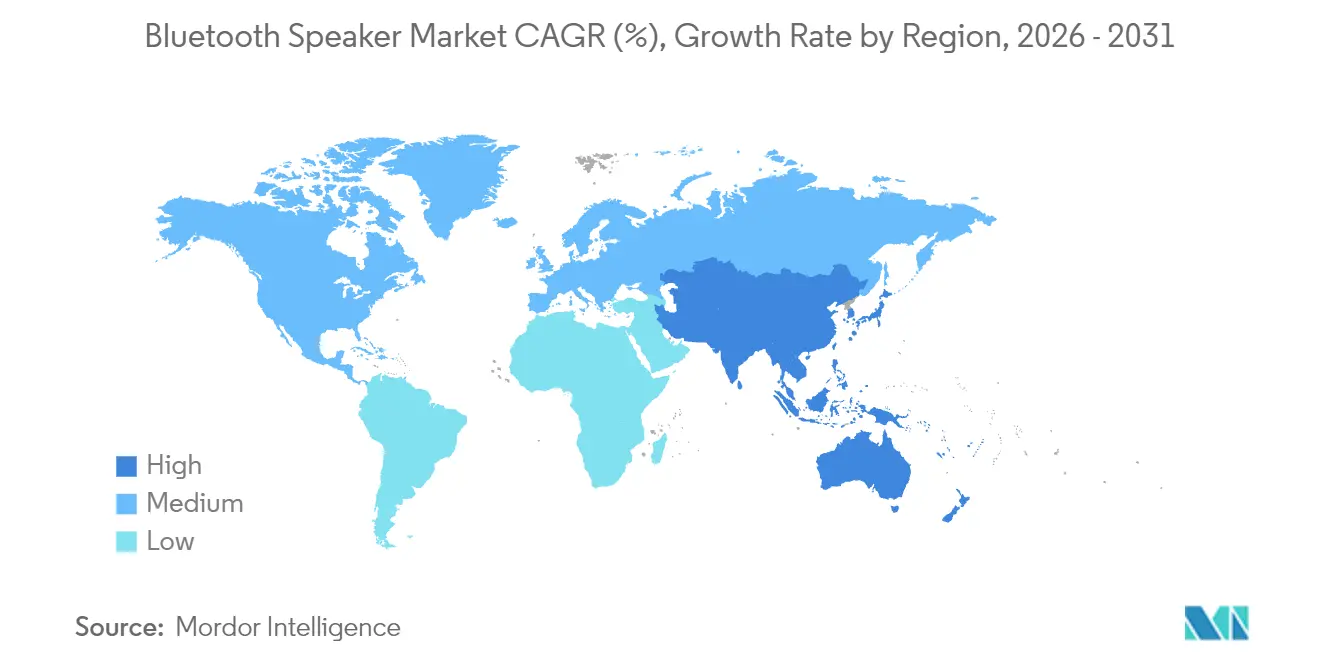
Asia-Pacific commanded 31.45% of the Bluetooth speaker market share in 2025, generating a 21.15% CAGR to 2031 on the back of manufacturing scale, youth-oriented consumption, and rapid smartphone proliferation. Chinese OEMs leverage proximity to printed-circuit and battery supply chains to compress lead times and capitalize on domestic demand, which is forecast to surpass CNY 5.8 trillion for professional AV equipment by 2030. Government incentives for IoT ecosystems further accelerate the adoption of smart speakers, solidifying regional leadership in both volume and innovation.
North America Bluetooth Speaker Market
North America trails in unit volumes yet achieves the highest ASPs. Early smart-home adoption and consumer willingness to pay for voice-assistant integration keep the region's gross margins above global averages. Outdoor recreation trends-from national park camping to city rooftop gatherings- stimulate demand for ruggedized models with multi-device pairing. Brand loyalty is strong, allowing category leaders such as Sonos to maintain premium shelf space even amid price-based competition.
Europe Bluetooth Speaker Market
Europe posts steady mid-teen growth, backed by stringent quality and cybersecurity standards that favor established brands. The updated Radio Equipment Directive effective August 2024 mandates secure boot and network safeguards, effectively filtering out low-end imports lacking compliance budgets. Consumers reward compliance with premium pricing, prompting local and international manufacturers to certify early and use CE markings as marketing differentiators, sustaining a value-heavy contribution to global Bluetooth speaker market revenues.

Regulatory Landscape
Bluetooth speakers fall under radio and product-safety regimes that govern intentional radiators and consumer electronics, with the European Union and the United States setting the most commonly referenced compliance baselines. In the EU, Radio Equipment Directive (RED) 2014/53/EU applies to Bluetooth-enabled products, and the cybersecurity provisions under Article 3.3 took effect on August 1, 2025. This raised expectations for secure-by-design implementations for connected audio devices sold with CE marking. EU rules on the commercialization of radio equipment were also updated via Directive (EU) 2024/2749, with national transposition required by May 29, 2026 and application from May 30, 2026, creating another compliance milestone for brands and ODMs serving Europe.
In the United States, Bluetooth speakers must meet FCC requirements under 47 CFR Part 15, which typically requires equipment authorization before marketing and affects RF test plans, labeling, and documentation. Alongside government rules, the Bluetooth Special Interest Group (Bluetooth SIG) runs a mandatory trademark and interoperability program: vendors that use the Bluetooth brand/logo must complete the Bluetooth qualification process and maintain a Compliance Folder. The Bluetooth SIG updated its Qualification Program Reference Document (QPRD) on April 21, 2026, reinforcing the need for manufacturers to manage dual-track compliance, public radio authorization plus private Bluetooth qualification, across multi-market product launches.
Value Chain Analysis
The Bluetooth speaker value chain begins with upstream component ecosystems for acoustic parts (drivers, enclosures, microphones), wireless connectivity (Bluetooth SoCs and RF modules), power subsystems (lithium-ion cells, BMS, charging ICs), and firmware/DSP stacks that shape differentiating sound signatures. Component supply and finished-goods assembly are concentrated in East Asian manufacturing clusters, notably South China, with brands typically using ODM/OEM partners for industrial design execution, tooling, RF integration, and scale production, while keeping acoustic tuning, app ecosystems, and brand marketing in-house.
Midstream, qualification and certification create gating steps between engineering and commercialization. Products commonly require market-access approvals, including EU RED and US FCC pathways, as well as Bluetooth SIG qualification to use the Bluetooth trademark in retail. Downstream, distribution spans omnichannel consumer-electronics retailers and online-only platforms, where counterfeit risk and returns logistics influence channel strategy and after-sales processes. Manufacturing diversification is also apparent through India-based assembly initiatives tied to localization, including OnePlus starting local production of IoT audio devices with Optiemus Electronics (Project Starlight, announced June 2025) and the EPACK Durable and Bumjin Electronics joint venture to manufacture soundbars and Bluetooth audio devices in India (announced July 2025). These steps regionalize assembly while keeping core component sourcing global.
Competitive Landscape
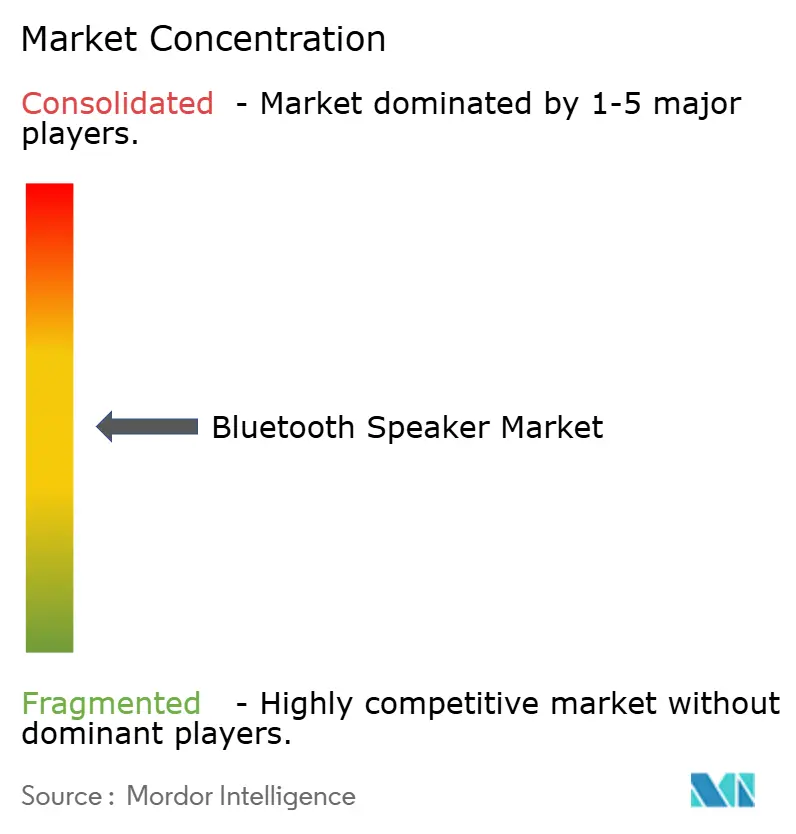
Market fragmentation remains moderate, with the top five brands controlling roughly 42% of global revenues. Consolidation is accelerating as titans absorb niche luxury houses for intellectual property and brand prestige. Samsung’s Harman paid USD 350 million for Masimo’s Sound United portfolio, Bowers & Wilkins, Denon, and Marantz, gaining entry into audiophile circles while reinforcing its technology stack for smartphones and TVs.
Bose responded by acquiring McIntosh Group, adding heritage brands McIntosh Labs and Sonus Faber in a bid to penetrate the USD 2.8 billion high-end loudspeaker segment. These moves compress the supplier base, giving buyers fewer but more vertically integrated partners capable of end-to-end ecosystems, from automotive head units to living-room home theaters, thus raising switching costs for consumers.
Technological differentiation concentrates on proprietary DSP algorithms, beam-forming microphones, and machine-learning–based room calibration. Sonos alone holds over 4,300 active patents, using litigation to defend its platform. Meanwhile, newcomers pivot toward rugged outdoor niches, classroom reinforcement systems, and assistive-listening devices, segments inadequately served by mainstream portfolios. As Auracast reaches mass deployment, expect open-standard interoperability to erode some walled-garden advantages, intensifying innovation races in AI acoustics and materials science within the Bluetooth speaker market.
Bluetooth Speaker Industry Leaders
-
Sony Corporation
-
Koninklijke Philips NV
-
Samsung Electronics Co. Ltd. (Harman International Industries)
-
Bose Corporation
-
Beat Electonics
- *Disclaimer: Major Players sorted in no particular order
Bluetooth Speaker Market Companies Covered in this Report
- Sony Group Corporation
- Samsung Electronics Co., Ltd. (Harman International Industries, Inc.)
- Panasonic Holdings Corporation
- Bose Corporation
- Beats Electronics LLC (Apple Inc.)
- Koninklijke Philips N.V.
- LG Electronics Inc.
- Logitech International S.A.
- Sonos, Inc.
- Bang & Olufsen A/S
- Yamaha Corporation
- Altec Lansing LLC
- JVCKENWOOD Corporation
- Anker Innovations Technology Co., Ltd.
- Ultimate Ears (Logitech)
- Tribit Audio (Thesy Technology Co., Ltd.)
- Onkyo Home Entertainment Corporation
- Zebronics India Pvt. Ltd.
- AOMAIS Audio (Shenzhen Jin Wen Hua)
- SoundBot Inc.

Market Opportunities and Future Outlook
Auracast broadcast audio is shifting from a device feature to a venue infrastructure use case, creating whitespace for Bluetooth speakers aimed at public-audio and assistive-listening scenarios rather than personal entertainment only. A specific proof point is the July 2026 completion of a permanent Auracast installation at Brighton Station in the UK (Greater Thameslink Railway) to broadcast announcements to compatible hearing aids and consumer audio devices, supporting transport hubs as an addressable deployment channel and increasing demand pull for Auracast-ready consumer speakers. In parallel, OS-level enablement in the Android ecosystem, for example Android 16 support referenced in industry updates, reduces friction for multi-listener and multi-speaker use cases and favors brands that ship certified, interoperable implementations across phones, TVs, and speakers.
On the product and platform side, the Bluetooth SIG technology roadmap points to workstreams including higher data throughput (targeting up to 8 Mbps) and enhancements to Bluetooth Channel Sounding. These developments open room for higher-fidelity wireless playback, tighter synchronization across multi-speaker setups, and new form factors balancing size with output. Compliance readiness has also become a commercial lever, not only a cost center, as EU RED cybersecurity requirements effective from August 2025 and continuing EU legislative updates in 2026 raise the minimum bar for connected audio sold in Europe. Together, public-venue Auracast deployments, OS-level support, and ongoing standards updates support differentiated growth across premium portable, fixed home theater, and commercial or education segments that prioritize low-latency, broadcast capability, and secure connected features.
Recent Industry Developments in Bluetooth Speaker Market
- July 2026: Harman (Samsung Electronics) broadened its portable lineup with JBL Go 5 and PartyBox On The Go 2 Plus launches, while also introducing the Harman Kardon Onyx Studio 9 portable home speaker. The releases point to faster product refresh cycles tied to newer Bluetooth features and reinforce scale advantages in retail shelf space across both entry portable and premium portable-home categories.
- September 2025: Philips announced the Fidelio FA3 active wireless speakers with Bluetooth 5.4, Auracast, and LDAC support, with availability communicated for Q1 2026. The update positions Philips to compete more directly in the premium wireless speaker tier where codec support and broadcast-ready connectivity are increasingly used in purchase decisions.
- April 2025: Sony expanded its ULT POWER SOUND series with the launch of ULT TOWER 9, ULT TOWER 9AC, ULT FIELD 5, and ULT FIELD 3 speakers. By adding multiple form factors within one branded family, Sony strengthened its presence across party-speaker and portable segments and expanded cross-selling potential alongside its broader audio ecosystem.


Bluetooth Speaker Market Report Scope and Research Methodology
Market Definition and Coverage
For this methodology, the Bluetooth speaker market covers wireless speakers that use Bluetooth for audio playback, and it includes both portable units and fixed or wall-mounted units sold for residential and commercial listening.
Scope exclusions: We exclude wired-only speakers and home audio devices that do not have Bluetooth as a supported playback connection.
Segments Covered in This Report
-
By Portability
- Portable
- Fixed / Wall-Mounted
-
By Application
- Residential
- Commercial
-
By Connectivity Technology
- Bluetooth-only
- Bluetooth + Wi-Fi (Multi-room)
- Smart Speakers w/ Voice Assistant
-
By Distribution Channel
- Online-Only Retailers
- Omnichannel Consumer-Electronics Stores
-
By Price Range
- Economy (Less than USD 50)
- Mid-range (USD 50-199)
- Premium (More than USD 200)
-
By Geography
-
North America
- United States
- Canada
- Mexico
-
South America
- Brazil
- Argentina
- Rest of South America
-
Europe
- Germany
- United Kingdom
- France
- Italy
- Rest of Europe
-
Asia-Pacific
- China
- Japan
- South Korea
- India
- Rest of Asia-Pacific
-
Middle East
- Saudi Arabia
- United Arab Emirates
- Rest of Middle East
-
Africa
- South Africa
- Rest of Africa
-
North America
Data Sources, Market Sizing, and Validation
Desk Research
Desk research started with building a clean fact base on device shipments, consumer electronics demand, and Bluetooth feature adoption so the model would be anchored to real market signals. We referenced public sources such as International Telecommunication Union indicators, World Bank macro series, and national customs and trade statistics that help track electronics flows and price trends.
To translate those signals into an addressable market, additional context was taken from sources such as Bluetooth SIG public materials, Federal Communications Commission equipment authorization databases, and peer-reviewed journals covering audio and battery performance. Company annual reports, investor presentations, product launch briefs, and reputable press were used to sanity check product mix and pricing movement over time, and a paid subscription for company financials and news was used selectively to fill gaps where public disclosures were limited. This list is illustrative only, and many other sources were also reviewed for data collection, cross-checking, and clarification.
Primary Interviews and Surveys
Primary work focused on interviews and short surveys with people across the Bluetooth speaker value chain, including product managers, channel leads, distributors, and retail-side category teams who track volume, pricing, and mix shifts. Since this is a global market, inputs were checked across major demand regions so assumptions on ASP movement, portability mix, and replacement cycles could be confirmed and then used to tighten the model outputs.
Distribution of primary research fieldwork respondents
| Company type | Respondent position | Region |
|---|---|---|
| Top tier: 30% | CXOs: 12% | APAC: 37% |
| Mid tier: 56% | Functional/Unit leaders: 28% | EMEA: 37% |
| Smaller Players: 14% | Managers: 60% | Americas: 26% |
Market-Sizing & Forecasting
Sizing was built using top-down and bottom-up logic together, where macro and electronics demand indicators are first translated into an addressable pool and then corrected using supplier and channel reality checks. The top-down track uses consumer electronics spending trends, device replacement behavior, and Bluetooth feature penetration to reconstruct demand, which is then corroborated with sampled price bands and volume signals seen in retail and distribution.
Key inputs used in the model include the portable versus fixed mix, average selling price ranges by price band, online versus offline channel weighting, regional adoption momentum, and the frequency of product refresh and replacement. Where direct volume data was not consistently available, gap handling relied on proxy indicators like trade flows for relevant product categories and interview-based mix splits, which were then stress tested across regions.
For the forecast, scenario analysis was used so growth could be expressed under different outcomes for pricing, feature upgrades, and consumer spending pressure, and then aligned back to expert consensus gathered in interviews. The final time series was checked for smoothness against expected seasonality around major sales periods and for realism against known product cycle patterns.
Data Validation & Update Cycle
Results were validated through triangulation across independent signals, followed by variance checks at the region and product-mix level so outliers could be explained before finalization. When large swings showed up, we re-checked the assumptions behind ASP movement, mix splits, and channel weighting, and then re-contact was triggered with select respondents to confirm whether the change was real or model-driven.
Before sign-off, the model and outputs go through multi-step analyst review so arithmetic integrity and assumption logic are both confirmed. Reports are refreshed annually, and interim updates are made when material events occur that can shift pricing, demand, or distribution patterns. Right before delivery, a final pass is completed so clients receive the most current view available.
Mordor Intelligence's Bluetooth Speaker Market Sizing Compared With Other Published Estimates
Published numbers for Bluetooth speakers can look far apart because the scope is often defined differently, and the price and volume assumptions are not always visible. Differences typically come from whether fixed or wall-mounted products are included, how average selling prices are treated across premium and mass segments, and how fast the data inputs are refreshed.
A common gap driver in this market is that some estimates only count portable units, which naturally lowers the total, while others mix in adjacent categories like smart home speakers without clearly separating Bluetooth-only demand. The way currency conversion timing is handled also matters because the market has a large import share, and assumptions on discounting during major online sale events can shift the value output meaningfully.
Benchmark comparison
| Source | Market Size | Gaps in Research Methodology |
|---|---|---|
| Mordor Intelligence | USD 18.32 B (2025) | |
| Global Research Publisher A | USD 12.90 B (2023) | This figure is portable-only, and it uses a 2023 base year, so fixed or wall-mounted Bluetooth speakers are not counted and the timeline does not match the current market year. |
| Industry Research Publisher B | USD 20.33 B (2024) | This estimate is also framed around portable Bluetooth speakers and a longer forecast window, and it can differ based on how price bands and discounting are averaged across regions. |
The spread in the table is mainly explained by product scope and base year alignment, since portable-only views exclude part of demand and older years miss recent mix and price changes. By keeping portable and fixed or wall-mounted units in-scope and re-checking ASP and mix assumptions with channel feedback, the value total stays tied to the defined Bluetooth speaker demand pool used by Mordor Intelligence.


Key Questions Answered in the Report
How big is the Bluetooth speaker market in 2026?
The Bluetooth speaker market size is valued at USD 21.93 billion in 2026.
What is the projected growth rate for Bluetooth speakers through 2031?
The market is forecast to expand at a 19.65% CAGR, reaching USD 53.79 billion by 2031.
Which region leads global demand for Bluetooth speakers?
Asia-Pacific holds 31.45% market share and posts the fastest 21.15% CAGR.
Which connectivity option is growing the fastest?
Smart speakers with integrated voice assistants exhibit a 21.35% CAGR through 2031.
What drives consumer upgrades from legacy speakers?
Key drivers include smart-home ecosystem integration, Auracast broadcast audio, and higher-resolution music streaming.
Why are battery safety standards critical for manufacturers?
Stricter legislation empowers regulators to recall non-compliant devices, making robust cell testing essential to avoid costly recalls.
Page last updated on:


 Your data is secure and never sold or shared.


