
Blockchain In Healthcare Market Size and Share
Market Overview
| Study Period | 2022 - 2031 |
|---|---|
| Market Size (2026) | USD 8.27 Billion |
| Market Size (2031) | USD 63.58 Billion |
| Growth Rate (2026 - 2031) | 50.38 % |
| Fastest Growing Market | Asia Pacific |
| Largest Market | North America |
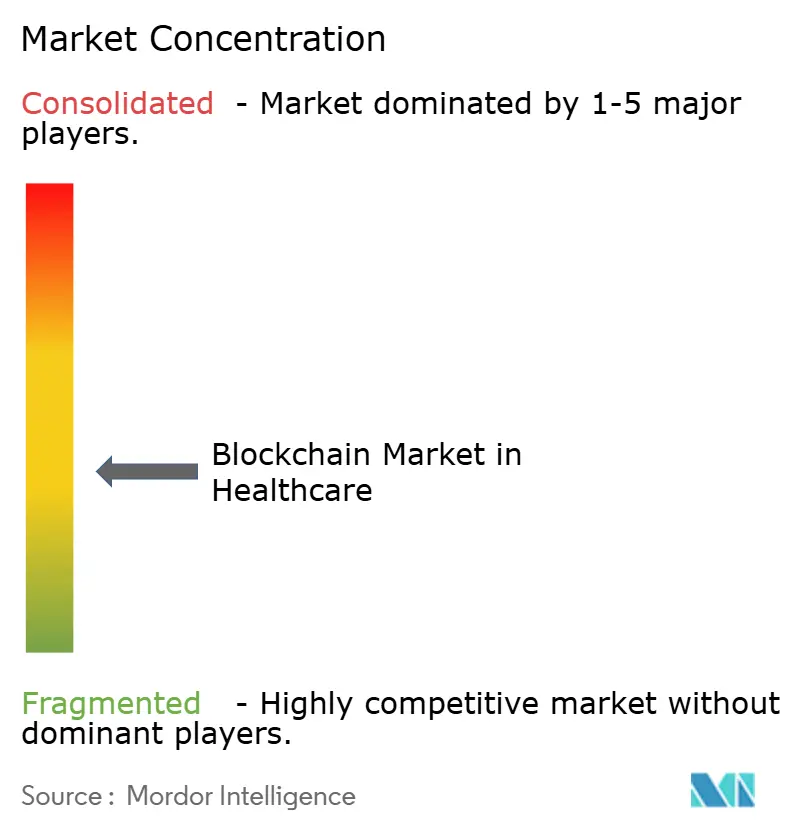
| Market Concentration | Medium |
Major Players *Disclaimer: Major Players sorted in no particular order Image © Mordor Intelligence. Reuse requires attribution under CC BY 4.0. | |
Blockchain In Healthcare Market Analysis by Mordor Intelligence
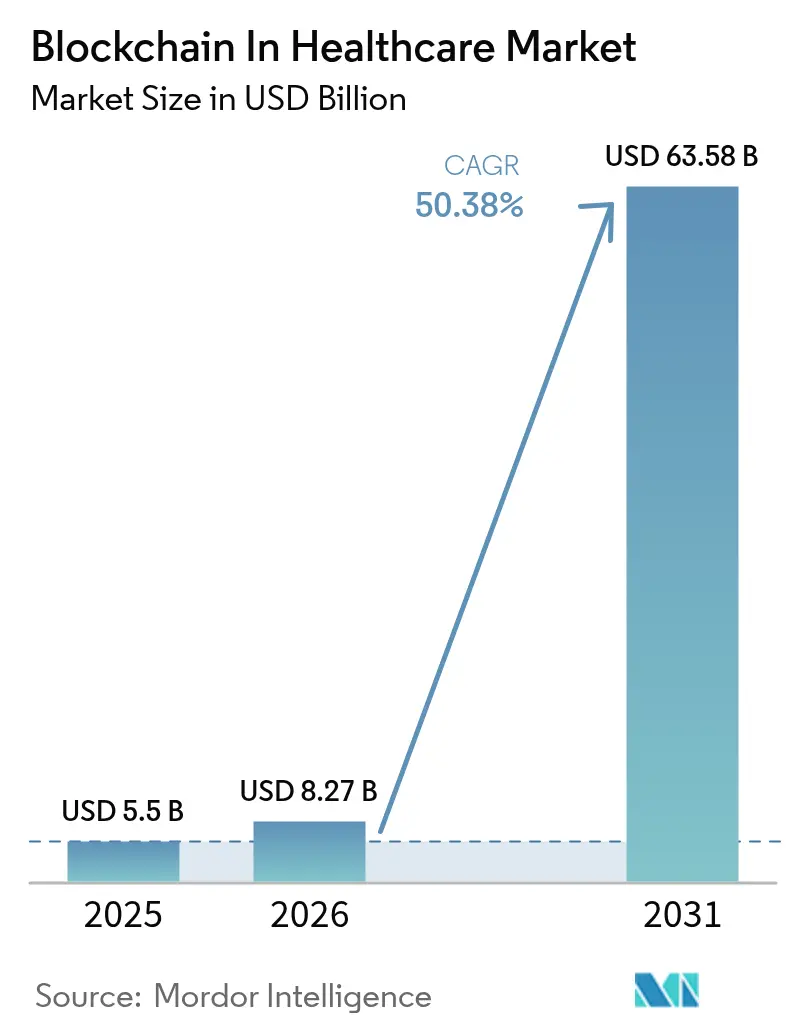
The Blockchain Market size In Healthcare market is expected to grow from USD 5.5 billion in 2025 to USD 8.27 billion in 2026 and is forecast to reach USD 63.58 billion by 2031 at 50.38% CAGR over 2026-2031.
This surge is tied to North American and European serialization laws, rising cyber-breach costs that now average USD 10.93 million per incident, and payer mandates to curb duplicate claims. Immutable ledgers increasingly serve as the backbone for regulatory compliance automation, while smart-contract adjudication reduces administrative waste and federated learning protocols unlock new data-monetization revenue for both providers and patients. CIOs view blockchain as infrastructure rather than a pilot technology, shifting budgets toward permissioned and consortium architectures that align with HIPAA, GDPR, and TEFCA requirements. As a result, the blockchain in healthcare market is pivoting from proof-of-concept projects to enterprise production deployments across clinical data exchange, drug supply chains, and tokenized health-data marketplaces.
Key Report Takeaways
- By application, Clinical Data Exchange led with 45.40% of the blockchain in healthcare market share in 2025, while Clinical Trials & Consent Management is on track for a 71.04% CAGR through 2031.
- By end user, Providers held 53.20% of the blockchain in healthcare market share in 2025; Patients & Health-Data Brokers record the fastest 76.95% CAGR between 2026-2031.
- By blockchain type, Private/Permissioned networks commanded 62.30% of the blockchain in the healthcare market size in 2025, whereas Consortium models will advance at a 66.93% CAGR over the forecast period.
- By geography, North America accounted for 40.95% of the blockchain in healthcare market share in 2025, yet Asia-Pacific is rising at a 61.18% CAGR through 2031.
Note: Market size and forecast figures in this report are generated using Mordor Intelligence’s proprietary estimation framework, updated with the latest available data and insights as of 2026.
Market Trends and Insights
Drivers Impact Analysis of Blockchain In Healthcare Market*
| Driver | (~) % Impact on CAGR Forecast | Geographic Relevance | Impact Timeline |
|---|---|---|---|
| Rising cyber-breach costs push CIO budgets toward blockchain security | +8.20% | Global, strongest in North America & EU | Medium term (2-4 years) |
| US & EU DSCSA / FMD serialization deadlines mandate end-to-end drug traceability | +12.50% | North America & EU, extending to APAC | Short term (≤ 2 years) |
| Payer pressure to cut duplicate claims fuels smart-contract adjudication | +6.80% | North America, early uptake in EU | Medium term (2-4 years) |
| Growing EHR interoperability projects accelerate demand | +9.30% | Global, led by TEFCA in North America | Short term (≤ 2 years) |
| Tokenized health-data marketplaces create new revenue lines | +7.10% | North America & EU, pilots in APAC | Long term (≥ 4 years) |
| AI-ready federated learning pilots require blockchain-anchored model proofs | +5.40% | Global, centered on research hubs | Long term (≥ 4 years) |
| Source: Mordor Intelligence | |||
Rising Cyber-Breach Costs Push CIO Budgets Toward Blockchain Security
Healthcare breaches compromised more than 500 million records since 2020, and average incident costs reached USD 10.93 million in 2024. The February 2024 Change Healthcare attack, which halted USD 22 million in daily claims and triggered a USD 22 million bitcoin ransom, underscored centralized system vulnerabilities. Distributed ledgers fit zero-trust architectures by offering tamper-evident audit trails, data provenance, and multi-party verification that satisfy the Department of Health and Human Services’ voluntary Cybersecurity Performance Goals. As insurers tighten underwriting criteria and regulators highlight blockchain for critical data integrity, CIOs now budget blockchain as core cybersecurity spend rather than innovation-hub outlay. This shift accelerates full-scale network rollouts across provider systems and payer clearinghouses
US & EU DSCSA / FMD Serialization Deadlines Mandate End-to-End Drug Traceability
The Drug Supply Chain Security Act’s enhanced requirements, extended but firm through 2026, compress implementation windows for serialized transactions. An FDA pilot with IBM, KPMG, Merck, and Walmart delivered 100% traceability compared with 73% under legacy tools, proving blockchain efficiency. Europe’s Falsified Medicines Directive exerts parallel pressure as serialized National Drug Codes demand unbroken auditability. Trading partners lacking electronic connections risk supply-chain exclusion, pushing pharmaceutical distributors to adopt permissioned ledgers that mesh GS1 EPCIS standards with smart contracts. Regulatory clarity on electronic pedigrees, therefore, moves blockchain from an opportunity choice to an operational prerequisite.
Payer Pressure to Cut Duplicate Claims Fuels Smart-Contract Adjudication
Duplicate and erroneous claims consume 8–12% of US payer outlays and inflate administrative costs by USD 68 billion annually. Smart-contract logic can validate claims in seconds against multi-payer databases, trimming processing windows from days to near real time while encrypting protected health information. Anthem’s blockchain collaboration with IBM shows prior authorization flows dropping from 14 to 3 days and fraud detection models flagging upcoding within minutes. When paired with AI, distributed ledgers analyze billing patterns and automate multi-signature consensus among patients, providers, and payers. This linkage converts blockchain deployments into direct cost-savings engines and supportive fraud mitigation tools
Growing EHR Interoperability Projects Accelerate Demand
The Trusted Exchange Framework and Common Agreement sets national guardrails for secure, patient-centric data exchange worth an estimated USD 77.8 billion in benefits. TEFCA’s reliance on standardized APIs dovetails with blockchain’s cryptographic proof of data integrity and granular access governance. Estonia’s health system, running nationwide blockchain medical records since 2018, operates at 99.9% uptime and demonstrates real-world scalability. US health systems must now verify record authenticity and log access events to remain QHIN-compliant, pushing consortium chains into production. Hospitals, therefore, treat blockchain not merely as storage but as an interoperability overlay indispensable to TEFCA adherence.[3]
Restraints Impact Analysis of Blockchain In Healthcare Market*
| Restraint | (~) % Impact on CAGR Forecast | Geographic Relevance | Impact Timeline |
|---|---|---|---|
| High migration cost from legacy HIS limits near-term rollouts | -4.70% | Global, acute in North America | Short term (≤ 2 years) |
| Fragmented global health-data regulations complicate cross-border chains | -3.20% | Global, notably EU-US transfers | Medium term (2-4 years) |
| Public-cloud carbon-footprint targets delay PoW implementations | -2.10% | EU & North America | Long term (≥ 4 years) |
| Limited API capabilities in legacy EHRs slow blockchain integration | -1.90% | Global, greatest in mid-sized hospitals | Short term (≤ 2 years) |
| Source: Mordor Intelligence | |||
High Migration Cost from Legacy HIS Limits Near-Term Rollouts
Large hospital systems spend USD 15-25 million on core HIS migrations and another USD 5-8 million for blockchain-ready middleware and staff upskilling. Legacy EHR stacks deployed more than a decade ago lack modern API layers, requiring custom connectors or full system overhaul—a budget strain for community hospitals. Maintaining HIPAA safeguards during transition raises legal and insurance liabilities that boards are hesitant to absorb. The Change Healthcare breach clarified the risks of inaction, but its USD 2.3 billion recovery bill also highlighted the capital burden of technology replacement. Consequently, many providers schedule blockchain adoption in phased pilots tied to broader EHR renewal cycles, moderating near-term uptake [1]
Fragmented Global Health-Data Regulations Complicate Cross-Border Chains
GDPR’s right-to-erasure, China’s Data Security Law, and impending Indian privacy rules all impose data-localization or mutability demands that conflict with blockchain’s immutable nature. Healthcare groups operating across borders thus maintain separate node clusters with jurisdiction-specific privacy overlays, adding complexity and cost. Absence of mutual recognition agreements further limits the value of global health data pools, even as cross-border clinical trials and medical tourism require seamless exchange. Enterprises now layer zero-knowledge proofs and hashing techniques to stay compliant, but governance overhead slows multi-region network expansion and dampens blockchain in healthcare market penetration outside single-country deployments.[2]
*Our forecasts treat driver/restraint impacts as directional, not additive. The impact forecasts reflect baseline growth, mix effects, and variable interactions.
Blockchain In Healthcare Market Segment Analysis
By Application:
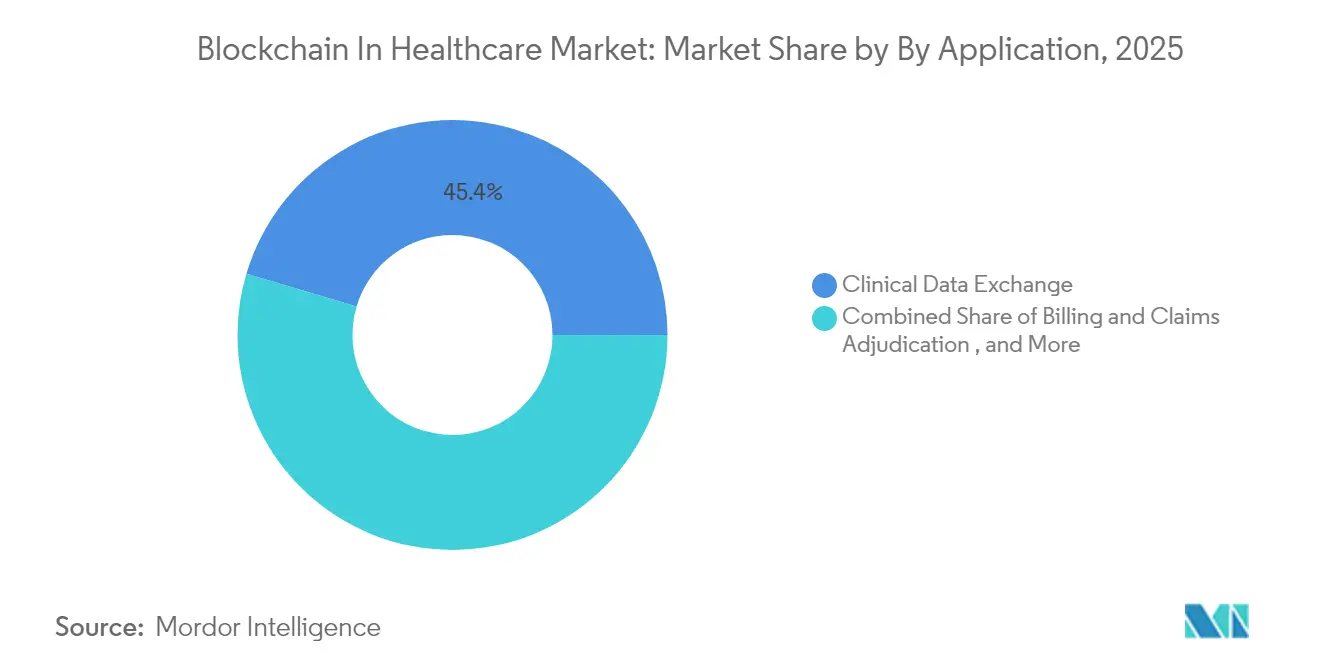
Clinical Data Exchange Dominates While Consent Management SurgesClinical Data Exchange secured 45.40% of the blockchain in healthcare market share in 2025, underpinned by TEFCA mandates that make verifiable information exchange a core provider obligation. The segment benefits from mature HL7-FHIR integrations and secure share-and-query workflows that minimize record duplication. Billing & Claims Adjudication follows as insurers implement smart contracts to cut USD 68 billion in duplicate payments. Conversely, Clinical Trials & Consent Management is the growth pacesetter with a 71.04% CAGR to 2031 as sponsors require immutable consent logs and decentralized recruitment. Pharmaceutical firms report 40% shorter enrollment windows after shifting to blockchain-verified permissions. Supply-Chain & Provenance solutions linked to DSCSA compliance round out the stack, ensuring serialized drug visibility down to unit level. The blockchain in healthcare market size for applications serving patient-centric consent networks is projected to expand at 71.04% annually through 2031, reshaping trial economics and patient engagement.
The convergence of AI with dynamic smart consent allows patients to grant time-boxed or condition-based data rights that expire automatically, embedding privacy by design. Automated royalty frameworks pay participants when their data drives trial insights, while zero-knowledge proofs preserve anonymity. Hospitals thereby transition from passive record custodians to active data brokers, and venture funding increasingly flows into platforms that operationalize patient ownership concepts at scale. Regulatory endorsement by the FDA for distributed trial evidence further propels adoption, turning consent management into a cornerstone for decentralized research networks.

By End User:
Providers Lead While Patient Data Brokers AccelerateProviders accounted for 53.20% of the blockchain in healthcare market share in 2025 as they shoulder HIPAA compliance and generate primary clinical data streams. Networks enable providers to reconcile disparate EHRs, prove data lineage, and feed analytics engines without central vulnerabilities. Payers & Pharmacy Benefit Managers use permissioned ledgers to authenticate claims and mitigate fraud, realizing 30-40% administrative savings. Patients & Health-Data Brokers, however, post the highest 76.95% CAGR, attaining critical mass on token-based marketplaces where individuals monetize anonymized records. This shift redefines data ownership norms and forms new revenue pools for patient communities.
Platforms such as Patientory and MedRec embed self-sovereign identity, giving individuals granular control of record sharing and financial returns. Providers, in turn, partner with these networks to improve longitudinal data quality and patient retention. Token incentives and transparent governance drive engagement, while secure wallets ensure records remain portable across providers. Pharmaceutical firms sourcing real-world evidence gain simplified consent workflows, accelerating drug discovery and personalized-medicine models. The blockchain in healthcare market therefore evolves into a tri-party ecosystem linking providers, payers, and empowered patients.
By Blockchain Type:
Private Networks Dominate With Consortium GrowthPrivate/Permissioned chains held 62.30% of the blockchain in healthcare market share in 2025, favored for role-based access and the capacity to honor deletion requests in hybrid off-chain storage. Hospitals deploy these networks behind firewalls, integrating identity management and HSM-backed key custody for HIPAA alignment. Consortium chains are expanding fastest at a 66.93% CAGR because drug-safety pilots, health-information exchanges, and payer-provider alliances demand shared governance. Hyperledger Fabric-based frameworks now embed Fabric-X modules for regulated digital assets, offering Byzantine Fault Tolerance and data-token partitioning.
Public chains remain niche due to privacy concerns, yet advances in zero-knowledge rollups and selective disclosure spark interest in global research collaborations. Sustainability agendas further tilt decisions toward Proof-of-Stake models that consume minimal energy compared with Proof-of-Work alternatives. As sustainability reporting becomes mandatory across the EU, healthcare buyers increasingly seek emissions data for blockchain workloads, steering investments into energy-efficient networks.

Geography Analysis
North America Blockchain in Healthcare Market
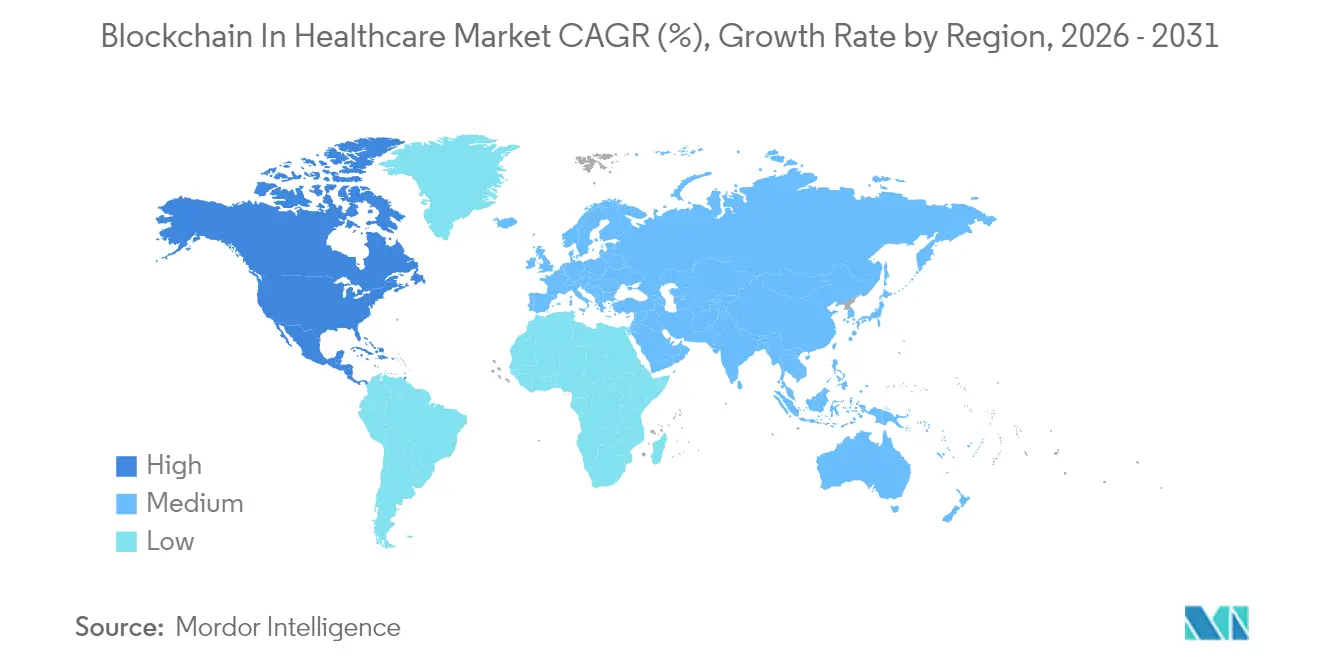
North America accounted for 40.95% of blockchain in healthcare market share in 2025, sustained by DSCSA serialization, TEFCA interoperability demands, and heightened breach-containment costs. The USD 22 million daily disruption from the 2024 Change Healthcare attack underscored the stakes, driving healthcare systems to allocate 6-10% of total IT budgets to cybersecurity-centric ledger deployments. Large hospital chains such as the Mayo Clinic and payer groups, including Anthem, now combine HL7-FHIR gateways with blockchain notarization for claims and medical records, while the Department of Veterans Affairs runs pilots for longitudinal patient wallets. Federal guidance from HHS that cites blockchain in critical-data-integrity recommendations cements its role across provider and payer stacks.
APAC Blockchain in Healthcare Market
Asia-Pacific is the growth nucleus with a 61.18% CAGR through 2031. China’s national health data platform mandates blockchain-anchored data provenance, though localization laws require in-country node residency. Japan’s 2024 Medical Law amendments explicitly promote digital-health tech, spurring hospital consortia to pilot blockchain for telemedicine and prescription verification. India’s Ayushman Bharat Digital Mission combines patient-controlled health IDs with sandboxed blockchain pilots, while the forthcoming Digital Personal Data Protection Act shapes privacy overlays. ASEAN nations integrate blockchain into medical-tourism corridors, ensuring secure transfer of diagnostic images and prescriptions for cross-border patients seeking treatment in Singapore and Thailand.
EMEA Blockchain in Healthcare Market
Europe maintains steady momentum as GDPR necessitates immutable but revocable audit trails, prompting region-wide interest in zero-knowledge proofs and off-chain storage hybrids. The European Blockchain Service Infrastructure publishes healthcare-specific guidelines that help member states converge on common consent receipts and digital signing standards. Germany’s Hospital Future Act funds blockchain proofs of record provenance, and the Nordics extend e-prescription platforms onto consortium chains. In the Middle East & Africa, Gulf Cooperation Council smart-city programs embed blockchain to manage citizen health wallets and pharmaceutical logistics, while South Africa pilots decentralized records at Frere Provincial Hospital. These deployments illustrate how resource-constrained markets leapfrog legacy IT by adopting ledger systems that bundle security, identity, and traceability.
Regulatory Landscape
Regulation is tightening around privacy, interoperability, and traceability, which is pushing blockchain deployments toward permissioned designs that use off-chain storage and auditable access controls. In July 2026, the European Data Protection Board (EDPB) finalized Guidelines 02/2025 on processing personal data through blockchain technologies, directly addressing GDPR alignment challenges such as Article 17 (right to erasure) and data minimization. This is pushing adoption toward revocable consent, hashing, and zero-knowledge-proof patterns, rather than on-ledger clinical data storage.
In the United States, the Office of the National Coordinator for Health IT (ONC) updated the 2026 Standards Version Advancement Process (SVAP) to support voluntary adoption of newer HL7 FHIR standards for health IT certification. That update reinforces the market shift toward standards-aligned data exchange layers that blockchain can notarize. For pharmaceutical provenance, FDA DSCSA requirements continue to emphasize interoperable electronic tracing (including EPCIS-aligned event data), sustaining demand for blockchain-enabled track-and-trace networks that can be shared across trading partners through 2026 implementation windows.
Value Chain Analysis
The value chain covers (1) data and identity inputs (EHR/claims events, product-serialization and EPCIS event data, patient identity and consent artifacts), (2) platform and protocol providers (permissioned/consortium blockchain frameworks, cryptography, key custody, and integration middleware), (3) solution integrators and network operators, and (4) end users that generate and consume verifiable records (providers, payers/PBMs, pharma and med-tech manufacturers, distributors/pharmacies, research sponsors/CROs, and regulators). Ecosystem coordinators and network managers also matter for aligning governance and onboarding participants, including in pharmaceutical traceability ecosystems such as Chronicleds MediLedger model.
Value realization concentrates in three operational streams: clinical data exchange and consent, billing and claims adjudication, and supply chain provenance. In each case, blockchain functions as an audit and access-control layer anchored to HL7 FHIR flows for clinical exchange, shared validation across payers and providers for claims, and unit-level traceability for DSCSA-style compliance. Bottlenecks persist at integration points, especially legacy EHR and HIS limitations, uneven API maturity, and the need for cross-entity governance that defines node roles, data retention, and dispute resolution for consortium networks.
Competitive Landscape
The blockchain in healthcare market is moderately fragmented, with global tech vendors vying against niche healthcare-specific platforms. IBM leverages its Food Trust heritage to deliver DSCSA compliance for drug traceability and partners with Anthem on claims automation, embedding Fabric-based nodes on IBM Cloud. Microsoft positions Azure Health Data Services as blockchain-ready infrastructure, furnishing identity, FHIR, and confidential computing modules that satisfy hybrid-cloud security mandates. Oracle tailors ledger services to pharmaceutical clients, integrating serialization and data analytics for supply-chain assurance.
Healthcare-native entrants such as BurstIQ, Patientory, and MedRec focus on patient-controlled data wallets and token economics, differentiating through privacy-preserving computation and federated learning integrations. Change Healthcare, now under Optum, embeds blockchain micro-services into existing clearing-house rails, easing migration for payers. Collaborations like the FDA pilot with IBM, KPMG, Merck, and Walmart show how mixed consortia blend enterprise scale with regulatory insight to meet stringent serialization targets.
Competitive positioning centers on three pillars: regulatory automation, cybersecurity resilience, and data-monetization enablement. Vendors that bundle standards-aligned governance, zero-knowledge proofs, and AI analytics position themselves to capture cross-segment share. Open-source momentum around Hyperledger’s Fabric-X release further tilts the field toward modular, audit-friendly frameworks that large hospitals and payers can tailor. Market entrants that lack compliance-grade tooling or broad partner ecosystems are increasingly restricted to pilot projects rather than full production contracts.
Blockchain In Healthcare Industry Leaders
-
IBM Corporation
-
Microsoft Corporation
-
Patientory Inc.
-
Guardtime Federal
-
Hashed Health
- *Disclaimer: Major Players sorted in no particular order
Blockchain In Healthcare Market Companies Covered in this Report
- IBM Corporation
- Microsoft Corporation
- Guardtime
- Hashed Health
- Patientory Inc.
- Factom Inc.
- Oracle Healthcare
- Hyperledger Foundation
- Change Healthcare (Optum)
- BurstIQ
- Chronicled Inc.
- Medicalchain
- Rymedi
- Nebula Genomics
- PokitDok (Change Health)
- Embleema
- Blockpharma
- Solve.Care
- BurstIQ
- GEM Health
Market Opportunities and Future Outlook
A key whitespace is compliance-grade, standards-aligned interoperability that avoids storing protected health information directly on-chain while still delivering tamper-evident provenance. The ONC 2026 SVAP update and the market pull toward HL7 FHIR create room for vendors that package FHIR-native connectors, consent receipts, and cryptographic notarization as deployable modules for TEFCA-oriented exchange and multi-provider record reconciliation. Academic work in 2026, including FHIR-based patient-controlled interoperability designs (for example, WiraChain) and cross-chain synchronization frameworks between permissioned networks and Ethereum testnets, further points to hybrid architectures that plug into existing EMR stacks and prove integrity without replacing core systems.
Another opportunity area is regulated, cross-border evidence and audit layers for regional data-sharing networks that must reconcile GDPR constraints with immutable ledgers. The EDPBs July 2026 blockchain guidance and research proposing a blockchain-based evidence layer for MyHealth@EU, aligned to EU interoperability standards and GDPR-compliant audit requirements, highlight demand for solutions that operationalize revocable access, rectification workflows, and privacy-preserving audit trails across jurisdictions. DSCSA-driven provenance requirements are also extending beyond conventional pharmaceuticals into adjacent healthcare product categories, which supports multiparty networks that blend EPCIS event integrity, partner onboarding, and automated compliance reporting.
Recent Industry Developments in Blockchain In Healthcare Market
- July 2026: The European Data Protection Board (EDPB) published the final Guidelines 02/2025 on processing personal data through blockchain technologies under GDPR. The guidance clarifies how controllers can address immutability conflicts (such as the right to erasure) using approaches like off-chain storage, hashing, and governance controls. This increases buyer scrutiny of architecture choices and pushes vendors toward compliance-by-design implementations for healthcare data exchange and consent workflows.
- June 2026: IBM collaborated with Aetna, Anthem, Health Care Service Corporation, and PNC Bank to design a blockchain-based ecosystem aimed at healthcare transparency and interoperability. The initiative brings payer and financial-services stakeholders into a shared network construct, reinforcing multiparty governance and shared verification as a procurement theme for claims and administrative workflows. It also broadens the partner footprint around enterprise-grade blockchain stacks used in regulated healthcare settings.
- December 2024: Microsoft Azure introduced Health Data Consortium features intended to support multi-jurisdiction data sharing with patient-centric privacy controls, including capabilities relevant to consortium-style governance. The release reinforces cloud-native foundations for permissioned and hybrid blockchain deployments that must integrate with healthcare data platforms and identity tooling. It also signals continued investment in managed infrastructure components that reduce integration burden for providers and payers.
Blockchain In Healthcare Market Report Scope and Research Methodology
Market Definition and Coverage
For this study, the blockchain in healthcare market is defined as spending on blockchain platforms, solutions, and related services used to store, share, verify, and track healthcare data and transactions across care delivery and life sciences workflows.
Scope exclusions: Crypto trading, consumer crypto wallets, and non-healthcare blockchain use cases are excluded even if they use similar underlying ledger technology.
Segments Covered in This Report
- By Application
- Clinical Data Exchange
- Billing and Claims Adjudication
- Supply-Chain and Provenance
- Clinical Trials and Consent Mgmt
- By End-User
- Providers (Hospitals, Clinics)
- Payers and PBMs
- Pharma / Med-tech Manufacturers
- Patients and Health-Data Brokers
- By Blockchain Type
- Private / Permissioned
- Consortium
- Public
- By Geography
- North America
- United States
- Canada
- South America
- Brazil
- Argentina
- Europe
- Germany
- United Kingdom
- France
- Russia
- Asia-pacific
- China
- Japan
- India
- Middle East and Africa
- GCC
- South Africa
- North America
Data Sources, Market Sizing, and Validation
Desk Research
Desk research was used to set the market boundaries, confirm the main demand pockets, and build realistic adoption and pricing assumptions. We relied on public sources such as the US FDA guidance pages for digital health context, the Office of the National Coordinator for Health IT (ONC) interoperability material, and CMS publications on claims and administrative processes that blockchain tools often target. We also reviewed cybersecurity and health data protection references from sources such as NIST, along with peer reviewed papers indexed in PubMed that explain where blockchain is technically practical in healthcare.
To cross-check regional direction, we used sources such as OECD health statistics, national health ministry releases, and trade association updates on pharmaceutical and medical device supply chains. Company annual reports, investor presentations, and reputable press were used to track product focus areas like consent management, data exchange, and traceability. Select paid subscriptions for company financials and news intelligence, plus patent databases and contract and tender trackers, were used to validate commercialization signals and timing. The sources listed here are illustrative and not exhaustive, since we reviewed many additional public references during data collection and clarification.
Primary Interviews and Surveys
Primary discussions were completed with solution providers, system integrators, healthcare providers, payers, and life sciences stakeholders to test adoption hurdles and real buying behavior. We used these inputs to validate where blockchain is being budgeted today, such as data exchange, claims workflows, and supply chain traceability, and to pressure-test assumptions that could not be resolved cleanly through public data. Since this is a global market, feedback was balanced across major regions so the final model reflects differences in regulation, IT maturity, and spending capacity.
Distribution of primary research fieldwork respondents
| Company type | Respondent position | Region |
|---|---|---|
| Top tier: 32% | CXOs: 14% | APAC: 42% |
| Mid tier: 46% | Functional/Unit leaders: 30% | EMEA: 31% |
| Smaller Players: 22% | Managers: 56% | Americas: 27% |
Market-Sizing & Forecasting
Market size was built using a top-down approach where healthcare IT and digital transformation spending is translated into a blockchain-addressable pool using adoption and use-case penetration factors by region, and then converted into value using typical solution plus service pricing. Once the demand pool was formed, it was segmented into the main workflows that repeatedly show up in procurement and deployments, such as clinical data exchange, billing and claims adjudication, and supply chain management.
To keep the model tied to reality, we corroborated totals with selective bottom-up approximations, including sampled vendor revenue disclosures, channel checks on typical implementation size, and volume-by-price logic for common deployment patterns. Inputs that shaped the model included the pace of interoperability programs and data sharing mandates, cybersecurity pressure and breach-related spending signals, the growth of digital claims volumes, the maturity of cloud adoption in healthcare IT stacks, and regulated supply chain traceability needs in pharmaceuticals and medical devices. Where bottom-up visibility was limited, gaps were handled through conservative ramp curves and ranges confirmed through interviews, and then narrowed during analyst review.
For forecasting, scenario analysis was used and then anchored with a multivariate regression check that linked spend growth to variables such as healthcare IT budgets, digital transaction volumes, and regulatory push for data exchange. Assumptions on pricing and adoption were refreshed for each region so the forecast reflects realistic rollout speed rather than a straight-line CAGR application.
Data Validation & Update Cycle
Model outputs were validated through repeated cross-checks against independent signals, such as the number and value of healthcare blockchain pilots moving into production, procurement activity visible in public tenders, and the pace of interoperability-driven IT upgrades. We also checked for year-to-year step changes that did not match observed market behavior, and those variances were reviewed until the driver was clear.
Before sign-off, the model goes through multi-step internal reviews, and respondents are re-contacted when a large assumption changes or when new evidence conflicts with earlier inputs. The report is refreshed annually, and interim updates are triggered when material events occur, such as major regulatory shifts or rapid changes in healthcare IT investment cycles. Right before delivery, a final scan is done so clients receive the most current view available.
Mordor Intelligence's Healthcare Blockchain Market Size Compared With Other Published Estimates
Published market sizes for blockchain in healthcare often spread widely because firms do not always count the same revenue streams, the same buyer groups, or the same timing for adoption. Some studies also anchor from different base years, which can make fast-growth categories look larger or smaller even before any forecasting assumptions are applied.
Key gap drivers usually come from scope and conversion choices, including whether consulting and integration are counted as part of the market, how private versus consortium network deployments are treated, and how multi-year contracts are recognized across years. Currency handling also matters because some estimates apply a single exchange-rate snapshot, even though cross-border healthcare IT deals can be booked at different times and in different currencies.
Benchmark comparison
| Source | Market Size | Gaps in Research Methodology |
|---|---|---|
| Mordor Intelligence | USD 8.27 B (2026) | |
| Global Consultancy A | USD 11.32 B (2024) | Uses an earlier base year and a broader interpretation of blockchain technology spend in healthcare, which can pull forward adoption and inflate current value when pilots and multi-year programs are annualized aggressively. |
| Industry Publisher B | USD 2.40 B (2025) | Leans on a narrower counted revenue set that appears to emphasize selected use cases and near-term realized deployments, which can understate services-heavy implementation work that is still budgeted but not fully recognized. |
Tender activity, live deployment announcements, and application-level adoption checks are the evidence that keeps Mordor Intelligence tied to spend that is actively being contracted and implemented. This helps explain why the estimate sits between the two external ranges shown here.
Key Questions Answered in the Report
What is the current size of the blockchain in healthcare market?
The blockchain in healthcare market reached USD 8.27 billion in 2026.
How fast is the blockchain in healthcare market expected to grow?
The market is forecast to grow at a 50.38% CAGR, hitting USD 63.58 billion by 2031.
Which application segment holds the largest share?
Clinical Data Exchange led with 45.40% market share in 2025.
What drives blockchain adoption among payers?
Smart-contract adjudication reduces duplicate claims and cuts administrative costs by up to 40% for insurers.
Why is Asia-Pacific the fastest-growing region?
Government-backed digital-health programs and revised medical laws in China, Japan, and India are propelling a 61.18% regional CAGR.
Which blockchain type is preferred in healthcare?
Private/Permissioned networks dominate with 62.30% share, though consortium models are expanding fastest at a 66.93% CAGR.