
Black Pepper Market Size and Share
Black Pepper Market Analysis by Mordor Intelligence
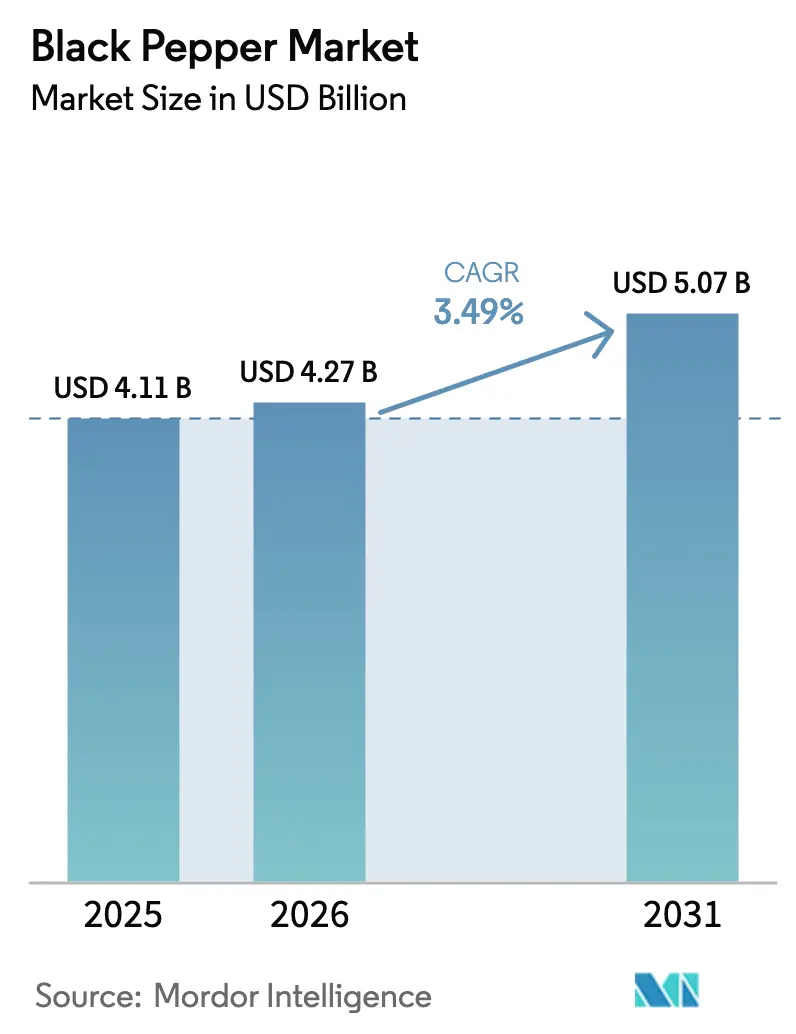
The black pepper commodity market was valued at USD 4.11 billion in 2025, and is estimated to grow from USD 4.27 billion in 2026 to reach USD 5.07 billion by 2031, at a CAGR of 3.49% during the forecast period (2026-2031). Higher average export prices in Vietnam, which topped USD 6,600 per metric ton in 2025, signal tightening supplies that favor origin-linked traders able to lock in multi-year contracts[1]Source: VietnamPlus, “Pepper exports hit record high in 2025,” vietnamplus.vn. Demand for functional ingredients from nutraceutical formulators, clean-label meat processors, and quick-service restaurants keeps volume momentum intact even in mature consumption regions. Blockchain-enabled traceability and climate-smart cultivation incentives are formalizing trade flows while raising compliance costs for smaller aggregators. Competitive pressures are intensifying as Brazil leverages currency weakness and lower freight costs to challenge Vietnam’s export leadership. Companies with vertically integrated supply chains and analytical infrastructure are well positioned to capture margin expansion during the next El Niño-linked supply squeeze.
Key Report Takeaways
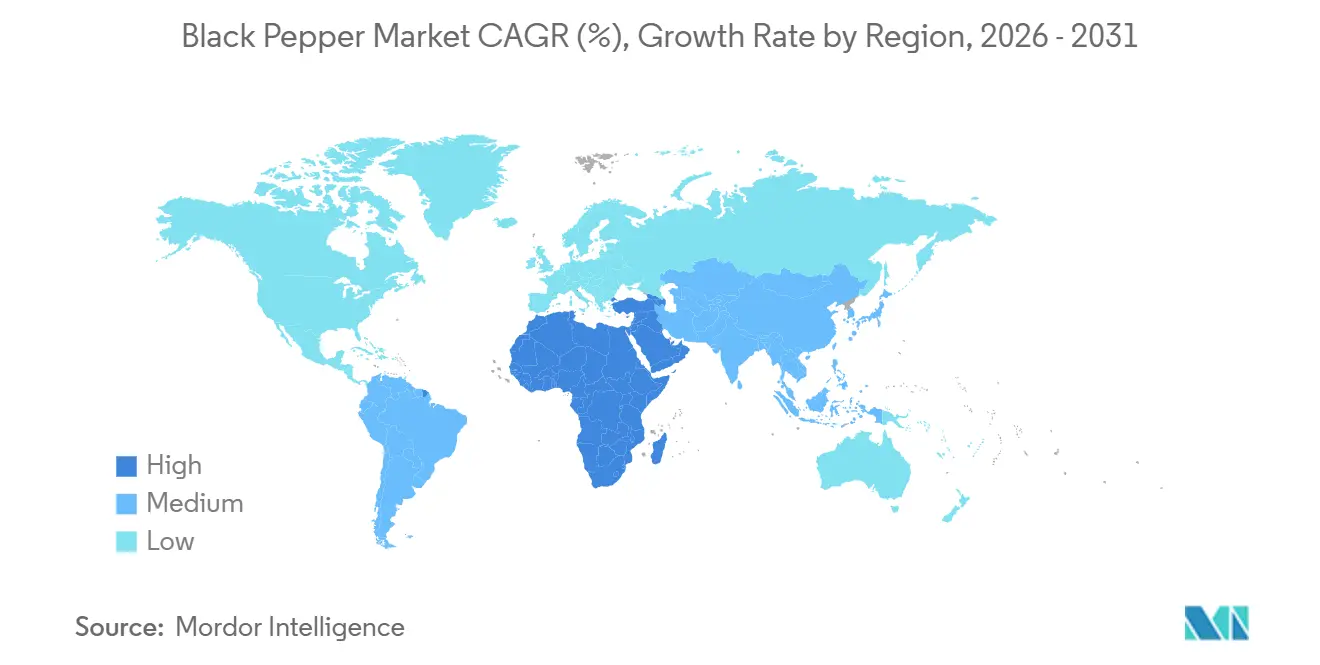
- By geography, Asia-Pacific accounted for 72.35% of the black pepper market share in 2025, while Africa is projected to expand at a 3.80% CAGR through 2031.
Note: Market size and forecast figures in this report are generated using Mordor Intelligence’s proprietary estimation framework, updated with the latest available data and insights as of January 2026.
Global Black Pepper Market Trends and Insights
Drivers Impact Analysis*
| Driver | ( ~ ) % Impact on CAGR Forecast | Geographic Relevance | Impact Timeline |
|---|---|---|---|
| Accelerated spice‐forward product launches by global packaged-food majors | +0.9% | Global, with highest intensity in North America and Europe | Medium term (2-4 years) |
| Growing demand from functional-ingredient nutraceutical formulators | +0.8% | Global, led by North America and Asia-Pacific | Medium term (2-4 years) |
| Rising preferences for natural preservatives in meat processing | +0.7% | North America, Europe, and emerging Asia-Pacific markets | Medium term (2-4 years) |
| Rapid food-service expansion in emerging economies | +0.8% | Asia-Pacific core, spill-over to Middle East and Africa | Short term (≤ 2 years) |
| Increased adoption of blockchain-enabled farm-to-port traceability | +0.6% | Global, early adoption in Europe and North America | Long term (≥ 4 years) |
| Climate-smart cultivation incentives and carbon-credit monetization | +0.5% | Asia-Pacific and Africa, pilot programs in India and Madagascar | Long term (≥ 4 years) |
| Source: Mordor Intelligence | |||
Accelerated Spice‐Forward Product Launches by Global Packaged-Food Majors
Multinational food companies are prioritizing bold, pepper-centric flavor profiles in snacks and seasonings to meet consumer demand for authentic heat. Procurement teams now commit to multi-year supply contracts that specify piperine content, tightening spot availability. Vertically integrated processors that control origin-level sourcing reap price premiums by guaranteeing standardized assays. As flavor becomes a differentiation lever, the black pepper commodity market deepens its strategic role within global ingredient portfolios. This shift narrows arbitrage opportunities for short-term traders and reinforces the pricing power of processors with laboratory capabilities.
Growing Demand from Functional-Ingredient Nutraceutical Formulators
Piperine is widely used to enhance the bioavailability of curcumin and other polyphenols, increasing its importance in dietary supplements. Standardized piperine extracts command premiums, creating a bifurcated market that rewards high-piperine cultivars and origin-level testing infrastructure[2]Source: Journal of Pharmacology and Experimental Therapeutics, “Influence of piperine on the pharmacokinetics of curcumin in animals and human volunteers,” aspet.org. Investment in high-performance liquid chromatography and gas chromatography-mass spectrometry raises entry barriers for smallholder cooperatives, concentrating value capture among vertically integrated firms. The nutraceutical channel’s expansion is reshaping upstream quality standards and sustaining demand even during commodity price spikes.
Rising Preferences for Natural Preservatives in Meat Processing
Retailer clean-label mandates and regulatory pressure to curb nitrite use are steering processors toward black pepper essential oil as an antimicrobial. Laboratory assays show minimum inhibitory concentrations of 1 µL/mL (microliters per milliliter) against Escherichia coli, enabling 2–3 log reductions in microbial levels in meat products[3]Source: Food Science and Technology Research, “Antimicrobial activity of black pepper essential oil,” jstage.jp. Demand is shifting from bulk peppercorns to higher-margin oleoresins that require consistent volatile-oil profiles. Suppliers with batch-level certificates and traceability systems gain priority, formalizing supply chains and squeezing informal aggregators.
Rapid Food-Service Expansion in Emerging Economies
Quick-service restaurant chains across Asia-Pacific, the Middle East, and Africa rely on coarse black pepper sachets and blends to drive incremental volume growth beyond household use. Institutional buyers favor processors that can provide pre-portioned formats and pass rigorous food-safety audits. Investments in milling and packaging lines align processors with food-service specifications, consolidating demand among audit-ready suppliers. As chains scale, they bolster year-round offtake, stabilizing demand during retail slowdowns.
Restraints Impact Analysis*
| Restraint | ( ~ ) % Impact on CAGR Forecast | Geographic Relevance | Impact Timeline |
|---|---|---|---|
| Heightened yield volatility from El Niño–linked rainfall anomalies | -0.8% | Asia-Pacific (Vietnam, India, Indonesia), with secondary effects in Brazil | Short term (≤ 2 years) |
| Escalating farm-input and ocean-freight costs | -0.9% | Global, with acute pressure in Asia-Pacific and Africa | Short term (≤ 2 years) |
| Pesticide-residue compliance tightening in the European Union | -0.7% | Europe (import rejections), with upstream impact on Asia-Pacific exporters | Medium term (2-4 years) |
| Price substitution toward cheaper capsicum oleoresins | -0.6% | Global, concentrated in cost-sensitive food-manufacturing segments | Medium term (2-4 years) |
| Source: Mordor Intelligence | |||
Escalating Farm-Input and Ocean-Freight Costs
Nitrogen fertilizer prices tripled between 2020 and 2022 before moderating, raising per-hectare cultivation expenses and prompting crop switching among marginal farmers[4]Source: United States Department of Agriculture Economic Research Service, “Chart Gallery: Fertilizer Prices,” ers.usda.gov. Concurrent shipping disruptions inflated freight rates, compressing arbitrage margins and limiting speculative inventory builds. Processors with forward-contract coverage mitigate margin erosion, whereas smaller aggregators face liquidity squeezes. Persistent cost inflation threatens volume growth in the informal segment of the black pepper industry.
Pesticide-Residue Compliance Tightening in the European Union
Regulation EC 396/2005 establishes maximum residue limits as low as 0.05 mg/kg for many active substances, prompting shipment rejections and costly re-exports. Exporters with in-house laboratories can pre-test consignments and secure premiums, while smallholder aggregators without such facilities lose access to the European Union market. Over time, this dynamic redirects some exports toward Middle Eastern buyers who accept wider residue thresholds but offer lower price premiums.
*Our forecasts treat driver/restraint impacts as directional, not additive. The impact forecasts reflect baseline growth, mix effects, and variable interactions.
Geography Analysis
In 2025, Asia-Pacific accounted for 72.35% of the black pepper market size, solidifying its leading position in commodity trade. The region handles over two-thirds of global volumes, driven by vertically integrated cultivation, processing, and export hubs in Vietnam and India. China's growing imports highlight the expansion of its food-service sector and the increasing significance of bonded zones for re-export activities. Additionally, blockchain-based traceability pilots are contributing to supply chain formalization, though adoption remains inconsistent among smallholder producers.
Africa represents a smaller share of the black pepper market but is the fastest-growing region, with a CAGR of 3.8%. Madagascar is expanding agroforestry plantations eligible for carbon credits, providing supplementary revenue alongside spice exports. Zimbabwe and Burkina Faso are emerging as producers, though their progress is hindered by limited access to planting materials and extension services. Improvements in port infrastructure and cold-chain logistics are critical to unlocking the region's export potential.
North America and Europe are experiencing more modest growth, influenced by stable household consumption patterns and stricter European Union regulations on residues. In the United States, imports from Vietnam remain a key component of the supply chain, despite occasional inventory adjustments by buyers. South America benefits from Brazil's efficient logistics for exports to North American markets. Meanwhile, Middle Eastern hubs, particularly the United Arab Emirates, are strengthening their role as re-export centers for North Africa and the Levant, reinforcing their strategic importance in global distribution networks.


Competitive Landscape
Competitive intensity in the black pepper market is increasing as buyers prioritize traceability, sustainability, and supply assurance over purely price-driven sourcing. Upstream, production remains highly fragmented, with millions of smallholder farmers cultivating plots of 1 to 3 hectares and selling through local aggregators. Midstream power is concentrated among vertically integrated processors such as Olam Food Ingredients, Synthite Industries Private Limited, and Nedspice Processing B.V., which add value through origin-level sourcing, pesticide-residue testing, and investments in blockchain-enabled traceability. Downstream, multinational flavor and ingredient companies, including McCormick & Company, Incorporated, Kerry Group plc, and Givaudan SA, depend on black pepper as a key raw material for seasonings, extracts, and blended formulations.
Brazil has strengthened its competitive position as currency depreciation and favorable freight economics enable suppliers to undercut Vietnamese exporters in spot markets, attracting volumes for re-processing and onward export. Strategic capacity expansion highlights a broader focus on origin proximity, exemplified by Synthite Industries Private Limited’s planned processing facility in Indonesia and Givaudan SA’s investment in its Cikarang manufacturing plant. These facilities incorporate sustainability and traceability features alongside scale efficiencies. Simultaneously, tightening retailer requirements for British Retail Consortium and ISO 22000 food-safety certifications are driving consolidation, sidelining smaller processors unable to meet audit standards due to limited capital and systems.
Emerging competitive pressure is also evident from regional consumer-facing brands such as India's Aachi Masala Foods Private Limited, which has sought private-equity funding to expand its distribution network and brand presence. Across the value chain, technology adoption is increasingly focused on sensor-based irrigation, digital farm monitoring, and drone-assisted pest management. However, the high capital intensity of these technologies restricts their deployment to well-capitalized estates. Overall, sustainable competitive advantage is shifting toward players capable of combining strong farmer relationships, flexible processing capabilities, and deep customer understanding. This enables them to pivot effectively between bulk commodity supply and higher-margin value-added extract channels.
Recent Industry Developments
- October 2025: Synthite Industries Private Limited plans to establish a pre-processing and blending facility in Indonesia to expand pepper sourcing and support local farmers through technology transfer, training, and sustainable practices. The company, currently operating facilities in Vietnam and Sri Lanka, aims to secure high-quality raw materials at the source and improve supply chain efficiency.
- April 2025: The United States imposed a 10% base tariff on a wide range of imports, increasing cost pressures on Vietnamese pepper exporters, especially those with pre-signed contracts that excluded the additional duties. The higher landed costs reduced profit margins and created uncertainty. This led buyers to reassess sourcing strategies and explore alternative sourcing origins amid rising trade risks.
- December 2024: Indonesia’s National Research and Innovation Agency (BRIN) launched coordinated pepper breeding and post-harvest handling research to supply processors with higher-quality, cleaner berry lots and post-harvest protocols that directly reduce processing sorting costs and increase mill throughput.


Global Black Pepper Market Report Scope
The Black Pepper Market Report is Segmented by Geography (North America, Europe, Asia-Pacific, South America, and More). The Report Includes Production Analysis (Volume), Consumption Analysis (Value and Volume), Import Analysis (Value and Volume), Export Analysis (Value and Volume), Wholesale Price Trend Analysis, List of Key Players, and More. The Market Forecasts are Provided in Terms of Value (USD) and Volume (Metric Tons).
| United States | Production Analysis (Area Harvested, Yield, and Production Volume) |
| Consumption Analysis (Consumption Value and Volume) | |
| Import Market Analysis (Import Value, Volume, and Key Supplying Markets) | |
| Export Market Analysis (Export Value, Volume, and Key Destination Markets) | |
| Wholesale Price Trend Analysis and Forecast | |
| Regulatory Framework | |
| List of Key Players | |
| Logistics and Infrastructure | |
| Seasonality Analysis | |
| Canada | Production Analysis (Area Harvested, Yield, and Production Volume) |
| Consumption Analysis (Consumption Value and Volume) | |
| Import Market Analysis (Import Value, Volume, and Key Supplying Markets) | |
| Export Market Analysis (Export Value, Volume, and Key Destination Markets) | |
| Wholesale Price Trend Analysis and Forecast | |
| Regulatory Framework | |
| List of Key Players | |
| Logistics and Infrastructure | |
| Seasonality Analysis |
| Brazil | Production Analysis (Area Harvested, Yield, and Production Volume) |
| Consumption Analysis (Consumption Value and Volume) | |
| Import Market Analysis (Import Value, Volume, and Key Supplying Markets) | |
| Export Market Analysis (Export Value, Volume, and Key Destination Markets) | |
| Wholesale Price Trend Analysis and Forecast | |
| Regulatory Framework | |
| List of Key Players | |
| Logistics and Infrastructure | |
| Seasonality Analysis | |
| Argentina | Production Analysis (Area Harvested, Yield, and Production Volume) |
| Consumption Analysis (Consumption Value and Volume) | |
| Import Market Analysis (Import Value, Volume, and Key Supplying Markets) | |
| Export Market Analysis (Export Value, Volume, and Key Destination Markets) | |
| Wholesale Price Trend Analysis and Forecast | |
| Regulatory Framework | |
| List of Key Players | |
| Logistics and Infrastructure | |
| Seasonality Analysis |
| Germany | Production Analysis (Area Harvested, Yield, and Production Volume) |
| Consumption Analysis (Consumption Value and Volume) | |
| Import Market Analysis (Import Value, Volume, and Key Supplying Markets) | |
| Export Market Analysis (Export Value, Volume, and Key Destination Markets) | |
| Wholesale Price Trend Analysis and Forecast | |
| Regulatory Framework | |
| List of Key Players | |
| Logistics and Infrastructure | |
| Seasonality Analysis | |
| France | Production Analysis (Area Harvested, Yield, and Production Volume) |
| Consumption Analysis (Consumption Value and Volume) | |
| Import Market Analysis (Import Value, Volume, and Key Supplying Markets) | |
| Export Market Analysis (Export Value, Volume, and Key Destination Markets) | |
| Wholesale Price Trend Analysis and Forecast | |
| Regulatory Framework | |
| List of Key Players | |
| Logistics and Infrastructure | |
| Seasonality Analysis | |
| United Kingdom | Production Analysis (Area Harvested, Yield, and Production Volume) |
| Consumption Analysis (Consumption Value and Volume) | |
| Import Market Analysis (Import Value, Volume, and Key Supplying Markets) | |
| Export Market Analysis (Export Value, Volume, and Key Destination Markets) | |
| Wholesale Price Trend Analysis and Forecast | |
| Regulatory Framework | |
| List of Key Players | |
| Logistics and Infrastructure | |
| Seasonality Analysis |
| Vietnam | Production Analysis (Area Harvested, Yield, and Production Volume) |
| Consumption Analysis (Consumption Value and Volume) | |
| Import Market Analysis (Import Value, Volume, and Key Supplying Markets) | |
| Export Market Analysis (Export Value, Volume, and Key Destination Markets) | |
| Wholesale Price Trend Analysis and Forecast | |
| Regulatory Framework | |
| List of Key Players | |
| Logistics and Infrastructure | |
| Seasonality Analysis | |
| India | Production Analysis (Area Harvested, Yield, and Production Volume) |
| Consumption Analysis (Consumption Value and Volume) | |
| Import Market Analysis (Import Value, Volume, and Key Supplying Markets) | |
| Export Market Analysis (Export Value, Volume, and Key Destination Markets) | |
| Wholesale Price Trend Analysis and Forecast | |
| Regulatory Framework | |
| List of Key Players | |
| Logistics and Infrastructure | |
| Seasonality Analysis | |
| Indonesia | Production Analysis (Area Harvested, Yield, and Production Volume) |
| Consumption Analysis (Consumption Value and Volume) | |
| Import Market Analysis (Import Value, Volume, and Key Supplying Markets) | |
| Export Market Analysis (Export Value, Volume, and Key Destination Markets) | |
| Wholesale Price Trend Analysis and Forecast | |
| Regulatory Framework | |
| List of Key Players | |
| Logistics and Infrastructure | |
| Seasonality Analysis | |
| China | Production Analysis (Area Harvested, Yield, and Production Volume) |
| Consumption Analysis (Consumption Value and Volume) | |
| Import Market Analysis (Import Value, Volume, and Key Supplying Markets) | |
| Export Market Analysis (Export Value, Volume, and Key Destination Markets) | |
| Wholesale Price Trend Analysis and Forecast | |
| Regulatory Framework | |
| List of Key Players | |
| Logistics and Infrastructure | |
| Seasonality Analysis | |
| Malaysia | Production Analysis (Area Harvested, Yield, and Production Volume) |
| Consumption Analysis (Consumption Value and Volume) | |
| Import Market Analysis (Import Value, Volume, and Key Supplying Markets) | |
| Export Market Analysis (Export Value, Volume, and Key Destination Markets) | |
| Wholesale Price Trend Analysis and Forecast | |
| Regulatory Framework | |
| List of Key Players | |
| Logistics and Infrastructure | |
| Seasonality Analysis | |
| Sri Lanka | Production Analysis (Area Harvested, Yield, and Production Volume) |
| Consumption Analysis (Consumption Value and Volume) | |
| Import Market Analysis (Import Value, Volume, and Key Supplying Markets) | |
| Export Market Analysis (Export Value, Volume, and Key Destination Markets) | |
| Wholesale Price Trend Analysis and Forecast | |
| Regulatory Framework | |
| List of Key Players | |
| Logistics and Infrastructure | |
| Seasonality Analysis |
| Saudi Arabia | Production Analysis (Area Harvested, Yield, and Production Volume) |
| Consumption Analysis (Consumption Value and Volume) | |
| Import Market Analysis (Import Value, Volume, and Key Supplying Markets) | |
| Export Market Analysis (Export Value, Volume, and Key Destination Markets) | |
| Wholesale Price Trend Analysis and Forecast | |
| Regulatory Framework | |
| List of Key Players | |
| Logistics and Infrastructure | |
| Seasonality Analysis | |
| United Arab Emirates | Production Analysis (Area Harvested, Yield, and Production Volume) |
| Consumption Analysis (Consumption Value and Volume) | |
| Import Market Analysis (Import Value, Volume, and Key Supplying Markets) | |
| Export Market Analysis (Export Value, Volume, and Key Destination Markets) | |
| Wholesale Price Trend Analysis and Forecast | |
| Regulatory Framework | |
| List of Key Players | |
| Logistics and Infrastructure | |
| Seasonality Analysis |
| Burkina Faso | Production Analysis (Area Harvested, Yield, and Production Volume) |
| Consumption Analysis (Consumption Value and Volume) | |
| Import Market Analysis (Import Value, Volume, and Key Supplying Markets) | |
| Export Market Analysis (Export Value, Volume, and Key Destination Markets) | |
| Wholesale Price Trend Analysis and Forecast | |
| Regulatory Framework | |
| List of Key Players | |
| Logistics and Infrastructure | |
| Seasonality Analysis | |
| Zimbabwe | Production Analysis (Area Harvested, Yield, and Production Volume) |
| Consumption Analysis (Consumption Value and Volume) | |
| Import Market Analysis (Import Value, Volume, and Key Supplying Markets) | |
| Export Market Analysis (Export Value, Volume, and Key Destination Markets) | |
| Wholesale Price Trend Analysis and Forecast | |
| Regulatory Framework | |
| List of Key Players | |
| Logistics and Infrastructure | |
| Seasonality Analysis | |
| Madagascar | Production Analysis (Area Harvested, Yield, and Production Volume) |
| Consumption Analysis (Consumption Value and Volume) | |
| Import Market Analysis (Import Value, Volume, and Key Supplying Markets) | |
| Export Market Analysis (Export Value, Volume, and Key Destination Markets) | |
| Wholesale Price Trend Analysis and Forecast | |
| Regulatory Framework | |
| List of Key Players | |
| Logistics and Infrastructure | |
| Seasonality Analysis |
| North America | United States | Production Analysis (Area Harvested, Yield, and Production Volume) |
| Consumption Analysis (Consumption Value and Volume) | ||
| Import Market Analysis (Import Value, Volume, and Key Supplying Markets) | ||
| Export Market Analysis (Export Value, Volume, and Key Destination Markets) | ||
| Wholesale Price Trend Analysis and Forecast | ||
| Regulatory Framework | ||
| List of Key Players | ||
| Logistics and Infrastructure | ||
| Seasonality Analysis | ||
| Canada | Production Analysis (Area Harvested, Yield, and Production Volume) | |
| Consumption Analysis (Consumption Value and Volume) | ||
| Import Market Analysis (Import Value, Volume, and Key Supplying Markets) | ||
| Export Market Analysis (Export Value, Volume, and Key Destination Markets) | ||
| Wholesale Price Trend Analysis and Forecast | ||
| Regulatory Framework | ||
| List of Key Players | ||
| Logistics and Infrastructure | ||
| Seasonality Analysis | ||
| South America | Brazil | Production Analysis (Area Harvested, Yield, and Production Volume) |
| Consumption Analysis (Consumption Value and Volume) | ||
| Import Market Analysis (Import Value, Volume, and Key Supplying Markets) | ||
| Export Market Analysis (Export Value, Volume, and Key Destination Markets) | ||
| Wholesale Price Trend Analysis and Forecast | ||
| Regulatory Framework | ||
| List of Key Players | ||
| Logistics and Infrastructure | ||
| Seasonality Analysis | ||
| Argentina | Production Analysis (Area Harvested, Yield, and Production Volume) | |
| Consumption Analysis (Consumption Value and Volume) | ||
| Import Market Analysis (Import Value, Volume, and Key Supplying Markets) | ||
| Export Market Analysis (Export Value, Volume, and Key Destination Markets) | ||
| Wholesale Price Trend Analysis and Forecast | ||
| Regulatory Framework | ||
| List of Key Players | ||
| Logistics and Infrastructure | ||
| Seasonality Analysis | ||
| Europe | Germany | Production Analysis (Area Harvested, Yield, and Production Volume) |
| Consumption Analysis (Consumption Value and Volume) | ||
| Import Market Analysis (Import Value, Volume, and Key Supplying Markets) | ||
| Export Market Analysis (Export Value, Volume, and Key Destination Markets) | ||
| Wholesale Price Trend Analysis and Forecast | ||
| Regulatory Framework | ||
| List of Key Players | ||
| Logistics and Infrastructure | ||
| Seasonality Analysis | ||
| France | Production Analysis (Area Harvested, Yield, and Production Volume) | |
| Consumption Analysis (Consumption Value and Volume) | ||
| Import Market Analysis (Import Value, Volume, and Key Supplying Markets) | ||
| Export Market Analysis (Export Value, Volume, and Key Destination Markets) | ||
| Wholesale Price Trend Analysis and Forecast | ||
| Regulatory Framework | ||
| List of Key Players | ||
| Logistics and Infrastructure | ||
| Seasonality Analysis | ||
| United Kingdom | Production Analysis (Area Harvested, Yield, and Production Volume) | |
| Consumption Analysis (Consumption Value and Volume) | ||
| Import Market Analysis (Import Value, Volume, and Key Supplying Markets) | ||
| Export Market Analysis (Export Value, Volume, and Key Destination Markets) | ||
| Wholesale Price Trend Analysis and Forecast | ||
| Regulatory Framework | ||
| List of Key Players | ||
| Logistics and Infrastructure | ||
| Seasonality Analysis | ||
| Asia-Pacific | Vietnam | Production Analysis (Area Harvested, Yield, and Production Volume) |
| Consumption Analysis (Consumption Value and Volume) | ||
| Import Market Analysis (Import Value, Volume, and Key Supplying Markets) | ||
| Export Market Analysis (Export Value, Volume, and Key Destination Markets) | ||
| Wholesale Price Trend Analysis and Forecast | ||
| Regulatory Framework | ||
| List of Key Players | ||
| Logistics and Infrastructure | ||
| Seasonality Analysis | ||
| India | Production Analysis (Area Harvested, Yield, and Production Volume) | |
| Consumption Analysis (Consumption Value and Volume) | ||
| Import Market Analysis (Import Value, Volume, and Key Supplying Markets) | ||
| Export Market Analysis (Export Value, Volume, and Key Destination Markets) | ||
| Wholesale Price Trend Analysis and Forecast | ||
| Regulatory Framework | ||
| List of Key Players | ||
| Logistics and Infrastructure | ||
| Seasonality Analysis | ||
| Indonesia | Production Analysis (Area Harvested, Yield, and Production Volume) | |
| Consumption Analysis (Consumption Value and Volume) | ||
| Import Market Analysis (Import Value, Volume, and Key Supplying Markets) | ||
| Export Market Analysis (Export Value, Volume, and Key Destination Markets) | ||
| Wholesale Price Trend Analysis and Forecast | ||
| Regulatory Framework | ||
| List of Key Players | ||
| Logistics and Infrastructure | ||
| Seasonality Analysis | ||
| China | Production Analysis (Area Harvested, Yield, and Production Volume) | |
| Consumption Analysis (Consumption Value and Volume) | ||
| Import Market Analysis (Import Value, Volume, and Key Supplying Markets) | ||
| Export Market Analysis (Export Value, Volume, and Key Destination Markets) | ||
| Wholesale Price Trend Analysis and Forecast | ||
| Regulatory Framework | ||
| List of Key Players | ||
| Logistics and Infrastructure | ||
| Seasonality Analysis | ||
| Malaysia | Production Analysis (Area Harvested, Yield, and Production Volume) | |
| Consumption Analysis (Consumption Value and Volume) | ||
| Import Market Analysis (Import Value, Volume, and Key Supplying Markets) | ||
| Export Market Analysis (Export Value, Volume, and Key Destination Markets) | ||
| Wholesale Price Trend Analysis and Forecast | ||
| Regulatory Framework | ||
| List of Key Players | ||
| Logistics and Infrastructure | ||
| Seasonality Analysis | ||
| Sri Lanka | Production Analysis (Area Harvested, Yield, and Production Volume) | |
| Consumption Analysis (Consumption Value and Volume) | ||
| Import Market Analysis (Import Value, Volume, and Key Supplying Markets) | ||
| Export Market Analysis (Export Value, Volume, and Key Destination Markets) | ||
| Wholesale Price Trend Analysis and Forecast | ||
| Regulatory Framework | ||
| List of Key Players | ||
| Logistics and Infrastructure | ||
| Seasonality Analysis | ||
| Middle East | Saudi Arabia | Production Analysis (Area Harvested, Yield, and Production Volume) |
| Consumption Analysis (Consumption Value and Volume) | ||
| Import Market Analysis (Import Value, Volume, and Key Supplying Markets) | ||
| Export Market Analysis (Export Value, Volume, and Key Destination Markets) | ||
| Wholesale Price Trend Analysis and Forecast | ||
| Regulatory Framework | ||
| List of Key Players | ||
| Logistics and Infrastructure | ||
| Seasonality Analysis | ||
| United Arab Emirates | Production Analysis (Area Harvested, Yield, and Production Volume) | |
| Consumption Analysis (Consumption Value and Volume) | ||
| Import Market Analysis (Import Value, Volume, and Key Supplying Markets) | ||
| Export Market Analysis (Export Value, Volume, and Key Destination Markets) | ||
| Wholesale Price Trend Analysis and Forecast | ||
| Regulatory Framework | ||
| List of Key Players | ||
| Logistics and Infrastructure | ||
| Seasonality Analysis | ||
| Africa | Burkina Faso | Production Analysis (Area Harvested, Yield, and Production Volume) |
| Consumption Analysis (Consumption Value and Volume) | ||
| Import Market Analysis (Import Value, Volume, and Key Supplying Markets) | ||
| Export Market Analysis (Export Value, Volume, and Key Destination Markets) | ||
| Wholesale Price Trend Analysis and Forecast | ||
| Regulatory Framework | ||
| List of Key Players | ||
| Logistics and Infrastructure | ||
| Seasonality Analysis | ||
| Zimbabwe | Production Analysis (Area Harvested, Yield, and Production Volume) | |
| Consumption Analysis (Consumption Value and Volume) | ||
| Import Market Analysis (Import Value, Volume, and Key Supplying Markets) | ||
| Export Market Analysis (Export Value, Volume, and Key Destination Markets) | ||
| Wholesale Price Trend Analysis and Forecast | ||
| Regulatory Framework | ||
| List of Key Players | ||
| Logistics and Infrastructure | ||
| Seasonality Analysis | ||
| Madagascar | Production Analysis (Area Harvested, Yield, and Production Volume) | |
| Consumption Analysis (Consumption Value and Volume) | ||
| Import Market Analysis (Import Value, Volume, and Key Supplying Markets) | ||
| Export Market Analysis (Export Value, Volume, and Key Destination Markets) | ||
| Wholesale Price Trend Analysis and Forecast | ||
| Regulatory Framework | ||
| List of Key Players | ||
| Logistics and Infrastructure | ||
| Seasonality Analysis | ||


Key Questions Answered in the Report
How large is the black pepper commodity market in 2026?
The black pepper commodity market size stands at USD 4.27 billion in 2026.
What is the projected growth rate of the market to 2031?
The market is projected to grow at a 3.49% CAGR, reaching USD 5.07 billion in 2031.
Which region holds the largest share of global trade?
Asia-Pacific leads with 72.35% of global share, driven by Vietnam and India.
Which region is forecast to grow fastest through 2031?
Africa is set to expand at the highest regional CAGR of 3.80%.
What factors are driving demand among meat processors?
Rising preference for natural preservatives is encouraging meat processors to use black pepper essential oil for antimicrobial functions.
How are companies addressing traceability requirements?
Leading processors deploy blockchain platforms that log farm-level transactions and shipment milestones to satisfy retailer mandates.
Page last updated on:





