
Biscuits Market Size and Share
Biscuits Market Analysis by Mordor Intelligence
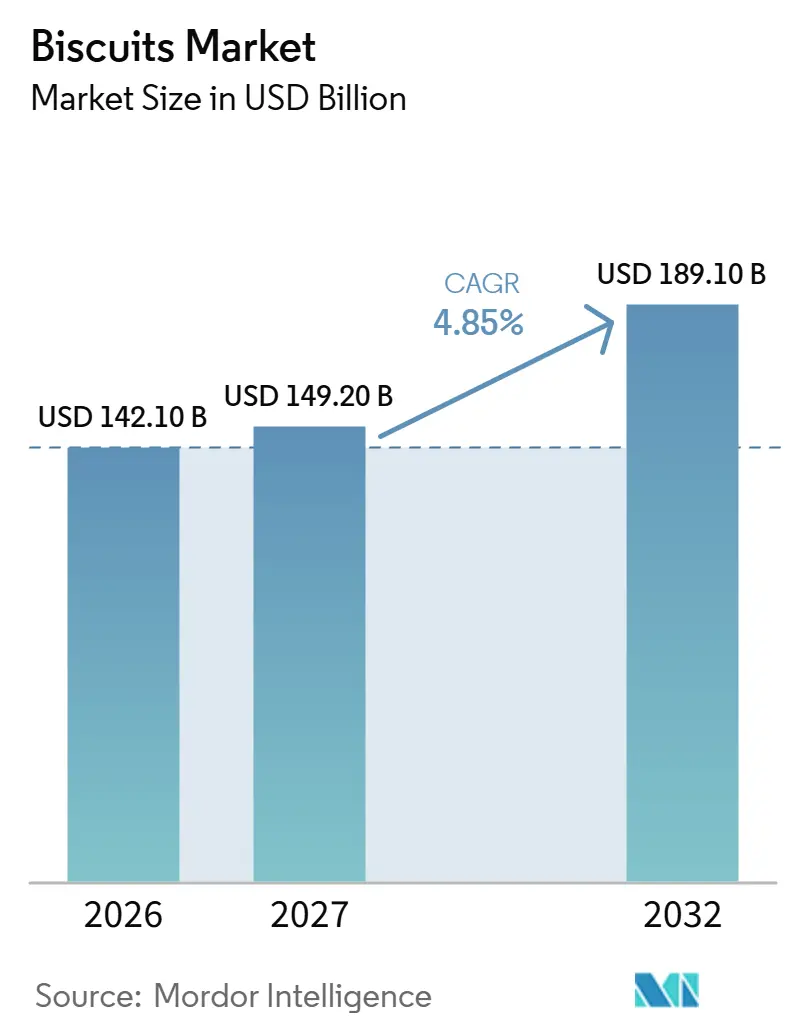
The biscuits market size is expected to grow from USD 142.1 billion in 2026 to USD 149.2 billion in 2027 and is forecast to reach USD 189.1 billion by 2032 at a 4.85% CAGR over 2027-2032.
Treat-led biscuit demand creates room for differentiated recipes and serving formats, with product value tied to a clear consumption purpose. In India, producers compete on factory efficiency and channel-specific brands, so cost control and retailer reach shape how quickly new recipes can scale. Individually wrapped multipacks can separate the serving occasion from the quantity purchased, giving premium recipes an additional route to repeated snack occasions. Advertising constraints and input-cost pressure limit that opening, so suppliers need product appeal and dependable execution to turn innovation into additional household demand.
Key Report Takeaways
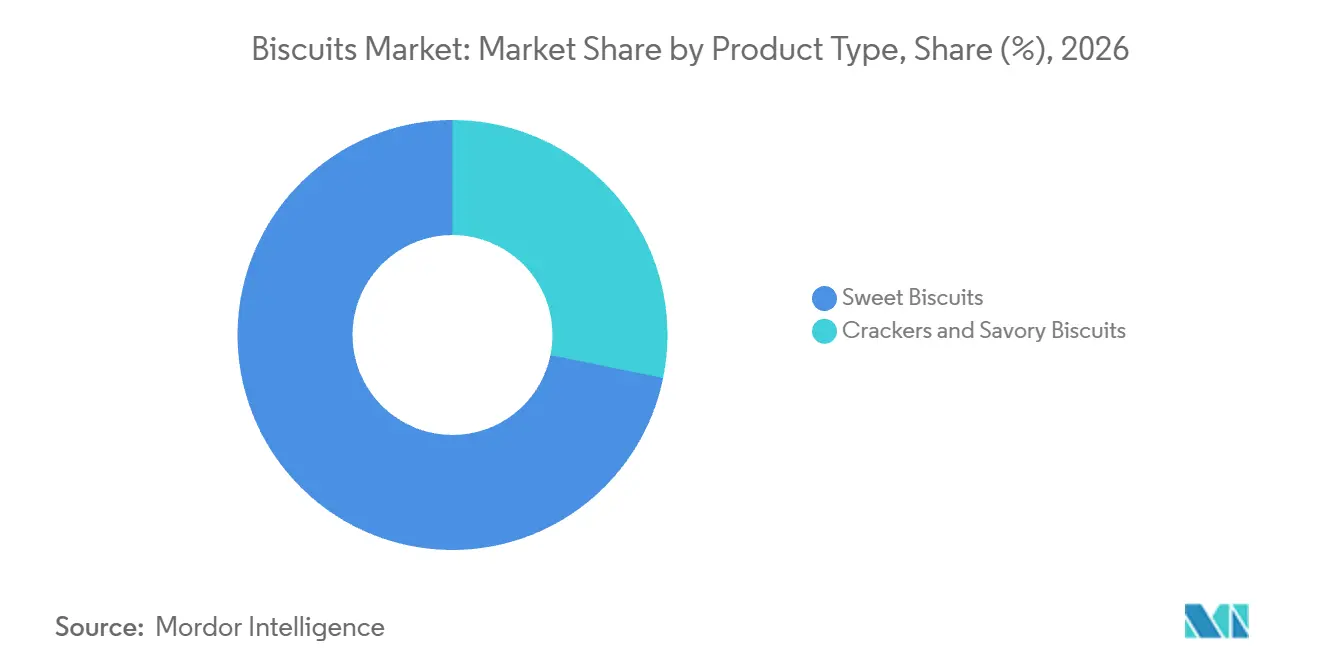
- By product type, sweet biscuits led with a 71.79% biscuits market share in 2026, while crackers and savory biscuits are forecast to grow fastest at a 6.05% CAGR over 2027-2032.
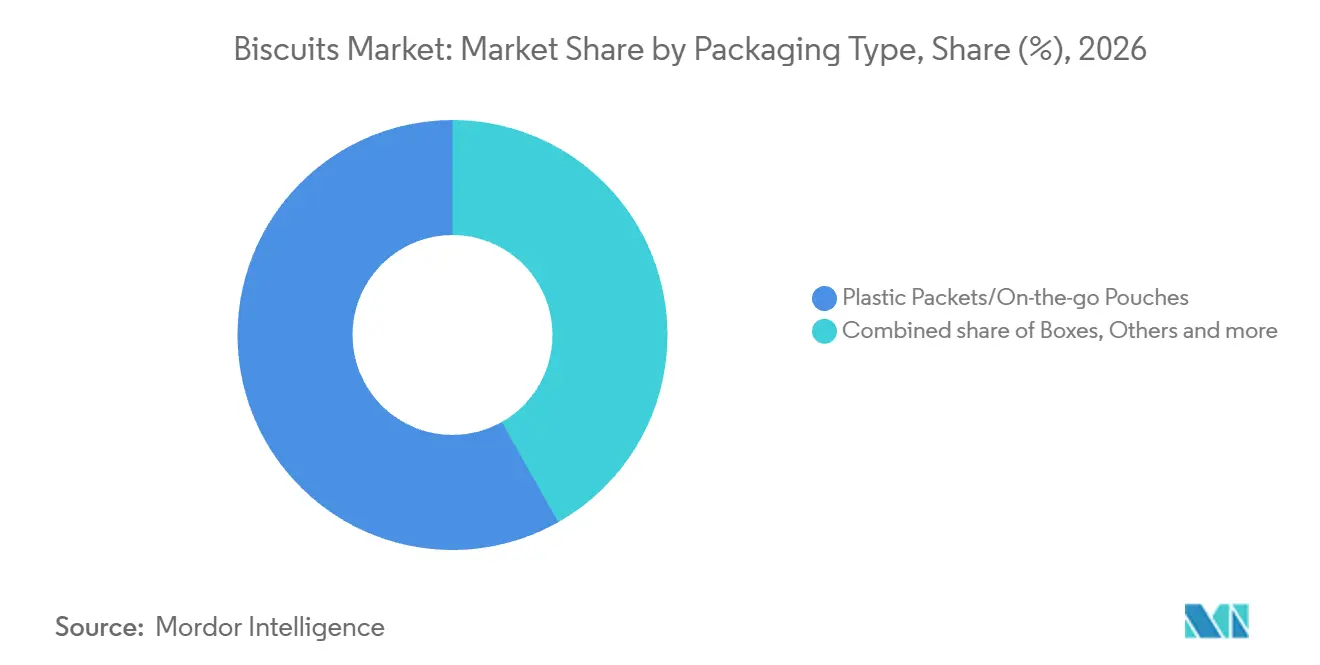
- For packaging, plastic packets/on-the-go pouches accounted for 58.19% of biscuit spending in 2026 and are forecast to record the fastest growth at a 5.3% CAGR over 2027-2032.
- Across categories, conventional biscuits led with an 84.56% share of the biscuits market size in 2026, while free-from biscuits are forecast to grow fastest at a 6.1% CAGR over 2027-2032.
- By distribution channel, supermarkets/hypermarkets held 44.74% of biscuit spending in 2026, and online retail stores are forecast to grow fastest at a 7.75% CAGR over 2027-2032.
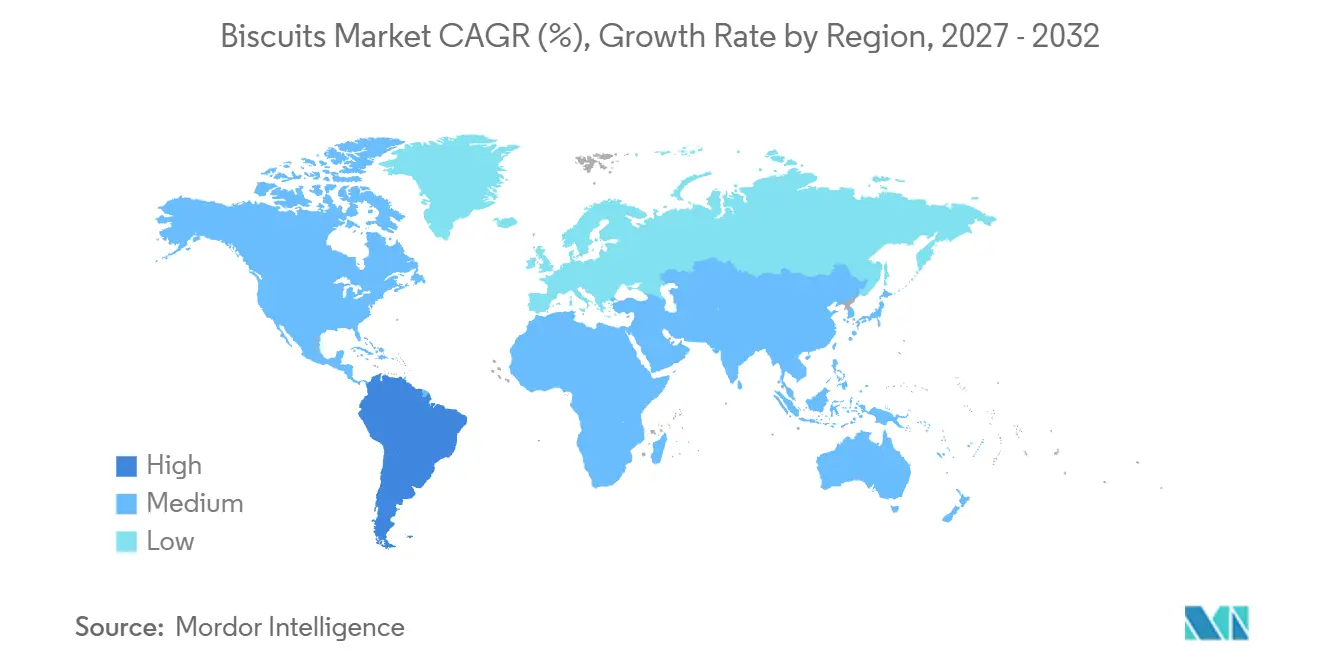
- Geographically, Europe led with 27.28% of biscuit spending in 2026, while South America is forecast to grow fastest at a 6.65% CAGR over 2027-2032.
Note: Market numbers in this report are based on Mordor Intelligence's proprietary estimation framework, which combines nine months of actuals with Q4 projections for base year 2026.
Market Trends and Insights
Drivers Impact Analysis of Biscuits Market*
| Driver | (~) % Impact on CAGR Forecast | Geographic Relevance | Impact Timeline |
|---|---|---|---|
| Rising demand for indulgent snack occasions | +2.2% | North America (Canada) | Medium term (2-4 years) |
| Health-oriented reformulations driving fiber-enriched biscuits | +1.25% | Europe (United Kingdom) | Medium term (2-4 years) |
| Premiumization trend fueling single-serve portion packs | +1.1% | Europe (United Kingdom) | Medium term (2-4 years) |
| Product innovation and flavor varieties | +1% | North America (United States), Europe (United Kingdom) | Short term (≤ 2 years) |
| Expansion of retail and e-commerce channels. | +0.75% | Europe (Great Britain) | Medium term (2-4 years) |
| Rising demand for organic and natural ingredient biscuits | +0.25% | Germany and Hong Kong | Long term (≥ 4 years) |
| Source: Mordor Intelligence | |||
Rising demand for indulgent snack occasions
Treat-oriented occasions give biscuit producers a demand opportunity centered on reward and enjoyment. In March 2025, 64% of Canadian sweet baked goods consumers said they ate the category, including cookies or scones, to treat themselves. That gives biscuit suppliers a basis for seeking demand through a specific reward occasion within an established sweet-baked-goods audience. Because the reported motivation describes sweet baked goods as a whole, the biscuit offer must compete with other baked treats for the same reward occasion. Demand can come from winning that wider occasion as well as from competing against other biscuit brands.
Health-oriented reformulations driving fiber-enriched biscuits
Fiber enrichment offers conventional biscuit manufacturers a way to add nutritional differentiation to an existing snack proposition. In August 2025, General Mills launched Fibre One Soft Baked Cookies in the United Kingdom, with each cookie providing at least 5 g of fiber. The cookies are positioned as a portion-controlled snack for raising fiber intake, so the health attribute sits inside an ordinary snack occasion. Offering that recipe beside a conventional version can test the proposition without making a separate dietary category the sole route to health-oriented buyers. Demand expansion depends on recruiting additional occasions for the enriched version, since switching between the supplier's recipes would only redistribute its existing sales.
Premiumization trend fueling single-serve portion packs
Premium positioning depends partly on how a biscuit is served, making portion architecture a demand opportunity. Scottish premium producer Border Biscuits announced investment in its individually portioned Mini Pack production line in 2025. Fox’s Rocky offered its Stack’d sandwich-style biscuit bar at Asda in the United Kingdom in July 2025 in multipacks of 6 individually wrapped biscuits. A multipack separates the quantity purchased from the portion opened, so premium serving size need not require a single-unit retail transaction. Producers can therefore address repeated small snack occasions while retaining a larger take-home selling unit.
Product innovation and flavor varieties
Product innovation can turn familiar biscuit brands into entry points for additional buyers. Mondelēz reported that its Chips Ahoy! brand added roughly 2 million U.S. households in the 26 weeks ended March 29, 2025.[1] The company associated one-quarter of that household growth with new innovations collectively, including flavors. Fox’s Burton’s Companies (FBC) UK Limited described its Dubai-style Fox’s Chocolatey biscuit, launched in the United Kingdom during FY2025, as the first global biscuit-format translation of that flavor trend. Mondelēz tied only one-quarter of the household gain to innovations collectively, so flavor launches offer one route to recruitment rather than evidence that launches account for all growth.
Restraints Impact Analysis of Biscuits Market*
| Restraint | (~) % Impact on CAGR Forecast | Geographic Relevance | Impact Timeline |
|---|---|---|---|
| Stringent HFSS advertising curbs limiting biscuit promotions | -0.65% | Europe (United Kingdom) | Short term (≤ 2 years) |
| Fluctuating wheat and sugar prices affect profit margins. | -0.55% | Asia-Pacific region (India) | Short term (≤ 2 years) |
| Competition from traditional savory snacks | -0.3% | Asia-Pacific region (India) | Medium term (2-4 years) |
| Intense private label competition | -0.2% | North America and Europe | Medium term (2-4 years) |
| Source: Mordor Intelligence | |||
Stringent HFSS advertising curbs limiting biscuit promotions
Advertising curbs constrain the channels through which qualifying biscuit products can attract attention and encourage trial. Since January 5, 2026, UK rules restrict identifiable less-healthy product advertising on broadcast television before 9 p.m. and paid online advertising at any time. Sweet biscuits fall within the covered categories when they meet the less-healthy test under the 2004 to 2005 nutrient profiling model and 2011 technical guidance. For affected manufacturers, recipe classification therefore influences the commercial reach available to an individual product. The resulting restriction narrows paid routes to product discovery, adding friction to launches that depend on showing the biscuit itself to prospective buyers.
Fluctuating wheat and sugar prices affect profit margins.
Input-cost volatility can weaken a biscuit producer's ability to maintain affordable packs while protecting earnings. In the quarter ended June 30, 2026, rising sugar, palm oil, and industrial fuel costs threatened margins at Britannia Industries Limited, the Indian producer of Good Day biscuits and other foods. This company-wide exposure illustrates how several cost pressures can narrow the room for absorbing an ingredient-price increase. Britannia said its pricing actions had so far offset about half of input-cost inflation. Partial recovery left a cost burden for Britannia to absorb, exposing earnings to the combined sugar, palm oil and fuel pressures described for the quarter.
*Our forecasts treat driver/restraint impacts as directional, not additive. The impact forecasts reflect baseline growth, mix effects, and variable interactions.
Biscuits Market Segment Analysis
By Product Type:
Brand Scale and Savory Production CapabilitySweet biscuits accounted for a 71.79% share of the biscuits market size in 2026. They were the largest segment. In 2025, Lotus Bakeries said its Biscoff cookie ranked among the top 5 global cookie brands and grew fastest within that ranking.[2] Biscoff's growth within the top 5 shows that an already prominent cookie brand can lead that ranking's growth, so challengers compete against both established scale and continued brand expansion.
Crackers and savory biscuits are forecast to be the fastest-growing segment at a 6.05% CAGR over 2027-2032. In March 2025, Kellanova, which Mars, Incorporated acquired in December 2025, was making around 14.5 million Cheez-It crackers per hour at its Cary, North Carolina, plant. At that scale, the consistency of each production run becomes commercially consequential for a supplier preparing large volumes of a recognizable cracker. Manufacturers seeking the forecast opportunity need to connect savory-product differentiation with dependable high-throughput execution, so that a distinctive biscuit offer can be supplied consistently when buyers place larger orders.

By Packaging Type:
Core Packet Formats and Collectible AlternativesPlastic packets/on-the-go pouches led with 58.19% of biscuit spending in 2026 and are forecast to be the fastest-growing segment at a 5.3% CAGR over 2027-2032. Aerts Speculaas said it had invested in a horizontal flowpack line to upgrade its biscuit packaging to recyclable polypropylene film with a resealable label. The proposed combination would let a biscuit producer address material choice and repeated opening within the same flexible pack. A resealable label would extend the flexible pack's function beyond its first opening, linking packaging investment to how the remaining biscuits are kept between servings.
Boxes can give a biscuit assortment a distinct retail identity. Fox’s Chocolatey Cookies Assortment selection-box value sales rose 29.7% in the United Kingdom in the 17 weeks ended December 27, 2025, compared with the corresponding 2024 period. For a manufacturer, selling a selection makes the complete assortment the unit whose commercial performance matters. The boxed offer therefore needs a combination of cookies worth choosing together, so product development must consider the appeal of the selection as well as each individual variety.
By Category:
Conventional Price Architecture and Free-From AccessConventional biscuits represented an 84.56% biscuits market share in 2026 and were the largest segment. Mondelēz reported that U.S. sales of Chips Ahoy! rose 2.3% during the 26 weeks ended March 29, 2025. That brand-level result shows a conventional biscuit offer can expand sales within its own established product category. A producer can use its everyday range as the price reference for variants, rather than treating each new flavor as a separate price decision.
Free-from biscuits are forecast to be the fastest-growing segment at a 6.1% CAGR over 2027-2032. In 2025, Lazy Day Foods supplied biscuits free from gluten, milk, egg, and nuts to UK supermarkets including Tesco, Sainsbury's, Morrisons, Asda, and Co-op. Its broader supplied range also included cakes and traybakes. For biscuit suppliers, these buyer relationships illustrate a route into mainstream grocery accounts for a defined multi-ingredient exclusion proposition. The growth opportunity depends on making that recipe proposition accessible within established food shopping, keeping the exclusion claim tied to a recognizable biscuit choice.
By Distribution Channel:
Retailer Assortments and Digital ConversionSupermarkets/hypermarkets were the largest segment, accounting for 44.74% of biscuit spending in 2026. For the 12 weeks to October 4, 2026, Tesco held 27.8% of the UK grocery market. This grocery-retail scale illustrates the reach a biscuit supplier can seek through a supermarket account. A range can give the retailer more reasons to list it when each biscuit line serves a different shopper need, so pruning overlap matters alongside adding variants.
Online retail stores are forecast to be the fastest-growing segment at a 7.75% CAGR over 2027-2032. In the first half of 2026, Jiashili Group, a producer of biscuits, pasta, and flour, said greater online investment and data analysis helped optimize its portfolio and increase transaction conversion. That company-wide result ties greater online investment and data analysis to a tuned product portfolio and higher transaction conversion. Convenience stores serve quick snacks and indulgent treats, with U.S. packaged sweet snacks, a category including cookies, recording a weekday-morning sales peak in 2025. The online example concerns converting transactions, whereas the convenience-store evidence points to when a broader sweet-snack range can meet quick-consumption needs.
Geography Analysis
Europe Biscuits Market
Europe accounted for a 27.28% biscuits market share in 2026 and was the largest geography. Mondelēz reported USD 4.97 billion in 2025 net revenue from Biscuits & Baked Snacks in its Europe reportable segment. In July 2025, Mondelēz España inaugurated an electric Oreo oven at its Viana, Spain, plant, adding 3,400 kilograms per hour to the plant's biscuit production capacity. That investment puts additional Oreo baking capability within Europe, so the producer can serve biscuit orders from a larger local production base.
South America Biscuits Market
South America is forecast to be the fastest-growing geography, with a 6.65% CAGR over 2027-2032. In 2025, Pastifício Selmi completed an expansion at its Sumaré factory in Brazil, increasing biscuit production capacity 43%, from 7,000 to 10,000 metric tons per month. Brazil's retail biscuit sales rose 3.7% in value in January-June 2026 while volume fell 2.3% to 747,000 metric tons, both against January-June 2025, so higher revenue per metric ton carried the value gain. The added Selmi capacity gives a producer room to serve that retail base, so using the new lines depends on winning orders.
North America's supplier relationships gained a Canadian framework when the voluntary, membership-based Grocery Code took effect on January 1, 2026, with trade rules and dispute resolution for grocery retailers and suppliers. In Asia-Pacific, Japan's convenience retailers accounted for 20.5% of total food retail sales in 2025. Within Middle East and Africa, a retail-sector report cited in August 2026 described souks, markets, informal channels and neighborhood shops as accounting for around 80% of Morocco's overall retail market. These examples place different demands on a biscuit supplier's commercial model, from retailer terms to channel choice and local delivery reach. A single retail-entry model would miss Canada's membership-based terms, Japan's convenience-store reach and Morocco's traditional outlets, so the distribution offer must change alongside the biscuit assortment.
Regulatory Framework and Outlook
These selected jurisdictions are compared from the perspective of a packaged-biscuit producer preparing compliant production and labels. Regulatory work spans production review and the information presented on consumer packs. Canada requires a front-of-package nutrition symbol on qualifying prepackaged foods high in saturated fat, sugars, or sodium from January 1, 2026. Products imported, manufactured in Canada, or packaged at retail before then may still be sold, so the labeling decision depends on the product’s supply timing.
Regulatory Table of Biscuits Market
| Decision factor | Canada | United Kingdom | China | Brazil | Saudi Arabia |
|---|---|---|---|---|---|
| Primary authority | Canadian Food Inspection Agency | Local food-law authorities in England, Wales, and Northern Ireland | State Administration for Market Regulation | ANVISA | Saudi Food and Drug Authority |
| Key instruments or direction | Food and Drug Regulations; Safe Food for Canadians Regulations | Prepacked-food ingredient and allergen rules in England, Wales, and Northern Ireland | Biscuit production-license review with general food-production review rules; GB 7718-2025 labeling transition | Packaged-food nutrition labeling and threshold-based warnings | GSO 9; GSO 2233; SFDA.FD 2333 |
| Commercial effect | Mandatory English/French copy with exceptions including business name/address; symbol when high in saturated fat, sugars, or sodium | Ingredient lists and allergen emphasis where applicable | Applicants provide truthful, qualified trial-batch reports matching declared type, process, and standard from January 1, 2027 | Front warnings when applicable nutrient thresholds are met | Mandatory Arabic; other languages alongside identical Arabic information |
| Current policy attractiveness | Medium | Medium | Medium | Medium | Medium |
| Future direction of policy attractiveness | No change | No change | No change | No change | No change |
| Source: Mordor Intelligence | |||||
China's scheduled 2027 production-review and labeling transitions preserve licensing as an entry gate, with applicants required to match trial-batch documentation to their declared biscuit product. Canada's bilingual and qualifying front-of-pack requirements call for language and nutrient checks, while ingredient and allergen rules shape pack copy in England, Wales, and Northern Ireland. Brazil's nutrient-triggered front warnings and Saudi Arabia's matching Arabic copy duty keep their obligations focused on nutrient profiling and language control. The practical consequence is a shared recipe-data task paired with separate language, warning-artwork, and production-review decisions before product release.
Value Chain Stages
These stages compare how packaging suppliers, biscuit manufacturers, and integrated distribution operators earn from bringing packaged biscuits to sale. Mondi supplies corrugated and solid board packaging for biscuits and snacks. Fortune Maroc inaugurated a Bouskoura factory extension in Morocco on April 17, 2026, with new lines for biscuits, chocolate, and confectionery.[3] Because the added lines serve biscuits, chocolate and confectionery, the extension supports a mixed-product manufacturing portfolio.
Value Chain Analysis Table of Biscuits Market
| Primary activity | Key participants | Value capture | Bottleneck | Resilience response |
|---|---|---|---|---|
| Protective packaging supply | Board-packaging suppliers such as Mondi | Packaging-material sales | Crushing and handling damage to fragile biscuits | Specify board protection for expected handling loads |
| Biscuit manufacturing | Biscuit producers such as Mondelēz International Inc., Lotus Bakeries NV, and Fortune Maroc | Finished-biscuit sales | Turning installed lines into reliable saleable output | Stage production ramp-up against validated runs |
| Integrated distribution | Integrated distribution operators such as Mondelēz International Inc. | Product sales supported by integrated fulfillment | Coordinating several product-category flows | Align dispatch planning with category-level orders |
| Source: Mordor Intelligence | ||||
Mondelēz's Truganina distribution center opened in July 2025 and handles Australian-made products across several categories, including Olina’s Bakehouse products. Lotus Bakeries' new Thailand facility delivered its first Biscoff cookies into Asia-Pacific in 2025. Both examples put capacity inside Asia-Pacific, one for distribution and one for production, showing how producers can place different supply stages close to regional biscuit buyers.
Competitive Landscape
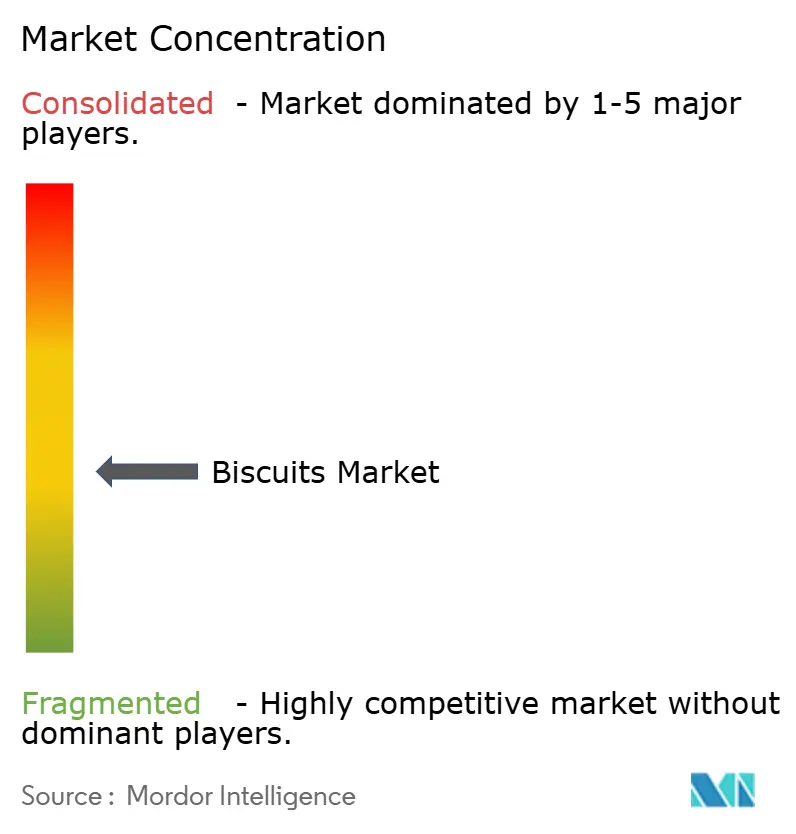
The moderately fragmented industry includes Mondelēz International Inc., Britannia Industries Limited, Parle Products Private Limited, Yıldız Holding A.Ş., and ITC Limited. Across its global operations, Mondelēz reported USD 18.39 billion in 2025 net revenue for its Biscuits & Baked Snacks category. Parle manufactures biscuits and confectionery, with biscuit brands including Parle-G, Monaco, Krackjack, 20-20 Cookies, and Hide & Seek. In April 2026, Yıldız Holding described an ecosystem spanning biscuits, chocolate, frozen food and packaging across 45 factories, including 25 in Türkiye. The leaders differ in kind, with Mondelēz reporting category revenue, Parle supplying a named biscuit range and Yıldız operating a broader factory network, so entrants face several incumbent models.
Britannia's process investments make factory economics part of biscuit competition. In FY2024-25, it installed energy-efficient direct gas-fired ovens on 3 production lines at Hajipur, Bihar, which were expected to reduce oven fuel and power consumption by up to 15%. The commercial value of that investment would come from improving the cost base of repeat production across the affected lines. If the expected oven savings are achieved, Britannia would have more room to defend its biscuit prices against challengers seeking the same retail orders.
ITC reported that Sunfeast Dark Fantasy was the leading overall biscuit brand in India's modern-trade channel in FY2025-26, with robust growth across its portfolio. This illustrates a competitive route built around a named brand's strength in a particular sales channel, allowing a supplier to concentrate its commercial proposition. Challengers need an equally defined reason for a retailer to allocate attention to their biscuits. China's biscuit production-license rules, effective January 1, 2027, make qualified trial-batch evidence part of market entry. For an entrant, regulatory readiness and a distinctive retail proposition address separate gates, so satisfying the licensing review alone cannot secure a retailer's shelf space.
Biscuits Industry Leaders
-
Mondelēz International Inc.
-
Britannia Industries Limited
-
Parle Products Private Limited
-
Yıldız Holding A.Ş.
-
ITC Limited
- *Disclaimer: Major Players sorted in no particular order
Biscuits Market Companies Covered in this Report
- Mondelēz International Inc.
- ITC Limited
- Britannia Industries Limited
- Parle Products Private Limited
- Yıldız Holding A.Ş.
- Mars, Incorporated
- Grupo Bimbo, S.A.B. de C.V.
- The Campbell's Company
- Lotus Bakeries NV
- Nestlé S.A.
- Bahlsen GmbH & Co. KG
- Walkers Shortbread Limited
- Fox’s Burton’s Companies (FBC) UK Limited
- PepsiCo Inc. (Gamesa)
- Orkla ASA (Göteborgs Kex)
- Grupo Arcor S.A.
- Universal Robina Corporation
- Lantmännen Unibake International
- Ferrero International S.A.
- Associated British Foods plc (Ryvita)
Key Opportunities for Market Participants
These opportunities distinguish consumer retail openings from adjacent institutional biscuit supply models. On January 21, 2025, Waitrose reported adding 18 products, including Sicilian lemon and white chocolate biscuits, to its 42-item FreeFrom range. That completed range expansion supports a retail proposition combining dietary suitability with a flavored sweet biscuit. Bangladesh's publicly funded school-feeding models below serve an adjacent institutional channel outside consumer retail and foodservice spending.
Market Opportunities Table of Biscuits Market
| Opportunity | Why now | Buyer / lead segment | Recommended play | Main barrier | Likely beneficiaries |
|---|---|---|---|---|---|
| Rangpur school biscuit supply | Closed 2026-27 biscuit tender was being processed | Selected Rangpur government primary schools | Prepare delivery mobilization if selected | Selection timing and delivery mobilization | Past program awardees, including PRAN Dairy Ltd. |
| Fortified-biscuit proposals for future menu decisions | Meal-program expansion planned by 2027 | School-feeding menu and procurement decisions | Present biscuit options when buyer requirements are issued | Acceptance of biscuits in the expanded menu | Fortified-biscuit suppliers |
| Multi-division biscuit delivery capability | Separate Rangpur and Dhaka biscuit tenders for 2026-27 | Directorate of Primary Education, divisional deliveries | Design delivery capacity around confirmed divisional orders | Reliable delivery across separate school areas | Suppliers able to document multi-division delivery capacity |
| Source: Mordor Intelligence | |||||
Bangladesh's Rangpur 2026-27 fortified-biscuit tender was being processed on October 20, 2026, after bids closed September 23 and its tentative October 5 supply start passed. Within consumer retail, UK online grocery sales through multiple grocers grew 9.9% and reached 13.5% of grocery sales in the four weeks ending December 27, 2025. This channel provides a route for a free-from biscuit proposition to reach grocery shoppers. The central retail opening combines dietary suitability and flavor with grocery distribution, giving the biscuit a defined place in a broader food assortment.
Recent Industry Developments in Biscuits Market
- Sep 2026: China's State Administration for Market Regulation issued revised biscuit production-license review rules, effective January 1, 2027.
- Sep 2026: Mondelēz International Inc. completed replacing rigid PET trays with FSC-certified paper trays across more than 115 cookie products in its European biscuits portfolio, covering 8 brands in over 25 European markets.
- Jun 2026: Mondelēz Brasil added Oreo Golden chocolate-flavor biscuits to its permanent Brazilian portfolio from June 15, combining vanilla-flavored wafers with chocolate-flavored filling.
Biscuits Market Report Scope and Research Methodology
Market Definition and Coverage
Biscuits market measures annual point-of-sale spending on packaged baked biscuits sold to consumers through retail and foodservice channels across Global markets. Sales are classified by biscuit type, package format, recipe category, point-of-sale channel, and geography.
Scope exclusions: Fresh, unpackaged bakery cookies sold loose, including in-store bakery counters, cakes and pastries, and separately sold wheat flour, sugar, oils, and other biscuit ingredients are excluded.
Segments Covered in This Report
- By Product Type
- Crackers and Savory Biscuits
- Sweet Biscuits
- Plain Biscuits
- Cookies
- Sandwich Biscuits
- Chocolate-Coated Biscuits
- Others
- By Packaging Type
- Boxes
- Plastic Packets/On-the-go Pouches
- Others
- By Category
- Conventional
- Free-From
- By Distribution Channel
- Supermarkets/Hypermarkets
- Convenience Stores
- Specialty and Gourmet Stores
- Online Retail Stores
- Other Distribution Channels
- By Geography
- North America
- United States
- Canada
- Mexico
- Rest of North America
- Europe
- Germany
- France
- United Kingdom
- Spain
- Netherlands
- Italy
- Sweden
- Poland
- Belgium
- Rest of Europe
- Asia-Pacific
- China
- India
- Japan
- Australia
- South Korea
- Indonesia
- Thailand
- SIngapore
- Rest of Asia-Pacific
- South America
- Brazil
- Argentina
- Colombia
- Chile
- Peru
- Rest of South America
- Middle East and Africa
- United Arab Emirates
- South Africa
- Nigeria
- Saudi Arabia
- Egypt
- Morocco
- Turkey
- Rest of Middle East and Africa
- North America
Data Sources, Market Sizing, and Validation
Desk Research
FAO's Global Information and Early Warning System Country Cereal Balance Sheets provide country and regional production, trade, food-use, and stock context, while FAOSTAT agricultural trade releases help check cross-border food flows. Eurostat harmonized consumer price indices and its food inflation releases help distinguish changes in nominal spending from price movement, and Codex Alimentarius standards inform product and labeling context. These sources are illustrative inputs for checking demand, price and regulatory conditions around the packaged biscuit market.
Company annual reports and regulatory filings provide category revenue, geographic exposure and investment disclosures where available, while company releases and reputable food-industry reporting help check product launches, capacity changes and channel developments. The named sources are not exhaustive, and further sources inform collection, validation and clarification.
Primary Interviews and Surveys
Interviews and structured surveys with biscuit manufacturers, retail and foodservice buyers, packaging specialists and distribution leaders can test secondary findings on purchase channels, product mix, prices and regional demand. Analysts compare respondent evidence with public company, trade and price indicators, then document differences by country, product type and channel. Where evidence is sparse, analysts identify the missing input, seek another qualified respondent or source, and triangulate the estimate using comparable markets and disclosed supplier data.
Distribution of primary research fieldwork respondents
| Company type | Respondent position | Region |
|---|---|---|
| Top tier: 34% | CXOs: 20% | APAC: 40% |
| Mid tier: 46% | Functional/Unit leaders: 38% | EMEA: 33% |
| Smaller Players: 20% | Managers: 42% | Americas: 27% |
Market-Sizing & Forecasting
The estimate starts top down with annual consumer spending on packaged biscuits across retail and foodservice in each country, then aggregates those country estimates to the global total. Analysts use five practical indicator groups: company filings for biscuit and baked-snack revenue and geographic exposure, cereal production and trade data for supply context, consumer price indices to separate price changes from spending growth, household income and population trends to inform demand, and public retail-channel or product-mix evidence to allocate sales by channel and biscuit type. Segment shares are built from disclosed category sales, product and channel evidence, and country demand patterns, with the evidence reconciled so product, packaging, category, channel and regional splits sum to the total. A multivariate regression can relate historical market growth to population, income, food prices and disclosed company sales, with scenario analysis used where the indicators point to materially different growth paths, and analysts then apply the selected growth assumptions through the 2027-2032 forecast period. Selective bottom-up checks multiply observed retail price ranges by estimated packaged-biscuit volumes in sampled markets and compare that result with supplier roll-ups, while interviews with market participants can test whether the variable-level forecasts fit local buying and selling conditions. When source observations are missing or inconsistent, analysts record the gap, use the closest comparable market or period with an explicit adjustment, and test the effect of that substitution before retaining the estimate.
Data Validation & Update Cycle
Analysts triangulate market totals and segment shares against independent company disclosures, trade and price series, channel indicators and respondent evidence, then investigate material variances by checking units, periods, country coverage and product definitions. A second review checks calculations, source dates, reconciliations and explanations, and analysts resolve anomalies before sign-off, with re-contact triggered when a respondent's account conflicts with a source or when a material input remains unexplained. The model is refreshed annually, updated between cycles after material events such as major acquisitions, regulatory changes or abrupt input-price shifts, and given a fresh source and calculation review before each delivery.
Mordor Intelligence's Biscuits Market Size Measured Against Other Published Estimates
Published estimates can differ in the transactions and products they count and the inputs used to model demand. Biscuits market measures annual point-of-sale spending on packaged baked biscuits sold to consumers through retail and foodservice channels across Global markets.
Key Gap Drivers include the study's defined coverage and market-specific modeling choices. Analysts use five practical indicator groups: company filings for biscuit and baked-snack revenue and geographic exposure, cereal production and trade data for supply context, consumer price indices to separate price changes from spending growth, household income and population trends to inform demand, and public retail-channel or product-mix evidence to allocate sales by channel and biscuit type.
Benchmark comparison
| Source | Market Size | Gaps in Research Methodology |
|---|---|---|
| Mordor Intelligence | USD 149.2 B (2027) | |
| Global Consultancy A | USD 111.08 B (2027) | At its 2027 base, this estimate is 25.6% below this report's 2027 value of USD 149.2 B. Its 2027 endpoint extends a forecast built from a 2018 baseline. |
| Global Consultancy B | USD 110.2 B (2027) | At its 2027 base, this estimate is 26.1% below this report's 2027 value of USD 149.2 B. Its forecast period begins in 2020 and carries that earlier outlook through 2027. |
Mordor Intelligence's analysts triangulate market totals and segment shares against independent company disclosures, trade and price series, channel indicators and respondent evidence, then investigate material variances by checking units, periods, country coverage and product definitions.
Key Questions Answered in the Report
What is the biscuits market size and growth outlook?
The size is USD 149.2 billion in 2027 and is forecast to reach USD 189.1 billion by 2032, at a 4.85% CAGR over 2027-2032.
What is driving demand for packaged biscuits?
Indulgent occasions and product innovation support demand. In March 2025, 64% of Canadian sweet baked goods consumers said they ate the category, including cookies or scones, to treat themselves.
Which biscuit product type leads sales?
Sweet biscuits led with 71.79% of biscuit spending in 2026. Crackers and savory biscuits are forecast to grow fastest at a 6.05% CAGR over 2027-2032.
Which companies are major biscuit competitors?
Major competitors include Mondelēz International Inc., Britannia Industries Limited, Parle Products Private Limited, Yıldız Holding A.Ş., and ITC Limited.
What advertising challenge do biscuit suppliers face?
In the United Kingdom, advertising for identifiable, qualifying less-healthy sweet biscuits is restricted on broadcast TV before 9 p.m. and paid online at any time.
Which regions lead biscuit sales and forecast growth?
Europe held 27.28% of biscuit spending in 2026. South America is forecast to grow fastest at a 6.65% CAGR over 2027-2032.