
Automotive Side Window Sunshades Market Size and Share
Market Overview
| Study Period | 2019 - 2031 |
|---|---|
| Market Size (2026) | USD 4 Billion |
| Market Size (2031) | USD 5.38 Billion |
| Growth Rate (2026 - 2031) | 6.10 % |
| Fastest Growing Market | Asia-Pacific |
| Largest Market | Asia Pacific |
| Market Concentration | Medium |
Major Players *Disclaimer: Major Players sorted in no particular order Image © Mordor Intelligence. Reuse requires attribution under CC BY 4.0. | |
Automotive Side Window Sunshades Market Analysis by Mordor Intelligence
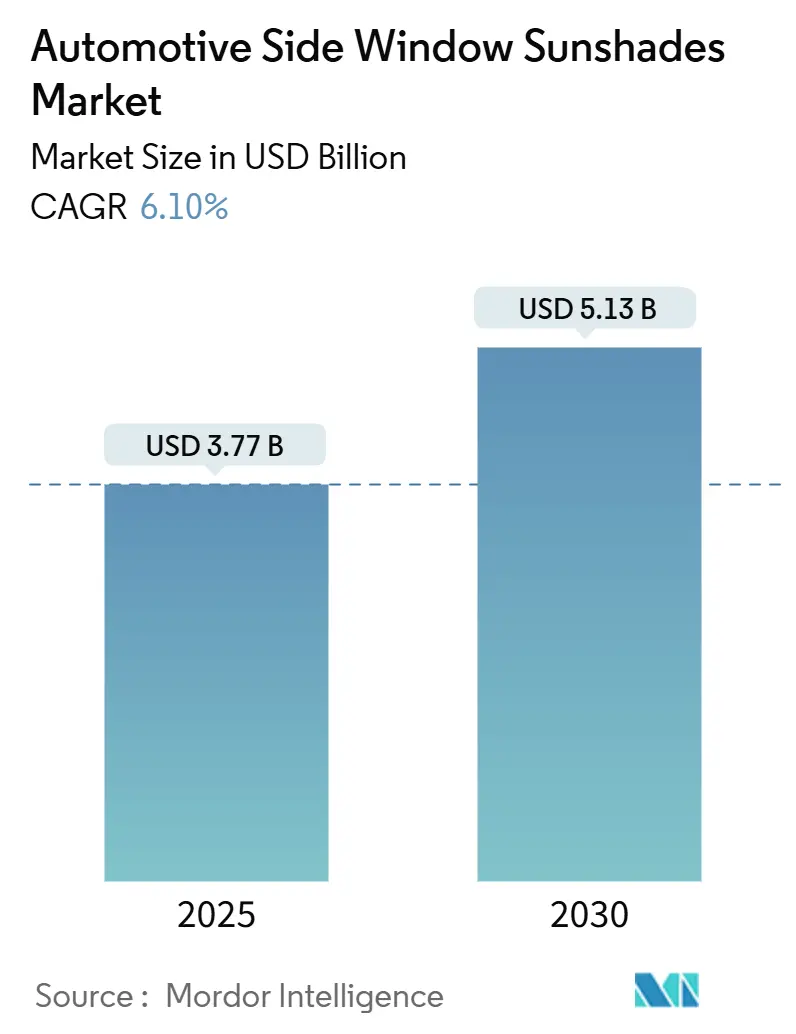
The automotive window sunshades market size was valued at USD 3.77 million in 2025 and estimated to grow from USD 4.00 billion in 2026 to reach USD 5.38 billion by 2031, at a CAGR of 6.10% during the forecast period (2026-2031). Demand is supported by stronger attention to cabin heat, ultraviolet exposure, and passenger comfort, especially in larger passenger vehicles. The automotive window shades market also benefits from SUV and crossover sales, which increase the amount of rear-passenger glass requiring coverage. OEMs are treating shades as part of cabin-comfort packages on mid-range and premium vehicles, while online channels make model-specific products easier to find. Electric vehicles add a practical use case because reducing solar heat can lower air-conditioning demand and support driving range. Factory-integrated dimmable glass remains a competitive risk because it can replace removable shades on higher-priced vehicles.
Key Report Takeaways
- By material type, recycled polyester held 45.23% of the automotive side window sunshades market share in 2025 and is on track to expand at a 9.82% CAGR through 2031.
- By product type, retractable shades led with 38.17% revenue share in 2025, while magnetic shades are forecast to grow the fastest at an 11.24% CAGR to 2031.
- By application, side window solutions accounted for 62.08% of the automotive side window sunshades market in 2025 and are projected to continue advancing at an 8.63% CAGR through 2031.
- By vehicle type, electric passenger cars commanded a 55.12% share of the automotive side window sunshades market size in 2025 and are set to expand at a 12.43% CAGR between 2026 and 2031.
- By sales channel, OEM distribution held 68.05% share in 2025, with a projected 10.11% CAGR to 2031.
- By geography, Asia-Pacific accounted for 34.09% of the automotive side window sunshades market size in 2025 and is projected to record a 9.72% CAGR through 2031.
Note: Market size and forecast figures in this report are generated using Mordor Intelligence’s proprietary estimation framework, updated with the latest available data and insights as of January 2026.
Market Trends and Insights
Drivers Impact Analysis of Automotive Side Window Sunshades Market*
| Driver | (~) % Impact on CAGR Forecast | Geographic Relevance | Impact Timeline |
|---|---|---|---|
| Surge in UV and Heat-Protection Regulations for Child/Passenger Safety | +1.8% | Global, with strongest enforcement in EU and North America | Medium term (2–4 years) |
| Rapid SUV and Crossover Sales Boosting Side-Window Accessory Uptake | +1.2% | North America and Asia-Pacific core, spill-over to Europe | Short term (≤ 2 years) |
| Aftermarket E-Commerce Boom for Vehicle Interior Add-Ons | +1.5% | Global, led by North America and Europe | Short term (≤ 2 years) |
| Magnet-Snap Quick-Fit Designs Driving Repeat Purchases | +0.9% | Global, with early adoption in Australia and North America | Medium term (2–4 years) |
| Ride-Hailing and Subscription Fleets Demanding Removable Shades | +0.7% | Asia-Pacific and North America urban centers | Long term (≥ 4 years) |
| Emerging Solar-Reflective Smart Textiles Enabling IoT Integration | +0.6% | Europe and North America, expanding to Asia-Pacific | Long term (≥ 4 years) |
| Source: Mordor Intelligence | |||
Surge in UV and Heat-Protection Regulations for Child/Passenger Safety
Regulatory frameworks governing child passenger protection are reshaping market demand through mandatory safety standards and enhanced testing protocols. The NHTSA's updated Federal Motor Vehicle Safety Standard No. 213b, effective December 2026, establishes stricter child restraint system requirements that indirectly influence side window accessory design and installation. These regulations mandate that aftermarket accessories cannot obstruct required child restraint anchorages, belt routing, or visibility zones, creating design constraints that favor integrated OEM solutions over retrofit products. Australian Radiation Protection and Nuclear Safety Agency testing has validated UV blocking capabilities up to 84.6% for advanced textile materials, establishing performance benchmarks that drive premium product development[1]. The regulatory emphasis on child safety creates sustainable demand drivers, as compliance requirements cannot be easily circumvented through alternative technologies. Market participants must navigate complex certification processes while maintaining cost competitiveness, particularly as regulations extend beyond traditional automotive markets into ride-sharing and commercial fleet applications.
Rapid SUV and Crossover Sales Boosting Side-Window Accessory Uptake
SUV and crossover vehicle architectures inherently create larger side window surfaces and elevated seating positions that amplify solar heat gain and UV exposure challenges, driving demand in the automotive side window sunshades market. These vehicles' higher ground clearance and expansive glazing areas generate approximately 25% more interior heat buildup compared to traditional sedans, driving accessory attachment rates significantly above passenger car averages. The trend toward panoramic sunroofs and larger side windows in premium SUV segments creates additional demand for coordinated shading solutions that complement factory-installed roof systems. Consumer behavior analysis reveals SUV owners demonstrate 40% higher propensity for aftermarket interior accessories compared to sedan owners, reflecting both higher disposable income and greater concern for passenger comfort during extended travel periods. Fleet operators managing SUV-heavy rental and ride-sharing services increasingly specify removable shading solutions to maintain vehicle resale value while addressing diverse passenger preferences across different geographic markets and seasonal conditions.
Aftermarket E-Commerce Boom for Vehicle Interior Add-Ons
Digital commerce transformation has fundamentally reshaped automotive accessory distribution, with e-commerce channels, including major platforms such as Amazon and eBay, experiencing strong growth [2]. Vehicle-specific fitment tools and guaranteed compatibility programs have reduced consumer purchase risk, enabling direct-to-consumer sales models that bypass traditional dealer networks. AI-driven demand forecasting and inventory optimization allow suppliers to maintain broader SKU portfolios while reducing stockout risks, particularly for seasonal products like sunshades that experience pronounced summer demand spikes. The shift toward DIY installation preferences, accelerated by online instructional content and simplified mounting systems, has expanded the addressable market beyond professional installation channels. E-commerce platforms provide valuable consumer behavior data that enables targeted marketing for specific vehicle models, geographic regions, and seasonal patterns, creating competitive advantages for suppliers who effectively leverage digital analytics.
Magnet-Snap Quick-Fit Designs Driving Repeat Purchases
Patent innovations in magnetic attachment systems have revolutionized installation convenience while addressing consumer concerns about adhesive damage to vehicle surfaces in the automotive side window sunshades market. Frameless window patent clips and smart magnetic mounting systems enable tool-free installation that can be completed in under 60 seconds, significantly reducing adoption barriers compared to traditional clip-on or suction cup designs. These systems maintain attachment integrity at highway speeds up to 70 km/h while allowing partial window operation, addressing safety and convenience concerns that previously limited market penetration. The removable nature of magnetic systems creates repeat purchase opportunities as consumers upgrade vehicles or replace worn components, generating higher lifetime customer value compared to permanent installation solutions. Advanced magnetic materials resist demagnetization from temperature extremes and electromagnetic interference, addressing early adoption concerns about compatibility with vehicle sensors and electronic systems that increasingly populate modern side window areas.
Restraints Impact Analysis of Automotive Side Window Sunshades Market*
| Restraint | (~) % Impact on CAGR Forecast | Geographic Relevance | Impact Timeline |
|---|---|---|---|
| Substitution by Factory-Tinted or Laminated Glass | -1.4% | Global, with strongest impact in premium vehicle segments | Medium term (2–4 years) |
| Price Sensitivity in Developing Markets | -0.8% | Asia-Pacific emerging markets, Latin America, Africa | Short term (≤ 2 years) |
| Magnet Interference Risk with Window/ADAS Sensors | -0.6% | Global, concentrated in vehicles with advanced driver assistance | Long term (≥ 4 years) |
| End-of-Life Recyclability Concerns for Multi-Material Shades | -0.4% | Europe and North America, expanding globally | Long term (≥ 4 years) |
| Source: Mordor Intelligence | |||
Substitution by Factory-Tinted or Laminated Glass
OEM integration of advanced glazing technologies presents the most significant structural threat to aftermarket sunshade demand in the automotive side window sunshades market, as automakers increasingly specify factory-tinted and laminated glass with integrated UV protection capabilities. Webasto's development of switchable PDLC glazing and glass-panel integrated shading systems demonstrates the industry's progression toward multifunctional glazing solutions that eliminate the need for separate accessories. Premium vehicle segments already incorporate electrochromic glass and solar-reflective coatings that provide comparable UV protection while maintaining unobstructed window surfaces required for advanced driver assistance systems. The cost differential between factory-integrated solutions and aftermarket accessories continues to narrow as glazing technologies achieve economies of scale, particularly in electric vehicle platforms, where weight reduction and aerodynamic efficiency favor integrated approaches. Regulatory compliance advantages of factory-integrated systems, which undergo comprehensive crash testing and certification processes, create additional barriers for aftermarket solutions that must demonstrate non-interference with safety systems and occupant protection mechanisms.
Price Sensitivity in Developing Markets
Economic constraints in emerging markets limit the adoption of premium sunshade solutions, creating downward pressure on average selling prices and profit margins across the automotive side window sunshades market. Currency volatility and import tariff structures in developing regions make imported accessories particularly vulnerable to price competition from local manufacturers who may not maintain equivalent quality standards or regulatory compliance. The prevalence of older vehicle fleets in these markets reduces compatibility with advanced magnetic mounting systems designed for modern window profiles and electronic architectures. Consumer purchasing patterns in price-sensitive markets favor basic functionality over premium features like smart textiles or IoT integration, limiting opportunities for value-added product differentiation. Distribution challenges in rural and semi-urban areas restrict e-commerce penetration, maintaining dependence on traditional retail channels with higher cost structures and limited product selection that constrains market development potential.
*Our forecasts treat driver/restraint impacts as directional, not additive. The impact forecasts reflect baseline growth, mix effects, and variable interactions.
Automotive Side Window Sunshades Market Segment Analysis
By Material Type:
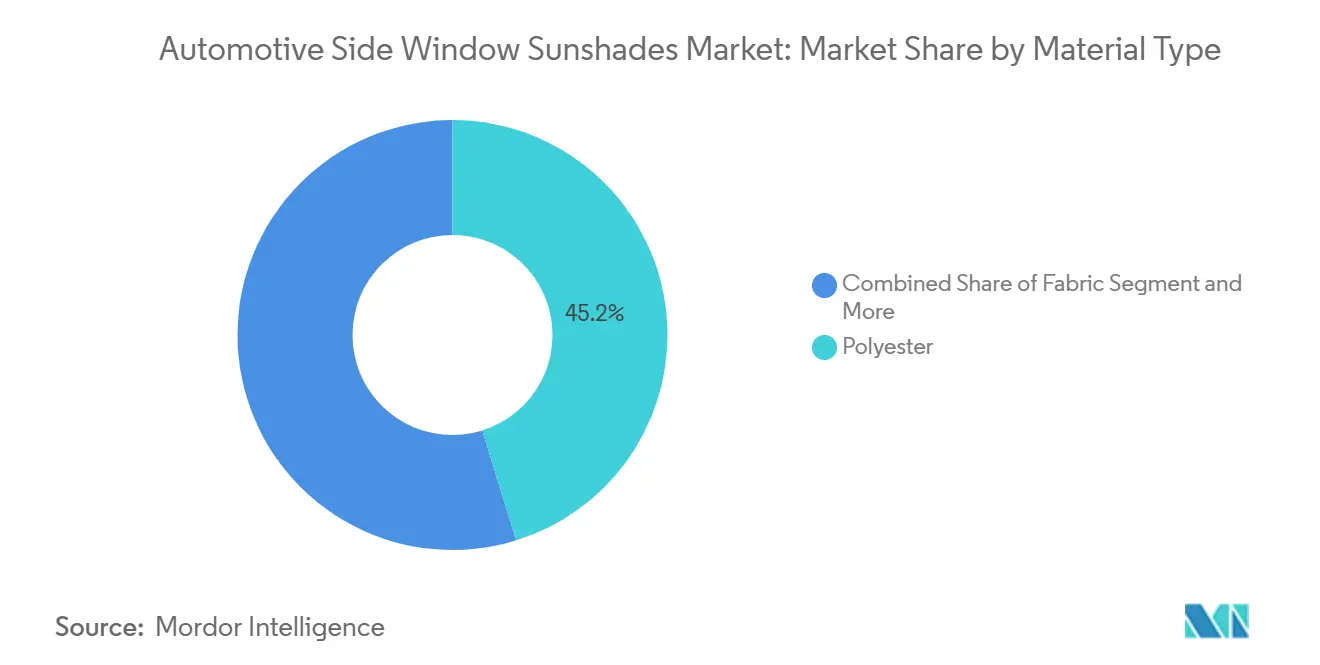
Recycled Polyester Leads Sustainability TransitionRecycled polyester dominates material segmentation with 45.23% market share in 2025 while achieving the fastest growth at 9.82% CAGR through 2031, reflecting the automotive industry's accelerating commitment to circular economy principles. This dual market position stems from Continental's expansion of ContiRe.Tex recycled PET yarn production across multiple European facilities, demonstrating scalable manufacturing processes that maintain performance standards while incorporating up to 15 recycled bottles per automotive component. Fabric materials capture secondary market share through traditional and nonwoven applications, while plastic components serve structural and mounting functions across all product categories. Foam materials occupy niche applications in premium insulated sunshades, where thermal performance justifies higher material costs.
The material landscape is evolving in response to regulatory compliance requirements. The EU End-of-Life Vehicle Directive requires the use of recycled plastics, including content sourced from automotive closed-loop streams. Advanced recycling technologies enable post-consumer recycled polyester to achieve performance comparable to virgin materials in UV stability, colorfastness, and mechanical properties required for automotive applications. Freudenberg Performance Materials’ Lutraflor recycled polyester nonwovens offer lower weight than traditional materials while maintaining dimensional stability and acoustic performance. Supply chain innovations, including take-back programs and industrial recycling partnerships, are creating reliable feedstock streams for automotive-grade recycled materials. These developments provide a competitive advantage to suppliers that invest in circular economy infrastructure.

By Product Type:
Magnetic Innovation Drives Market EvolutionMagnetic shades emerge as the fastest-growing product segment, with an 11.24% CAGR through 2031, while retractable shades maintain the largest market share at 38.17% in 2025. This growth differential reflects consumer preference for installation convenience and vehicle surface protection, as magnetic systems eliminate adhesive residue and tool requirements that historically limited adoption. Patent developments in frameless window attachment technology enable secure mounting without visible hardware, addressing aesthetic concerns while maintaining functionality at highway speeds. Static shades serve price-sensitive market segments where permanent installation is acceptable, while roller shades occupy premium applications requiring precise light control and compact storage.
Product development trends emphasize multifunctionality and smart integration capabilities, as suppliers incorporate IoT sensors and solar-reflective materials that respond to environmental conditions. The automotive industry's progression toward autonomous vehicles creates opportunities for reconfigurable shading solutions that adapt to non-traditional seating orientations, as demonstrated by Magna's flexible interior concepts for ride-sharing applications. Regulatory compliance considerations increasingly influence product design, as FMVSS standards require accessories to maintain visibility zones and avoid interference with safety systems, favoring solutions that integrate seamlessly with vehicle architectures rather than aftermarket retrofits.
By Application:
Side Window Dominance Reflects Core Market FocusSide window applications command 62.08% market share in 2025 while growing at 8.63% CAGR through 2031, reflecting the segment's core value proposition of passenger protection and comfort enhancement. This application's focus stems from the side windows' direct exposure to lateral solar radiation during extended travel periods, which creates the most pronounced passenger discomfort and UV exposure risks. Front-window applications remain constrained by visibility regulations and driver-safety requirements, while rear-window solutions compete with factory-installed privacy glass and integrated defrosting systems. The side window segment benefits from regulatory clarity, as FMVSS No. 111 rear-visibility standards provide specific guidance on permissible obstruction levels, enabling compliant product development.
Application-specific innovation focuses on sensor compatibility and ADAS integration, as modern vehicles incorporate cameras, radar, and lidar systems in window areas that require unobstructed operation. Smart sunshade designs incorporate cutouts and transparent zones that maintain sensor functionality while providing passenger protection, addressing the fundamental tension between comfort and safety technology requirements. Fleet applications drive demand for removable solutions that facilitate vehicle cleaning and maintenance while accommodating diverse passenger preferences across ride-sharing and rental use cases.
By Vehicle Type:
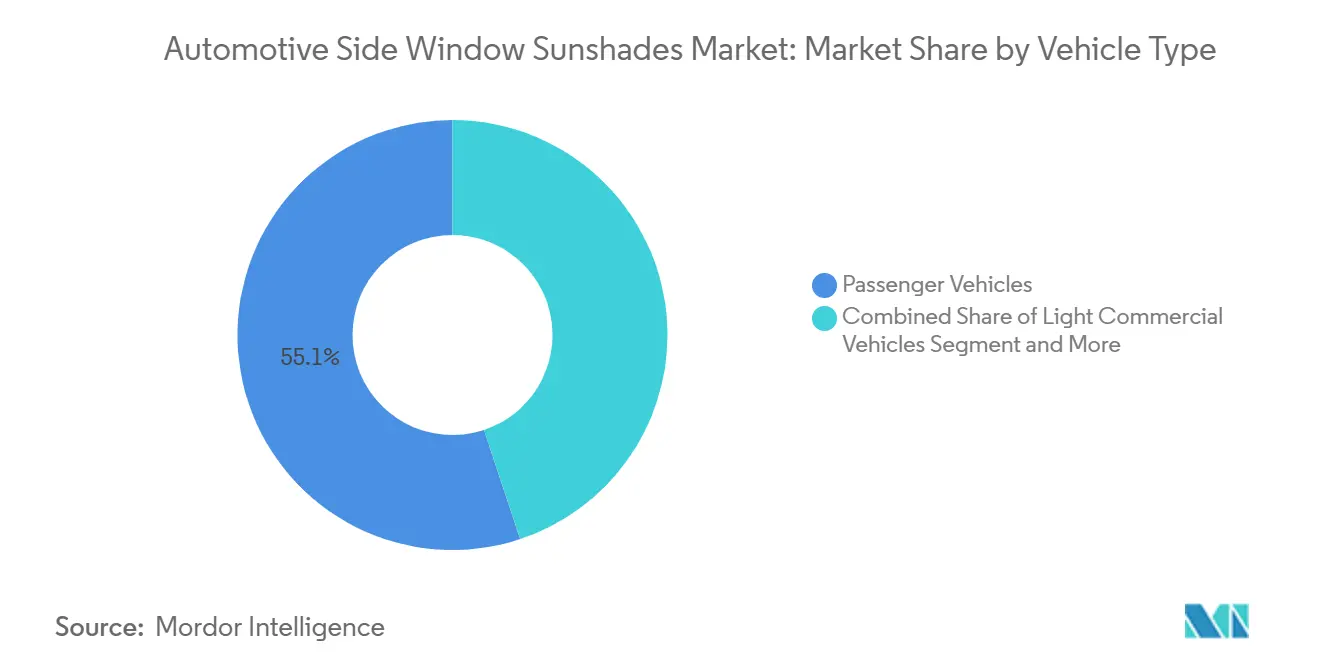
Electric Vehicles Accelerate Market GrowthPassenger Vehicles represent 55.12% of vehicle-type segmentation in 2025 and achieve the fastest growth at a 12.43% CAGR through 2031, driven by global EV adoption rates and enhanced cabin comfort requirements in battery-powered vehicles. EV architectures create unique thermal management challenges, as traditional engine waste heat is unavailable for cabin warming, making solar heat gain control more critical for energy efficiency and range optimization. China’s growing electric vehicle (EV) market penetration is expected to drive substantial volume growth for accessories that improve EV usability. Light commercial vehicles (LCVs) and medium- and heavy-duty commercial vehicles serve specialized applications in which driver comfort and cargo protection support premium accessory investments.
The transition to electric vehicles creates opportunities for integrated smart shading solutions that communicate with vehicle thermal management systems to optimize energy consumption while maintaining passenger comfort. Advanced material development focuses on lightweight solutions that minimize the impact on EV range, while smart textiles enable dynamic opacity control based on battery status and climate conditions. Commercial vehicle applications increasingly specify removable shading systems to support fleet management and vehicle utilization across diverse operating environments and regulatory jurisdictions.
By Sales Channel:
OEM Integration Gains MomentumOEM channels maintain a 68.05% market share in 2025, with 10.11% growth through 2031, reflecting automakers' strategic shift toward factory-integrated solutions to ensure regulatory compliance and warranty coverage. This channel dominance stems from OEMs' ability to integrate shading systems during vehicle assembly, achieving cost efficiencies and quality control that aftermarket solutions cannot match. Aftermarket channels serve replacement and upgrade markets, particularly for older vehicles lacking factory-installed solutions and consumers seeking customization options beyond OEM specifications. The channel split reflects broader automotive industry trends toward vertical integration and supplier consolidation, favoring established tier-one relationships over fragmented aftermarket competition.
E-commerce transformation in aftermarket channels is driven by vehicle-specific fitment tools and guaranteed-compatibility programs that reduce consumers’ purchase risk. Digital platforms support direct-to-consumer sales models that bypass traditional dealer networks while generating valuable consumer behavior data for targeted marketing and inventory optimization. Partnerships between OEMs and aftermarket suppliers are creating hybrid distribution models that leverage factory integration capabilities while preserving aftermarket flexibility and customization options.
Geography Analysis
APAC Automotive Side Window Sunshades Market
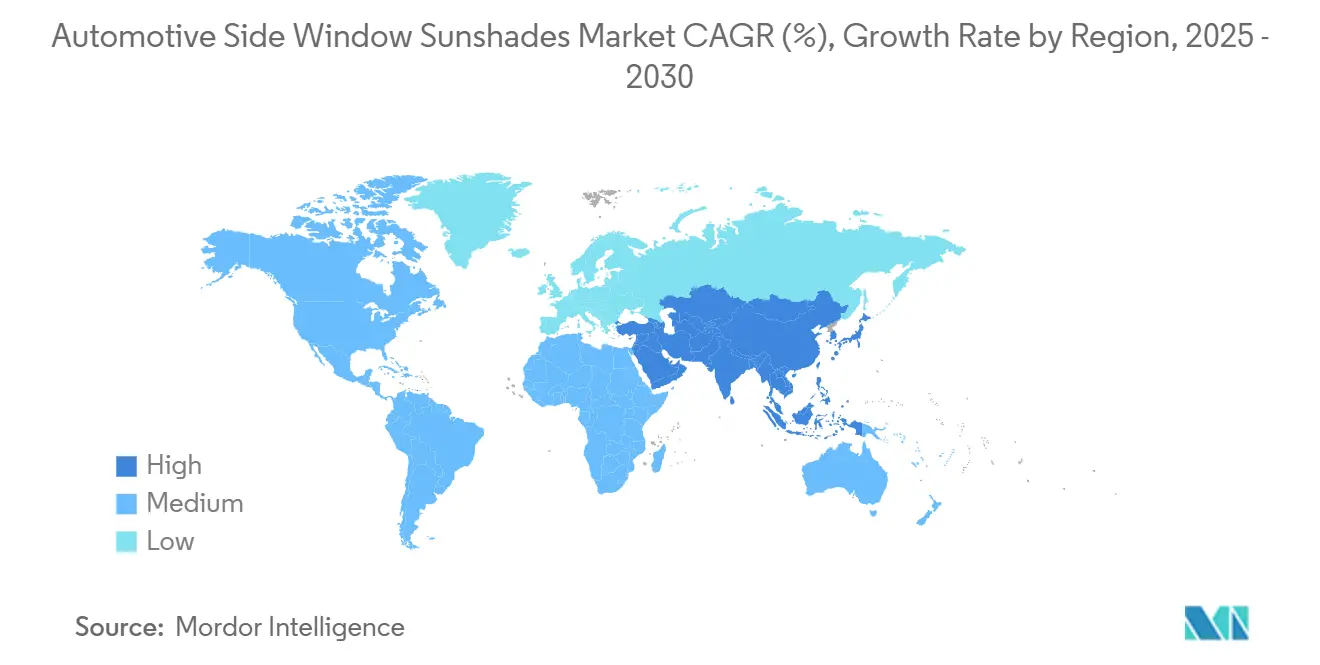
Asia-Pacific commands 34.09% market share in 2025 while expanding at 9.72% CAGR through 2031, driven by China's automotive market growth and accelerating electric vehicle adoption that creates enhanced demand for cabin comfort accessories. China's domestic vehicle market is expected to expand, with electric vehicles accounting for a significant share of sales. This growth will create substantial volume opportunities for integrated and aftermarket sunshade solutions. The region's manufacturing cost advantages and established supply chain infrastructure support domestic consumption and global export markets. China is a major exporter of passenger vehicles. Japan and South Korea contribute through advanced materials technologies and premium vehicle segments, while India represents an emerging growth market driven by rising disposable incomes and urbanization. Regional regulatory frameworks increasingly emphasize child safety and UV protection standards aligned with global best practices, creating standardized demand drivers across diverse national markets.
North America and Europe Automotive Side Window Sunshades Market
North America and Europe represent mature markets with established regulatory frameworks and premium product demand that emphasizes quality, safety compliance, and sustainable materials. These regions drive innovation in smart textiles, IoT integration, and circular economy solutions, as demonstrated by FORVIA's MATERI'ACT division's development of recycled and bio-based automotive materials that achieve up to 90% CO2 reduction compared to traditional alternatives. European markets particularly benefit from stringent End-of-Life Vehicle regulations that mandate recycled content and create competitive advantages for suppliers who invest in sustainable manufacturing processes. North American markets demonstrate strong e-commerce adoption and DIY installation preferences that favor magnetic mounting systems and simplified product designs, while maintaining premium pricing for advanced features and materials.
South America and MEA Automotive Side Window Sunshades Market
South America, the Middle East, and Africa present emerging opportunities, driven by rising vehicle ownership and growing awareness of the benefits of UV protection. However, price sensitivity and distribution challenges constrain near-term growth. These regions benefit from exports from established manufacturing hubs, particularly China, which supports product availability across Russia and the Middle East markets. Regional climatic conditions generate strong demand for solar protection solutions, while economic development and infrastructure improvements gradually expand the addressable market and distribution reach.
Competitive Landscape
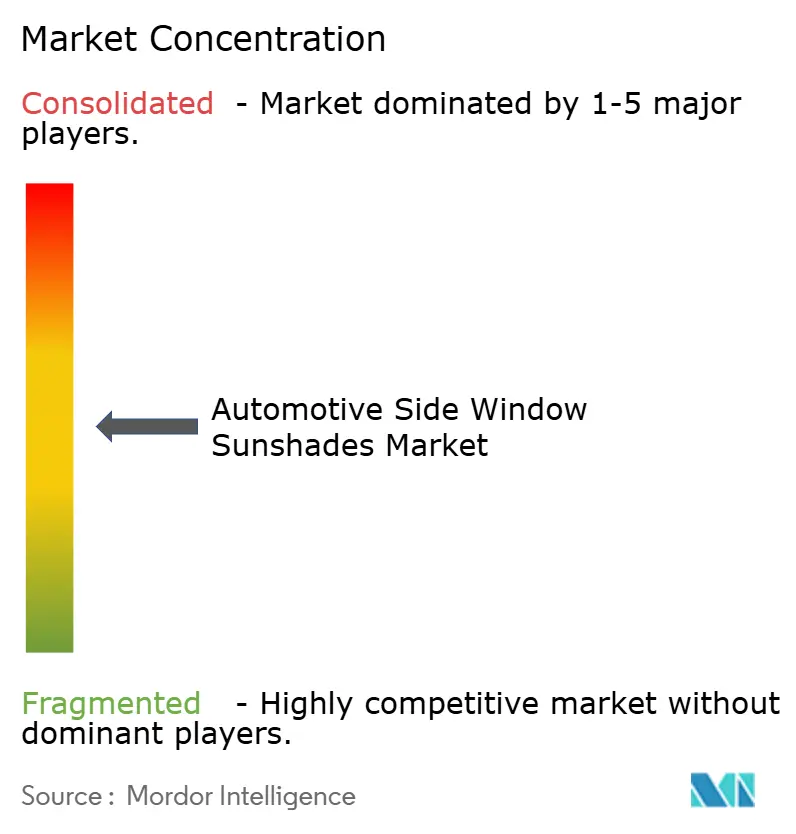
The automotive side window sunshades market exhibits moderate concentration with fragmented competition among specialized suppliers, established automotive tier-one companies, and emerging direct-to-consumer brands. Market leaders leverage patent portfolios and regulatory compliance expertise to maintain competitive advantages, as demonstrated by patent filings for semi-automatic sunshade mechanisms and magnetic attachment systems that create barriers to entry for new participants. Established players like Magna International and Webasto possess integration capabilities and OEM relationships that enable factory-installed solutions, while specialized suppliers focus on aftermarket channels and premium materials innovation. The competitive landscape increasingly rewards suppliers who demonstrate sustainability credentials and circular economy compliance, as automotive OEMs prioritize partnerships with vendors who support their environmental commitments and regulatory requirements.
Technology adoption patterns reveal strategic differentiation through smart materials, IoT integration, and advanced manufacturing processes that enable mass customization and vehicle-specific fitment. Companies invest in AI-driven demand forecasting and inventory optimization to manage seasonal demand variations and complex SKU portfolios across diverse vehicle platforms and geographic markets. White-space opportunities exist in autonomous vehicle applications, fleet management solutions, and integrated smart cabin systems that coordinate shading with thermal management and occupant monitoring technologies. Emerging disruptors leverage e-commerce platforms and direct-to-consumer models to capture market share from traditional distribution channels, while established players respond through digital transformation initiatives and partnership strategies that combine manufacturing scale with digital marketing capabilities.
Automotive Side Window Sunshades Industry Leaders
-
Macauto Group
-
BOS Group
-
Magna International
-
Webasto SE
-
Ashimori Industry
- *Disclaimer: Major Players sorted in no particular order
Automotive Side Window Sunshades Market Companies Covered in this Report
- Macauto Group
- BOS Group
- Magna International
- Webasto SE
- Ashimori Industry
- Continental AG
- Inteva Products
- Yashow Industrial
- Snap Shades
- Trokot
- RVSunshades
- Car Shades (Australia)
- Intro-Tech Automotive
- Cartine Car Accessories
- Ningbo Great Industry
- OAD4x4
- X-Car Australia
- Dr Shadez
- Fresh Promotions
- Hunter Douglas Automotive
- Levolor (Automotive Fabrics)
- Comfortex (Automotive Mesh)
- Solarplexius
- WindowSox
Recent Industry Developments in Automotive Side Window Sunshades Market
- August 2026: NDR Auto Components announced that its NDR Hayashi joint venture in Bengaluru began operations in June 2026 to manufacture sunshades. The joint venture also plans to launch ambient-lighting programs for Maruti Suzuki models in 2028.
- July 2026: Volkswagen of America (VWoA) announced U.S. pricing for the all-new 2027 Atlas. The redesigned midsize SUV starts at USD 41,610 for front-wheel-drive models and USD 43,610 for all-wheel-drive models. The second-generation Atlas features updated exterior styling, a redesigned interior, and an upgraded 2.0-liter engine that improves performance and fuel efficiency. Volkswagen has also expanded standard features across the lineup to include a power tailgate, rear sunshades, dual wireless phone charging, Park Distance Control, and enhanced driver-assistance technologies.
Global Automotive Side Window Sunshades Market Report Scope
The Automotive Sun Shades Market is Segmented by Material (Fabric, Polyester, Plastic, and Foam), Product Type (Roller, Magnetic, Static, and Retractable), Application (Front, Side, and Rear Window), Vehicle Type (Passenger, Light Commercial, and Medium and Heavy Commercial Vehicles), Sales Channel (OEM and Aftermarket), and Geography (North America, South America, Europe, Asia-Pacific, and Middle East and Africa). Forecasts in Terms of Value (USD).
| Fabric |
| Polyester |
| Plastic |
| Foam |
| Roller Shades |
| Magnetic Shades |
| Static Shades |
| Retractable Shades |
| Front Window |
| Side Window |
| Rear Window |
| Passenger Vehicles |
| Light Commercial Vehicles |
| Medium and Heavy Commercial Vehicles |
| OEM |
| Aftermarket |
| North America | United States |
| Canada | |
| Rest of North America | |
| South America | Brazil |
| Argentina | |
| Rest of South America | |
| Europe | United Kingdom |
| Germany | |
| Spain | |
| Italy | |
| France | |
| Russia | |
| Rest of Europe | |
| Asia-Pacific | India |
| China | |
| Japan | |
| South Korea | |
| Rest of Asia-Pacific | |
| Middle-East and Africa | United Arab Emirates |
| Saudi Arabia | |
| Turkey | |
| Egypt | |
| South Africa | |
| Rest of Middle-East and Africa |
| By Material Type | Fabric | |
| Polyester | ||
| Plastic | ||
| Foam | ||
| By Product Type | Roller Shades | |
| Magnetic Shades | ||
| Static Shades | ||
| Retractable Shades | ||
| By Application | Front Window | |
| Side Window | ||
| Rear Window | ||
| By Vehicle Type | Passenger Vehicles | |
| Light Commercial Vehicles | ||
| Medium and Heavy Commercial Vehicles | ||
| By Sales Channel | OEM | |
| Aftermarket | ||
| By Geography | North America | United States |
| Canada | ||
| Rest of North America | ||
| South America | Brazil | |
| Argentina | ||
| Rest of South America | ||
| Europe | United Kingdom | |
| Germany | ||
| Spain | ||
| Italy | ||
| France | ||
| Russia | ||
| Rest of Europe | ||
| Asia-Pacific | India | |
| China | ||
| Japan | ||
| South Korea | ||
| Rest of Asia-Pacific | ||
| Middle-East and Africa | United Arab Emirates | |
| Saudi Arabia | ||
| Turkey | ||
| Egypt | ||
| South Africa | ||
| Rest of Middle-East and Africa | ||
Key Questions Answered in the Report
What is the current value of the automotive side window sunshades market?
The market is valued at USD 3.77 billion in 2025, growing toward USD 5.38 billion by 2031.
Which material leads demand for side window sunshades?
Recycled polyester dominates with 45.23% share and the fastest 9.82% CAGR.
How fast is the magnetic shade segment expanding?
Magnetic shades are forecast to grow at an 11.24% CAGR, the quickest among product types.
Why are electric vehicles important to shade suppliers?
Electric passenger cars hold 55.12% segment share and need shades to limit HVAC load, growing at a 12.43% CAGR.
Which region offers the strongest growth outlook?
Asia-Pacific leads with 34.09% share and is projected to advance at a 9.72% CAGR through 2031.