
Automotive Heat Shield Market Size and Share
Market Overview
| Study Period | 2020 - 2031 |
|---|---|
| Market Size (2026) | USD 14.01 Billion |
| Market Size (2031) | USD 17.69 Billion |
| Growth Rate (2026 - 2031) | 4.77 % |
| Fastest Growing Market | Asia Pacific |
| Largest Market | Asia Pacific |
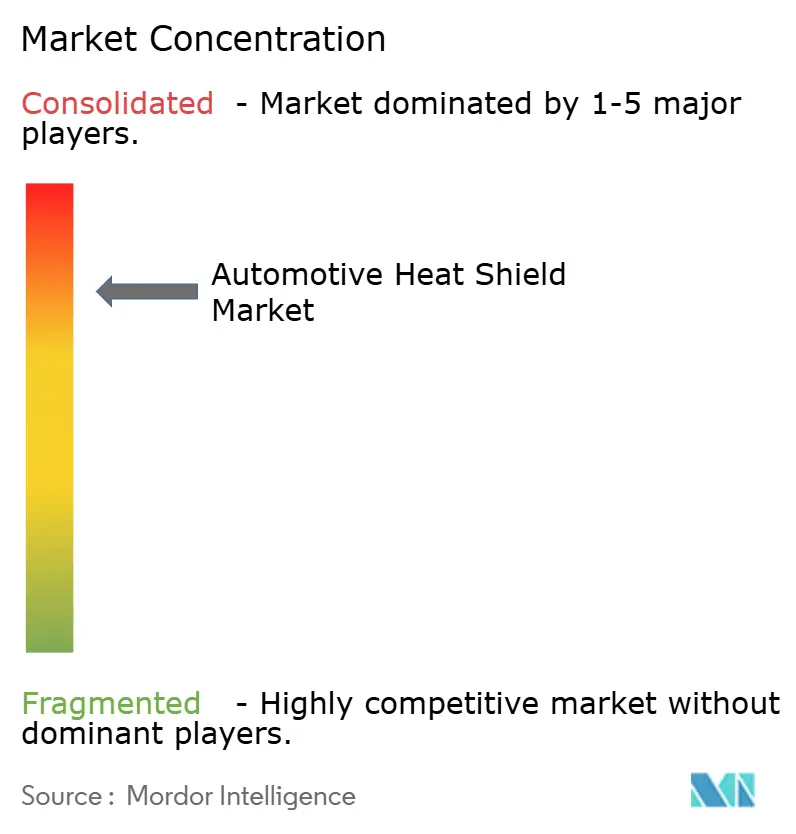
| Market Concentration | High |
Major Players *Disclaimer: Major Players sorted in no particular order Image © Mordor Intelligence. Reuse requires attribution under CC BY 4.0. | |
Automotive Heat Shield Market Analysis by Mordor Intelligence
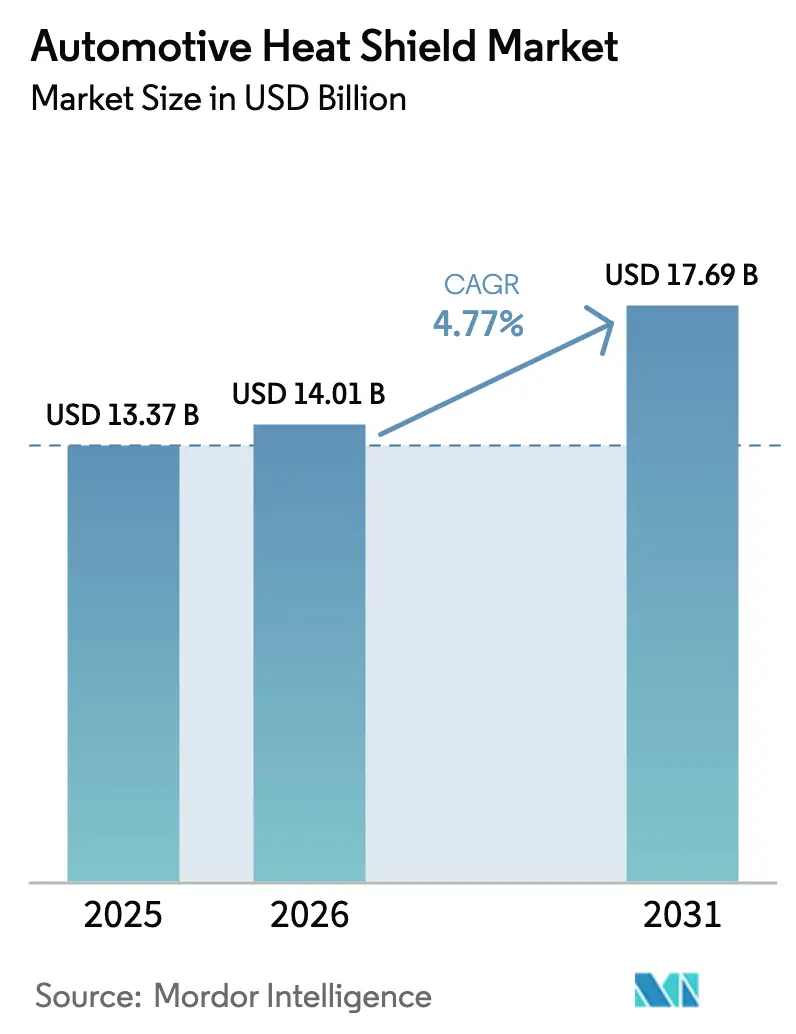
The Automotive Heat Shield Market size was valued at USD 13.37 billion in 2025 and estimated to grow from USD 14.01 billion in 2026 to reach USD 17.69 billion by 2031, at a CAGR of 4.77% during the forecast period (2026-2031). Stricter emissions regulations and a swift pivot to electric powertrains are shaping the industry's trajectory. Across all vehicle classes, automakers prioritize thermal protection, driven by battery safety mandates, lightweighting goals, and innovative materials. They're adopting composite materials and smart sensors to reduce weight, maintain catalytic converter efficiency, and protect lithium-ion batteries during quick charges. Concurrently, larger tier-one suppliers leverage scale benefits, diversify their material portfolios, and employ hedging strategies.
Key Report Takeaways
- By component type, Engine Compartment Shields held 79.02% of the automotive heat shield market share in 2025, while Battery & Power-Electronics Shields are projected to expand at a 11.62% CAGR through 2031.
- By sales channel, OEM deliveries commanded an 84.05% share of the automotive heat shield market in 2025, whereas the aftermarket is advancing at an 7.72% CAGR through 2031.
- By vehicle type, passenger cars accounted for 62.58% of the automotive heat shield market size in 2025, and light commercial vehicles posted the fastest growth with 13.86% CAGR during the 2026-2031 period.
- By material, Metallic Heat Shields accounted for 86.45% of the automotive heat-shield market in 2025, while Non-metallic/Composite Heat Shields are projected to grow the fastest, at an 8.18% CAGR through 2031.
- By product structure, Single-Shell designs dominated with a 55.52% share in 2025, whereas Sandwich-Composite shields are expected to register the quickest expansion, rising at a 6.98% CAGR to 2031.
- By form, Rigid heat shields captured roughly 68.84% of 2025 revenues, while Flexible formats are forecast to outpace them, advancing at a 6.08% CAGR over the same period.
- By vehicle propulsion, ICE-powered vehicles still led with about 88.95% of heat-shield demand in 2025, but Battery-Electric-Vehicle applications are set to surge ahead with a 13.72% CAGR through 2031.
- By region, Asia-Pacific captured 46.48% revenue share of the automotive heat shield market in 2025; the same region is projected to grow at a 9.21% CAGR to 2031.
Note: Market size and forecast figures in this report are generated using Mordor Intelligence’s proprietary estimation framework, updated with the latest available data and insights as of 2026.
Global Automotive Heat Shield Market Trends and Insights
Drivers Impact Analysis*
| Driver | (~) % Impact on CAGR Forecast | Geographic Relevance | Impact Timeline |
|---|---|---|---|
| Stricter Emission & Fuel Economy Rules | +1.2% | North America & Europe, with spillover to China & India | Medium term (2-4 years) |
| Hybrid / EV Thermal Demand Surge | +1.8% | Global, with concentration in Europe & China | Long term (≥ 4 years) |
| Lightweight Aluminum & Composites Adoption | +0.9% | Global, led by North America & Europe | Medium term (2-4 years) |
| Rising APAC Vehicle Output | +1.4% | China, India, Japan, South Korea | Short term (≤ 2 years) |
| Active / Smart Heat Shields Emergence | +0.7% | North America, Europe, Japan | Long term (≥ 4 years) |
| ELV Aluminum Upcycling for Low-Carbon Shields | +0.5% | Europe, North America, Japan | Medium term (2-4 years) |
| Source: Mordor Intelligence | |||
Stricter Emission & Fuel-Economy Regulations
Current EPA rules push CO₂ limits for new passenger models toward 85 g / mile by 2032, compelling automakers to operate engines hotter and keep catalytic converters at optimal light-off temperatures. Multi-layer metallic shields that capture radiant exhaust heat are pivotal to meeting emissions and corporate average fuel-economy targets. Higher-margin premium shields are seeing the fastest uptake in California, Western Europe, and Japan, whereas cost-driven variants dominate emerging markets with looser rules but converging deadlines.
Surge in Hybrid & EV Battery-Thermal-Management Demand
Lithium-ion packs run safest between 20-40 °C, and containment structures must withstand events exceeding 1,000 °C. New ceramic-fiber and intumescent layers inside battery enclosures limit propagation during thermal runaway, while embedded cooling channels and phase-change inserts handle rapid-charge spikes. Automakers treating thermal shields as safety-critical hardware drive double-digit growth, especially in China and Germany, where electric models launch at the unprecedented cadence.
Lightweight Aluminum & Composite Material Adoption
High-Mg aluminum forgings and sandwich composites trim 40-60% mass versus steel while reflecting more infrared energy. Gigacasting now compresses sizable underbody panels—including exhaust tunnel shields—into single shots, saving welding steps and improving heat dissipation. Aerogel-loaded laminates cut thermal transfer by another 35% and allow thinner profiles, opening cramped EV skateboard layouts for larger cell modules.
Rising Vehicle Production in APAC
Asia-Pacific output eclipses global peers, raising near-term demand for cost-effective yet regulatory-ready thermal shields. Chinese EV lines specify ceramic-fiber battery wraps at scale, Japanese hybrids adopt ultra-thin multi-layer engine shields for NVH and weight perks, and Indian plants request simplified punched-aluminum formats that meet value thresholds while preserving 500,000-km durability targets.[1]“Integrated Report 2024,” Nippon Steel Corporation, nipponsteel.com
Restraints Impact Analysis*
| Restraint | (~) % Impact on CAGR Forecast | Geographic Relevance | Impact Timeline |
|---|---|---|---|
| Raw Material Price Volatility (Al, SS) | -0.8% | Global, with higher impact in import-dependent regions | Short term (≤ 2 years) |
| Durability Issues With Non-Metallic Shields | -0.6% | Global, with concentration in regions with extreme climates | Medium term (2-4 years) |
| Compliance Costs From Cartel Probes | -0.4% | Europe, North America, Japan | Medium term (2-4 years) |
| Diesel Vehicle Phase-Down in Europe | -0.7% | Europe, with spillover effects in global export markets | Long term (≥ 4 years) |
| Source: Mordor Intelligence | |||
Raw-Material Price Volatility (Al, SS)
Aluminum prices spiked 15% in early 2025 following bauxite disruptions in Australia and power outages in Yunnan, squeezing margins for stamped-sheet suppliers whose bill-of-materials can exceed 70% metal content. Tier-ones hedge on futures exchanges, but many tier-threes lack credit lines, prompting accelerated R&D into polymer or ceramic alternatives with steadier cost curves.
Durability Challenges of Non-Metallic Shields
Certain polymer composites lose up to 40% tensile strength after 5,000 h at 200 °C, prompting warranty fears for turbocharger or under-floor locations. Freeze-thaw cycling in Canada, Scandinavia, and the Himalayas induces micro-cracks that can propagate during vibration, steering OEMs toward hybrid metal–ceramic sandwiches or reinforcing scrim fabrics until higher-temperature resins mature.[2]“Sustainability Roadmap 2050,” Morgan Advanced Materials, morganadvancedmaterials.com
*Our forecasts treat driver/restraint impacts as directional, not additive. The impact forecasts reflect baseline growth, mix effects, and variable interactions.
Segment Analysis
By Component Type: Battery Shields Disrupt Traditional Hierarchy
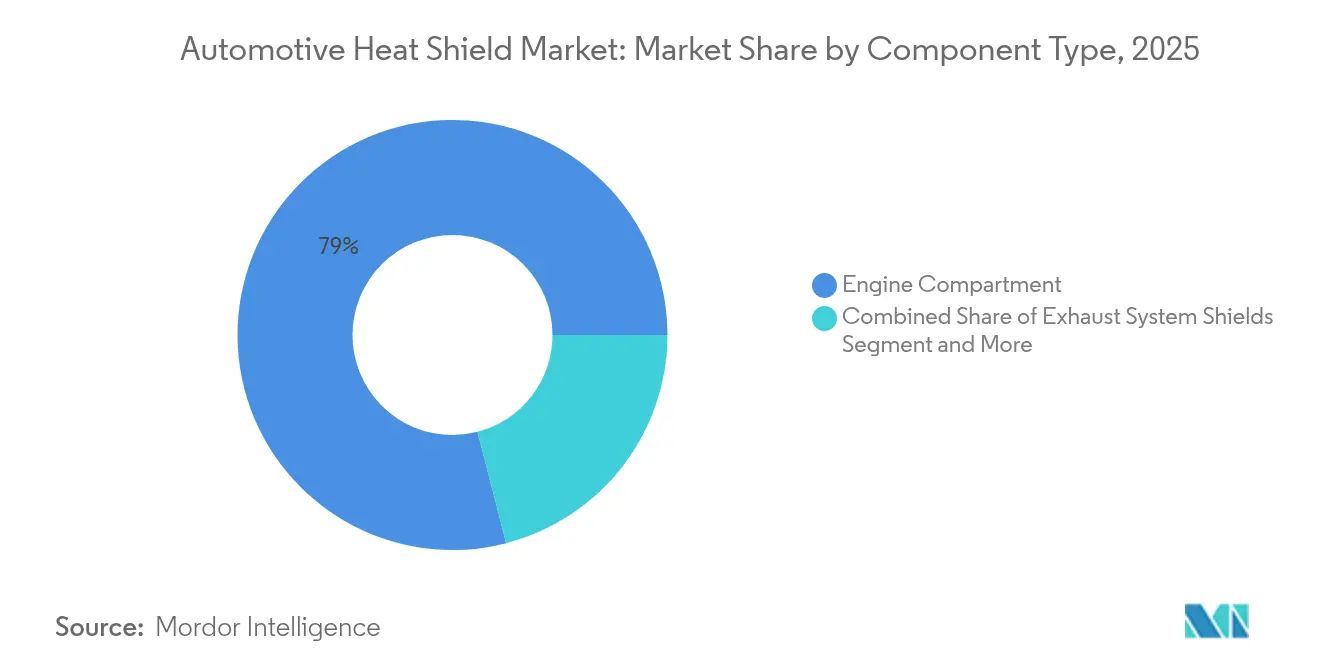
Engine Compartment Shields controlled 79.02% of the automotive heat shield market in 2025, reflecting the longstanding need to protect wiring, plastic reservoirs, and passenger footwells from engine block and exhaust manifold radiation. Evolving turbo and downsized cylinder heads run hotter, so multilayer aluminum-with-glass-mat designs stay central. Battery & Power-Electronics Shields, though smaller in revenue, are advancing at 11.62% CAGR as every additional kilowatt-hour of energy density raises containment stakes. Flexible ceramic papers and intumescent foams line battery frames, while copper-mesh spreaders move hotspots away from cells during DC-fast-charge phases.
Exhaust System Shields remain the second-largest sub-segment at 15.34%, driven by Euro 7 and EPA after-treatment temperature windows. These assemblies often carry double-shell construction and dimpled patterns to hold boundary-layer air and slash surface temps by 40 °C. Turbocharger & Intake-Manifold Shields follow, registering 9.29% CAGR thanks to global turbo-gasoline adoption. Underbody & Floor-pan Shields couple thermal and acoustic layers to cut drivetrain hum by up to 3 dB and resist stone impacts in off-road SUVs.



By Material: Composites Challenge Metallic Dominance
Metallic solutions, hold 86.45% of the market share in 2025—chiefly three xxx aluminum sheet and 409 stainless—still comprise the bulk of automotive heat shield market shipments because of well-known forming, joining, and recycling streams. Variable-thickness hydroforming and laser-perforation now shave weight while venting trapped exhaust heat.
Non-metallic and composite alternatives are seizing share, leveraging 40-60% mass savings and 35% insulation drops. Aerogel-filled blankets push conductivity down to 0.015 W/mK, allowing 2 mm sandwiches that rival 6 mm aluminum shells. Aspen Aerogels’ PyroThin® panels surround EV cell groups, confining runaway events to single modules and giving pack designers valuable cooling headroom.
By Product Structure: Sandwich Designs Gain Traction
Single-shell stampings hold 55.52% of the market share in 2025, remaining popular for splash zones and moderate-heat brackets because their one-piece geometry limits tooling outlay. Yet rising under-bonnet peak temperatures expose their 200 °C ceiling. Double-shell forms insert an air gap that blocks up to 40% radiative flux, meeting stricter cabin soak targets without redesigning firewall geometry.
The fastest growth lies in sandwich composites that pair an aluminum skin with a microporous ceramic center. Morgan Advanced Materials now supplies multi-layer mats that trim 70% of the weight compared with earlier steel pans while holding exhaust-gas ducts at or below 450 °C during hill-climb duty cycles.
By Form: Flexible Solutions Address Complex Geometries
Rigid shields command a dominant 68.84% share of the automotive heat shield market in 2025, primarily catering to big-volume orders. Automated presses are busy producing uniform parts for ICE manifolds and under-floor tunnels. With continuous 600-ton transfers, manufacturers maintain a cost parity, keeping expenses below USD 3 per part for mid-size sedans.
However, the market is shifting towards flexible foils and quilted mats as EVs integrate power-electronics bays with tightly packed wiring, coolant lines, and charge ports. Projections indicate a burgeoning flexible sub-category, expected to reach USD 5.85 billion by 2031, with an annual growth rate of 6.08%. Notably, when bonded to aluminum foil, aramid-glass cloths offer a unique advantage: they can be hand-fitted post-assembled, effectively sealing gaps around high-voltage junction boxes and significantly reducing rework time.
By Vehicle Propulsion: Electrification Drives Specialized Solutions
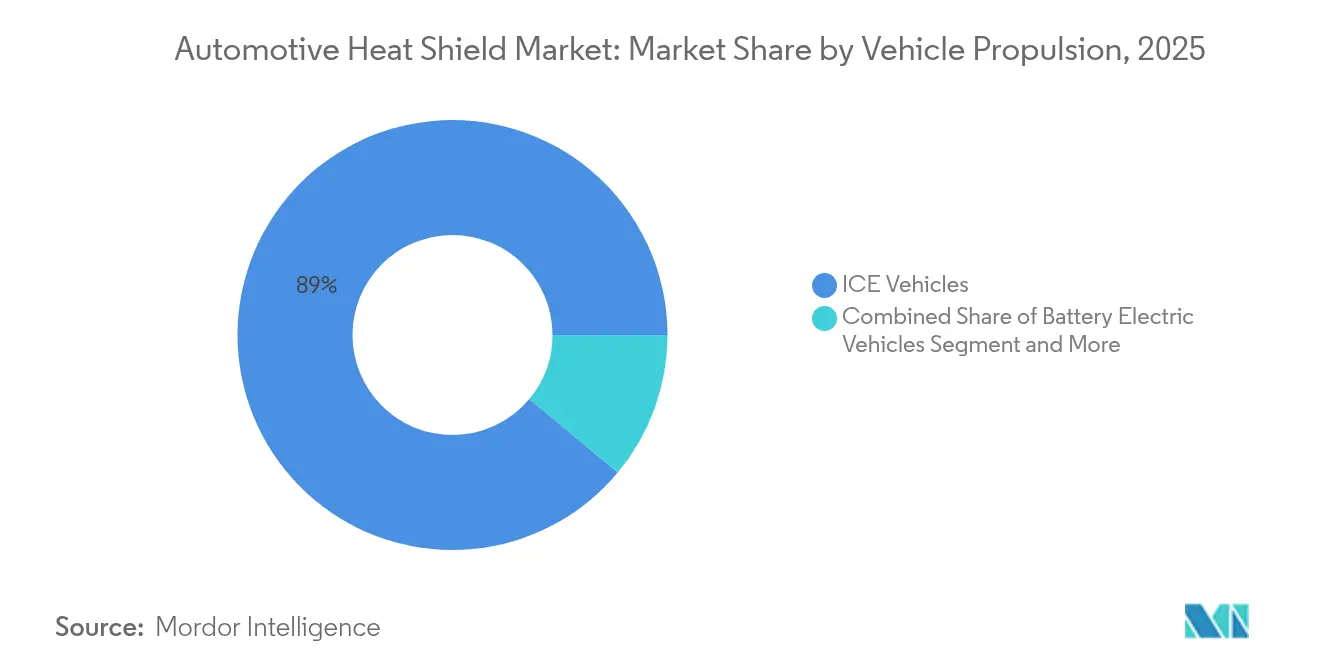
ICE models dominate the market, commanding an 88.95% share in 2025. These models require shields to maintain catalytic substrates above 400 °C for effective emissions conversion and prevent scorch damage during high-grade ascents. Meanwhile, hybrid electric vehicles are incorporating secondary insulation to shield traction batteries from surges in the engine bay. This move broadens the thermal zone, now encompassing inverters and DC-DC converters.
The automotive heat shield market is witnessing the fastest growth in the battery electric segment, projected at a 13.72% CAGR through 2031. This surge is driven by OEMs adopting double-wall steel tubs filled with ceramic blankets, engineered to endure thermal events of up to 1,100 °C, in line with UN ECE R100 fire testing standards.
By Vehicle Type: Passenger Cars Lead, Commercial Fleets Follow
Passenger cars generated 62.58% of revenue in 2025, with mid-range sedans and crossovers adopting composite encapsulation around turbo scrolls to meet idle-stop restart timing. Light commercial vans saw a 24.18% share, prioritizing durability for multi-shift logistics routes; perforated steel tunnels paired with fiberglass-needled liners extend life to 300,000 km.
Heavy commercial rigs leverage thicker 409 SS sheet and ceramic wrap-around diesel particulate filters for uptime demands topping 1 million km. Off-highway tractors integrate reinforced basalt cloth shields that resist mud impact and wash-down chemicals.
By Sales Channel: OEMs Dominate, Aftermarket Accelerates
OEM contracts represented 84.05% of the automotive heat shield market revenue in 2025, thanks to early-phase design integration and validation requirements that lock suppliers into multi-year platforms. Platform lifecycles now include EV skateboard architectures, demanding requalification of shield performance under new thermal maps.
The aftermarket grows 7.72% annually as owners retrofit aluminized glass cloth to vintage turbo projects or replace corroded OE parts in high-salt regions. Specialty tuners offer polished stainless wraps that double as aesthetic upgrades while cutting under-hood intake temps by 8°C.
Geography Analysis
Asia-Pacific retained a 46.48% share of the automotive heat shield market in 2025 and is expanding at a 9.21% CAGR. Chinese EV assembly hubs in Guangdong and Jiangsu specify ceramic-fiber battery isolators, while Japanese OEMs ship multi-layer acoustic-thermal hybrids that lower drivetrain noise and cabin soak simultaneously. India’s localized suppliers produce cost-optimized punched-aluminum forms, meeting small-car price targets while ensuring 500,000-km durability in monsoon climates. South Korean firms specialize in high-density battery pack cooling shields for export SUVs, leveraging domestic cell technology leadership.
Europe followed at 27.34% share, where Euro 7 exhaust rules and stringent OEM lightweighting quotas spur demand for composite and recycled-aluminum designs. German luxury brands pay premiums for ultra-thin titanium-aluminide heat blankets that safeguard turbo housings. French mid-segment programs experiment with end-of-life aluminum feedstock that cuts embedded CO₂ by up to 95%. British low-volume performance builders choose 3D-printed Inconel shields for complex turbine scrolls, illustrating the region’s appetite for additive manufacturing.
North America contributed 18.09% of 2025 revenue. United States pickup and SUV lines consume traditional stamped aluminum shields in large lots, yet Tesla, GM, and Ford EV platforms drive rapid growth in battery-compartment protection. Canada’s freeze-thaw climate elevates durability testing thresholds, pushing composite suppliers toward hybrid metal-ceramic architectures. Mexico’s maturing supplier base now molds aerogel-filled flexible wraps for export to Michigan and Ontario assembly plants, diversifying the regional sourcing map.
Mordor Intelligence provides coverage of the automotive heat shield market across other key regional markets, including North America, each with their regulatory frameworks and demand patterns.


Regulatory Landscape
Automotive heat shields and adjacent thermal-insulation parts are subject to fire-performance and chemical-substance compliance requirements that vary by region, but increasingly align at OEM sourcing gates. For flammability, UN Regulation No. 118 (burning behavior of interior materials used in certain vehicle categories) and the US FMVSS 302 requirement (49 CFR 571.302 on flammability of interior materials) act as recurring anchors for material qualification and documentation. This shapes how suppliers select foils, mats, adhesives, and facing materials used in underbody, engine-bay, and cabin-adjacent shielding.
On the chemical side, EU REACH and EU RoHS restrict allowable chemistries in polymer binders, coatings, and composite constructions used with heat shields. A key inflection point is the REACH Annex XVII restriction package effective June 1, 2026, which restricts specified phthalates and certain fluoropolymers in vehicle-related insulation components. In practice, suppliers are pushed toward earlier substance disclosure, tighter change-control, and faster requalification cycles for multilayer laminates and coated fabrics. In EV applications, battery thermal-runaway barrier materials are increasingly screened against system-level test protocols such as UL 9540A, which increases demand for higher-temperature, lower-smoke, and traceable-material constructions for battery and power-electronics shielding.
Value Chain Analysis
The value chain begins with upstream inputs such as aluminum and stainless sheet/foil, ceramic fibers and fillers (including boron nitride used in thermal-management formulations), aerogel and microporous insulation media, and polymer systems (for example, specialty polyamides and silicone-based thermal materials) that feed composite blankets, laminates, and coated textiles. Conversion and component manufacturing then covers stamping, hydroforming, lamination, quilting, and adhesive bonding to produce rigid shells, flexible wraps, and sandwich structures that meet OEM packaging and temperature targets. Tier-one groups such as Autoneum, Dana, ElringKlinger, Tenneco, and Sumitomo Riko operate alongside specialists focused on insulation and sealing formats.
Midstream, process control and quality standards shape cost and repeatability, including automotive heat-treat and manufacturing quality frameworks applied across supply bases (for example, AIAG CQI-9 in heat-treat governance and NAAMS standardization in North American assembly and fabrication practices). Downstream, OEMs dominate demand through platform-level design-in (consistent with the report's high OEM share), with validation cycles, PPAP-style documentation, and just-in-time logistics influencing supplier selection. Key friction points are metal price volatility and multi-chemistry compliance reporting driven by REACH and RoHS, which raises the value of suppliers that pair regional manufacturing footprints with in-house materials engineering and rapid prototyping for EV battery and power-electronics thermal protection.
Competitive Landscape
The top five suppliers—Autoneum, Dana, ElringKlinger, Tenneco, and Sumitomo Riko—collectively owned majority of 2024 global shipments, reflecting moderate consolidation. Larger tier-ones leverage multi-regional plants and hedged aluminum contracts to buffer commodity swings, while specialist newcomers tackle high-growth EV niches with aerogel or intumescent chemistries. Aspen Aerogels licenses its PyroThin® technology to multiple module integrators, creating cross-brand safety commonalities. Dana’s 2025 acquisition of a composite molding line in Slovakia underscores a strategy to blend metallic and polymer expertise.
Price pressure weighs on legacy metallic parts as stamping know-how commoditizes, whereas EV-specific shields maintain higher gross margins through patent-protected chemistries. Additive manufacturing firms such as EOS help premium OEMs print lattice-cooling structures in thin-wall Inconel, cutting mass and easing under-bonnet airflows. Strategic white-space resides in integrated thermal-acoustic panels that consolidate NVH foam, heat reflection, and water-ingress barriers in one install step, especially appealing to skateboard-style EV frames.
Smaller suppliers without global hedging capacity face raw-material cost exposure, driving merger talks and joint ventures. Tier-twos that master hybrid aluminum-composite layups win share when OEMs demand combined lightweighting and high-temperature tolerance, notably in Asia, where production volumes reward fast tooling cycles. Market entry barriers revolve around material IP, capital-intensive forming presses, and validation protocols that stretch from -40 °C Arctic tests to 1,200 °C thermal runaway firewalls.
Automotive Heat Shield Industry Leaders
ElringKlinger AG
Dana Incorporated
Autoneum Holding AG
Tenneco Inc. (Federal-Mogul)
Sumitomo Riko Co. Ltd.
- *Disclaimer: Major Players sorted in no particular order

Market Opportunities and Future Outlook
Electrification is expanding whitespace in battery and power-electronics shielding, where OEMs treat thermal barriers as safety-critical hardware. That creates room for multilayer, intumescent, and aerogel-based constructions that support thermal-runaway containment while reducing thickness in skateboard layouts. A visible proof point is the continued industrialization of advanced insulation approaches referenced in the report narrative, including aerogel-loaded laminates and PyroThin-type panels around cell groups. Higher-temperature validation anchors such as UN ECE R100 fire testing, alongside broader system-level screening using UL 9540A-style protocols, increase the emphasis on traceable materials, repeatable lamination processes, and integrated design support.
Regional capacity build-outs and localized sourcing programs also open commercial opportunities, especially in Asia where production volume and rapid EV program cadence favor suppliers that can tool quickly and support local engineering. In India, supplier-side investments provide tangible evidence: Talbros Automotive reported INR 14.75 billion of new orders spanning gaskets and heat shields (May 2025), alongside a stated capacity expansion program through FY27, and Teconnex India started a new heat shield manufacturing line at its Chakan, Pune facility (September 2025). These moves point to active procurement cycles for heat shields and adjacent thermal parts, and they increase competitive pressure on both global tier-ones and regional stampers to broaden material portfolios (metallic plus composite) and offer integrated thermal-acoustic modules that reduce part count and assembly time for OEM platforms.
Recent Industry Developments
- April 2026: ElringKlinger highlighted its role in New Energy Vehicle programs at Auto China 2026, showcasing thermal management sealing solutions and battery cell contacting systems. The emphasis on electrified-platform content reinforces the shift in supplier engineering focus from conventional exhaust-side shielding toward battery and power-electronics thermal protection.
- January 2026: Dana Incorporated reaffirmed its 2026 business outlook and pointed to incremental new business tied to next-generation vehicle platforms. This signals ongoing platform refresh activity and supports supplier strategies that balance legacy metallic shielding volumes with higher-value electrification-driven thermal solutions.
- January 2025: CERTINA Group completed the acquisition of ElringKlinger AG's heat and noise shielding production sites in Sevelen, Switzerland, and Buford, USA. The transaction reorganized capacity under a specialist owner, influencing how OEMs and tier suppliers source heat and noise shielding components across Europe and North America.


Research Methodology Framework and Report Scope
Market Definition and Coverage
This market covers heat shielding parts used in vehicles to reduce heat transfer and protect nearby components, mainly around the exhaust, engine bay, underbody, and newer electrified powertrain areas. We size the market in revenue terms across major automotive production and replacement demand.
Scope exclusions: It excludes non-automotive industrial heat shielding and general thermal insulation sold for buildings or equipment.
Segmentation Overview
- By Component Type
- Engine Compartment Shields
- Exhaust System Shields
- Turbocharger & Intake-Manifold Shields
- Underbody & Floor-pan Shields
- Battery & Power-Electronics Shields
- Other Component Shields
- By Material
- Metallic Heat Shields
- Non-metallic / Composite Heat Shields
- Insulation Blankets / Multi-layer
- By Product Structure
- Single Shell
- Double Shell
- Sandwich Composite
- By Form
- Rigid
- Flexible
- By Vehicle Propulsion
- ICE Vehicles
- Hybrid Electric Vehicles
- Battery Electric Vehicles
- By Vehicle Type
- Passenger Cars
- Light Commercial Vehicles
- Heavy Commercial Vehicles
- Off-Highway & Agricultural Vehicles
- By Sales Channel
- OEMs
- Aftermarket
- By Geography
- North America
- United States
- Canada
- Mexico
- South America
- Brazil
- Argentina
- Rest of South America
- Europe
- Germany
- United Kingdom
- France
- Spain
- Italy
- Russia
- Rest of Europe
- APAC
- China
- India
- Japan
- South Korea
- ASEAN
- Rest of APAC
- Middle East and Africa
- Saudi Arabia
- United Arab Emirates
- South Africa
- Rest of Middle East and Africa
- North America
Data Sources, Market Sizing, and Validation
Desk Research
Desk work starts by anchoring the vehicle parc and production outlook, and then mapping where heat shielding is typically installed by powertrain and underbody locations. Public sources are used to set the outer boundaries, such as OICA production tables, US EPA and NHTSA documentation around emissions and safety, Eurostat trade and industry data, and UNECE regulations that affect underhood temperature management.
Next, we compile supply and demand signals from sources such as company annual reports and investor presentations, association websites, technical papers that discuss material adoption, and reputable press coverage of platform changes. Where available, a paid subscription focused on company financials and intelligence is used to cross-check revenue direction, and an import/export shipment-level database is used selectively to sanity-check trade flows for relevant heat shield material forms. The desk source list is not exhaustive, and many other public references were used for data collection, validation, and clarification.
Primary Interviews and Surveys
Primary work is used to pressure-test the install-rate assumptions and pricing movement, especially where platform choices differ between ICE, hybrid, and battery electric vehicles. We spoke with participants across the value chain, including component manufacturers, material converters, OEM-linked engineering teams, and aftermarket channel contacts across APAC, EMEA, and the Americas, and then reconciled their inputs back into a single model.
Distribution of primary research fieldwork respondents
| Company type | Respondent position | Region |
|---|---|---|
| Top tier: 28% | CXOs: 15% | APAC: 47% |
| Mid tier: 57% | Functional/Unit leaders: 33% | EMEA: 29% |
| Smaller Players: 15% | Managers: 52% | Americas: 24% |
Market-Sizing & Forecasting
Sizing starts from the demand pool, where vehicle production by region and propulsion is translated into heat-shielding content per vehicle, and then extended with a replacement component layer using parc and service patterns. To keep the logic explainable, the top-down approach links production and powertrain mix to typical shield fitment points (exhaust system, engine compartment, underbody, and battery or power electronics where applicable), which are then priced using representative ASP bands.
After that, results are corroborated with selective bottom-up approximations, mainly through sampled supplier revenue direction, channel checks on OEM versus aftermarket shares, and volume x ASP spot checks for major applications. Key model inputs include light vehicle and commercial vehicle production trends, ICE versus BEV penetration, metallic versus non-metallic material mix, shifts toward flexible versus rigid formats, and OEM platform cycle timing that affects redesign frequency. Forecasts are run using scenario analysis, where production outlook, electrification pace, and ASP progression are varied within ranges validated through expert feedback, and then the final path is selected as the most consistent set of assumptions. If a sub-segment has limited disclosure, we fill gaps using adjacent platform analogs and then re-check totals against the overall regional demand signal.
Data Validation & Update Cycle
Outputs are validated through multiple checks so the totals do not rely on a single data stream. We compare implied revenue per vehicle against reasonable engineering content ranges, test regional splits against production concentration, and review any sharp jumps that do not match known platform or regulation changes. When a variance looks material, the assumption is re-opened and the relevant respondents are contacted again to confirm whether it is pricing, mix, or volume that moved.
Before sign-off, the model and narrative are reviewed in steps by another analyst to catch inconsistencies across definitions, units, and year labeling. Reports are refreshed annually, and interim updates are made when major events occur that can shift production, electrification mix, or pricing. Right before delivery, a final pass is completed so clients receive an updated view aligned to the latest available signals.
Mordor Intelligence's Automotive Heat Shield Market Size Compared Against Other Published Estimates
Published market values for automotive heat shields can differ even when the topic sounds identical, since each publisher chooses its own year, scope boundaries, and the way it handles pricing and electrification mix. Differences also come from how OEM and aftermarket demand are split, and whether battery and power electronics shielding is treated as a core part of the market.
The key drivers in this market are usually the assumed heat-shield content per vehicle by propulsion, the pace of BEV adoption by region, and how ASP changes are applied as materials shift between metallic and non-metallic designs. Currency conversion timing and the refresh cadence also matter, especially when production volumes change quickly in APAC and when model-year redesigns pull demand forward or push it out.
Benchmark comparison
| Source | Market Size | Gaps in Research Methodology |
|---|---|---|
| Mordor Intelligence | USD 13.37 B (2025) | |
| Industry Publisher A | USD 13.81 B (2025) | Uses a different base-year build-up and can treat ASP progression mainly through material share shifts, with less explicit reconciliation to OEM versus aftermarket channel splits by region. |
| Global Publisher B | USD 15.69 B (2025) | Applies a faster near-term growth trajectory from a broader demand view, which can pull in adjacent thermal protection content and uses more aggressive production and electrification assumptions for the same year. |
The table shows a meaningful spread for the same year, and in Mordor Intelligence's model the count is limited to defined automotive heat-shield applications across OEM and aftermarket, including battery and power electronics only when it is a vehicle-installed heat shielding part rather than general insulation. With that scope clarity, plus explicit checks against production mix and channel shares, the final value stays traceable to inputs that a buyer can follow and repeat.


Key Questions Answered in the Report
What is the current size of the automotive heat shield market?
The automotive heat shield market size is USD 14.01 billion in 2026, projected to reach nearly USD 17.69 billion by 2031.
Which component segment holds the largest share?
Engine Compartment Shields lead with 79.02% of global revenue in 2025 due to their long-standing role in managing under-bonnet heat.
Why are battery-specific heat shields growing so quickly?
Battery and power-electronics Shields are advancing at an 11.62% CAGR because electric vehicle packs require sophisticated thermal barriers that prevent thermal runaway and maintain optimal operating temperatures.
Which region contributes the most to demand?
Asia-Pacific commands 46.48% of global sales thanks to high vehicle production in China, India, Japan, and South Korea, and it is also the fastest-growing region at 9.21% CAGR.
How are raw-material price swings affecting suppliers?
Volatile aluminum and stainless prices compress supplier margins by up to 0.8 points of CAGR, forcing larger players to hedge and prompting smaller firms to explore polymer or ceramic substitutes.
What innovative materials are shaping future heat shields?
Aerogel-filled composites, intumescent foams, and multi-layer aluminum-ceramic sandwiches enable thinner, lighter shields that withstand temperatures above 1,000 °C while meeting automaker lightweighting targets.
Page last updated on:


 Your data is secure and never sold or shared.


