
Automotive Ignition Coil Market Size and Share
Market Overview
| Study Period | 2020 - 2031 |
|---|---|
| Market Size (2026) | USD 11.74 Billion |
| Market Size (2031) | USD 14.46 Billion |
| Growth Rate (2026 - 2031) | 4.26 % |
| Fastest Growing Market | Asia Pacific |
| Largest Market | Asia Pacific |
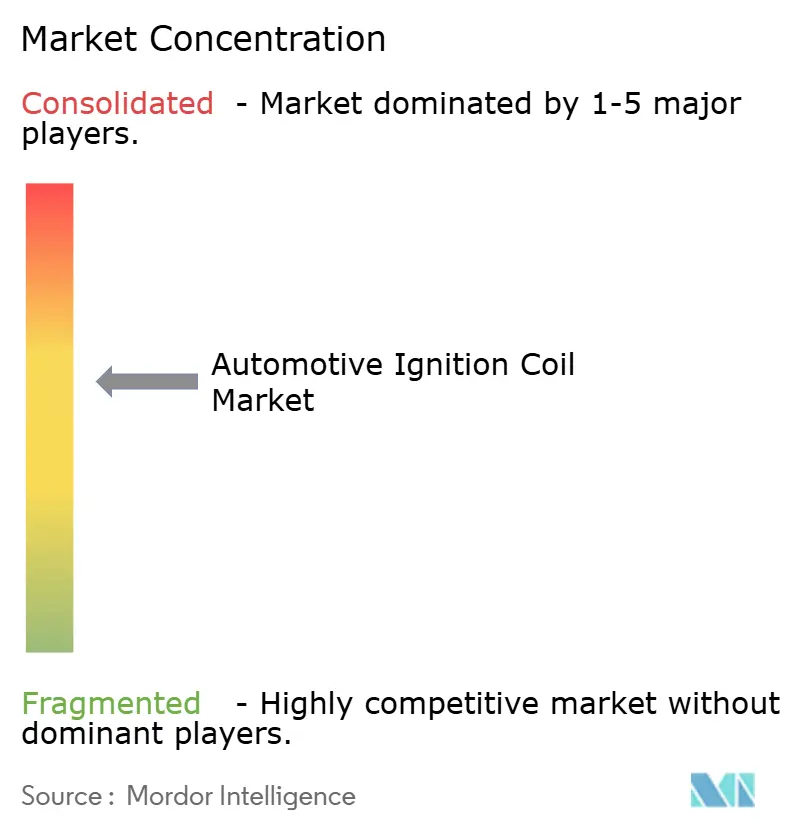
| Market Concentration | Medium |
Major Players *Disclaimer: Major Players sorted in no particular order Image © Mordor Intelligence. Reuse requires attribution under CC BY 4.0. | |
Automotive Ignition Coil Market Analysis by Mordor Intelligence
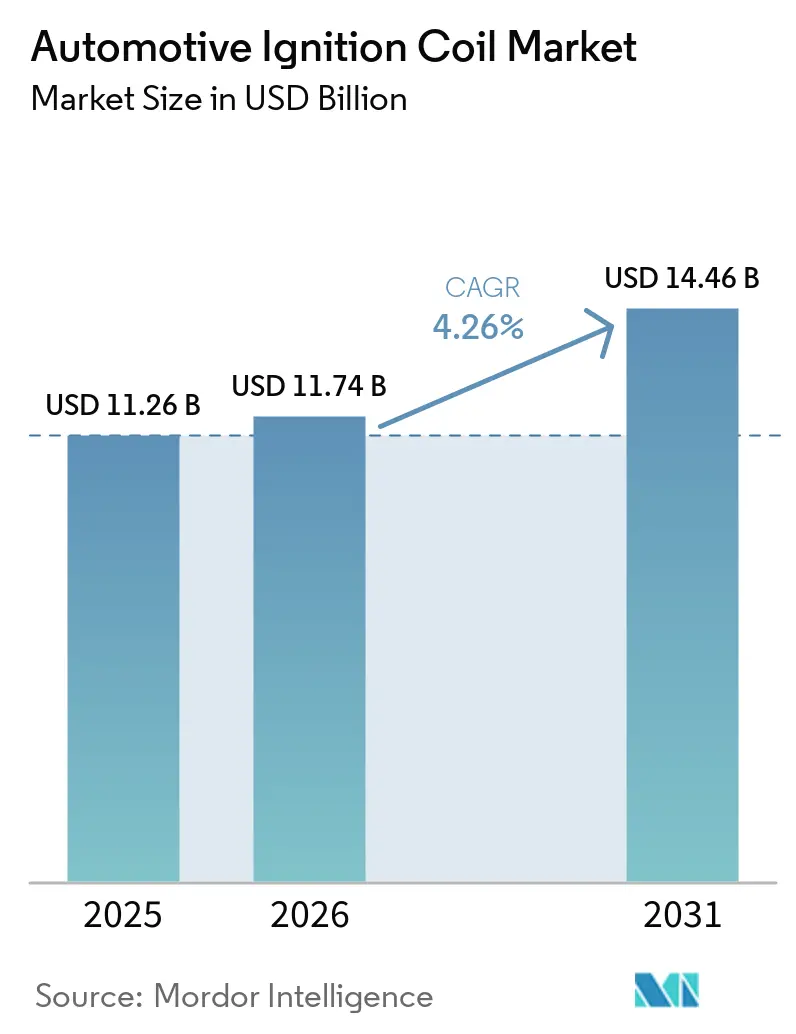
Automotive ignition coil market size in 2026 is estimated at USD 11.74 billion, growing from 2025 value of USD 11.26 billion with 2031 projections showing USD 14.46 billion, growing at 4.26% CAGR over 2026-2031. Rising light-vehicle output in Asia Pacific, continued dominance of coil-on-plug (COP) technology, and a resilient replacement cycle in mature fleets collectively underpin growth. OEMs are fine-tuning ignition designs for turbocharged downsized engines that must comply with near-term Euro 7 limits, while the aftermarket benefits from the 12.5-year average vehicle age in the United States. At the same time, elevated copper prices and supply risks for rare-earth magnets are compressing supplier margins, and battery-electric-vehicle (BEV) penetration sets a clear upper bound on long-term demand. These crosscurrents place the automotive ignition coil market at a strategic pivot between legacy combustion needs and a rapidly electrifying future.
Key Report Takeaways
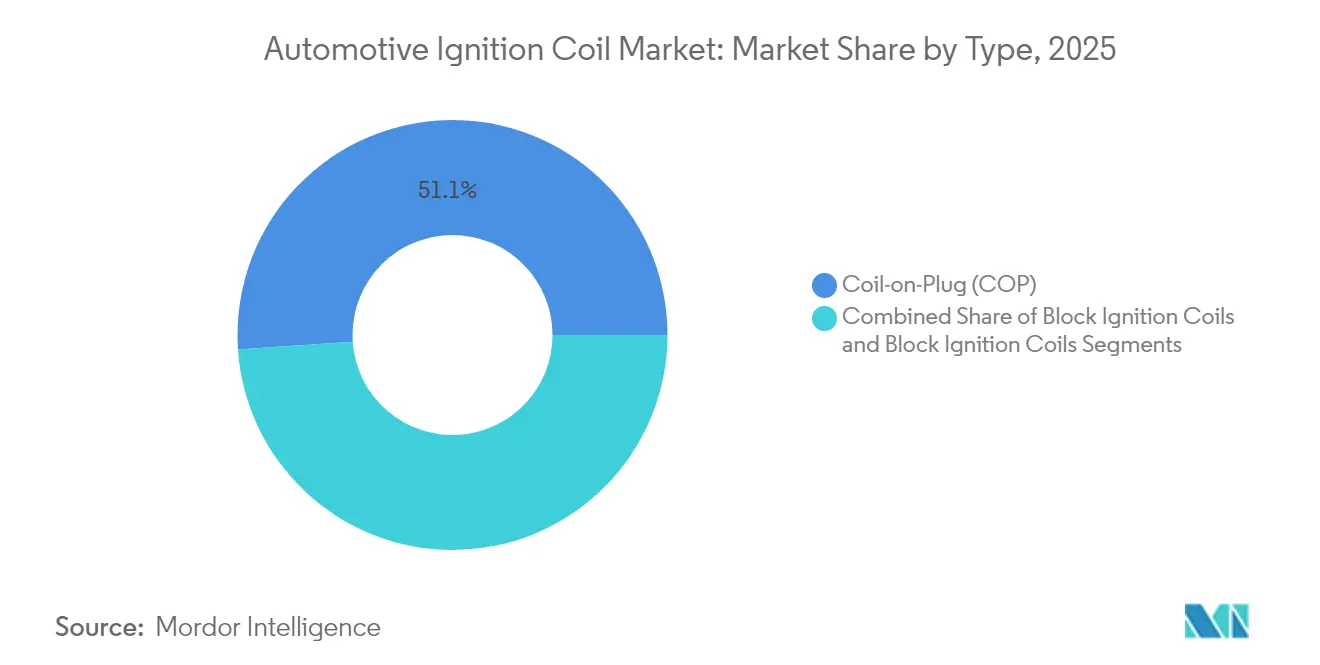
- By type, coil-on-plug systems captured 51.07% revenue share in 2025, while also recording the fastest growth at 6.08% CAGR to 2031.
- By operating principle, single-spark technology held 62.27% of the automotive ignition coil market share in 2025, whereas dual-spark designs are forecast to grow at a 5.76% CAGR.
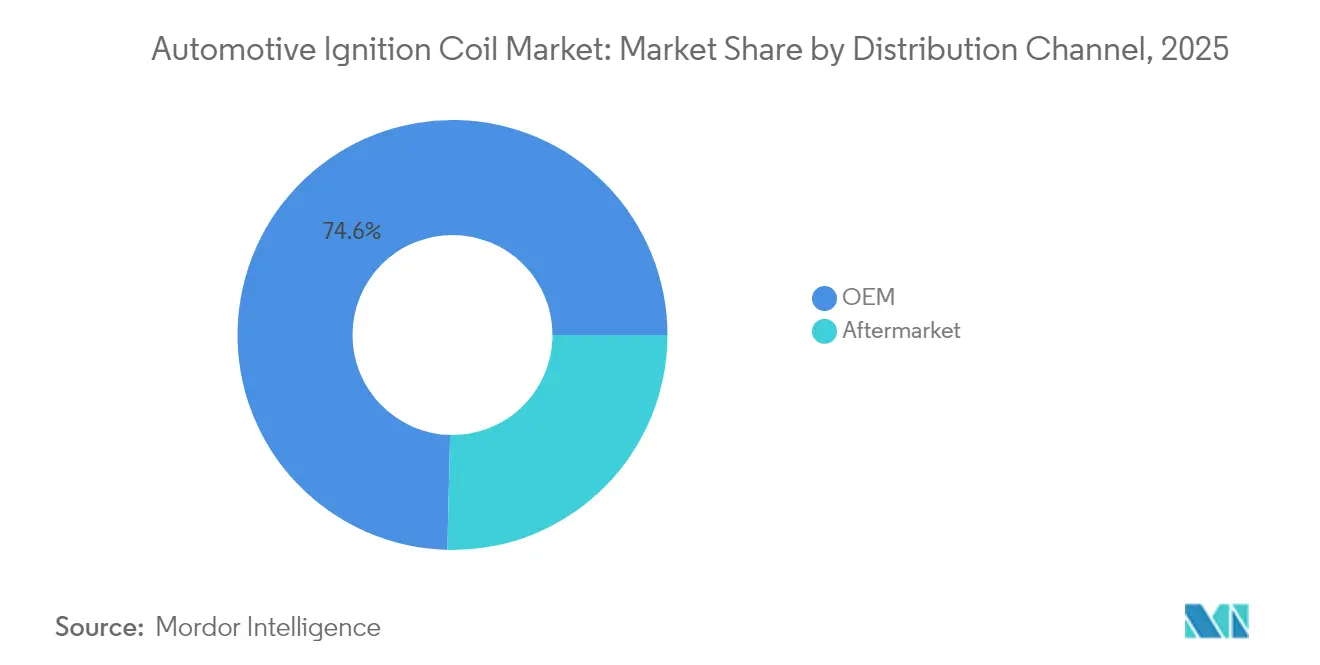
- By distribution channel, OEM accounts for 74.62% of revenue in 2025, but the aftermarket is set to grow the quickest at 6.91% CAGR through 2031.
- By vehicle type, passenger cars represented 63.95% of market value in 2025, yet commercial vehicles are poised to register the highest 6.22% CAGR to 2031.
- By geography, Asia Pacific led with a 46.05% share of the automotive ignition coil market in 2025; the same region is projected to expand at a 6.74% CAGR through 2031.
Note: Market size and forecast figures in this report are generated using Mordor Intelligence’s proprietary estimation framework, updated with the latest available data and insights as of 2026.
Market Trends and Insights
Drivers Impact Analysis of Automotive Ignition Coil Market*
| Driver | (~) % Impact on CAGR Forecast | Geographic Relevance | Impact Timeline |
|---|---|---|---|
| Growth in Passenger & Light Commercial Vehicle Production | +1.2% | Global with APAC leading growth | Medium term (2-4 years) |
| Ageing Fleet Supporting Aftermarket Demand | +1.1% | North America and Europe core markets | Short term (≤ 2 years) |
| Emission Norms Driving High-Performance Coils | +0.8% | Europe and North America expanding to APAC | Long term (≥ 4 years) |
| Turbocharged Engines Requiring COP Coils | +0.7% | Global with premium segment focus | Medium term (2-4 years) |
| Flex-Fuel Adoption Needing Durable Coils | +0.4% | Brazil, India, Southeast Asia | Medium term (2-4 years) |
| Rise of Smart-Diagnostic Connected Coils | +0.3% | North America and Europe early adopters | Long term (≥ 4 years) |
| Source: Mordor Intelligence | |||
Rising Global Production of Passenger and Light Commercial Vehicles
Vehicle volumes continue to rebound from pandemic lows, especially in Asia Pacific, where industry revenue climbed 7% in 1H 2024. Production upswings favor the automotive ignition coil market because light commercial electrification trails passenger adoption by roughly five years. Automakers are also rolling out 48V mild-hybrid platforms that keep internal-combustion engines (ICE) in play, extending coil demand while cutting emissions. The emphasis on precise ignition timing to satisfy Euro 7 creates tailwinds for COP assemblies that support individual-cylinder control. Together, these forces add a moderate uplift to the growth trajectory.
Aftermarket Replacement Demand From Ageing Parc
Average fleet age reached 12.5 years in the United States during 2024. Older vehicles require more frequent service, which supports a vibrant aftermarket for coils. Standard Motor Products already fields 800 SKUs with 99% coverage, while NGK’s European range covers 420-part numbers that fit 87% of vehicles on the road. Independent workshops rely on broad compatibility, making the aftermarket an increasingly lucrative channel. The time buffer before legacy vehicles retire creates a durable revenue stream for at least one model cycle.
Stringent Emission Norms Pushing High-Performance Coils
Euro 7 rules and aligned global standards oblige OEMs to guarantee more complete combustion. To do so, manufacturers are integrating higher output coils with improved heat resistance and moisture sealing. Dual-spark architecture, although still niche, is gaining ground in premium models because multiple ignition points per cycle reduce particulate formation. Suppliers such as NGK Insulators cite steady sales of value-added products that help customers meet stricter thresholds. This driver lengthens the relevance of ICE ignition even as BEV momentum climbs.
Turbo-Charged Downsized Gasoline Engines Need COP Coils
Turbo share of light-duty engines jumped from 1% in 2000 to 37% in 2023 and is on pace to reach 83.3% by 2025. High boost pressure risks low-speed pre-ignition, making cylinder-specific spark control essential. COP solutions eliminate high-voltage losses and allow flexible dwell timing, which mitigates knock and improves efficiency. Leading brands such as BERU report deep penetration in volume models from Volkswagen Group and BMW Group, underlining how turbocharging aligns with premium ignition content.
Restraints Impact Analysis of Automotive Ignition Coil Market*
| Restraint | (~) % Impact on CAGR Forecast | Geographic Relevance | Impact Timeline |
|---|---|---|---|
| BEV Shift Reducing Ignition System Demand | -2.1% | Global, with Europe and China leading the transition | Long term (≥ 4 years) |
| Copper & Rare-Earth Price Volatility | -0.6% | Global supply chain impact | Short term (≤ 2 years) |
| 48V Hybrids Lowering Coil Requirements | -0.4% | Europe and premium segments globally | Medium term (2-4 years) |
| Rise of Plasma-Based Ignition Technologies | -0.2% | Premium segments in developed markets | Long term (≥ 4 years) |
| Source: Mordor Intelligence | |||
BEV Penetration Eliminates Conventional Ignition Systems
Electric cars remove the entire spark-ignition assembly, cutting maintenance costs by up to 40%. DENSO projects BEVs will dominate global production by 2035, prompting suppliers to pivot toward battery, inverter, and thermal-management modules [1]. Passenger segments will see the sharpest drop first, while heavier commercial classes will transition later due to range and payload limits. Nonetheless, the directional shift places a ceiling on future coil volumes.
Price Volatility of Copper and Rare-Earth Magnets
Copper touched USD 4.04 per lb in May 2024 and is forecast at USD 5.31 per lb during 2025. Chinese export curbs on rare-earth magnets have already forced short-term line stoppages in Europe. Coils rely on copper windings and magnet assemblies, so price spikes erode margins unless OEM contracts allow rapid pass-through. Material inflation is therefore a tangible headwind for the automotive ignition coil market until supply stabilizes.
*Our forecasts treat driver/restraint impacts as directional, not additive. The impact forecasts reflect baseline growth, mix effects, and variable interactions.
Automotive Ignition Coil Market Segment Analysis
By Type:
COP Commands Premium ApplicationsCoil-on-plug systems accounted for 51.07% of 2025 revenue, and their 6.08% CAGR positions them as the clear growth engine for the automotive ignition coil market. High-energy coils tailored to direct-injection and turbo platforms command price premiums that lift revenue faster than unit shipments, making coils a profit engine inside the automotive ignition system market size for suppliers with vertical integration. The design removes high-voltage leads, reduces electromagnetic loss, and supports advanced knock-control strategies demanded by turbocharged engines. Block coils and rail assemblies stay competitive in cost-sensitive models, especially in entry-level segments across emerging economies.
OEM case studies reinforce the shift: Bosch introduced a spring-contact COP for BMW models to improve spark-plug connection reliability, while DENSO’s portfolio roadmap highlights distributor-less solutions as a core product line. Hybrid powertrains, which blend a 48 V e-motor with an ICE, still require one coil per cylinder, securing volume for COP units through 2031. Competitive pricing, simplified installation, and incremental engine-management gains will keep COP at the center of the automotive ignition coil market narrative.

By Operating Principle:
Single-Spark Still DominantSingle-spark designs owned 62.27% of sales in 2025, reflecting mature manufacturing, proven reliability, and lower cost. Yet dual-spark units are tracking a 5.76% CAGR as premium OEMs chase further combustion efficiency. In Brazil’s flex-fuel fleet, variable ethanol content makes multiple ignition points advantageous for stable flame propagation.
BorgWarner’s multi-spark line illustrates how suppliers extend dwell time or deliver sequential pulses to optimize burn time. Dual-spark value scales when regulators tighten particulate limits. Even so, single-spark’s sizeable installed base and compatibility with a broad engine mix mean that the automotive ignition coil market size for this configuration will remain substantial through the forecast horizon.
By Distribution Channel:
Aftermarket Widens Its FootprintOEM contracts delivered 74.62% of 2025 sales, but aftermarket revenue is rising at 6.91% CAGR, faster than any other channel in the automotive ignition coil market. Independent garages rely on ready availability and multi-pack options, attributes embraced by Standard Motor Products and NGK.
The aging vehicle profile in North America and Western Europe underpins parts replacement. Meanwhile, emerging markets such as India see aftermarket coils used in second-hand imports that lack dealer support. As BEVs shrink OEM coil demand, aftermarket activity will become the stabilizing pillar for the automotive ignition coil industry.
By Vehicle Type:
Commercial Vehicles Provide a Growth CushionPassenger cars delivered 63.95% of 2025 revenue, but commercial vehicles are accelerating at 6.22% CAGR. Their longer service life and slower path to full electrification of the shelter coil demand.
Hitachi’s USD 33 million Chennai plant expansion underscores faith in sustained truck and bus production. Fleets value durability and low total ownership cost, fueling a gradual shift to higher-grade insulation and moisture-proof designs. These attributes keep the automotive ignition coil market size for commercial vehicles expanding even as the passenger-car BEV share climbs.
Geography Analysis
APAC and North America Automotive Ignition Coil Market
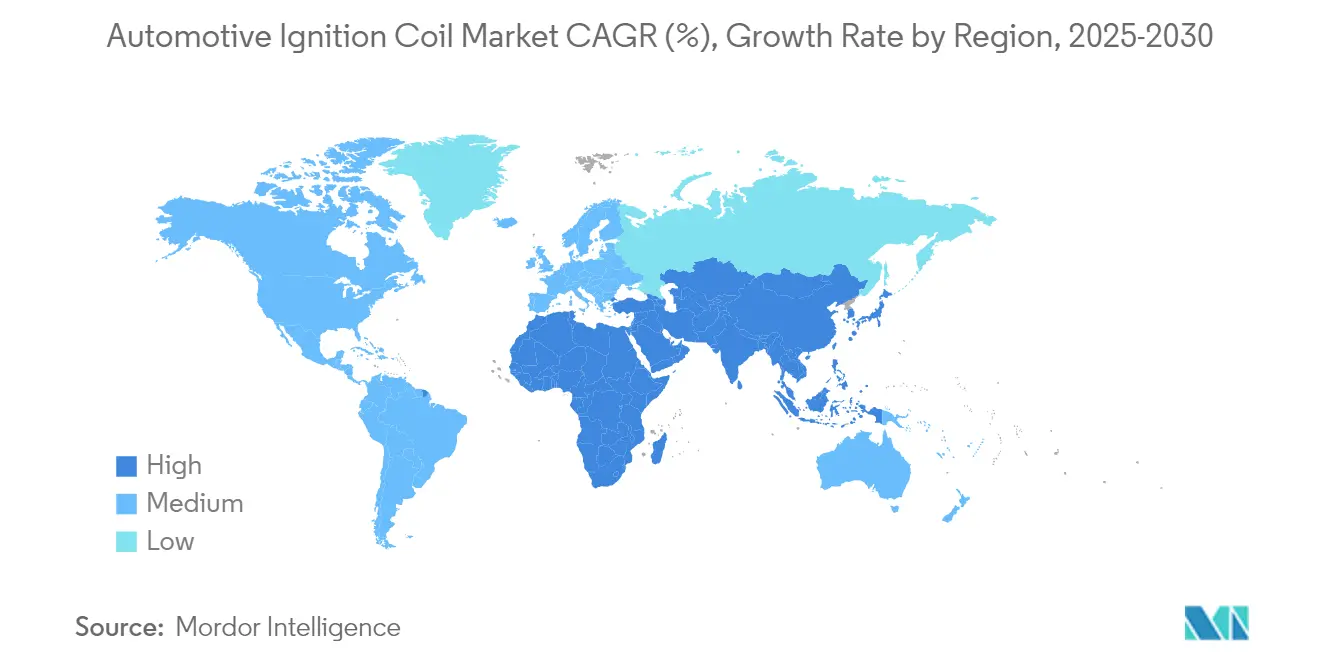
Asia Pacific leads the automotive ignition coil market with 46.05% share and is on pace for 6.74% CAGR. China recorded auto-industry revenue of 10 trillion yuan in 2024, and domestic brands accounted for 61.9% of sales, driving strong local coil demand. Japanese manufacturers such as NGK ship advanced units worldwide, while India’s low-cost base draws investment for OEM supply and aftermarket export. North America is a mature but profitable arena; the 12.5-year average fleet age secures steady aftermarket pull, and strict U.S. EPA rules keep premium coils relevant for remaining ICE platforms.
EMEA and South America Automotive Ignition Coil Market
Europe balances aggressive BEV policy with interim Euro 7 compliance. Automakers must fit high-output coils to meet particulate limits until battery platforms scale, and NGK’s 87% aftermarket coverage ensures part availability for aging gasoline and mild-hybrid fleets. South America is driven by Brazil’s flex-fuel ecosystem, where 82% of the light-vehicle park runs on ethanol blends, a scenario that raises coil stress and boosts demand for corrosion-resistant designs; Brazil’s ethanol output reached 35.3 billion liters in 2023 . The Middle East and Africa remain smaller contributors yet record incremental gains as motorization rates climb. Political instability and currency volatility complicate logistics, but localized assembly by Japanese and Chinese brands is opening coil opportunities in Nigeria, Egypt, and South Africa. Overall, geographic diversity cushions the automotive ignition coil market against single-region shocks.
Regulatory Landscape
Ignition coil demand and specification tightening are indirectly shaped by emissions policy, as regulators push spark-ignited engines toward cleaner, more repeatable combustion. In the United States, the EPA finalized multi-pollutant emissions standards for model year 2027 and later light-duty and medium-duty vehicles in April 2024, which has led OEMs to further optimize ignition energy and control strategies on remaining ICE and hybrid platforms as the powertrain mix transitions.
On the component compliance side, ignition coils are governed by established test and dimensional standards used in OEM validation and aftermarket quality assurance. ISO methods such as ISO 6518-2 (electrical performance and function tests), ISO 13476 (electrical characteristics and measurement methods for key coil parameters), and ISO 10455 (dimensional requirements for certain dry ignition coil configurations) provide the benchmarking framework for high-voltage performance, repeatability, and fitment across global supply bases.
Value Chain Analysis
The ignition coil value chain runs from upstream materials and electronics into precision manufacturing, then to OEM and aftermarket distribution. Key inputs include copper magnet wire, steel laminations, plastics and elastomers for housings and boots, and semiconductors and passive components where coils are integrated with suppression or diagnostic electronics. These are processed by specialist fabricators for winding, molding, potting, and PCB assembly, and then to Tier 1 suppliers (including DENSO, Bosch, BorgWarner, Valeo, Mitsubishi Electric, and Hitachi Astemo/Astemo) that integrate coils into distributorless ignition modules or COP assemblies for first-fit supply.
Downstream, OEMs account for the majority of revenue (74.62% in 2025), with logistics and line-side delivery requirements favoring suppliers that can meet validation, traceability, and quality targets at scale; the aftermarket (25.38% in 2025) depends on broad SKU coverage and channel partners serving independent workshops. Standardization underpins qualification and interchangeability: SS-ISO 6518-2:2024 updates electrical performance and function test methods in line with current ignition architectures, and SAE International published J973_202603 in March 2026 to define updated ignition system measurement procedures for distributorless systems, supporting consistent validation across supply tiers.
Competitive Landscape
The competitive arena is moderately concentrated. NGK/Niterra commands extensive reach through 69 subsidiaries and 34 factories and continues to diversify from spark plugs into full ignition modules. DENSO is reallocating R&D toward inverter and battery-cooling products, signaling a proactive response to BEV displacement risks. Bosch demonstrates incremental innovation, recently replacing plastic gripping features with contact springs in COP housings to assure spark-plug integrity under vibration.
Material supply is the new battleground. Copper and rare-earth volatility incentivize research into aluminum windings and ferrite magnets. Suppliers able to switch materials without compromising coil output gain a margin edge. Digital diagnostics is another frontier: embedded sensors relay coil temperature and spark energy to telematics portals, empowering predictive maintenance for fleet operators.
Aftermarket specialists carve out space below the tier-one giants. Standard Motor Products pushes monthly SKU additions to maintain 99% vehicle coverage, and its multi-pack Blue Streak line targets quick-turn repairs. Regional firms in China and India compete primarily on cost but increasingly license designs from global leaders, adding volume without disrupting the technological hierarchy. Collectively, these strategies shape an automotive ignition coil market that rewards both scale and agile adaptation.
Automotive Ignition Coil Industry Leaders
-
Denso Corporation
-
NGK Spark Plug Co. Ltd (Niterra)
-
Hitachi Astemo Ltd
-
Robert Bosch GmbH
-
BorgWarner Inc. (incl. Delphi Technologies)
- *Disclaimer: Major Players sorted in no particular order
Automotive Ignition Coil Market Companies Covered in this Report
- NGK Spark Plug Co. Ltd (Niterra)
- Denso Corporation
- Robert Bosch GmbH
- Hitachi Astemo Ltd
- Diamond Electric Holdings Co. Ltd
- Taiwan Ignition System Co. Ltd
- BorgWarner Inc. (incl. Delphi Technologies)
- Eldor Corporation
- Valeo SA
- Continental AG
- Mitsubishi Electric Corporation
- Standard Motor Products Inc.
- Federal-Mogul (Tenneco)
- Mahle GmbH
- Walker Products Inc.
Market Opportunities and Future Outlook
Aftermarket expansion is a practical whitespace where suppliers can monetize the aging global parc, particularly in North America and Europe where older vehicles sustain higher replacement rates and SKU breadth becomes a competitive moat. Evidence of active portfolio investment includes Niterra (NGK Ignition Parts) extending its ignition-coil range in April 2026 with additional part references targeting a wide set of legacy and premium marques. This reinforces the strategic importance of vehicle-in-operation coverage as OEM coil volumes face longer-term electrification pressure.
On the OE side, tighter tailpipe requirements and engine-design shifts are raising the value content of ignition coils on remaining gasoline and hybrid platforms, especially for turbocharged downsized engines where cylinder-specific spark control via COP is a key design direction. Opportunities also extend to higher-durability coils for flex-fuel markets such as Brazil, where ethanol blends increase corrosion and thermal stress, and to smart-diagnostic coil designs that feed temperature and spark-energy data into telematics and predictive maintenance workflows for fleets. Material and supply resilience (copper and rare-earth exposure) remains a commercial lever, incentivizing redesigns and sourcing strategies that protect margins without sacrificing high-voltage performance.
Recent Industry Developments in Automotive Ignition Coil Market
- April 2026: Niterra (NGK Ignition Parts) expanded its ignition-coil aftermarket lineup with additional part references targeting a broad set of vehicle brands, including Ford, Nissan, Toyota, Porsche, Alfa Romeo, Fiat, Jaguar Land Rover, and Hyundai. The move strengthens VIO coverage and supports workshop demand for reliable, OE-aligned replacements as fleets age in core service markets.
- April 2025: Hitachi Astemo Ltd. changed its company name to Astemo Ltd.. The rebranding aligns the supplier identity across its electrification and powertrain portfolio, while keeping ignition components positioned within a broader mobility systems offering to OEM customers.
- November 2024: Diamond & Zebra Electric Mfg. Co. launched an ignition coil for hydrogen engines with false-ignition prevention. This product direction broadens ignition-coil relevance into alternative-fuel combustion programs and highlights ongoing engineering investment beyond conventional gasoline applications.
Automotive Ignition Coil Market Report Scope and Research Methodology
Market Definition and Coverage
This market covers the revenue generated from automotive ignition coils that convert low-voltage battery power into high-voltage output for spark creation in spark-ignition engines, across vehicle production and replacement demand. Values are measured at the point of sale for coils supplied through OEM and aftermarket routes.
Scope exclusions: It does not include complete ignition system assemblies, spark plugs, wires, engine control units, or diagnostic services unless they are bundled as part of an ignition coil sale.
Segments Covered in This Report
- By Type
- Block Ignition Coils
- Coil-on-Plug (COP)
- Ignition Coil Rail
- By Operating Principle
- Single Spark Technology
- Dual Spark Technology
- By Distribution Channel
- OEM
- Aftermarket
- By Vehicle Type
- Passenger Cars
- Commercial Vehicles
- By Geography
- North America
- United States
- Canada
- Rest of North America
- South America
- Brazil
- Argentina
- Rest of South America
- Europe
- Germany
- United Kingdom
- France
- Italy
- Russia
- Rest of Europe
- Asia Pacific
- China
- Japan
- India
- South Korea
- Australia
- New Zealand
- Rest of Asia Pacific
- Middle East and Africa
- Saudi Arabia
- United Arab Emirates
- Egypt
- Turkey
- South Africa
- Rest of Middle East and Africa
- North America
Data Sources, Market Sizing, and Validation
Desk Research
Desk research was used to set the demand pool and keep assumptions realistic by linking ignition coil needs to measurable vehicle activity. Public sources such as OICA vehicle production statistics, UNECE vehicle regulations, US EPA emissions and certification materials, Eurostat trade statistics, and USITC import data were reviewed to understand vehicle output, cross-border flow patterns, and regulatory pressure that can affect ignition architectures.
We also checked company annual reports, investor presentations, reputable automotive press coverage, and association websites to map typical channel splits between OEM fitment and replacement. Where needed, paid subscriptions were used in a limited way for company financials and intelligence, patent databases for technology direction, and an import-export shipment-level database to sanity-check major trade corridors. These desk inputs were treated as constraints for the model rather than the final answer. The sources listed here are illustrative only, and many other references were used for data collection, clarification, and cross-checking.
Primary Interviews and Surveys
Primary work focused on validating how coils are specified and sold by channel, and on translating vehicle activity into realistic replacement rates and pricing. We spoke with a mix of OEM-linked participants, aftermarket distribution participants, and technical experts across APAC, EMEA, and the Americas so assumptions could be stress-tested by geography, vehicle parc age, and service behaviors.
Distribution of primary research fieldwork respondents
| Company type | Respondent position | Region |
|---|---|---|
| Top tier: 32% | CXOs: 15% | APAC: 47% |
| Mid tier: 53% | Functional/Unit leaders: 40% | EMEA: 30% |
| Smaller Players: 15% | Managers: 45% | Americas: 23% |
Market-Sizing & Forecasting
Market sizing was built using a top-down and bottom-up approach where vehicle production and the in-use vehicle parc were reconstructed by region, and then converted into coil demand using fitment rules and replacement behavior. In practice, new-vehicle volumes guide OEM coil demand, while parc size and service frequency shape aftermarket demand, after which pricing is applied to reach value.
Several market-specific inputs were used to keep the totals grounded, such as gasoline and other spark-ignition powertrain mix by region, average coils per engine architecture (for example, coil-on-plug versus rail systems), aftermarket replacement intervals linked to mileage and vehicle age, the split between passenger cars and commercial vehicles, and the channel mix between OEM and aftermarket. To avoid relying on any single data stream, selective bottom-up approximations were added as checks, including sampled ASP-by-region ranges from channel participants and a supplier roll-up on a small set of high-visibility product lines, with gaps adjusted when coverage was incomplete.
Forecasting relied mainly on scenario analysis supported by short ARIMA runs on vehicle production and parc growth series, and then refined using primary feedback on pricing progression and technology adoption pace. Where input data was thin for a country, proxy markets with similar parc age and service patterns were used, followed by a second-pass adjustment after expert review.
Data Validation & Update Cycle
Validation was done through a step-by-step set of checks so the final numbers stayed consistent with observable automotive activity. Outputs were compared against independent signals such as vehicle production totals, trade movement patterns for ignition components, and realistic ranges for coil replacement volumes implied by parc size and service intervals.
When a region showed unusual growth or a sudden price swing, the driver assumptions were revisited and, when needed, respondents were re-contacted to confirm whether the change was real or a modeling artifact. Before sign-off, the model and key assumptions go through analyst peer review, and outliers are documented with the reason for keep or correction. Reports are refreshed annually, with interim updates triggered by material events such as major production shifts, regulation changes that impact spark-ignition volumes, or sharp currency moves. Right before delivery, an analyst completes a final review pass so clients receive the latest updated view.
Mordor Intelligence's Automotive Ignition Coil Market Estimate Compared With Other Published Estimates
Published market values for ignition coils often differ because the same product can be counted at different selling points, and because OEM fitment and replacement demand get handled in different ways across studies. Differences also come from how quickly pricing assumptions are refreshed and whether the model ties back to vehicle production and parc realities.
The main gap comes from whether adjacent ignition parts and broader ignition-system revenues are included. In that regard, Mordor Intelligence counts only ignition coils sold through OEM and aftermarket channels, then applies channel-specific ASP and replacement-rate inputs to reach the total. Year choice also matters because some sources anchor on 2025 and others on 2026, which shifts the value when production timing and currency effects are not aligned.
Benchmark comparison
| Source | Market Size | Gaps in Research Methodology |
|---|---|---|
| Mordor Intelligence | USD 11.74 B (2026) | |
| Industry Publisher A | USD 12.17 B (2026) | This estimate appears to use a different base-case set for pricing and regional weighting, and it may lean more on reported revenue benchmarks without fully separating coil-only scope from broader ignition component baskets. |
| Industry Publisher B | USD 11.55 B (2025) | The value is anchored to 2025 and a longer forecast window, which can dampen the near-term market level if production normalization and ASP updates are not carried forward into the next year in the same way. |
Looking across the table, the spread is mostly explained by scope handling and the selected base year, followed by how pricing and replacement rates are updated. By keeping the demand pool tied to vehicle output and parc-driven replacement, and by treating OEM and aftermarket pricing as separate levers, the resulting total stays traceable to clear inputs and repeatable checks.
Key Questions Answered in the Report
What is the current size of the automotive ignition coil market?
The market is valued at USD 11.74 billion in 2026 and is projected to reach USD 14.46 billion by 2031.
Which region leads the automotive ignition coil market?
Asia Pacific holds the top position with 46.05% share in 2025 and is growing at a 6.74% CAGR to 2031.
Why are coil-on-plug systems growing faster than other types?
COP technology offers precise cylinder-specific spark control essential for turbocharged and downsized engines, resulting in a 6.08% CAGR.
Why is the aftermarket channel expanding more rapidly than OEM supply?
Vehicle fleets are aging, leading to higher replacement rates; aftermarket suppliers cover up to 99% of models, driving a 6.91% CAGR.