
Microcontroller (MCU) Market Size and Share
Market Overview
| Study Period | 2020 - 2031 |
|---|---|
| Market Size (2026) | USD 38.34 Billion |
| Market Size (2031) | USD 62.74 Billion |
| Growth Rate (2026 - 2031) | 10.33 % |
| Fastest Growing Market | Asia Pacific |
| Largest Market | Asia-Pacific |
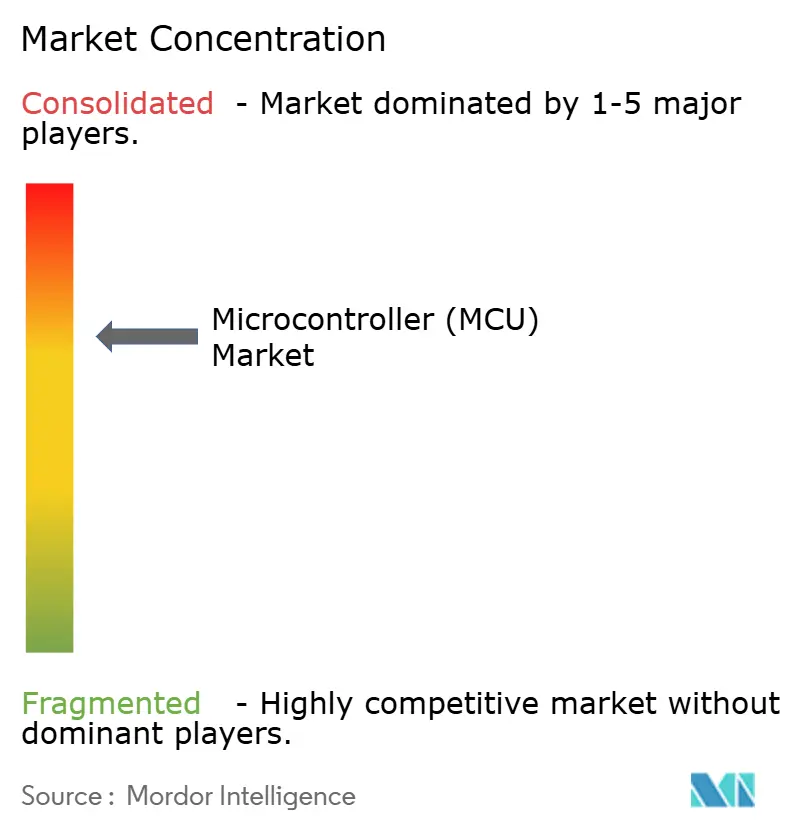
| Market Concentration | Medium |
Major Players *Disclaimer: Major Players sorted in no particular order Image © Mordor Intelligence. Reuse requires attribution under CC BY 4.0. | |
Microcontroller (MCU) Market Analysis by Mordor Intelligence
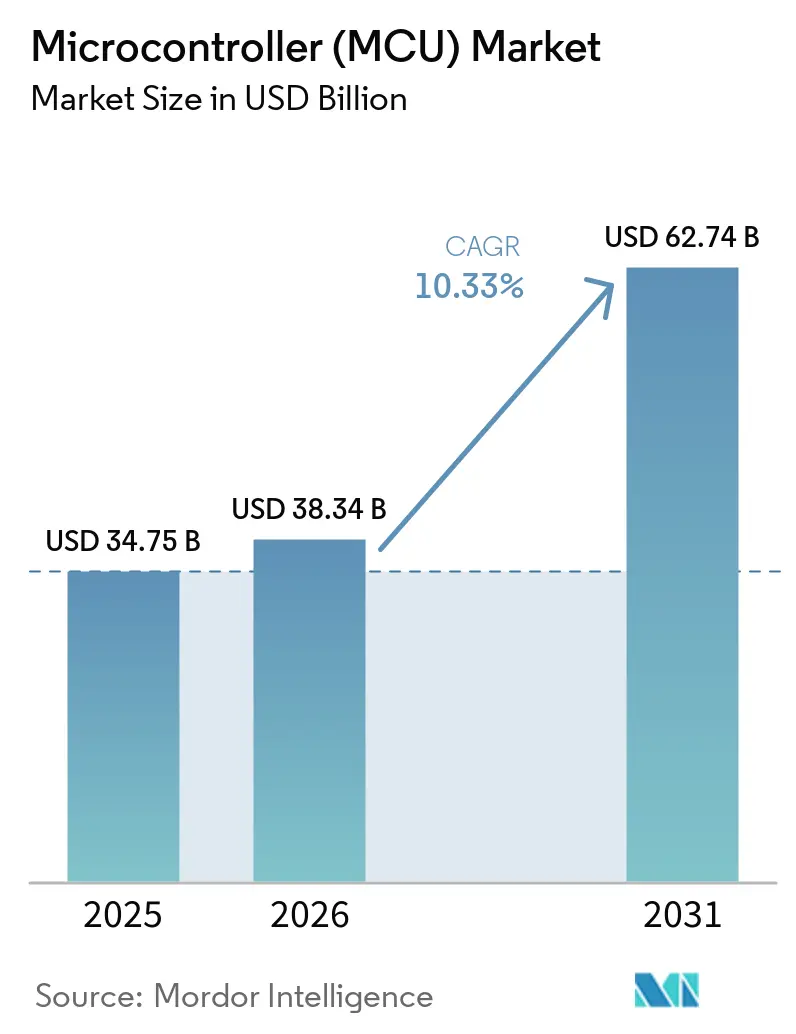
The Microcontroller market size was valued at USD 34.75 billion in 2025 and estimated to grow from USD 38.34 billion in 2026 to reach USD 62.74 billion by 2031, at a CAGR of 10.33% during the forecast period (2026-2031). This trajectory reflects the rising demand for embedded intelligence across electrified vehicles, Internet of Things (IoT) endpoints, and next-generation consumer devices. Content per car is increasing as functional-safety mandates expand MCU counts, while predictive-maintenance programs in factories accelerate the rollout of smart sensors. Open instruction-set architectures reduce licensing costs, helping smaller vendors address edge-AI workloads. Meanwhile, regional near-shoring and supply-chain diversification stimulate fresh capacity investments even as average selling prices (ASP) remain under pressure.
Key Report Takeaways
- By application, automotive electronic control units led the microcontroller market with a 30.42% share in 2025; industrial IoT sensors are expected to advance at a 11.12% CAGR through 2031.
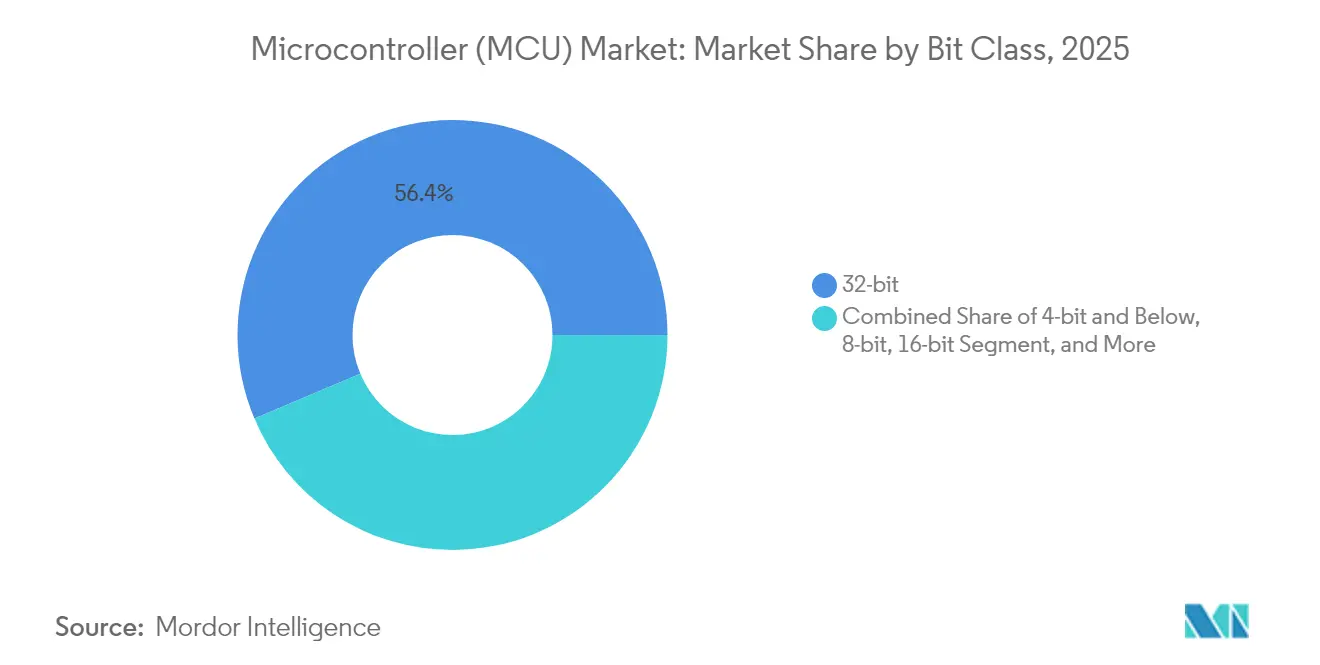
- By bit class, 32-bit devices commanded a 56.35% share of the Microcontroller market size in 2025.
- By core architecture, ARM Cortex-M retained 68.25% share in 2025, while RISC-V is expanding at a 15.09% CAGR through 2031.
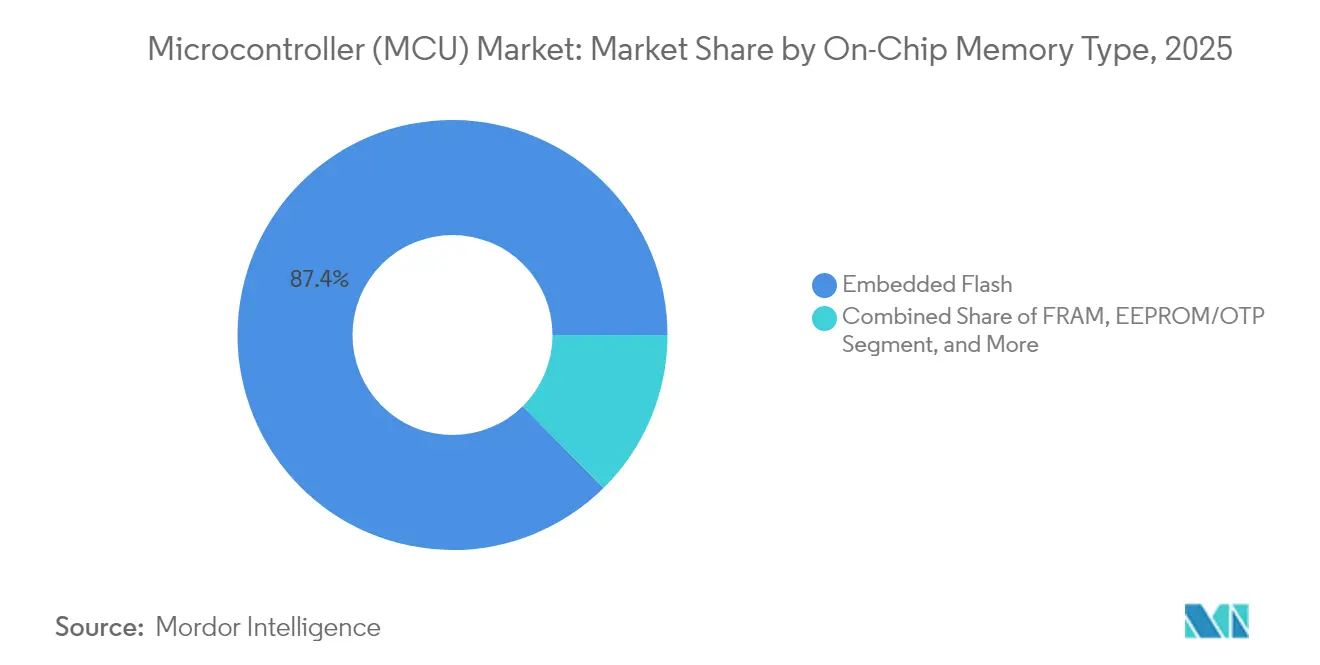
- By 2025, on-chip memory, specifically embedded flash, captured 87.40% of the Microcontroller market size; FRAM is growing at a 12.07% CAGR.
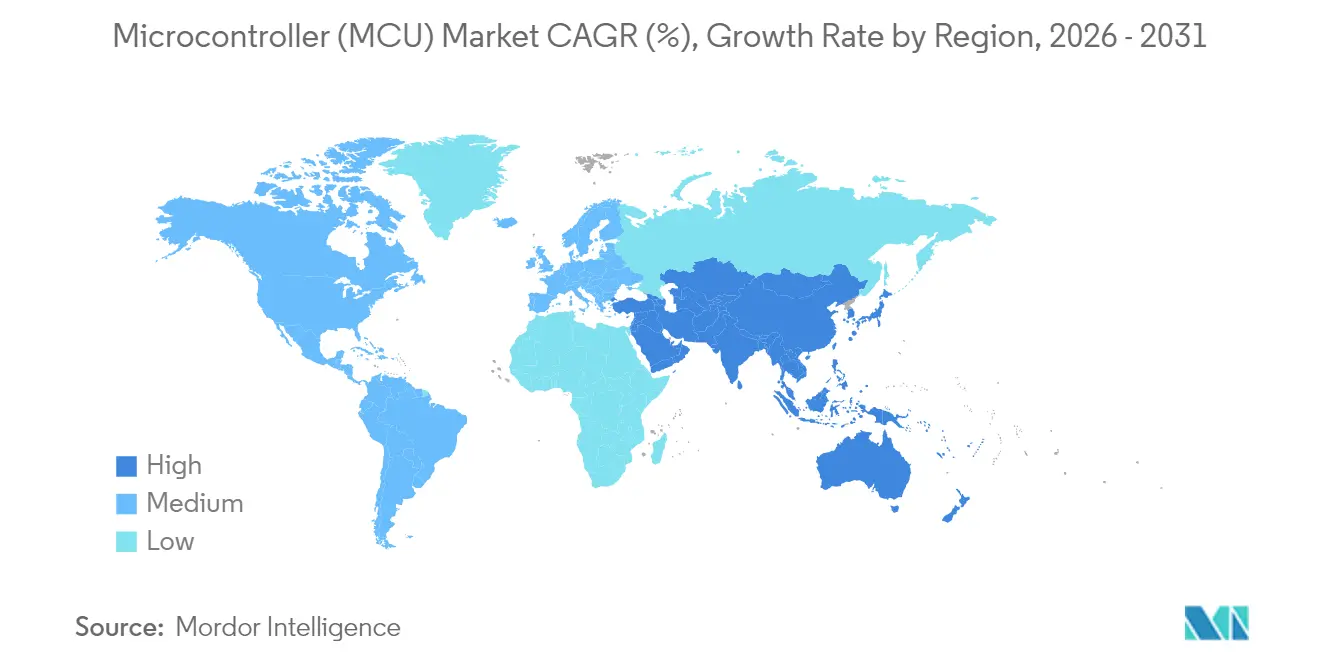
- By geography, APAC accounted for 47.30% of the revenue in 2025; South America is projected to grow at a 10.22% CAGR through 2031.
Note: Market size and forecast figures in this report are generated using Mordor Intelligence’s proprietary estimation framework, updated with the latest available data and insights as of 2026.
Market Trends and Insights
Drivers Impact Analysis of Microcontroller (MCU) Market*
| Driver | (~) % Impact on CAGR Forecast | Geographic Relevance | Impact Timeline |
|---|---|---|---|
| IoT node proliferation | +2.8% | Global, APAC leadership | Medium term (2-4 years) |
| Automotive electrification and ADAS | +2.1% | North America and EU, China EV expansion | Long term (≥ 4 years) |
| Smart-home and appliance MCU integration | +1.6% | North America and EU, accelerating APAC adoption | Medium term (2-4 years) |
| Shift to RISC-V open ISA | +1.4% | Global, led by China and India | Long term (≥ 4 years) |
| Ultra-low-power edge-AI MCUs | +1.2% | Global, early automotive and industrial | Medium term (2-4 years) |
| Industrial cybersecurity mandates | +0.9% | EU, North America, critical infrastructure | Short term (≤ 2 years) |
| Source: Mordor Intelligence | |||
IoT Node Proliferation Drives Embedded Intelligence Demand
Connected endpoints are projected to exceed 20 billion units by 2030, forcing manufacturers to embed multi-protocol radios and efficient processors into cost-sensitive designs. Nordic Semiconductor’s nRF54 series combines Bluetooth LE 5.4, Thread, and Matter in a single device, while maintaining a battery-friendly current draw, thereby reducing the bill of materials and firmware complexity [1]Source: Nordic Semiconductor, “Nordic Semiconductor to Launch First Products in Class-Leading nRF54 Series,” nordicsemi.com. Premium-priced analytics services, enabled by richer local processing, shift revenue models away from pure hardware sales. Semiconductor suppliers, such as Synaptics, are repositioning their portfolios toward IoT-optimized solutions rather than pursuing general-purpose computing.
Automotive Electrification and ADAS Integration Accelerate MCU Content Growth
A battery-electric vehicle can host up to 3,000 semiconductor components, quadrupling the MCU footprint versus internal-combustion models. Mercedes-Benz relies on discrete microcontroller clusters to manage the battery, thermal, and regenerative braking systems in accordance with ISO 26262. Continental’s cooperation with NXP centralizes multiple chassis functions into software-upgradable domain controllers, cutting wiring weight and enabling seamless over-the-air updates. EU regulations mandating the deployment of advanced driver-assistance systems across all classes by 2026 further amplify this shift. Honda’s partnership with Renesas to co-develop 2,000 TOPS SoCs highlights how computational demands are reshaping the Microcontroller market.
Smart-Home and Appliance MCU Integration Transforms Consumer Electronics
Open-standard Matter firmware allows white-goods firms to serve Apple Home, Google Home, and Amazon Alexa with a single hardware platform. STMicroelectronics’ ready-made Matter code examples accelerate compliance testing [2]Source: STMicroelectronics, “Connectivity: Matter Develop and Prototype,” stmicroelectronics.com. Cascoda’s SMARTRange radio doubles indoor range without raising power budgets, solving multi-story connectivity gaps [3]Source: Thread Group, “Case Studies,” threadgroup.org. Case studies demonstrate that IoT-enabled appliances can reduce household energy consumption by 27%, prompting retailers to favor models with this technology. u-blox’s MAYA-W2 module integrates Wi-Fi 6, Bluetooth LE, and Thread into a single, certified package, reducing product cycles for mid-tier brands [4]Source: u-blox, “Selecting the Right Hardware for Smart Home Solutions,” u-blox.com .
Shift to RISC-V Open ISA Disrupts Traditional Licensing Models
Royalty-free cores help emerging economies localize chip supply. Government-funded programs in China and India subsidize RISC-V tool-chain training, easing entry barriers for fabless startups. Renesas is diverting resources from SiC to open-ISA microcontrollers, signaling that even incumbents see sustainability in customized extensions over blanket license fees. Tailored instruction sets enable automotive suppliers to add hardware redundancy for ASIL-D compliance, while IoT designers integrate neural-network accelerators onto the same base architecture.
Restraints Impact Analysis of Microcontroller (MCU) Market*
| Restraint | (~) % Impact on CAGR Forecast | Geographic Relevance | Impact Timeline |
|---|---|---|---|
| Supply-chain cyclicality | -1.8% | Global, APAC manufacturing concentration | Short term (≤ 2 years) |
| ASP erosion from Chinese fabs | -1.4% | Global, mature-node pricing pressure | Medium term (2-4 years) |
| Rising NRE for sub-28 nm embedded flash | -0.7% | Advanced-node applications | Long term (≥ 4 years) |
| Talent shortage in mixed-signal design | -0.6% | North America and EU | Medium term (2-4 years) |
| Source: Mordor Intelligence | |||
Supply-Chain Cyclicality Creates Inventory and Pricing Volatility
Foundry scheduling swings expose MCU vendors to abrupt wafer-allocation shifts. Recent inventory digestion phases forced Nordic Semiconductor to cut 8% of its workforce after revenue fell 30% in 2023 [5]Source: Nordic Semiconductor, “Annual Report 2023,” nordicsemi.com . The oversupply of metal-silicon pulled benchmark spot prices down 2.3% to USD 2.95/kg in April 2025, yet tariffs threaten to reverse the cost gains [6]Source: Wafer World, “Falling Silicon Prices: Why Are They Going Down—and Will It Last?” waferworld.com. The concentration of mature-node capacity in Taiwan, mainland China, and South Korea magnifies geopolitical risk premiums, prompting OEMs to fund buffer stocks that tie up working capital.
ASP Erosion from Chinese Fabs Intensifies Pricing Competition
Aggressive 10-15% price cuts at domestic foundries squeeze incumbents in 8-bit and 16-bit lanes where differentiation is thin. The “China shock” forces players like GlobalFoundries to chase volume in automotive and telecom while accepting margin compression. Persistent headwinds risk diverting R&D budgets away from next-generation edge AI microcontrollers, potentially delaying the market-wide adoption of safety-critical features.
*Our forecasts treat driver/restraint impacts as directional, not additive. The impact forecasts reflect baseline growth, mix effects, and variable interactions.
Microcontroller (MCU) Market Segment Analysis
By Bit Class:
Rising Performance Needs Sustain 32-Bit LeadershipIn 2025, 32-bit devices captured 56.35% of the Microcontroller market share, illustrating a decisive tilt toward complex workloads. The segment is projected to grow at an 8.76% CAGR, driven by ADAS sensor fusion, industrial drive control, and voice-enabled consumer gadgets. 32-bit architectures enable larger addressable memory and integrate digital-signal-processing extensions, thereby reducing the need for external components. MCU designers now embed neural engines and cybersecurity accelerators directly on the die, eliminating the need for discrete coprocessors. Lower-cost 8-bit and 16-bit parts remain viable in interface logic, while sub-4-bit variants linger in remote controls and thermostats serving ultra-thin margin categories.
Developers are increasingly requesting single-chip prototypes that incorporate secure boot, CAN-FD, and multi-protocol radio in a single package. This all-in-one trend supports platform reuse across product lines, reducing firmware maintenance. Meanwhile, integrated FRAM options on 32-bit units provide instant-write capability without charge-pump overhead, which is critical for data-logging sensors that operate in high-vibration environments.



By Core Architecture:
ARM Ecosystem Strength Meets RISC-V MomentumCortex-M cores supplied 68.25% of shipments in 2025, bolstered by mature toolchains and robust middleware stacks. Customers value out-of-the-box RTOS support and expansive community libraries that shorten debug cycles. Yet RISC-V’s 15.09% CAGR points to mounting enthusiasm for instruction-set customization at zero royalty cost. Governments deploy domestic RISC-V programs to safeguard technology sovereignty, funneling subsidies toward open-ISA chiplets spanning wearables to automotive gateway nodes. Proprietary cores persist in niche avionics and industrial drives that require deterministic, cycle-accurate responses, whereas x86 processors are used in server-class board management controllers.
For the Microcontroller market, vendor success hinges on the richness of the development environment. ARM continues to extend TrustZone, PSA-Certified security, and M-Profile Vector Extensions, whereas RISC-V groups invest in unified software-layer harmonization to stave off fragmentation. Some suppliers hedge bets by offering pin-compatible ARM or RISC-V alternatives within the same product family.
By On-Chip Memory Type:
FRAM Challenges Flash SupremacyEmbedded flash accounted for 87.40% of the Microcontroller market size in 2025, thanks to decades of process maturity and cost efficiency. Nevertheless, FRAM’s 12.07% expansion pace demonstrates rising preference for instant-write endurance in edge-AI logging. Industrial robotics relies on constant state snapshots to comply with safety integrity level ratings; FRAM ensures data retention during brownouts. Suppliers are exploring 3D NOR and MRAM for higher densities without charge-trap issues, although price parity with planar flash has not yet been achieved. EEPROM and OTP retain roles in secure-key storage and calibration trimming, while SRAM-only parts reside in minimal-footprint devices tethered to external code flash.
By Application:
Industrial IoT Sensors Outpace Legacy SegmentsAutomotive ECUs accounted for 30.42% of revenue in 2025, driven by electrification and ADAS. Yet, industrial IoT sensors are expected to lead the fastest growth at an 11.12% CAGR through 2031, as factories retrofit predictive-maintenance nodes to reduce unplanned downtime. IoT microcontrollers with edge-AI capabilities enable local vibration, acoustic, and thermal analytics, reducing cloud bandwidth requirements. Consumer electronics, ranging from wearables to AR glasses, benefit from reduced standby currents and integrated radio subsystems that extend battery life. Healthcare designers adopt ultra-low-leakage architectures for implantable devices that must pass stringent FDA durability testing, while aerospace and defense engineers specify radiation-hardened variants with guarded supply chains. Cloud-server BMCs complete the mix, adding secure out-of-band management to hyperscale racks.
Geography Analysis
APAC Microcontroller (MCU) Market
APAC retained 47.30% of global revenue in 2025 on the strength of China’s consumer-electronics assembly ecosystem and Japan’s automotive semiconductor depth. Chinese five-year plans targeting local silicon autonomy create pull for domestic MCU tape-outs across home appliances and public-charging infrastructure. Japanese suppliers maintain traction with powertrain-qualified microcontrollers specifically designed for hybrid drive cycles, leveraging their long-standing OEM ties. South Korean conglomerates integrate native memory IP with logic blocks to build one-chip solutions for smartphones and smart TVs. Rising labor, energy, and geopolitical costs prompt some diversification into Vietnam and Thailand, yet the region’s cohesive component ecosystem preserves its comparative advantage, keeping it as the fastest-growing market for microcontrollers.
The Americas and Europe Microcontroller (MCU) Market
South America emerges as one of the fastest-growing regions in the microcontroller market, with a 10.22% CAGR from 2020 to 2031. Brazil’s renewed automotive-production incentives and Mexico’s USMCA-enabled export corridors lure EV platform assembly that requires localized MCU sourcing. Government-directed renewable energy grids are driving the rollout of smart meters, which in turn boosts demand for secure, low-power 32-bit controllers. Local-content mandates spur joint ventures between global silicon vendors and regional design houses, catalyzing the development of talent around embedded software stacks. North America centers on high-value safety-critical niches. The CHIPS Act earmarks billions for wafer-fab construction, though most capacity targets sub-10 nm nodes rather than mature MCU geometries. Defense contractors stipulate onshore production and supply-chain attestations, ensuring steady demand for ITAR-compliant parts. Europe focuses on adhering to ISO 26262 and IEC 62443 within the automotive and process automation verticals. TSMC’s planned Dresden fab will supply 40,000 300 mm wafers monthly to European Tier-1s, shortening lead times for high-reliability microcontrollers .

Regulatory Landscape
The regulatory environment for microcontrollers is shaped by trade measures and export controls that affect mature-node supply availability and customer qualification practices. In January 2026, the United States issued a Section 232 proclamation covering imports of certain semiconductors and derivative products, and U.S. authorities updated advanced computing export controls administered under the Export Administration Regulations (EAR) through BIS. Those changes raise the compliance burden around product classification, customer screening, and end-use restrictions for shipments tied to sensitive destinations.
On the standards side, cybersecurity and functional-safety requirements increasingly influence MCU selection for automotive and industrial programs. In Europe, CENELEC draft standards prEN 50765:2026 and prEN 50766:2026 formalize cybersecurity assessment expectations for microcontrollers and microprocessors with security-relevant functions, aligning with the EU cybersecurity regulatory direction. That reinforces the need for documented secure boot, key protection, and security evaluation artifacts, alongside established automotive and industrial expectations such as ISO 26262 and IEC 62443 referenced in customer procurement and validation workflows.
Value Chain Analysis
The MCU value chain runs from IP and EDA enablement through wafer fabrication on mature process nodes, assembly and test, distribution, and OEM/EMS integration with long lifecycle support. For high-volume MCUs, foundry wafer supply is the most capital-intensive and capacity-constrained step, with mature-node manufacturing concentrated among large foundries and IDMs, while packaging and test partners provide automotive-grade qualification flows that add time and cost. On the demand side, automotive ECUs and industrial automation programs raise expectations for AEC-Q100-grade qualification, long-term availability, and security collateral, pushing vendors toward platform software and reference designs that reduce customer integration effort.
Supply chain strategy increasingly combines captive manufacturing, long-term capacity reservations, and regionalized partnerships to reduce exposure to allocation swings and trade friction. STMicroelectronics has emphasized in-house 28 nm production for automotive-focused MCU platforms, while Microchip strengthened supply resilience by deepening cooperation with TSMC around a dedicated 40 nm product line at JASM in Kumamoto, Japan. Distribution and authorized channel management also carry more weight as OEMs seek buffer stocks and multi-sourcing, and pricing pressure in mature-node categories makes cost control across wafer procurement, test throughput, and firmware ecosystem support more important.
Competitive Landscape
The Microcontroller industry is moderately fragmented. Infineon, NXP, and STMicroelectronics lead the way with multi-domain portfolios that bundle processors, power management, and connectivity. Their platform strategies emphasize common software, driving economies of scale and time-to-market advantages. Renesas’ AUD 9.1 billion acquisition of Altium adds a board-design toolchain, creating an end-to-end ecosystem from schematic to compiled firmware. Patent filings increased by 22% in 2024; Samsung alone filed 10,000, underscoring the intensifying intellectual property rivalry.
Niche innovators such as Ambiq Micro and Nordic Semiconductor gain share by specializing in sub-200 nA sleep currents and advanced radio stacks, respectively. Open-ISA specialists target cost-sensitive deployments with differential advantages in configurability and licensing. Automotive networking consolidation continues: Infineon has acquired Marvell’s automotive Ethernet assets for USD 2.5 billion, aiming to supply complete zonal architecture chipsets. Strategic collaborations dominate go-to-market moves, for example, Texas Instruments teaming with Delta Electronics on high-efficiency onboard chargers for EVs. Customers value suppliers who offer long-term supply guarantees, robust functional safety collateral, and in-house security certifications.
Microcontroller (MCU) Industry Leaders
Infineon Technologies AG
Microchip Technology Inc.
NXP Semiconductors N.V.
STMicroelectronics N.V.
Texas Instruments Incorporated
- *Disclaimer: Major Players sorted in no particular order
Microcontroller (MCU) Market Companies Covered in this Report
- Infineon Technologies AG
- Microchip Technology Inc.
- NXP Semiconductors N.V.
- STMicroelectronics N.V.
- Texas Instruments Incorporated
- Renesas Electronics Corporation
- Silicon Laboratories Inc.
- Nordic Semiconductor ASA
- Espressif Systems (Shanghai) Co., Ltd.
- GigaDevice Semiconductor Inc.
- Nuvoton Technology Corporation
- Toshiba Electronic Devices and Storage Corporation
- Rohm Co., Ltd.
- onsemi Corporation
- Holtek Semiconductor Inc.
- Ambiq Micro, Inc.
- ASR Microelectronics (Shanghai) Co., Ltd.
- Realtek Semiconductor Corp.
- Zilog, Inc.
- Analog Devices, Inc.

Market Opportunities and Future Outlook
One opportunity sits at the intersection of automotive electrification, functional safety, and software-defined architectures, where OEMs and Tier-1s are consolidating functions into domain and zonal controllers while still deploying large counts of companion MCUs. The report context points to this shift in supplier roadmaps and collaborations, including Continental working with NXP on domain controller approaches and suppliers aligning to ISO 26262 programs. That widens demand for MCUs that package safety documentation, secure provisioning, and connectivity stacks, especially within 32-bit platforms that already account for the majority of shipments by bit class.
A second opportunity is supply-chain localization and ecosystem build-out around mature nodes and embedded security, supported by active policy programs and standards work. India announced India Semiconductor Mission 2.0 in February 2026, with funding aimed at ecosystem deepening and advanced packaging, while the European Commission published a Chips Act 2.0 proposal in June 2026 to reinforce European capabilities across mainstream semiconductors. In parallel, emerging European cybersecurity assessment drafts, CENELEC prEN 50765:2026 and prEN 50766:2026, increase the commercial value of secure MCU feature sets and verification artifacts. That creates room for vendors that can provide prescriptive security features, evaluation support, and long-term supply commitments for industrial IoT and smart infrastructure deployments.
Recent Industry Developments in Microcontroller (MCU) Market
- July 2026: Infineon Technologies AG completed the acquisition of ams OSRAM Group's non-optical analog and mixed-signal sensor portfolio. The acquisition expands Infineon's sensor offering that pairs with MCU-based sensing and control in automotive and industrial designs, supporting higher-content platforms that integrate sensors, connectivity, and embedded processing.
- March 2026: STMicroelectronics released the STM32C5 entry-level 32-bit MCU family based on Arm Cortex-M33, with pricing positioned for cost-sensitive designs. By bringing Cortex-M33 class security and performance into entry tiers, the release increases competitive pressure in high-volume industrial and IoT endpoints where customers want secure boot and modern toolchains without moving to premium MCU lines.
- March 2025: Texas Instruments unveiled a new MCU positioned as the world's smallest, extending its MSPM0 portfolio for compact applications such as medical wearables and personal electronics. The launch is aimed at board-space-constrained designs and supports faster product cycles by reducing component footprint while keeping sensing and control functions on a single device.


Microcontroller (MCU) Market Report Scope and Research Methodology
Market Definition and Coverage
For this methodology, the microcontroller (MCU) market includes revenue earned from standalone MCU devices sold into end-use equipment, where the MCU acts as the embedded control and processing unit.
Scope exclusions: We exclude embedded CPUs/MPUs that are not sold as MCUs, plus discrete peripheral ICs that may sit next to an MCU in a design.
Segments Covered in This Report
- By Bit Class
- 4-bit and below
- 8-bit
- 16-bit
- 32-bit
- By Core Architecture
- ARM Cortex-M
- RISC-V
- x86
- Proprietary / Others
- By On-Chip Memory Type
- Embedded Flash
- FRAM
- EEPROM/OTP
- SRAM-only (code-in-RAM)
- By Application
- Automotive
- Consumer Electronics and Home Appliances
- Industrial and Factory Automation
- Healthcare
- Aerospace and Defense
- Data-Com and Cloud Infrastructure
- Others
- By Geography
- North America
- United States
- Canada
- Mexico
- Europe
- Germany
- United Kingdom
- France
- Italy
- Rest of Europe
- Asia Pacific
- China
- Japan
- South Korea
- India
- Taiwan
- Rest of Asia Pacific
- South America
- Brazil
- Argentina
- Rest of South America
- Middle East and Africa
- GCC
- South Africa
- Rest of Middle East and Africa
- North America
Data Sources, Market Sizing, and Validation
Desk Research
Desk work started with pinning down the demand pool and the supply context for MCUs, so our assumptions stayed tied to the real electronics build cycle. We leaned on public sources such as U.S. Census Bureau manufacturing and trade tables, UN Comtrade trade flows for relevant HS codes, OECD industrial production series, and World Bank macro indicators to keep regional demand movement grounded.
We then reviewed industry-facing documents such as company annual reports and investor decks, credible press coverage on wafer capacity and lead times, and technical publications and patent databases to track MCU-related design activity. For cross-checks, we used paid subscriptions for company financials and intelligence, plus news and financials, and we also referred to a semiconductor value chain database for context on nodes and supply constraints. The sources listed here are illustrative only, and many other public documents and data series were used to collect, validate, and clarify inputs.
Primary Interviews and Surveys
Primary work was used to pressure-test the model inputs that are hard to observe in public data, including typical MCU content per system, mix shifts between 8-bit, 16-bit, and 32-bit parts, and expected pricing movement as supply normalizes. We spoke with a balanced set of participants across device suppliers, channel partners, and high-volume end users in automotive, industrial automation, consumer electronics, and communications. This input was used to confirm realistic adoption timing by region and to sanity-check the application mix assumptions.
Distribution of primary research fieldwork respondents
| Company type | Respondent position | Region |
|---|---|---|
| Top tier: 39% | CXOs: 17% | APAC: 49% |
| Mid tier: 43% | Functional/Unit leaders: 35% | EMEA: 29% |
| Smaller Players: 18% | Managers: 48% | Americas: 22% |
Market-Sizing & Forecasting
Our sizing uses a top-down and bottom-up blend, where the main totals are rebuilt from semiconductor demand signals and end-market activity, and then checked with selective supplier and channel roll-ups. In practice, electronics production trends and trade movement are used to set the demand envelope, after which application-level shares are assigned using usage patterns from interviews.
Key inputs include regional output of vehicles and industrial equipment (as a proxy for embedded controller needs), electronics production and export intensity, MCU content per system for priority applications, average selling price movement by bit class, and observed lead-time and inventory normalization signals. Where bottom-up checks show gaps, such as missing coverage for long-tail suppliers or captive flows, we apply conservative correction factors tied to the share of fragmented shipments confirmed by channel respondents. For forecasting, we run scenario analysis around a central case, because MCU demand is sensitive to auto build cycles, industrial capex timing, and consumer device refresh rates, and these variables were aligned to the consensus ranges we heard from practitioners.
Data Validation & Update Cycle
Before sign-off, outputs are tested against independent signals such as regional electronics production, trade directionality, and application growth patterns, and any outliers are investigated until the driver is clear. We also run variance checks across regions and applications so implied unit and price trends do not conflict with feasible ranges described by respondents.
Each report goes through multi-step analyst review, followed by targeted re-contacts if a key assumption shifts, or if the model shows an unusual break from expected demand behavior. The report is refreshed annually, with interim updates when material events occur, including sharp supply disruptions or major end-market demand resets. Right before delivery, an analyst performs a final pass so clients receive the latest view supported by the most recent available evidence.
Mordor Intelligence's Microcontroller Mcu Market Sizing Compared With Other Published Estimates
Published MCU market numbers can look far apart because the boundaries are not always the same, and some publishers use broad semiconductor baskets that blend adjacent device types. Differences also show up when one estimate leans on aggressive price expansion, or when it reports a different base year than the one being discussed.
Unit and ASP tracking by bit class, along with cross-checks against end-market build indicators, are the practical checks that keep Mordor Intelligence tied to a standalone MCU revenue pool, rather than folding in programmable logic, embedded processors, or loosely defined "programmable" device categories.
Benchmark comparison
| Source | Market Size | Gaps in Research Methodology |
|---|---|---|
| Mordor Intelligence | USD 38.34 B (2026) | |
| Trade Journal A | USD 34.00 B (2030) | The estimate is presented as a long-range target and is commonly communicated without a clearly stated base-year build, which can compress short-term recovery and understate near-term price and mix effects. |
| Industry Publication B | USD 102.40 B (2032) | The scope is labeled as programmable microcontrollers, which can broaden coverage beyond standalone MCUs and can also apply a higher growth path that assumes faster adoption across multiple embedded categories. |
The spread in the table is mostly explained by scope labels and time anchoring, rather than a simple math difference. When the counted device set and the year being sized are made explicit, the total becomes easier to reproduce, and users can map it cleanly to the applications and regions they actually sell into.


Key Questions Answered in the Report
How large will the Microcontroller market be by 2031?
Forecasts place the market at USD 62.74 billion in 2031, growing at a 10.33% CAGR from 2026.
Which Microcontroller bit class sees the greatest growth?
32-bit devices expand at an 8.76% CAGR on sustained demand for edge-AI and ADAS processing.
Why is South America the fastest-growing geography?
Vehicle-assembly near-shoring and renewable-energy projects lift microcontroller demand, delivering a 10.22% CAGR through 2031.
What drives RISC-V adoption in embedded systems?
Royalty-free licensing and government sovereignty initiatives push RISC-V microcontrollers to a 15.09% CAGR.
Which connectivity option grows fastest in embedded designs?
Wi-Fi-integrated MCUs advance at a significant CAGR as Matter adoption raises bandwidth needs across smart-home products.
How are suppliers addressing rising cybersecurity mandates?
Vendors integrate secure boot, hardware key storage and IEC 62443-certified reference designs to meet industrial and automotive compliance requirements.
Page last updated on:




