
Automotive Fascia Market Size and Share
Market Overview
| Study Period | 2020 - 2031 |
|---|---|
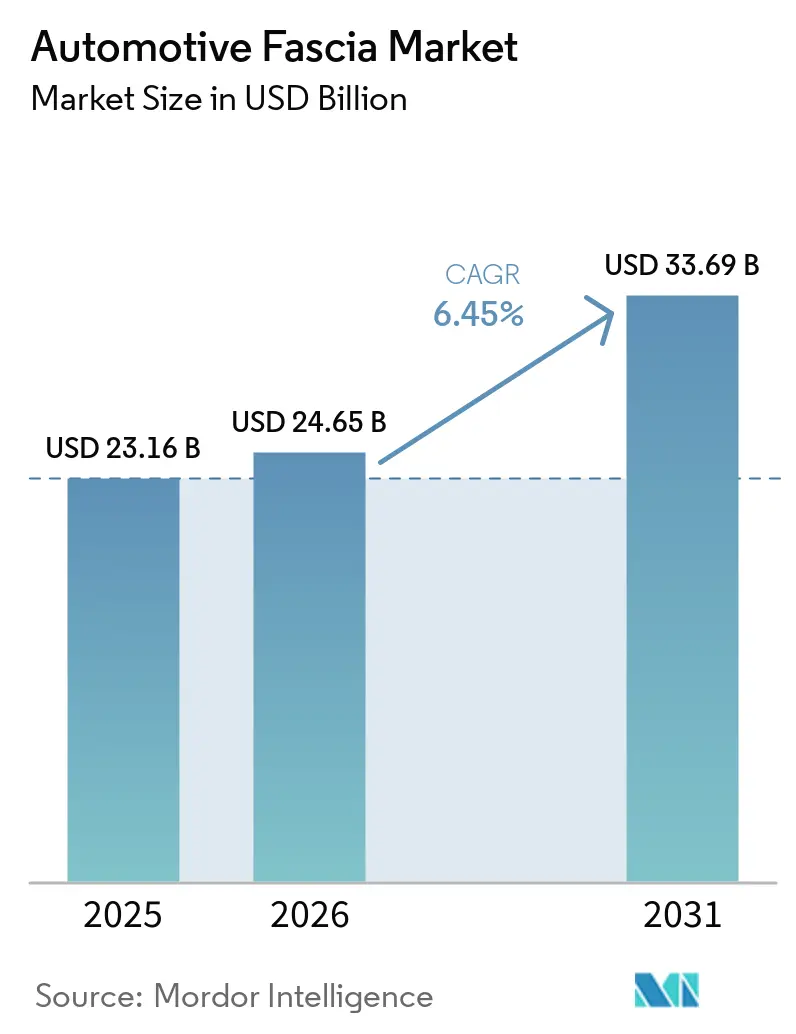
| Market Size (2026) | USD 24.65 Billion |
| Market Size (2031) | USD 33.69 Billion |
| Growth Rate (2026 - 2031) | 6.45 % |
| Fastest Growing Market | South America |
| Largest Market | Asia Pacific |
| Market Concentration | Medium |
Major Players *Disclaimer: Major Players sorted in no particular order Image © Mordor Intelligence. Reuse requires attribution under CC BY 4.0. | |
Automotive Fascia Market Analysis by Mordor Intelligence
The Automotive Fascia Market size was valued at USD 23.16 billion in 2025 and estimated to grow from USD 24.65 billion in 2026 to reach USD 33.69 billion by 2031, at a CAGR of 6.45% during the forecast period (2026-2031). Continued electrification, tighter pedestrian-safety rules, and the push for lighter front-end modules redefine how bumpers, grilles, and lighting treatments come together. OEMs are shifting from stand-alone bumpers to fully integrated sensor platforms that house LiDAR, radar, and cameras while managing battery-cooling airflow. The European Union’s 2023 End-of-Life Vehicles update obliges automakers to raise recycled-plastic content, accelerating use of next-generation polyolefins and recycled aluminum skins[1].
Key Report Takeaways
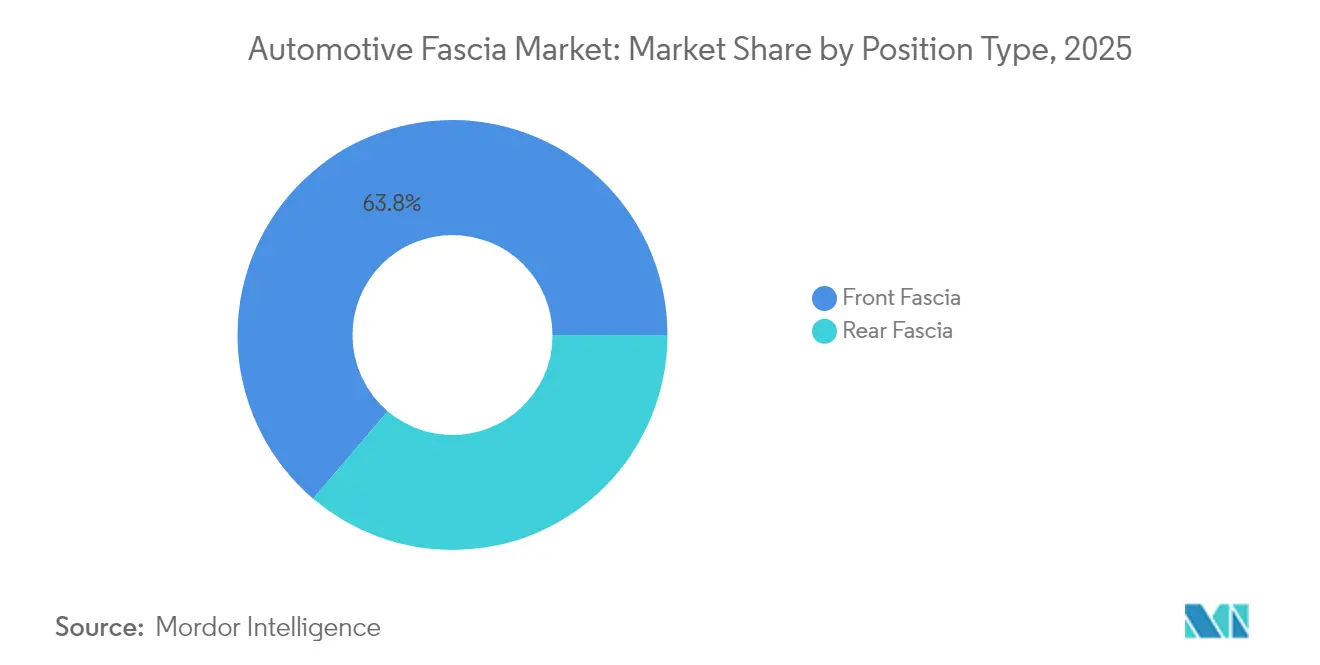
- By position type, front fascia commanded 63.78% of the automotive fascia market share in 2025 and is expanding at a 6.66% CAGR through 2031.
- By material, plastic-covered styrofoam held 46.10% of the automotive fascia market size in 2025, whereas plastic-covered aluminum is projected to grow at 5.96% CAGR to 2031.
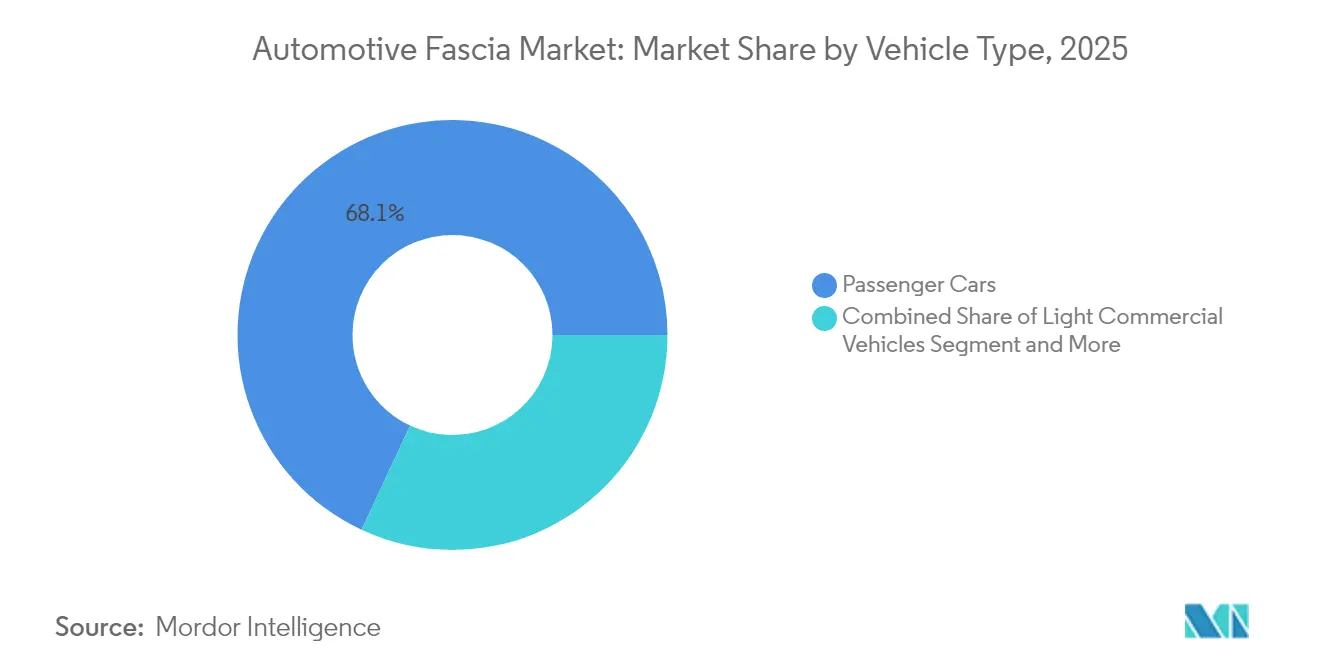
- By vehicle type, passenger cars accounted for 68.05% share of the automotive fascia market size in 2025 while electric passenger cars are advancing at a 7.01% CAGR through 2031.
- By sales channel, OEM supply held 85.88% share of the automotive fascia market size in 2025, yet the aftermarket is rising at 7.38% CAGR over the same period.
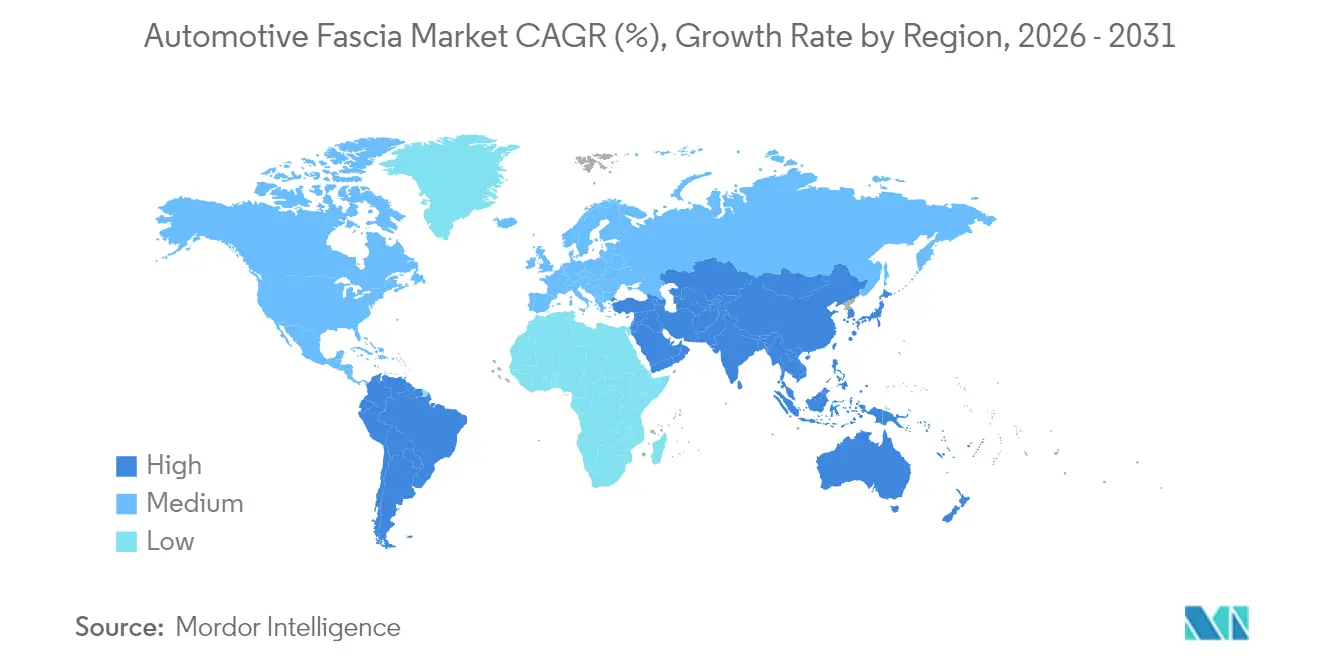
- By geography, Asia Pacific led with 47.96% revenue share in 2025, while South America is projected to record a 6.98% CAGR to 2031.
Note: Market size and forecast figures in this report are generated using Mordor Intelligence’s proprietary estimation framework, updated with the latest available data and insights as of 2026.
Market Trends and Insights
Drivers Impact Analysis of Automotive Fascia Market*
| Driver | (~) % Impact on CAGR Forecast | Geographic Relevance | Impact Timeline |
|---|---|---|---|
| Growth of EV & Autonomous Vehicle | +2.1% | Global, led by China and Europe | Long term (≥ 4 years) |
| Lightweighting & Emission-Regulation | +1.8% | North America and EU primarily, expanding to Asia | Long term (≥ 4 years) |
| Integration of Advanced Sensing | +1.3% | North America, Europe, China | Medium term (2-4 years) |
| Increasing Vehicle Production & Sales | +1.2% | Global, with concentration in Asia-Pacific | Medium term (2-4 years) |
| Modular Front-End Modules Adoption | +0.9% | Global, with early adoption in premium segments | Medium term (2-4 years) |
| Shift to Recycled & Bio-Based Polymers | +0.7% | EU and North America leading, global expansion | Long term (≥ 4 years) |
| Source: Mordor Intelligence | |||
Growth of EV and Autonomous Vehicle Platforms
Electric vehicles change cooling loads and open grille-less design options, forcing suppliers to redesign fascia modules that can mount LiDAR, 4D radar, and high-resolution cameras without raising drag. Hyundai Mobis has introduced integrated front-face units for battery cars that package active shutters, millimeter-wave radar, and camera cleaning systems into a single sub-assembly. Additionally, Marelli announced a partnership with Hesai to embed LiDAR into headlamp housings, shifting sensing hardware from bumper skins to lighting clusters. Moreover, premium 800-volt EVs need electromagnetic shielding for high-frequency switching, so fascia panels blend aluminum films with plastic topcoats for EMI control.
Light-weighting and Emission-Regulation Compliance
Stricter CO2 caps in the EU and CAFE targets in North America push OEMs toward lighter structures that still pass FMVSS impact tests. Carbon-fiber reinforced plastics cut as much as 60% mass versus steel yet deliver the same crush-energy absorption. Constellium’s M-LightEn consortium commercializes ultra-high-strength aluminum grades with 80% recycled content, reducing component carbon intensity by half[2]. Toyoda Gosei is validating cellulose-nanofiber reinforced polypropylene to trim weight and cradle-to-grave emissions. Sensor additions add weight back in, so engineers juggle mass savings with LiDAR housings and radar radomes.
Integration of Advanced Sensing (LiDAR/Radar) into Fascia
ADAS adoption turns the fascia into an active sensing surface. Radar-transparent polycarbonate blends and thin paint formulas are now specified to ensure 77-81 GHz signals are not attenuated. Aeva and AGC’s Wideye division have demonstrated FMCW LiDAR units that mount behind glass, freeing bumper real estate for styling while preserving aerodynamic efficiency. Aptiv’s corner-radar strategy points to a distributed sensor layout that may reduce large central radar modules in the bumper but increases side-fender integration needs. Suppliers must balance structural stiffness, low dielectric loss, and paint durability within tight packaging envelopes.
Modular Front-End Modules Adoption by OEMs
Just-in-sequence delivery of complete front-end modules can cut line-side labor and capital outlay. LANXESS’s hollow-profile hybrid combines metal and plastic in a single shot to yield a torsionally stiff carrier that routes cooling fluid and cable harnesses. EV cooling loops are simpler, letting suppliers integrate radiator frames and pedestrian-impact beams into one unit. While modularization raises content per vehicle for Tier 1 firms, it also forces them to master logistics and thermal, lighting and sensor domains traditionally handled by different suppliers.
Restraints Impact Analysis of Automotive Fascia Market*
| Restraint | (~) % Impact on CAGR Forecast | Geographic Relevance | Impact Timeline |
|---|---|---|---|
| Same Raw-Material Price Volatility | -1.1% | Global, with acute impact in emerging markets | Short term (≤ 2 years) |
| High Maintenance & Replacement Cost | -0.8% | Global, particularly in premium vehicle segments | Medium term (2-4 years) |
| ADAS-Led Fall in Collision Frequency | -0.6% | North America and Europe leading | Long term (≥ 4 years) |
| OEM Vertical Integration Curbing Aftermarket | -0.4% | Global, concentrated in EV platforms | Medium term (2-4 years) |
| Source: Mordor Intelligence | |||
High Maintenance and Replacement Cost
Calibration of radar and camera modules after a minor parking scrape can lift repair bills by 37%, challenging insurer economics and consumer willingness to pay. OEM-approved bumper paints must remain radar-transparent, narrowing repair-paint options and steering work to certified centers with costly alignment rigs. Independent shops face five-figure investments in ADAS calibration bays, prompting market consolidation. The higher part complexity also boosts idle time, raising rental-car days and pushing insurers to negotiate deeper part discounts with Tier 1 vendors.
ADAS-Led Fall in Collision Frequency
Forward-collision warning and automatic emergency braking reduce front-end impacts, the very events that generate steady fascia-replacement revenue. A study suggests that up to 8,700 crashes and 70 fatalities could be prevented in the United States by 2040, trimming demand for front bumpers. Fewer accidents hurt volume, but deeper technology in each bumper raises the average selling price. European repair groups are pivoting to subscription-based service contracts, focusing on maintenance routines and software updates instead of collision repair.
*Our forecasts treat driver/restraint impacts as directional, not additive. The impact forecasts reflect baseline growth, mix effects, and variable interactions.
Automotive Fascia Market Segment Analysis
By Position Type:
Front Fascia Drives InnovationFront fascia assemblies represented 63.78% automotive fascia market share in 2025, underscoring their central role in aerodynamic drag reduction and pedestrian protection. This segment is forecast to progress at a 6.66% CAGR, fuelled by the need to mount high-definition cameras, long-range radar and cleaning nozzles without enlarging frontal area. Successive design cycles now route washer-fluid channels and heating elements directly into the bumper beam to guarantee sensor uptime in icy climates. Rear fascia systems trail in revenue but are also evolving to accommodate smart-lighting arrays and parking radars that help automated-parking software.
Valeo has begun validating fascia skins printed with embedded micro-LED matrices that deliver dynamic turn signals and cyclist alerts, a preview of communication-centric exteriors. The upcoming NHTSA FMVSS No. 228 rule changes amplify the need for compliant crush cans and deformable foams that maintain head-injury criteria below 1,000 HIC, driving deeper collaboration between polymer chemists and crash-simulation engineers. Bio-polypropylene foams with tuned cell geometry have emerged as candidates to balance energy absorption with recyclability.

By Material:
Aluminum Gains Ground under Lightweight MandatePlastic-covered styrofoam retained a 46.10% slice of the automotive fascia market in 2025 due to mature molding economics and global tooling availability. Yet plastic-covered aluminum panels are on track for a 5.96% CAGR to 2031 as EV makers exploit aluminum’s thermal conductivity to dissipate inverter heat. Thin 1 mm aluminum substrates laminated with impact-modified PP outer skins weigh 15% less than comparable PP/EPP foams while passing pedestrian impact. Emerging composite skins blend bio-polyurethane back-foams with recycled aluminum films, allowing OEMs to advertise lower cradle-to-gate CO2.
MacDermid Enthone has released anodizing chemistries that accept low-temperature plastics over-molding without blistering, streamlining joins between metal and polymer skins. Recycled aluminum scrap flows from beverage cans into Constellium grades, proving automotive fascia industry progress toward circularity. Steel and rubber blends hold niche beachheads in heavy-duty trucks where stone-chip resistance outweighs weight concerns.
By Vehicle Type:
Electric Passenger Cars Lead Growth CurvePassenger cars delivered 68.05% of 2025 revenues in the automotive fascia market, reflecting global build volumes. Electric passenger cars are the fastest riser, with a 7.01% CAGR projected through 2031. Grille-less EV faces present smooth surfaces that can host brand-signature lighting strips and hidden sensors, motivating design studios to collaborate with Tier 1 fascia specialists early in program cycles. Light commercial vans need ruggedized bumpers that tolerate frequent curb contacts; however, last-mile delivery electrification is nudging this segment toward composite skins that resist low-speed knocks yet weigh less.
BMW’s Neue Klasse sedan, starting production in 2025, uses a flush fascia with active-air flaps that open only during battery fast-charge cooling cycles, demonstrating the intersection of thermal management, automotive active body panel design, and styling. Cellular PP foams infused with natural fibers damp inverter whine while shedding kilograms relative to glass-filled nylon. Medium and heavy trucks still specify high-durometer elastomer skins, but sensor fusion for highway-pilot systems will gradually raise content value even in this conservative space.
By Sales Channel:
Aftermarket Finds Niche GrowthOEM installations dominated delivery lines with an 85.88% hold on the 2025 automotive fascia market share, supported by platform-wide standardization of sensor packages. Despite fewer collisions, the aftermarket is set for a 7.38% CAGR because calibration services, paint systems matched to radar transparency, and subscription-based software updates create new billable items. North American collision shops now advertise “ADAS-ready” bumper replacements that include calibration tokens coded to a specific VIN.
The European independent aftermarket keeps a 60% share of the spare-parts pool by adding remote-diagnosis and digital-inventory services. E-commerce pure-plays in the United States are forecast to lift online bumper sales between 2025 and 2029 by bundling paint-to-order services, compressing delivery lead times from weeks to days. OEM vertical integration on EV programs restricts third-party access to design blueprints, but right-to-repair legislation in several US states moderates that control.
Geography Analysis
APAC and North America Automotive Fascia Market
In 2025, Asia Pacific secured 47.96% of the revenue share, solidifying its position as the manufacturing epicenter of the automotive fascia market. China is one of the largest producers of vehicles in 2024 and keeps scaling gigacasting pilots that could roll fascia, crash beam, and battery tray into one aluminum shot, reducing part counts. India’s auto-components roadmap targets a USD 200 billion turnover by FY26, supported by production-linked incentives that reimburse up to 13% of local value addition. Honda’s CAD 15 billion (USD 11 billion) commitment to develop a Canadian EV supply chain will open new North American export routes for Asian Tier 1 tooling firms.
The Americas Automotive Fascia Market
South America is the fastest-growing region, with a 6.98% CAGR as Stellantis channels EUR 5.6 billion into Bio-Hybrid drivetrain platforms built in Brazil and Argentina. Bio-ethanol-compatible bumpers require coatings resistant to sugar-based fuel sprays, prompting local formulators to adapt resin chemistries. Colombia has become the region’s third-largest assembler, while Peru leverages free-trade agreements to ship plastic inserts and chrome trims into the United States duty-free. Exchange-rate volatility remains a cost-planning hurdle, so suppliers increasingly hedge resin contracts in USD.
North America and Europe Automotive Fascia Market
North America and Europe retain strategic importance as regulation trend-setters. NHTSA’s pending pedestrian rule is already embedded in 2026 model-year North American fascia designs. The EU Circular Economy Action Plan pushes recyclates into trim components and incentivizes digital passports that log resin genealogy. War-risk premiums on Red Sea freight lanes have nudged OEMs toward near-shoring fascia tool builds in Mexico and Eastern Europe. Europe’s EV adoption pace demands fast cycles on grille-less styling; conversely, US demand is tied to charging-infrastructure roll-outs, leading to phased tooling plans that mix ICE and EV fascias on the same line for risk mitigation.
Regulatory Landscape
Automotive fascia design and materials are increasingly shaped by safety, chemicals, and circularity requirements. In the United States, bumper and impact performance requirements under FMVSS 581 influence energy-absorbing foam and carrier choices, while pedestrian-protection requirements referenced by OEMs in 2026 model-year design cycles push deformable structures and compliant front-end packaging. In China, MIIT-linked GB standards for pedestrian protection similarly drive fascia geometry and material tuning, reinforcing global convergence toward pedestrian-friendly front modules.
Regulation is also affecting resin and coatings selection and cross-border sourcing. EU REACH substance restrictions can trigger 18-24 month reformulation cycles for plastics and coatings used in bumper skins and radar-transparent paints. The EU Packaging and Packaging Waste Regulation (PPWR) takes effect on 12 August 2026, adding compliance considerations for packaging used in parts logistics. In parallel, trade and customs enforcement, including UFLPA-related scrutiny and regional content documentation tied to USMCA rules of origin and Section 232 tariff risk, increases the focus on traceability across fascia supply chains.
Value Chain Analysis
The automotive fascia value chain runs from petrochemical and recycled feedstock suppliers, including PP and PC blends, EPP and EPS foams, and aluminum sheet, through compounders and additive providers. Compounders and coating suppliers support impact modifiers, low-dielectric formulations, and radar-transparent finishes, while tooling ecosystems provide multi-cavity molds, jigs, and automated paint lines.
Tier-1 module integrators then assemble bumper covers, carriers, energy absorbers, grilles and active shutters, lighting trims, and sensor radomes into just-in-sequence front-end modules for OEM assembly plants. Collision repair networks and certified calibration centers anchor aftermarket demand for sensor-equipped fascias. Integration and localization are also tightening as Tier-1s push for one-stop exterior system offerings and stronger program control. The Yanfeng Plastic Omnium joint venture integration upgrade highlighted in 2026 reflects consolidation of exterior capabilities to serve local EV OEM programs with integrated solutions rather than stand-alone bumper parts. At the same time, regional regulatory paths and trade-risk management are fragmenting footprints through nearshoring and dual sourcing, while tooling capacity constraints, including bottlenecks in established mold-making clusters, can extend lead times for fascia program launches and refresh cycles.
Competitive Landscape
Competitive intensity is moderate as the top five suppliers command roughly two-thirds of global fascia revenue, leaving room for niche specialists focused on sensor transparency and bio-materials. Plastic Omnium is channeling EUR 300 million toward hydrogen tank and fuel-cell integration that could place the firm at the center of zero-emission commercial-vehicle fascia assemblies. Magna is collaborating with NVIDIA on Level 2+ to Level 4 active-safety stacks, positioning its e-beam grille shutters and surround-view fascia trims as hardware anchors for over-the-air software features[3]. FORVIA leverages its seating and lighting portfolio to sell full-width lightbars behind color-matched polycarbonate bumper skins, bundling style and communication functions into one purchase order.
Gigacasting constitutes the most visible disruptive threat. Tesla’s 6,000-ton presses meld front structural rails with bumper attachments in a single aluminum melt, potentially shrinking the addressable market for bolt-on fascia carriers. Toyota, Ford, and Volvo are running feasibility prototypes, but pedestrian-impact zones and sensor replacements remain unresolved challenges that favor detachable bumper covers in the near term. Suppliers are hedging by developing quick-replace skin panels that fasten to gigacast structures without adhesive, preserving aftermarket revenue streams.
White-space growth areas range from LiDAR integration brackets to bio-based polyurethane foams that match petroleum counterparts on impact strength. LANXESS markets flax-fiber reinforced thermoplastics that cut CO2 by 50% compared with glass-fiber staples while passing Euro NCAP pedestrian tests. LyondellBasell has introduced polypropylene compounds using mechanically recycled feedstock paired with mass-balance certified bio-naptha, appealing to OEM recyclability scorecards. The march toward software-defined vehicles is blurring lines between electronics and exterior trim, evident in the GM-Magna-Wipro SDVerse marketplace that lets automakers purchase software modules decoupled from hardware.
Automotive Fascia Industry Leaders
-
Magna International
-
Flex-N-Gate Corporation
-
Plastic Omnium
-
Faurecia SE
-
Samvardhana Motherson
- *Disclaimer: Major Players sorted in no particular order

Automotive Fascia Market Companies Covered in this Report
- Plastic Omnium
- Magna International
- Faurecia SE
- Flex-N-Gate Corporation
- Samvardhana Motherson Group
- Gestamp Automoción
- Toyoda Gosei
- Dongfeng Electronic Technology
- Aisin Corporation
- Benteler Automotive
- Denso Corporation
- Yanfeng Automotive Trim
- Sanko Gosei
- Chiyoda Manufacturing
- Dakkota Integrated Systems
- Revere Plastics Systems
- Inhance Technologies
- Eakas Corporation
- MRC Manufacturing
Market Opportunities and Future Outlook
The move from stand-alone bumper covers to integrated, sensor-enabled front-end modules creates room for suppliers that can pair styling surfaces with radar and LiDAR compatibility, thermal management, and lighting signatures. This direction shows up in OEM and Tier-1 activity around integrated front-face units and sensor packaging, as well as in supplier strategies that bundle lighting and smart surfaces into exterior systems to raise content per vehicle. For buyers, the value proposition centers on reduced line-side operations through module delivery and faster design iteration for grille-less EV fronts, where airflow control and battery-cooling management are built into the fascia.
Materials and compliance-led redesign cycles also expand the addressable pull for recyclate-ready polymers and coatings that keep sensor transparency while meeting evolving chemical and circularity constraints. The EU circularity push referenced in the report context, along with EU REACH-driven reformulation pressure, requires OEMs and Tier-1s to qualify new resin systems and low-dielectric paint stacks. That work supports specialty compounders and coating suppliers that can validate RF performance at 77-81 GHz alongside durability. Regionally, EV platform integration needs cited for the Yangtze River Delta and the broader Asia-Pacific production base point to localized module manufacturing and tooling ecosystems that can supply complete front fascia assemblies with embedded sensing and thermal features.
Recent Industry Developments in Automotive Fascia Market
- June 2026: Inaugurated a manufacturing facility in Bawal, Haryana for the BOS-JRG Automotive Systems JV, focusing on automotive shading and cargo management systems. The initiative expands regional production capacity for fascia related shading modules and strengthens the Asia-Pacific supply footprint.
- June 2026: Amaneos completed the acquisition of Magna International's European automotive lighting business to integrate with Light Mobility Solutions LMS. The consolidation affects fascia perception and sensor integration through lighting assets centralized under LMS.
- May 2026: Magna International awarded a Driver and Occupant Monitoring System program by a European OEM, utilizing mirror-integrated camera architecture. The program integrates sensor enabled fascia and interior modules into the front end and could influence front end module specifications.
Automotive Fascia Market Report Scope and Research Methodology
Market Definition and Coverage
For this study, the automotive fascia market covers the revenue earned from supplying front and rear fascia assemblies used on passenger and commercial vehicles, including painted or unpainted plastic and composite fascia parts sold to OEM and aftermarket channels.
Scope exclusions: It excludes full front-end module carrier systems, standalone lamps and sensors, and non-fascia exterior trim that does not function as a fascia assembly.
Segments Covered in This Report
- By Position Type
- Front Fascia
- Rear Fascia
- By Material
- Plastic-covered Styrofoam
- Plastic-covered Aluminum
- Other Materials (Steel, Rubber, etc.)
- By Vehicle Type
- Passenger Cars
- Light Commercial Vehicles
- Medium and Heavy Commercial Vehicles
- By Sales Channel
- OEM
- Aftermarket
- By Region
- North America
- United States
- Canada
- Rest of North America
- South America
- Brazil
- Argentina
- Rest of South America
- Europe
- United Kingdom
- Germany
- France
- Spain
- Russia
- Rest of Europe
- Asia-Pacific
- China
- India
- Japan
- South Korea
- Rest of Asia-Pacific
- Middle East and Africa
- Saudi Arabia
- United Arab Emirates
- Egypt
- South Africa
- Rest of Middle East and Africa
- North America
Data Sources, Market Sizing, and Validation
Desk Research
Desk research was used to set the base model structure by matching vehicle output trends, trade flows, and materials direction with what is realistically consumed in fascia programs. We referenced public production and registrations series from sources such as OICA and ACEA, plus national transport agencies, and then checked safety and end-of-life policy signals from bodies such as NHTSA, Euro NCAP, and the European Commission.
To keep assumptions grounded, the desk work also used official trade statistics from customs authorities and the UN Comtrade database. For materials context, we referenced plastics and recycling work from groups such as PlasticsEurope, and peer-reviewed journals on polymer performance and paint and coating systems. In parallel, supplier financial filings, investor presentations, and reputable press were reviewed to understand capacity moves and customer mix. Where available, paid subscriptions for company financials and intelligence, patent databases, and shipment-level import and export records were used selectively to cross-check footprints and supply routes. These desk inputs are illustrative, and many other public and paid sources were also reviewed for data collection, validation, and clarification.
Primary Interviews and Surveys
Primary work focused on interviews and surveys with fascia manufacturers, material converters, paint and coating ecosystem contacts, and OEM-facing program roles who track awarded volumes and sourcing shifts. Because this is a global market, inputs were balanced across major vehicle-producing regions. Responses were then used to confirm typical fascia content per vehicle, channel splits between OEM and replacement demand, and how sensor-friendly designs are changing average selling prices over time.
Distribution of primary research fieldwork respondents
| Company type | Respondent position | Region |
|---|---|---|
| Top tier: 38% | CXOs: 14% | APAC: 48% |
| Mid tier: 48% | Functional/Unit leaders: 33% | EMEA: 29% |
| Smaller Players: 14% | Managers: 53% | Americas: 23% |
Market-Sizing & Forecasting
Sizing starts with a demand pool built from vehicle production and parc signals by region, which are then converted into fascia demand using fitment rates and replacement intensity that differ by vehicle class and channel. That top-down and bottom-up logic is handled by building totals from vehicle-linked demand first, then corroborating them with selective bottom-up approximations such as sampled supplier revenue splits, program-level volume discussions, and ASP x unit sanity checks for front and rear assemblies.
Key inputs used in the model include light vehicle and commercial vehicle production. We also account for the share of fascia systems designed for sensor integration, since this influences material and finish. Resin and coating cost direction is tracked because it can affect pass-through pricing. We model OEM versus aftermarket mix alongside regional trade exposure, which can shift where parts are produced versus installed. Forecasts are built using scenario analysis supported by expert inputs, where vehicle build outlook, electrification mix, and regulation-driven design changes are varied to test the range. Where direct supplier roll-ups were incomplete, missing portions were bridged using peer benchmarking by vehicle output, typical fascia content value, and region-specific pricing levels.
Data Validation & Update Cycle
Validation is handled through multiple checks, starting with reconciling the model output against independent signals like vehicle builds, trade movements for relevant exterior parts, and disclosed supplier business trends. If the implied fascia value per vehicle drifts beyond what interviews and desk evidence support, assumptions are revisited and, when required, respondents are re-contacted to confirm what changed.
Before sign-off, the model and assumptions go through step-by-step analyst reviews that focus on variance checks across regions, channel splits, and price progression. Reports are refreshed annually, and interim updates are done when material events occur such as sharp production revisions or policy changes that impact fascia design. Right before delivery, a final review pass is completed so clients receive the latest updated view.
Mordor Intelligence's Automotive Fascia Market Size Versus Other Published Estimates
Published market sizes for automotive fascia can look far apart even when they appear to measure the same thing, since the scope and pricing logic are often not aligned. We try to keep the count tied to installed demand and replacement cycles, and then cross-check it with supplier and trade signals so the final number is not driven by a single assumption.
By tracking vehicle production, refreshing region-level OEM versus aftermarket splits, and checking fascia ASP progression against sensor-integration content shifts, Mordor Intelligence keeps front and rear fascia assemblies separate from adjacent front-end module carriers and standalone lighting units that are sometimes bundled into larger exterior totals.
Benchmark comparison
| Source | Market Size | Gaps in Research Methodology |
|---|---|---|
| Mordor Intelligence | USD 24.65 B (2026) | |
| Trade Journal A | USD 33.40 B (2024) | This estimate appears to use a broader exterior content scope, where fascia-related styling items and integrated front-end pieces can be counted together. Pricing is often applied as a blended value without a clear OEM versus aftermarket split. |
| Regional Consultancy B | USD 21.27 B (2024) | This value reads closer to a near-term historical run-rate view, and it can understate the uplift from sensor-ready fascia designs if ASP updates are not tied to current model-year content. It can also reflect less frequent refreshes of regional mix. |
The spread across sources mainly comes from what is counted as fascia content, the year used as the anchor, and how prices are updated as designs change. When the steps are kept repeatable and inputs are checked against vehicle output and channel behavior, the resulting market size is easier to defend in discussions and easier to update when conditions shift.
Key Questions Answered in the Report
What is the current size of the automotive fascia market and how fast is it growing?
The market is valued at USD 24.65 billion in 2026 and is forecast to reach USD 33.69 billion by 2031, growing at a 6.45% CAGR during the forecast period (2026-2031).
Which region holds the largest share of revenue?
Asia-Pacific leads with 47.96% of global revenue due to its dominant vehicle‐production base and mature supply chains.
What is the fastest-growing regional market through 2031?
South America is projected to expand at a 6.98% CAGR through 2031, supported by Stellantis’s EUR 5.6 billion investment in Bio-Hybrid vehicle programs.
Which product segment generates the most revenue?
Front fascia assemblies account for 63.78% of 2025 sales because they integrate aerodynamics, pedestrian-impact structures and ADAS sensors.
What main trends are propelling demand for new fascia designs?
Electrification, lightweighting mandates, and the need to embed LiDAR and radar in grille-less vehicle fronts are driving rapid product redesign cycles.
How concentrated is supplier competition in this industry?
The top five Tier 1 suppliers control considerable share of the automotive fascia market revenue, reflecting moderate concentration and ongoing opportunities for niche materials and sensor specialists.