
Automotive Steering System Market Size and Share
Market Overview
| Study Period | 2019 - 2031 |
|---|---|
| Market Size (2026) | USD 36.85 Billion |
| Market Size (2031) | USD 47.77 Billion |
| Growth Rate (2026 - 2031) | 5.33 % |
| Fastest Growing Market | Asia Pacific |
| Largest Market | Asia Pacific |
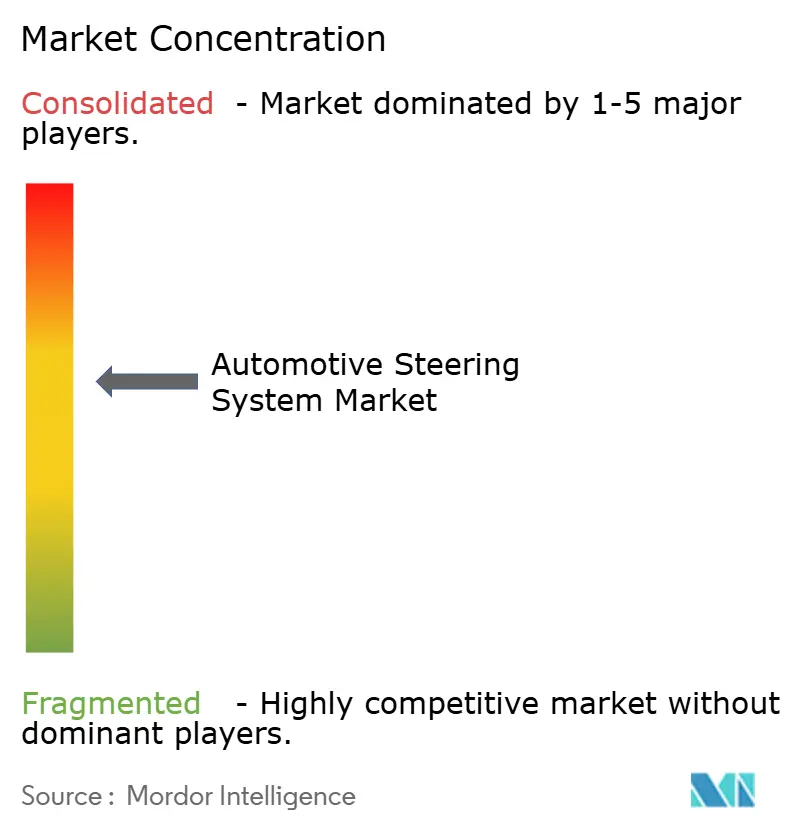
| Market Concentration | Medium |
Major Players *Disclaimer: Major Players sorted in no particular order Image © Mordor Intelligence. Reuse requires attribution under CC BY 4.0. | |
Automotive Steering System Market Analysis by Mordor Intelligence
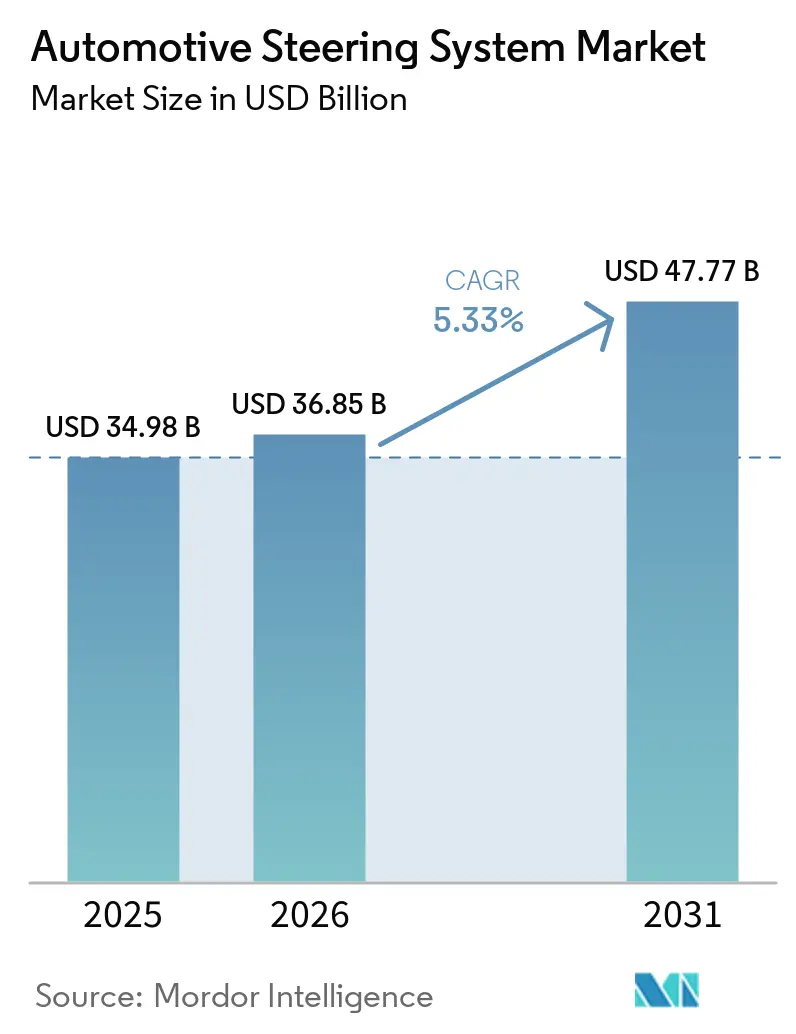
The Automotive Steering System Market size was valued at USD 34.98 billion in 2025, is estimated to grow to USD 36.85 billion in 2026, and is projected to reach USD 47.77 billion by 2031, growing at a 5.33% CAGR over 2026-2031. The automotive steering system market is undergoing a clear technology reset, in which electric power steering has become standard equipment on modern vehicle platforms, while steer-by-wire is beginning to define the next premium layer of value. China is setting the near-term pace for that shift because new energy vehicle production remained very strong in 2025, and the GB17675-2025 rule that takes effect on July 1, 2026, removes the mandatory mechanical steering connection requirement for the first time [1]“NEV Production January To November 2025,” China Association of Automobile Manufacturers, caam.org.cn . The same electrification trend is also expanding the role of software, as torque-overlay updates within EPS control units create a path to recurring post-sale revenue rather than one-time hardware income. Competition in the automotive steering system market remains moderately concentrated around large Tier-1 suppliers with scale in EPS and steer-by-wire, but software integration and ASIL-D safety capability now matter as much as hardware cost in platform awards. The main limits on faster expansion remain the supply side, especially rare-earth magnet inflation and mature-node automotive MCU tightness, because both can delay production schedules and squeeze margins in mainstream EPS programs.
Key Report Takeaways
- By component, the Steering Column/Rack led with 38.74% of the automotive steering system market share in 2025, while the Electric Motor is forecast to grow at 8.53% CAGR through 2031.
- By vehicle type, Passenger Cars held 62.65% of the automotive steering system market share in 2025, while Commercial Vehicles are projected to expand at 7.28% CAGR through 2031.
- By mechanism, Electronic Power Steering (EPS) held 71.20% of the automotive steering system market share in 2025, while Steer-by-Wire is projected to grow at 7.95% CAGR through 2031.
- By sales channel, OEM held 86.70% of the automotive steering system market share in 2025, while the Aftermarket is projected to grow at 7.02% CAGR through 2031.
- By geography, Asia-Pacific accounted for 48.25% of the automotive steering system market size in 2025 and is expected to record the fastest regional CAGR of 6.52% through 2031.
Note: Market size and forecast figures in this report are generated using Mordor Intelligence’s proprietary estimation framework, updated with the latest available data and insights as of 2026.
Global Automotive Steering System Market Trends and Insights
Drivers Impact Analysis*
| Driver | (~) % Impact on CAGR Forecast | Geographic Relevance | Impact Timeline |
|---|---|---|---|
| EPS Penetration in ICE and XEV | +1.8% | Global, concentrated in Asia-Pacific and Europe | Short term (≤ 2 years) |
| Steer-By-Wire in Premium EVs | +1.2% | Asia-Pacific, especially China and Japan, and Europe, especially Germany | Medium term (2-4 years) |
| Demand For ADAS-Ready Architectures | +0.9% | Global, concentrated in premium and upper-mid vehicle segments | Medium term (2-4 years) |
| Cyber-Secure ECU Mandates | +0.7% | Europe, Japan, South Korea, and Australia | Short term (≤ 2 years), Medium term (2-4 years) |
| Lightweight Steering Columns | +0.6% | Europe and North America | Medium term (2-4 years) |
| OTA-Upgradable Torque-Overlay | +0.4% | Global, concentrated in premium EV hubs in Asia-Pacific and Europe | Long term (≥ 4 years) |
| Source: Mordor Intelligence | |||
Rapid EPS Penetration in ICE and XEV Platforms
EPS is often described as an EV-led technology, but the bigger volume engine in the automotive steering system market still comes from ICE and hybrid vehicle production. Removing the hydraulic pump reduces parasitic engine load and improves fuel economy by 3-5%, keeping EPS relevant even where combustion platforms still account for most vehicle output. EPS is also the controllable actuator used for lane keeping, automated parking, and steering correction, so its role is expected to grow as more vehicles add assisted driving features. The lower-cost column-assist format still matters for high-volume programs, yet heavier SUVs and larger electrified vehicles need more torque than standard C-EPS can usually deliver. Nexteer responded in April 2025 with a High-Output Column-Assist EPS that extends assist capacity to 110 Nm for crossover and entry EV programs, which sit above the normal C-EPS range [2]“High-Output Column-Assist EPS Launch,” Nexteer Automotive, nexteer.com . This keeps the automotive steering system market on a stepwise migration path, where suppliers move through larger vehicle classes and higher-output variants rather than relying on a single wave of EPS adoption.
Steer-By-Wire Deployment in Premium EVs From 2025
Steer-by-wire moved from technical promise to serial production during 2025 and 2026, adding a new premium growth layer to the automotive steering system market. ZF began series production for NIO’s ET9 in February 2025, and Mercedes-Benz brought steer-by-wire into European series production in April 2026 on the refreshed EQS using ZF hardware. Nexteer also began ASIL-D-certified steer-by-wire production in April 2026 for a Chinese NEV manufacturer, marking its first full-scale production program in this architecture. China remains the most important catalyst because GB17675-2025, effective July 1, 2026, removes the mandatory mechanical steering link and gives commercial deployment a clear legal basis. The presence of programs from NIO, XPeng, BYD, and Li Auto shows that adoption is already moving below the ultra-luxury tier and into broader EV price bands. ZF’s planned capacity of 380,000 steer-by-wire sets a year in Zhangjiagang also shows that suppliers are now committing capital on the assumption that the automotive steering system market will absorb meaningful production volume rather than pilot-scale output [3]“Steer-By-Wire Series Production and Capacity Expansion,” ZF Group, zf.com .
OEM Demand For ADAS-Ready "Fail-Operational" Architectures
As automation functions advance, the automotive steering system market is shifting from fail-safe logic toward fail-operational designs that must preserve steering authority after a single fault. In practice, that means redundant power paths, duplicated sensing, and motor and controller designs that can still deliver controlled torque when one channel fails. For EPS programs tied to active steering features, ASIL-D expectations are pushing suppliers toward dual-winding brushless DC motors and lockstep processing architectures that support independent torque delivery and fault monitoring. The cost-effectiveness is significant because a steering assembly with this level of redundancy contains more electronics, more software, and a broader validation burden than a standard EPS rack. That creates a two-tier structure in the automotive steering system market, where standard EPS still accounts for most volume, while fail-operational EPS and steer-by-wire capture the higher-value pool. Suppliers that can reuse the same safety architecture across EPS and steer-by-wire lines are therefore better positioned to reduce certification effort and protect margins on future platform launches.
Cyber-Secure ECU Mandates in UNECE R155 Markets
Cybersecurity has become a design requirement in the automotive steering system market because steering ECUs operate on the vehicle network and can be vulnerable to malicious command injection if not properly protected. UNECE Regulation No. 155 has applied to all new production vehicles since July 2024, meaning OEMs and suppliers must demonstrate a certified cybersecurity management system throughout the product lifecycle in covered markets [4]“UN Regulation No. 155 Cybersecurity And Cybersecurity Management System,” United Nations Economic Commission for Europe, unece.org . That obligation changes the supplier role because steering control units now need evidence trails for risk analysis, secure development, software maintenance, and post-production monitoring. The practical result is that cybersecurity work now sits alongside functional safety rather than after it, especially for EPS and steer-by-wire systems tied to assisted driving functions. Suppliers with mature compliance processes can lower the approval burden for automakers and become more valuable than pure hardware vendors. This governance advantage is becoming another reason why the automotive steering system market is favoring large suppliers with strong software engineering depth and formal validation systems.
Restraints Impact Analysis*
| Restraint | (~) % Impact on CAGR Forecast | Geographic Relevance | Impact Timeline |
|---|---|---|---|
| Rare-Earth Magnet Price Volatility | -0.8% | Global, amplified in Europe and North America | Short term (≤ 2 years) |
| Automotive MCU Shortage | -0.6% | Global, concentrated in North America, Europe, and Japan | Short term (≤ 2 years) |
| Steering-Feel Concerns Slowing Rollout | -0.4% | Europe, North America, and Japan | Medium term (2-4 years) |
| Tier-1 Consolidation Limits | -0.3% | Global | Medium term (2-4 years), Long term (≥ 4 years) |
| Source: Mordor Intelligence | |||
Rare-Earth Magnet Price Volatility Inflates EPS BOM
Rare-earth exposure remains one of the clearest supply risks in the automotive steering system market because NdFeB magnets are central to EPS motor performance. China accounts for 91% of globally refined rare earth output and 94% of sintered NdFeB magnet manufacturing, so policy changes there move cost curves quickly across the rest of the supply chain. MOFCOM’s April 2025 export licensing action on seven medium and heavy rare earth elements tightened the outlook further because dysprosium and terbium are important for the high-temperature performance needed in steering motors. From the start of 2026 to later that year, NdPr oxide prices experienced a significant surge before easing. This substantially increased bill-of-materials pressures for EPS programs, particularly in the most price-sensitive vehicle categories. In response, suppliers are forging non-Chinese sourcing agreements and delving deeper into ferrite-based motor designs tailored for applications with lower demand. Concurrently, producers like Lynas are ramping up NdPr capacity beyond China's borders. Despite these measures, the automotive steering system market grapples with a lopsided cost burden: mainstream EPS assemblies have tighter pricing constraints compared to their premium steer-by-wire counterparts.
Automotive MCU Shortage Through 2026
Automotive MCU supply remains a second restraint for the automotive steering system market because most steering controllers depend on mature 40-90 nm nodes rather than the leading-edge nodes that attract the highest investment. Capacity tightness at those mature nodes is structural, as foundries have prioritized more advanced process technologies for AI and high-performance computing. Safety certification adds another limit because only a narrow group of fabs and assembly sites can support the process quality required for ASIL-D steering controllers. The squeeze is more severe for steer-by-wire and high-availability EPS because those systems require greater compute content, secure hardware modules, and more redundant controller paths than older designs. Procurement discipline helps, but it does not quickly remove the bottleneck when qualified supply is concentrated at a small number of sites. This is why the automotive steering system market continues to face production timing risk even as order books remain healthy in the highest-growth applications.
*Our forecasts treat driver/restraint impacts as directional, not additive. The impact forecasts reflect baseline growth, mix effects, and variable interactions.
Segment Analysis
By Component: Electric Motors Gain Structural Primacy as Steering Intelligence Rises
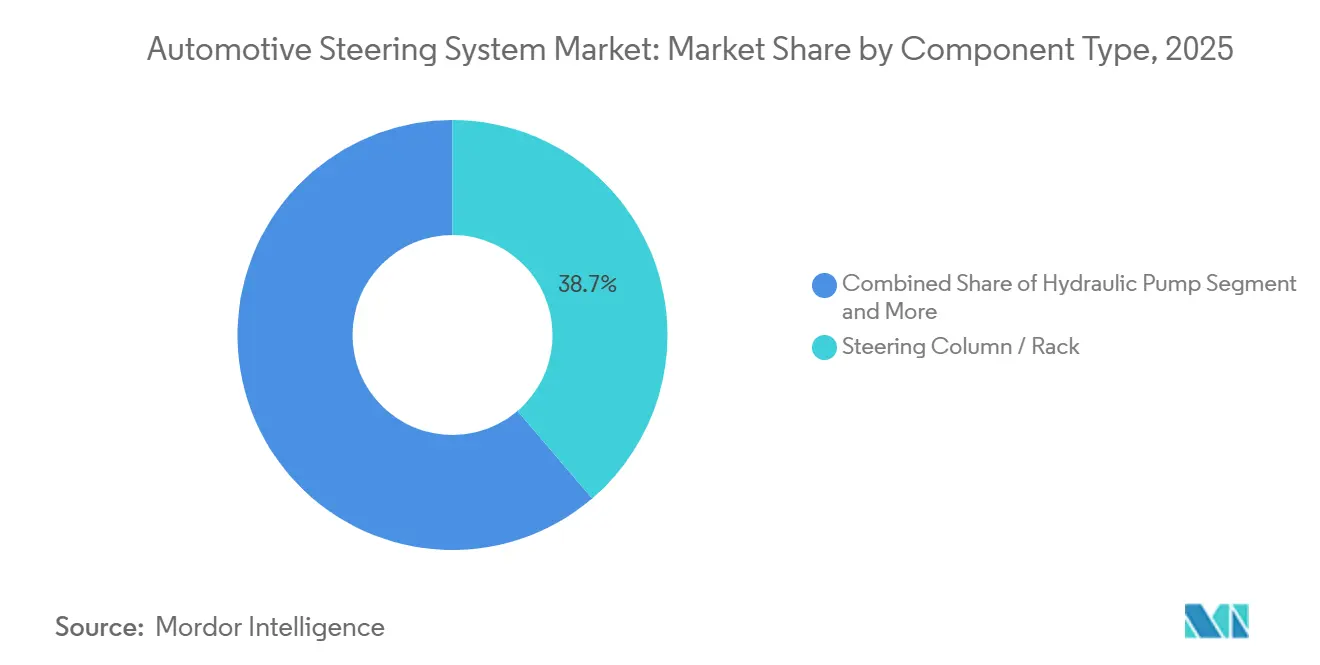
Steering Column/Rack accounted for 38.74% of the automotive steering system market in 2025, making it the largest component group across all steering architectures. That lead reflects the fact that columns, racks, shafts, joints, and gear mechanisms remain present in EPS, EHPS, and the remaining hydraulic programs, even as more value moves into electronics and software. Revenue in this area stays resilient because every vehicle still needs the mechanical path that translates commanded steering input into wheel angle, regardless of how the assist function is delivered. Within the automotive steering system market, this makes the column-and-rack set the anchor content layer, while electronics increasingly determine product differentiation. The hydraulic pump sub-segment is now under sustained pressure because new passenger car platforms continue to move away from hydraulic steering in favor of electric assist.
That shift is shifting value toward electric motors, ECUs, and sensing elements rather than eliminating demand for components. ECU revenue is rising because EPS controllers now manage torque overlay, sensor fusion inputs, and increasingly software-defined steering behavior, rather than handling only assist logic. The sensors layer is also deepening because ADAS-ready systems require multiple torque, angle, and position measurements to meet diagnostic coverage expectations, thereby increasing content per assembly. Electric Motor is projected to grow at 8.53% CAGR from 2026 to 2031, making it the fastest-growing component in the automotive steering system market as higher-output EPS and fail-operational designs spread across more vehicle classes. Dual-winding brushless DC motors are becoming a more common baseline for L2+ applications because each winding must maintain partial steering authority after a single fault. The steer-by-wire transition adds another layer of demand because the rack actuator motor is separate from the steering-wheel feedback simulator motor, which increases motor content per system. Nexteer’s 2025 booking mix, with a significant share tied to fully EV and split EV-and-ICE platforms, shows that this content shift is already evident in active business awards. As a result, the automotive steering system industry is seeing the value center steadily shift toward electronically integrated motor assemblies without diminishing the fundamental importance of mechanical steering hardware.



By Vehicle Type: Commercial Vehicles Gain Momentum as LCV Electrification Accelerates
Passenger Cars held 62.65% of the automotive steering system market share in 2025, reflecting both higher unit production and near-complete penetration of EPS in new passenger models. SUVs remain the most important body style within this vehicle group because their weight and wider tire footprints support demand for rack-assist and dual-pinion EPS solutions with stronger lateral torque handling. Hatchbacks still matter in Europe and South Asia, where urban driving patterns continue to support compact formats, and sedans keep a stable role through domestic Chinese production. Multi-purpose vehicles remain smaller in absolute terms, yet they retain relevance in Southeast Asia, where family-oriented vehicle formats continue to have enduring appeal. Across passenger cars, the automotive steering system market is already shaped by an established EPS baseline in Europe and Japan. At the same time, Chinese NEV platforms increasingly pair EPS with early steer-by-wire preparation.
Commercial Vehicles are projected to grow at a 7.28% CAGR from 2026 to 2031, making them the fastest-growing vehicle category in the automotive steering system market. The near-term lift comes from light commercial vehicle electrification in urban delivery fleets, where electric drivetrains remove the natural fit that hydraulic power steering once had in conventional layouts. Medium and heavy commercial vehicles still rely heavily on hydraulic or electro-hydraulic steering because front axle loads remain very high. Still, the direction of travel is changing as automated highway functions require more precise lane-centering control. That need is prompting truck manufacturers to evaluate redundant EPS designs for future platforms, especially where highway automation or platooning is part of the product roadmap. A U.S. patent application highlighted safe controller switching during commercial vehicle mode transitions, which reflects the functional safety attention now being placed on fault handover at highway speeds. For suppliers, the commercial vehicle opportunity is attractive because the shift starts from a lower electric-assist base, offering more room for conversion. It also broadens the revenue mix of the automotive steering system market by bringing higher-torque steering content into electrification programs that were previously dominated by passenger cars. The automotive steering system industry will therefore depend not only on more EVs, but also on the growing need to electrify steering in heavy-duty applications where control precision has strategic value.
By Mechanism: EPS Consolidates While Steer-by-Wire Defines the Next Value Tier
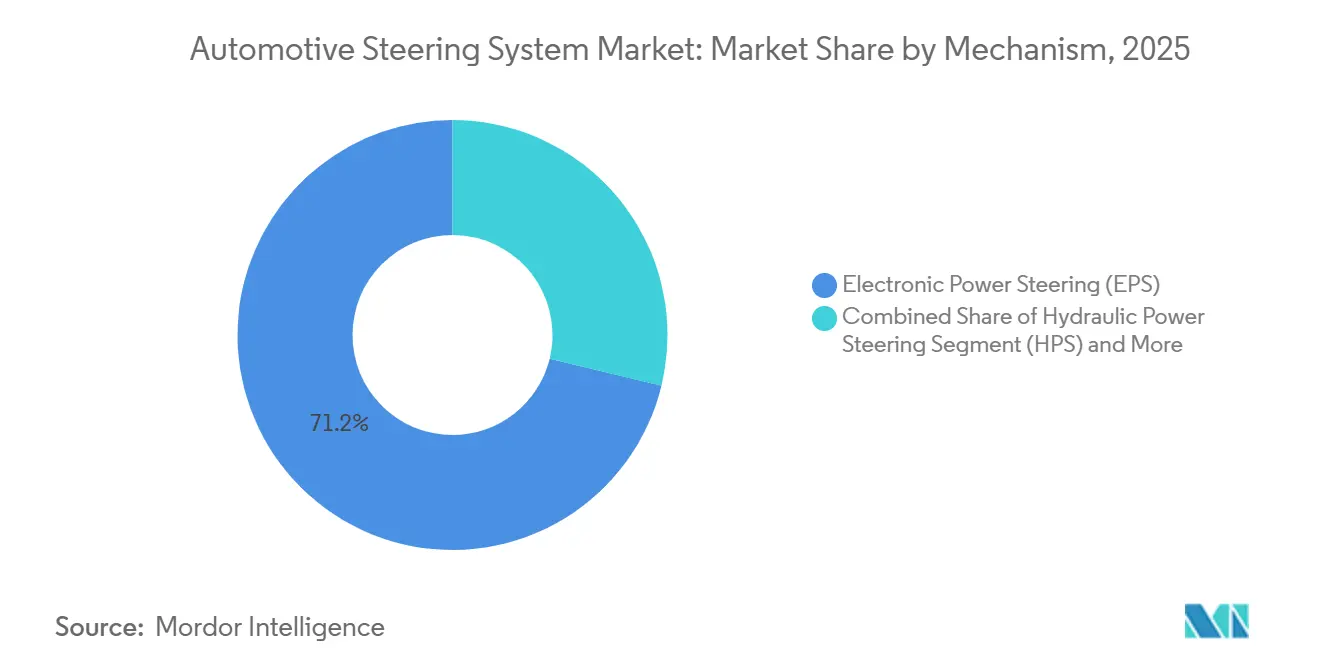
EPS retained 71.20% market share in the automotive steering system market in 2025 and remains the unquestioned baseline mechanism in the market. Its position is supported by fuel economy gains of 3-5% over hydraulic systems, direct compatibility with ADAS functions, and the ability to tune steering feel through software rather than hardware alone. This combination gives automakers a scalable solution that works from small passenger cars to increasingly large SUVs, provided motor output and rack design are matched to vehicle load. Hydraulic Power Steering still has a role in applications with very high steering loads, especially large trucks, construction equipment, and some heavy buses. Still, its relevance is narrowing within the on-road light-vehicle mix. EHPS continues to hold a transitional position because it offers electronically managed assistance while retaining hydraulic actuation, which suits certain vans, buses, and vocational vehicles that need high force with gradual electrification.
Steer-by-Wire is projected to grow at 7.95% CAGR from 2026 to 2031 and stands out as the fastest-moving premium layer in the automotive steering system market. Until recently, its volume base was minimal, but series production announcements from ZF, Nexteer, and Bosch in 2025 and 2026 moved the discussion from prototypes to production readiness. China is the central deployment market because regulation, NEV platform momentum, and 48V architecture all align. The legal framework now exists under GB17675-2025, while Chinese OEM programs indicate that steer-by-wire is beginning to extend beyond flagship vehicles into more mainstream EV segments. Another demand pool comes from robotaxi and autonomous platforms, where a full drive-by-wire chassis is not optional, and steering is often the first major control axis to be electronically decoupled. For the automotive steering system market, this means EPS will continue to dominate in terms of volume. At the same time, steer-by-wire will absorb a disproportionate share of future engineering attention and premium value creation. This is also where software, system redundancy, and validation depth matter more than pure hardware cost, which changes the basis of supplier competition over time. The automotive steering system market size tied to this mechanism shift will therefore depend less on basic replacement of hydraulic systems and more on how quickly redundant electric architectures scale in serial production.
By Sales Channel: Aftermarket Acceleration Driven by EPS Replacement and Software Recalibration
OEM held an 86.70% share in 2025, reflecting the safety-critical integration of steering assemblies and positioning factory-fit supply as the core route to scale in the automotive steering system market. The importance of this channel extends beyond initial installation, as modern steering systems are now tied to vehicle software architecture, ADAS calibration, and homologation requirements that begin at the platform design stage. That is changing how value is captured, since steering suppliers can now support software-defined drive modes and torque-overlay behavior that remain active after the vehicle leaves the plant. In the automotive steering system market, this means OEM relationships increasingly include lifecycle software support rather than ending with the delivery of a mechanical or electromechanical assembly. It also gives automakers a way to improve steering response over the air without a full hardware change, which extends the commercial life of a given steering platform.
The aftermarket is projected to grow at a 7.02% CAGR from 2026 to 2031, making it the fastest-moving channel in the automotive steering system market as more EPS-equipped vehicles enter replacement cycles. EPS service work is more technical than legacy hydraulic replacement because new units often need VIN-linked parameter matching, torque sensor recalibration, and, in some cases, ADAS revalidation before the vehicle can return to normal operation. That complexity favors dealer networks and authorized service centers, since they have better access to calibration tools, software permissions, and model-specific procedures. The same pattern is likely to become more pronounced when steer-by-wire fleets age, because recalibration and software refresh work will carry higher value than traditional steering maintenance. Suppliers also benefit from this trend, as post-sale service can include diagnostic support, software packages, and validation steps that were not part of the older hydraulic business model. As the installed base grows, the aftermarket side of the automotive steering system market will no longer be defined only by spare parts volume. It will also be shaped by who controls software access, calibration rights, and the ability to certify that a repaired steering system still meets safety and driver assistance requirements. That shift gives the automotive steering system industry a longer revenue tail than it had in previous generations of steering technology.
Geography Analysis
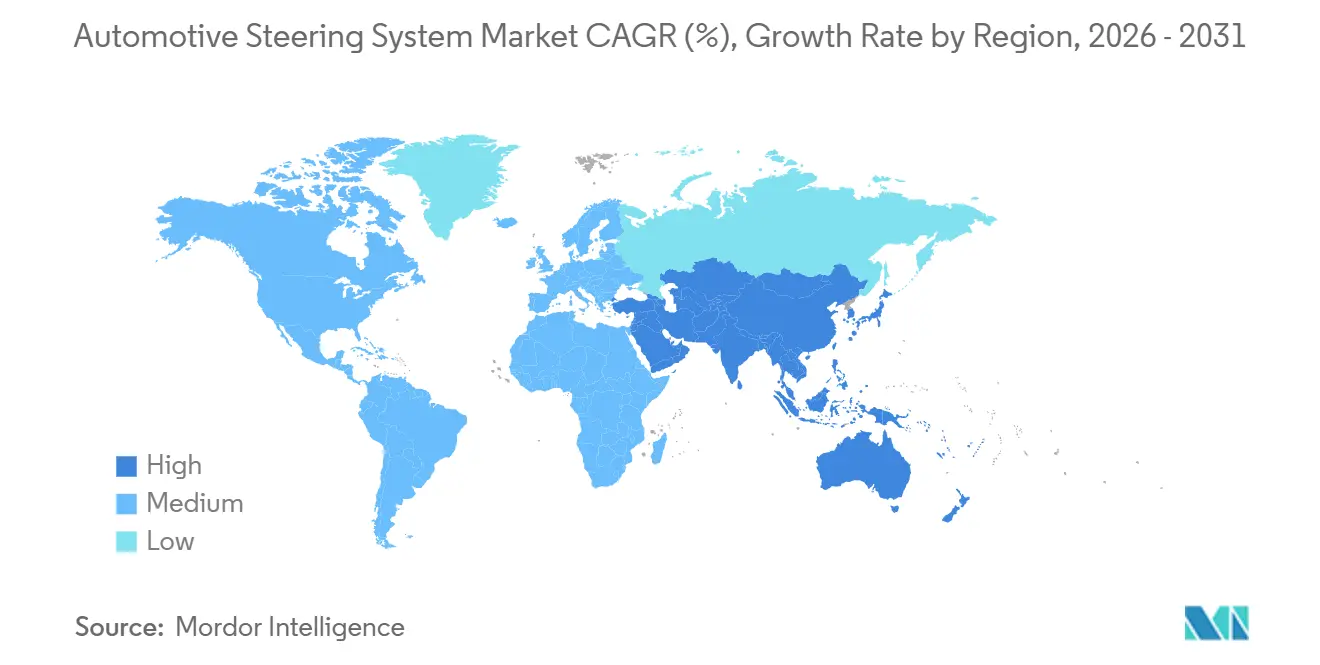
Asia-Pacific accounted for 48.25% of the automotive steering system market size in 2025 and is expected to expand at a 6.52% CAGR through 2031, giving it both the largest base and the fastest growth rate. China remains the most important country within the automotive steering system market because it combines the world’s largest vehicle production footprint with the strongest near-term steer-by-wire pipeline. By 2025, China will have experienced significant growth in new energy vehicle production, reflecting rising demand for EPS and new by-wire platforms. The formalization of the legal pathway for commercial steer-by-wire deployment, set to take effect in 2026 under GB17675-2025, holds significance as major Chinese OEMs have already greenlit programs in this domain. Meanwhile, India bolsters regional momentum with robust EV policy support and investments in domestic manufacturing clusters. Japan, on the other hand, showcases its prowess in precision steering supply and premium by-wire development, as evidenced by the launch of the Lexus RZ 550e F SPORT's steer-by-wire system in 2026.
Europe remained the second-largest regional block in the automotive steering system market in 2025 and continues to be driven by strict safety and emissions rules, plus a dense Tier-1 supplier base. Germany is the center of the region’s steer-by-wire push because ZF and Bosch have both moved into serial supply positions, and Mercedes-Benz introduced the first large-scale European series application on the EQS in 2026. The region’s regulatory path keeps EPS demand firm because assisted-lane and safety features increasingly require electronically controllable steering output, even where older hydraulic solutions were once acceptable. Bosch has already attached major long-range revenue expectations to by-wire systems, which shows how seriously the supplier base views this transition. Eastern European production hubs such as the Czech Republic, Slovakia, and Hungary continue to absorb EPS demand by serving as assembly locations for Western OEM programs. At the same time, Russia faces a slower path due to sanctions and supply-chain isolation, which limit access to advanced semiconductors and top-tier steering systems.
North America remains a major region in the automotive steering system market because its product mix includes large pickups and full-size SUVs that have historically supported hydraulic and electro-hydraulic steering for longer than in other regions. That same mix now creates an important opportunity for higher-output EPS and future steer-by-wire systems as assisted-driving features spread to larger vehicles. South America continues to track the assembly cycles of Brazil and Argentina, with Brazil acting as the main production and distribution base and a growing EPS replacement market emerging as the installed fleet ages. The Middle East and Africa show steadier but smaller gains, supported by fleet growth in Saudi Arabia and the UAE, and by Turkey’s export-linked production base, which must meet European steering specifications.

Regulatory Landscape
Automotive steering systems operate under a mix of global and regional safety, cybersecurity, and type-approval frameworks that increasingly treat steering as a software-controlled, safety-critical function. At the global level, UNECE UN Regulation No. 79 governs steering equipment approvals (including requirements for advanced driver assistance steering systems and driver override behavior), while the European Union General Safety Regulation, Regulation (EU) 2019/2144 (GSR 2), tightens vehicle safety requirements and reinforces the need for robust control strategies as automated functions proliferate.
In the United States, steering integrity is anchored by Federal Motor Vehicle Safety Standards, including FMVSS No. 204 on steering control rearward displacement. NHTSA published a final rule on FMVSS No. 204 in June 2026, after earlier activity such as a May 2025 notice addressing applicability considerations. As electronically controlled EPS becomes more common and steer-by-wire architectures advance, these requirements increase compliance workload around validation, documentation, and fault response for safety-related steering functions.
Value Chain Analysis
The automotive steering system value chain runs from raw materials (steel and aluminum for columns/racks, copper windings, and rare-earth or alternative magnet materials) through precision machining, mechatronic assembly (motors, sensors, ECUs), and software calibration, before moving into OEM integration and service networks. Tier-1 suppliers including JTEKT, Bosch, ZF, Nexteer, thyssenkrupp Steering, Mando, and NSK typically deliver complete EPS modules or subassemblies (rack, column, motor, ECU, sensors), with more content shifting toward safety-certified software and cybersecurity-ready electronic control units.
Recent value-chain moves reflect the shift from mechanical hardware dominance to software-defined, redundant architectures. In July 2025, L&T Technology Services and thyssenkrupp Steering set up a software development hub in Pune focused on safety-critical software for advanced steering, aligning with ISO 26262-aligned development demands. In February 2026, NIO and Bosch signed a strategic cooperation agreement covering smart EV technologies including steering and drive-by-wire chassis modules, pointing to tighter OEM and Tier-1 co-development loops. Supplier consolidation also continues, with Bethel announcing plans in February 2026 to acquire a controlling stake (50.9727%) in Yubei Steering System (Xinxiang) Co., Ltd. to broaden its automotive safety footprint and strengthen vertical access to steering system capability in China.
Competitive Landscape
The automotive steering system market is moderately concentrated, with an in-depth cybersecurity maturity and proof of serial production. Japanese suppliers still benefit from long-standing strengths in precision manufacturing and close ties to major Asian automakers, while German suppliers are leveraging the rapid technological shift in Chinese NEVs to accelerate learning and commercial scale-up. This keeps the automotive steering system market balanced between established mechanical expertise and newer systems integration capability.
Bosch strengthened its by-wire position in 2026 through an agreement with NIO covering by-wire chassis architecture across several NIO brand platforms, signaling a broader move toward integrated chassis control rather than stand-alone steering supply. ZF has paired product launches with capacity investment, including expansion at Zhangjiagang that supports both rear-axle steering and steer-by-wire output at an industrial scale. Nexteer added another strategic marker when it began series production of steer-by-wire in China in April 2026, followed by a new column-assist EPS plant in Thailand to support regional expansion. These moves matter because they show that the automotive steering system market is no longer preparing for by-wire technology; in theory, it is building factories, safety cases, and production programs around it. They also show that suppliers are trying to lock in local manufacturing positions near the fastest-growing OEM customers, especially in the Asia-Pacific region.
A second layer of competition is forming below the global leaders as Chinese suppliers such as Bethel Automotive, Tuopu Group, and Jingwei Hirain build 48V steer-by-wire and related steering electronics for domestic NEV brands. Their advantage is speed, cost fit, and shorter qualification cycles with local automakers, while the larger multinational suppliers still hold an edge in global validation depth and platform breadth. The opening opportunity in the automotive steering system market lies between conventional EPS and full mechanical decoupling, where software-defined variable steering ratio and higher-availability EPS can provide OEMs with an intermediate step toward L2+ functions. Over time, this means the winners in the automotive steering system market are likely to be suppliers that combine durable mechanical execution with software control, safety certification, and the ability to support recurring lifecycle revenue after the vehicle is sold.
Automotive Steering System Industry Leaders
JTEKT Corporation
Robert Bosch GmbH
ZF Friedrichshafen AG
Nexteer Automotive Corporation
NSK Ltd.
- *Disclaimer: Major Players sorted in no particular order

Market Opportunities and Future Outlook
The market opportunity is expanding around steer-by-wire industrialization, with the redundancy, functional safety, and software toolchains needed for Level 2+ and Level 3-capable vehicles. Progress is visible in Asia where OEM platform cadence is fastest: ZF has outlined steer-by-wire system production activities at its Zhangjiagang campus in China (with an SOP timeline communicated for 2026), and Nexteer has been expanding manufacturing footprints aligned to APAC growth, including a smart manufacturing project in Liuzhou, China, reaching full operational status in H1 2026 per company disclosures.
A second opportunity area centers on how steering electronics, motors, and software integration are being localized and restructured across regional supply chains, particularly in Southeast Asia and China. Nexteer opened a new manufacturing facility in Rayong, Thailand in March 2026, strengthening local supply to Southeast Asian OEM programs and supporting shorter logistics cycles for EPS and advanced steering assemblies. At the standards level, activity under UNECE R79 and functional safety expectations under ISO 26262 are pushing suppliers toward modular, certifiable architectures (dual-motor actuation, isolated power and communications paths, and validated software stacks). This creates openings for motor, sensor, and ECU specialists to reduce rare-earth exposure while still meeting ASIL-D system targets for by-wire platforms.
Recent Industry Developments
- May 2026: JTEKT branded its steer-by-wire system as Syncusteer and began commercial proposals to customers under the new name. The rebrand clarifies product positioning and supports broader customer engagement as OEMs evaluate by-wire architectures for premium and automated-driving-capable platforms.
- April 2026: Nexteer announced that its first steer-by-wire system has entered mass production for a passenger-vehicle program at a Chinese new-energy vehicle manufacturer. The start of production, supported by ASIL D functional safety approval obtained in late 2025, marks a key step from pilot programs to series supply in the steer-by-wire segment.
- June 2025: Volvo Trucks unveiled an enhanced Volvo Dynamic Steering system with a function designed to detect tire blowouts and help keep the truck safely positioned in its lane. The update raises the value proposition of electronically assisted steering in commercial vehicles by adding safety-oriented control features that can be integrated into broader ADAS stacks.


Research Methodology Framework and Report Scope
Market Definition and Coverage
For this study, the automotive steering market means the revenue earned from steering systems and key steering components that are installed on road vehicles, covering both traditional and electrically assisted designs across major vehicle categories.
Scope exclusions: We do not count unrelated chassis parts (for example suspension-only components), general repair labor, or software that is not directly tied to steering control.
Segmentation Overview
- By Component
- Hydraulic Pump
- Electric Motor
- Steering Column / Rack
- Sensors (Torque, Angle, Position)
- Electronic Control Unit (ECU)
- Other Components
- By Vehicle Type
- Passenger Cars
- Hatchback
- Sedan
- Sport Utility Vehicle
- Multi-Purpose Vehicle
- Commercial Vehicles
- Light Commercial Vehicles
- Medium and Heavy Commercial Vehicles
- Passenger Cars
- By Mechanism
- Electronic Power Steering (EPS)
- Hydraulic Power Steering (HPS)
- Electro-hydraulic Power Steering (EHPS)
- Steer-by-Wire
- By Sales Channel
- Original Equipment Manufacturer (OEM)
- Aftermarket
- By Geography
- North America
- United States
- Canada
- Rest of North America
- South America
- Brazil
- Argentina
- Rest of South America
- Europe
- Germany
- United Kingdom
- France
- Italy
- Russia
- Rest of Europe
- Asia-Pacific
- China
- Japan
- India
- South Korea
- Rest of Asia-Pacific
- Middle East and Africa
- Turkey
- Saudi Arabia
- United Arab Emirates
- South Africa
- Rest of Middle East and Africa
- North America
Data Sources, Market Sizing, and Validation
Desk Research
Desk research was used to frame the size logic and to anchor the model to real vehicle output and technology adoption signals. We referenced public datasets and publications such as OICA vehicle production statistics, national transport and safety agencies that publish vehicle registrations and recalls, trade and customs statistics for auto parts flows, and standards and regulatory releases that influence steering electronics requirements.
On top of that, we reviewed annual reports, investor decks, and product documentation from steering and vehicle supply chain participants to understand product mix shifts like EPS penetration and feature content per vehicle. We also used paid subscriptions for company financials and for news and financials to track capacity expansions, program wins, and pricing commentary that can move assumptions. The desk sources mentioned here are illustrative only, and many other references were also consulted for data collection, validation, and clarification.
Primary Interviews and Surveys
Primary work was completed through expert interviews and structured surveys with a mix of steering component suppliers, vehicle manufacturers, distributors, and service channel participants. We used these conversations to confirm adoption curves for EPS and steer-by-wire, to sanity check price ranges by vehicle class, and to validate how OEM and aftermarket demand behaves across APAC, EMEA, and the Americas.
Distribution of primary research fieldwork respondents
| Company type | Respondent position | Region |
|---|---|---|
| Top tier: 31% | CXOs: 15% | APAC: 45% |
| Mid tier: 49% | Functional/Unit leaders: 28% | EMEA: 29% |
| Smaller Players: 20% | Managers: 57% | Americas: 26% |
Market-Sizing & Forecasting
The market size was built using a top-down and bottom-up approach, where the starting point was the global vehicle production and parc by region, which was then translated into a steerable vehicle demand pool by vehicle type and steering fitment. To keep the numbers grounded, we then corroborated totals with selective bottom-up checks, such as sampled supplier revenue splits, channel checks for aftermarket replacement, and ASP times volume spot builds for key components.
A few practical inputs shaped the model, including annual light vehicle and commercial vehicle output, EPS versus HPS and EHPS penetration by region, average steering system content per vehicle (including columns or racks and assist units), OEM to aftermarket mix, and observed pricing movement tied to material and electronics content. Where bottom-up datapoints were missing for smaller countries, we used proxy ratios from comparable production markets, and then the results were adjusted after expert validation.
For forecasting, we relied on scenario analysis supported by a simple regression view against vehicle production outlook, electrification mix, and technology adoption timing for advanced steering. The final forecast reflects the most consistent view from primary inputs, and it remains traceable to the same demand pool and pricing logic each year.
Data Validation & Update Cycle
Validation was handled through stepwise checks so the totals do not drift away from real world signals. We compared model outputs against independent indicators like vehicle output trends, technology mix statements from industry experts, and visible program launches, and then investigated any sharp variances at region or vehicle class level.
Before sign-off, assumptions and calculations go through multi-step analyst reviews, and callbacks are triggered if a key input moves beyond a set tolerance (for example, a sudden change in OEM production guidance or a component pricing reset). Reports are refreshed annually, with interim updates when material events occur, and a final pre-delivery review is done so clients receive the latest view.
Mordor Intelligence's Automotive Steering Market Size Measured Against Other Published Estimates
Published market values for automotive steering often differ, and the gap usually comes from what is counted as a steering system, which sales channels are included, and how quickly older hydraulic designs are assumed to phase down. Differences also show up when one estimate leans on a single base year snapshot, then another relies more on forward vehicle production assumptions.
Some publications fold in adjacent chassis electronics or broader automated steering functions, and the OEM versus aftermarket split is sometimes not stated clearly. Some estimates also apply a uniform global ASP uplift even when the steering mix is shifting toward higher EPS content in one region faster than another. Several sources also label the market as steering in general, but they do not always clarify whether columns, racks, assist motors, and control units are all included at the same level of detail.
Benchmark comparison
| Source | Market Size | Gaps in Research Methodology |
|---|---|---|
| Mordor Intelligence | USD 36.85 B (2026) | |
| Global Research Publisher A | USD 28.08 B (2024) | Uses a different value year and does not clearly separate OEM and aftermarket revenues, which can reduce totals if replacement demand is not modeled explicitly. |
| Industry Research Firm B | USD 24.11 B (2024) | Anchors on an earlier value year and applies a higher growth arc, which points to different assumptions on steering content per vehicle and faster technology mix shifts than what was validated in interviews. |
The table shows that the spread is mainly driven by base year choice and how steering content and channels are treated. Some estimates group in wider vehicle motion electronics, then the steering-only total becomes less comparable, and Mordor Intelligence counts steering systems and core steering components across OEM and aftermarket, but excludes non-steering chassis electronics and standalone ADAS functions that do not directly sit in the steering control chain.


Key Questions Answered in the Report
What is the current size of the automotive steering system market?
The Automotive Steering System Market size was valued at USD 34.98 billion in 2025, is estimated to grow to USD 36.85 billion in 2026, and is projected to reach USD 47.77 billion by 2031, growing at a 5.33% CAGR over 2026-2031.
Which steering technology leads global demand today?
EPS remains the leading mechanism with a 71.20% share in 2025 because it supports fuel savings, ADAS functions, and software-based steering tuning.
Why is steer-by-wire gaining attention so quickly?
Steer-by-wire is projected to grow at 7.95% CAGR through 2031 as serial production programs move ahead in China and Europe and regulation now supports commercial deployment.
Which region offers the strongest growth potential?
Asia-Pacific is the largest and fastest-growing regional block, with 48.25% share in 2025 and a projected 6.52% CAGR through 2031, led by China’s NEV and by-wire momentum.
Which vehicle category is expanding fastest?
Commercial vehicles are projected to grow at 7.28% CAGR through 2031 as LCV electrification advances and heavier platforms begin to adopt more redundant electric steering systems.
What are the biggest risks for suppliers and OEMs?
Rare-earth magnet inflation and automotive MCU tightness remain the clearest risks because they raise EPS costs, pressure margins, and can disrupt production schedules for more complex steering systems.
Page last updated on:


 Your data is secure and never sold or shared.


