
Automotive Carbon Fiber Composites Market Size and Share
Market Overview
| Study Period | 2021 - 2031 |
|---|---|
| Market Size (2026) | USD 31.65 Billion |
| Market Size (2031) | USD 51.04 Billion |
| Growth Rate (2026 - 2031) | 10.04 % |
| Fastest Growing Market | Asia Pacific |
| Largest Market | Asia Pacific |
| Market Concentration | Medium |
Major Players *Disclaimer: Major Players sorted in no particular order Image © Mordor Intelligence. Reuse requires attribution under CC BY 4.0. | |
Automotive Carbon Fiber Composites Market Analysis by Mordor Intelligence
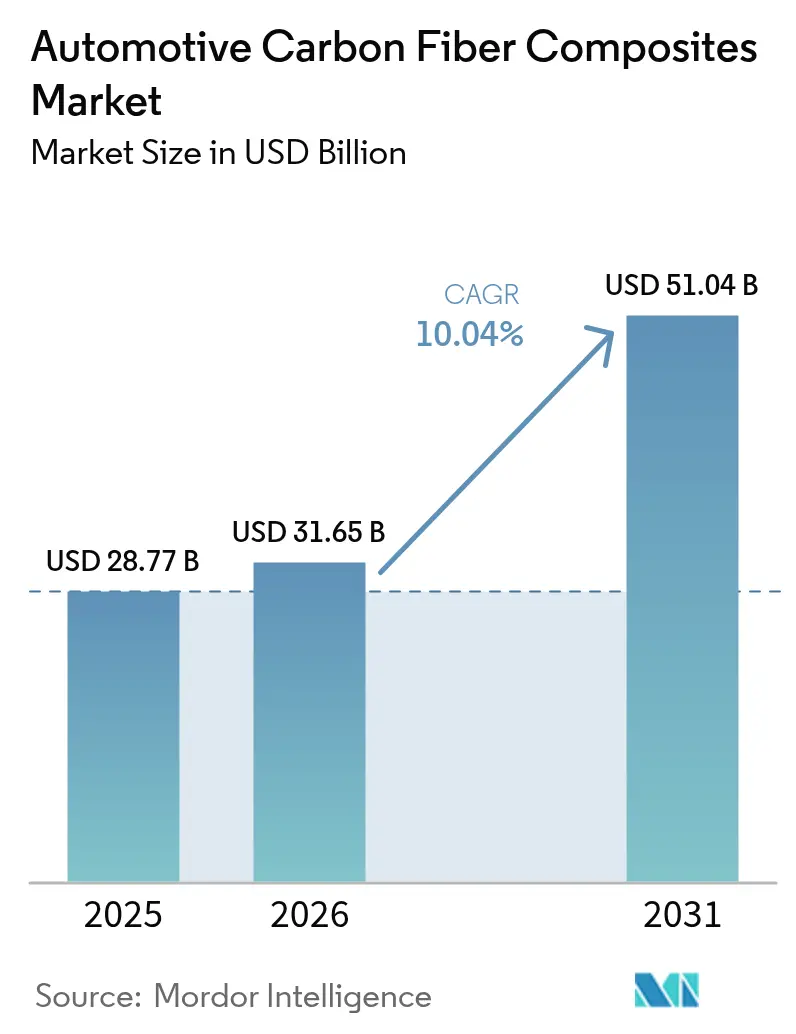
Automotive Carbon Fiber Composites Market size in 2026 is estimated at USD 31.65 billion, growing from 2025 value of USD 28.77 billion with 2031 projections showing USD 51.04 billion, growing at 10.04% CAGR over 2026-2031.
Carbon fiber composites are revolutionizing the automotive industry, offering benefits like lightweight construction, better fuel efficiency, superior performance, and design flexibility. These advantages have made carbon fiber a favored choice among automotive manufacturers aiming to produce high-performance, lightweight vehicles.
As the automotive industry increasingly demands lightweight materials and prioritizes fuel economy, carbon fiber's popularity surges. With tightening emission regulations and escalating fuel prices, carbon fiber emerges as a superior alternative to traditional metals, significantly reducing vehicle weight. This not only boosts fuel efficiency and engine performance but also boasts a physical strength nearly double that of conventional metals.
Leading carbon fiber suppliers are aligning with the aspirations of vehicle OEMs, system suppliers, and end-users to produce lighter, cleaner, safer, and more cost-effective vehicles. Major automakers, including BMW, Audi, GM, and Honda, are forging partnerships with carbon fiber producers for mass production, channeling investments into processes that promise cost-effective carbon fiber manufacturing. For instance,
- In April 2024, Hyundai Motor Group inked a strategic cooperation deal with Toray Industries, Inc., a frontrunner in carbon fiber and composite technology. This collaboration aims to harness advanced materials, particularly carbon fiber, to bolster the performance and safety of future mobility solutions.
Yet, the intricate manufacturing processes of carbon fiber drive up costs, hindering widespread adoption. Additionally, the lack of a robust recycling infrastructure for carbon fiber raises environmental concerns due to potential waste accumulation. Such challenges could stifle market growth, especially since integrating carbon fiber into budget vehicles could significantly inflate their prices.
With the global surge in electric vehicle demand, carbon fiber's role in extending EV range becomes pivotal, suggesting a robust market growth trajectory in the coming years.
Note: Market size and forecast figures in this report are generated using Mordor Intelligence’s proprietary estimation framework, updated with the latest available data and insights as of 2026.
Global Automotive Carbon Fiber Composites Market Trends and Insights
Passenger Cars Dominate the Automotive Carbon Fiber Market
- Passenger cars are experiencing significant growth globally, driven by increasing urbanization, evolving consumer preferences for affordable personal transportation, and the rising adoption of electric vehicles. To meet government fuel efficiency standards, automakers are prioritizing the use of lightweight materials like carbon fiber to reduce fuel consumption.
- Advanced materials such as carbon fiber are critical for improving the fuel efficiency of modern vehicles while maintaining safety and performance. Lightweight materials are essential for optimizing vehicle efficiency, as less energy is required to accelerate lighter objects. For instance, reducing a vehicle's weight by 10% can result in a 6-8% improvement in fuel economy.
- As exhaust emissions raise environmental concerns, the demand for high-performance electric vehicles has surged. This momentum is bolstered by stringent regulations on emissions and fuel economy, alongside government initiatives like subsidies and incentives promoting the shift to electrification. For instance,
- The UK government has announced its intention to reduce CO2 emissions by 68% by 2030 as part of its climate change strategy and has set a ban on gasoline and diesel cars starting in 2030.
- Carbon fiber's importance in electric vehicles lies in its ability to enhance driving range. Given that electric vehicles rely heavily on battery life, reducing vehicle weight with carbon fiber decreases energy consumption, enabling longer travel distances on a single charge. These benefits are expected to drive the demand for carbon fiber composites in electric vehicle design.
- Furthermore, numerous automakers are channeling efforts into crafting lightweight electric vehicles, harnessing advanced materials like carbon fiber for peak performance. For instance,
- In September 2024, Lotus unveiled its ultra-luxury electric hyper-SUV variant, the Eletre Carbon, in North America. This model features an extensive carbon fiber design both inside and out, marking the debut of Lotus's new performance SUV lineage.
- Given these dynamics, the demand for Automotive Carbon Fiber Composites Market in passenger cars is set to witness significant growth in the coming years.


Asia-Pacific Anticipated to Lead the Automotive Carbon Fiber Market
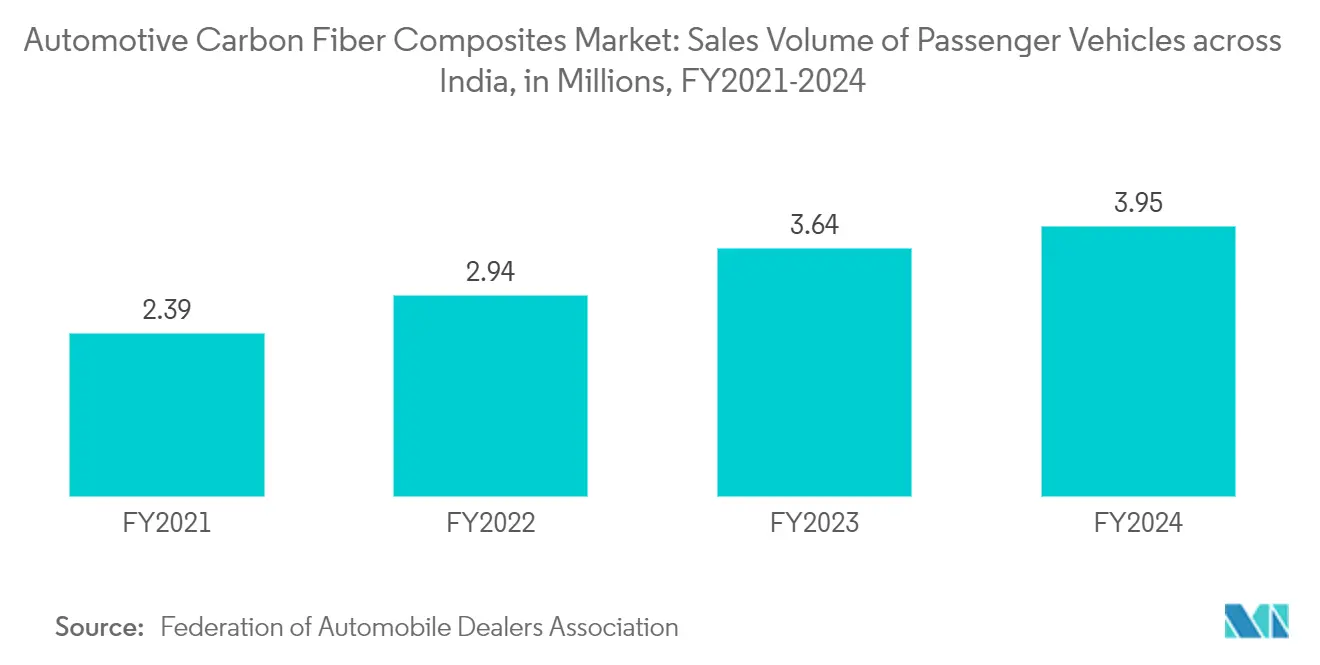
- The Asia-Pacific region is experiencing significant growth in the automotive carbon fiber market, driven by its strong automotive industry, rapid industrial expansion, and the increasing adoption of lightweight materials to enhance fuel efficiency and reduce emissions, particularly with the growing popularity of electric vehicles.
- According to the China Association of Automobile Manufacturers (CAAM), in 2024, China set new records by producing 31.28 million and selling 31.44 million vehicles, marking year-on-year increases of 3.7% and 4.5%, and surpassing the 30 million unit threshold for the second consecutive year.
- Stringent government regulations on vehicle emissions are catalyzing a shift towards eco-friendly vehicles in the region. Given that vehicle weight significantly influences fuel consumption, automakers are increasingly turning to lightweight materials like carbon fiber to enhance fuel efficiency. For instance,
- China's Ministry of Ecology and Environment (MEE) has proposed a policy aiming for electric vehicles (EVs) to constitute 50% of all vehicle sales by 2030 in "key polluting regions," underscoring a targeted effort to curb emissions in areas grappling with severe air pollution.
- Additionally, nations like Japan and South Korea are carving out a competitive edge in carbon fiber production and processing. Furthermore, heightened R&D initiatives by chemical firms to craft advanced composite materials for automotive uses are poised to bolster the carbon fiber market. For instance,
- In April 2024, UBE Corporation, a Japan-based chemicals firm, unveiled a new composite product aimed at curbing greenhouse gas emissions. By integrating recycled carbon fiber with various nylons and enhancing functionalities, UBE's innovation targets automotive and sports markets, emphasizing energy conservation through weight reduction.
- Given the mounting emphasis on sustainable mobility, rigorous emissions regulations, and the surging demand for lightweight materials in the automotive sector, the Asia-Pacific region is set to lead the Automotive Carbon Fiber Composites Market in the coming years.

Competitive Landscape
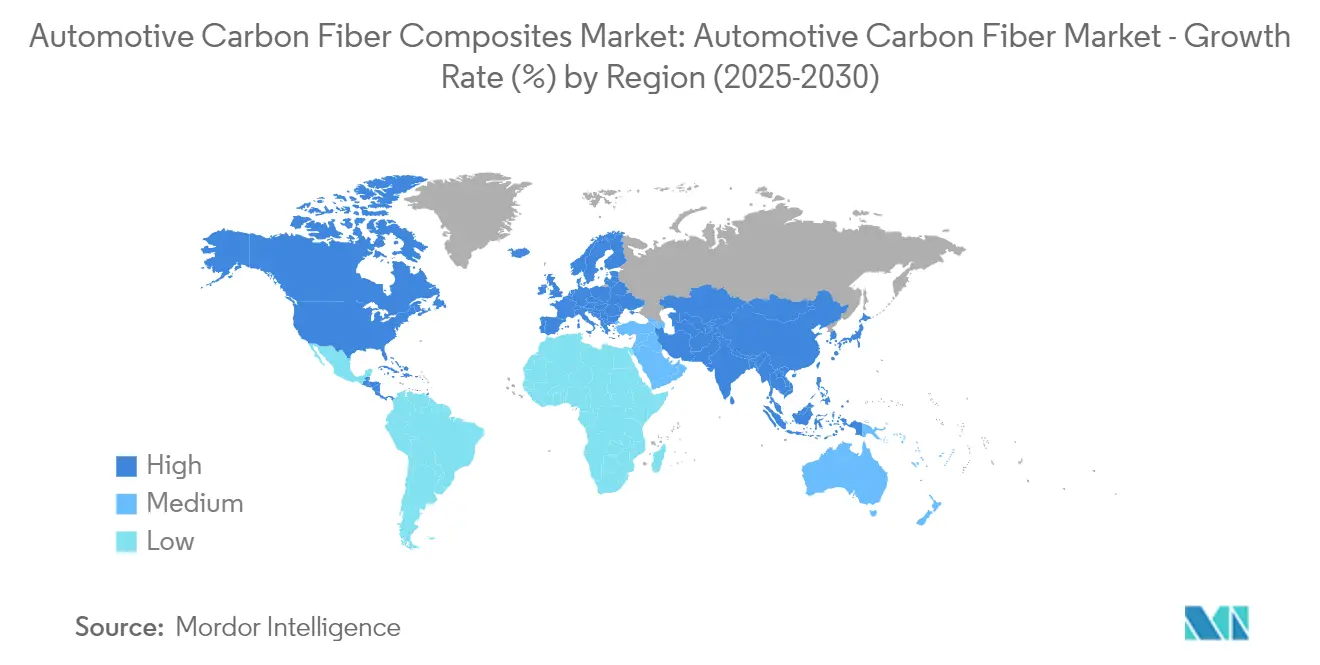
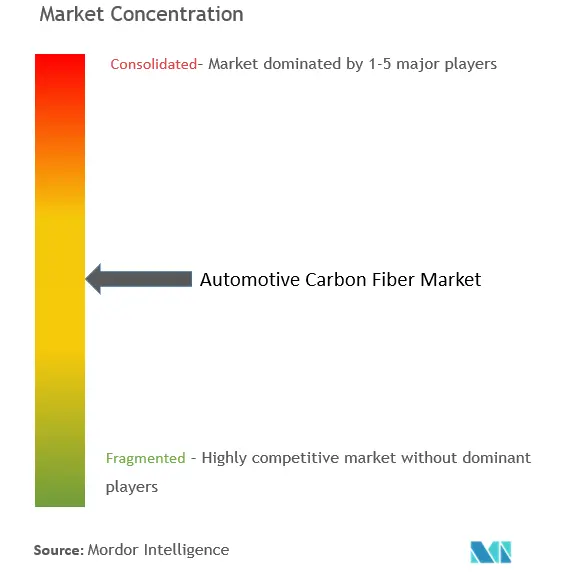
Several key players, including Hexcel Corporation, Mitsubishi Chemical Group, Teijin Limited, Toray Industries Inc., and SGL Carbon SE, dominate the Automotive Carbon Fiber Composites Market, which is moderately consolidated. Demand remains robust, driven by aggressive expansion and growth strategies from leading carbon fiber manufacturers. For instance,
In March 2024, Mitsubishi Chemical Group unveiled its BiOpreg #400 series, a carbon fiber prepreg material crafted from plant-derived resin. This innovative fiber targets mobility applications, specifically for both interior and exterior automotive materials, as well as broader industrial uses.
Automotive Carbon Fiber Composites Industry Leaders
Toray Industries Inc.
Hexcel Corporation
SGL Carbon SE
Teijin Limited
Mitsubishi Chemical Corporation
- *Disclaimer: Major Players sorted in no particular order

Market Opportunities and Future Outlook
Automotive carbon fiber composites are moving from niche, low-volume performance programs into higher-volume vehicle designs where lightweighting aligns with electrification needs and new body architectures. OEM and material-supplier collaboration is one visible channel, including Hyundai Motor Group and Toray Industries (strategic cooperation announced in April 2024). Another is concept-to-application signaling, such as Lynk & Co featuring TeXtreme 360 discontinuous fiber composites in an interior application at the Beijing Auto Show (April 2026).
On the supply side, firms are expanding regional production capacity, which is beginning to address availability constraints for automotive customers. Toray Carbon Fibers Europe started up a new carbon fiber production facility at its Abidos, France site in March 2026, increasing capacity from 5,000 to 6,000 tonnes per year. In parallel, Washington State Department of Commerce highlighted SGL Automotive Carbon Fibers investment plans to double Moses Lake output to support BMW EV supply. Manufacturing-rate improvements and sustainability-linked material options are also shaping commercialization priorities for automotive exteriors, interiors, and structural inserts. Technology licensing and industrialization efforts aimed at cycle-time reduction, such as Syensqo partnering with Bucci Composites to accelerate high-volume automotive composites manufacturing (June 2026) and Cygnet Texkimp industrializing McLaren Automotive’s ART high-rate fiber deposition approach (October 2025), expand the practical design space for prepregs and formed composite parts. OEM and motorsport-led trials are also sharpening attention on lower-footprint material choices and hybrid strategies, including Hexcel’s bio-based-content cosmetic epoxy prepreg positioning for automotive exterior surfaces (announced for JEC World 2026) and SGL Carbon’s natural-fiber prepreg work in motorsports programs, which feeds into automotive requirements around cost, recyclability, and reporting.
Recent Industry Developments
- March 2026: Toray Carbon Fibers Europe announced the operational start-up of a new carbon fiber production facility at its Abidos, France site, lifting annual capacity from 5,000 to 6,000 tonnes. The added European output is intended to improve supply security for premium automotive programs alongside aerospace and energy demand, helping shorten lead times for regional customers.
- October 2025: Toray Industries and Hyundai Motor Group signed a strategic joint development agreement to expand collaboration on high-performance composite materials, including CFRP parts for next-generation mobility platforms. The agreement reinforces OEM-supplier co-development as a route to qualify new composite solutions and scale them from R&D into vehicle applications.
- July 2024: Hexcel received a USD 40 million building permit tied to its planned USD 200 million expansion in Decatur, Alabama, including a new carbon fiber production line. The project supports North American carbon fiber manufacturing capacity and aligns with tighter supplier localization requirements from transportation and adjacent end markets.


Research Methodology Framework and Report Scope
Market Definition and Coverage
This market covers the value of carbon fiber composite materials and composite solutions used inside automotive applications, where the material is selected mainly for weight reduction and strength benefits.
Scope exclusions: We exclude non-automotive carbon fiber composites, along with pure glass-fiber composites and metal substitutes that do not contain carbon fiber reinforcement.
Segmentation Overview
- By Application
- Structural Assembly
- Powertrain Components
- Interiors
- Exteriors
- By Vehicle Type
- Passenger Car
- Commercial Vehicle
- By Propulsion
- Internal Combustion Engine
- Battery Electric Vehicles
- Hybrid Electric Vehicles
- Plug-in Hybrid Electric Vehicles
- Fuel Cell Electric Vehicles
- By Geography
- North America
- United States
- Canada
- Rest of North America
- Europe
- Germany
- United Kingdom
- France
- Italy
- Rest of Europe
- Asia-Pacific
- China
- Japan
- India
- South Korea
- Rest of Asia-Pacific
- Rest of the World
- South America
- Middle East and Africa
- North America
Data Sources, Market Sizing, and Validation
Desk Research
Desk research is used to set the demand context and make sure the model is tied to real vehicle activity, not only to supplier announcements. We typically start from public production and registration signals, such as government transport and trade statistics and customs data, and then connect them to carbon fiber use cases in vehicles.
For this market, we relied on public and official sources such as OICA vehicle production statistics, US EPA and NHTSA rulemaking and compliance documents, Eurostat trade and industrial statistics, UN Comtrade for cross-border flows, and technical papers in peer-reviewed composites and materials journals. To convert activity into value, we also reviewed company filings, earnings decks, association websites, and reputed press coverage, and we used a paid subscription focused on company financials and another on patent databases to cross-check product activity and timing. These examples are not exhaustive, and many other sources were also reviewed for data collection, validation, and clarification.
Primary Interviews and Surveys
Primary work was carried out through structured expert interviews and short surveys across the value chain, including material suppliers, part fabricators, OEM-facing engineering teams, and aftermarket oriented distributors. Since this is a global market, we spread discussions across APAC, EMEA, and the Americas to pressure-test adoption rates by vehicle type, application area, and propulsion mix, and then to confirm the assumptions used in pricing and volume conversion.
Distribution of primary research fieldwork respondents
| Company type | Respondent position | Region |
|---|---|---|
| Top tier: 33% | CXOs: 15% | APAC: 48% |
| Mid tier: 47% | Functional/Unit leaders: 34% | EMEA: 29% |
| Smaller Players: 20% | Managers: 51% | Americas: 23% |
Market-Sizing & Forecasting
Market sizing was built using a top-down approach where vehicle production and sales by region are translated into an addressable demand pool, followed by applying carbon fiber composite penetration by application areas such as structural parts, exteriors, interiors, and selected powertrain components. Once the core pool is formed, value is derived using typical composite content per vehicle and an average price pathway that reflects resin system mix and processing route.
To keep the totals realistic, we corroborated them with selective bottom-up approximations, like sampled supplier revenues tied to automotive end use and channel checks on program-level adoption, and then the totals were adjusted if the two views were not aligning. Inputs that matter in this market include EV and premium vehicle build rates, lightweighting driven content per vehicle, mix of resin systems (for example epoxy heavy designs), process shift signals like RTM adoption, and regional currency conversion timing for reported values. For forecasting, scenario analysis was used so the base case reflects how fast lightweighting penetrates mainstream vehicle platforms, and then we aligned the slope with what experts expect on program launches and capacity readiness. When bottom-up information was missing for smaller markets, we used proxy penetration rates based on similar vehicle mix and then validated them through follow-up calls.
Data Validation & Update Cycle
Outputs are checked through triangulation across independent signals, followed by variance checks at region and application level so unusually high jumps are flagged early. Where a number looked off, we rechecked the underlying driver, which is usually a penetration input, an assumed composite content per vehicle, or an exchange-rate timing mismatch.
Before sign-off, the model and narrative go through a multi-step analyst review so assumptions are consistent across chapters and tables. Reports are refreshed annually, and interim updates are made when material events change demand or pricing, such as major vehicle program changes or large capacity moves. Right before delivery, a final pass is completed so clients receive the latest updated view based on newly available public data and recent expert feedback.
Mordor Intelligence's Automotive Carbon Fiber Composites Market Size Compared Against Other Published Estimates
Published estimates for this market can differ by a lot, even when the title looks the same, because the counted value can sit at different points in the chain. Some sources focus on carbon fiber or CFRP materials only, while others also roll in fabricated parts, conversion services, and wider composites that are not strictly carbon fiber.
The main gap comes from whether the number is restricted to material-level CFRP value or expanded to include higher-value automotive composite assemblies, and then how penetration assumptions are applied across structural, exterior, interior, and powertrain use cases, which is where Mordor Intelligence counts value through application-led demand signals rather than treating all vehicle builds as equally addressable.
Benchmark comparison
| Source | Market Size | Gaps in Research Methodology |
|---|---|---|
| Mordor Intelligence | USD 31.65 B (2026) | |
| Industry Publisher A | USD 1.69 B (2025) | This estimate appears to stay closer to carbon fiber composite materials only, which can exclude the conversion and part-level value that becomes meaningful in structural and exterior applications. |
| Industry Publisher B | USD 26.80 B (2024) | The difference is typically driven by base-year choice and how resin and process mix are priced over time, since some approaches apply a single blended price rather than updating ASPs by application and propulsion mix. |
Overall, the spread in published values mostly reflects scope placement in the value chain and a few practical modeling choices like the base year, pricing progression, and how fast penetration rises outside premium programs. By keeping the sizing steps traceable to vehicle activity, application-level adoption, and a clear price logic, the final number stays easier to reproduce and explain on a call.


Key Questions Answered in the Report
How big is the Automotive Carbon Fiber Composites Market?
The Automotive Carbon Fiber Composites Market size is expected to reach USD 31.65 billion in 2026 and grow at a CAGR of 10.04% to reach USD 51.04 billion by 2031.
What is the current Automotive Carbon Fiber Composites Market size?
In 2026, the Automotive Carbon Fiber Composites Market size is expected to reach USD 31.65 billion.
Who are the key players in Automotive Carbon Fiber Composites Market?
Toray Industries Inc., Hexcel Corporation, SGL Carbon SE, Teijin Limited and Mitsubishi Chemical Corporation are the major companies operating in the Automotive Carbon Fiber Composites Market.
Which is the fastest growing region in Automotive Carbon Fiber Composites Market?
Asia Pacific is estimated to grow at the highest CAGR over the forecast period (2026-2031).
Which region has the biggest share in Automotive Carbon Fiber Composites Market?
In 2025, the Asia Pacific accounts for the largest market share in Automotive Carbon Fiber Composites Market.
What years does this Automotive Carbon Fiber Composites Market cover, and what was the market size in 2025?
In 2025, the Automotive Carbon Fiber Composites Market size was estimated at USD 31.65 billion. The report covers the Automotive Carbon Fiber Composites Market historical market size for years: 2020, 2021, 2022, 2023 and 2024. The report also forecasts the Automotive Carbon Fiber Composites Market size for years: 2026, 2027, 2028, 2029, 2030 and 2031.
Page last updated on:





